
- Home
- »
- Medical Devices
- »
-
Weight Management Market Size & Share Report, 2026-2033GVR Report cover

Weight Management Market (2026 - 2033)
Size, Report By Function (Diet, Fitness Equipment, Surgical Equipment, Services (Fitness centers, Consultation services)), By Region (North America, Europe, Asia Pacific, Latin America, MEA), And Segment Forecasts
Market Size, 2025
$190.6BMarket Estimate, 2026
$221.7BMarket Forecast, 2033
$562.2BCAGR, 2026–2033
14.2%Weight Management Market Summary
The global weight management market size was valued at USD 190.6 billion in 2025 and is projected to grow from USD 221.7 billion in 2026 to USD 562.2 billion by 2033, growing at a CAGR of 14.2% from 2026 to 2033. The market in Asia Pacific dominated with a revenue share of 35.0% in 2025. The market growth can be attributed to rising volumes of bariatric surgeries, rapid adoption of online weight-loss and management programs, higher disposable incomes in developing countries, increasing government initiatives to raise awareness about weight management, and growing obesity cases driven by sedentary lifestyles.
Key Market Trends & Insights
- By function: Diet segment dominated the market, accounting for over 70% of global revenue in 2025.
Regional Highlights
- Largest regional market: Asia Pacific (35.0% revenue share, 2025)
- Fastest-growing regional market: North America (highest CAGR, 2026-2033)
Market Size & Forecast
- Market size in 2025: USD 190.6 Billion
- Estimated market size in 2026: USD 221.7 Billion
- Projected market size by 2033: USD 562.2 Billion
- CAGR (2026-2033): 14.2%
Three ways to get this report
Buy it, customize it, or ask a question.Ask an Analyst
Analyst response in 1 business day
- AccessReport author, directly
- Reply timeWithin 1 working day
- No sales callDirect answer only
- FormatEmail reply
- CostFree, no cost
Get the Full Report
What the study covers
- FormatsPDF · Excel · Dashboard
- Timeline2026–2033 annual, 2025 base
- Coverage20+ countries, 5 regions
- Companies10+ key players profiled
Customize the Report
20% free customization
- IncludeCountries, segments, points
- TailorTo your product definition
- ExtendDeeper competitor detail
- OrA fully bespoke study
- Turnaround5–10 working days
The World Health Organization defines obesity as a chronic disease that results from neurobiological eating behaviors, access to a healthy diet, market forces, and the broader environment. Obesity poses an enormous challenge for the developed countries and the lower & middle-income countries. The overweight and obese population reports a high prevalence of chronic diseases, including diabetes, hypertension, and orthopedic diseases. Thus, the growing obese population is driving the growth of the weight management industry. Children in low- and middle-income countries are exposed to high-fat, high-sugar, high-salt, energy-dense, and micronutrient-poor foods, which tend to be lower in cost but lower in nutrient quality. As per the article published by Narayana Health, India reported about 14.4 million cases of obesity in children, which is the second-highest number of obese children in the world.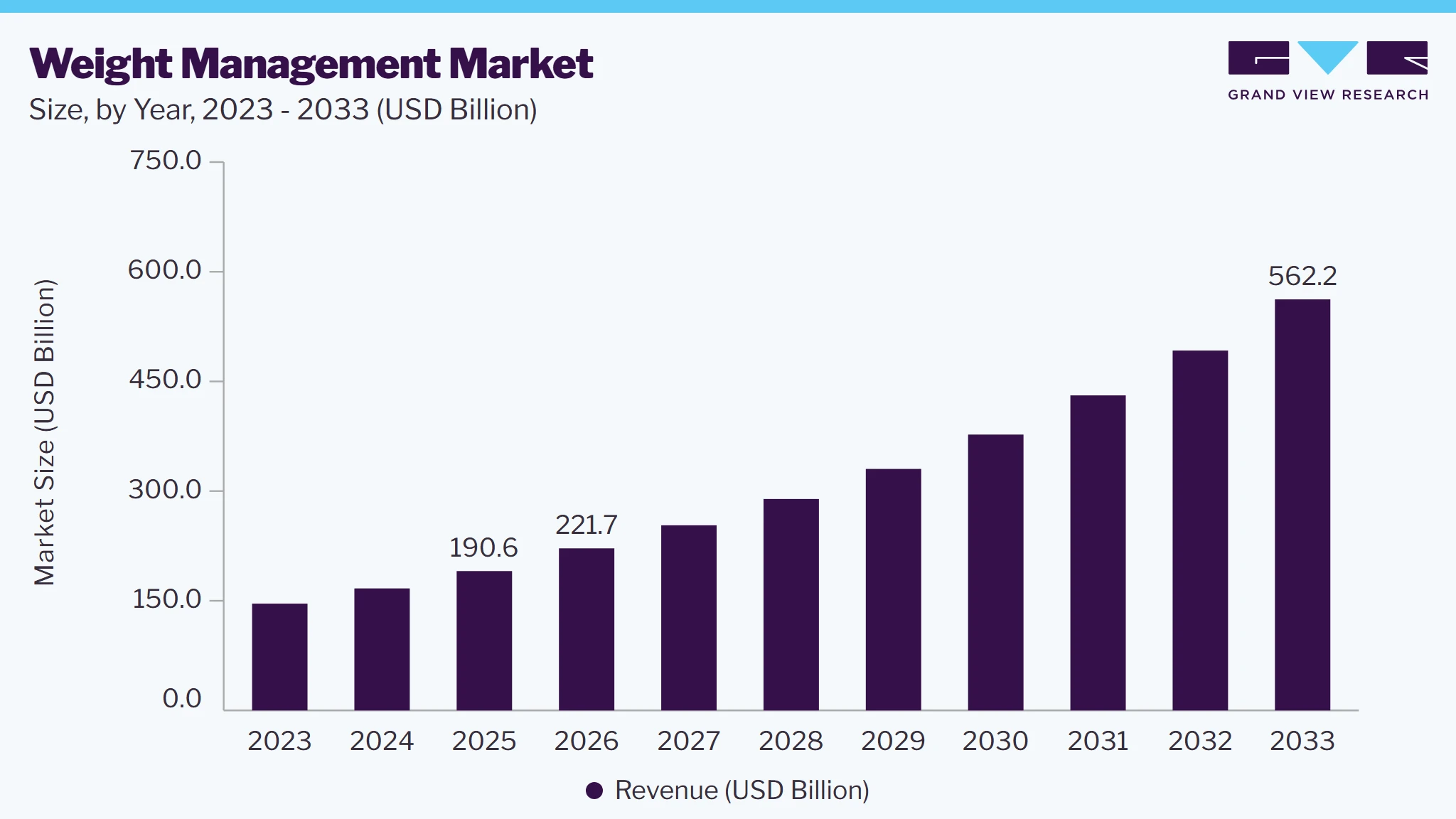 Source: Grand View Research, IR Documents, Primary Interviews, Paid DatabasesTo learn more about this report,
 Download Free Sample Report
 Due to the increasing number of hours spent in front of televisions and computers, there has been a significant rise in inactive time. Overweight or obese children have a higher chance of having chronic diseases at an early age. Increasing consumption of junk food, physical inactivity, and the growing fast-food industry are leading to an unhealthy & sedentary lifestyle, which results in weight gain. In addition, increasingly hectic routines and rising stress are leading people to consume fast food, which is causing untoward health effects. Thus, all these factors together are fueling growth in the weight management industry. Rapid globalization and digitalization are making it easier to access information about the repercussions of being overweight.
This is leading to increased awareness of various weight management solutions, including diet meals, beverages & supplements, exercise, and surgical procedures. The increase in the prevalence of chronic diseases due to rapid urbanization and changing lifestyles has significantly driven market growth. People are increasingly opting for weight management products and services to avoid diseases associated with a sedentary lifestyle.
Moreover, the temporary closure of gyms, fitness centers, health clubs, and sports institutes negatively impacted the market growth. However, online sales increased rapidly in 2020 due to greater awareness of the importance of a healthy lifestyle and overall well-being. The availability of a wide range of products in various forms, including Ready-to-Drink (RTD) beverages, bars, gels, and powders, is projected to drive the market. Manufacturers are adding innovative flavors and functional ingredients to enhance the nutritional value of their products. For instance, brands are adding natural ingredients, caffeine, and low-sugar content to RTD products. For instance, Brands such as Cosmix, Yoga Bar, ALOHA, and others are launching functional bars with zero palm oil, no refined sugar, and no artificial or lab-made flavors, making them gut-friendly and guilt-free.
Market Dynamics
The World Health Organization cited that 1 out of 8 people is obese globally. A sedentary lifestyle, rapid urbanization, rising obesity rate, and high health awareness drive the market. Events such as Hyrox, Yoddha Race, CrossFit OPEN, and others tend to influence people to adopt a healthy lifestyle. Functional confectionery products are also leading the weight management market by introducing guilt-free, gut-friendly gummies, bars, and chocolates. The clinical development of the medicine launched a weight-loss product that reduces hunger. For instance, as of 2025, the FDA approved Oral Semaglutide as the first GLP-1 pill for weight loss.
Stringent government regulatory approvals for pharmaceuticals constrain the weight management market. These drugs cost a hefty amount and come with a plethora of side effects—the urge of customers to ‘fix fast’ or ‘quick solutions’ limits the growth. Alongside the growing sedentary lifestyle, this is leading to an increase in fast-food outlets. Physical activities are being neglected due to the hectic work environment in developed nations. Whereas middle- and low-income regions are provided with food that is high in fat, sugar, and salt, energy-dense, and micronutrient-poor, which tend to be lower in cost but also lower in nutrient quality.
Analyst Perspective
The weight management market is undergoing a fundamental shift, with obesity increasingly being treated as a chronic medical condition rather than a lifestyle concern. As a result, market leadership is expected to move toward companies that can support patients over extended treatment journeys and demonstrate meaningful health outcomes. The value creation opportunities will emerge at the intersection of therapeutics, clinical care, and digital engagement, where providers can improve treatment adherence and long-term weight maintenance. Over time, outcome-based reimbursement models are expected to play a larger role in shaping purchasing decisions, favoring organizations with strong clinical evidence, provider relationships, and patient retention capabilities. This dynamic is likely to drive consolidation, creating a more concentrated market centered on integrated care ecosystems rather than standalone weight-loss solutions.
Function Insights
Based on function, the global market has been further categorized into diet, fitness equipment, surgical equipment, and services. The diet segment dominated the market, accounting for over 70% of global revenue in 2025. Diet includes meals, beverages, and supplements. Diet is gaining popularity as a solution for weight loss and management in both developed and developing countries. Meals containing the right amounts of protein & fiber and a lower amount of carbohydrates are considered an effective method of weight management.
The trend of customized, personalized diet plans tailored to a patient’s physiological conditions is encouraging people to opt for diet meals. Beverages, including green tea and slimming waters containing catechins & antioxidants, help in improving metabolism, thereby contributing to the reduction of stubborn fat. The easy availability and high acceptance of these products are expected to drive the growth of the beverage sub-segment during 2026-2033. Supplements include protein mixes, herbal powders, tablets, and capsules. The easy availability of these products is expected to drive the growth of this sub-segment.
Regional Insights
Asia Pacific was the dominant regional market, accounting for the largest revenue share of over 35% in 2025. The regional market is expected to retain its leading position, growing at the fastest CAGR from 2026 to 2033. The market growth is attributed to the growing overweight & obese population and increasing incidence of hypertension & diabetes. In addition, a paradigm shift toward minimally invasive and non-invasive procedures is propelling growth in the weight management industry. Other factors driving market growth include rising awareness of available alternatives for weight loss and management. The increasing popularity of diet plans and fitness centers is expected to drive the regional weight management market growth further.
 To learn more about this report, Download Free Sample Report
 North America Weight Management Market Trends
North America is projected to be one of the fastest-growing regions, with the highest CAGR from 2026 to 2033, owing to the alarming rise in obesity cases in the U.S. According to the Brand Finance Restaurants 25, 2026 report, the brand value of fast-food brands in America is increasing. This leads to a direct link in the growth of obesity in the region. As of December 2025, nearly 70% of the U.S adults could be classified as obese.
This has led to a rising percentage of the population opting for gyms and wellness centers. Moreover, the presence of major market players in North America and the easy availability of products are also expected to drive the regional market. The rising demand for natural, plant-based supplements in North America is further creating opportunities for key players to develop new products. Europe accounted for a considerable revenue share in 2025. Higher consumer awareness and per capita disposable income in developed countries like France, Germany, and the UK are expected to drive the weight management industry over the forecast period.
Key Weight Management Company Insights
The key participants in the market are devising various strategic initiatives to expand their business footprint and gain a competitive edge in the weight management market. Key players are focusing on strategic initiatives, such as mergers & acquisitions, technological collaborations, partnerships, funding & investments, and innovative product developments & launches to expand their expertise & product portfolio. For instance, in March 2023, Viking Therapeutics disclosed the launch of a Phase I clinical trial of its weight-reduction drugs to assess VK2735, a dual glucagon-like peptide 1 (GLP-1) & glucose-dependent insulinotropic polypeptide (GIP) receptor agonist.
Recent Developments
-
In May 2026, Eli Lilly and Company introduced its weight loss pill, Retatrutide, next stage GLP-1, which is in its development phase, is reaching phase 3 clinical trials. Eli Lilly is working on Retatrutide for studying obesity, type 2 diabetes, knee osteoarthritis pain, moderate-to-severe obstructive sleep apnea (OSA), chronic low back pain, cardiovascular and renal outcomes, and metabolic dysfunction-associated steatotic liver disease (MASLD).
-
In January 2026, Novo Nordisk Inc., launched oral GLP-1 pill, which was approved by the FDA in late December 2025, providing an alternative to injection. The pill can be used with a reduced-calorie diet and an increase in physical activity to help adults with obesity.
Key Weight Management Companies
The following key companies have been profiled for this study on the weight management market.
-
Herbalife International, Inc.
-
NutriSystem, Inc.
-
Alticor corporation
-
GNC Holdings, Inc.
-
Amer Sports
-
Abbott Laboratories
-
Nestle SA
-
The Kellogg Company
-
Johnson Health Tech
-
Now Health Group, Inc.
-
Technogym
-
Atkins Nutritionals, Inc
-
Glanbia PLC
-
Weight Watchers International, Inc.
Weight Management Market Report Scope
Report Attribute
Details
Market size in 2025
USD 190.6 billion
Estimated market size in 2026
USD 221.7 billion
Projected market size by 2033
USD 562.2 billion
Growth rate
CAGR of 14.2% from 2026 to 2033
Base year for estimation
2025
Historical data
2021 - 2024
Forecast period
2026 - 2033
Quantitative units
Revenue in USD billion, and CAGR from 2026 to 2033
Report coverage
Revenue forecast, company ranking, competitive landscape, growth factors, and trends
Segments covered
Function, region
Regional Scope
North America; Europe; Asia Pacific; Latin America; MEA
Country scope
U.S.; Canada; Germany; UK; France; Italy; Spain; Denmark; Sweden; Norway; China; Japan; India; South Korea; Australia; Thailand; Brazil; Mexico, Argentina; South Africa; Saudi Arabia, UAE; Kuwait
Key companies profiled
Herbalife International, Inc.; NutriSystem, Inc.; Weight Watchers International, Inc.; Glanbia PLC; Atkins Nutritionals, Inc; Technogym; Now Health Group, Inc.; Johnson Health Tech; The Kellogg Company; Nestle SA; Abbott Laboratories; Amer Sports; GNC Holdings, Inc.; Alticor Corporation
Customization scope
Free report customization (equivalent up to 8 analysts working days) with purchase. Addition or alteration to country, regional & segment scope.
Pricing and purchase options
Avail of customized purchase options to meet your exact research needs. Explore purchase options
Global Weight Management Market Report Segmentation
This report forecasts revenue growth at the global, regional, and country levels and provides an analysis of the latest industry trends in each of the sub-segments from 2021 to 2033. For this study, grand view research has segmented the global weight management market report based on function and region:
-
Function Outlook (Revenue, USD Billion, 2021 - 2033)
-
Diet
-
Meals
-
Beverages
-
Supplements
-
Proteins
-
Fibers
-
Green tea extract
-
Conjugate linoleic acid
-
Green coffee
-
L-carnitine
-
-
-
Fitness equipment
-
Cardiovascular training equipment
-
Strength training equipment
-
Others
-
-
Surgical equipment
-
Minimally invasive surgical equipment
-
Noninvasive surgical equipment
-
-
Services
-
Fitness centers
-
Slimming centers
-
Consultation services
-
Online weight loss service
-
-
-
Regional Outlook (Revenue, USD Billion, 2021 - 2033)
-
North America
-
U.S.
-
Canada
-
-
Europe
-
Germany
-
UK
-
France
-
Italy
-
Spain
-
Denmark
-
Sweden
-
Norway
-
-
Asia Pacific
-
China
-
Japan
-
India
-
South Korea
-
Australia
-
Thailand
-
-
Latin America
-
Brazil
-
Mexico
-
Argentina
-
-
Middle East & Africa
-
South Africa
-
Saudi Arabia
-
UAE
-
Kuwait
-
-
Frequently Asked Questions About This Report
Asia Pacific dominated with a revenue share of 35.0% in 2025.
The global weight management market size was valued at USD 190.6 billion in 2025 and is expected to reach USD 221.7 billion in 2026.
The global weight management market is expected to grow at a compound annual growth rate of 14.2% from 2026 to 2033 to reach USD 562.2 billion by 2033.
Diet segment dominated the market, accounting for over 70% of global revenue in 2025.
Some key players operating in the weight management market include Herbalife International, Inc.; NutriSystem, Inc.; Weight Watchers International, Inc.; Glanbia PLC; Atkins Nutritionals, Inc; Technogym; Now Health Group, Inc.; Johnson Health Tech; The Kellogg Company; Nestle SA; Abbott Laboratories; Amer Sports; GNC Holdings, Inc.; Alticor Corporation
About the Author(s)
Medical Devices Research Team
Healthcare · Medical DevicesThis report was authored by the medical devices research team at Grand View Research - comprising two research analysts, one senior research analyst, and one industry expert - with specialized expertise in the medical devices segment of the healthcare industry. All findings are based on proprietary healthcare databases, executive interviews, and regulatory analysis, subject to internal peer review prior to publication.
Last Updated:
Speak to Analyst

Customize this report to your needs - add regions, segments, or data points, with 20% free customization.
Or view our licence options:


ISO 9001:2015 & 27001:2022 Certified
We are GDPR and CCPA compliant! Your transaction & personal information is safe and secure. For more details, please read our privacy policy.


