- Home
- »
- Water & Sludge Treatment
- »
-
Waste Recycling Services Market Size & Share Report, 2033GVR Report cover
![Waste Recycling Services Market (2026 - 2033)Report]()
Waste Recycling Services Market (2026 - 2033)
Size, Share & Trends Analysis Report By Product (Paper & Paperboard, Metals, Plastics, Glass, Food, Bulbs, Batteries & Electronics, Yard Trimmings), By Application (Municipal, Industrial), By Region (North America, Europe), And Segment Forecasts
Market Size, 2025
$68.2BMarket Estimate, 2026
$71.6BMarket Forecast, 2033
$109.8BCAGR, 2026–2033
6.3%Humanoid Robot Market Summary
The global waste recycling services market size was valued at USD 68.2 billion in 2025 and is projected to grow from USD 71.6 billion in 2026 to USD 109.8 billion by 2033, growing at a CAGR of 6.3% from 2026 to 2033. Asia Pacific dominated the market with the largest revenue share of 42.0% in 2025. The growth is driven by growing environmental concerns, strict government regulations, rising industrial waste, and increasing awareness of sustainable practices.

Key Market Trends & Insights
- By product: Paper & paperboard segment led the market with the largest revenue share of 40.1% in 2025.
- By application: Municipal segment led the market with the largest revenue share of 52.1% in 2025.
Regional Highlights
- Largest regional market: Asia Pacific (42.0% revenue share, 2025)
- By country: The China held the largest market share in 2025
Market Size & Forecast
- Market size in 2025: USD 68.2 Billion
- Estimated market size in 2026: USD 71.6 Billion
- Projected market size by 2033: USD 109.8 Billion
- CAGR (2026-2033): 6.3%
Demand for resource recovery, circular economy initiatives, and corporate responsibility also contribute, encouraging businesses and consumers to adopt efficient waste management and recycling solutions. Technological advancements in sorting and processing have revolutionized recycling by increasing efficiency, accuracy, and speed. Automated systems, AI, robotics, and sensor-based sorting reduce contamination, lower labor costs, and maximize material recovery.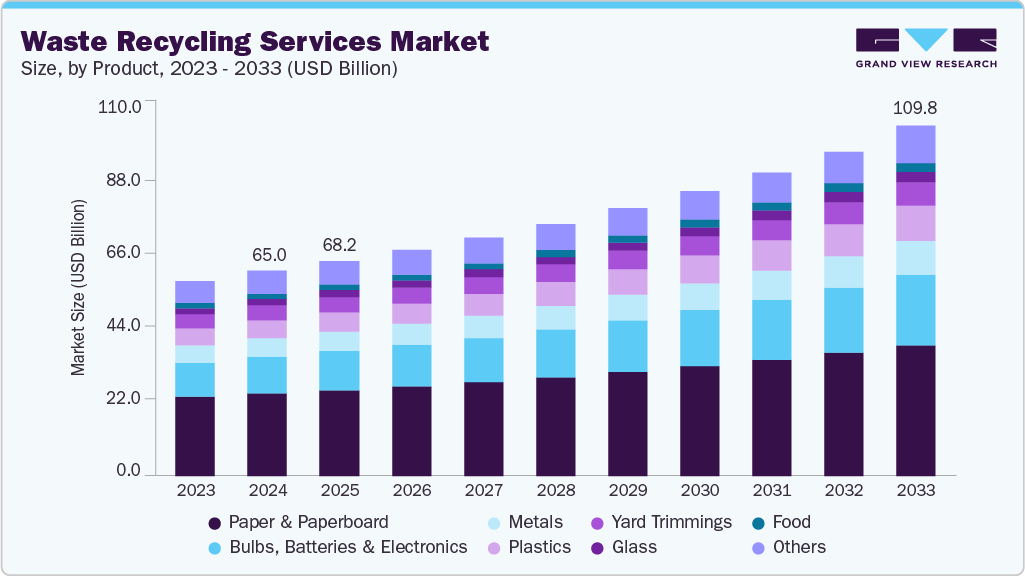
These innovations make recycling more cost-effective and profitable, encouraging wider adoption across industries and municipalities.

Market Dynamics
The waste recycling services market is experiencing steady growth due to increasing environmental concerns, stringent waste management regulations, and rising adoption of circular economy practices across industries. Governments and private organizations are investing heavily in recycling infrastructure to reduce landfill dependence, conserve natural resources, and lower greenhouse gas emissions. Growing urbanization, industrialization, and consumption patterns are generating larger volumes of municipal and industrial waste, creating substantial demand for efficient collection, sorting, processing, and recycling services.
Governments worldwide are implementing stricter regulations aimed at reducing landfill waste, increasing recycling rates, and promoting sustainable waste management practices. Policies such as extended producer responsibility (EPR), landfill taxes, recycling mandates, and waste diversion targets are compelling municipalities and industries to adopt professional recycling services. Regulatory frameworks are particularly strengthening the management of plastics, electronic waste, batteries, and hazardous materials, creating sustained demand for specialized recycling solutions.
At the same time, corporations are increasingly integrating sustainability goals into their business strategies to meet environmental, social, and governance (ESG) commitments. Organizations are seeking recycling partners to improve resource recovery, reduce carbon footprints, and demonstrate responsible waste management practices. This growing emphasis on sustainability across both public and private sectors continues to accelerate investments in waste recycling infrastructure and service capabilities.
Despite growing demand, the waste recycling services market faces challenges related to the high costs of waste collection, transportation, sorting, and processing. Recycling facilities require substantial capital investments in advanced machinery, automation technologies, and compliance measures to meet environmental standards. Additionally, fluctuations in the prices of recycled materials can affect profitability, making it difficult for service providers to maintain stable revenue streams. These financial pressures can limit the expansion of recycling operations, particularly in developing regions where waste management infrastructure remains underdeveloped.
The global transition toward a circular economy presents significant opportunities for waste recycling service providers. Governments, manufacturers, and consumers are increasingly prioritizing resource efficiency and material recovery, encouraging greater utilization of recycled materials in production processes. This shift is creating long-term demand for advanced recycling services capable of recovering high-value materials from complex waste streams.
Additionally, emerging technologies such as artificial intelligence based sorting systems, robotic waste separation, chemical recycling, and waste-to-energy solutions are enhancing recycling efficiency and material recovery rates. These innovations enable service providers to process previously unrecyclable materials and improve operational profitability. As industries continue to seek sustainable alternatives to virgin raw materials, advanced recycling capabilities are expected to unlock new growth opportunities across the market.
Market Concentration & Characteristics
The industry is moderately fragmented, with major companies holding significant influence. Leading players such as Veolia, Suez, Hitachi, and Dow offer comprehensive water treatment and recycling solutions across the municipal and industrial sectors. These firms benefit from advanced technologies, global networks, and strong project execution capabilities. However, the market also includes a wide range of regional and specialized providers, particularly in emerging economies. This diversity of participants prevents full consolidation, encouraging competitive pricing, localized innovation, and service differentiation. Ongoing investments in sustainable infrastructure and water scarcity mitigation continue to shape the market landscape.
The industry is witnessing high innovation driven by AI, robotics, and sensor-based technologies. Automation enhances sorting accuracy and efficiency, while advancements in chemical and biological recycling offer new recovery pathways. Innovation also targets reducing contamination and improving traceability for higher-value recyclables.
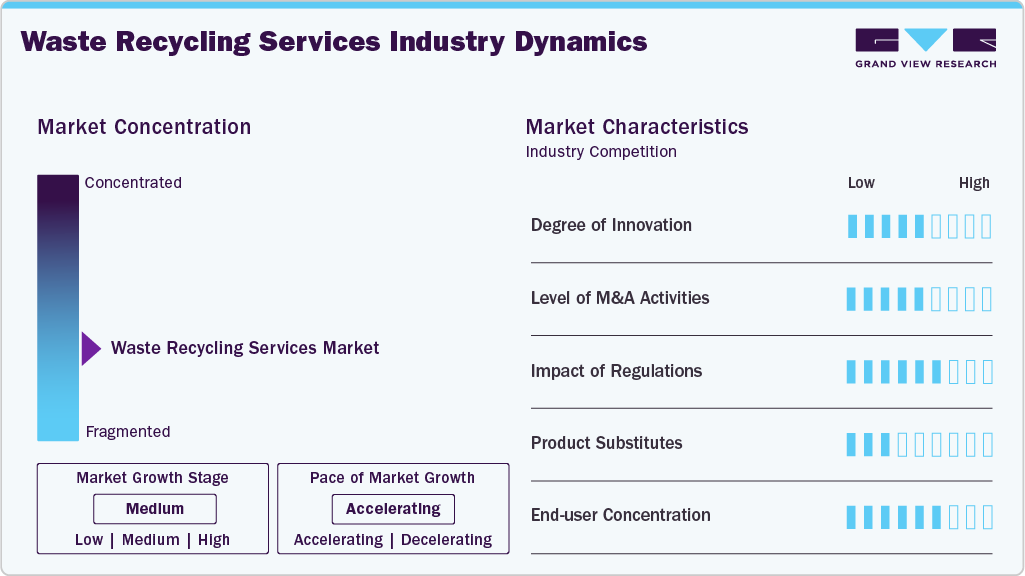
Mergers and acquisitions in the waste recycling services industry are increasing over the years, aiming to expand service capabilities, geographic reach, and technology portfolios. Large firms acquire specialized or regional players to integrate advanced sorting, processing, or digital tools. These activities help consolidate market share and address the growing demand for sustainable waste management solutions. For instance, in March 2025, VLS Environmental Solutions acquired Samex Environmental, expanding its service offerings and sustainability capabilities. Samex, based in San Diego, specializes in hazardous waste fuel blending and recycling, with advanced facilities in Tijuana, Mexico. The acquisition enhances VLS’s West Coast footprint and adds specialized expertise and infrastructure, supporting its strategic growth in environmental compliance and resource recovery.
Regulations play a critical role in shaping the waste recycling services industry. Landfill restrictions, recycling targets, and extended producer responsibility laws drive demand for recycling services. Compliance requirements push companies to upgrade technology and improve sorting efficiency, while supportive policies and subsidies foster innovation and private sector participation.
Analyst Perspective
The waste recycling services market is experiencing sustained growth as governments, municipalities, and industrial operators increasingly prioritize circular economy initiatives, landfill diversion, and resource recovery. Rising volumes of industrial, commercial, and plastic waste, coupled with stricter environmental regulations and extended producer responsibility (EPR) frameworks, are driving greater investment in recycling infrastructure and specialized waste processing services. Growth opportunities are particularly strong in Asia-Pacific, where rapid urbanization and industrialization are generating significant waste streams, while developed markets are focusing on advanced sorting, material recovery, and recycling efficiency improvements. Going forward, service providers that can leverage automation, digital waste tracking, and high-value material recovery solutions are expected to strengthen their competitive position as sustainability objectives become a core business and regulatory requirement.
Drivers, Opportunities & Restraints
Growing environmental awareness and strict government regulations worldwide are driving demand for waste recycling services. Increasing urbanization and industrialization generate more waste, pushing governments and businesses to adopt efficient recycling solutions to reduce landfill use and carbon emissions, supporting circular economy goals.
Emerging economies offer vast growth potential due to rising waste generation and the government's focus on sustainability. Advances in AI and chemical recycling enable better resource recovery. Public-private partnerships and green financing facilitate infrastructure development, driving market expansion and innovation.
High operational and capital costs, especially for advanced recycling technologies, limit market growth. Many regions lack adequate infrastructure and skilled labor, and fluctuating prices for recycled materials can reduce profitability, discouraging investments in large-scale recycling projects.
Product Insights
Based on product, paper & paperboard segment led the market with the largest revenue share of 40.1% in 2025. due to its high recycling rates, established collection systems, and economic viability. It benefits from standardized pulping and deinking technologies that efficiently convert waste into reusable fiber. For instance, India’s paper recycling industry is growing rapidly, with 70-75% of paper and paperboard consumption being recycle-grade. This drives demand for around 20 million tonnes of wastepaper annually.
The plastics segment is witnessing strong growth in the market due to increasing plastic waste generation and rising environmental concerns over plastic pollution. Advances in sorting technologies like AI and near-infrared (NIR) sensors improve plastic identification and separation. Additionally, stricter regulations on single-use plastics and growing demand for recycled plastics in packaging and manufacturing drive investment and expansion in plastic recycling services.
Application Insights
Based on application, municipal segment led the market with the largest revenue share of 52.1% in 2025. due to increased urbanization and stringent waste management policies. Governments are implementing recycling mandates and investing in infrastructure to improve waste segregation and processing. Public-private partnerships are enhancing efficiency, while public awareness campaigns encourage recycling practices. These combined efforts are driving the expansion of municipal waste recycling services.
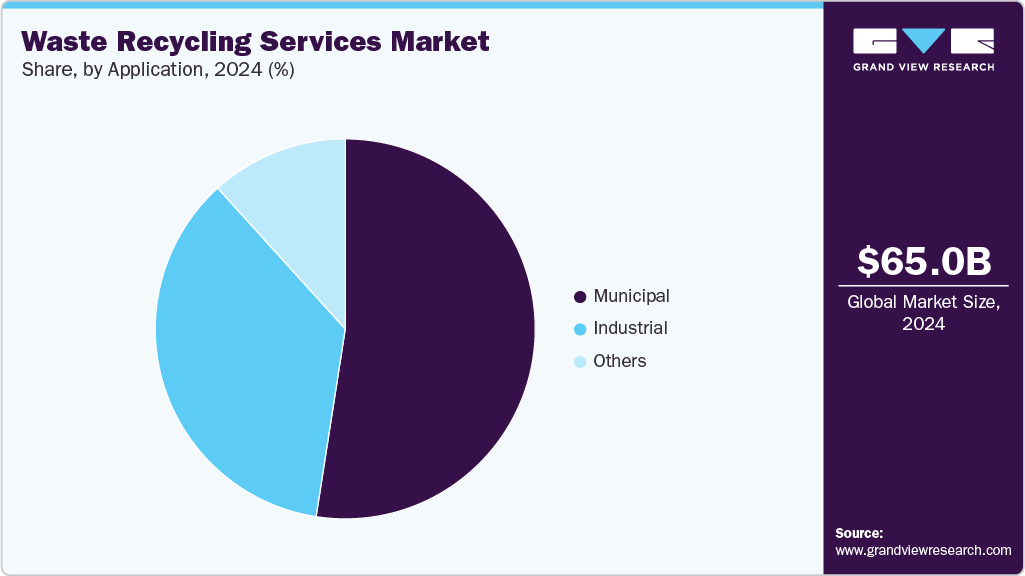
The industrial segment is expanding rapidly, driven by escalating waste generation from manufacturing processes and stricter environmental regulations. Industries are adopting sustainable practices, including recycling and resource recovery, to comply with regulations and reduce costs. Technological advancements in sorting and processing are improving efficiency. This sector's growth is also fueled by the rising demand for recycled materials in production processes.
Regional Insights
North America waste recycling services market is expected to grow at a CAGR of 4.1% during the forecast period, due to stringent environmental regulations, increased public awareness, and ongoing urbanization. Demand for advanced recycling technologies and improved infrastructure is rising, particularly in urban centers. Government initiatives and corporate sustainability goals are further supporting market expansion across various waste streams, including plastics, paper, and electronics.
U.S. Waste Recycling Services Market Trends
The waste recycling services market in the U.S. is expected to grow at a CAGR of 3.8% from 2026 to 2033. The U.S. is poised for strong growth in the market due to high waste generation and evolving federal and state regulations. Policies targeting plastic reduction, organic waste diversion, and circular economy practices are encouraging investment in modern recycling infrastructure.
Mexico waste recycling services market is growing due to increasing environmental awareness, government-led recycling initiatives, and infrastructure development. Focus areas include plastic, electronic, and hazardous waste recycling. Public-private partnerships and growing investment in advanced recycling methods are improving service capacity and efficiency, positioning Mexico as a key player in regional sustainability efforts.
Europe Waste Recycling Services Market Trends
The waste recycling services market in Europe is witnessing strong growth due to strict environmental regulations, circular economy initiatives, and landfill reduction targets. The EU promotes advanced recycling technologies and harmonized waste management policies across member states. Investments in AI-driven sorting and chemical recycling are improving efficiency, while both established and emerging markets contribute to regional growth.
Germany waste recycling services market is growing rapidly, supported by strong environmental legislation and a well-established recycling culture. The country is investing in advanced sorting systems, plastic recovery technologies, and digital waste tracking. As waste volumes increase, Germany remains a leader in innovation and infrastructure within the European recycling landscape.
The waste recycling services market in the UK is growing significantlydue to national sustainability goals, evolving recycling regulations, and a shift toward circular economy practices. Companies are upgrading their infrastructure with AI and automation to boost recycling efficiency. Industrial and commercial sectors are driving demand, while government strategies support long-term investment in waste reduction and material recovery.
Asia Pacific Waste Recycling Services Market Trends
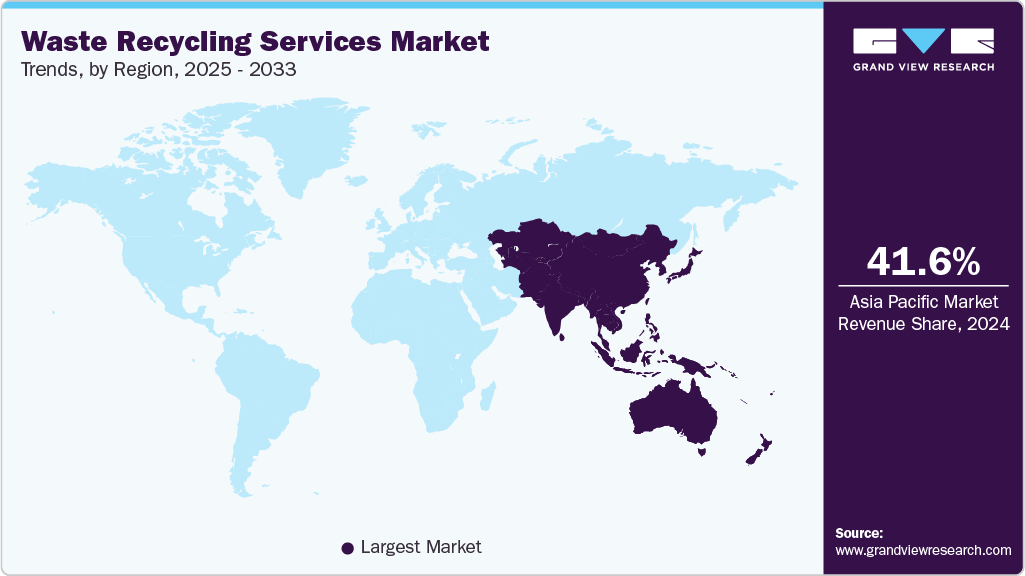
Asia Pacific dominated the waste recycling services market with the largest revenue share of 42.0% in 2025. due to rapid urbanization, industrialization, and rising environmental awareness. Governments are introducing stricter regulations and investing in recycling infrastructure. Technological advancements and growing demand for sustainable waste management solutions are driving expansion across key countries like China, India, Japan, and South Korea, making the region a significant contributor to the global recycling market.
The waste recycling services market in the China held the largest share in the Asia Pacific region in 2025. as the government enforces strict waste management policies and promotes circular economy principles. Investments in advanced recycling technologies and infrastructure improvements support better material recovery. Increasing public awareness and corporate sustainability efforts also contribute to growth, particularly in plastic and electronic waste recycling.
The waste recycling services market in India is growing rapidly due to rising waste generation from urban and industrial sectors, along with government initiatives promoting sustainable waste management. Increasing investments in recycling infrastructure and the adoption of modern technologies are enhancing recycling efficiency. Growing awareness and participation in waste segregation and recycling are further accelerating market development.
Middle East & Africa Waste Recycling Services Market Trends
The waste recycling services market in the Middle East & Africa is poised for steady growth as governments are implementing stricter regulations and investing in recycling infrastructure. Technological advancements and the adoption of sustainable practices are driving the expansion of recycling services across various sectors, including municipal, industrial, and electronic waste.
Saudi Arabia waste recycling services market is actively pursuing growth as part of its Vision 2033 initiative. The government has announced plans to recycle up to 95% of the country's waste, aiming to contribute significantly to the GDP and create numerous employment opportunities. Investments in modern waste management infrastructure and technologies are expected to enhance recycling capabilities and promote sustainability.
Latin America Waste Recycling Services Market Trends
The waste recycling services market in Latin America is growing steadily, due to increasing urbanization, industrialization, and environmental awareness. Governments are implementing stricter regulations and investing in recycling infrastructure.
Brazil waste recycling services market is driven by government initiatives and private sector investments. The implementation of the National Solid Waste Plan aims to modernize solid waste management and increase recycling rates. Additionally, advancements in recycling technologies and infrastructure improvements are enhancing the efficiency of waste recovery systems, fostering a conducive environment for market growth.
Key Waste Recycling Services Companies Insights
Key players operating in the waste recycling services market are undertaking various initiatives to strengthen their presence and increase the reach of their products and services. Strategies such as expansion activities and partnerships are key in propelling the market growth.
Key Waste Recycling Services Companies:
The following key companies have been profiled for this study on the waste recycling services market.
-
Eurokey Recycling, Ltd.
-
Northstar Recycling
-
Triple M Metal LP
-
Veolia Environnement S.A.
-
Interface, Inc.
-
Reworld
-
Epson, Inc.
-
Waste Management, Inc.
-
Xerox Corp.
-
SUEZ
-
Zanker Road Landfill
-
Rubicon Global
-
RU Recycling- und Umweltdienst GmbH
-
Waste Connections
-
Biffa
Competitive Benchmarking
Operating Strategies
Competitive Edge
Weaknesses
Established Players (e.g., Veolia Environnement S.A., Waste Management, Inc., Waste Connections, Biffa, Reworld)
- Invest in advanced recycling technologies, material recovery facilities, and waste-to-energy infrastructure to improve processing efficiency and resource recovery.
- Strengthen market presence through long-term municipal contracts, acquisitions, and integrated waste management service offerings.
- Extensive collection networks, large processing capacities, and strong financial resources support large-scale operations.
- Established brand recognition and regulatory expertise enable them to secure high-value contracts and maintain customer trust.
- High capital and operating costs associated with maintaining extensive infrastructure and compliance requirements.
- Complex organizational structures can slow decision-making and adaptation to emerging market trends.
Emerging & Regional Players (e.g., Rubicon Global, Northstar Recycling, Triple M Metal LP, Eurokey Recycling, Ltd., RU Recycling- und Umweltdienst GmbH, Zanker Road Landfill)
- Focus on regional markets and specialized recycling streams such as metals, electronics, or commercial waste.
- Utilize digital platforms, innovative collection models, and strategic partnerships to enhance operational efficiency.
- Greater flexibility allows rapid adoption of new technologies and tailored customer solutions.
- Strong local market knowledge and niche expertise help address specific recycling and waste management requirements.
- Limited financial resources may restrict investments in large-scale infrastructure and technology upgrades.
- Smaller geographic footprint and customer base can constrain market expansion and competitive positioning.
Recent Developments
-
In July 2025, Eco Recycling Ltd enhanced India’s circular economy by establishing a mineral recovery facility. This initiative targets valuable materials extraction from e-waste, including printed circuit boards, hard disk drives, and lithium-ion batteries, supporting sustainable resource recovery and reducing environmental impact from electronic waste.
-
In May 2025, Germany approved its first dedicated ship recycling yard, operated by EWD Benli Recycling, marking a major step toward sustainable maritime practices in Europe. The facility focuses on environmentally responsible dismantling and recycling of large ships, addressing global shipbreaking concerns.
Waste Recycling Services Market Report Scope
Report Attribute
Details
Market size in 2025
USD 68.2 billion
Estimated market size in 2026
USD 71.6 billion
Projected market size by 2033
USD 109.8 billion
Growth rate
CAGR of 6.3% from 2026 to 2033
Base year for estimation
2025
Historical data
2021 - 2024
Forecast period
2026 - 2033
Quantitative units
Revenue in USD billion and CAGR from 2026 to 2033
Report coverage
Revenue forecast, company ranking, competitive landscape, growth factors, and trends
Segments covered
Product, application, region.
Regional scope
North America; Europe; Asia Pacific; Latin America; Middle East & Africa
Country scope
U.S.; Canada; Mexico; UK; Germany; France; Spain; Italy; China; Japan; India; Australia; South Korea; Brazil; Argentina; Saudi Arabia; South Africa; UAE
Key companies profiled
Eurokey Recycling, Ltd.; Northstar Recycling; Triple M Metal LP; Veolia Environnement S.A.; Interface, Inc.; Reworld; Epson, Inc.; Waste Management, Inc.; Xerox Corp.; SUEZ; Zanker Road Landfill; Rubicon Global; RU Recycling- und Umweltdienst GmbH; Waste Connections; Biffa.
Customization scope
Free report customization (equivalent up to 8 analysts' working days) with purchase. Addition or alteration to country, regional & segment scope.
Pricing and purchase options
Avail customized purchase options to meet your exact research needs. Explore purchase options
Global Waste Recycling Services Market Report Segmentation
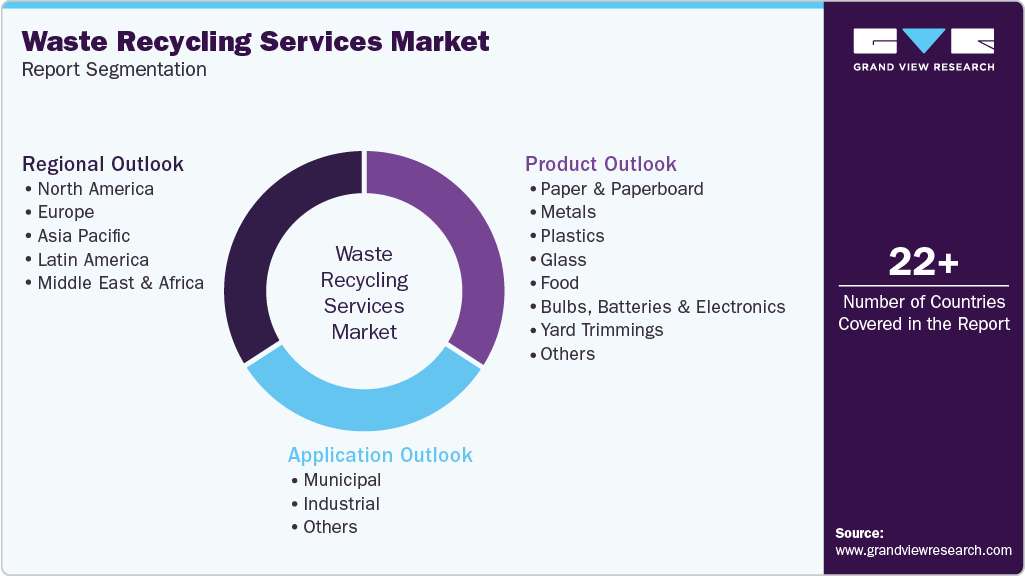
This report forecasts revenue growth at the global, regional, and country levels and provides an analysis of the latest industry trends in each of the sub-segments from 2021 to 2033. For this study, Grand View Research has segmented the global waste recycling services market report based on product, application, and region.
-
Product Outlook (Revenue, USD Million, 2021 - 2033)
-
Paper & Paperboard
-
Metals
-
Plastics
-
Glass
-
Food
-
Bulbs, Batteries & Electronics
-
Yard Trimmings
-
Others
-
-
Application Outlook (Revenue, USD Million, 2021 - 2033)
-
Municipal
-
Industrial
-
Others
-
-
Regional Outlook (Revenue, USD Million, 2021 - 2033)
-
North America
-
U.S.
-
Canada
-
Mexico
-
-
Europe
-
Germany
-
France
-
Italy
-
Spain
-
UK
-
-
Asia Pacific
-
China
-
India
-
Japan
-
South Korea
-
Australia
-
-
Latin America
-
Brazil
-
Argentina
-
-
Middle East and Africa
-
Saudi Arabia
-
UAE
-
South Africa
-
-
Research Methodology
(a) Segment Definition
Product
Revenue Capture Definition
Paper & Paperboard
Revenue is generated through the collection, sorting, processing, and resale of recovered paper and paperboard materials. Service providers also earn income from municipal contracts and industrial recycling programs that support the production of recycled packaging and paper products.
Metals
Revenue is derived from the recovery, separation, and sale of ferrous and non-ferrous metals collected from municipal, industrial, construction, and demolition waste streams. The relatively high market value of recycled metals contributes significantly to service provider earnings.
Plastics
Revenue is captured through the collection, sorting, washing, and processing of plastic waste into recyclable resins and raw materials. Increasing demand for recycled plastics from packaging, consumer goods, and manufacturing industries supports recurring revenue generation.
Glass
Revenue is generated from the collection and processing of glass waste into cullet used in the production of new glass containers and construction materials. Long-term supply agreements with beverage and packaging manufacturers further contribute to revenue streams.
Food
Revenue is obtained through food waste collection, composting services, anaerobic digestion, and the production of biogas, fertilizers, and soil amendments. Growing regulations regarding organic waste diversion are creating additional service opportunities.
Bulbs, Batteries & Electronics
Revenue is generated through specialized collection, dismantling, material recovery, and safe disposal services for electronic and hazardous waste. Valuable recovered materials such as precious metals, lithium, and rare earth elements enhance revenue potential.
Yard Trimmings
Revenue is captured through the collection and processing of grass clippings, leaves, branches, and landscaping waste into compost, mulch, and biomass products. Municipal green waste programs represent a major source of recurring income.
Others
Revenue is derived from the recycling, treatment, and recovery of specialized waste materials generated by industrial and commercial sectors. Service providers earn income through material recovery, waste treatment contracts, and compliance-driven disposal services.
Application
Revenue Capture Definition
Municipal
Revenue is generated through residential and community waste collection, recycling processing, and long-term contracts with local governments and public agencies. Population growth and increasing recycling mandates support stable revenue generation.
Industrial
Revenue is captured from waste management, recycling, and resource recovery services provided to manufacturing, construction, mining, energy, and commercial facilities. Customized recycling programs and high-volume waste streams contribute to significant contract values.
Others
Revenue is derived from the collection, treatment, recycling, and disposal of agricultural residues, chemical waste, and hazardous materials. Strict regulatory requirements and specialized handling processes enable service providers to command premium service fees.
(b) Estimation Model
Layer No.
Layer Name
Key Question
Description
01
Waste Generation Layer
Who generates recyclable waste requiring collection services?
The estimation begins by analyzing total waste generation across residential, commercial, industrial, construction, and institutional sectors. Factors such as population growth, urbanization, industrial output, and consumption patterns are evaluated to determine the volume of recyclable materials entering the waste stream.
02
Recycling Collection & Processing Layer
What fraction of generated waste enters the recycling ecosystem?
Potential market demand is estimated by assessing collection rates, recycling participation levels, waste segregation practices, and processing infrastructure availability. Regional regulations, recycling mandates, and investments in material recovery facilities significantly influence recyclable waste volumes.
03
Recycling Service Demand Layer
Who actively purchases this services?
Demand is calculated based on municipal contracts, industrial waste management requirements, commercial recycling programs, and specialized services for e-waste, food waste, and hazardous waste. Sustainability initiatives, circular economy adoption, and regulatory compliance requirements are key demand drivers.
04
Revenue Layer
How much revenue is generated from recycling services?
Market revenue is derived by evaluating service fees associated with collection, transportation, sorting, processing, material recovery, disposal, and value-added recycling solutions. Revenue contributions across paper, metals, plastics, glass, organics, electronics, and specialty waste streams are aggregated to determine the overall market size.
Delivered Customizations
This report has been delivered with the following In-depth customizations
Client Request
Customization Delivered
Value Adds
Growth Opportunity Assessment by Waste Stream
Delivered detailed analysis and forecasting across Paper & Paperboard, Metals, Plastics, Glass, Food Waste, E-Waste, Yard Trimmings, and Specialty Waste segments, highlighting market attractiveness, growth trends, and revenue potential.
Enabled identification of high-growth recycling segments, supporting investment prioritization and long-term expansion strategies within the circular economy ecosystem.
Regional Market Intelligence
Delivered detailed market sizing, historical trend analysis, and forecast assessment for the Waste Recycling Services Market across North America, Europe, Asia Pacific, Latin America, and Middle East & Africa.
Enabled identification of high-growth recycling markets, sustainability investment hotspots, and future waste management infrastructure opportunities.
Competitive Benchmarking
Delivered detailed benchmarking of leading waste recycling service providers based on collection networks, processing capabilities, technology adoption, sustainability initiatives, regional footprint, and strategic developments.
Provided clear visibility into competitor positioning, operational strengths, and market leadership trends.
Frequently Asked Questions About This Report
The global waste recycling services market size was estimated at USD 68.2 billion in 2025 and is expected to be USD 71.6 billion in 2026.
The global waste recycling services market, in terms of revenue, is expected to grow at a compound annual growth rate of 6.3% from 2026 to 2033 to reach USD 109.8 billion by 2033.
Some of the key players operating in the global waste recycling services market include Eurokey Recycling, Ltd., Northstar Recycling, Triple M Metal LP, Veolia Environnement S.A., Interface, Inc., Reworld, Epson, Inc., Waste Management, Inc., Xerox Corp., Zanker Road Landfill, Rubicon Global, RU Recycling- und Umweltdienst GmbH, Waste Connections, Biffa.
Key factors driving the global waste recycling services market include increasing waste generation, stringent environmental regulations, rising sustainability goals, technological advancements in recycling, growing urbanization, and strong demand for resource recovery and circular economy practices across industrial and municipal sectors.
The paper & paperboard segment dominated the market in 2025, accounting for a 40.1% share due to its high recycling rates, established collection systems, and economic viability. It benefits from standardized pulping and deinking technologies that efficiently convert waste into reusable fiber.
Asia Pacific dominated the waste recycling services market with the largest revenue share of 42.0% in 2025.
Asia Pacific is anticipated to be one of the fastest-growing regional markets over the forecast period, driven by rapid urbanization, industrialization, and increasing government initiatives promoting waste management and recycling.
The municipal segment accounted for the largest revenue share of 52.1% in 2025.
Key trends include increasing adoption of advanced sorting technologies, expansion of material recovery facilities, growing focus on plastic recycling, and rising investments in circular economy and resource recovery initiatives.
About the Author(s)
Water & Sludge Treatment Research Team
Bulk Chemicals · Water & Sludge TreatmentThis report was authored by the water & sludge treatment research team at Grand View Research - comprising two research analysts, one senior research analyst, and one industry expert - with specialized expertise in the water & sludge treatment segment of the bulk chemicals industry. All findings are based on proprietary bulk chemicals databases, executive interviews, and regulatory analysis, subject to internal peer review prior to publication.
Last Updated:
Speak to Analyst

Need a Tailored Report?
Customize this report to your needs — add regions, segments, or data points, with 20% free customization.
Or view our licence options:


ISO 9001:2015 & 27001:2022 Certified
We are GDPR and CCPA compliant! Your transaction & personal information is safe and secure. For more details, please read our privacy policy.