
- Home
- »
- Advanced Interior Materials
- »
-
Vibratory Plate Compactor Market, Industry Report, 2033GVR Report cover

Vibratory Plate Compactor Market (2025 - 2033) Size, Share & Trends Analysis Report By Power Source (Diesel, Gasoline, Electric), By Compacting Force (Up to 20 KN, 20 - 40 KN, Above 40 KN), By Application (Utility Trenches, Asphalt Paving, Concrete Flooring), By Region, And Segment Forecasts
Market Size, 2024
$1,237.5MMarket Estimate, 2026
$1,354.1MMarket Forecast, 2033
$1,979.5MCAGR, 2025–2033
5.5%Vibratory Plate Compactor Market Summary
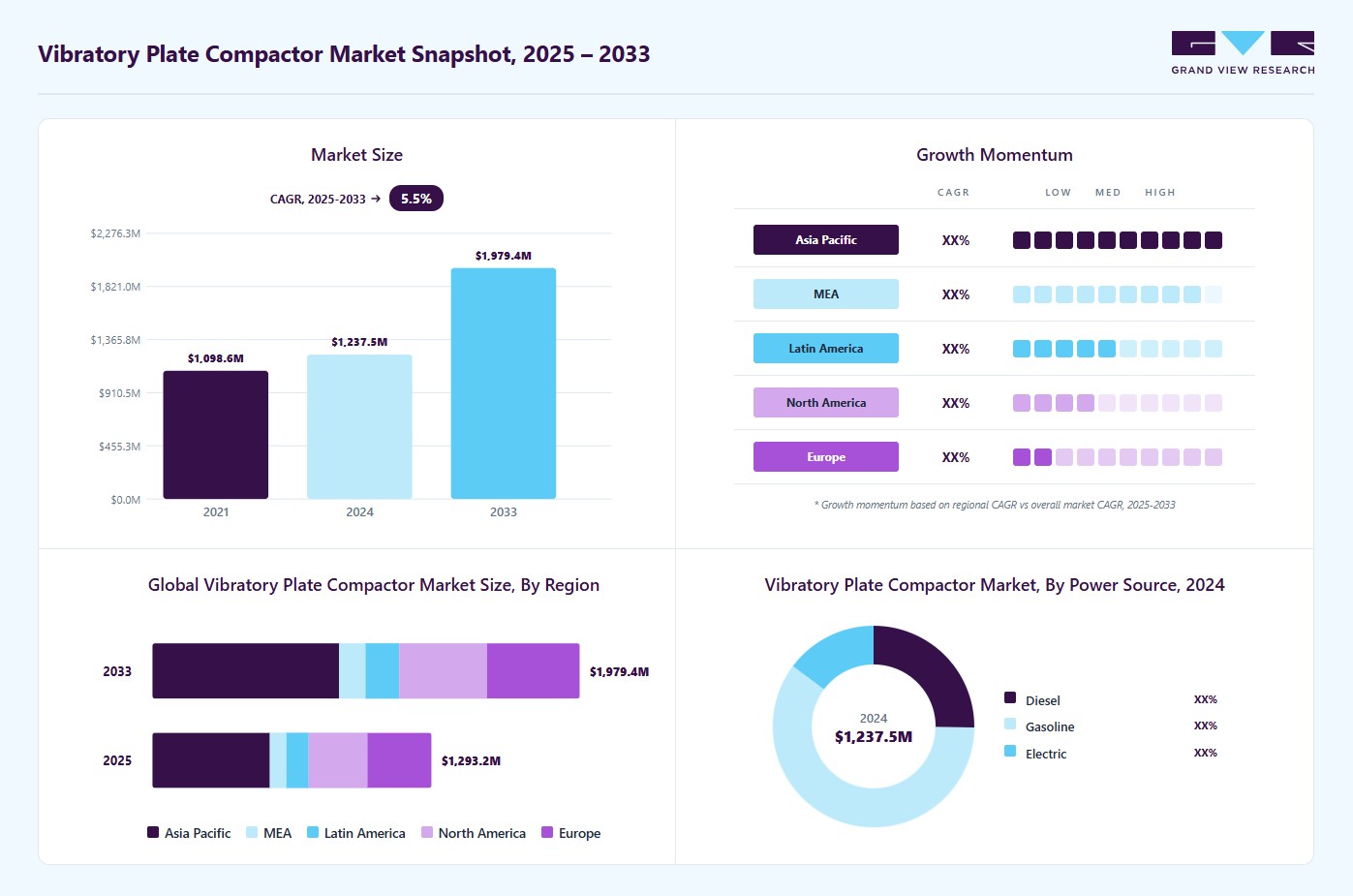
The global vibratory plate compactor market size was estimated at USD 1,237.5 million in 2024 and is projected to reach USD 1,979.5 million by 2033, growing at a CAGR of 5.5% from 2025 to 2033. The growth is primarily driven by the increasing demand for efficient soil and asphalt compaction equipment in the construction and infrastructure sectors.
 Source: Grand View Research, IR Documents, Primary Interviews, Paid DatabasesTo learn more about this report,
 Download Free Sample Report
 Key Market Trends & Insights
- Asia Pacific dominated the vibratory plate compactor market with the largest revenue share of 41.8% in 2024.
- The vibratory plate compactor industry in the U.S. is expected to grow at a substantial CAGR of 5.3% from 2025 to 2033.
- By power source, the electric segment is expected to grow at a considerable CAGR of 7.0% from 2025 to 2033 in terms of revenue.
- By compacting force, the 20 - 40 KN segment is expected to grow at a considerable CAGR of 6.0% from 2025 to 2033 in terms of revenue.
- By application, the road construction segment is expected to grow at a considerable CAGR of 6.3% from 2025 to 2033 in terms of revenue.
Market Size & Forecast
- 2024 Market Size: USD 1,237.5 Million
- 2033 Projected Market Size: USD 1,979.5 Million
- CAGR (2025-2033): 5.5%
- Asia Pacific: Largest Market in 2024
Three ways to get this report
Buy it, customize it, or ask a question.Ask an Analyst
A direct answer, usually in 1 working day
- AccessReport author, directly
- Reply timeWithin 1 working day
- No sales callDirect answer only
- FormatEmail reply
- CostFree, no cost
Get the Full Report
What the study covers
- FormatsPDF · Excel · Dashboard
- Timeline2025–2033 annual, 2024 base
- Coverage20+ countries, 5 regions
- Companies10+ key players profiled
Customize the Report
20% free customization
- IncludeCountries, segments, points
- TailorTo your product definition
- ExtendDeeper competitor detail
- OrA fully bespoke study
- Turnaround5–10 working days
Expanding road development projects, urbanization, and government investments in public infrastructure are significantly boosting the use of compactors for creating durable foundations. Another major driving factor for the vibratory plate compactor industry is the continuous advancement in equipment design and technology, leading to more ergonomic, fuel-efficient, and low-vibration models. Manufacturers are focusing on integrating smart controls, improved vibration frequency, and eco-friendly engines to meet emission regulations and reduce operator fatigue. The growing adoption of compact and portable models for landscaping and maintenance applications in residential and commercial projects also contributes to the increasing demand.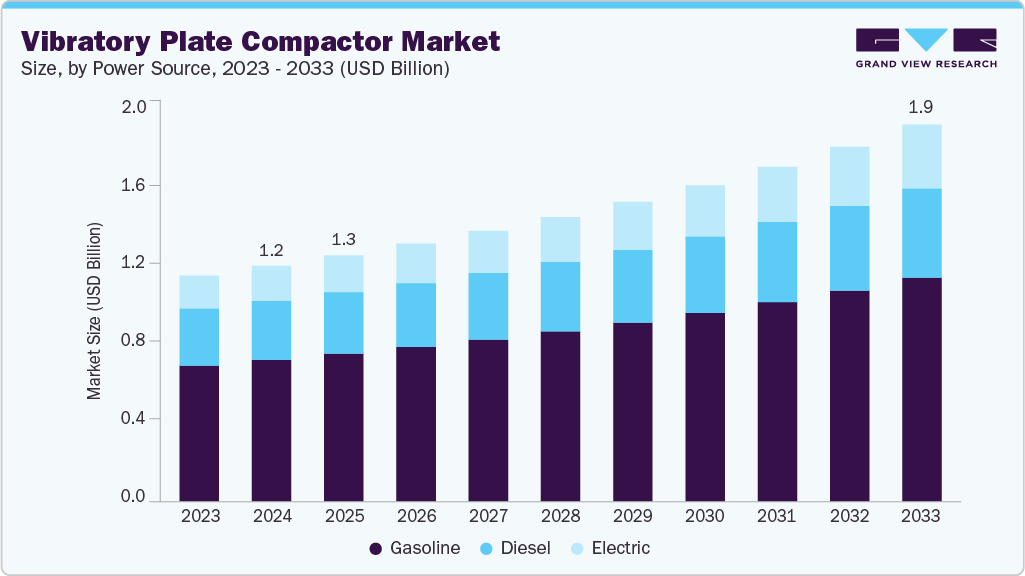 To learn more about this report, Download Free Sample Report
 Market Dynamics
The growing investment in infrastructure development, road construction, urbanization, and commercial construction is a major driver of the Vibratory Plate Compactor Market. Vibratory plate compactors are widely used for soil compaction, asphalt repair, paving applications, landscaping, and foundation preparation due to their ability to deliver high compaction efficiency in confined and small-scale work areas. Rapid expansion of transportation infrastructure projects, residential developments, and municipal construction activities across emerging economies is significantly increasing demand for compact and efficient compaction equipment.
Contractors and construction companies are increasingly preferring vibratory plate compactors because of their portability, operational flexibility, and suitability for compacting granular soils, sand, gravel, and asphalt surfaces. Technological advancements such as low-emission engines, battery-powered compactors, and ergonomic equipment designs are also contributing to increased adoption, particularly in urban construction environments with strict environmental and noise regulations.
Vibratory plate compactors operate under harsh working conditions involving continuous vibration, dust exposure, and heavy mechanical stress, which can result in frequent wear and tear of components such as engine systems, plates, bearings, and vibration mechanisms. This increases maintenance expenses, repair costs, and equipment downtime, particularly for contractors operating in high-intensity construction environments. Additionally, larger infrastructure and road construction projects often prefer alternative equipment such as roller compactors and ride-on compaction machinery that offer higher productivity and coverage capacity for large-scale applications.
Market Concentration & Characteristics
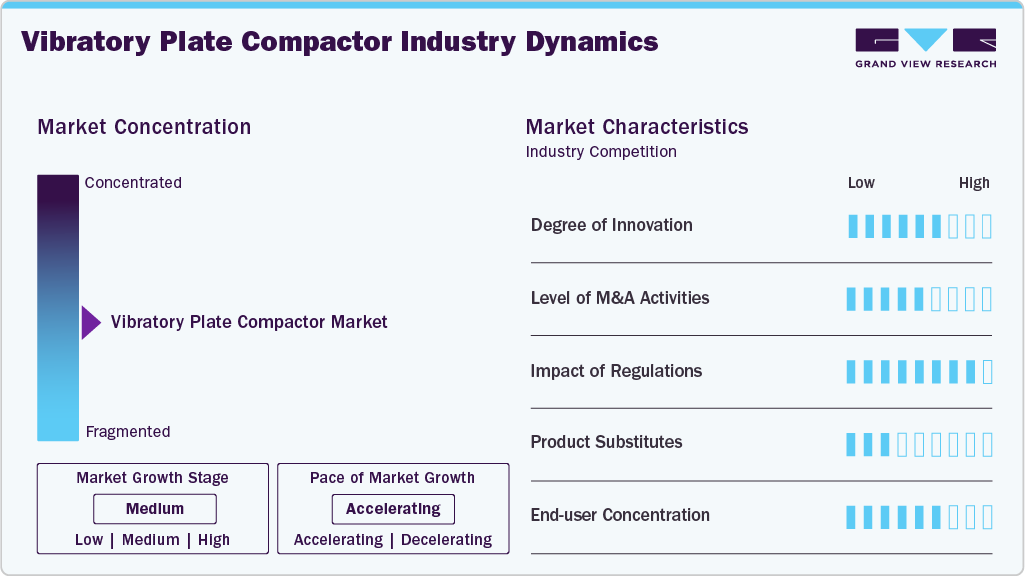
The vibratory plate compactor market is moderately fragmented, with the presence of several regional and global manufacturers competing through product innovation and pricing strategies. While a few key players hold notable market shares due to advanced technology and strong distribution networks, numerous small and mid-sized companies cater to localized demand, particularly in emerging economies. This diversity fosters healthy competition, encouraging continuous improvements in performance efficiency and operator safety features.
The vibratory plate compactor market demonstrates a steady degree of innovation, primarily driven by advancements in vibration technology, engine efficiency, and operator comfort. Manufacturers are developing models with reduced noise, low-emission engines, and smart monitoring systems for real-time performance tracking. The integration of electric and battery-powered compactors is gaining momentum as sustainable construction practices become increasingly prevalent. Continuous R&D investments are enhancing durability, productivity, and ease of maintenance, giving manufacturers a competitive edge.
 To learn more about this report, Download Free Sample Report
 Regulations related to noise emissions, engine efficiency, and worker safety have a significant impact on the market. Governments across regions are enforcing stricter emission standards and environmental regulations, prompting manufacturers to adopt cleaner technologies. Compliance with safety guidelines from organizations such as OSHA and EU directives ensures the protection of operators and promotes responsible manufacturing. These evolving regulatory frameworks encourage the adoption of eco-friendly and ergonomic compactor designs.
The availability of product substitutes in the vibratory compactor market is limited, as few alternatives can match the efficiency and compaction quality of these products. However, in smaller-scale applications, hand tampers or roller compactors are sometimes used as low-cost substitutes. Despite this, vibratory plate compactors remain the preferred choice for their high precision, speed, and suitability across a wide range of soil types. The growing shift toward mechanized compaction further reduces the threat of substitutes, strengthening their position in the construction equipment sector.
Power Source Insights
The gasoline-powered segment dominated the global vibratory plate compactor market, with a share of 60.1% in 2024, due to its high power output, easy refueling, and suitability for heavy-duty applications. These compactors are preferred in large-scale road and infrastructure projects where consistent performance and mobility are critical. Their widespread availability and lower upfront cost compared to alternative power sources further enhance their market share. Moreover, gasoline compactors offer robust operation in remote areas with limited access to electricity, strengthening their dominance.
The electric-powered segment is witnessing the fastest growth, driven by the industry’s shift toward eco-friendly and noise-free construction equipment. These models offer lower operating costs, minimal emissions, and easy maintenance, making them ideal for indoor or urban applications that require compliance with strict environmental regulations. Technological advancements in battery efficiency and charging infrastructure are improving their performance and runtime. As sustainability becomes a key focus, electric compactors are gaining strong traction among contractors and municipal authorities.
Compacting Force Insights
The up to 20 KN segment dominates the global vibratory plate compactor industry, with a 45.2% share in 2024, due to its versatility, lightweight design, and ease of operation. These compactors are widely used in landscaping, pavement maintenance, and small-scale construction projects. Their lower cost and compact structure make them ideal for contractors handling confined or residential areas. Additionally, their efficient performance on granular soils and asphalt surfaces contributes to their continued market leadership.
The 20-40 KN segment is the fastest-growing category, driven by increasing demand from large infrastructure and road-building projects. These compactors offer superior compaction depth and coverage, ensuring enhanced durability and stability of the foundation. Rising investments in highways, airports, and industrial facilities are boosting the adoption of higher-force models. Moreover, manufacturers are integrating advanced vibration control systems to improve efficiency and operator comfort, further supporting segment growth.
Application Insights
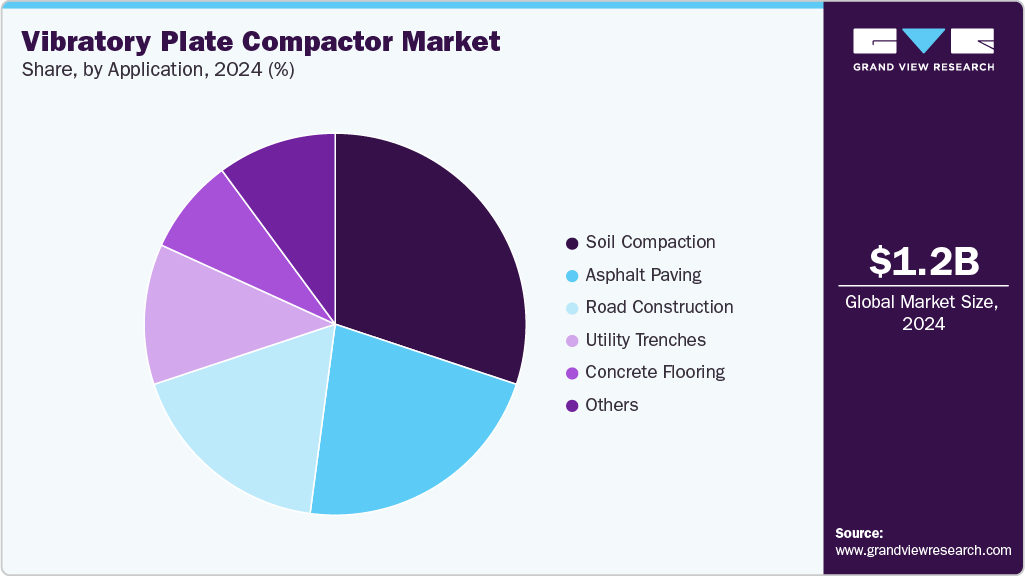
The soil compaction segment dominated the global vibratory plate compactor market, with a share of 30.1% in 2024, owing to its widespread use in residential, commercial, and industrial foundation works. These compactors are essential for stabilizing soil layers before structural construction, ensuring long-term strength and load-bearing capacity. Contractors prefer them for their efficiency in compacting various soil types, including granular and mixed materials. The segment’s growth is supported by increasing building construction and land development activities worldwide.
 To learn more about this report, Download Free Sample Report
 The road construction segment is the fastest-growing application area of the vibratory plate compactor industry, driven by expanding infrastructure projects and government investments in highway modernization. Vibratory plate compactors are increasingly used for compacting base layers, asphalt patches, and pavement edges to achieve uniform surfaces. Their portability and ability to deliver high compaction force make them suitable for both urban and rural road projects. The surge in global road connectivity initiatives continues to accelerate demand in this segment.
Regional Insights
The North America vibratory plate compactor market is expected to grow at a significant CAGR of 5.1%, driven by the refurbishment of aging infrastructure and new residential developments. The adoption of advanced, low-emission compactors aligns with the region’s stringent environmental standards. Increased demand from road maintenance and utility construction sectors boosts equipment sales. Moreover, strong rental market penetration supports equipment accessibility for small and mid-sized contractors.
U.S. Vibratory Plate Compactor Market Trends
The U.S. dominates the North America vibratory plate compactor industry, due to large-scale infrastructure rehabilitation and ongoing residential construction projects. Federal investments in road modernization and public works are significantly driving equipment demand. The presence of major construction equipment manufacturers and a strong rental network enhances accessibility and adoption. Moreover, the growing shift toward advanced, low-emission compactors aligns with the country’s sustainability goals.
The Canada vibratory plate compactor market is witnessing notable growth, supported by increasing investments in transportation and urban infrastructure. The government’s focus on expanding road networks and sustainable housing projects fuels steady equipment demand. Cold climate conditions also drive the need for effective soil and asphalt compaction solutions in construction and maintenance work. Additionally, the rising adoption of compact, electric-powered models reflects Canada’s commitment to eco-friendly construction practices.
Europe Vibratory Plate Compactor Market Trends
The Europe vibratory plate compactor industry’s growth is supported by strict regulatory norms promoting the use of eco-friendly and low-noise construction machinery. The region’s focus on sustainable infrastructure and energy-efficient urban projects drives demand for advanced compactors. Continuous investments in road rehabilitation and public transport networks enhance market prospects. Additionally, innovation-led competition among established manufacturers fosters steady market expansion.
The Germany vibratory plate compactor market dominates Europe, owing to its strong construction industry and advanced engineering capabilities. The country’s focus on sustainable infrastructure, energy-efficient buildings, and extensive road maintenance programs drives consistent equipment demand. German manufacturers are known for developing high-performance and durable compactors that meet strict EU emission standards. Furthermore, ongoing investments in urban redevelopment and transport expansion strengthen Germany’s market leadership.
The vibratory plate compactor market in the UK is growing steadily, supported by government initiatives focused on modernizing transport and residential infrastructure. The increasing number of urban construction and road repair projects is driving the adoption of portable and fuel-efficient compactors. The rise of eco-friendly construction practices is encouraging demand for electric and low-noise models. Additionally, the presence of rental service providers enhances equipment accessibility for small and medium contractors across the country.
Asia Pacific Vibratory Plate Compactor Market Trends
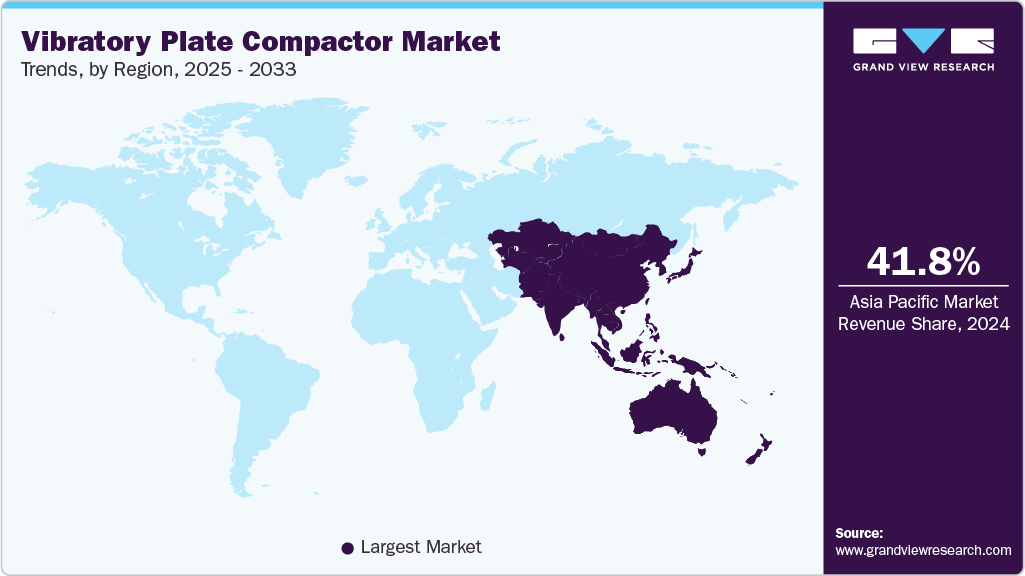
The Asia Pacific led the vibratory plate compactor industry with a 41.8% share in 2024, driven by massive infrastructure development and rapid urbanization across countries such as China, India, and Indonesia. Government initiatives, such as Smart Cities and large-scale road expansion projects, are driving equipment demand. The region benefits from cost-effective manufacturing and the presence of numerous local and global players. Rising construction spending and continuous industrial development further reinforce its market leadership.
 To learn more about this report, Download Free Sample Report
 The China vibratory plate compactor market dominates Asia Pacific, due to its massive infrastructure investments and rapid urbanization. Large-scale projects in highways, industrial zones, and smart cities create substantial demand for compaction equipment. The government’s emphasis on modernizing construction technology supports the adoption of advanced and fuel-efficient compactors. Additionally, strong domestic manufacturing capabilities and cost competitiveness further reinforce China’s leading position.
The vibratory plate compactor market in India is experiencing rapid growth, driven by government initiatives such as Bharatmala, the Smart Cities Mission, and PM Awas Yojana. The expansion of road networks and housing construction activities is boosting demand for efficient compaction machinery. The increasing preference for mechanized equipment among contractors enhances productivity and reduces project timelines. Furthermore, local manufacturing and foreign investments are making advanced compactors more accessible across the country.
Middle East & Africa Vibratory Plate Compactor Market Trends
The Middle East and Africa vibratory plate compactor industry is emerging as a promising region due to the expansion of construction activities in both residential and commercial sectors. Mega infrastructure projects in the UAE, Saudi Arabia, and South Africa are creating strong demand for compaction equipment. The region’s focus on modernizing its transport networks and developing smart cities further enhances its growth potential. Additionally, the growing presence of global construction firms supports the steady adoption of advanced compactors.
The Saudi Arabia vibratory plate compactor market is witnessing strong growth, fueled by large-scale infrastructure and urban development projects under Vision 2030. Massive investments in smart cities, transport corridors, and housing construction are driving equipment demand. The growing emphasis on modern construction practices and sustainable machinery supports the adoption of advanced compactors. Additionally, government-backed diversification initiatives are attracting international contractors, further boosting market expansion.
Latin America Vibratory Plate Compactor Market Trends
Latin America is experiencing moderate growth in the vibratory plate compactor industry, supported by rising construction and urban infrastructure investments. Countries like Brazil, Argentina, and Chile are prioritizing road modernization and housing projects. The increasing adoption of compact and affordable models among small contractors fuels regional demand. Economic reforms and foreign investments in infrastructure also contribute to the market’s upward trajectory.
The Brazil vibratory plate compactor market is experiencing steady growth, driven by increasing infrastructure investments and urban development initiatives. Expanding road construction, housing, and industrial projects are creating strong demand for efficient soil and asphalt compaction equipment. The government’s focus on improving logistics and transportation networks further supports market expansion. Moreover, the growing presence of international equipment manufacturers enhances access to advanced and cost-effective compactors.
Key Vibratory Plate Compactor Company Insights
Some of the key players operating in the market include BOMAG GmbH; Caterpillar Inc.; and Wacker Neuson SE.
-
BOMAG GmbH, a Germany-based specialist in compaction technology, is renowned for its advanced soil, asphalt, and landfill compaction equipment. The company’s vibratory plate compactors are engineered with intelligent control systems, such as ECONOMIZER and BOMAG TELEMATIC, for real-time performance monitoring and fuel optimization. BOMAG’s strong R&D capabilities focus on reducing emissions and vibration exposure while maximizing operational efficiency. Its product portfolio is widely used in infrastructure, road maintenance, and urban construction projects. With a robust global presence, BOMAG continues to set benchmarks in durability and compaction precision.
-
Caterpillar Inc., a U.S.-based global leader in construction machinery, offers high-performance vibratory plate compactors designed for reliability and productivity. The company integrates its equipment with advanced hydraulic systems and engine technologies that meet stringent emission standards. Caterpillar emphasizes operator safety and comfort through ergonomic designs and low-vibration models. Its compactors are widely adopted in road, utility, and foundation works for superior compaction control. Backed by a strong dealer network and digital solutions like Cat® Product Link™, Caterpillar ensures efficient fleet management and minimal downtime.
Key Vibratory Plate Compactor Companies:
The following are the leading companies in the vibratory plate compactor market. These companies collectively hold the largest market share and dictate industry trends.
- BOMAG GmbH
- Caterpillar Inc.
- Wacker Neuson SE
- Ammann Group
- Husqvarna Construction Products
- Multiquip Inc.
- Doosan Portable Power
- MIKASA SANGYO Co., Ltd.
- MBW Inc.
- Simex S.r.l.
- WEBER MASCHINENTECHNIK GmbH
- Jaypee India Ltd.
- Allied Machinery Works
- TMG Industrial US
- DENQBAR
Competitive Benchmarking
Operating Strategies
Competitive Edge
Weaknesses
Mature Players: BOMAG GmbH; Caterpillar Inc.; Wacker Neuson SE; Ammann Group; Husqvarna Construction Products; Multiquip Inc.; Doosan Portable Power;MIKASA SANGYO Co., Ltd.
- Expansion of product portfolios across road construction, infrastructure, and landscaping applications.
- Integration of ergonomic designs, telematics, and operator-friendly features into compaction equipment.
- Extensive global dealer, rental, and aftermarket service networks.
- Strong global brand recognition and diversified construction equipment portfolios.
- High product durability, operational reliability, and strong compaction efficiency.
- Advanced engineering capabilities and broad penetration across infrastructure and construction projects.
- Premium pricing compared to regional equipment manufacturers.
- High dependence on construction and infrastructure investment cycles.
- Exposure to fluctuations in raw material and fuel costs.
Emerging Players: MBW Inc.; Simex S.r.l.; WEBER MASCHINENTECHNIK GmbH; Jaypee India Ltd.; Allied Machinery Works; TMG Industrial US; DENQBAR
- Focus on cost-effective and application-specific compaction equipment solutions.
- Expansion into regional construction and rental equipment markets.
- Increasing emphasis on compact, portable, and low-maintenance machinery designs.
- Competitive pricing and flexibility in customized compaction solutions.
- Strong responsiveness to localized construction requirements.
- Growing adoption among small and medium-sized contractors.
- Comparatively lower global market penetration and brand visibility.
- Limited financial scale for large R&D and international expansion investments.
- Lower diversification compared to multinational construction equipment manufacturers
Recent Developments
-
In February 2025, BOMAG GmbH launched the BR 95 e vibratory plate under its e-PERFORMANCE range, expanding its battery-powered equipment lineup. The model delivers strong compaction with zero emissions, ideal for indoor and urban use. Designed for quiet and efficient operation, it meets the growing demand for sustainable construction tools. This launch highlights BOMAG’s focus on eco-friendly innovation in compaction technology.
-
In January 2024, Husqvarna Construction introduced the LF 60i LAT, a battery-powered plate compactor offering high performance with zero emissions. Powered by dual BLi300 batteries, it provides up to 45 minutes of runtime with automatic battery switching. Its brushless motor ensures quiet, maintenance-free operation ideal for urban and landscaping tasks. The model combines portability, efficiency, and sustainability for modern construction needs.
Vibratory Plate Compactor Market Report Scope
Report Attribute
Details
Market size value in 2025
USD 1,293.2 million
Revenue forecast in 2033
USD 1,979.5 million
Growth rate
CAGR of 5.5% from 2025 to 2033
Historical data
2021 - 2023
Forecast period
2025 - 2033
Quantitative units
Revenue in USD million and CAGR from 2025 to 2033
Report coverage
Revenue forecast, company ranking, competitive landscape, growth factors, and trends
Segments covered
Power source, compacting force, application, region.
Regional scope
North America; Europe; Asia Pacific; Latin America; Middle East & Africa
Country scope
U.S.; Canada; Mexico; UK; Germany; France; Spain; Italy; China; Japan; India; Australia; South Korea; Brazil; Argentina; Saudi Arabia; South Africa; UAE
Key companies profiled
BOMAG GmbH; Caterpillar Inc.; Wacker Neuson SE; Ammann Group; Husqvarna Construction Products; Multiquip Inc.; Doosan Portable Power; MIKASA SANGYO Co., Ltd.; MBW Inc.; Simex S.r.l.; WEBER MASCHINENTECHNIK GmbH; Jaypee India Ltd.; Allied Machinery Works; TMG Industrial US; DENQBAR.
Customization scope
Free report customization (equivalent up to 8 analysts working days) with purchase. Addition or alteration to country, regional & segment scope.
Pricing and purchase options
Avail customized purchase options to meet your exact research needs. Explore purchase options
Global Vibratory Plate Compactor Market Report Segmentation
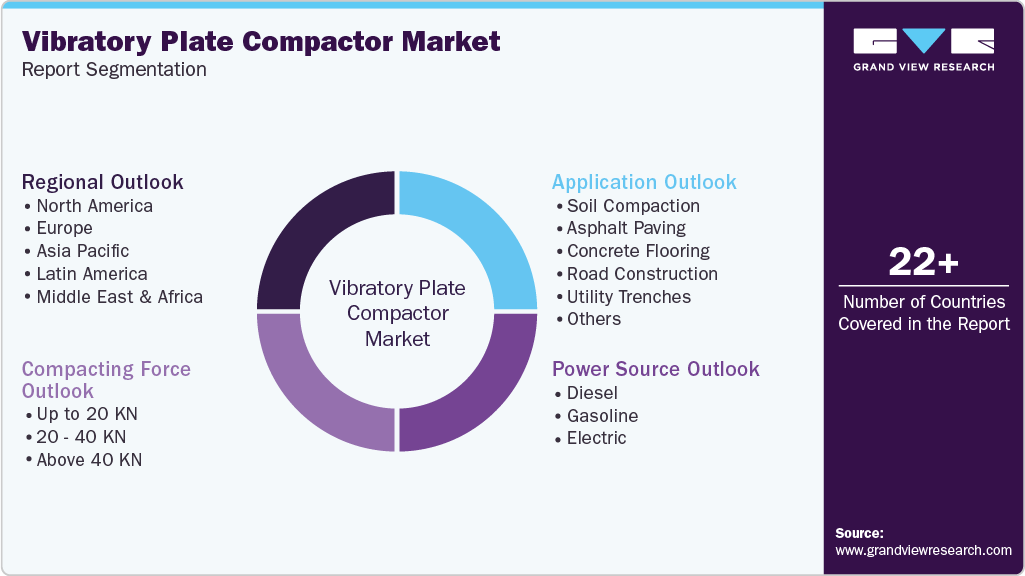
This report forecasts revenue growth at the global, regional, and country levels and provides an analysis of the latest industry trends in each of the sub-segments from 2021 to 2033. For this study, Grand View Research has segmented the global vibratory plate compactor market report based on power source, compacting force, application, and region:
 To learn more about this report, Download Free Sample Report
 -
Power Source Outlook (Revenue, USD Million, 2021 - 2033)
-
Diesel
-
Gasoline
-
Electric
-
-
Compacting Force Outlook (Revenue, USD Million, 2021 - 2033)
-
Up to 20 KN
-
20 - 40 KN
-
Above 40 KN
-
-
Application Outlook (Revenue, USD Million, 2021 - 2033)
-
Soil Compaction
-
Asphalt Paving
-
Concrete Flooring
-
Road Construction
-
Utility Trenches
-
Others
-
-
Regional Outlook (Revenue, USD Million, 2021 - 2033)
-
North America
-
U.S.
-
Canada
-
Mexico
-
-
Europe
-
Germany
-
France
-
Italy
-
Spain
-
UK
-
-
Asia Pacific
-
China
-
India
-
Japan
-
South Korea
-
Australia
-
-
Latin America
-
Brazil
-
Argentina
-
-
Middle East and Africa
-
Saudi Arabia
-
UAE
-
South Africa
-
-
Delivered Customizations
This report has been delivered with the following In-depth customizations
Client Request
Customization Delivered
Value Adds
Regional Segmentation
Detailed market estimates and forecasts for the Vibratory Plate Compactor Market across North America, Europe, Asia Pacific, Latin America, and Middle East & Africa. Country-level demand analysis covering road construction, infrastructure development, landscaping, paving, and residential construction activities.
Identify high-growth regional markets and infrastructure investment hotspots. Support regional expansion planning, distributor network optimization, and demand forecasting.
Competitive Benchmarking
Detailed benchmarking of leading vibratory plate compactor manufacturers based on product portfolio, engine efficiency, compaction performance, durability, regional presence, rental market penetration, and strategic initiatives.
Enable competitive intelligence and product benchmarking. Support product positioning, partnership evaluation, and innovation strategy development.
Opportunity Assessment
Identification of emerging growth opportunities driven by infrastructure modernization, smart city projects, rental equipment demand growth, battery-powered compaction equipment adoption, and increasing mechanization in construction activities.
Prioritize high-growth applications and investment opportunities. Support innovation roadmap development and long-term strategic planning.
Frequently Asked Questions About This Report
The global vibratory plate compactor market size was estimated at USD 1,237.5 million in 2024 and is expected to be USD 1,293.2 million in 2025.
The global vibratory plate compactor market, in terms of revenue, is expected to grow at a compound annual growth rate of 5.5% from 2025 to 2033 to reach USD 1,979.5 million by 2033.
The gasoline-powered segment dominates the global vibratory plate compactor market and accounted for a share of 60.1% in 2024, due to its high power output, easy refueling, and suitability for heavy-duty applications. These compactors are preferred in large-scale road and infrastructure projects where consistent performance and mobility are critical.
Some of the key players operating in the global vibratory plate compactor market include BOMAG GmbH, Caterpillar Inc., Wacker Neuson SE, Ammann Group, Husqvarna Construction Products, Multiquip Inc., Doosan Portable Power, MIKASA SANGYO Co., Ltd., MBW Inc., Simex S.r.l., WEBER MASCHINENTECHNIK GmbH, Jaypee India Ltd., Allied Machinery Works, TMG Industrial US, and DENQBAR.
The key factors driving the global vibratory plate compactor market include rapid urbanization, expanding infrastructure projects, and increasing demand for efficient soil and asphalt compaction. Advancements in technology, such as fuel-efficient engines and low-vibration designs, further enhance equipment adoption. Additionally, government investments in road development and smart city initiatives continue to boost market growth worldwide.
About the Author(s)
Advanced Interior Materials Research Team
Advanced Materials · Advanced Interior MaterialsThis report was authored by the advanced interior materials research team at Grand View Research - comprising two research analysts, one senior research analyst, and one industry expert - with specialized expertise in the advanced interior materials segment of the advanced materials industry. All findings are based on proprietary advanced materials databases, executive interviews, and regulatory analysis, subject to internal peer review prior to publication.
Last Updated:
Speak to Analyst

Customize this report to your needs - add regions, segments, or data points, with 20% free customization.
Or view our licence options:


ISO 9001:2015 & 27001:2022 Certified
We are GDPR and CCPA compliant! Your transaction & personal information is safe and secure. For more details, please read our privacy policy.


