- Home
- »
- Animal Health
- »
-
Animal Vaccines Market Size & Share, Industry Report, 2030GVR Report cover
![Animal Vaccines Market Size, Share & Trends Report]()
Animal Vaccines Market (2025 - 2030) Size, Share & Trends Analysis Report By Animal Type (Livestock, Companion), By Product, By Route Of Administration, By Distribution Channel, By Region, And Segment Forecasts
- Report ID: GVR-2-68038-053-8
- Number of Report Pages: 150
- Format: PDF
- Historical Range: 2018 - 2024
- Forecast Period: 2025 - 2030
- Industry: Healthcare
- Report Summary
- Table of Contents
- Interactive Charts
- Methodology
- Download FREE Sample
-
 Download Sample Report
Animal Vaccines Market Summary
The global animal vaccines market size was estimated at USD 13.48 billion in 2024 and is projected to reach USD 22.95 billion by 2030, growing at a CAGR of 9.5% from 2025 to 2030. The increasing cattle disease outbreaks and the ever-expanding livestock population are the key factors for globally accepting ruminants, especially cattle vaccines.
Key Market Trends & Insights
- North America dominated the market and accounted for a revenue share of over 28% in 2024.
- The animal vaccines market in the U.S. is growing significantly.
- By product, the attenuated live vaccines segment dominated the market and accounted for a revenue share of over 37.00% in 2024.
- By animal type, the livestock segment dominated the market with the highest revenue share in 2024.
- By distribution channel, hospital/clinic pharmacy held the dominant share of the market in 2024.
Market Size & Forecast
- 2024 Market Size: USD 13.48 Billion
- 2030 Projected Market Size: USD 22.95 Billion
- CAGR (2025-2030): 9.5%
- North America: Largest market in 2024
Furthermore, increasing government initiatives is a major factor responsible for market growth. These programs aim to enhance animal welfare, guarantee food safety, limit the spread of illnesses, and advance sustainable agriculture. For example, in February 2025, Biovet, a division of Bharat Biotech Group, revealed that BIOLUMPIVAXIN, a vaccine to prevent lump skin disease in dairy calves and buffaloes, has been approved by India's Central Drug Standard Control Organization (CDSCO).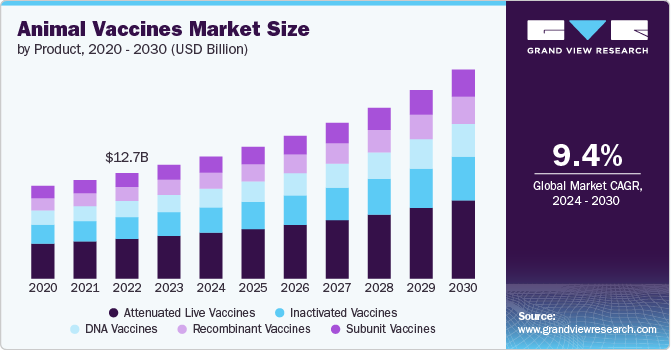
The market saw moderate growth in 2020. The COVID-19 pandemic has impacted all industries, including animal vaccines. During the initial pandemic, OIE confirmed that no animals could spread this virus. However, human-to-animal transmission has been reported in a few countries. IDEXX Laboratories and other companies have tested many dogs and cats for the virus, with negative test results. In the initial months of the pandemic, speculation was that it may spread through birds, negatively impacting the livestock industry. In the U.S., several pig and poultry processing plants shut down after the major outbreak.
Rising concerns over food security and increasing animal husbandry are boosting the demand for animal vaccines for the livestock population. Increasing demand for animal products has led to growth in livestock production globally. Furthermore, various factors, such as variations in food preferences due to changing lifestyles and population growth, are increasing the demand for livestock products. According to OECD projections, global pork meat consumption is expected to increase from 112.58 megatons in 2022 to 127.27 megatons by 2029. According to the OECD's 2020-2029 projections, cow milk makes for over 80% of worldwide milk output, with India and Pakistan predicted to account for more than 30% of global milk production by that year. These elements are contributing to market expansion. In addition, the breakout of animal diseases and the ongoing development of technologically sophisticated vaccinations have contributed to the changing market dynamics.
The increasing prevalence of zoonotic diseases can negatively impact human lives, which is likely to boost the demand for animal vaccines. For instance, according to an article published by The Economic Times, in February 2025, A new strain of the H5N1 avian flu virus has been detected in six dairy herds in Nevada, according to the US Department of Agriculture. The need for H5N1-specific animal vaccinations is expected to rise in response. The livestock sector is probably going to push for rapid research and development of potent vaccines to safeguard cattle and stop the disease from spreading. To protect animal and public health, this circumstance emphasizes the necessity of strengthened biosecurity protocols and all-encompassing immunization programs.
However, pricing plays a significant role in driving the market by influencing the adoption, accessibility, and profitability of vaccines. Companies in the market analyze competitor pricing and market demand to set competitive prices. Competitive pricing helps increase product accessibility and adoption among veterinarians, farmers, and pet owners.
Table 1 Pricing Analysis by AWA, Vaccines, (USD)
Vaccine Category
ASP (USD)
Rabies Vaccine
30.0
Bordetella Vaccine
26.0
Bordetella Vaccine Injectable
31.0
Feline Leukemia Vaccine
26.0
Feline Distemper Vaccine (FvRCP)
28.0
Canine Distemper Vaccine (DAPP)
30.0
Canine Influenza Vaccine (Currently Unavailable)
31.0
Lyme Vaccine
30.0
Leptospirosis Vaccine
28.0
Source: Secondary Research, Animal Welfare Association, Grand View Research
Market Concentration & Characteristics
The animal vaccines industry exhibits a moderate market concentration, and the pace of market growth is accelerating. One of the key factors fueling the market growth is rapid advancements in veterinary vaccines. For instance, in August 2024, in partnership with the Indian Council of Agricultural Research-Central Institute of Brackishwater Aquaculture (ICAR-CIBA), Indian Immunologicals Limited (IIL) progressed the development of its fish vaccine, "Nodavac-R." This collaboration seeks to address aquaculture's health issues while advancing environmentally friendly fish farming methods.
The market demonstrates a high degree of innovation. Innovations in animal vaccines have become increasingly significant in veterinary medicine, driven by advances in biotechnology, changing disease landscapes, and growing awareness of animal welfare. Key trends and innovations include recombinant DNA vaccines, which use genetic engineering to produce antigens that stimulate the immune response. They are safer than traditional vaccines because they don't require live pathogens. Recombinant vaccines are effective for diseases like rabies, feline leukemia, and foot-and-mouth disease.
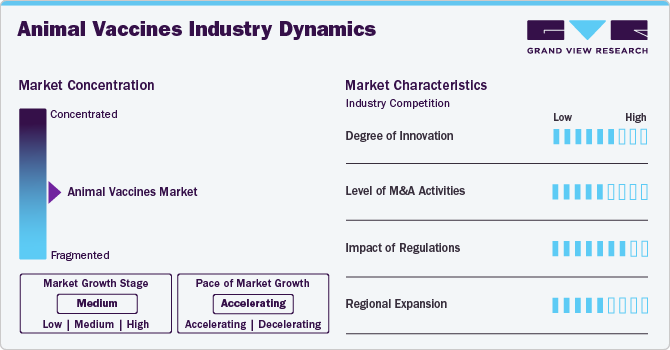
Within the market, there exists a moderate to high level of mergers and acquisitions activity, indicative of ongoing consolidation, strategic acquisitions, and partnerships among industry players. For instance, in January 2025, Ceva Sante Animale acquired Scout Bio to expand into veterinary biologics and gene therapies.
The market experiences a high impact of regulations. Vaccines must undergo a rigorous approval process before they are marketed. This involves laboratory research, clinical trials, and reviews of safety, efficacy, and quality. In the U.S., the Center for Veterinary Biologics (CVB), under the U.S. Department of Agriculture (USDA), regulates veterinary vaccines. Moreover, manufacturers must adhere to Good Manufacturing Practices (GMP) to ensure the quality and consistency of vaccines. GMP compliance is regularly monitored through inspections.
Initiatives by major competitors in the market cause moderate regional growth operations. For instance, in July 2024, Biogénesis Bagó opened a new vaccine production plant in Campo Largo, Brazil, with a $30 million investment, making it the largest veterinary vaccine producer in Latin America. The facility will produce over 10 million doses annually for pets and livestock, strengthening Biogénesis Bagó's presence in Brazil’s animal health market and expanding its reach across Latin America.
Product Insight
The attenuated live vaccines segment dominated the market and accounted for a revenue share of over 37.00% in 2024. The most traditional immunization technique in the veterinary industry is live attenuation. The major advantages of these vaccines are that they are cheap and offer better immune responses. Moreover, doses are required less frequently and provide long-lasting immunity. Such vaccines are, therefore, useful for a large number of animals as small dosages will ensure protection against diseases. Due to these advantages, the demand for these vaccines is expected to grow over the coming years.
The recombinant vaccine segment is anticipated to grow at the fastest CAGR over the forecast period. These vaccines help reduce the risk of pathogenicity in animals after vaccination. Recombinant vaccines are also expected to help achieve vaccination against multiple virus strains, as recombinants can carry multiple gene inserts. These vaccine formulations can avoid the need for adjuvants, increase the viability of the vaccine, and improve stability. In veterinary medicine, recombinant vaccinations are offered against canine distemper, avian influenza, Newcastle disease, pseudorabies, and Lyme disease.
Animal Type Insight
The livestock segment dominated the market with the highest revenue share in 2024. This can be attributed to factors such as the rising livestock population, supportive government initiatives, and the outbreak of diseases among cattle and sheep. The livestock population has increased, with significant growth in cattle, sheep, pigs, and poultry being raised for meat production. For instance, as of January 2024, the U.S. Foreign Agricultural Service's Livestock and Poultry: World Markets and Trade report states that there were 87.8 million cattle and 74.97 million pigs in the United States. To preserve health and productivity, this sizable animal herd requires extensive vaccinations.
The companion segment is expected to exhibit the fastest growth rate during the forecast period. House pets and ferrets carry canine distemper virus and require strictly preventive vaccination as no post-infection treatment is available. The Morbillivirus affects dogs, foxes, raccoons, and wolves to cause distemper and is transmitted through the air and other modes of contact between infected and healthy animals. Immunization of dogs is essential as canine distemper destroys the respiratory, urogenital, and gastrointestinal tract. Dogs suffering from gastrointestinal tract bacterial infections and newborn pups are more susceptible to this disease. Several canine distemper vaccines are available, including Megavac 6 and 7, DHPPi/L Vaccine, DHP, and Vanguard.
Distribution Channel Insight
Hospital/clinic pharmacy held the dominant share of the market in 2024. These facilities are often at the forefront of adopting new technologies. Moreover, they are often the first point of contact for pet owners and farmers seeking medical care for their animals. They serve as trusted sources for recommending and administering vaccines. Hospitals and clinics often collaborate with vaccine manufacturers, gaining access to the latest products and technologies. These partnerships can drive the adoption of new vaccines in the market.
E-commerce is anticipated to grow at the fastest CAGR over the forecast period. E-commerce platforms provide broader geographic reach, making it easier for veterinarians, farmers, and pet owners to access vaccines, especially in remote areas where physical stores may be scarce. Online retailers often offer competitive pricing compared to traditional brick-and-mortar stores, which can drive sales. Discounts, bulk purchasing, and subscription models further incentivize customers to buy online.
Route of Administration Insight
The subcutaneous segment dominated the market for animal vaccines, with a revenue share of over 41.0% in 2024. In most animals, the subcutaneous injection sites are located behind the shoulder blades and neck. Ease of administration of drugs subcutaneously as they can be absorbed slowly into the body is anticipated to boost the market growth. The subcutaneous route of administration is also quicker and less painful for animals. Furthermore, it is easier to train veterinary professionals to administer subcutaneous injections. Intramuscular and subcutaneous are the common routes of administration in animals currently. These factors promote the segment growth.
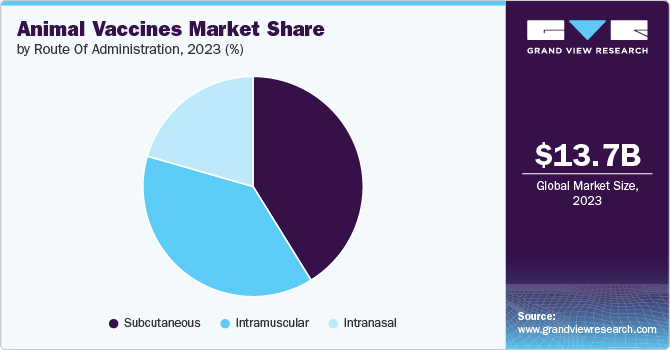
The intranasal segment is expected to exhibit the fastest growth rate of over 10.0% during the forecast period. Intranasal vaccines are mostly limited to a single dose. The growing prevalence of respiratory diseases in animals and rising research activities by market players to develop better vaccines are expected to fuel market growth. Moreover, intranasal vaccines stimulate mucosal immunity, offering a first-line defense against pathogens. This is especially beneficial in preventing respiratory diseases in livestock, poultry, and companion animals.
Regional Insights
North America dominated the market and accounted for a revenue share of over 28% in 2024. The region is expected to remain dominant throughout the forecast period. This large share can be attributed to the high prevalence of livestock and zoonotic diseases leading to large-scale animal deaths. In addition, the market is anticipated to grow more quickly due to the high number of well-established pharmaceutical companies constantly working to expand their global reach and commercialize their vaccines. In addition, the growing number of pets in the United States and the rising occurrence of canine diseases, which is driving up vaccine adoption, are some of the key factors contributing to the market expansion.

U.S. Animal Vaccines Market Trends
The animal vaccines market in the U.S. is growing significantly. This growth is attributed to a wide range of definitive measures adopted by government animal care organizations that are consistently striving for improvement. For instance, Animal Health Emergency Management (AHEM) aims to ensure food security and concentrates on aspects associated with animal products, such as quality, safety, and affordability. Moreover, the market has benefited from the local presence of significant industry companies, including Zoetis, Elanco, and others. These businesses are making significant investments in R&D and implementing other calculated strategies to meet the rising market demand. For example, USDA's Animal and Plant Health Inspection Service (APHIS) stated in May 2024 that it would invest over USD 22.2 million to improve early detection, prevention, preparedness, and quick response to the most common livestock diseases in the United States. Therefore, the growing number of such initiatives is expected to propel the market.
Europe Animal Vaccines Market Trends
The animal vaccines market in Europe is anticipated to grow significantly, attributed to increased cat and dog use as pets and pet care expenditure. For instance, according to the FEDIAF Report 2024, With 50% of European homes owning 166 million of the 352 million pets in Europe, the number of pet owners is rising. Regular vaccination is essential because pets, particularly dogs and cats, are vulnerable to a number of infectious diseases, including rabies, distemper, parvovirus, and feline leukemia. In addition, to prevent infectious and zoonotic diseases, veterinarians are urging pet owners to implement preventative healthcare practices, such as routine vaccination.
The UK animal vaccines market is anticipated to grow at a constant rate due to the rising number of R&D activities and the influx of new animal products, rising animal adoption & cattle population, increasing adoption of preventive care for animals, and growing awareness about the significance of the health of farm & companion animals in the country. For instance, according to an article published by The Pirbright Institute, in March 2023, A new center at the Pirbright Institute has been inaugurated as part of a collaborative effort between the UKRI Biotechnology and Biological Sciences Research Council (BBSRC), the Foreign, Commonwealth and Development Office (FCDO), and the Bill & Melinda Gates Foundation. The aim is to expedite the development of animal vaccines to combat urgent and emerging infectious diseases. The new Centre for Veterinary Vaccine Innovation and Manufacture (CVIM) will close the gap between research and competence in process development and manufacturing.
Asia Pacific Animal Vaccines Market Trends
The animal vaccines market in Asia Pacific is expected to register the fastest growth rate during the forecast period. The anticipated rise in the livestock population and government initiatives, especially in developing economies, are some of the major factors expected to boost market growth in the region. Moreover, the large cattle population in the country calls for vaccine demand. The market is driven by high R&D expenditures by many major players, combined with rising attempts to commercialize veterinary vaccines and inoculations at tolerably low prices.
China animal vaccines market is growing rapidly due to the country's increasing prevalence of animal diseases. For instance, according to an article published by The Times of India, in May 2024, on May 18, 2024, the Chinese Ministry of Agriculture reported occurrences of bird flu in wild birds in western China. 275 cases of H5 influenza among deceased Pallas' gulls and other wild birds were reported in two counties in Qinghai province. Thus, the confirmation of H5 influenza cases in wild birds by China’s Ministry of Agriculture highlights the growing importance of disease surveillance and control measures, which directly impact the market.
Latin America Animal Vaccines Market Trends
The animal vaccines market in Latin America is expected to show growth over the forecast period owing to increasing reforms in the healthcare industry in this region. The rising incidence of chronic livestock diseases is a factor driving market growth. Furthermore, the rise in supportive government funding in countries such as Brazil is another contributing factor. The presence of untapped opportunities, economic development, and rising awareness levels are some of the factors that can account for the rapid growth of this region.
Brazil animal vaccines market is growing significantly over the forecast period. Growing mandates for vaccination to curb livestock disease outbreaks and increasing demand for livestock-related food products are primary factors expected to drive the market. Brazil's veterinary vaccines market growth can be attributed to a large cattle population. For instance, according to Agro Concept Management Ltd, Brazil had the second-largest cattle herd, accounting for 232 million heads. Moreover, the country is also the world’s largest exporter of beef. This has resulted in greater awareness of animal health and, subsequently, boosted the demand for veterinary medicines in the country.
Middle East & Africa Animal Vaccines Market Trends
South Africa, Saudi Arabia, UAE, and Kuwait constitute the Middle East & Africa (MEA). This market is anticipated to grow during the forecast period due to the high incidence of diseases like animal influenza and viral diseases, such as foot-and-mouth disease, coupled with rising awareness. These factors increased the need for effective management of the aforementioned chronic diseases in regions such as South Africa. The rising urgency can be attributed to inadequate treatment alternatives present in this region. The growing consumer preference for a healthy lifestyle is also fueling the market.
South Africa animal vaccines market is anticipated to grow at a lucrative rate during the forecast period. This is believed to be a consequence of certain government programs focused on improving overall animal health care in the country. Livestock production accounts for up to 25% of national income. South Africa produces chicken at the 6th lowest price per kilo in the world, making it competitive in the global poultry industry. Increasing government initiatives to advance the poultry sector are key factors driving the country's market growth.
Key Animal Vaccines Company Insights
The market is highly competitive and marked by various small and large animal vaccine manufacturers. The key parameters affecting competition include the rapid adoption of veterinary preventive injections and government-aided bulk purchase of veterinary vaccines. In addition, to retain shares and diversify the product portfolio, major players frequently opt for various strategies such as mergers and acquisitions, partnerships, and new product launches. For instance, in February 2021, Ceva partnered with the French National Research Institute for Agriculture, Food, and Environment (INRAE) for R&D to prevent infectious diseases from animal origin and improve animal health.
Key Animal Vaccines Companies:
The following are the leading companies in the animal vaccines market. These companies collectively hold the largest market share and dictate industry trends.
- Zoetis
- Merck & Co., Inc.
- Boehringer Ingelheim Animal Health
- Elanco
- Virbac
- Phibro Animal Health Corporation
- Calier
- Ceva
- Bimeda Biologicals
- Neogen Corporation
Recent Developments
-
In February 2025, Zoetis received conditional approval from the USDA CVB for its killed virus vaccines on H5N2 Avian Influenza.
-
In February 2025, Medgene and Elanco agreed to jointly commercialize Elanco’s HPAI vaccine platform for dairy cattle in the U.S
-
In August 2022, Zoetis expanded the poultry product portfolio with the Poulvac Procerta HVT-IBD vaccine to protect poultry against Infectious Bursal Disease (IBD). This added to the company’s line of recombinant vector vaccines.
-
In January 2022, Boehringer Ingelheim collaborated with MabGenesis, a biopharmaceutical company, to discover novel canine monoclonal antibodies.
-
In November 2021, Ceva created a new cryogenic storage facility in Monor by investing in its European vaccine production capacity to meet the rapidly growing vaccine demand.
Animal Vaccines Market Report Scope
Report Attribute
Details
Market size value in 2025
USD 14.57 billion
Revenue forecast in 2030
USD 22.95 billion
Growth rate
CAGR of 9.5% from 2025 to 2030
Historical Period
2018 - 2024
Forecast period
2025 - 2030
Quantitative units
Revenue in USD million/billion, and CAGR from 2024 to 2030
Report coverage
Revenue forecast, company ranking, competitive landscape, growth factors, and trends
Segments covered
Animal type, product, route of administration, distribution channel, region.
Regional scope
North America; Europe Asia; Pacific; Latin America; MEA;
Country scope
U.S.; Canada; Mexico; UK; Germany; France; Italy; Spain; Denmark; Sweden; Norway; Japan; China, India; Australia; South Korea; Thailand; Brazil; Argentina; South Africa; Saudi Arabia; UAE; Kuwait
Key companies profiled
Zoetis; Merck & Co., Inc.; Boehringer Ingelheim Animal Health; Elanco; Virba;, Phibro Animal Health Corporation; Calier; Ceva; Bimeda Biologicals; Neogen Corporation
Customization scope
Free report customization (equivalent up to 8 analysts working days) with purchase. Addition or alteration to country, regional & segment scope.
Pricing and purchase options
Avail customized purchase options to meet your exact research needs. Explore purchase options
Global Animal Vaccines Market Report Segmentation
This report forecasts revenue growth at global, regional, and country levels and provides an analysis of the latest industry trends in each of the sub-segments from 2018 to 2030. For this study, Grand View Research has segmented the global animal vaccines market report based on animal type, product, route of administration, distribution channel, and region:
-
Product Outlook (Revenue, USD Million, 2018 - 2030)
-
Attenuated Live Vaccines
-
Inactivated Vaccines
-
Subunit Vaccines
-
DNA Vaccines
-
Recombinant Vaccines
-
-
Route of Administration Outlook (Revenue, USD Million, 2018 - 2030)
-
Subcutaneous
-
Intramuscular
-
Intranasal
-
-
Animal Type Outlook (Revenue, USD Million, 2018 - 2030)
-
Livestock
-
Poultry
-
Aqua
-
Ruminants
-
Swine
-
-
Companion
-
Canine
-
Feline
-
Others
-
-
-
Distribution Channel Outlook (Revenue, USD Million, 2018 - 2030)
-
Retail
-
E-Commerce
-
Hospital/ Clinic Pharmacy
-
-
Regional Outlook (Revenue, USD Million, 2018 - 2030)
-
North America
-
U.S.
-
Canada
-
Mexico
-
-
Europe
-
UK
-
Germany
-
France
-
Italy
-
Spain
-
Denmark
-
Sweden
-
Norway
-
Rest of Europe
-
-
Asia Pacific
-
Japan
-
India
-
China
-
South Korea
-
Australia
-
Thailand
-
Rest of APAC
-
-
Latin America
-
Brazil
-
Argentina
-
Rest of LATAM
-
-
Middle East and Africa (MEA)
-
South Africa
-
Saudi Arabia
-
UAE
-
Kuwait
-
Rest of MEA
-
-
Frequently Asked Questions About This Report
b. The global animal vaccines market size was estimated at USD 13.48 billion in 2024 and is expected to reach USD 14.57 billion in 2025.
b. Some key players operating in the animal vaccines market include Zoetis, Merck & Co., Inc., Boehringer Ingelheim Animal Health, Elanco, Virbac, Phibro Animal Health Corporation, Calier, Ceva, Bimeda Biologicals, Neogen Corporation
b. The global animal vaccines market is expected to grow at a compound annual growth rate of 9.51% from 2025 to 2030 to reach USD 22.95 billion by 2030.
b. North America dominated the animal vaccines market and accounted for the largest revenue share of over 28% in 2024. This large share can be attributed to the high prevalence of livestock and zoonotic diseases leading to large-scale animal deaths.
b. Key factors that are driving the animal vaccines market growth include growing livestock population, growing demand for animal derived food products, rising disease outbreak, and increasing R&D and manufacturing advancements


Share this report with your colleague or friend.
Need a Tailored Report?
Customize this report to your needs — add regions, segments, or data points, with 20% free customization.


ISO 9001:2015 & 27001:2022 Certified
We are GDPR and CCPA compliant! Your transaction & personal information is safe and secure. For more details, please read our privacy policy.
Trusted market insights - try a free sample
See how our reports are structured and why industry leaders rely on Grand View Research. Get a free sample or ask us to tailor this report to your needs.