
- Home
- »
- Medical Devices
- »
-
U.S. Ambulatory Surgery Center Market Size Report, 2033GVR Report cover

U.S. Ambulatory Surgery Center Market (2026 - 2033) Size, Share & Trends Analysis Report By Application (Orthopedics, Cardiology), By Ownership (Physician, Hospital), By Center Type (Single-Specialty, Multi-Specialty), By Device Type, By Region, And Segment Forecasts
U.S. Ambulatory Surgery Center Market Summary
The U.S. ambulatory surgery center market size was valued at USD 45.3 billion in 2025 and is projected to grow from USD 48.0 billion in 2026 to USD 72.7 billion by 2033, at a CAGR of 6.1% from 2026 to 2033. The Southeast region dominated the U.S. ambulatory surgery center market with the largest revenue share of 29.1% in 2025. The market growth can be attributed to rising investments in ASCs and favorable reimbursement for ASC services in the U.S. For instance, in April 2026, COMMUNITY HEALTH SYSTEMS, INC., announced its strategic advancements aimed at improving its network of ASCs.
Key Market Trends & Insights
- The ambulatory surgery center market in the Midwest region is anticipated to grow at the fastest CAGR during the forecast period.
- By application, the orthopedics segment led the market with the largest revenue share of 26.5% in 2025.
- By ownership, the physician-owned ASCs segment led the market with the largest revenue share of 62.1% in 2025.
- By center type, the multi-specialty segment is expected to grow at the fastest CAGR from 2026 to 2033.
Market Size & Forecast
- 2025 Market Size: USD 45.3 Billion
- 2026 Market Size: USD 48.0 Billion
- 2033 Projected Market Size: USD 72.7 Billion
- CAGR (2026-2033): 6.1%
- Southeast region: Largest market in 2025
Three ways to get this report
Buy it, customize it, or ask a question.Ask an Analyst
Analyst response in 1 business day
- AccessReport author, directly
- Reply timeWithin 1 working day
- No sales callDirect answer only
- FormatEmail reply
- CostFree, no cost
Get the Full Report
What the study covers
- FormatsPDF · Excel · Dashboard
- Timeline2026–2033 annual, 2025 base
- Coverage20+ countries, 5 regions
- Companies10+ key players profiled
Customize the Report
20% free customization
- IncludeCountries, segments, points
- TailorTo your product definition
- ExtendDeeper competitor detail
- OrA fully bespoke study
- Turnaround5–10 working days
The company’s subsidiaries have established new centers in Birmingham and Foley, Alabama, and have acquired a majority ownership interest in a center in Anchorage, Alaska. Currently, the organization operates 36 affiliated ASCs across the United States. These developments underscore the significant growth potential of the ambulatory surgical care market and reflect a strategic trend among healthcare providers to enhance existing ASC networks delivering same-day surgical services. Source: Grand View Research, IR Documents, Primary Interviews, Paid DatabasesTo learn more about this report,
 Download Free Sample Report
 The section below outlines the key factors driving the growth of the U.S. ambulatory surgery centers industry, highlighting the increasing shift toward outpatient surgical procedures, rising demand for cost-effective healthcare services, and growing preference for minimally invasive surgeries. It also examines the increasing burden of chronic diseases, advancements in surgical technologies and anesthesia techniques, expanding physician partnerships, favorable reimbursement structures, and the growing focus on reducing hospital stays and improving patient convenience, all of which are supporting market expansion.
Market Dynamics
ASCs provide surgical treatments at significantly lower cost than hospital-based inpatient settings while delivering faster patient turnaround times, shorter hospital stays, and a lower risk of hospital-acquired infections. This cost efficiency has encouraged patients, healthcare providers, and payers to shift a growing number of minimally invasive and same-day procedures toward ambulatory settings.
Technological advancements in minimally invasive surgeries, anesthesia techniques, and post-operative recovery protocols have further expanded the range of procedures that can be safely performed in ASCs, including orthopedic, ophthalmic, gastrointestinal, cardiovascular, pain management, and cosmetic surgeries. In addition, rising healthcare expenditure pressures and increasing emphasis on value-based care are encouraging insurers and government healthcare programs to promote outpatient surgical care models.
For instance, the Centers for Medicare & Medicaid Services (CMS) continues to expand the list of reimbursable procedures eligible for ASC settings, supporting greater patient migration from hospitals to outpatient centers. Moreover, leading healthcare systems and physician groups are increasingly investing in ASC partnerships to improve operational efficiency and reduce overall treatment costs, thereby accelerating market expansion.
One of the major restraints affecting the growth of the U.S. ambulatory surgery center industry is the limited range of procedures that can be performed safely in outpatient settings. While ASCs are increasingly adopting minimally invasive and same-day surgical techniques, complex, high-risk, and emergency procedures still require advanced infrastructure, intensive care support, and multidisciplinary expertise available in hospitals. In addition, patients with severe comorbidities or those requiring extended post-operative monitoring are often not suitable for ASC-based treatment, limiting the scope of services offered by these facilities.
This limited procedural capability limits ASC revenue-generating opportunities and reduces their penetration in certain high-acuity surgical segments. Furthermore, stringent regulatory guidelines and payer policies regarding patient eligibility and outpatient reimbursement continue to constrain the expansion of procedure volumes within ambulatory care facilities. For instance, while orthopedic, ophthalmology, gastroenterology, and pain management procedures have rapidly shifted toward ASCs, many advanced surgical specialties still rely heavily on hospital-based operating rooms, thereby limiting the overall market potential of ASCs.
Advancements in minimally invasive surgical technologies, anesthesia techniques, and rapid recovery protocols have enabled a growing number of orthopedic, gastrointestinal, ophthalmic, cardiovascular, pain management, and cosmetic procedures to be safely performed in ASCs. Patients and healthcare providers are increasingly preferring ASCs for shorter wait times, lower infection risk, faster recovery, and significantly lower treatment costs compared to inpatient hospital care.
In addition, rising healthcare expenditure pressures and reimbursement optimization strategies are encouraging payers and governments to promote outpatient surgical care models. The growing aging population and the increasing prevalence of chronic diseases requiring elective surgical interventions are further supporting growth in procedure volume across ASCs.
For instance, major healthcare systems and physician groups across the U.S. continue expanding ASC networks through acquisitions, partnerships, and specialty-focused center development. Furthermore, technological advancements such as robotic-assisted surgery, same-day joint replacement procedures, and AI-enabled surgical workflow optimization are creating substantial opportunities for ASC operators and medical device companies to expand service capabilities and improve operational efficiency.
A shortage of trained medical professionals, such as anesthesiologists, can pose significant challenges for the U.S. ambulatory surgery center industry during the forecast period. Easy accessibility to efficient imaging tools, such as intraoperative ultrasound, C-arm imaging, and portable CT scanners, has facilitated an increasing number of same-day surgeries in the U.S. The ability of modern technologies to provide precise, real-time visualizations to surgeons has reduced the complexity associated with multiple procedures and increased the number of minimally invasive surgeries (MIS) and orthopedic interventions in the recent past. However, the availability of anesthesiologists in ASCs has not kept pace with the demand. According to the December 2025 Health Workforce Projections released by the National Center for Health Workforce Analysis (NCHWA), for 2023-2038, the U.S. is estimated to experience a shortage of 10,660 anesthesiology physicians in 2038. This may pose a major challenge to the U.S. healthcare industry.
Market Characteristics & Concentration
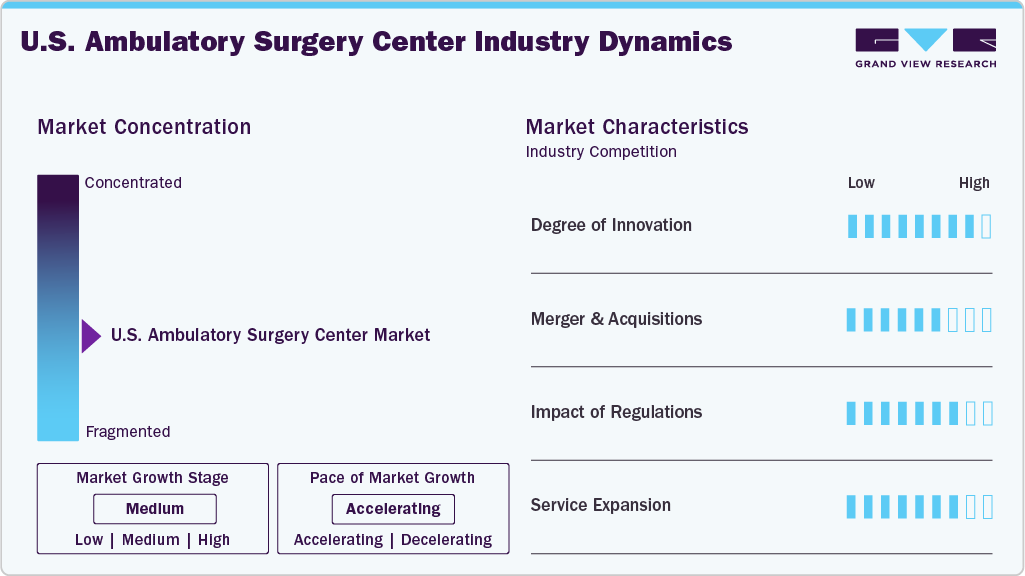
The U.S. ambulatory surgery centers industry is experiencing significant innovation, driven by growing demand for technology solutions that improve same-day surgical care delivery. In November 2025, AI-driven 3D optical navigation technology provider for spinal surgery, PathKeeper Surgical, announced completion of the first outpatient spine procedure at an Ambulatory Surgery Center (ASC), using its technology, comprising proprietary AI and ultra-high resolution 3D cameras, enabling real-time surgical guidance during the process.
The level of merger & acquisitions in the U.S. ambulatory surgery centers industry is moderate. In recent years, numerous healthcare providers operating across several states have been focusing on enhancing their patient access points by acquiring facilities and stakes in ASCs. For instance, Tenet Healthcare Corporation announced that during the year ended on 31st of December 2025, it acquired controlling ownership interests in 27 ASCs. Its subsidiary, USPI Holding Company, Inc., held ownership interests in 533 ambulatory surgery centers across 37 states. This indicates the market's growth potential.
 To learn more about this report, Download Free Sample Report
 The impact of regulations on the U.S. ambulatory surgery center industry is significant, as procedures and operations related to outpatient care are highly regulated in the U.S. In 2026, the Centers for Medicare & Medicaid Services announced a 2.6% increase in ASC payment rates, while adding a large number of procedures to the list. To receive full payment updates, ASCs must report quality measures through the ASC Quality Reporting (ASCQR) program.
The level of service expansion is high in the U.S. ambulatory surgery centers industry. In recent years, multiple industry participants have been expanding the number of ambulatory surgery centers. For instance, in 2025, Surgery Partners, one of the major operators of surgical facilities in the U.S., acquired a controlling interest in 12 surgical facilities. In 2024, it acquired a non-controlling interest in 4 surgical facilities. Such developments highlight the intensity of merger & acquisition activities in the U.S. ambulatory surgery centers market.
Case Study: Rising Demand for Outpatient Surgical Procedures Accelerating Growth of Ambulatory Surgery Centers
Background:
The healthcare industry is experiencing a major transition from inpatient hospital-based surgeries toward outpatient and same-day surgical care models. Ambulatory Surgery Centers (ASCs) have emerged as a preferred alternative for providing cost-effective, efficient, and patient-centric surgical services. Increasing adoption of minimally invasive surgical techniques, shorter recovery times, and growing patient preference for convenience are significantly contributing to the expansion of the U.S. ambulatory surgery center industry.
A physician-focused perspective published by the Ambulatory Surgery Center of Bala Cynwyd highlighted how outpatient surgical procedures are transforming surgical care delivery by improving operational efficiency, reducing healthcare costs, and enhancing patient satisfaction.
Client Objective:
The objective of the study was to evaluate the factors driving the increasing adoption of outpatient surgical procedures and assess their impact on the growth of Ambulatory Surgery Centers. The client also sought to understand how minimally invasive technologies, physician preferences, patient convenience, and healthcare cost optimization are reshaping the outpatient surgery landscape.
Customization Delivered:
A comprehensive assessment was conducted to analyze the evolving role of ASCs in modern healthcare delivery. The study evaluated patient migration trends from hospitals to outpatient centers, physician adoption patterns, operational efficiencies, reimbursement dynamics, and advancements in minimally invasive surgical procedures.
The assessment further analyzed specialty-wise ASC adoption across orthopedic surgery, spine procedures, pain management, podiatry, gastrointestinal procedures, and other outpatient interventions commonly performed in ambulatory settings. In addition, the study examined physician ownership trends, the benefits of workflow optimization, and the impact of reduced infection risk and faster recovery times on patient outcomes.
Key Findings
-
Increasing Preference for Minimally Invasive Procedures: The study identified minimally invasive surgical advancements as one of the primary factors driving ASC growth. Technologies such as laser-assisted spine surgery, image-guided pain management injections, and advanced arthroscopic procedures enable surgeries to be performed safely in outpatient settings with reduced tissue damage and faster recovery periods.
-
Rising Demand for Cost-Effective Surgical Care: Outpatient surgery centers were found to provide significantly lower procedural costs compared to hospital inpatient departments. Reduced overhead expenses, elimination of overnight stays, and streamlined operational workflows contribute to improved affordability for both patients and insurers. This has accelerated payer support and increased physician referrals toward ASCs.
-
Improved Patient Experience & Recovery Outcomes: Patients increasingly prefer ASCs due to shorter waiting times, same-day discharge, personalized care environments, and lower exposure to hospital-acquired infections. The patient-centric care model offered by ASCs has contributed to higher satisfaction rates and improved post-operative recovery experiences.
-
Growing Physician Participation & Operational Efficiency: The study also observed growing physician preference for ASC-based procedures due to greater scheduling flexibility, improved control over surgical workflows, optimized resource utilization, and enhanced practice efficiency. Physician ownership models and collaborative ASC partnerships continue to strengthen surgeon participation in outpatient surgical care.
- Expansion of Multi-Specialty ASC Facilities: Modern ASCs are increasingly expanding into multi-specialty surgical centers capable of handling orthopedic, spine, pain management, podiatry, and gastrointestinal procedures. Investments in advanced operating rooms, digital imaging systems, and anesthesia technologies are broadening the range of procedures that can safely transition to outpatient environments.
Business Impact/Value Add
The study enabled stakeholders to identify the key growth opportunities in the U.S. ambulatory surgery centers industry and to understand the evolving dynamics of outpatient surgical care. The findings supported strategic decision-making related to ASC expansion, physician partnerships, technology investments, and specialty service prioritization.
In addition, the research provided actionable insights into patient expectations, reimbursement trends, and minimally invasive surgical adoption patterns, enabling healthcare providers and investors to strengthen long-term operational and commercialization strategies within the rapidly growing ambulatory surgery ecosystem.
Application Insights
The orthopedics segment led the market with the largest revenue share of 26.5% in 2025. The growth of this segment is primarily driven by factors such as growing migration of critical procedures from inpatient to outpatient settings, cost-effectiveness enabled by ASCs for payers and patients, and easy accessibility to minimally invasive techniques. According to the American College of Rheumatology, nearly 790,000 total knee replacements and approximately 544,000 hip replacements are performed in the U.S. each year. This data indicates the lucrative growth opportunities for this segment. In recent years, multiple healthcare providers have also been focusing on reducing the burden on large facilities through decentralizing procedures and developing de novo ASCs. For instance, in June 2025, UC Davis Health, one of the major academic health centers in Sacramento, California, announced the opening of its 48X Complex, a newly developed outpatient surgery center, comprising a four-story, 268,000 sq. ft. facility.
The cardiology segment is expected to record at the fastest CAGR from 2026 to 2033. The projected growth of this segment is mainly influenced by factors such as lower costs offered by the ASCs, enhanced patient convenience enabled by outpatient facilities, and improved reimbursement rates for specific low-acuity cases such as PCIs and catheterizations. As the number of individuals experiencing health issues associated with cardiac health is growing at a rapid rate, professionals and specialists often recommend minimally invasive medical imaging tests such as angiographies, leading to a higher number of surgeries performed as compared to previous years.
Ownership Insights
The physician-owned ASCs segment led the market with the largest revenue share of 62.1% in 2025. Physician-owned centers focus on a small number of procedures in a single setting and bring concerns directly to the physicians who have proper knowledge about every patient’s case. Furthermore, these centers offer maximum professional control over the clinical setting and the standard of patient care. Some of these factors contribute to the rise in patient footfall in physician-owned ASCs, thereby driving segment growth.
The hospital-owned segment is anticipated to grow at the fastest CAGR during the forecast period, driven by the rising migration of patients from inpatient hospital settings to hospital-owned ASCs. Furthermore, strategic initiatives, such as new facility developments, acquisitions, and others, undertaken by key players to strengthen the market share, are projected to provide steady growth for this segment. For instance, in June 2025, Ascension, one of the non-profit organizations that runs a comprehensive health system across the country, announced it had entered into an agreement to acquire an independent, Nashville-based ASC operator, AMSURG, with the aim of expanding its care delivery network and non-hospital-based health system. The deal is set to add nearly 250 ambulatory surgery centers located across 34 states in the U.S. in Ascension’s network.
Center Type Insights
The single-specialty segment accounted for the largest market revenue share in 2025. This can be attributed to the large number of single-specialty ASCs in the U.S. Surgeries performed in these ASCs include cataract surgery, hernia repair, joint replacements, colonoscopies, and other minimally invasive procedures. These facilities must comply with strict regulations and standards for patient safety & quality of care. Moreover, these centers are likely to have a high reimbursement per procedure.
The multi-specialty segment is anticipated to grow at the fastest CAGR during the forecast period, driven by a comprehensive, patient-centered approach to surgical care. Multi-specialty centers offer a range of services under one roof, helping streamline patients' healthcare experience. Unlike single-specialty ASCs, a multi-specialty center has 50 to 100 surgeons. Thus, benefits associated with multi-specialty ASCs are expected to drive market growth over the coming years.
Device Type Insights
The orthopedic device segment led the market with the largest revenue share of 30.8% in 2025. This can be attributed to the shift of orthopedic procedures toward outpatient centers in the U.S. This shift is driven by the pandemic and Medicare's increasing compliance with reimbursement for procedures conducted at ASCs. Thus, observing an opportunity in this trend, medical device companies are now providing financing plans for equipment and even assembling design teams to assist as an increasing number of physicians establish ASCs.
 To learn more about this report, Download Free Sample Report
 The cardiology segment is anticipated to grow at the fastest CAGR from 2026 to 2033. With the growing shift of procedures being performed in hospital settings to ASCs, many providers are launching specific facilities designed to cater to the demand by ASCs in the U.S.In April 2026, ChristianaCare announced its latest partnership with Cardiovascular Physicians of Delaware, and its partner organization, US Health Partners, initiated to form a joint venture. The newly formed joint venture is established to develop a new cardiovascular ambulatory surgery center in Newark, under the ChristianaCare Atlas ASC partnership. Such developments highlight the segment's growth potential.
Country Insights
The Southeast region dominated the U.S. ambulatory surgery centers market with the largest revenue share of 29.1% in 2025, owing to the increasing popularity of outpatient surgery and a significant number of physician-owned ASCs in the region. In March 2025, Orthopedic Institute of North Texas, Lam Vascular & Associates, and Compass Surgical Partners entered into a strategic partnership to develop a new ambulatory surgery center in Frisco, Texas.
The ambulatory surgery centers market in the Midwest is expected to grow at the fastest CAGR during the forecast period, driven by advancements in ASCs across the region, including improvements in technology, patient experience, and medical procedures. Moreover, ASCs in the Midwest have adopted new surgical techniques that minimize pain, scarring, and recovery time. In February 2026, UM Health-Sparrow announced that the Board of Regents recently approved UM Health-Sparrow Lansing Ambulatory Surgery Center, which is projected to provide care for patients undergoing procedures at the St. Lawrence campus and handle some of the cases at Lansing Hospital.
Key Ambulatory Surgery Centers Company Insights
The demand for ASCs has led to increased competition among companies in the market. Furthermore, increasing industry consolidation activities, such as partnerships & collaborations, acquisitions, and mergers, by the top market players, as well as growing initiatives aimed at launching new products by key players, are also anticipated to increase their share in the U.S. ambulatory surgery centers industry.
Key Ambulatory Surgery Centers Companies
-
Service Providers:
-
Envision Healthcare Corporation (KKR & CO. Inc.) LLC
-
Tenet Healthcare Corporation
-
Pediatrix Medical Group, Inc.
-
TeamHealth
-
UnitedHealth Group.
-
Quorum Health
-
Surgery Partners
-
Community Health Systems, Inc.
-
SurgCenter
-
Prospect Medical Systems
-
Edward-Elmhurst Health
-
-
Manufacturers
-
McKesson Corp.
-
BD.
-
Koninklijke Philips N.V.
-
3M
-
Olympus America
-
Abbott
-
Medtronic
-
Zimmer Biomet
-
Henry Schein, Inc.
-
STERIS Plc
-
Competitive Benchmarking
Operating Strategies
Competitive Edge
Weaknesses
Mature Players: Envision Healthcare Corporation
- Focus on multi-specialty center expansion, strategic hospital partnerships, physician alignment models, value-based care integration, and acquisition of independent surgery centers to strengthen regional presence.
- Strong brand recognition, extensive payer networks, established referral systems, larger capital availability, experienced workforce, and economies of scale.
- Face challenges related to high operational costs, complex organizational structures, integration difficulties following acquisitions, staffing shortages, and slower adaptability to rapidly changing outpatient care trends.
Emerging Players: Henry Schein, Inc.
- Focus on niche specialties, underserved regions, flexible operations, and cost-efficient outpatient care models.
- Offer greater operational agility, faster adoption of innovative technologies, personalized patient experiences, and lower-cost service models.
- Face limited financial resources, restricted bargaining power with payers, lower brand visibility, and challenges in attracting skilled surgeons and clinical staff
Recent Developments
-
In April 2026, the Leapfrog Group, one of the independent national nonprofit organizations focused on patient safety, announced the expansion of its Ambulatory Surgery Center (ASC) Public Reporting Program. The redesign of the initiative includes rating the safety of nearly 4,000 facilities in the U.S., starting from July 2026.
-
In November 2025, the University of Kansas Health System announced the opening of its Quivira Ambulatory Surgery Center in Olathe, Kansas. The center features 35 preop/postanesthesia care bays and 10 operating rooms. Including various other specialized procedures, the newly opened center also provides same-day total joint replacement and outpatient gynecological surgery.
-
In October 2025, Summit Spine & Joint Centers announced the opening of its latest ambulatory surgery center (ASC) and clinic in Warner Robins, Georgia. It also opened centers at other locations, including Dawsonville and Fayetteville, Georgia, and Anderson, South Carolina. With its latest locations, it now operates a network of 18 ASCs.
U.S. Ambulatory Surgery Center Market Report Scope
Report Attribute
Details
Market size value in 2025
USD 45.3 billion
Market size value in 2026
USD 48.0 billion
Revenue forecast in 2033
USD 72.7 billion
Growth rate
CAGR of 6.1% from 2026 to 2033
Base year for estimation
2025
Historical data
2021 - 2024
Forecast period
2026 - 2033
Quantitative units
Revenue in USD million/billion, and CAGR from 2026 to 2033
Report coverage
Revenue forecast, company ranking, competitive landscape, growth factors, and trends
Segments covered
Application, ownership, center type, device type, region
Country scope
U.S.
Key companies profiled
Envision Healthcare Corporation (KKR & CO. Inc.) LLC; Tenet Healthcare Corporation; Pediatrix Medical Group, Inc.; TeamHealth; UnitedHealth Group; Quorum Health; Surgery Partners; Community Health Systems, Inc.; SurgCenter; Prospect Medical Systems; Edward-Elmhurst Health; McKesson Corp.; BD.; Koninklijke Philips N.V.; 3M; Olympus America; Abbott; Medtronic; Zimmer Biomet; Henry Schein, Inc.; STERIS Plc.
Customization scope
Free report customization (equivalent up to 8 analysts working days) with purchase. Addition or alteration to country, regional & segment scope.
Pricing and purchase options
Avail customized purchase options to meet your exact research needs. Explore purchase options
U.S. Ambulatory Surgery Market Report Segmentation
This report forecasts revenue growth at the country level and provides an analysis on the latest industry trends and opportunities in each of the sub-segments from 2021 to 2033. For this study, Grand View Research has segmented the U.S. ambulatory surgery center market report based on the application, ownership, center type, device type, and region:
-
Application Outlook (Revenue, USD Million, 2021 - 2033)
-
Orthopedics
-
Pain Management/Spinal Injections
-
Gastroenterology
-
Ophthalmology
-
Plastic Surgery
-
Otolaryngology
-
Obstetrics/Gynecology
-
Dental
-
Podiatry
-
Cardiology
-
Respiratory
-
Others
-
-
Ownership Outlook (Revenue, USD Million, 2021 - 2033)
-
Physician Owned
-
Hospital Owned
-
Corporate Owned
-
-
Center Type Outlook (Revenue, USD Million, 2021 - 2033)
-
Single-Specialty
-
Multi-Specialty
-
-
Device Type Outlook (Revenue, USD Million, 2021 - 2033)
-
Orthopedic
-
Gastroenterology
-
Ophthalmology
-
Dermatology
-
Pain Management
-
Cardiology
-
Respiratory
-
Others
-
-
Regional Outlook (Revenue, USD Billion, 2021 - 2033)
-
Southeast
-
West
-
Midwest
-
Northeast
-
Southwest
-
Delivered Customizations
This report has been delivered with the following In-depth customizations
Client Request
Customization Delivered
Value Adds
ASC Procedure Volume & Specialty Mix Analysis
Developed a comprehensive assessment of ambulatory surgery procedure volumes segmented by orthopedic, gastroenterology, ophthalmology, cardiology, pain management, ENT, urology, and cosmetic surgery specialties. The study evaluated procedure migration trends from hospitals to ASCs, patient throughput, reimbursement trends, and regional procedure demand variations.
Enables stakeholders to identify high-growth surgical specialties, optimize capacity planning, improve operational efficiency, and prioritize investments in rapidly expanding outpatient procedure segments.
Personalized ASC Patient Journey & Satisfaction Analytics Study
Developed a patient-centric analysis tracking the pre-operative, perioperative, and post-operative journey of ASC patients. The study incorporated scheduling behavior, patient satisfaction metrics, discharge efficiency, digital engagement trends, recovery monitoring, and follow-up care analytics across outpatient surgical settings.
Provides actionable insights for improving patient retention, surgical experience, recovery outcomes, and personalized outpatient care delivery models across ambulatory surgery centers.
Physician Ownership & ASC Partnership Opportunity Assessment
Developed an evaluation of physician ownership models, hospital-ASC joint ventures, private equity investments, and multispecialty ASC partnership strategies. The study examined financial performance indicators, referral patterns, physician engagement models, and consolidation trends across the ASC landscape.
Assists stakeholders in identifying expansion opportunities, strengthening physician alignment strategies, and optimizing partnership and acquisition decisions within the outpatient surgery ecosystem.
Frequently Asked Questions About This Report
Key factors that are driving the U.S. ASCs market growth include increasing demand for minimally invasive surgeries (MIS), technological developments in surgical devices and equipment, and surgeons’ control over the choice of such equipment.
The U.S. ambulatory surgery center market size was estimated at USD 45.3 billion in 2025 and is expected to reach USD 48.0 billion in 2026.
The U.S. ambulatory surgery center (ASCs) market is expected to grow at a CAGR of 6.1% from 2026 to 2033 to reach at a value of 72.7 billion by 2033.
The orthopedics segment dominated the U.S. ASCs market by application with a share of 26.5% in 2025. This is attributable to the increasing demand for minimally invasive orthopedic surgical procedures such as hip and joint replacement from the geriatric population.
Some of the key players operating in the U.S. ambulatory surgery centers market include Envision Healthcare Corporation (KKR & Co. Inc.) LLC; Tenet Healthcare Corporation; Pediatrix Medical Group, Inc.; TeamHealth; UnitedHealth Group; Quorum Health; Surgery Partners; Community Health Systems, Inc.; SurgCenter; Prospect Medical Systems; Edward-Elmhurst Health; McKesson Corp.; BD; Koninklijke Philips N.V.; 3M; Olympus America; Abbott; Medtronic; Zimmer Biomet; Henry Schein, Inc.; and STERIS plc
About the Author(s)
Medical Devices Research Team
Healthcare · Medical DevicesThis report was authored by the medical devices research team at Grand View Research - comprising two research analysts, one senior research analyst, and one industry expert - with specialized expertise in the medical devices segment of the healthcare industry. All findings are based on proprietary healthcare databases, executive interviews, and regulatory analysis, subject to internal peer review prior to publication.
Last Updated:
Speak to Analyst

Customize this report to your needs - add regions, segments, or data points, with 20% free customization.
Or view our licence options:


ISO 9001:2015 & 27001:2022 Certified
We are GDPR and CCPA compliant! Your transaction & personal information is safe and secure. For more details, please read our privacy policy.


