
- Home
- »
- Automotive & Transportation
- »
-
Truck Trailer Market Size, Share & Trends Report, 2026-2033GVR Report cover
![Truck Trailer Market Size, Share & Trends Report]()
Truck Trailer Market (2026 - 2033) Size, Share & Trends Analysis Report By Trailer Type (Flat Bed Trailer, Dry Vans, Lowboy Trailers), By Material (Steel, Aluminum), By Tonnage Capacity, By Length, By End-use Industry (Agriculture, Oil & Gas), By Region, And Segment Forecasts
Market Size, 2025
$46.1BMarket Estimate, 2026
$49.0BMarket Forecast, 2033
$80.4BCAGR, 2026–2033
7.3%Truck Trailer Market Summary
The global truck trailer market size was valued at USD 46.1 billion in 2025 and is projected to grow from USD 49.0 billion in 2026 to USD 80.4 billion by 2033, at a CAGR of 7.3% from 2026 to 2033. Asia Pacific dominated the global industry and accounted for a share of 36.6% in 2025. The rapid growth of e-commerce, retail distribution, and industrial trade is increasing the demand for efficient freight transportation solutions. This is driving the adoption of truck trailers for long-haul and regional cargo movement.

Key Market Trends & Insights
- The Chinese truck trailer market held a dominant position in the Asia Pacific region in 2025.
- By trailer type, the dry vans segment accounted for the largest share of 35.89% in 2025.
- Based on material, the steel segment held the dominating share in 2025.
- By tonnage capacity, the 25-50 tons segment dominated the market in 2025.
- Based on length, the 28-45 feet segment dominated the market in 2025.
Market Size & Forecast
- 2025 Market Size: USD 46.1 Billion
- 2033 Projected Market Size: USD 80.4 Billion
- CAGR (2026-2033): 7.3%
- Asia Pacific: Largest market in 2025
Three ways to get this report
Buy it, customize it, or ask a question.Ask an Analyst
A direct answer, usually in 1 working day
- AccessReport author, directly
- Reply timeWithin 1 working day
- No sales callDirect answer only
- FormatEmail reply
- CostFree, no cost
Get the Full Report
What the study covers
- FormatsPDF · Excel · Dashboard
- Timeline2026–2033 annual, 2025 base
- Coverage20+ countries, 5 regions
- Companies10+ key players profiled
Customize the Report
20% free customization
- IncludeCountries, segments, points
- TailorTo your product definition
- ExtendDeeper competitor detail
- OrA fully bespoke study
- Turnaround5–10 working days
The growth can be attributed to the rising transportation of perishable food products, pharmaceuticals, and temperature-sensitive chemicals, which is increasing demand for refrigerated and insulated truck trailers. The expansion of the food & beverage industry, pharmaceutical supply chains, and healthcare logistics networks is further accelerating the development of cold chain infrastructure across various regions. Thus, logistics providers are increasingly adopting advanced temperature-controlled trailers to preserve product quality, meet regulatory standards, and improve overall supply chain efficiency.The adoption of electric and hybrid trailers is rising as companies prioritize sustainability, emission reduction, and fuel efficiency. Electric trailers use battery-powered systems instead of diesel engines, enabling low-emission transport and meeting strict urban environmental regulations. In addition, advances in battery technology are also extending the efficiency and range of electric trailers for long-haul use. Hybrid trailers combine internal combustion engines with electric power, allowing electric operation at low speeds and engine power for longer routes. These technologies are gaining traction for reducing fuel consumption, lowering emissions, and improving transportation efficiency.

Regulations play a critical role in shaping the truck trailer industry. Governments and transportation authorities have established strict standards for axle weight, vehicle dimensions, emissions, cargo safety, braking systems, and maintenance to enhance road safety and reduce environmental impact. For instance, the Federal Motor Carrier Safety Administration (FMCSA) in the U.S. oversees commercial vehicle safety standards, while the European Union enforces vehicle emission limits and advanced safety requirements for heavy-duty vehicles. These regulations drive manufacturers and fleet operators to use lightweight materials, aerodynamic designs, advanced braking systems, and telematics to maintain compliance and improve efficiency.
The market faces several challenges, one of them being the high maintenance and operational costs associated with truck trailers. Truck trailers are subject to continuous wear and tear, corrosion, failures of coupling mechanisms, floor damage, refrigeration unit malfunctions, and load securement issues during transportation operations. These maintenance requirements increase repair costs, downtime, and operational expenses for fleet operators, thereby restraining market growth.
Market Dynamics
The industry is advancing rapidly due to increasing demand for efficient, safe, and sustainable transportation solutions. Manufacturers are adopting lightweight materials, such as aluminum and composites, to improve fuel efficiency, reduce vehicle wear, and increase load capacity for long-haul operations. In addition, aerodynamic features, including trailer skirts, side fairings, and tail fairing systems, are being integrated to reduce drag and improve operational efficiency. The rising adoption of advanced safety technologies and electric and hybrid trailer systems is further supporting market growth by enhancing road safety and promoting low-emission transportation solutions.
The industry faces challenges due to stringent axle-weight and gross vehicle weight regulations imposed by transportation authorities across various countries. Federal regulations generally limit single axles to 20,000 pounds, tandem axles to 34,000 pounds, and gross vehicle weight to 80,000 pounds to protect road infrastructure and improve transportation safety. These restrictions can limit cargo-carrying capacity and reduce operational efficiency for fleet operators involved in heavy-duty freight transportation.
In addition, exceeding axle-weight limits can increase the risk of rollovers, brake failures, tire blowouts, and longer stopping distances, thereby increasing accident risk and regulatory penalties. Compliance with varying state and regional weight regulations also requires fleet operators to adopt advanced load distribution systems, lightweight trailer materials, and certified weighing technologies, increasing operational and maintenance costs.
Growing investments in infrastructure, renewable energy, and industrial construction are creating substantial opportunities in the industry. Major road, rail, and logistics projects in China, India, and Southeast Asia are increasing demand for flatbed and heavy-duty trailers to transport construction materials and equipment. Government initiatives such as China’s Belt and Road Initiative and India’s National Infrastructure Pipeline are further driving the adoption of multi-axle, high-capacity trailers for heavy-haul applications. Moreover, the expansion of wind and solar farms is also emphasizing demand for specialized trailers designed to transport turbine blades, solar modules, and oversized equipment. Thus, trailer manufacturers are prioritizing advanced hydraulic steering, extendable trailers, and high-load-capacity designs to meet complex transportation needs.
Market Concentration & Characteristics
The industry is moderately fragmented, characterized by the presence of several global manufacturers along with numerous regional and local players operating across different trailer segments. Key companies such as Schmitz Cargobull AG, Wabash National Corporation, Great Dane LLC, Utility Trailer Manufacturing Company, and Krone Commercial Vehicle Group compete based on product portfolio, trailer customization capabilities, technological advancements, pricing strategies, manufacturing capacity, and aftersales service networks. The market includes manufacturers specializing in dry van, refrigerated, flatbed, and tanker trailers, as well as heavy-haul transportation solutions, resulting in a highly diversified competitive environment.
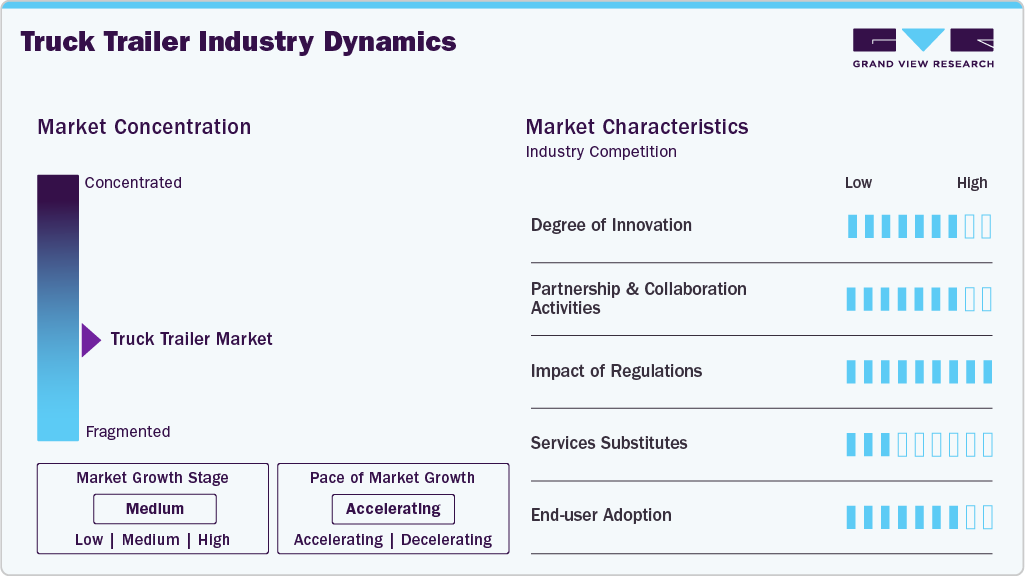
Market participants are prioritizing product innovation, lightweight trailer technologies, telematics integration, aerodynamic designs, and advanced safety systems to enhance their market position and address changing transportation needs. Companies are increasingly adopting strategic initiatives, such as partnerships, acquisitions, manufacturing facility expansions, and the development of electric and smart trailer solutions, to strengthen their market presence. Moreover, the growing demand from the logistics, e-commerce, construction, food and beverage, and cold chain transportation sectors is intensifying competition among established companies and new regional manufacturers.
Trailer Type Insights
The dry vans segment accounted for the largest share of 35.89% in 2025, driven by increased demand for freight transportation in e-commerce, retail, consumer goods, and manufacturing. Dry van trailers are preferred for long-haul and regional logistics due to their suitability for packaged and non-temperature-sensitive goods. Moreover, the expansion of warehousing and third-party logistics networks also supports demand. Their enclosed design protects cargo from weather, theft, and damage, making them ideal for large-scale domestic and cross-border freight.
The refrigerated trailers segment is expected to grow at the fastest CAGR during the forecast period. The segment is supported by increased transportation of perishable foods, dairy, frozen products, pharmaceuticals, and healthcare items that require temperature-controlled logistics. The expansion of cold chain infrastructure and rising demand for food delivery and pharmaceutical distribution are accelerating global adoption of refrigerated trailer solutions. In addition, stricter regulations on food safety and pharmaceutical storage are prompting logistics providers to invest in advanced refrigerated trailers with temperature monitoring and energy-efficient cooling systems. The continued growth of supermarket chains, online grocery delivery platforms, and healthcare logistics networks further supports this trend.
Material Insights
The steel segment held the dominating share in 2025, propelled by the high strength and load-bearing capacity of steel used in trailer manufacturing. Steel trailers are widely used in heavy-duty freight, construction, tanker, and industrial applications because they are reliable, cost-effective, and capable of withstanding harsh conditions and high payloads. In addition, increased infrastructure development and construction activities are raising demand for steel trailers to transport heavy machinery and materials. The expansion of logistics and long-haul freight networks also supports growth, as steel trailers provide durability and longer operational life for commercial transportation.
The composite material segment is expected to grow at the fastest CAGR during the forecast period.The increasing demand for lightweight, fuel-efficient trailer solutions is driving the segment's growth. Composite materials help reduce overall trailer weight, improve fuel efficiency, lower vehicle emissions, and increase payload capacity, making them highly suitable for long-haul freight transportation and logistics operations. In addition, the growing adoption of advanced, aerodynamic trailer technologies is driving the use of composite materials in modern trailer manufacturing. These materials offer benefits such as corrosion resistance, improved thermal insulation, enhanced durability, and lower maintenance requirements, which are increasing their adoption in refrigerated trailers and technologically advanced transportation applications.
Tonnage Capacity Insights
The 25-50 tons segment dominated the market in 2025. Rising demand for medium- and heavy-duty freight transport in the logistics, construction, manufacturing, and industrial sectors is driving the growth. Trailers in this range are commonly used to move construction materials, industrial equipment, consumer goods, machinery, and bulk cargo across long-haul and regional routes. Moreover, the expansion of e-commerce and cross-border trade is increasing the need for trailers with higher payloads and greater efficiency. The 25-50-ton segment offers a strong balance of capacity and cost-effectiveness, making it a preferred choice for logistics providers and fleet operators.
The above 100 tons segment is projected to grow at the fastest CAGR over the forecast period.Increasing demand for heavy-haul transportation of oversized industrial equipment, construction machinery, mining equipment, and wind turbine components is driving the adoption of trailers with capacities above 100 tons. These trailers are increasingly used in construction, energy, mining, and heavy engineering to transport large cargo over long and complex routes. Furthermore, growing investments in infrastructure and renewable energy projects are also emphasizing demand for multi-axle and hydraulic trailer systems. The expansion of wind farms, industrial manufacturing, and large-scale construction projects is accelerating the global adoption of advanced heavy-haul transportation solutions.
Length Insights
The 28 to 45 feet segment dominated the market in 2025.Rising demand for efficient freight transportation is driving growth in the segment. These trailers are widely used for consumer goods, retail products, industrial materials, and packaged cargo across regional and long-haul networks because of their flexibility and optimized capacity. Moreover, growth in e-commerce and distribution is also increasing demand for 28 to 45 feet truck trailers. Their balance of load capacity, maneuverability, and fuel efficiency makes them a preferred choice for logistics providers, fleet operators, and commercial transportation companies.
The above 45 feet segment is expected to grow at the fastest CAGR over the forecast period.Rising demand for high-capacity freight and bulk cargo transport is driving segment growth, as these trailers are widely used to move large-volume goods, industrial materials, consumer products, and e-commerce shipments over long distances. This helps fleet operators increase cargo efficiency and lower transportation costs per trip. Further, the expansion of warehousing and logistics is accelerating the adoption of trailers over 45 feet, which offer greater payload capacity and improved operational efficiency. These features make them well-suited for large-scale commercial freight and distribution.
End-use Industry Insights
The retail & e-commerce segment held the largest share in the market in 2025. Growth in online shopping, retail distribution, and the transportation of fast-moving consumer goods is driving demand in the retail and e-commerce segment. Retailers and e-commerce companies are adopting dry van, refrigerated, and high-capacity trailers to support large-scale freight movement and last-mile distribution across regional and long-haul networks. The expansion of warehousing and fulfillment centers is further increasing demand for advanced truck-trailer solutions. Higher consumer expectations for faster deliveries and efficient supply chains are prompting logistics providers and retailers to invest in technologically advanced, high-capacity trailer systems.

The construction segment is projected to grow at a significant CAGR over the forecast period. Rising investments in infrastructure, commercial construction, and industrial projects are propelling growth in the construction segment. Construction companies are adopting flatbed, lowboy, dump, and heavy-haul trailers to transport materials, machinery, steel, cement, and oversized equipment. Moreover, increased government spending on highways, railways, renewable energy, and urban infrastructure is also emphasizing demand for advanced heavy-duty trailers. The expansion of large-scale construction activities is accelerating the adoption of high-capacity, specialized truck trailers for more efficient material transport.
Regional Insights
Asia Pacific truck trailer market dominated the global industry and accounted for a share of 36.59% in 2025. The growth is primarily driven by the rapid expansion of logistics and freight transportation activities across developing economies such as China and India. For instance, in July 2025, CBRE reported that nearly 70% of Asia-Pacific logistics occupiers planned to expand their logistics footprint in India over the next two years, supporting increased demand for freight transportation and commercial trailer solutions. In addition, rising infrastructure and construction activity across the region are accelerating the adoption of flatbed, tanker, refrigerated, and heavy-duty trailers for material and equipment transportation.

China Truck Trailer Market Trends
The truck trailer market in China held a significant share in 2025 in the Asia Pacific region. The growth is supported by the country’s large manufacturing and industrial base, which generates strong demand for freight transportation and heavy-haul trailer solutions. Furthermore, ongoing infrastructure development and cross-border trade activities are increasing the adoption of specialized truck trailers across logistics and construction sectors.
India truck trailer market is expected to grow at the fastest rate during the forecast period. The growth is attributed to the rising highway and infrastructure development projects, along with expanding domestic logistics and warehousing activities. In addition, increasing cold chain transportation demand is supporting the adoption of refrigerated and high-capacity trailer solutions across the country.
North America Truck Trailer Industry Trends
The truck trailer market in North America is expected to grow at a significant CAGR during the forecast period. The region’s growth is attributed to the strong presence of freight and logistics industries across the U.S. and Canada, supported by increasing long-haul transportation activities and expanding e-commerce distribution networks. Major logistics and transportation companies such as United Parcel Service, FedEx Corporation, XPO, Inc., and J.B. Hunt Transport Services, Inc. are also supporting demand for advanced truck-trailer solutions across the region. In addition, the rising adoption of technologically advanced trailers equipped with telematics, aerodynamic systems, and smart fleet management solutions is further supporting market expansion.
The truck trailer market in the U.S. held a dominant position in 2025. The country’s growth is supported by strong e-commerce activity and ongoing inventory replenishment across the retail and industrial sectors. Fleet operators are increasingly focusing on operational efficiency and visibility, leading to higher adoption of smart trailers integrated with real-time cargo monitoring and advanced safety systems. This shift is helping logistics companies optimize fleet utilization, improve delivery efficiency, and improve overall transportation performance across the country.
Europe Truck Trailer Industry Trends
The truck trailer market in Europe was identified as a lucrative region in 2025. The market growth is primarily driven by strong cross-border freight transportation activities across key economies such as Germany, France, Italy, and the U.K., supported by well-established logistics networks and industrial supply chains. In addition, increasing demand for advanced, low-emission trailer solutions are accelerating the adoption of lightweight, aerodynamic trailer technologies across the region.
The Germany truck trailer market held a substantial share in 2025, mainly driven by the country’s strong automotive manufacturing base and high freight movement across domestic and international logistics corridors. In addition, the growing emphasis on emissions reduction and regulatory compliance is driving the adoption of technologically advanced trailers with improved fuel efficiency and smart fleet management systems.
The truck trailer market in the UK is expected to grow at a significant rate during the forecast period. Rising demand for efficient freight transportation driven by e-commerce, retail distribution, and food logistics is supporting the market growth in the country. In addition, expanding cold chain logistics infrastructure is further driving the adoption of refrigerated and specialized trailer solutions across the country.
Key Truck Trailer Companies Insights
Some of the key companies in the truck trailer market include Schmitz Cargobull AG, Wabash National Corporation, Great Dane LLC, and others. Organizations are focusing on increasing the customer base to gain a competitive edge in the industry. Therefore, key players are taking several strategic initiatives, such as mergers and acquisitions, and partnerships with other major companies.
-
Schmitz Cargobull AG is a Germany-based manufacturer of semi-trailers, trailers, and truck bodies for freight transportation applications. The company offers a broad portfolio of refrigerated trailers, curtainsider trailers, box body trailers, and telematics solutions serving logistics, retail, construction, and cold chain industries. Its extensive manufacturing network, focus on trailer innovation, and integration of digital fleet management technologies support its presence in the market.
-
Wabash National Corporation is a U.S.-based manufacturer of transportation equipment and logistics solutions. The company designs and manufactures a wide range of products, including dry van trailers, refrigerated trailers, flatbed trailers, truck bodies, and platform trailers for commercial freight and logistics applications. It also focuses on lightweight trailer technologies, fleet efficiency solutions, and advanced transportation equipment for the trucking and distribution sectors.
Key Truck Trailer Companies:
The following key companies have been profiled for this study on the truck trailer market.
-
Schmitz Cargobull AG
-
Wabash National Corporation
-
Great Dane LLC
-
Utility Trailer Manufacturing Company
-
Krone Commercial Vehicle Group
-
Hyundai Translead
-
Kögel Trailer GmbH
-
CIMC Vehicles Group
-
MAC Trailer Manufacturing, Inc.
-
Manac Inc.
Recent Developments
-
In November 2025, Schmitz Cargobull and AddSecure partnered to introduce an integrated telematics solution for trucks and trailers across Europe. The system enabled automatic transfer of telematics and tire pressure monitoring system (TPMS) data through the TrailerConnect Data Management Center to AddSecure’s FleetVision portal. The solution was developed to simplify fleet management, reduce IT workload, and support the digitalization of logistics operations.
-
In June 2025, Schmitz Cargobull, a Europe-based manufacturer of semi-trailers, trailers, and truck bodies, and GT Trailers, a Poland-based manufacturer of high-volume bodies and trailers, partnered to strengthen their capabilities in trailer technology and production. The partnership followed regulatory approval of Schmitz Cargobull AG’s 48% stake in GT Trailers. The companies combined their expertise in technology, design, manufacturing, and sales of truck bodies and trailers with galvanized chassis.
Truck Trailer Market Report Scope
Report Attribute
Details
Market size value in 2026
USD 49.0 billion
Revenue forecast in 2033
USD 80.4 billion
Growth rate
CAGR of 7.3% from 2025 to 2033
Base year for estimation
2025
Historical data
2021 - 2025
Forecast period
2026 - 2033
Quantitative units
Revenue in USD billion and CAGR from 2026 to 2033
Report coverage
Revenue forecast, company ranking, competitive landscape, growth factors, and trends
Segments covered
Trailer type, material, tonnage capacity, length, end-use industry, region
Regional scope
North America; Europe; Asia Pacific; Latin America; MEA
Country scope
U.S.; Canada; Mexico; Germany; UK; France; China; Japan; India; South Korea; Australia; Brazil; KSA; UAE; South Africa
Key companies profiled
Schmitz Cargobull AG; Wabash National Corporation; Great Dane LLC; Utility Trailer Manufacturing Company; Krone Commercial Vehicle Group; Hyundai Translead; Kögel Trailer GmbH; CIMC Vehicles Group; MAC Trailer Manufacturing, Inc.; Manac Inc.
Customization scope
Free report customization (equivalent up to 8 analysts working days) with purchase. Addition or alteration to country, regional & segment scope.
Pricing and purchase options
Avail customized purchase options to meet your exact research needs. Explore purchase options
Global Truck Trailer Market Report Segmentation
This report forecasts revenue growth at global, regional, and country levels and provides an analysis of the latest industry trends in each of the sub-segments from 2021 to 2033. For this study, Grand View Research has segmented the global truck trailer market report based on trailer type, material, tonnage capacity, length, end-use industry, and region:
-
Trailer Type Outlook (Revenue, USD Billion, 2021 - 2033)
-
Flat Bed Trailer
-
Dry Vans
-
Refrigerated Trailers
-
Lowboy Trailers
-
Tankers
-
Others
-
-
Material Outlook (Revenue, USD Billion, 2021 - 2033)
-
Steel
-
Aluminum
-
Composite Materials
-
-
Tonnage Capacity Outlook (Revenue, USD Billion, 2021 - 2033)
-
Below 25 Tons
-
25 to 50 Tons
-
51 to 100 Tons
-
Above 100 Tons
-
-
Length Outlook (Revenue, USD Billion, 2021 - 2033)
-
Up to 40 Feet
-
28 to 45 Feet
-
Above 45 Feet
-
-
End-use Industry Outlook (Revenue, USD Billion, 2021 - 2033)
-
Food & Beverage
-
Construction
-
Oil & Gas
-
Agriculture
-
Retail & E-Commerce
-
Chemicals
-
Others
-
-
Regional Outlook (Revenue, USD Billion, 2021 - 2033)
-
North America
-
U.S.
-
Canada
-
Mexico
-
-
Europe
-
Germany
-
UK
-
France
-
-
Asia Pacific
-
China
-
Japan
-
India
-
South Korea
-
Australia
-
-
Latin America
-
Brazil
-
-
Middle East and Africa (MEA)
-
KSA
-
UAE
-
South Africa
-
-
Delivered Customizations
This report has been delivered with the following In-depth customizations
Client Request
Customization Delivered
Value Adds
Regional Truck Trailer Market Opportunity Assessment
Country/region-wise market sizing and forecasts
Analysis of demand, adoption trends, and regulatory landscape
Identification of high-growth regions and investment hotspots
Identified region-specific growth opportunities
Supported expansion and go-to-market strategy
Enabled informed regional investment decisions
Cross-Segmentation Analysis for the Truck Trailer Market
Cross-market analysis by trailer type, material, tonnage capacity, length, and end use industry
Demand and adoption assessment across key segments
Segment attractiveness and growth potential benchmarking
Identified high-potential market segments
Supported targeted product positioning and marketing strategy
Improved customer and segment prioritization
Competitive Benchmarking and Strategic Positioning in the Truck Trailer Market
Benchmarking of key competitors across products, pricing, partnerships, and innovation
Comparative assessment of market share, capabilities, and strategies
Analysis of competitive strengths, gaps, and differentiation areas
Identified competitive white spaces and growth gaps
Supported strategic positioning and differentiation
Enabled data-driven competitive strategy development
Frequently Asked Questions About This Report
The global truck trailer market size was estimated at USD 46.1 billion in 2025 and is expected to reach USD 49.0 billion in 2026.
The global truck trailer market is expected to grow at a compound annual growth rate of 7.3% from 2026 to 2033 to reach USD 80.3 billion by 2033.
The dry vans segment accounted for the largest share of 35.89% in 2025. The segment growth is driven by increased demand for freight transportation in e-commerce, retail, consumer goods, and manufacturing.
Some key players operating in the truck trailer market include Schmitz Cargobull AG; Wabash National Corporation; Great Dane LLC; Utility Trailer Manufacturing Company; Krone Commercial Vehicle Group; Hyundai Translead; Kögel Trailer GmbH; CIMC Vehicles Group; MAC Trailer Manufacturing, Inc.; Manac Inc.
The rapid growth of e-commerce, retail distribution, and industrial trade is increasing the demand for efficient freight transportation solutions. This is driving the adoption of truck trailers for long-haul and regional cargo movement.
About the Author(s)
Automotive & Transportation Research Team
Technology · Automotive & TransportationThis report was authored by the automotive & transportation research team at Grand View Research - comprising two research analysts, one senior research analyst, and one industry expert - with specialized expertise in the automotive & transportation segment of the technology industry. All findings are based on proprietary technology databases, executive interviews, and regulatory analysis, subject to internal peer review prior to publication.
Last Updated:
Speak to Analyst


Customize this report to your needs - add regions, segments, or data points, with 20% free customization.
Or view our licence options:


ISO 9001:2015 & 27001:2022 Certified
We are GDPR and CCPA compliant! Your transaction & personal information is safe and secure. For more details, please read our privacy policy.


