- Home
- »
- Next Generation Technologies
- »
-
Sourcing Software Market Size, Share, Industry Report 2033GVR Report cover
![Sourcing Software Market Size, Share, & Trends Report]()
Sourcing Software Market (2026 - 2033) Size, Share, & Trends Analysis Report By Component (Software, Services), By Solution (eSourcing, Supplier Management (SRM)), By Deployment, By Enterprise Size, By End Use, By Region And Segment Forecasts
- Report ID: GVR-4-68040-899-9
- Number of Report Pages: 120
- Format: PDF
- Historical Range: 2021 - 2025
- Forecast Period: 2026 - 2033
- Industry: Technology
- Report Summary
- Table of Contents
- Segmentation
- Methodology
- Download FREE Sample
-
 Download Sample Report
Sourcing Software Market Summary
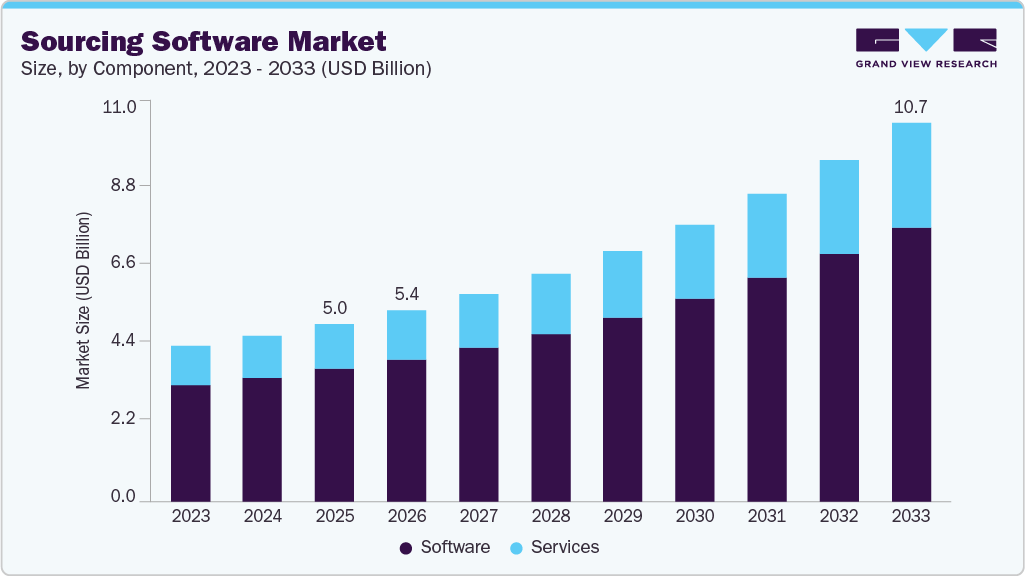
The global sourcing software market size was estimated at USD 5.03 billion in 2025 and is projected to reach USD 10.73 billion by 2033, growing at a CAGR of 10.2% from 2026 to 2033. The market growth is primarily driven by increasing demand for cost optimization, rising supply chain complexity, growing digital transformation in procurement functions, and the need for improved supplier risk management.
Key Market Trends & Insights
- North America held 36.9% revenue share of the sourcing software market.
- The U.S. sourcing software market is growing due to the increasing focus on supplier risk management and supply chain resilience.
- By component, the software segment held the largest revenue share of 74.7% in 2025.
- By solution, the eSourcing segment held the largest revenue share in 2025.
- By deployment, the cloud segment is expected to grow at the fastest CAGR during the forecast period.
Market Size & Forecast
- 2025 Market Size: USD 5.03 Billion
- 2033 Projected Market Size: USD 10.73 Billion
- CAGR (2026-2033): 10.2%
- North America: Largest Market in 2025
- Asia Pacific: Fastest growing market
Organizations are increasingly shifting from manual sourcing processes to automated, data-driven platforms to enhance efficiency, transparency, and decision-making. There is continuous pressure on organizations to reduce procurement costs and improve operational efficiency. Sourcing software enables businesses to compare supplier bids, negotiate better pricing, and identify cost-saving opportunities through analytics. Even small improvements in sourcing decisions can lead to significant financial savings, especially for large enterprises with high procurement volumes. This makes sourcing software a critical tool for achieving strategic cost management goals.The increasing complexity of global supply chains is one of the key driving factors of the sourcing software market. Companies today rely on a wide network of suppliers across multiple regions, making manual sourcing management difficult. Sourcing software simplifies this process by centralizing supplier information, automating request-for-quotation (RFQ) processes, and providing real-time visibility into supplier performance. This helps organizations manage risks, ensure continuity, and make faster sourcing decisions in a dynamic business environment.
The ongoing digital transformation of procurement functions is also accelerating market growth. Organizations are moving toward integrated, cloud-based platforms that connect sourcing with procurement, finance, and supply chain systems. This integration enables better data flow, improved collaboration, and more strategic decision-making. In addition, the adoption of advanced technologies such as artificial intelligence and predictive analytics is enhancing the capabilities of sourcing software, allowing businesses to move from reactive to proactive sourcing strategies.
Furthermore, the growing focus on supplier risk management and regulatory compliance is driving the adoption of sourcing software. Businesses are increasingly required to ensure supplier transparency, adhere to environmental and social standards, and mitigate risks related to supplier disruptions. Sourcing platforms help organizations monitor supplier performance, track compliance, and maintain detailed audit trails. As regulatory requirements and sustainability expectations continue to rise, the demand for vital sourcing solutions is expected to grow steadily over the forecast period.
Component Insights
The software segment accounted for the largest revenue share of 74.7% in 2025. This dominance is driven by the increasing adoption of digital procurement platforms that enable organizations to automate sourcing activities, streamline supplier selection, and enhance decision-making through data analytics. Businesses are prioritizing software solutions to reduce manual efforts, improve sourcing efficiency, and achieve cost savings through better supplier comparison and negotiation capabilities. In addition, the growing integration of sourcing tools with enterprise systems such as ERP and procurement platforms is further accelerating adoption.
The services segment is anticipated to grow at the fastest CAGR during the forecast period, due to the increasing need for implementation, integration, and ongoing support associated with sourcing software solutions. As organizations adopt advanced sourcing platforms, they require specialized consulting services to customize workflows, integrate with existing enterprise systems, and ensure smooth deployment. In addition, the growing complexity of procurement processes and supplier ecosystems is driving demand for managed services and continuous optimization support. Companies rely on service providers for expertise in configuring sourcing strategies, training users, and maintaining system performance, contributing to the rapid growth of the services segment.
Solution Insights
The eSourcing segment dominated the sourcing software market in 2025. This dominance is driven by the widespread adoption of digital tools for managing supplier selection, request-for-quotation (RFQ) processes, and competitive bidding in a structured and efficient manner. Organizations are increasingly leveraging eSourcing platforms to automate manual sourcing activities, enhance transparency, and achieve better pricing through real-time supplier competition, such as reverse auctions. The ability of eSourcing solutions to streamline communication with multiple suppliers, reduce procurement cycle time, and improve decision-making through data-driven insights is a key factor supporting its leading position. In addition, growing pressure on businesses to optimize costs and improve sourcing efficiency is further accelerating the adoption of eSourcing solutions across industries.
The supplier management (SRM) segment is expected to register the fastest CAGR from 2026 to 2033.This growth is driven by the increasing need for organizations to build stronger, more transparent, and risk-resilient supplier relationships in a highly dynamic global supply environment. Companies are moving beyond transactional sourcing and focusing on continuous supplier evaluation, performance tracking, and collaboration to ensure long-term value. SRM solutions enable businesses to monitor supplier reliability, compliance, and quality metrics in real time, which is becoming critical amid rising regulatory requirements and supply chain disruptions. In addition, the growing focus on supplier diversification, ESG compliance, and risk mitigation is accelerating the adoption of SRM platforms, as organizations seek greater visibility and control over their supplier ecosystems.
Deployment Insights
The cloud segment dominated the sourcing software market in 2025. This dominance is attributed to the growing preference for scalable, flexible, and cost-efficient deployment models that enable organizations to access sourcing tools anytime, anywhere. Cloud-based solutions eliminate the need for heavy upfront infrastructure investment and allow faster implementation, making them highly attractive for both large enterprises and SMEs. In addition, the increasing shift toward digital procurement transformation, along with the rising demand for remote collaboration and centralized supplier management, is further strengthening the dominance of cloud deployment in the market.
The on-premise segment is expected to register a robust CAGR from 2026 to 2033, due to the increasing need for enhanced data security, control, and customization among organizations operating in highly regulated environments. Enterprises in sectors such as BFSI, government, and healthcare prefer on-premise deployment to maintain full ownership of sensitive procurement and supplier data, reducing exposure to external risks. In addition, on-premise solutions offer greater flexibility for tailoring sourcing workflows, integrations, and compliance requirements according to specific organizational needs. The growing concerns around data privacy, internal governance, and system control, along with the ability to operate in low-connectivity or restricted environments, are key factors driving renewed interest and growth in on-premise sourcing software deployments.
Enterprise Size Insights
The large enterprises segment dominated the sourcing software industry in 2025. This dominance is driven by the high volume and complexity of procurement activities handled by large organizations, which require advanced tools to manage multiple suppliers, geographies, and sourcing events efficiently. These enterprises have greater financial resources to invest in comprehensive sourcing platforms and are more focused on achieving cost optimization, supplier standardization, and process automation at scale. In addition, large enterprises often operate in highly competitive and regulated environments, increasing the need for transparency, compliance tracking, and risk management in sourcing operations, which drives the market growth.
The SMEs segment is expected to register the fastest CAGR from 2026 to 2033. This growth is driven by the increasing accessibility of cloud-based sourcing solutions that offer low upfront costs and easy deployment, making them highly suitable for small and medium-sized businesses. SMEs are increasingly recognizing the need to streamline procurement processes, improve supplier visibility, and control costs in a competitive business environment. In addition, the availability of subscription-based pricing models and user-friendly interfaces is encouraging adoption among organizations with limited IT resources. The rising focus on digital transformation, along with the need to enhance operational efficiency and decision-making, is further accelerating the growth of sourcing software within the SME segment.
End Use Insights
The manufacturing segment accounted for the largest market share of the sourcing software industry in 2025. This dominance is driven by the high dependency of manufacturing companies on a wide network of suppliers for raw materials, components, and production inputs, making efficient sourcing critical to operations. Manufacturers require strong sourcing solutions to manage supplier selection, ensure timely procurement, and maintain cost control across large-scale production cycles. In addition, the need to reduce supply chain disruptions, optimize inventory planning, and maintain consistent product quality is pushing the adoption of advanced sourcing tools. The increasing complexity of global supply chains and the growing focus on operational efficiency and cost competitiveness are further supporting the strong demand for sourcing software in the manufacturing sector.
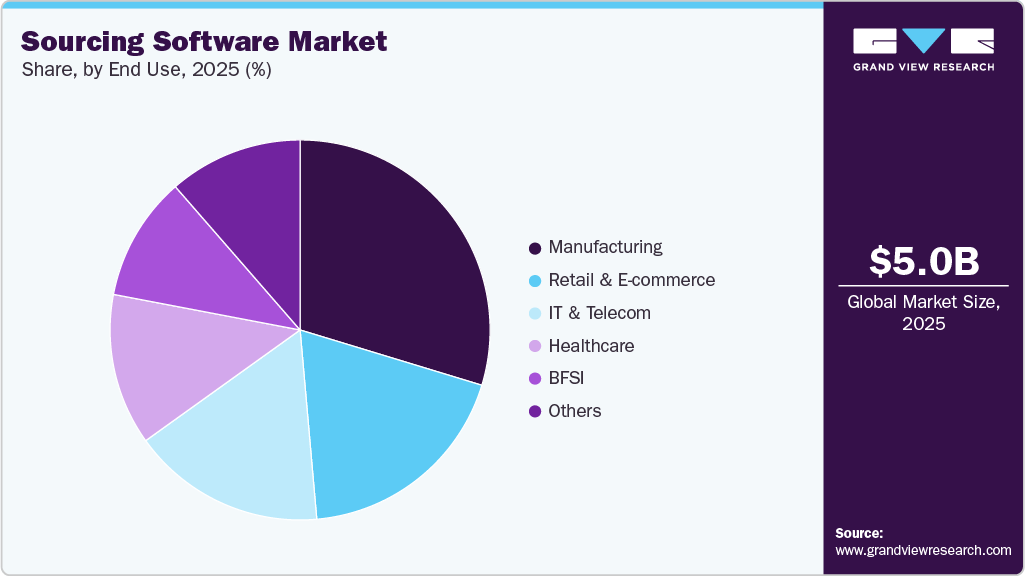
The retail & e-commerce segment is anticipated to register the fastest CAGR during the forecast period. This growth is driven by the rapid expansion of online retail operations, increasing product variety, and the need for agile and responsive sourcing processes to meet dynamic consumer demand. Retailers and e-commerce companies frequently source products from a large and diverse supplier base, often across multiple geographies, creating a strong need for efficient supplier selection and price-optimization tools. In addition, the high pace of product turnover and seasonal demand fluctuations requires faster sourcing cycles, which is accelerating the adoption of automated sourcing platforms. The growing focus on private-label brands, vendor competition, and cost control, along with the need for real-time supplier collaboration and inventory alignment, is further driving the strong growth of sourcing software in the retail and e-commerce sectors.
Regional Insights
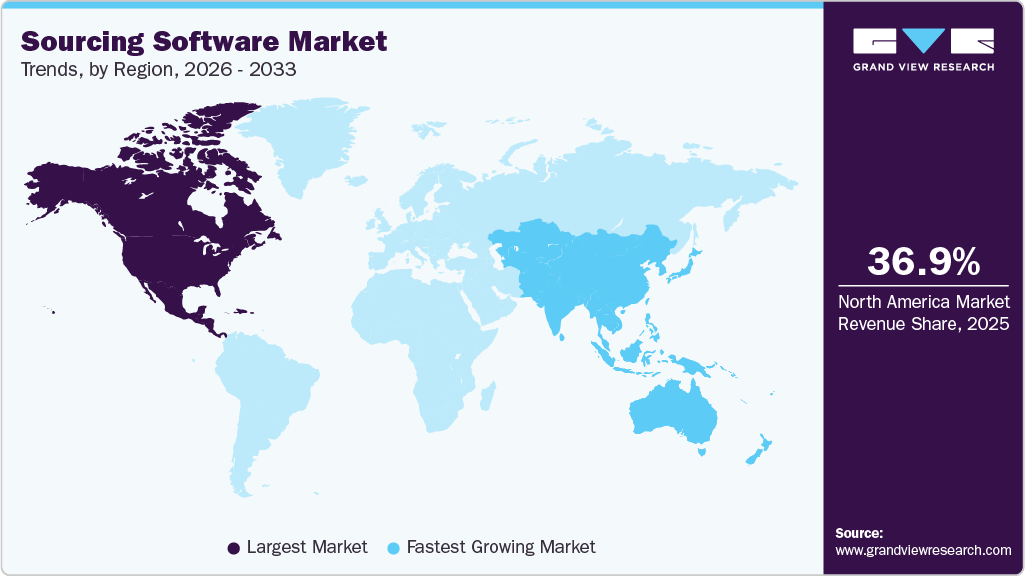
The sourcing software industry in North America accounted for the largest market share of 36.9% in 2025, driven by the strong adoption of digital procurement solutions, high presence of large enterprises, and early integration of advanced technologies such as cloud computing and AI across procurement functions. Organizations in the region are increasingly focusing on automating sourcing processes to improve efficiency, reduce procurement cycle time, and enhance supplier management. In addition, North America benefits from a well-established technology ecosystem and the presence of major sourcing software providers, both of which accelerate innovation and adoption. Strict regulatory frameworks on data security and procurement transparency further push enterprises to adopt structured, compliant sourcing platforms, while the ongoing emphasis on cost optimization and operational efficiency drives market growth.
U.S. Sourcing Software Market Trends
The sourcing software industry in the U.S. is projected to grow significantly during the forecast period. This growth is driven by rapid digital transformation across industries. Large U.S. enterprises and government organizations are managing highly complex supplier networks and large-scale procurement budgets, making manual sourcing inefficient and error-prone. As a result, businesses are increasingly adopting AI-enabled and cloud-based sourcing solutions to streamline supplier selection, improve compliance, and reduce operational risks. In addition, the rise of distributed work environments and the need for centralized procurement systems are further accelerating adoption, positioning the U.S. as a key growth engine in the market.
Asia Pacific Sourcing Software Market Trends
The sourcing software industry in the Asia Pacific is expected to grow at the fastest CAGR from 2026 to 2033. This rapid growth is driven by strong industrial expansion, rising cross-border trade activities, and increasing government-led digitalization initiatives across procurement and supply chain operations. Countries in the Asia Pacific are heavily investing in digital infrastructure and smart manufacturing, which is accelerating the adoption of sourcing software to manage complex supplier ecosystems and large-scale procurement needs. In addition, the growing presence of SMEs and their increasing shift toward cloud-based, cost-effective sourcing solutions is significantly expanding the market base. The region’s diverse and fragmented supplier networks, along with the need for better supplier visibility and efficiency, are further fueling demand for advanced sourcing platforms.
The China sourcing software industry is projected to grow steadily during the forecast period. This growth is driven by the country’s strong manufacturing dominance, increasing focus on supply chain localization, and rapid adoption of Industry 4.0 technologies. Enterprises in China are managing highly complex, multi-tier supplier networks across industries such as electronics, automotive, and industrial equipment, creating a strong need for structured and scalable sourcing solutions. In addition, government policies promoting domestic production and digital transformation are encouraging companies to adopt advanced sourcing platforms to improve efficiency and reduce dependency on manual processes. The rise of large-scale e-commerce ecosystems and export-driven businesses further increases sourcing complexity, pushing organizations to invest in software that enables better supplier coordination, real-time data visibility, and faster decision-making.
Europe Sourcing Software Market Trends
The sourcing software industry in Europe is experiencing steady growth, supported by strict regulatory frameworks, a strong focus on sustainability and ESG compliance, and widespread digitalization of public procurement systems. Governments and enterprises across the region are increasingly adopting eProcurement and sourcing platforms to comply with EU directives that mandate transparency, standardized processes, and participation in cross-border procurement. The European Union’s push toward fully digital procurement processes, including eSubmission and eInvoicing, is significantly accelerating the adoption of sourcing software to reduce administrative burden and improve efficiency. In addition, rising sustainability requirements are compelling organizations to track supplier environmental impact and ensure ethical sourcing, making advanced sourcing platforms essential for compliance and reporting.
The UK sourcing software industry is projected to grow significantly during the forecast period. This growth is driven by post-Brexit procurement restructuring, increasing focus on supplier diversification, and the need to simplify procurement processes for domestic and international suppliers. UK organizations are navigating changes in trade regulations and supplier networks, which have increased the complexity of sourcing decisions. As a result, businesses are adopting sourcing software to standardize procurement processes, improve supplier onboarding, and enhance visibility across fragmented supply chains. Furthermore, initiatives such as digital-first procurement frameworks and efforts to improve SME participation in public tenders are encouraging the use of sourcing platforms that simplify bidding and supplier engagement. These factors are collectively driving the adoption of sourcing software in the UK, positioning it as a key growth market within Europe.
Key Sourcing Software Company Insights
Some prominent players in the sourcing software market include Corcentric, Coupa, GEP, Ivalua Inc., and JAGGAER, among others.
-
Ivalua is a global provider of unified procurement and sourcing software, offering a comprehensive source-to-contract (S2C) platform that enables organizations to manage all sourcing activities within a single integrated system. Its sourcing solution is designed to automate and optimize end-to-end sourcing processes, including RFx management, supplier selection, auctions, and category management, while providing a centralized “single source of truth” across all spend types, including direct, indirect, services, and capital expenditures.
-
JAGGAER is a global provider of intelligent procurement and sourcing solutions, offering its AI-powered JAGGAER One platform, which covers the full source-to-pay lifecycle with strong capabilities in strategic sourcing. Its sourcing solution enables organizations to manage both direct and indirect sourcing activities through a unified platform, supporting RFx creation, supplier evaluation, eAuctions, and complex sourcing events with automated workflows and data-driven decision-making. JAGGAER has a strong presence in the sourcing software market, particularly in strategic sourcing and supplier collaboration, driven by its focus on automation, compliance, ESG integration, and end-to-end procurement visibility across global enterprises.
Key Sourcing Software Companies:
The following key companies have been profiled for this study on the sourcing software market.
- Corcentric
- Coupa
- GEP
- Ivalua Inc.
- JAGGAER
- Keelvar
- Proactis Holdings Limited.
- Procol Tech Inc.
- Promena Strategic Procurement Software
- SAP SE
- Tradeshift Holdings, Inc.
- Unit4 (Scanmarket)
- VORTAL
- Workday, Inc.
- Zycus Inc.
Recent Developments
-
In March 2026, SAP SE announced the launch of its next-generation SAP Ariba platform, an AI-native source-to-pay solution built on SAP Business Technology Platform, designed to transform procurement and sourcing processes through embedded intelligence and automation. The new platform introduces capabilities such as AI-driven bid analysis, automated contract insights, and a unified data environment, enabling organizations to make faster and more informed sourcing decisions.
Sourcing Software Market Report Scope
Report Attribute
Details
Market size value in 2026
USD 5.42 billion
Revenue forecast in 2033
USD 10.73 billion
Growth rate
CAGR of 10.2% from 2026 to 2033
Actual data
2021 - 2025
Forecast period
2026 - 2033
Quantitative units
Revenue in USD million/billion and CAGR from 2026 to 2033
Report coverage
Revenue forecast, company share, competitive landscape, growth factors, and trends
Segments covered
Component, solution, deployment, enterprise size, end use, region
Regional scope
North America; Europe; Asia Pacific; Latin America; Middle East and Africa
Country scope
U.S.; Canada; Mexico; UK; Germany; France; China; India; Japan; Australia; South Korea; Brazil; UAE; Saudi Arabia; South Africa
Key companies profiled
Corcentric; Coupa; GEP; Ivalua Inc.; JAGGAER; Keelvar; Proactis Holdings Limited.; Procol Tech Inc.; Promena Strategic Procurement Software; SAP SE; Tradeshift Holdings, Inc.; Unit4 (Scanmarket); VORTAL; Workday, Inc.; Zycus Inc.
Customization scope
Free report customization (equivalent to 8 analysts working days) with purchase. Addition or alteration to country, regional & segment scope.
Pricing and purchase options
Avail customized purchase options to meet your exact research needs. Explore purchase options
Global Sourcing Software Market Report Segmentation
This report forecasts revenue growth at global, regional, and country levels and provides an analysis of the latest industry trends in each of the sub-segments from 2021 to 2033. For this study, Grand View Research has segmented the global sourcing software market report based on component, solution, deployment, enterprise size, end use, and region.
-
Component Outlook (Revenue, USD Million, 2021 - 2033)
-
Software
-
Services
-
-
Solution Outlook (Revenue, USD Million, 2021 - 2033)
-
eSourcing
-
Supplier Management (SRM)
-
Spend Analysis
-
Contract Lifecycle Management (CLM)
-
Others
-
-
Deployment Outlook (Revenue, USD Million, 2021 - 2033)
-
Cloud
-
On-premise
-
-
Enterprise Size Outlook (Revenue, USD Million, 2021 - 2033)
-
Large Enterprises
-
SMEs
-
-
End Use Outlook (Revenue, USD Million, 2021 - 2033)
-
BFSI
-
Healthcare
-
IT & Telecom
-
Manufacturing
-
Retail & E-commerce
-
Others
-
-
Regional Outlook (Revenue, USD Million, 2021 - 2033)
-
North America
-
U.S.
-
Canada
-
Mexico
-
-
Europe
-
Germany
-
UK
-
France
-
-
Asia Pacific
-
China
-
India
-
Japan
-
South Korea
-
Australia
-
-
Latin America
-
Brazil
-
-
Middle East & Africa
-
UAE
-
Saudi Arabia
-
South Africa
-
-
Frequently Asked Questions About This Report
b. The global sourcing software market size was estimated at USD 5.03 billion in 2025 and is expected to reach USD 5.42 billion in 2026.
b. The global sourcing software market is expected to grow at a compound annual growth rate of 10.2% from 2026 to 2033 to reach USD 10.73 billion by 2033.
b. The software segment accounted for the largest revenue share in 2025 in the sourcing software market, driven by the increasing adoption of digital procurement platforms that enable organizations to automate sourcing activities, streamline supplier selection, and enhance decision-making through data analytics.
b. Some key players operating in the market include Corcentric; Coupa; GEP; Ivalua Inc.; JAGGAER; Keelvar; Proactis Holdings Limited.; Procol Tech Inc.; Promena Strategic Procurement Software; SAP SE; Tradeshift Holdings, Inc.; Unit4 (Scanmarket); VORTAL; Workday, Inc.; Zycus Inc., and Others.
b. Factors such as the increasing need for procurement process automation and cost optimization, growing adoption of digital sourcing and supplier management solutions, and rising demand for enhanced supply chain visibility and risk management play a key role in accelerating the sourcing software market.


Share this report with your colleague or friend.
Need a Tailored Report?
Customize this report to your needs — add regions, segments, or data points, with 20% free customization.


ISO 9001:2015 & 27001:2022 Certified
We are GDPR and CCPA compliant! Your transaction & personal information is safe and secure. For more details, please read our privacy policy.
Trusted market insights - try a free sample
See how our reports are structured and why industry leaders rely on Grand View Research. Get a free sample or ask us to tailor this report to your needs.