- Home
- »
- IT Services & Applications
- »
-
Security Posture Management Market, Industry Report, 2033GVR Report cover
![Security Posture Management Market Size, Share & Trends Report]()
Security Posture Management Market (2026 - 2033) Size, Share & Trends Analysis Report By Component (Software, Services), By Deployment (On-Premise, Cloud-based), By Enterprise Size (Large Enterprises, SMEs), By End Use (BFSI, IT & Telecom, Healthcare), By Region, And Segment Forecasts
- Report ID: GVR-4-68040-855-3
- Number of Report Pages: 120
- Format: PDF
- Historical Range: 2021 - 2025
- Forecast Period: 2026 - 2033
- Industry: Technology
- Report Summary
- Table of Contents
- Segmentation
- Methodology
- Download FREE Sample
-
 Download Sample Report
Security Posture Management Market Summary
The global security posture management market size was estimated at USD 27.80 billion in 2025 and is projected to reach USD 82.87 billion by 2033, growing at a CAGR of 14.7% from 2026 to 2033. The market focuses on Softwares that enable organizations continuously assess, monitor, and improve their security across cloud, data, identity, and application environments.
Key Market Trends & Insights
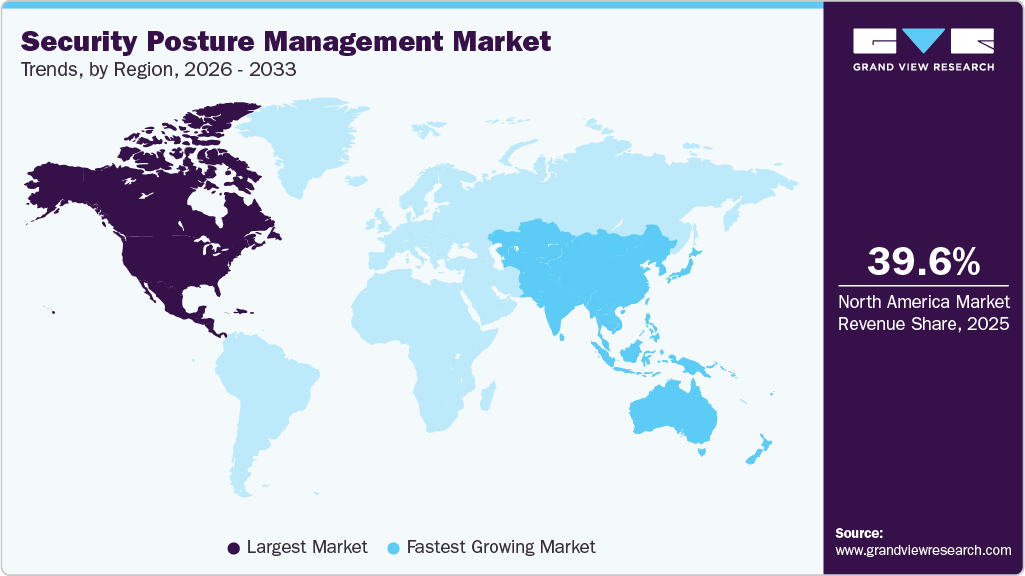
- North America held a 39.6% revenue share of the global Security Posture Management (SPM) market in 2025.
- In the U.S., the market is driven by widespread cloud and hybrid infrastructure usage and growing complexity of IT environments.
- By component, the software segment held the largest revenue share of 74.1% in 2025.
- By enterprise size, the large enterprises segment held the largest revenue share in 2025.
Market Size & Forecast
- 2025 Market Size: USD 27.80 Billion
- 2033 Projected Market Size: USD 82.87 Billion
- CAGR (2026-2033): 14.7%
- North America: Largest market in 2025
- Asia Pacific: Fastest growing market
Growing cloud adoption, regulatory pressure, and rising cyber threats are driving steady demand for these platforms. Security posture management involves the ongoing evaluation and enhancement of an organization’s defenses against cyber threats. It focuses on identifying vulnerabilities, ensuring compliance with regulations, and aligning security measures with business goals. In essence, it's such as conducting regular health checks on a company’s digital assets to spot weaknesses before attackers do. This approach helps firms reduce risks, respond faster to incidents, and build trust with clients and partners. By prioritizing proactive steps over reactive fixes, businesses can stay ahead in a landscape where data breaches are increasingly common. Regular posture reviews also support better decision-making when investing in new technologies or entering new markets.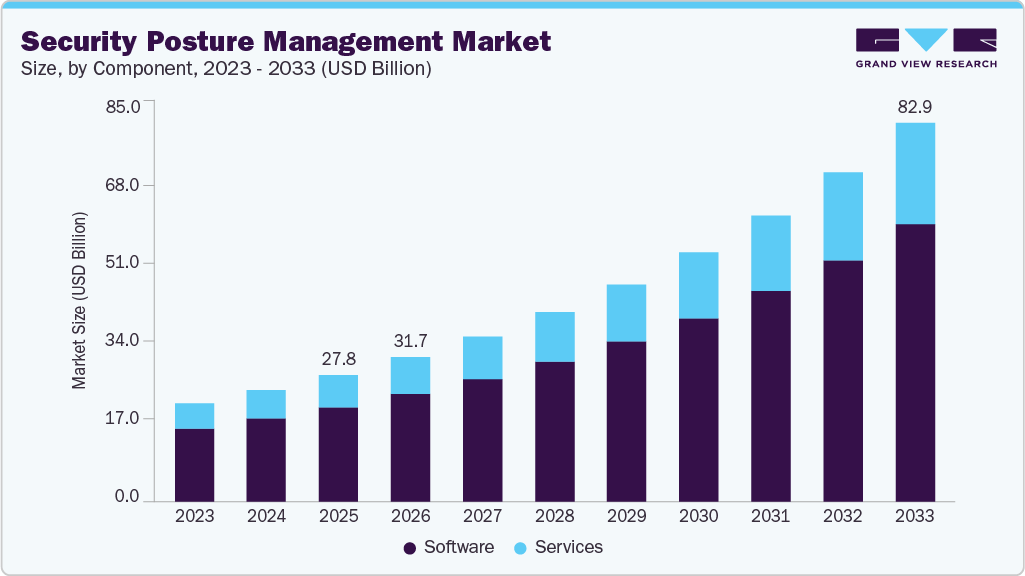
Key elements include assessing tools such as firewalls and access controls, monitoring cloud environments, and training staff on best practices. Managers often use dashboards to track metrics such as patch levels or threat exposure. The process isn’t just technical; it requires buy-in from leadership to integrate security into daily operations. For instance, regular audits and simulations refine strategies, making sure resources are allocated where they’re needed most. This holistic view turns security from a cost center into a strategic advantage. Clear reporting to the board further ensures that everyone understands the current risk level and planned improvements.
To meet these complex challenges, organizations are increasingly turning to strategic collaborations that integrate advanced technologies and expertise for comprehensive security posture management. For instance, in December 2024, Cyera and ArmorCode have formed a strategic partnership to enhance security posture management across data, applications, and infrastructure. Combining AI-driven vulnerability management with advanced data security, the collaboration enables organizations to identify risks, strengthen cybersecurity, improve compliance, and safeguard sensitive assets across cloud, hybrid, SaaS, and on-premise environments.
Component Insights
The software segment accounted for the largest revenue share of 74.1% in the global security posture management market in 2025, reflecting strong demand for ready-to-deploy tools that deliver immediate visibility and control over security risks. Companies increasingly favor these platforms because they provide automated scanning, misconfiguration detection, and prioritized remediation without requiring heavy custom development. This preference stems from the rapid expansion of cloud and hybrid environments, where manual oversight often falls short against sophisticated threats. As a result, organizations allocate more budget to proven Softwares that integrate smoothly with existing infrastructure and show quick returns through reduced exposure. This trend highlights how leading vendors are gaining recognition for offering comprehensive, ready-to-use platforms that enable organizations proactively manage and strengthen their security postures. For instance, in February 2026, CrowdStrike was named a Customers’ Choice in Gartner Peer Insights for Application Security Posture Management (ASPM) tools, recognized for delivering unified, AI-driven application security, real-time risk insights, and seamless DevSecOps integration. This recognition is expected to increase trust in the market, promote greater adoption of AI-driven ASPM Softwares, and encourage organizations to invest in comprehensive, automated security platforms worldwide.
The services segment is expected to register the fastest CAGR in the global security posture management market during the forecast period. Many companies now prefer to rely on expert consulting and managed services rather than building full in-house teams, especially as cloud setups grow more complicated and regulations become stricter. Providers deliver hands-on help with posture assessments, ongoing monitoring, compliance tuning, and quick remediation guidance, which saves time and reduces the burden on internal staff. This trend reflects a broader shift where businesses seek specialized support to handle evolving threats without stretching their budgets too thin on talent shortages. Overall, the strong demand for these practical, outcome-focused services underscores their rising importance in keeping security programs effective and up to date.
Deployment Insights
The cloud-based segment accounted for the largest share in the global security posture management market in 2025, driven largely by widespread adoption of public and hybrid cloud setups across industries. Companies have shifted major workloads to cloud platforms for flexibility and cost savings, yet this move has exposed them to new risks such as misconfigurations and inconsistent policy enforcement. As a result, organizations now rely heavily on cloud-focused tools to gain continuous visibility, automatically detect vulnerabilities, and maintain compliance without slowing down operations. This dominance reflects a clear business reality: effective security posture management has become essential for protecting dynamic cloud environments where traditional perimeter defenses fall short. For instance, in November 2024, AppOmni partners with Cisco to integrate Zero Trust Posture Management with Security Service Edge, enhancing SaaS security. The collaboration improves visibility, mitigates misconfigurations, and strengthens cloud-based application security for enterprises globally. This trend highlights how strategic partnerships and advanced Softwares are increasingly critical for addressing complex cloud security challenges and ensuring robust protection across dynamic enterprise environments.
The on-premises segment is expected to grow at a significant CAGR during the forecast period. Several industries with strict regulatory needs, such as banking, government, and healthcare, prefer keeping sensitive data and critical systems under direct physical control rather than relying fully on external providers. This choice stemmed from concerns over data sovereignty, long-term compliance obligations, and the desire to avoid potential vendor lock-in. On-premises deployments offered these businesses greater customization of security policies and more predictable performance for legacy applications that remain essential to daily operations.
Enterprise Size Insights
The large enterprises segment accounted for the largest market share in the global security posture management market in 2025. Their extensive and often complicated IT setups, which frequently span multiple cloud providers and hybrid environments, create far more entry points and potential weaknesses than smaller organizations face. With heavier regulatory requirements and larger budgets available, these companies have moved quickly to adopt advanced posture management tools that deliver ongoing visibility, automated fixes, and stronger overall risk control. This dominant position reflects how seriously big firms take the need to protect vast amounts of sensitive data and critical operations in today's threat environment. This market leadership is further reinforced by strategic partnerships and technology integrations aimed at addressing enterprise-scale security challenges. For instance, in October 2025, Akamai and Apiiro expand their partnership to deliver unified application security posture management for large enterprises, combining API visibility, supply chain risk, governance, and runtime protection across the full software lifecycle. This collaboration is expected to strengthen the large enterprises segment further and contribute to overall market growth by accelerating the adoption of integrated, end-to-end security posture management Softwares.
The SMEs segment is projected to register the fastest CAGR over the forecast period. Most of the small and medium-sized enterprises now depend heavily on cloud services, SaaS tools, and remote work setups, which widen their exposure to cyber risks without the large budgets or dedicated teams that bigger organizations typically have. Industry reports show the SMEs segment growing at the fastest pace compared to large enterprises, driven by the urgent need for straightforward, cost-effective ways to spot misconfigurations, track vulnerabilities, and maintain compliance. Affordable, cloud-native Softwares have made these tools more accessible, allowing smaller businesses to shift from reacting to breaches toward preventing them. This trend reflects how digital transformation pushes SMEs to treat security posture as a core part of operations rather than an optional expense.
End Use Insights
The IT & telecom segment is expected to grow at a significant CAGR during the forecast period. This leadership stems from the sector's heavy reliance on vast, interconnected networks that handle enormous volumes of sensitive customer data and critical communications infrastructure. Companies in this field face constant pressure to protect against sophisticated threats while maintaining high availability and regulatory compliance. The rapid rollout of technologies such as 5G and edge computing has further expanded attack surfaces, making continuous posture assessment essential. Firms invest heavily in these Softwares to detect misconfigurations, monitor vulnerabilities, and ensure rapid remediation across complex environments. This focus prevents service disruptions and safeguards user trust in an industry where even brief outages draw significant attention.
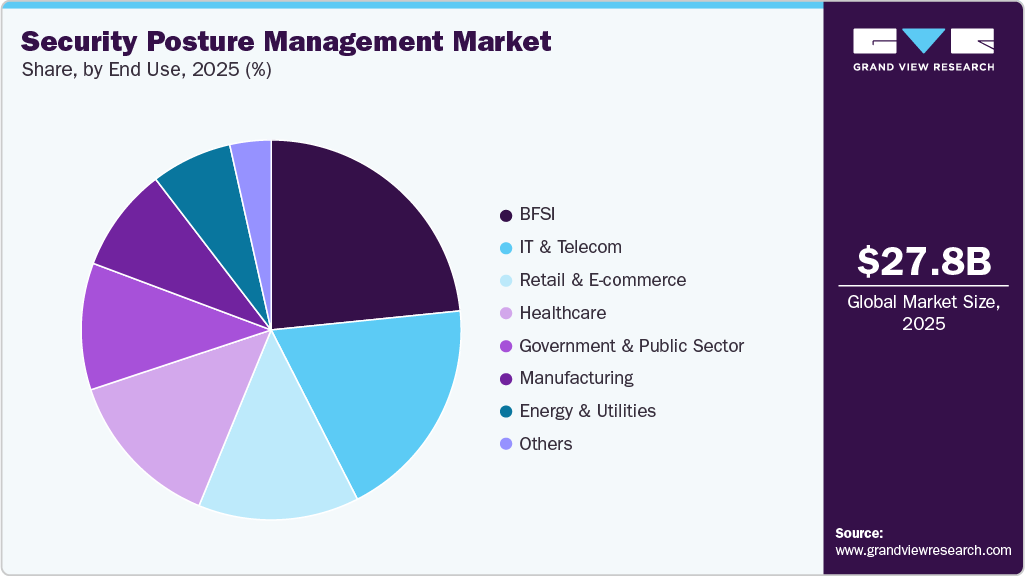
The BFSI segment accounted for the largest market share in the global security posture management market in 2025. Banks and insurers handle vast amounts of sensitive customer data while facing mounting pressure from regulators to maintain strong defenses against breaches. Many institutions have accelerated their shift to cloud platforms and digital channels, which introduces new vulnerabilities such as misconfigurations and expanded attack surfaces. Industry reports indicate that BFSI consistently holds one of the largest shares in SPM adoption, fueled by the need for continuous visibility, automated risk assessments, and faster remediation.
Regional Insights
North America accounted for the largest market share in 2025 in the global Security Posture Management market, driven by widespread cloud adoption, strict regulatory demands, and a strong presence of leading technology providers. Businesses in the region face constant pressure to protect expanding digital assets across hybrid and multi-cloud setups, where misconfigurations and emerging threats can quickly lead to serious exposure. Many organizations here invest early in advanced SPM tools to gain clear visibility, automate compliance checks, and maintain a proactive defense. This leadership position reflects both the maturity of the cybersecurity landscape and the high volume of sensitive data handled by enterprises and government entities. The focus remains on turning security into a core business enabler rather than just a compliance exercise.
U.S. Security Posture Management Market Trends
Security Posture Management market in the U.S. is experiencing strong growth. Firms are turning to these Softwares to gain continuous visibility into risks, fix misconfigurations quickly, and keep defenses aligned with fast-changing attack patterns. This shift reflects a broader move from reactive security toward proactive risk reduction, which helps organizations protect critical assets while supporting digital growth initiatives.
Europe Security Posture Management Market Trends
The SPM market in Europe is anticipated to register significant growth from 2026 to 2033, fueled mainly by tougher regulations and the widespread shift toward cloud and hybrid setups. Companies across sectors such as banking, manufacturing, and government face mounting pressure to maintain clear visibility into risks and fix misconfigurations quickly. This demand grows even more urgent as organizations juggle multiple cloud providers while meeting strict data protection rules such as GDPR and the expanding NIS2 requirements. Many firms now view effective posture management not merely as a technical necessity but as a core part of staying competitive and trustworthy in the market. The combination of rising cyber incidents and regulatory deadlines has pushed boards to allocate larger budgets toward these Softwares.
The UK Security Posture Management market is experiencing strong growth, as organizations respond to rising cyber threats, stringent regulatory requirements, and broader adoption of cloud and hybrid environments that demand continuous visibility and risk mitigation. The expansion of cybersecurity regulations, such as proposed updates in the Cyber Security and Resilience Bill to strengthen breach reporting and resilience standards, is encouraging investment in posture management tools that ensure compliance and reduce vulnerabilities. In addition, UK firms are increasingly adopting automated SPM Softwares to improve real‑time risk assessment and compliance monitoring across complex IT infrastructures. This trend is reflected in the broader market’s rapid growth trajectory, with strong interest from enterprises seeking to strengthen their security posture and safeguard critical digital assets.
Security Posture Management market in Germany is witnessing robust growth, fueled by mounting pressure from regulators and the steady expansion of cloud and hybrid infrastructures across key industries. With the full rollout of NIS2 requirements and ongoing enforcement of GDPR, companies especially in manufacturing, finance, and critical infrastructure-have little choice but to invest in tools that deliver continuous visibility, automated misconfiguration detection, and proactive risk remediation.
The Security Posture Management market in France is growing significantly at a CAGR from 2026 to 2033. fueled by the country's rapid shift toward cloud and hybrid infrastructures alongside persistent pressure to meet stringent European data protection rules. French organizations, particularly in finance, government, and manufacturing, are prioritizing tools that deliver continuous visibility, automated risk remediation, and real-time compliance insights as cyber incidents grow more sophisticated and frequent. Recent initiatives, including sovereign cloud projects and updated national cybersecurity guidelines, have encouraged wider adoption of integrated SPM platforms that help reduce misconfigurations and strengthen overall resilience.
Asia Pacific Security Posture Management Market Trends
Asia Pacific is expected to register the fastest CAGR from 2026 to 2033, with multiple industries projecting it to lead in compound annual growth rates. This outlook stems largely from continued rapid digital adoption, expanding middle-class consumption, and heavy investments in advanced technologies across countries such as China, India, and Southeast Asian economies. Businesses are also benefiting from supportive government policies promoting Industry 4.0 initiatives and infrastructure upgrades, alongside rising smartphone usage and e-commerce penetration that accelerate consumer-facing innovations.
The SPM market in India is poised for robust growth from 2026 to 2033, fueled by widespread cloud adoption, stricter data protection rules, and the steady rise in sophisticated cyber threats targeting businesses and government entities. Companies across sectors such as banking, IT services, healthcare, and e-commerce are moving beyond basic firewalls and antivirus tools toward continuous monitoring and automated risk assessment Softwares that give real-time visibility into vulnerabilities and compliance gaps. This shift reflects a broader recognition that maintaining a solid security posture is no longer optional but essential for protecting customer trust, avoiding hefty regulatory fines, and ensuring uninterrupted operations in an increasingly digital economy. As Indian enterprises scale their hybrid and multi-cloud setups, demand for integrated SPM platforms continues to build momentum, positioning the segment for sustained double-digit growth over the forecast period.
The China Security Posture Management market is witnessing rapid growth. Rapid cloud adoption across industries, combined with tougher national regulations on data handling and cybersecurity, has pushed organizations to treat continuous risk visibility as a core business requirement rather than an optional IT task. Enterprises now face complex hybrid environments where misconfigurations and shadow IT can quickly turn into major liabilities, so many are investing in tools that deliver real-time assessments, automated remediation, and clearer compliance reporting. This shift reflects a broader recognition that a solid security stance directly supports operational reliability, customer confidence, and the ability to scale without constant fear of disruption.
Key Security Posture Management Company Insights
Key players operating in the Security Posture Management industry are Aqua Security, Check Point Software Technologies Ltd., CrowdStrike and others. Companies are focusing on various strategic initiatives, including new product development, partnerships & collaborations, and agreements to gain a competitive advantage over their rivals.
Key Security Posture Management Companies:
The following key companies have been profiled for this study on the security posture management market
- Aqua Security
- Check Point Software Technologies Ltd.
- CrowdStrike
- Lacework Inc.
- Microsoft Corporation
- Orca Security
- Palo Alto Networks
- SentinelOne
- Trend Micro Incorporated
- Wiz, Inc.
Recent Developments
-
In January 2026, Group-IB launched its Cloud-based Security Posture Management (CSPM) Software within the Unified Risk Platform to help organizations secure cloud environments. The platform automates misconfiguration detection and remediation, ensures continuous compliance, provides risk-prioritized insights, and protects cloud applications across CI/CD pipelines, strengthening overall security posture and business continuity.
-
In November 2025, Cohesity announced a partnership with Microsoft, achieved strong growth by integrating AI-powered data security and resilience across Microsoft Cloud-based services. The collaboration enhances data protection, strengthens enterprise security posture, and enables AI-driven insights, supporting over 13,000 organizations-including major Fortune Global 500 companies-in managing and securing critical data efficiently.
-
In November 2025, Microsoft Purview DSPM enhances data security for the AI era by unifying visibility, control, and intelligent remediation. It helps organizations continuously assess data security posture, address emerging AI-related risks, close compliance gaps, and build a holistic, outcome-focused program that strengthens trust and reduces enterprise-wide data risks.
-
In October 2025, Fortra has launched its Data Security Posture Management (DSPM) Software to help organizations discover, classify, and protect sensitive data across hybrid environments. The platform provides automated monitoring, real-time risk insights, and compliance management, enhancing visibility and control, and strengthening overall security posture in today’s complex enterprise IT landscape.
Security Posture Management Market Report Scope
Report Attribute
Details
Market size in 2026
USD 31.70 billion
Revenue forecast in 2033
USD 82.87 billion
Growth rate
CAGR of 14.7% from 2026 to 2033
Actual data
2021 - 2025
Forecast period
2026 - 2033
Quantitative units
Revenue in USD Million/Billion and CAGR from 2026 to 2033
Report Coverage
Revenue forecast, company share, competitive landscape, growth factors, and trends
Segments covered
Component, deployment, enterprise size, end use, region
Regional scope
North America; Europe; Asia Pacific; Latin America; MEA
Country scope
U.S.; Canada; Mexico; UK; Germany; France; China; India; Japan; Australia; South Korea; Brazil; UAE; Kingdom of Saudi Arabia; South Africa
Key companies profiled
Aqua Security; Check Point Software Technologies Ltd.; CrowdStrike; Lacework Inc.; Microsoft Corporation; Orca Security; Palo Alto Networks; SentinelOne; Trend Micro Incorporated; Wiz, Inc..
Customization scope
Free report customization (equivalent to 8 analysts working days) with purchase. Addition or alteration to country, regional & segment scope.
Pricing and purchase options
Avail customized purchase options to meet your exact research needs. Explore purchase options
Global Security Posture Management Market Report Segmentation
This report forecasts revenue growth at global, regional, and country levels and provides an analysis of the latest industry trends in each of the sub-segments from 2021 to 2033. For this study, Grand View Research has segmented the Security Posture Management market report based on component, deployment, enterprise size, end use, and region.
-
Component Outlook (Revenue, USD Billion, 2021 - 2033)
-
Software
-
Cloud-based Security Posture Management (CSPM)
-
Identity Security Posture Management (ISPM)
-
Data Security Posture Management (DSPM)
-
Application Security Posture Management (ASPM)
-
SaaS Security Posture Management (SSPM)
-
-
Services
-
Professional Services
-
Managed Services
-
-
-
Deployment Outlook (Revenue, USD Billion, 2021 - 2033)
-
On-Premise
-
Cloud-based
-
Hybrid
-
-
Enterprise Size Outlook (Revenue, USD Billion, 2021 - 2033)
-
Large Enterprises
-
SMEs
-
-
End Use Outlook (Revenue, USD Billion, 2021 - 2033)
-
BFSI
-
IT & Telecom
-
Government & Public Sector
-
Healthcare
-
Retail & E-commerce
-
Manufacturing
-
Energy & Utilities
-
Others
-
-
Regional Outlook (Revenue, USD Billion, 2021 - 2033)
-
North America
-
U.S.
-
Canada
-
Mexico
-
-
Europe
-
UK
-
Germany
-
France
-
-
Asia Pacific
-
China
-
India
-
Japan
-
South Korea
-
Australia
-
-
Latin America
-
Brazil
-
-
Middle East & Africa
-
UAE
-
Saudi Arabia
-
South Africa
-
-
Frequently Asked Questions About This Report
b. The global security posture management market size was estimated at USD 27.80 billion in 2025 and is expected to reach USD 31.70 billion in 2026.
b. The software segment dominated the security posture management (SPM) market in 2025 driven by rising cloud adoption, increasing cybersecurity threats, and growing demand for automated risk assessment, continuous monitoring, and compliance management solutions across complex enterprise IT environments.
b. Factors such as increasing regulatory and compliance requirements, complexity of multi-cloud and hybrid environments, and demand for continuous risk assessment play a key role in accelerating the security posture management (SPM) market.
b. The global security posture management market is expected to grow at a compound annual growth rate of 14.7% from 2026 to 2033 to reach USD 82.87 billion by 2033.
b. Some key players operating in the market include Aqua Security, Check Point Software Technologies Ltd., CrowdStrike, Lacework Inc., Microsoft Corporation, Orca Security, Palo Alto Networks, SentinelOne, Trend Micro Incorporated, Wiz, Inc. and Others.


Share this report with your colleague or friend.
Need a Tailored Report?
Customize this report to your needs — add regions, segments, or data points, with 20% free customization.


ISO 9001:2015 & 27001:2022 Certified
We are GDPR and CCPA compliant! Your transaction & personal information is safe and secure. For more details, please read our privacy policy.
Trusted market insights - try a free sample
See how our reports are structured and why industry leaders rely on Grand View Research. Get a free sample or ask us to tailor this report to your needs.