
- Home
- »
- Advanced Interior Materials
- »
-
Safety, Storm & Tornado Shelters Market Size, Growth Report, 2026-2033GVR Report cover

Safety, Storm & Tornado Shelters Market (2026 - 2033)
Size, Share & Trends Analysis Report By Product (Above Ground Shelters, Below Ground Shelters), By End Use (Residential, Non-residential), By Region (North America, Europe, APAC, MEA), And Segment Forecasts
Market Size, 2025
$16.5BMarket Estimate, 2026
$17.4BMarket Forecast, 2033
$26.8BCAGR, 2026–2033
6.4%Safety, Storm & Tornado Shelters Market Summary
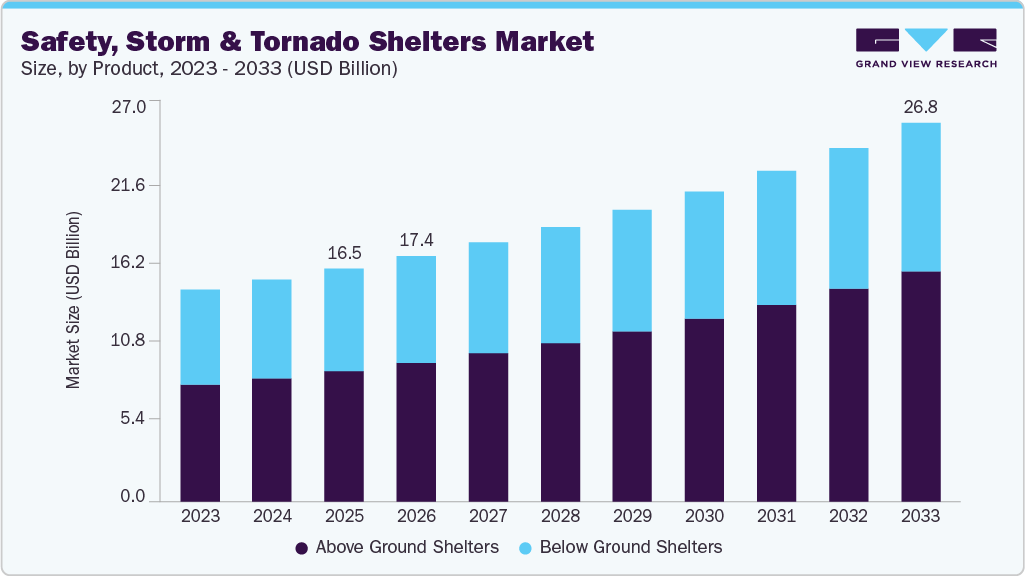
The global safety, storm & tornado shelters market size was valued at USD 16.5 billion in 2025 and is projected to grow from USD 17.4 billion in 2026 to USD 26.8 billion by 2033, at a CAGR of 6.4% from 2026 to 2033. North America dominated the global market, accounting for the largest revenue share of 36.5% in 2025. The market is gaining momentum due to the rising occurrence of high-intensity weather events such as tornadoes, cyclones, and severe thunderstorms, which are increasingly threatening both life and critical infrastructure.
 Source: Grand View Research, IR Documents, Primary Interviews, Paid DatabasesTo learn more about this report,
 Download Free Sample Report
 Key Market Trends & Insights
- By product: Above ground shelters is expected to grow at a CAGR of 7.5% over the forecast period.
- By end use: Residential end use accounted for the largest revenue share of 70.6%.
Regional Highlights
- Largest regional market: North America (36.5% revenue share, 2025)
- Fastest-growing regional market: Asia Pacific (highest CAGR, 2026-2033)
- By country: The China safety, storm & tornado shelters industry is a major contributor to the global market.
Market Size & Forecast
- Market size in 2025: USD 16.5 Billion
- Estimated market size in 2026: USD 17.4 Billion
- Projected market size by 2033: USD 26.8 Billion
- CAGR (2026-2033): 6.4%
Three ways to get this report
Buy it, customize it, or ask a question.Ask an Analyst
Analyst response in 1 business day
- AccessReport author, directly
- Reply timeWithin 1 working day
- No sales callDirect answer only
- FormatEmail reply
- CostFree, no cost
Get the Full Report
What the study covers
- FormatsPDF · Excel · Dashboard
- Timeline2026–2033 annual, 2025 base
- Coverage20+ countries, 5 regions
- Companies10+ key players profiled
Customize the Report
20% free customization
- IncludeCountries, segments, points
- TailorTo your product definition
- ExtendDeeper competitor detail
- OrA fully bespoke study
- Turnaround5–10 working days
This has led to a growing emphasis on protective infrastructure, particularly in regions with historically high exposure to such natural disasters. Growing public awareness regarding emergency preparedness and risk mitigation is a key factor driving demand for storm shelters. Homeowners are increasingly investing in residential safe rooms and underground shelters to enhance personal safety, while commercial and institutional sectors are adopting large-capacity shelters to protect occupants during emergencies. Schools, hospitals, and community centers are among the prominent end users integrating dedicated shelter systems into their infrastructure.Regulatory support and evolving construction standards are further accelerating market growth. In several high-risk regions, building codes are being updated to either recommend or mandate the inclusion of storm shelters, particularly in newly constructed public buildings. Government-backed initiatives, including funding programs and rebates for shelter installation, are also encouraging adoption, especially in areas prone to tornado outbreaks and hurricanes.
 To learn more about this report, Download Free Sample Report
 In addition, the expansion of urban areas into disaster-prone zones is increasing vulnerability, thereby strengthening the need for reliable shelter solutions. Population growth in such regions is leading to higher demand for both private and community shelters. Commercial facilities, including manufacturing units, warehouses, and retail establishments, are also prioritizing shelter installations as part of their broader business continuity and employee safety strategies.
From a product innovation perspective, the market is witnessing advancements in shelter design and construction materials. Manufacturers are focusing on developing structures that comply with stringent safety standards while offering improved durability, faster installation, and cost efficiency. Prefabricated and modular shelters are gaining popularity due to their flexibility and ease of deployment. In addition, the incorporation of features such as enhanced ventilation, emergency power backup, and communication systems is improving functionality. Increasing attention to design aesthetics and space utilization is also enabling better integration of shelters into residential and commercial environments.
Market Concentration & Characteristics
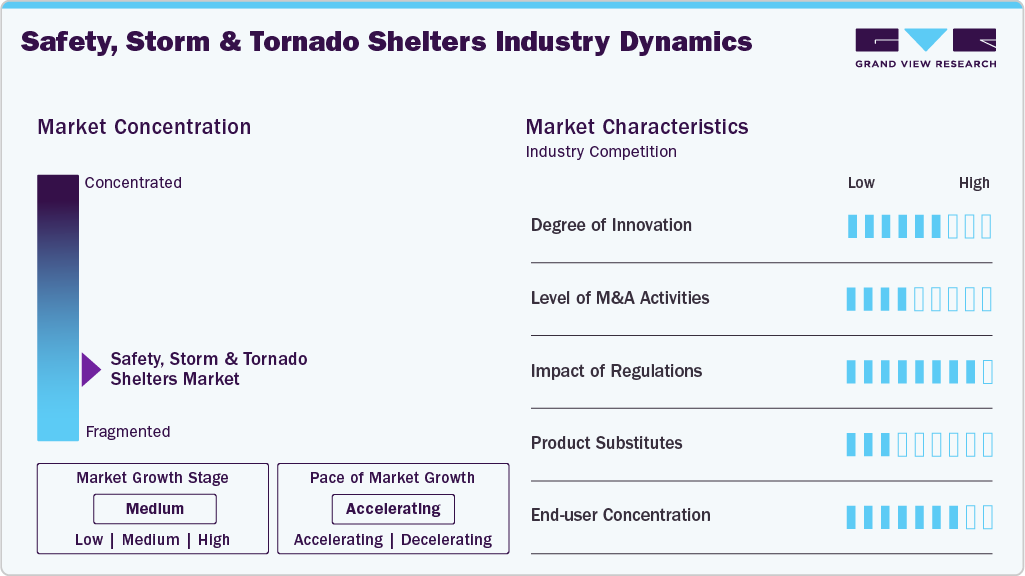
The safety, storm & tornado shelters industry is moderately fragmented, characterized by the presence of a mix of established global manufacturers and numerous regional and local players. Competition is primarily based on product reliability, compliance with recognized safety standards (such as FEMA and ICC guidelines), structural strength, and the ability to offer customized solutions for different end-use environments. Companies are increasingly focusing on expanding their product portfolios to include residential safe rooms, underground shelters, and large-scale community shelters to cater to diverse customer needs.
The market also benefits from strong regulatory influence, as compliance with safety certifications and testing standards is essential for product acceptance. Companies that offer certified and tested shelter solutions gain a competitive advantage, especially in institutional and government-funded projects. Furthermore, increasing focus on sustainability, including the use of eco-friendly materials and energy-efficient designs, is gradually shaping product development strategies.
 To learn more about this report, Download Free Sample Report
 Substitute solutions, such as structurally reinforced rooms without formal certification or general-purpose basements, present a degree of competition, particularly among cost-sensitive consumers. However, purpose-built storm and tornado shelters continue to maintain a strong market position due to their proven performance under extreme conditions, regulatory compliance, and higher safety assurance. The growing emphasis on life safety, insurance benefits, and long-term resilience is expected to support the continued adoption of certified shelter systems across residential, commercial, and public infrastructure applications.
Product Insights
The above-ground shelters segment accounted for the largest revenue share of 56.1% in 2025 and is also expected to register the fastest CAGR over the forecast period. This growth is primarily driven by their increasing adoption across residential and institutional applications due to ease of installation, accessibility, and compliance with safety standards such as FEMA and ICC guidelines. Unlike below-ground alternatives, above-ground shelters can be installed within existing structures or as standalone units without extensive excavation, making them a more convenient and cost-effective solution. Their suitability for individuals with mobility challenges, along with advancements in reinforced materials and prefabricated designs, is further supporting segment growth. In addition, rising demand for quick-to-install and structurally reliable safety solutions in tornado-prone regions is contributing to their widespread adoption.
The below-ground shelters segment continues to hold a significant share of the market, owing to their long-standing reputation for providing maximum protection against extreme wind events and flying debris. These shelters, typically installed underground or in basements, offer enhanced safety due to natural ground insulation and structural stability. They are particularly preferred in regions with a high incidence of tornadoes, where maximum protection is a priority. However, factors such as higher installation costs, the need for excavation, and potential challenges related to water ingress and ventilation slightly limit their adoption compared to above-ground alternatives. Nevertheless, ongoing improvements in waterproofing, drainage systems, and construction materials are supporting steady demand for this segment.
End Use Insights
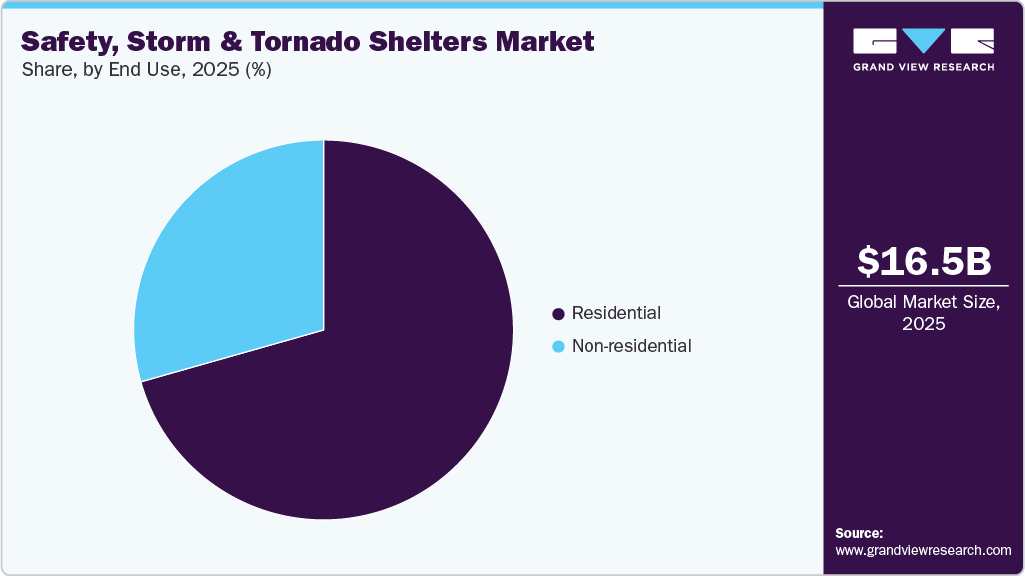
The residential segment dominated the market in 2025 with a revenue share of 70.6% and is projected to grow at the fastest CAGR over the forecast period. Increasing homeowner awareness regarding personal safety, coupled with rising incidences of extreme weather events, is driving the demand for residential storm shelters. Government incentives, insurance benefits, and evolving building codes encouraging the installation of safe rooms in homes are further supporting segment growth. In addition, the growing trend of home renovation and retrofitting is prompting homeowners to incorporate above ground or underground shelters into existing properties. The availability of compact, customizable, and aesthetically adaptable shelter solutions is also making them more appealing for residential applications.
 To learn more about this report, Download Free Sample Report
 The non-residential segment is also witnessing steady growth, driven by increasing adoption across schools, hospitals, commercial buildings, and community centers. Regulatory mandates and safety guidelines in several regions require the inclusion of storm shelters in public and institutional infrastructure, particularly in high-risk areas. Businesses are increasingly investing in shelter solutions to ensure employee safety and maintain operational continuity during disasters. Furthermore, government investments in community shelters and public safety infrastructure are contributing to the expansion of this segment.
Regional Insights
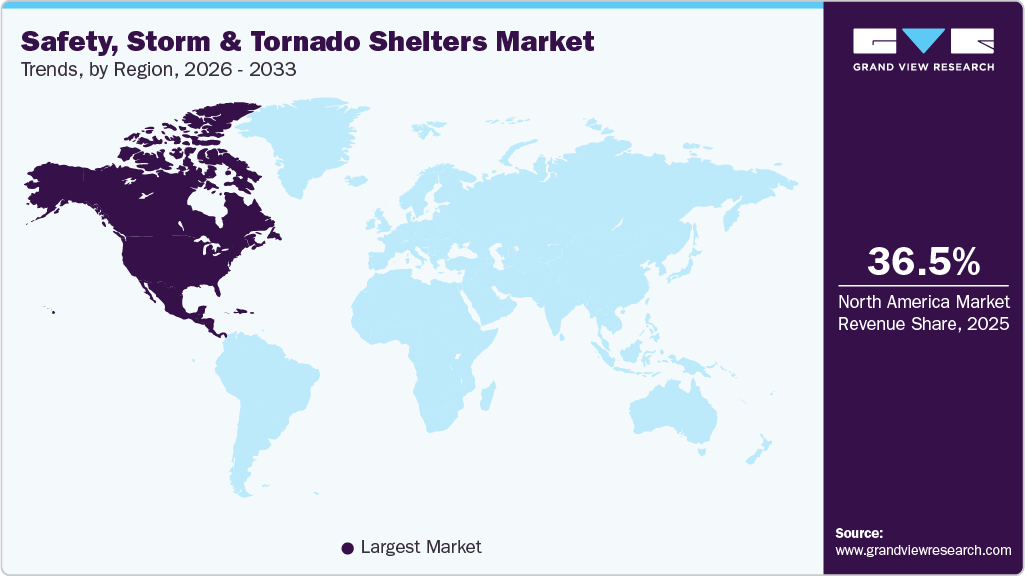
North America accounted for the largest market share of 36.5% in 2025, driven by the region’s high exposure to tornadoes, hurricanes, and severe storms. The U.S. experiences frequent extreme weather events, particularly in tornado-prone regions, which has significantly increased the demand for certified storm shelters. Stringent building codes and safety regulations, along with FEMA and ICC guidelines, are supporting market growth by encouraging or mandating shelter installation in residential and public infrastructure. In addition, strong awareness regarding disaster preparedness and government-backed funding programs is further driving adoption across the region.
 To learn more about this report, Download Free Sample Report
 Asia Pacific Safety, Storm & Tornado Shelters Market Trends
The safety, storm & tornado shelters market in the Asia Pacific is expected to register the fastest CAGR over the forecast period, owing to rising incidences of cyclones, typhoons, and severe storms. Rapid urbanization in high-risk coastal regions, coupled with increasing population exposure, is driving demand for reliable shelter solutions. Governments are gradually strengthening building regulations and investing in disaster-resilient infrastructure, particularly in countries such as India, China, and Japan. Growing awareness regarding safety and emergency preparedness is further supporting market expansion.
Europe Safety, Storm & Tornado Shelters Market Trends
The safety, storm & tornado shelters market in Europe is witnessing steady growth, supported by increasing extreme weather events and rising focus on climate resilience. Governments and property owners are investing in stronger building infrastructure and safety systems, particularly in critical facilities such as schools and public buildings. Although adoption levels remain moderate compared to North America, evolving regulatory frameworks and infrastructure modernization are contributing to gradual market growth.
Key Safety, Storm & Tornado Shelters Company Insights
Some of the key players operating in the market include FamilySafe Shelters, Survive-A-Storm Shelters, and Valley Storm Shelters.
-
FamilySafe Shelters is a manufacturer and installer of above-ground steel tornado shelters, safe rooms, and storm protection systems designed for residential, commercial, and military applications. The company collaborates with industry partners such as Texas Tech University and HILTI for structural validation and anchoring systems. Its portfolio includes above-ground MAX tornado shelters, custom safe rooms, and storm shelters for new construction and existing buildings.
-
Survive-A-Storm Shelters is a U.S.-based manufacturer of prefabricated steel underground and above-ground tornado shelters and safe rooms designed for residential, commercial, and community applications. The company provides FEMA-compliant storm protection solutions engineered to withstand extreme tornado conditions, including EF5 winds, and distributes its shelters through direct sales, retail partnerships, and nationwide shipping.
Ground Zero Shelters, Co., US Safe Room, and TORNADO ALLEY ARMOR LLC are some of the emerging market participants.
-
Ground Zero Shelters, Co. is a manufacturer and installer of patented tornado shelters, underground garage units, and safe rooms designed to protect homes and businesses from extreme weather events. The company provides end-to-end services, including design, fabrication, installation, and maintenance, with products engineered to meet or exceed FEMA safety standards.
-
U.S. Safe Room is a manufacturer of engineered safe rooms, storm shelters, and secure storage structures. The company offers customizable solutions, including above-ground safe rooms, panelized shelters, underground bunkers, and community tornado shelters built with reinforced steel construction for residential, commercial, and government applications.
Key Safety, Storm & Tornado Shelters Companies:
The following key companies have been profiled for this study on the safety, storm & tornado shelters market.
- FamilySafe Shelters
- Survive-A-Storm Shelters
- Valley Storm Shelters
- Ground Zero Shelters, Co.
- Atlas Safe Rooms
- American Tornado Master
- TORNADO ALLEY ARMOR LLC
- Safe Sheds, Inc.
- US Safe Room
- F5 STORM SHELTERS
Recent Developments
-
In March 2026, Atlas Survival Shelters, LLC reported rising global demand for luxury underground survival bunkers, driven by geopolitical tensions and increasing interest in multi-purpose shelters that function as recreational spaces or emergency safe rooms, with projects expanding into markets such as the Middle East.
-
In December 2025, The Toro Company completed the USD 279 million acquisition of Tornado Infrastructure Equipment Ltd., strengthening its portfolio in hydrovac excavation and underground infrastructure equipment and expanding its presence in the growing construction and utility infrastructure markets.
Safety, Storm & Tornado Shelters Market Report Scope
Report Attribute
Details
Market size in 2025
USD 16.5 billion
Estimated Market size in 2026
USD 17.4 billion
Projected Market size by 2033
USD 26.8 billion
Growth rate
CAGR of 6.4% from 2026 to 2033
Actual data
2021 - 2025
Forecast period
2026 - 2033
Quantitative units
Revenue in USD million/billion and CAGR from 2026 to 2033
Report coverage
Revenue forecast, company ranking, competitive landscape, growth factors, and trends
Segments covered
Product, end use, region
Regional scope
North America; Europe; Asia Pacific; Latin America; MEA
Country scope
U.S.; Canada; Mexico; Germany; UK; Italy; France; China; Japan; India; South Korea; Brazil
Key companies profiled
FamilySafe Shelters; Survive-A-Storm Shelters; Valley Storm Shelters; Ground Zero Shelters, Co.; Atlas Safe Rooms; American Tornado Master; TORNADO ALLEY ARMOR LLC; Safe Sheds, Inc.; US Safe Room; F5 STORM SHELTERS
Customization scope
Free report customization (equivalent up to 8 analysts working days) with purchase. Addition or alteration to country, regional & segment scope.
Pricing and purchase options
Avail customized purchase options to meet your exact research needs. Explore purchase options
Global Safety, Storm & Tornado Shelters Market Report Segmentation
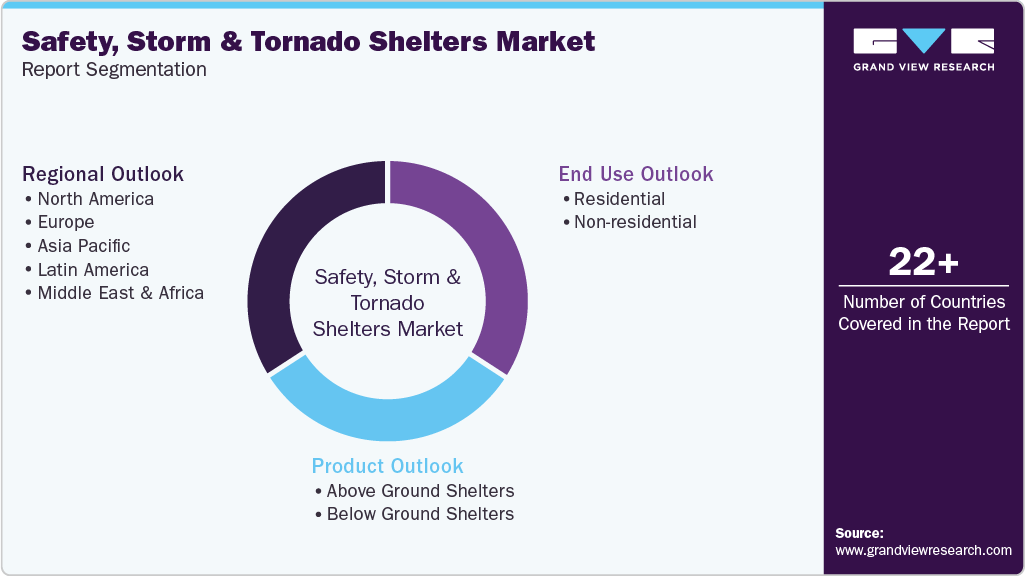
This report forecasts revenue growth at the regional & country levels and provides an analysis of the industry trends in each of the sub-segments from 2021 to 2033. For this study, Grand View Research has segmented the global safety, storm & tornado shelters market based on product, end use, and region:
 To learn more about this report, Download Free Sample Report
 -
Product Outlook (Revenue, USD Million, 2021 - 2033)
-
Above Ground Shelters
-
Below Ground Shelters
-
-
End Use Outlook (Revenue, USD Million, 2021 - 2033)
-
Residential
-
Non-residential
-
-
Regional Outlook (Revenue, USD Million, 2021 - 2033)
-
North America
-
U.S.
-
Canada
-
Mexico
-
-
Europe
-
UK
-
Germany
-
France
-
Italy
-
-
Asia Pacific
-
China
-
Japan
-
India
-
South Korea
-
-
Latin America
-
Brazil
-
-
Middle East and Africa
-
Frequently Asked Questions About This Report
The residential segment accounted for the largest share of 70.6% in 2025, driven by rising homeowner awareness and increasing adoption of in-house storm shelters for safety and disaster preparedness.
Key players include FamilySafe Shelters; Survive-A-Storm Shelters; Valley Storm Shelters; Ground Zero Shelters, Co.; Atlas Safe Rooms; American Tornado Master; TORNADO ALLEY ARMOR LLC; Safe Sheds, Inc.; US Safe Room; F5 STORM SHELTERS.
Key factors driving the safety, storm & tornado shelters market include the increasing frequency of extreme weather events, growing awareness of life safety, stringent building codes, and rising investments in residential and public safety infrastructure.
The global safety, storm & tornado shelters market size was valued at USD 16.5 billion in 2025 and is estimated at USD 17.4 billion for 2026.
The global safety, storm & tornado shelters market is expected to grow at a CAGR of 6.4% from 2026 to 2033, reaching USD 26.8 billion by 2033.
North America dominated with a 36.5% revenue share in 2025.
Asia Pacific is the fastest-growing region over the forecast period.
The residential led with a 70.6% revenue share in 2025, and is the fastest-growing segment.
Above-ground shelters segment held the largest share (over 56.0%) in 2025, and is the fastest-growing product.
About the Author(s)
Advanced Interior Materials Research Team
Advanced Materials · Advanced Interior MaterialsThis report was authored by the advanced interior materials research team at Grand View Research - comprising two research analysts, one senior research analyst, and one industry expert - with specialized expertise in the advanced interior materials segment of the advanced materials industry. All findings are based on proprietary advanced materials databases, executive interviews, and regulatory analysis, subject to internal peer review prior to publication.
Last Updated:
Speak to Analyst

Customize this report to your needs - add regions, segments, or data points, with 20% free customization.
Or view our licence options:


ISO 9001:2015 & 27001:2022 Certified
We are GDPR and CCPA compliant! Your transaction & personal information is safe and secure. For more details, please read our privacy policy.


