- Home
- »
- Power Generation & Storage
- »
-
Residential Battery Market Size, Industry Report, 2033GVR Report cover
![Residential Battery Market Size, Share & Trends Report]()
Residential Battery Market (2026 - 2033) Size, Share & Trends Analysis Report By Battery Type (Lead-acid, Lithium-ion, Flow), By Sales Channel (Direct-to-consumer, Installer/Distributor-led), By System Configuration, By Region, And Segment Forecasts
- Report ID: GVR-4-68040-857-5
- Number of Report Pages: 120
- Format: PDF
- Historical Range: 2021 - 2024
- Forecast Period: 2026 - 2033
- Industry: Energy & Power
- Report Summary
- Table of Contents
- Segmentation
- Methodology
- Download FREE Sample
-
 Download Sample Report
Residential Battery Market Summary
The global residential battery market size was estimated at USD 18.26 billion in 2025 and is projected to reach USD 67.99 billion by 2033, growing at a CAGR of 17.9% from 2026 to 2033. Its expansion is largely supported by the rising installation of rooftop solar panels, escalating power prices, and increasing consumer interest in self-sufficient energy solutions.
Key Market Trends & Insights
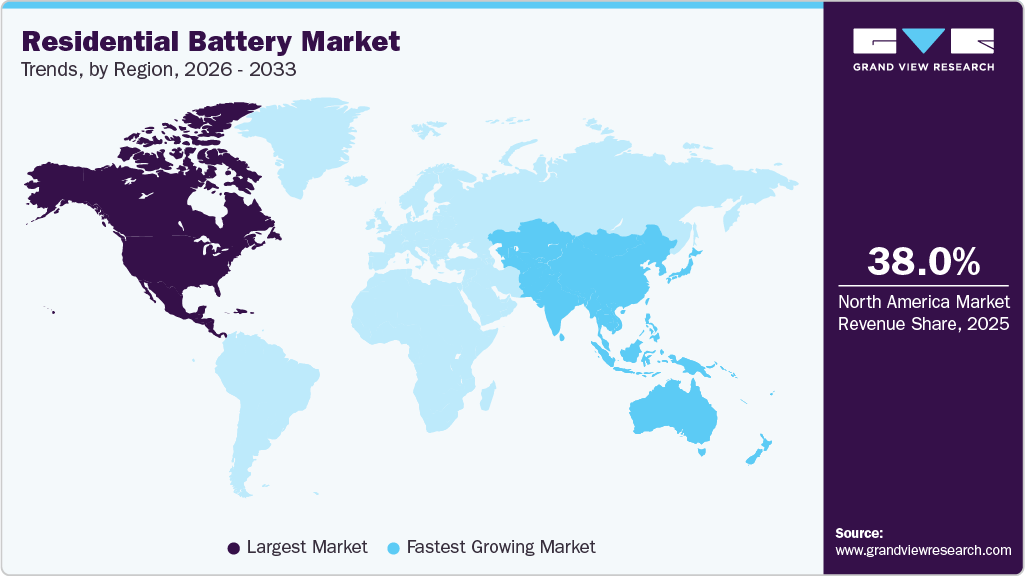
- North America led the global residential battery market in 2025, accounting for over 38% of total revenue.
- Based on battery type, lithium-ion dominated market share in 2025, driven by higher efficiency and longer lifecycle performance.
- Based on system configuration, hybrid systems are projected to witness the fastest growth, expanding at a CAGR of 23.3% during the forecast period.
- Based on sales channel, direct-to-consumer remained the preferred route, contributing over 64% of total sales in 2025.
Market Size & Forecast
- 2025 Market Size: USD 18.26 Billion
- 2033 Projected Market Size: USD 67.99 Billion
- CAGR (2026-2033): 17.9%
- North America: Largest market in 2025
- Asia Pacific: Fastest-growing market
Homeowners are increasingly investing in battery storage systems to optimize solar energy usage, reduce reliance on the grid, and lower peak electricity expenses. Moreover, concerns around grid reliability, weather-related disruptions, and favorable policy incentives for distributed energy systems are further strengthening demand for intelligent and flexible residential energy storage solutions.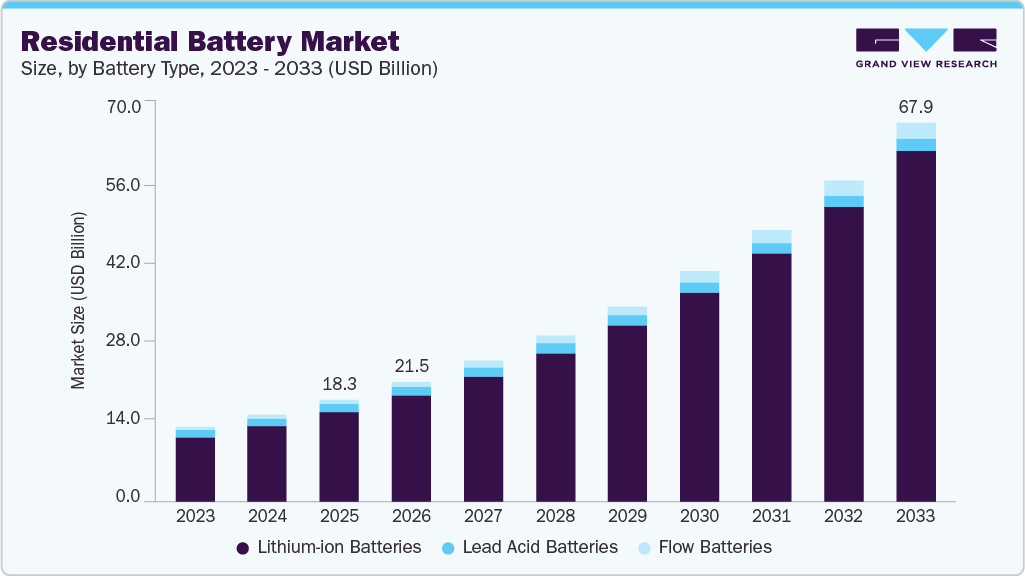
Lithium-ion batteries lead the residential storage market due to their high energy density, efficiency, and compact design, making them ideal for rooftop solar integration and daily load shifting. Their long lifecycle and enhanced safety, particularly with LFP chemistry, have further reinforced their widespread adoption. For instance, in December 2025, ProLux Solutions recalled its vanadium redox flow home storage systems and pivoted to LFP-based designs, citing performance and market viability concerns.
Lead-acid batteries continue to serve niche residential applications, particularly in cost-sensitive and off-grid settings. Their lower upfront cost and well-established recycling infrastructure make them an accessible option for backup power needs. However, limitations such as shorter cycle life, lower depth of discharge, and larger physical footprint compared to lithium-ion systems restrict their adoption in mainstream grid-connected homes.
Drivers, Opportunities & Restraints
Growing rooftop solar installations and rising household electricity prices are major market drivers. For instance, data from the U.S. Energy Information Administration shows that homeowners in California are increasingly adding batteries to new solar systems as net-metering changes and time-of-use pricing encourage storing excess power for use during peak hours and outages. By April 2024, more than half of new residential solar installations in the state included battery storage, compared with just over one-fifth in October 2023, reflecting rapidly increasing adoption.
Ongoing improvements in battery technology, particularly safer and longer-lasting chemistries such as LFP, are opening new growth opportunities. Integration with smart home systems and participation in virtual power plant (VPP) programs can provide added financial benefits. The growing adoption of electric vehicles also strengthens demand for home energy storage.
However, high upfront system costs remain a key restraint, especially in regions with reliable grids and limited incentives. Regulatory uncertainty, permitting delays, and safety concerns can further slow installations. In some markets, reduced solar compensation rates may also affect the overall return on investment for solar-plus-storage systems.
Battery Type Insights
Lithium-ion batteries used in residential systems typically operate with advanced battery management systems (BMS) that monitor cell voltage, temperature, and state of charge to optimize performance and safety. They offer high round-trip efficiency, low self-discharge rates, and modular scalability, allowing homeowners to expand storage capacity as energy needs grow. Thermal management systems further enhance operational stability and lifespan under varying load conditions.
Lead-acid batteries function through a reversible electrochemical reaction between lead dioxide, sponge lead, and sulfuric acid. They are available in flooded, AGM, and gel variants, each differing in maintenance requirements and electrolyte containment. While technically mature and easy to deploy, they typically support fewer charge-discharge cycles and lower usable capacity compared to newer chemistries.
Flow batteries use liquid electrolytes stored in external tanks, allowing energy capacity and power output to be scaled independently. They offer long cycle life and minimal performance degradation, making them technically suitable for long-duration storage. However, larger physical footprint, higher system costs, and lower round-trip efficiency have limited their adoption in residential settings. As lithium-ion systems continue to improve in cost and safety, flow batteries remain more relevant for niche or commercial-scale applications rather than mainstream home installations.
Sales Channel Insights
The direct-to-consumer sales channel remains an important route for residential battery adoption, as manufacturers increasingly use brand platforms and e-commerce to reach homeowners directly. For example, Ola Electric launched its Ola Shakti home battery systems in late 2025, enabling reservations and purchases through its online platform and select retail outlets. This approach allows OEMs to engage directly with customers, improve pricing transparency, and strengthen brand visibility, particularly in emerging markets like India.
The installer- and distributor-led channel continues to play a critical role, especially in markets where system customization, permitting, and grid interconnection are complex. As residential storage becomes more integrated with rooftop solar, EV chargers, and smart home systems, many homeowners still rely on certified installers for technical expertise and after-sales support. Together, these channels reflect a hybrid sales model rather than a shift from one to the other.
System Configuration Insights
Grid-connected systems represent the largest market share, as most installations occur in homes already connected to utility infrastructure. In this configuration, batteries are primarily used to store excess rooftop solar energy, reduce peak electricity costs, and participate in grid programs where available. The dominance of this segment indicates that residential storage is largely driven by energy optimization and tariff management rather than basic electricity access.
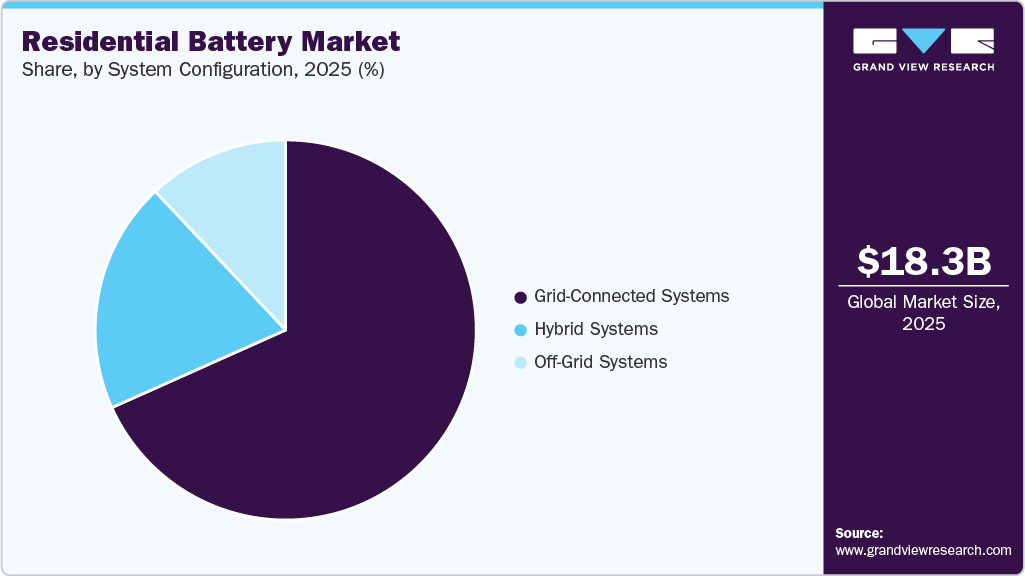
Off-grid systems are typically deployed in remote or rural areas without reliable grid access. In these setups, batteries operate alongside solar panels or generators to provide a primary and continuous power source. This configuration is essential for energy independence and uninterrupted supply in locations beyond standard utility coverage.
Hybrid systems are gaining traction as homeowners increasingly prioritize both grid connectivity and backup capability. These systems allow homes to remain connected to the grid during normal conditions while switching to battery power during outages. The increasing adoption of hybrid configurations reflects growing interest in resilience, flexibility, and integrated home energy solutions.
Regional Insights
North America represents the largest regional market for residential batteries, as the region benefits from established installer networks, growing consumer awareness of energy resilience, and supportive clean energy policies. Across the region, homeowners are increasingly integrating battery storage with solar systems to enhance self-consumption, manage peak electricity costs, and improve backup capability.
U.S. Residential Battery Market Trends
The residential battery market in the U.S. is the largest single-country market, supported by strong rooftop solar adoption, time-of-use pricing structures, and VPP participation. Grid reliability concerns and federal clean energy incentives continue to drive solar-plus-storage installations. In addition, utility-led initiatives, such as El Paso Electric’s 2024 home battery program, highlight the growing integration of residential storage into grid management strategies.
Asia Pacific Residential Battery Market Trends
The residential battery market in the Asia Pacific is gradually increasing its share, backed by robust solar adoption and policy support in key markets such as Australia and Japan. In Australia, home battery installations have surged dramatically following government subsidy programs and strong rooftop solar penetration, with over 183,000 residential batteries sold in the second half of 2025, a figure larger than the previous four years combined. This boom reflects growing interest in self-consumption and energy cost management.
Europe Residential Battery Market Trends
The residential battery market in Europe continues to be a significant regional market. Countries such as Germany, Italy, and the UK have well-established solar and storage ecosystems, while emerging markets are showing rapid uptake of combined PV and storage systems. For example, at Solar Flex Prague 2026, it was highlighted that over 90% of new residential photovoltaic installations in the Czech Republic now include battery storage, showing how household demand for energy independence and tariff savings is translating into real-world adoption across the region.
Latin America Residential Battery Market Trends
The residential battery market in Latin America accounts for a smaller global market share, but certain countries are demonstrating growing momentum as cost and policy dynamics evolve. In Brazil, residential electricity tariffs have risen faster than inflation between 2010 and 2024, increasing pressure on household energy expenses and driving interest in solar installations paired with battery storage to reduce grid consumption and bills. This cost-driven dynamic is helping boost solar and storage deployment in urban residential segments.
Middle East & Africa Residential Battery Market Trends
The residential battery market in the Middle East & Africa represents a modest but developing market. South Africa stands out due to frequent load-shedding and grid instability, which have significantly increased demand for residential backup battery systems. Solar potential across the region presents long-term growth opportunities.
Key Residential Battery Company Insights
Capital inflows into residential energy storage continue to intensify competition and validate long-term growth expectations. The competitive landscape includes established battery manufacturers, inverter companies expanding into storage, and software-driven energy platforms. Players such as Tesla, Enphase Energy, SolarEdge Technologies, and BYD compete across performance, safety, integration capability, and ecosystem control.
Strategic installer partnerships, utility collaborations, and participation in VPP programs remain key competitive levers. As distributed storage becomes more integrated with solar, EV charging, and smart energy management software, competition is shifting beyond hardware toward platform control and digital energy orchestration.
Key Residential Battery Companies:
The following key companies have been profiled for this study on the residential battery market.
- BYD
- Enphase Energy
- Generac
- LG Energy Solutions
- Panasonic
- Pylontech
- SolarEdge Technologies
- Sonnen
- Sungrow
- Tesla
Recent Developments
-
In February 2026, Anker introduced its Solix E10 smart hybrid whole-home backup system at CES 2026, offering a more affordable alternative to premium solutions like Tesla Powerwall. The modular E10 system supports scalable capacity and rapid switchover during outages, highlighting increasing product diversity and competition in the residential segment.
-
In February 2026, Lunar Energy raised USD 232 million to scale deployment of grid-interactive home battery systems, underscoring strong investor confidence in distributed storage platforms and VPP models. This funding reflects a broader industry shift toward positioning residential batteries as grid assets rather than solely backup solutions.
Residential Battery Market Report Scope
Report Attribute
Details
Market Definition
The market represents the global revenue generated from the deployment of home energy storage systems used for backup power, solar energy storage, and electricity cost optimization across residential properties worldwide.
Market size value in 2026
USD 21.47 billion
Revenue forecast in 2033
USD 67.99 billion
Growth rate
CAGR of 17.9% from 2026 to 2033
Base year for estimation
2025
Historical data
2021 - 2024
Forecast period
2026 - 2033
Quantitative Units
Revenue in USD million/billion and CAGR from 2026 to 2033
Report coverage
Revenue forecast, competitive landscape, growth factors, and trends
Segments covered
Battery type, sales channel, system configuration, region
Regional scope
North America; Europe; Asia Pacific; Latin America; MEA
Country scope
U.S.; Canada; Mexico; Germany; UK; France; Italy; Spain; China; India; Japan; Brazil; Argentina; Saudi Arabia; UAE; South Africa
Key companies profiled
BYD, Enphase Energy, Generac, LG Energy Solution, Panasonic, Pylontech, SolarEdge Technologies, Sonnen, Sungrow, Tesla
Customization scope
Free report customization (equivalent up to 8 analysts working days) with purchase. Addition or alteration to country, regional & segment scope.
Pricing and purchase options
Avail customized purchase options to meet your exact research needs. Explore purchase options
Global Residential Battery Market Report Segmentation
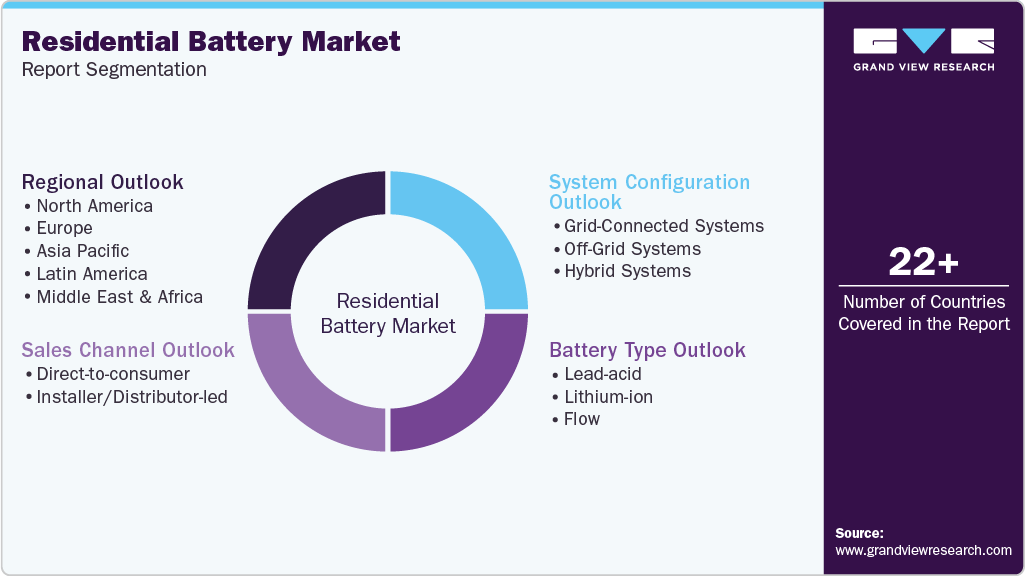
This report forecasts revenue growth at global, regional, and country levels and provides an analysis of the latest industry trends in each of the sub-segments from 2021 to 2033. For this study, Grand View Research has segmented the residential battery market report based on battery type, sales channel, system configuration, and region:
-
Battery Type Outlook (Revenue, USD Million, 2021 - 2033)
-
Lead-acid
-
Lithium-ion
-
Flow
-
-
Sales Channel Outlook (Revenue, USD Million, 2021 - 2033)
-
Direct-to-consumer
-
Installer/Distributor-led
-
-
System Configuration Outlook (Revenue, USD Million, 2021 - 2033)
-
Grid-Connected Systems
-
Off-Grid Systems
-
Hybrid Systems
-
-
Regional Outlook (Revenue, USD Million, 2021 - 2033)
-
North America
-
U.S.
-
Canada
-
Mexico
-
-
Europe
-
Germany
-
UK
-
France
-
Italy
-
Spain
-
-
Asia Pacific
-
China
-
India
-
Japan
-
-
Latin America
-
Brazil
-
Argentina
-
-
Middle East & Africa
-
Saudi Arabia
-
UAE
-
South Africa
-
-
Frequently Asked Questions About This Report
b. The global residential battery market size was estimated at USD 18.26 billion in 2025 and is expected to reach USD 21.47 billion in 2026.
b. The global residential battery market is expected to grow at a compound annual growth rate of 17.9% from 2026 to 2033 to reach USD 67.99 billion by 2033.
b. Based on the battery, lithium-ion batteries dominated market share in 2025, driven by higher efficiency and longer lifecycle performance.
b. Some of the key vendors operating in the global residential battery market include BYD, Enphase Energy, Generac, LG Energy Solution, Panasonic, Pylontech, SolarEdge Technologies, Sonnen, Sungrow, and Tesla.
b. The key factors driving the residential battery market include rising rooftop solar adoption, increasing electricity tariffs, growing demand for energy resilience during outages, and the need for greater self-consumption and grid flexibility across residential households.


Share this report with your colleague or friend.
Need a Tailored Report?
Customize this report to your needs — add regions, segments, or data points, with 20% free customization.


ISO 9001:2015 & 27001:2022 Certified
We are GDPR and CCPA compliant! Your transaction & personal information is safe and secure. For more details, please read our privacy policy.
Trusted market insights - try a free sample
See how our reports are structured and why industry leaders rely on Grand View Research. Get a free sample or ask us to tailor this report to your needs.