
- Home
- »
- Digital Media
- »
-
Professional Services Automation Software Market Report, 2033GVR Report cover

Professional Services Automation Software Market (2026 - 2033)
Size, Share & Trends Analysis Report By Solution (Project Management, Billing & Invoice Management), By Deployment (On-Premise, Cloud), By Enterprise Size, By Application (Consulting Firm, Technology Companies), By Region, And Segment Forecasts
Market Size, 2025
$14.9BMarket Estimate, 2026
$16.4BMarket Forecast, 2033
$35.1BCAGR, 2026–2033
11.5%Professional Services Automation Software Market Summary
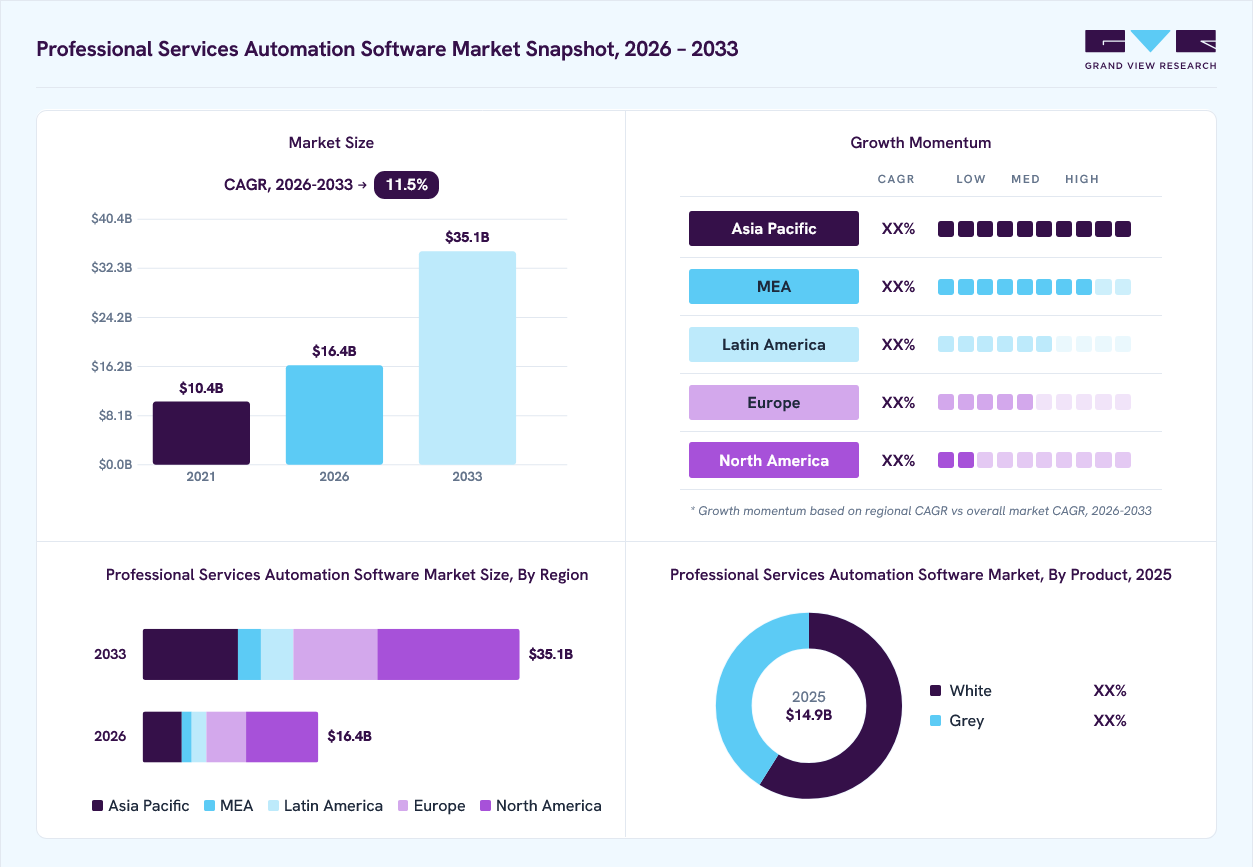
The global professional services automation software market size was valued at USD 14.9 billion in 2025 and is projected to grow from USD 16.4 billion in 2026 to USD 35.1 billion by 2033, at a CAGR of 11.5% from 2026 to 2033. The market in North America dominated with a revenue share of 41.6% in 2025. This growth is driven by increasing focus on automating time tracking, billing, and invoicing processes.
 Source: Grand View Research, IR Documents, Primary Interviews, Paid DatabasesTo learn more about this report,
 Download Free Sample Report
 Key Market Trends & Insights
- By solution: Project management segment dominated the market, with a revenue share of 29.5% in 2025.
- By deployment: Cloud segment held the largest market share of 64.9% in 2025.
- By enterprise size: Large enterprises segment held the largest market share of 60.0% in 2025.
- By application: Technology companies segment led the market with the largest revenue share of 40.7% in 2025.
Regional Highlights
- Largest regional market: North America (41.6% revenue share, 2025)
- Fastest-growing regional market: Asia Pacific (highest CAGR, 2026-2033)
- By country: The U.S. held the largest market share in 2025.
Market Size & Forecast
- Market size in 2025: USD 14.9 Billion
- Estimated market size in 2026: USD 16.4 Billion
- Projected market size by 2033: USD 35.1 Billion
- CAGR (2026-2033): 11.5%
Three ways to get this report
Buy it, customize it, or ask a question.Ask an Analyst
A direct answer, usually in 1 working day
- AccessReport author, directly
- Reply timeWithin 1 working day
- No sales callDirect answer only
- FormatEmail reply
- CostFree, no cost
Get the Full Report
What the study covers
- FormatsPDF · Excel · Dashboard
- Timeline2026–2033 annual, 2025 base
- Coverage20+ countries, 5 regions
- Companies10+ key players profiled
Customize the Report
20% free customization
- IncludeCountries, segments, points
- TailorTo your product definition
- ExtendDeeper competitor detail
- OrA fully bespoke study
- Turnaround5–10 working days
The rising adoption of cloud-based professional services automation (PSA) software solutions is driving the market growth. The growing emphasis on client-centric service delivery models is driving the expansion of the professional services automation software industry. Clients expect personalized solutions, transparent communication, and measurable results. PSA solutions empower service providers to meet these expectations by offering real-time project tracking, client reporting, and feedback integration mechanisms. These systems enable firms to share live dashboards with clients, showcasing progress updates, milestones achieved, and resource utilization. This transparency fosters trust and strengthens client relationships, ultimately leading to higher retention rates and recurring business. Furthermore, by leveraging PSA data, companies can gain deep insights into client behavior, project profitability, and satisfaction levels, allowing them to tailor future services more effectively.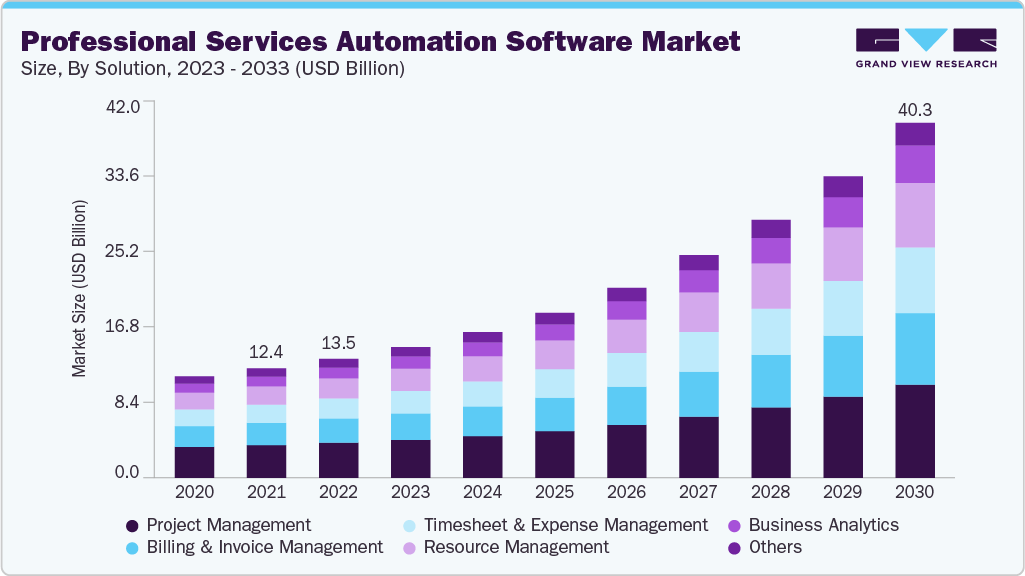 To learn more about this report, Download Free Sample Report
 The market growth is further driven by the rapid integration of emerging technologies such as generative AI, machine learning, and robotic process automation (RPA) into service operations. These technologies are transforming how professional service firms plan, execute, and deliver projects. Generative AI, for instance, can assist in creating project documentation, proposals, and client communications automatically, while RPA streamlines repetitive administrative tasks, such as invoicing and data entry. This technological synergy reduces manual errors, increases speed, and enhances overall efficiency in project management workflows.
The growth of the market for professional services automation software is also accelerated by the increasing prevalence of subscription-based and outcome-driven business models in the professional services sector. Traditional project-based engagements are being gradually replaced by recurring revenue models that focus on delivering continuous value. PSA systems are designed to support such frameworks by enabling accurate tracking of recurring tasks, subscription billing, and service-level agreement (SLA) compliance. These capabilities enable organizations to maintain financial predictability while ensuring that services are consistently delivered in accordance with client expectations. Moreover, as professional services become increasingly digital, the integration of PSA with customer success management tools enables companies to monitor client outcomes and adjust their strategies proactively. This alignment between service delivery and long-term business value creation is fostering stronger adoption of PSA platforms among firms transitioning toward subscription-oriented operating models.
The rising adoption of hybrid delivery models combining on-site, remote, and outsourced teams is another major driver shaping the professional services automation market landscape. Professional service firms today operate in a highly distributed environment where projects often involve collaboration between in-house teams, freelancers, and third-party vendors across time zones. Managing such dynamic ecosystems manually is both complex and inefficient. PSA platforms simplify this challenge by providing centralized coordination tools that integrate communication, task management, and workflow automation. These systems enable managers to oversee cross-functional collaboration seamlessly while maintaining a unified view of project progress and resource utilization. As global workforce models become more fluid and talent increasingly distributed, the ability of professional services automation systems to manage diverse teams effectively is becoming a key factor driving their adoption across industries.
Market Dynamics
The professional services automation software market is experiencing strong growth as service-based organizations increasingly seek to improve project execution, resource utilization, time tracking, billing accuracy, and overall operational efficiency. Businesses in consulting, IT services, engineering, legal services, and other professional sectors are adopting PSA solutions to manage complex projects, optimize workforce allocation, and gain greater visibility into service delivery performance. The growing shift toward project-based business models, hybrid work environments, and outcome-driven client engagements is increasing the need for centralized platforms that can coordinate people, projects, and financial processes. Additionally, organizations are placing greater emphasis on profitability management and real-time operational insights, further driving the adoption of PSA solutions.
The increasing focus on automating time-tracking, billing, and invoicing processes is a major driver of the professional services automation (PSA) software market, as professional service organizations depend heavily on accurate recording of employee effort and efficient revenue management. In industries such as consulting, legal services, engineering, accounting, marketing, and IT services, profitability is closely tied to the ability to accurately capture billable hours and convert them into revenue without delay. Manual processes often result in missed time entries, administrative errors, and inconsistencies that can negatively impact financial performance. PSA software automates these activities by enabling real-time tracking, automatic work allocation, and invoice generation based on predefined billing rules. This reduces human error while improving operational efficiency and revenue realization. As firms increasingly seek to optimize financial performance, demand for PSA software continues to expand.
High implementation and customization costs associated with advanced professional services automation platforms pose a significant restraint on the PSA software market, as many organizations must make substantial upfront investments before realizing operational benefits. While PSA solutions can improve efficiency, resource utilization, project visibility, and financial management, the deployment process often requires extensive planning, software configuration, system integration, and organizational change management. Professional services firms often operate with unique workflows, billing structures, project methodologies, and reporting requirements that may not always be accommodated by standard software configurations. As a result, businesses often need customized implementations, which increase consulting, development, and deployment costs. These costs can be particularly challenging for small and medium-sized firms with limited technology budgets. Consequently, the perceived financial burden of implementation may delay or discourage the adoption of PSA software.
The expansion of mobile-first professional services automation platforms for distributed workforces presents a significant opportunity for the PSA software market as organizations increasingly operate with employees working across multiple locations, client sites, and geographic regions. Traditional PSA systems were largely designed for desktop environments and centralized office operations, but modern work models require continuous access to project information, timesheets, resource schedules, and client communications regardless of location. Mobile-first platforms allow professionals to record billable hours, update project statuses, submit expenses, and access critical business information directly from smartphones and tablets. This flexibility improves productivity by eliminating delays associated with returning to office-based systems. As remote and hybrid work arrangements become a permanent feature of professional services organizations, demand for mobile-centric PSA solutions is expected to grow substantially.
Analyst Perspective
The professional services automation software market is evolving from a back-office operational tool into a strategic profitability management platform for service-centric enterprises. Unlike broader enterprise software segments that focus primarily on process standardization, PSA solutions are directly tied to revenue generation because organizational success depends on how effectively billable resources are utilized and on how effectively projects are delivered. Vendors that can provide deeper visibility into project margins, workforce productivity, forecasting accuracy, and client engagement performance will be better positioned to differentiate themselves in an increasingly competitive landscape. As professional services firms face growing pressure to improve utilization rates while maintaining service quality, PSA platforms that enable predictive resource planning and data-driven decision-making are expected to capture a larger share of technology spending.
Solution Insights
Based on solution, the project management segment led the market with the largest revenue share of 29.5% in 2025. The growing need for streamlined coordination and visibility across complex, multi-phase projects drives market growth. As organizations undertake larger and more intricate service engagements, often involving cross-functional teams and global clients, the limitations of traditional project tracking tools have become increasingly evident. PSA solutions with integrated project management capabilities enable centralized oversight of project timelines, budgets, deliverables, and performance metrics in real time. This unified approach allows managers to align resource allocation, task dependencies, and client milestones more effectively, reducing inefficiencies and communication gaps. The ability to visualize project progress through dynamic dashboards and analytics empowers decision-makers to respond promptly to delays or risks, ultimately enhancing delivery quality and profitability. The demand for transparency and agility in project execution, particularly among IT, consulting, and engineering firms, continues to drive the adoption of PSA systems tailored to robust project management functionalities.
Business analytics is projected to be the fastest-growing segment from 2025 to 2033. The rising demand for real-time performance monitoring and agile reporting is fueling the growth of the business analytics segment. In today’s fast-paced service environment, decision-makers need instant access to key business metrics without waiting for periodic reports. PSA platforms equipped with real-time analytics dashboards provide immediate visibility into project health, resource performance, and financial indicators. This instant insight empowers leaders to act swiftly in response to emerging issues such as delays, overspending, or utilization gaps before they escalate into major problems. Additionally, real-time analytics facilitate agile business planning, enabling teams to adapt quickly to client requirements or market shifts. As organizations increasingly adopt agile methodologies, the need for continuous, real-time visibility through PSA analytics tools is becoming a vital driver of market expansion.
Deployment Insights
Based on deployment, the cloud segment led the market with the largest revenue share of 64.9% in 2025. The increasing importance of intellectual property (IP) protection and proprietary data confidentiality among professional service firms drives segment growth. In consulting, design, engineering, and IT services, proprietary methodologies, algorithms, and client-specific solutions represent valuable intellectual assets. On-premise PSA systems enable organizations to safeguard this proprietary knowledge within their own data environments, reducing exposure to external vendors or shared cloud infrastructures. By ensuring that project documentation, performance analytics, and internal strategies remain securely hosted, companies mitigate the risks of data leakage or unauthorized access. This control over intellectual property is particularly critical for firms that work on competitive bids or sensitive projects, where confidentiality directly impacts client trust and brand reputation. The assurance of keeping IP-secure under organizational control continues to drive strong adoption of on-premise PSA systems across high-value professional service sectors.
The cloud segment is projected to grow the fastest from 2025 to 2033. The increasing pace of digital transformation and software-as-a-service (SaaS) adoption across professional service industries is a significant factor fueling growth in the cloud PSA market. Organizations are increasingly transitioning from traditional, static software deployments to cloud-native solutions that provide continuous updates, integrations, and process automation. PSA vendors have responded by offering advanced cloud-based platforms equipped with AI-driven analytics, workflow automation, and predictive forecasting capabilities that help organizations manage projects more intelligently. The cloud environment supports easy integration with enterprise applications such as customer relationship management (CRM), enterprise resource planning (ERP), and collaboration tools, creating a connected ecosystem for seamless data flow. This interoperability enables professional service firms to eliminate silos, enhance transparency, and make data-driven decisions in real time.
Enterprise Size Insights
Based on enterprise size, the large enterprise segment led the market with the largest revenue share of 60.0% in 2025. The increasing importance of cross-functional collaboration and integrated service delivery propels segment growth. Large enterprises often operate through multiple departments, such as IT, finance, operations, and customer success, that must work cohesively to deliver complex client solutions. PSA systems enable this integration by connecting disparate functions through a unified platform that ensures smooth information flow and collaborative project execution. For example, the integration of PSA with customer relationship management (CRM) and enterprise resource planning (ERP) systems allows enterprises to synchronize client engagement, project planning, and financial management. This holistic visibility fosters greater coordination between departments and ensures alignment between client expectations and internal capabilities.
The small & medium enterprise segment is projected to grow at a significant CAGR from 2025 to 2033. The shift toward remote and hybrid work models drives the adoption of PSA among SMEs. With smaller teams often dispersed across multiple locations or working from home, maintaining coordination and productivity can be challenging. PSA solutions provide centralized, cloud-based platforms that allow teams to collaborate, share updates, and track project milestones in real time. Mobile accessibility and intuitive user interfaces enable employees to manage tasks and submit reports on the go, increasing engagement and accountability. This digital connectivity enhances overall project performance, even in decentralized work environments. For SMEs that rely heavily on flexible staffing and freelance consultants, PSA tools also simplify contract management and performance tracking, ensuring that all team members remain aligned with organizational goals despite geographical dispersion.
Application Insights
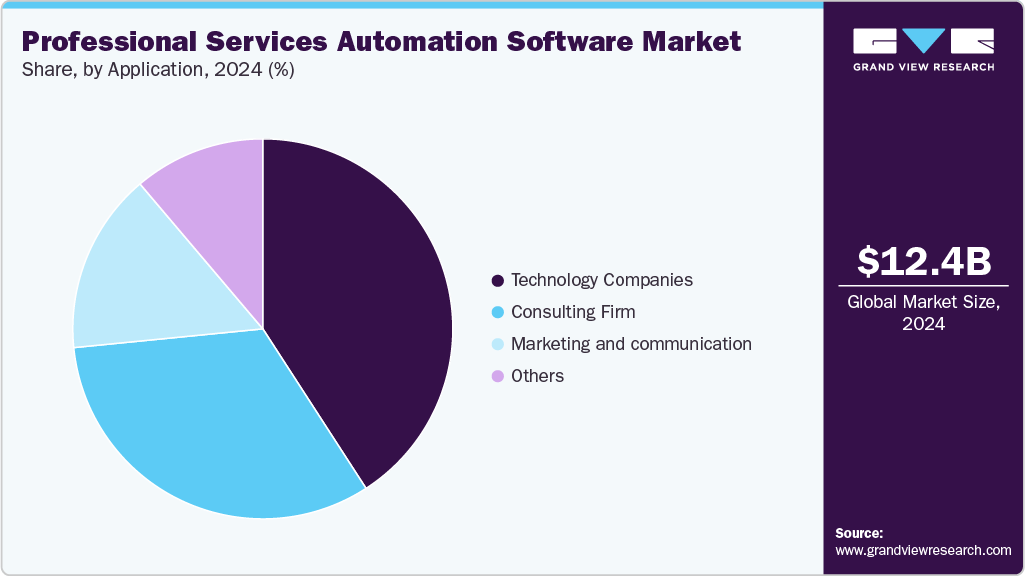
Based on application, the technology companies segment led the market with the largest revenue share of 40.7% in 2025. The increasing reliance on distributed and remote workforces in the technology sector is fueling the PSA market’s growth. Technology companies often employ global teams that work across multiple time zones, utilizing remote collaboration tools and agile methodologies. PSA platforms provide a centralized digital environment that allows teams to coordinate effectively, track progress in real time, and maintain consistent project documentation. Cloud-based PSA solutions, in particular, support seamless access to project data from any location, ensuring that teams remain aligned and productive even in decentralized setups. This centralized visibility is crucial for maintaining accountability, particularly in industries where project deadlines and deliverable quality significantly impact client satisfaction.
 To learn more about this report, Download Free Sample Report
 The marketing and communication segment is projected to grow the fastest from 2025 to 2033. The rapid digitalization of marketing channels and tools is also driving growth in the PSA market within the marketing and communication sector. Agencies today manage diverse digital assets across social media, search engines, content platforms, and advertising networks, all of which demand continuous monitoring and coordination. PSA platforms help centralize campaign schedules, creative approvals, and deliverable tracking within one environment, ensuring that cross-channel campaigns remain synchronized. Additionally, the integration of PSA solutions with marketing automation, CRM, and content management systems allows firms to unify client data and campaign insights, creating a cohesive workflow from planning to reporting. This interconnectivity eliminates data silos, enhances collaboration, and enables faster turnaround times for campaign execution.
Regional Insights
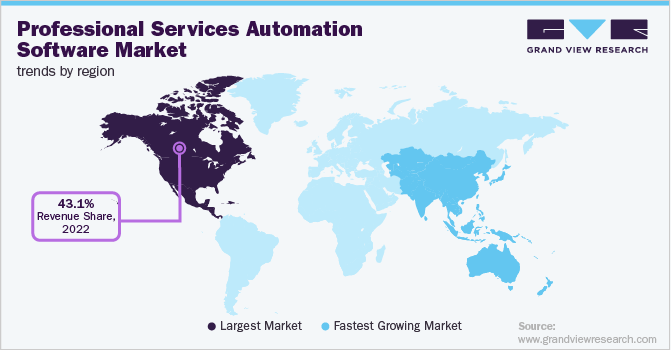
North America dominated the global professional services automation software market with the largest revenue share of 41.6% in 2025. The high penetration of small and medium-sized enterprises (SMEs) across North America has played a crucial role in driving PSA market expansion. SMEs are increasingly investing in automation tools to enhance operational efficiency, control project costs, and compete with larger firms. The availability of affordable cloud-based PSA solutions tailored for smaller organizations has lowered adoption barriers and encouraged widespread use. These systems enable SMEs to manage multiple client projects, optimize team productivity, and enhance billing accuracy with minimal upfront investment. As SMEs continue to embrace digitalization to remain agile in competitive markets, PSA vendors are expanding their offerings with modular, scalable, and easy-to-integrate platforms.
 To learn more about this report, Download Free Sample Report
 U.S. Professional Services Automation Software Market Trends
The professional services automation software market in the U.S. held the largest share in the North America region in 2025. The increasing adoption of cloud-native and mobile-enabled PSA platforms drives U.S. market growth. With professionals working across diverse environments, including client sites, offices, and remotely, there is an increasing need for mobile access to project data, approvals, and performance dashboards. PSA vendors in the U.S. are responding by offering mobile-first applications that provide real-time project tracking, task management, and communication capabilities accessible from smartphones and tablets. This mobility enables service professionals to stay connected and responsive, even while on the move, thereby enhancing operational agility and reducing turnaround times.
Asia Pacific Professional Services Automation Software Market Trends
The Asia Pacific professional services automation software industry is expected to grow at the fastest CAGR of 16.8% over the forecast period. The integration of advanced analytics and performance measurement capabilities within PSA systems is another crucial growth driver. Enterprises across the Asia Pacific are adopting PSA platforms not just for process automation but for their ability to generate actionable insights into project profitability, employee productivity, and client engagement. With built-in analytics, these platforms enable decision-makers to monitor key performance indicators (KPIs) in real time and identify bottlenecks that affect delivery or cost efficiency. Predictive analytics functions also help forecast future project outcomes, enabling proactive decision-making and resource optimization. This analytical depth is driving PSA adoption among data-driven organizations that value transparency and continuous improvement in operational performance.
The professional services automation software market in China is projected to grow during the forecast period. The rise of cloud computing and the adoption of Software-as-a-Service (SaaS) in China are driving the growth of professional services automation solutions. Chinese enterprises are increasingly favoring cloud-based PSA platforms for their scalability, flexibility, and cost efficiency. Cloud deployment enables real-time data access, collaborative workflows, and integration with other enterprise systems such as customer relationship management (CRM) and enterprise resource planning (ERP). This aligns with China’s broader move toward cloud infrastructure, supported by both public and private investments in digital transformation. The growing trust in cloud security and local data governance frameworks further accelerates the adoption of PSA across industries.
Europe Professional Services Automation Software Market Trends
The professional services automation software industry in Europe is expected to grow during the forecast period. The rise of the gig economy and flexible workforce structures in Europe contributes to PSA market expansion. With the growing prevalence of freelancers, independent consultants, and contract-based professionals, organizations are seeking automation tools that can effectively manage dynamic workforce models. PSA platforms enable the seamless integration of freelance resources into ongoing projects, allowing for precise tracking of time, deliverables, and costs. This flexibility enables firms to maintain project continuity and optimize staffing levels in response to workload fluctuations. Moreover, PSA systems streamline administrative processes, such as invoicing and expense management, for both permanent and contract workers. As Europe continues to embrace flexible employment and digital freelancing, PSA tools are becoming central to efficiently coordinating distributed and hybrid workforces.
The professional services automation software market in Germany is expected to grow during the forecast period. The increasing integration of artificial intelligence (AI) and predictive analytics into PSA systems is also fueling market growth in Germany. Businesses are leveraging AI-driven automation to enhance project forecasting, financial planning, and performance monitoring. Predictive analytics capabilities within PSA solutions enable organizations to identify potential project risks, budget overruns, or resource bottlenecks before they occur, allowing for proactive decision-making. German enterprises, known for their data-driven and engineering-oriented management approaches, are particularly receptive to these intelligent automation capabilities. The integration of AI aligns with Germany’s broader technological innovation initiatives, fostering a culture of continuous improvement and process optimization.
Key Professional Services Automation Software Company Insights
Microsoft Corporation and Oracle Corporation are some of the leading participants in the professional services automation software market.
-
Microsoft Corporation is a global technology company. At the core of Microsoft’s presence in the market is its Dynamics 365 platform, a comprehensive suite of enterprise applications that integrates customer relationship management (CRM) and enterprise resource planning (ERP) functionalities. Dynamics 365 Project Operations, a specialized PSA solution within this ecosystem, enables professional service organizations to manage projects end-to-end from opportunity and contract management to resource scheduling, time tracking, and financial analytics.
-
Oracle Corporation is a global technology company. Oracle’s PSA capabilities are primarily delivered through Oracle Fusion Cloud Applications, specifically within the Oracle Cloud ERP and Oracle Cloud Project Management solutions. These platforms are designed to provide end-to-end visibility and control over service projects, from planning and budgeting to execution and billing. By integrating these functions into a unified cloud environment, Oracle enables professional service firms to maintain transparency and agility throughout the project lifecycle.
ConnectWise, Inc. and Workday, Inc. are some of the emerging participants in the professional services automation software market.
-
ConnectWise, Inc. is a U.S.-based software company. ConnectWise’s PSA offerings include ConnectWise PSA, a robust cloud-based solution designed to centralize and automate service operations. The platform provides end-to-end functionality that supports project planning, time tracking, billing, ticketing, and contract management. It enables service providers to monitor project progress in real time, optimize resource utilization, and maintain full visibility over costs and revenue streams.
-
Workday, Inc. is an enterprise software company. Workday’s PSA offering is its Workday Professional Services Automation Software solution, which combines resource management, project tracking, time and expense management, and billing into one unified system. This platform enables professional service organizations to optimize workforce deployment, monitor project performance, and maintain financial accuracy. By integrating human capital management (HCM) and financial management functionalities, Workday ensures that businesses have a complete view of both their talent and operational outcomes.
Key Professional Services Automation Software Companies:
The following key companies have been profiled for this study on the professional services automation software market.
-
Autotask Corporation
-
Atlassian
-
BMC Software, Inc.
-
ConnectWise, Inc.
-
Deltek, Inc.
-
FinancialForce.com
-
Kimble Apps
-
Klient, Inc.
-
Microsoft Corporation
-
NetSuite OpenAir, Inc.
-
Oracle Corporation
-
Planview
-
SAP SE
-
Upland Software, Inc.
-
Workday, Inc.
Competitive Benchmarking
Category
Operating Strategies
Competitive Edge
Weakness
Established Players (Microsoft; Oracle; SAP; Salesforce; Deltek)
- Mature players in the professional services automation software market focus on unifying project delivery, resource planning, financial management, and customer engagement within a single platform. They target large consulting firms, IT service providers, and enterprise service organizations with comprehensive workflow automation capabilities. Their strategy emphasizes operational visibility, profitability tracking, and cross-functional collaboration. They also leverage existing ERP and CRM ecosystems to drive PSA adoption among enterprise customers.
- Mature players benefit from deep expertise in enterprise process management and large customer networks. Their platforms provide extensive functionality covering the entire project lifecycle. Strong integration with finance, HR, and customer management systems improves operational efficiency. Their ability to support global service organizations strengthens their competitive position.
- These solutions can be overly complex for smaller professional service firms. Implementation projects often require significant configuration and change management efforts. Licensing and maintenance costs may be substantial for growing organizations. Feature-rich platforms can also lead to lower user adoption if not managed effectively.
Emerging Players (Kantata; Scoro; Productive; BigTime Software; Accelo)
- Emerging players focus on cloud-native PSA platforms designed for agile and project-driven organizations. They emphasize streamlined resource scheduling, time tracking, and project profitability management. Their strategy centers on delivering intuitive user experiences and rapid implementation. Many also incorporate AI-driven forecasting and workload optimization capabilities to improve resource utilization.
- Emerging players offer greater flexibility and ease of deployment than traditional enterprise systems. Their subscription-based models make PSA technology accessible to mid-sized firms and agencies. Modern interfaces improve employee adoption and reduce training requirements. Faster product development cycles also enable quicker response to changing customer needs.
- Emerging players may lack the extensive enterprise integrations offered by established vendors. Their platforms can have limited functionality for highly complex global service operations. Smaller customer bases may reduce their ability to invest heavily in R&D. Market expansion can also be challenging when competing against vendors with established enterprise relationships.
Recent Developments
-
In Septemeber 2025, DarcyIQ launched a native Kaseya Autotask integration via a new MCP (Model Context Protocol) server. This integration lets Managed Service Providers and IT service firms connect Autotask PSA with DarcyIQ’s AI consulting tools, enabling natural language management of tickets, projects, and client workflows directly within DarcyIQ for greater operational efficiency and seamless service delivery.
-
In June 2025, ConnectWise, Inc. launched ConnectWise PSA, a transformative initiative that delivers a modernized professional services automation software (PSA) experience within the Asio Platform. This integration offers a unified user interface (UI) and user experience (UX), minimizing the need to switch between multiple solutions and enabling faster, more efficient issue resolution. By utilizing shared platform services, ConnectWise PSA enhances operational efficiency and helps managed service providers (MSPs) lower overall costs.
Professional Services Automation Software Market Report Scope
Report Attribute
Details
Market size in 2025
USD 14.9 billion
Estimated market size in 2026
USD 16.4 billion
Projected market size by 2033
USD 35.1 billion
Growth rate
CAGR of 11.5% from 2026 to 2033
Base year for estimation
2025
Historical data
2021 - 2024
Forecast period
2026 - 2033
Quantitative units
Revenue in USD million/billion and CAGR from 2026 to 2033
Report coverage
Revenue forecast, company market share analysis, competitive landscape, growth factors, and trends
Segments covered
Solution, deployment, enterprise size, application, region
Regional scope
North America; Europe; Asia Pacific; Latin America; MEA
Country scope
U.S.; Canada; Mexico; UK; Germany; France; China; India; Japan; Australia; South Korea; Brazil; UAE; Saudi Arabia; South Africa
Key companies profiled
Accenture PLC; Aera Technology; Birst, Inc.; Capgemini SA; Genpact Limited; International Business Machines Corporation; JDA Software Group Inc.; Kinaxis; Lockheed Martin Corporation; Maersk Group; Manhattan Associates, Inc.
Customization scope
Free report customization (equivalent up to 8 analysts' working days) with purchase. Addition or alteration to country, regional & segment scope.
Pricing and purchase options
Avail customized purchase options to meet your exact research needs. Explore purchase options
Global Professional Services Automation Software Market Report Segmentation
This report forecasts revenue growth at global, regional, and country levels and provides an analysis of the latest industry trends in each of the sub-segments from 2021 to 2033. For this study, Grand View Research has segmented the global professional services automation software market report based on solution, deployment, enterprise size, application, and region:
-
Solution Outlook (Revenue, USD Billion, 2021 - 2033)
-
Project Management
-
Billing & Invoice Management
-
Resource Management
-
Timesheet & Expense Management
-
Business Analytics
-
Others
-
-
Deployment Outlook (Revenue, USD Billion, 2021 - 2033)
-
On-Premise
-
Cloud
-
-
Enterprise Size Outlook (Revenue, USD Billion, 2021 - 2033)
-
Large Enterprise
-
Small & Medium Enterprise
-
-
Application Outlook (Revenue, USD Billion, 2021 - 2033)
-
Consulting Firm
-
Technology Companies
-
Marketing and Communication
-
Others
-
-
Regional Outlook (Revenue, USD Billion, 2021 - 2033)
-
North America
-
U.S.
-
Canada
-
Mexico
-
-
Europe
-
Germany
-
UK
-
France
-
-
Asia Pacific
-
China
-
India
-
Japan
-
South Korea
-
Australia
-
-
Latin America
-
Brazil
-
-
Middle East & Africa
-
UAE
-
Saudi Arabia
-
South Africa
-
-
Research Methodology
The professional services automation software market figures in this report are based on a proven research process that combines executive interviews with secondary research from proprietary databases, company filings, and recognized regulatory and institutional sources. Market size is built through value-chain sizing - reconciling supply-side and demand-side estimates - and triangulated with bottom-up and top-down approaches. Every estimate passes multiple levels of expert validation before publication, with each professional services automation software segment quantified using the revenue-capture definitions in the table below.
Segment Definition
Segment - Service Type
Revenue capture definition
Project Management
The largest solution segment, capturing value through platforms that support project planning, task allocation, milestone tracking, collaboration, and delivery management. Vendors benefit from organizations seeking greater project visibility, improved utilization rates, and stronger control over service delivery outcomes.
Billing & Invoice Management
Revenue opportunities arise from solutions that automate invoicing, contract billing, revenue recognition, and payment tracking processes. Businesses adopt these tools to accelerate cash flow, reduce billing errors, and improve financial transparency across client engagements.
Resource Management
Economic value is derived from workforce allocation, capacity planning, skills matching, and utilization optimization capabilities. Organizations increasingly invest in these solutions to maximize billable hours and ensure efficient deployment of professional talent across projects.
Timesheet & Expense Management
Market demand is driven by the need to accurately capture employee time, project costs, travel expenses, and reimbursement workflows. These solutions help service organizations strengthen profitability analysis while simplifying compliance and approval processes.
Business Analytics
Providers monetize through advanced reporting, forecasting, KPI tracking, profitability analysis, and operational intelligence tools. Decision-makers rely on these insights to improve project performance, identify growth opportunities, and support strategic planning initiatives.
Others
This segment includes contract management, customer relationship management integration, document management, collaboration tools, and workflow automation solutions. Value creation is centered on streamlining business processes and enhancing operational efficiency across service organizations.
Segment - Delivery Model
Revenue capture definition
On-Premise
Large Enterprises
Cloud
Small & Medium Enterprises
Segment - Enterprise Size
Revenue capture definition
Large Enterprises
The large enterprises segment, with respect to the number of employees, typically comprises organizations employing more than 1,000 employees for multinational corporations.
Small & Medium Enterprises
The SMEs segment, with respect to the number of employees, generally includes organizations employing between 10 and 999 employees.
Segment - Enterprise Size
Revenue capture definition
Consulting Firm
Consulting organizations use PSA platforms to manage client engagements, optimize consultant utilization, monitor project profitability, and streamline billing. Demand is driven by the need to balance resource efficiency with high-quality client service delivery.
Technologies Companies
Software developers, IT service providers, and system integrators deploy PSA solutions to coordinate implementation projects, support services, and technical consulting engagements. The growing complexity of technology projects continues to strengthen investment in automation capabilities.
Marketing and Communication
Agencies leverage PSA platforms to manage creative projects, campaign execution, resource scheduling, client approvals, and budget tracking. Effective workflow coordination and project visibility are critical factors that support adoption in this segment.
Others
This category includes legal services, accounting firms, engineering consultancies, architectural practices, education services, and business advisory organizations. Market participants adopt PSA solutions to improve service delivery efficiency, strengthen client management, and enhance financial performance across project-based operations.
Estimation Model
Layer
Question
Analysis
01 Professional Services Workflow Layer
Which business processes require automation?
Identify service-centric organizations such as consulting firms, IT service providers, engineering companies, legal service firms, marketing agencies, and managed service providers that depend on project-based work. This layer focuses on operational functions including project planning, resource scheduling, time tracking, expense management, billing, and client engagement that are often managed through fragmented systems and manual processes.
Operational Coordination Layer
Where can automation improve service delivery efficiency?
Evaluate areas where organizations face challenges related to resource allocation, project visibility, utilization management, budget control, and workforce productivity. Professional Service Automation (PSA) platforms address these inefficiencies by creating a unified environment that connects project execution, workforce planning, financial management, and performance monitoring, enabling better coordination across service teams.
Enterprise Adoption Layer
Who actively integrates PSA platforms into daily operations?
Analyze adoption among organizations managing multiple concurrent projects, distributed teams, and client contracts. Users leverage PSA solutions to automate workflow approvals, forecast resource demand, monitor project profitability, optimize employee utilization rates, and improve service-level compliance. Adoption is particularly strong among knowledge-based industries where human capital represents the primary revenue-generating asset.
Business Performance Layer
How is revenue and business value generated through PSA solutions?
Assess revenue generation through software subscriptions, implementation services, customization projects, training programs, analytics modules, and ongoing technical support. The value proposition extends beyond software sales, as PSA platforms help organizations increase billable utilization, reduce project overruns, accelerate invoicing cycles, improve revenue recognition accuracy, and enhance overall profitability through data-driven service operations management.
Delivered Customizations
This report has been delivered with the following In-depth customizations
CLIENT REQUEST
CUSTOMIZATION DELIVERED
VALUE ADDS
Resource Utilization, Workforce Planning & Billable Efficiency Trends
Conducted a focused analysis of professional service organizations covering resource allocation, capacity planning, skill matching, utilization tracking, and billable hour optimization across consulting, IT services, engineering, and legal firms.
Helps stakeholders identify workforce productivity opportunities, evaluate resource management maturity, and assess revenue optimization potential through improved utilization rates.
Project Profitability, Service Delivery & Financial Performance Trends
Evaluated adoption trends for project budgeting, time and expense management, revenue recognition, project accounting, and margin tracking solutions supporting end-to-end service delivery operations.
Provides insights into profitability drivers, project performance challenges, and commercially attractive automation capabilities that improve financial visibility and operational control.
Professional Services Operations & Intelligent Automation Opportunity Assessment
Assessed demand for AI-enabled project forecasting, automated workflow management, contract-to-cash processes, service analytics, and integrated PSA platforms, along with challenges related to data accuracy, change management, and integration with ERP and CRM systems.
Supports investment and expansion strategies by identifying operational transformation opportunities, evaluating technology readiness, and strengthening long-term growth potential in data-driven professional services management.
Frequently Asked Questions About This Report
The global professional services automation software market is expected to grow at a CAGR of 11.5% from 2026 to 2033, reaching USD 35.1 billion by 2033.
The project management segment led with a 29.5% revenue share in 2025, while small and medium enterprises segment
North America dominated with 41.6% revenue share in 2025.
Asia Pacific is the fastest-growing region over the forecast period.
The cloud segment led with a 64.9% revenue share in 2025 and it is the fastest-growing segment.
The large enterprise segment led with a 60.0% revenue share in 2025, while small and medium enterprises segment is the fastest-growing segment.
Key players operating in the professional services automation market include: Autotask Corporation, BMC Software, Inc., ConnectWise, Inc., Deltek, Inc., FinancialForce.com, Kimble Apps, Microsoft Corporation, NetSuite OpenAir, Inc., Oracle Corporation and Planview are some of the major industry players in this domain.
Key factors include increasing focus on automating time tracking, billing, and invoicing processes, increasing focus on automating time-tracking, billing, and invoicing processes, and expansion of mobile-first professional services automation platforms for distributed workforces.
The global professional services automation software market size was valued at USD 14.9 billion in 2025 and is estimated at USD 16.4 billion for 2026.
About the Author(s)
Digital Media Research Team
Technology · Digital MediaThis report was authored by the digital media research team at Grand View Research - comprising two research analysts, one senior research analyst, and one industry expert - with specialized expertise in the digital media segment of the technology industry. All findings are based on proprietary technology databases, executive interviews, and regulatory analysis, subject to internal peer review prior to publication.
Last Updated:
Speak to Analyst

Customize this report to your needs - add regions, segments, or data points, with 20% free customization.
Or view our licence options:


ISO 9001:2015 & 27001:2022 Certified
We are GDPR and CCPA compliant! Your transaction & personal information is safe and secure. For more details, please read our privacy policy.


