
- Home
- »
- Advanced Interior Materials
- »
-
Plastic Processing Auxiliary Equipment Market Report, 2030GVR Report cover
![Plastic Processing Auxiliary Equipment Market (2026 - 2033)Report]()
Plastic Processing Auxiliary Equipment Market (2026 - 2033)
Size, Share & Trends Analysis Report By Type (Material Handling Equipment, Temperature Control Equipment, Dehumidification and Drying Equipment), By Process Type, By End-use, By Region, And Segment Forecasts
Market Size, 2025
$7.6BMarket Estimate, 2026
$7.9BMarket Forecast, 2033
$10.7BCAGR, 2026–2033
4.5%Plastic Processing Auxiliary Equipment Market Summary
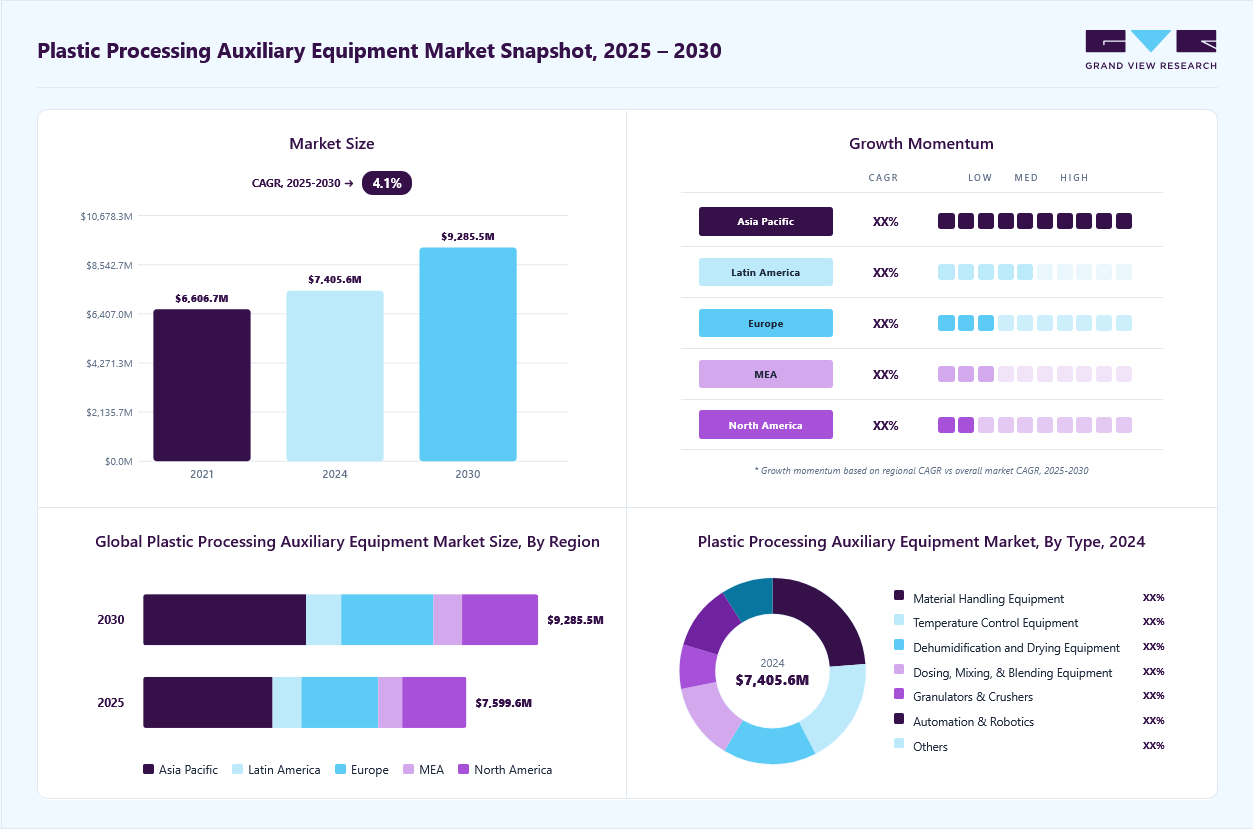
The global plastic processing auxiliary equipment market size was valued at USD 7.6 billion in 2025 and is projected to grow from USD 7.9 billion in 2026 to USD 10.7 billion by 2033, growing at a CAGR of 4.5% from 2026 to 2033. Asia Pacific dominated the market, accounting for the largest global share of 40.0% in 2025. The plastic processing auxiliary equipment industry is increasingly focused on energy efficiency and sustainability, driven by both regulatory pressures and the rising demand for eco-friendly manufacturing solutions.
Key Market Trends & Insights
- By type: Material handling equipment segment held the largest share of 23.9% in 2025.
- By process type: Injection molding segment held the largest share of 40.0% in 2025.
- By end-use: Packaging segment held the largest revenue share of 31.2% in 2025.
Regional Highlights
- By type: Material handling equipment segment held the largest share of 23.9% in 2025.
- By process type: Injection molding segment held the largest share of 40.0% in 2025.
- By end-use: Packaging segment held the largest revenue share of 31.2% in 2025.
Market Size & Forecast
- Market size in 2025: USD 7.6 Billion
- Estimated market size in 2026: USD 7.9 Billion
- Projected market size by 2033: USD 10.7 Billion
- CAGR (2026-2033): 4.5%
Three ways to get this report
Buy it, customize it, or ask a question.Get the Full Report
What the study covers
- FormatsPDF · Excel · Dashboard
- Timeline2026–2033 annual, 2025 base
- Coverage20+ countries, 5 regions
- Companies10+ key players profiled
Customize the Report
20% free customization
- IncludeCountries, segments, points
- TailorTo your product definition
- ExtendDeeper competitor detail
- OrA fully bespoke study
- Turnaround5–10 working days
Ask an Analyst
A direct answer, usually in 1 working day
- AccessReport author, directly
- Reply timeWithin 1 working day
- No sales callDirect answer only
- FormatEmail reply
- CostFree, no cost
As environmental concerns grow, manufacturers are developing equipment that reduces energy consumption, optimizes processing cycles, and minimizes waste. This shift is especially evident in the design of energy-efficient drying systems, temperature control units, and material handling solutions, which help manufacturers meet stringent environmental standards while reducing operating costs.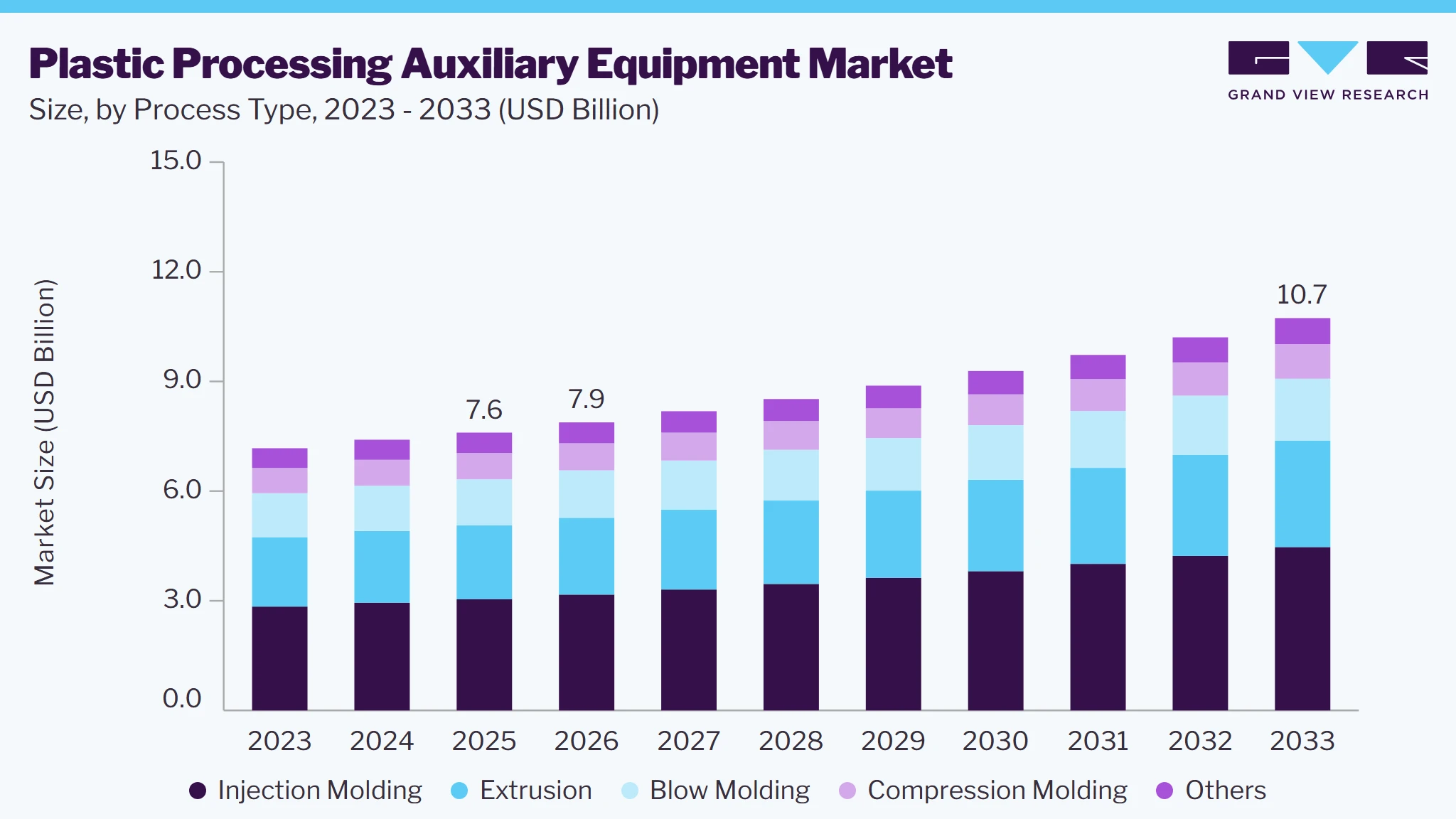
Automation and digitalization are also reshaping the landscape of the market. The rise of Industry 4.0 technologies, including IoT-enabled systems, robotics, and advanced control software, is driving significant advancements in manufacturing efficiency. These innovations allow for real-time monitoring, predictive maintenance, and enhanced precision in processing, helping reduce downtime and improve product consistency. As production environments become more automated, demand for advanced auxiliary systems that seamlessly integrate with other manufacturing technologies is rising. This trend toward smarter, more interconnected systems is revolutionizing the market, providing companies with the tools to optimize their operations and increase overall productivity.
Market Dynamics
The plastic processing auxiliary equipment market is shaped by a combination of industrial, technological, regulatory, and economic factors that collectively influence adoption across end-use industries. Growth in plastic processing output across packaging, automotive, construction, and consumer goods sectors directly drives demand for auxiliary systems that support efficient material handling, drying, blending, and temperature control. Increasing emphasis on product quality, process consistency, and reduction of material waste is encouraging manufacturers to integrate advanced auxiliary equipment into production lines. Technological advancements in automation, IoT-enabled monitoring, and energy-efficient system design are enhancing operational productivity and enabling real-time process optimization.
The expansion of plastic processing activities across packaging, automotive, construction, electrical & electronics, and consumer goods industries remain a driver for the auxiliary equipment market. Increasing production volumes are creating sustained demand for supporting systems such as material handling units, drying systems, blending equipment, and temperature control solutions to ensure uninterrupted and efficient operations.
Growing focus on production efficiency, material optimization, and process consistency is further accelerating the integration of advanced auxiliary systems within injection molding, extrusion, and blow molding processes. Additionally, the increasing shift toward automation and smart manufacturing practices is strengthening the adoption of integrated and high-performance auxiliary equipment.
The market is constrained by the high initial capital investment required for advanced auxiliary equipment, including automated handling systems, intelligent drying units, and integrated temperature control solutions. These systems involve high costs not only for procurement but also for installation, system integration, and supporting infrastructure.
For small and medium-sized manufacturers, such financial requirements can delay modernization or limit adoption. Furthermore, integration complexity with existing processing machinery and production lines poses operational challenges, particularly in fragmented and cost-sensitive manufacturing environments.
The transition toward smart manufacturing and sustainable production practices presents significant growth opportunities for the market. The adoption of IoT-enabled monitoring systems, predictive maintenance technologies, and automated control solutions is improving operational efficiency, reducing downtime, and enhancing process visibility.
In addition, the increasing use of recycled and alternative plastic materials is driving demand for advanced auxiliary systems capable of handling variable feedstock characteristics, such as moisture content and material inconsistency. Rising emphasis on energy efficiency, waste reduction, and environmentally compliant manufacturing is further supporting the deployment of next-generation, intelligent auxiliary equipment solutions.
Market Concentration & Characteristics
The market is moderately fragmented, featuring a combination of established global players and increasing regional and specialized distributors. Leading companies such as Piovan, Conair, Motan Colortronic, and AEC maintain strong market positions through comprehensive product portfolios, cutting-edge technologies, and extensive distribution networks. Moreover, regional and independent distributors are vital in serving local markets, offering tailored solutions that meet specific industry needs, material handling requirements, and customer preferences in different regions.
Environmental regulations and sustainability standards play a critical role in shaping the dynamics of the plastic market. Regulatory agencies enforce stricter guidelines on energy efficiency and waste reduction, prompting manufacturers to develop eco-friendly solutions. As a result, manufacturers increasingly focus on offering auxiliary equipment that complies with these evolving standards, leading to greater demand for energy-efficient systems, such as low-energy dryers, optimized material handling equipment, and sustainable cooling solutions. This regulatory pressure not only drives market growth but also encourages manufacturers and distributors to invest in innovative, environmentally friendly technologies.
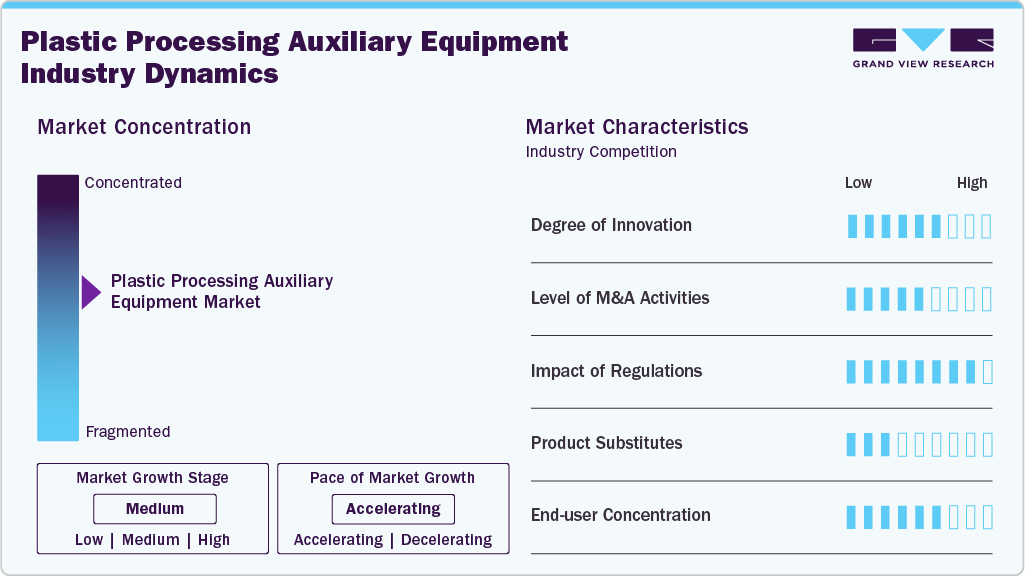
Technological innovations are reshaping the plastic processing auxiliary equipment industry, with the integration of advanced automation and smart technologies. IoT-enabled systems, predictive maintenance tools, and enhanced process control are transforming the way plastic manufacturers handle materials, monitor equipment performance, and manage production processes. These technologies are becoming standard in the market, prompting distributors to offer products that provide real-time data, increase energy efficiency, and streamline operations. Additionally, the growing adoption of advanced filtration systems and automated blending solutions is enhancing operational efficiency and product quality, pushing the market toward more sophisticated and digitally connected equipment.
Asia Pacific holds a dominant share of the market, supported by robust industrial activity, regulatory incentives for energy-efficient solutions, and a well-established aftermarket service network. The region's focus on sustainable manufacturing practices and technological advancements further solidifies its position as a leader in the market. These trends reflect the shift toward high-performance, energy-efficient, and environmentally friendly plastic processing solutions, distributed through an increasingly diverse and technologically advanced network of distributors and suppliers.
Analyst Perspective
The plastic processing auxiliary equipment market is evolving alongside the increasing automation and efficiency requirements of the plastics manufacturing industry. As processors focus on improving product quality, reducing material waste, and minimizing production downtime, demand for advanced auxiliary equipment, including material handling systems, dryers, temperature controllers, and automation solutions, is steadily increasing. The rapid expansion of packaging, automotive, medical, and electronics manufacturing is further encouraging investments in integrated, energy-efficient production lines. In addition, the growing adoption of Industry 4.0 technologies, smart factory initiatives, and robotics is transforming auxiliary equipment from standalone machines into intelligent systems that optimize production performance.
Drivers, Opportunities & Restraints
The growing demand for energy-efficient and environmentally friendly solutions is a key driver for the plastic processing auxiliary equipment industry. Stricter environmental regulations and sustainability standards are pushing manufacturers to adopt more energy-efficient technologies, such as low-energy dryers, advanced material handling systems, and optimized cooling equipment. These innovations not only help companies meet regulatory requirements but also reduce operational costs, making them increasingly popular in industries such as automotive, packaging, and consumer goods.
High initial investment costs for advanced plastic processing auxiliary equipment pose a significant restraint on the market. While these systems offer long-term operational savings, the upfront cost of acquiring sophisticated machinery like automated material handling systems, smart temperature control units, and IoT-enabled solutions can be prohibitive for smaller manufacturers. This can limit the adoption of such technologies in emerging markets or for companies with lower capital expenditures, slowing overall market growth.
The rising adoption of recycled plastics presents a significant opportunity for the market. As the demand for sustainable production practices grows, manufacturers are increasingly incorporating recycled materials into their processes. This requires specialized equipment capable of handling the unique challenges of recycled plastics, such as varying moisture content and inconsistent material properties. Companies that can develop and offer advanced solutions tailored for recycling processes are well-positioned to capitalize on this growing trend in the market.
Type Insights
Based on type, the material handling equipment segment led the market with the largest revenue share of 23.9% in 2025 due to its crucial role in improving efficiency and reducing labor costs in plastic manufacturing processes. Systems such as vacuum loaders, conveyors, and automated storage and retrieval systems streamline the flow of raw materials, additives, and finished products. These solutions help reduce material wastage, enhance production speeds, and ensure consistent material quality throughout the manufacturing process.
Robotic systems, including robotic arms for part removal, automated material handling, and smart blending systems, are revolutionizing the way plastic products are processed and assembled. These technologies not only reduce labor costs but also minimize human error, improve product consistency, and increase production throughput. The increasing integration of IoT-enabled systems and AI-driven robots is further boosting the demand for automation solutions, making it a dominant segment in the market as industries strive for higher operational efficiency and faster time-to-market.
Process Type Insights
Based on process type, the injection molding segment led the market with the largest revenue share of 40.0% in 2025. Injection molding is a widely used plastic processing method that involves injecting molten plastic into a mold to form parts with intricate shapes and high precision. This process relies heavily on equipment such as material handling systems, dryers, mold temperature controllers, and robotic part removal systems. Material handling systems, such as vacuum loaders, ensure a smooth and continuous resin supply to the injection molding machine.
Extrusion is a continuous process where plastic is melted and forced through a die to create long shapes such as pipes, sheets, and profiles. In the market, extrusion systems are supported by various auxiliary equipment, including material handling solutions, granulators, and cooling systems. Material handling systems, such as conveyors and loaders, ensure the smooth delivery of raw materials to the extruder. Granulators are often used to recycle plastic scrap, reducing waste and cost. Cooling systems, such as water baths and air cooling units, are crucial for solidifying the extruded plastic and ensuring it retains the desired properties.
End-use Insights
Based on end-use, the packaging segment led the market with the largest revenue share of 31.2% in 2025. In the packaging industry, plastic processing auxiliary equipment plays a crucial role in ensuring high-quality, efficient production of plastic packaging materials such as bottles, films, and containers. Equipment like material handling systems, dryers, and blending units is essential for managing the flow of raw materials, ensuring that plastics are processed with minimal defects. Auxiliary equipment such as automated labeling systems, temperature control units, and cutting devices further streamlines the production of plastic packaging, meeting the high-speed demands of the industry.
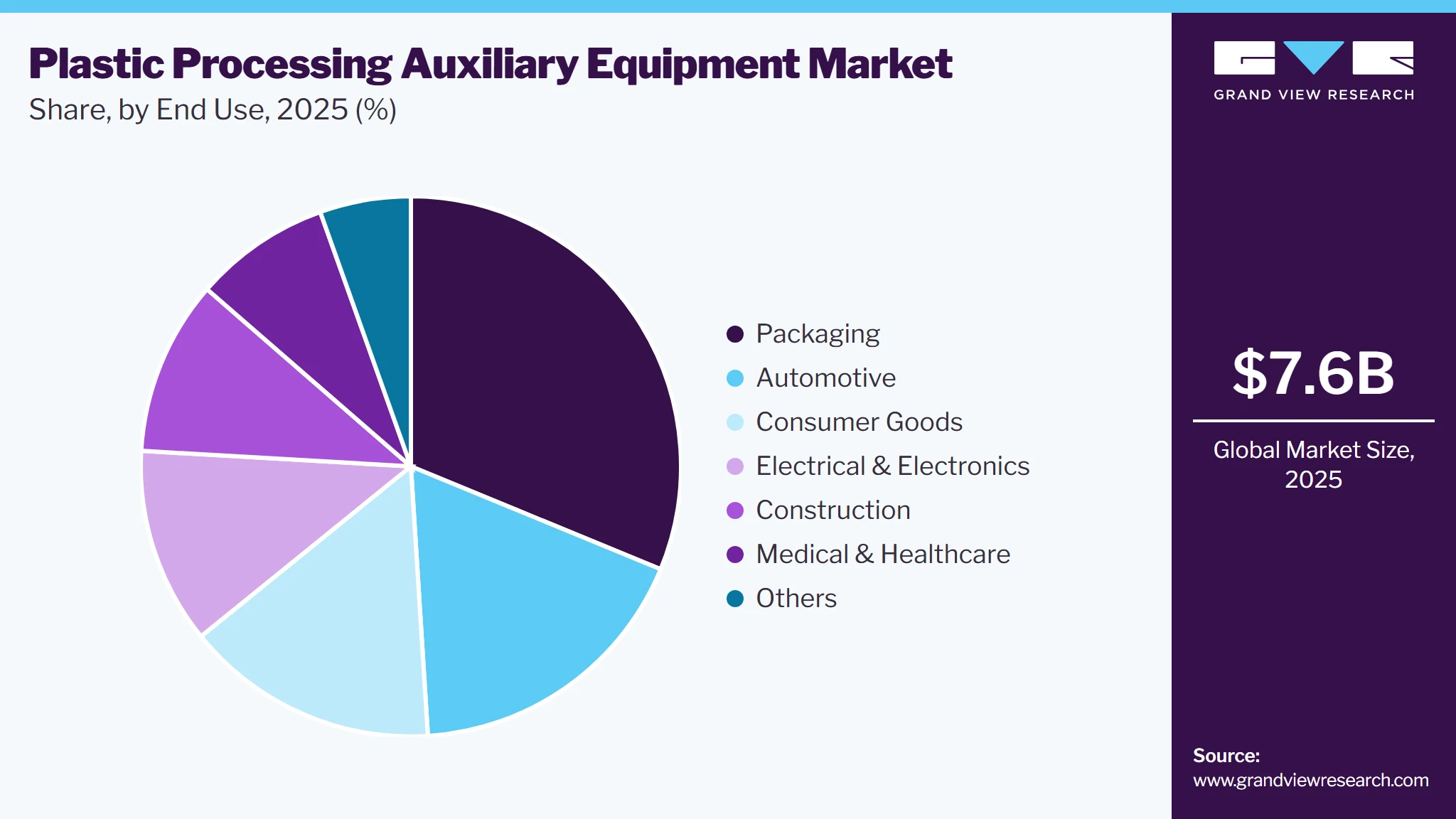
The medical & healthcare industries require highly specialized plastic products that must meet strict quality, safety, and compliance standards. In this sector, plastic processing auxiliary equipment such as temperature controllers, material dryers, and mold temperature controllers is essential for producing components like syringes, IV bags, surgical instruments, and diagnostic devices. These pieces of equipment ensure that the materials used in medical applications are processed consistently and without contamination, maintaining the integrity of the products.
Regional Insights
The North American plastic processing auxiliary equipment market is seeing substantial growth driven by the strong industrial base in the region, with key sectors such as automotive, packaging, and healthcare fueling demand. The increasing adoption of energy-efficient and automated solutions, in line with stricter environmental regulations, is one of the major trends in this market. Manufacturers are investing in advanced equipment such as IoT-enabled systems, material handling units, and smart temperature control devices.
U.S. Plastic Processing Auxiliary Equipment Market Trends
The plastic processing auxiliary equipment market in the U.S. is expected to grow at a CAGR of 3.6% from 2026 to 2033, driven by a robust manufacturing sector that includes industries such as automotive, consumer goods, and packaging. The demand for automation and smart manufacturing solutions is increasing, with companies focusing on improving production efficiency and reducing operational costs. The growing emphasis on sustainable practices is also leading to the adoption of energy-efficient systems like low-energy dryers, predictive maintenance tools, and recyclable material handling solutions.
The plastic processing auxiliary equipment market in Canada is expected to grow at a CAGR of 4.2% from 2026 to 2033. Canada’s plastic processing auxiliary equipment market is benefiting from steady growth in the manufacturing and construction sectors, with a particular focus on energy efficiency and sustainability. The demand for eco-friendly solutions, such as low-GWP refrigerants, advanced cooling systems, and optimized drying units, is rising as Canadian manufacturers seek to meet regulatory requirements and reduce their environmental impact.
Asia Pacific Plastic Processing Auxiliary Equipment Market Trends
Asia Pacific dominated the plastic processing auxiliary equipment market with the largest revenue share of 40.0% in 2025. The market is experiencing rapid growth, driven by rapid industrialization, urbanization, and rising demand for plastic products in sectors such as automotive, construction, and packaging. Countries like China and India are witnessing a surge in manufacturing activities, which is driving the need for advanced, efficient plastic processing equipment. The market is also witnessing an increase in the adoption of automation and digital technologies, such as IoT-enabled systems and robotics, to improve productivity and reduce operational costs.

The plastic processing auxiliary equipment market in China held the largest share in the Asia Pacific region in 2025. China is the largest market for plastic processing auxiliary equipment in Asia Pacific, fueled by its massive manufacturing sector and demand for a wide variety of plastic products. The country’s focus on upgrading its manufacturing infrastructure through Industry 4.0 technologies is driving demand for advanced auxiliary equipment, particularly in injection molding and extrusion processes.
The plastic processing auxiliary equipment market in India is expected to grow at a CAGR of 6.1% from 2026 to 2033. India’s plastic processing auxiliary equipment market is expanding rapidly, supported by the country's thriving manufacturing sector and increased demand for plastic products in the packaging, automotive, and consumer goods industries. The rise in industrial automation and the need for more energy-efficient solutions are key trends driving the market.
Europe Plastic Processing Auxiliary Equipment Market Trends
Europe is one of the key regions driving innovation in the plastic processing auxiliary equipment market, with a strong focus on sustainability, energy efficiency, and compliance with strict environmental regulations. The European Union’s commitment to reducing carbon emissions and promoting circular economies is pushing the demand for advanced auxiliary equipment, such as material handling systems that support the recycling of plastics and low-energy processing technologies.
The Germany plastic processing auxiliary equipment market is a European region owing to its strong manufacturing and industrial base, particularly in the automotive and packaging sectors. The country’s commitment to Industry 4.0 technologies, such as automation and digitalization, is transforming the market.
The UK plastic processing auxiliary equipment market is driven by the expanding demand for packaging solutions, particularly in the food and beverage industries. Sustainability and regulatory compliance are top priorities, with a rising demand for energy-efficient equipment such as dryers, blending systems, and cooling units that meet environmental standards.
Middle East & Africa Plastic Processing Auxiliary Equipment Market Trends
The plastic processing auxiliary equipment market in the Middle East & Africa is experiencing steady growth, with increasing demand from industries like construction, packaging, and automotive. The region’s focus on infrastructure development and industrialization is driving the demand for plastic products, leading to higher adoption of plastic processing technologies.
The Saudi Arabia plastic processing auxiliary equipment market is growing rapidly, driven by the country’s focus on industrial diversification and infrastructure development. The demand for plastic products in construction, packaging, and consumer goods is on the rise, leading to a greater need for advanced processing equipment. Saudi Arabia is also increasingly focused on sustainability, with growing interest in energy-efficient and environmentally friendly auxiliary equipment that helps reduce the carbon footprint of plastic manufacturing processes.
Latin America Plastic Processing Auxiliary Equipment Market Trends
The Latin American plastic processing auxiliary equipment market is experiencing moderate growth, primarily driven by the automotive and packaging industries. With a growing emphasis on sustainability, Latin American countries are increasingly adopting energy-efficient solutions to meet environmental regulations and reduce costs. As manufacturing activities ramp up in countries like Brazil and Mexico, there is a rising need for automation and smart technologies to improve production efficiency.
The Brazil market for plastic processing auxiliary equipment is the largest in Latin America, with significant demand from the automotive, packaging, and consumer goods sectors. The country’s growing focus on sustainability and the adoption of energy-efficient technologies are driving the demand for advanced auxiliary equipment, such as low-energy drying systems and optimized material handling solutions.
Key Plastic Processing Auxiliary Equipment Company Insights
Some of the key players operating in the market include Wittmann and Shibaura Machine Co., Ltd.
-
Wittmann is a leading global supplier of automation and auxiliary equipment for the plastics processing industry, known for its high-quality products that enhance the efficiency, sustainability, and performance of manufacturing processes. Founded in 1976 and headquartered in Vienna, Austria, the company offers a wide range of solutions, including robotics, dryers, granulators, temperature control units, and material handling systems. Wittmann focuses on providing integrated systems that enable seamless automation, improve production quality, and optimize energy usage.
-
Shibaura Machine Co., Ltd., a prominent Japanese manufacturer, specializes in injection molding machines and automation solutions for the plastics processing industry. Founded in 1949, the company is renowned for its advanced technology, producing high-precision and energy-efficient machines that meet diverse industrial needs. Shibaura Machine's product offerings include injection molding machines, robotic systems, and other auxiliary equipment designed to improve manufacturing efficiency and product quality.
Key Plastic Processing Auxiliary Equipment Companies:
The following key companies have been profiled for this study on the plastic processing auxiliary equipment market.
- Fel Plast India
- Wittmann
- Piovan
- Shibaura Machine Co., Ltd.
- Colortronic GmbH
- Conair
- Yushin
- Motan Colortronic
- Sidel
- Buss AG
- Coperion
- Novatec
- XIECHENG
- AIC Acquisition Company LLC
- Bry-Air (Asia) Pvt. Ltd.
Competitive Benchmarking
Category
Operating Strategies
Competitive Edge
Weakness
Established Players (e.g., Piovan; Wittmann; Conair; Motan Colortronic; Sidel; Coperion; Novatec; Shibaura Machine Co., Ltd..)
- Focus on integrated auxiliary system portfolios covering drying, conveying, dosing, and automation solutions for end-to-end process optimization.
- Strong emphasis on Industry 4.0 integration, offering smart monitoring, predictive maintenance, and centralized control platforms.
- Expansion through global service networks, OEM partnerships, and long-term customer lifecycle contracts.
- Strong dominance in high-volume, technologically advanced processing environments.
- Differentiated through system integration capability and process optimization solutions rather than standalone equipment.
- High reliance on aftermarket services and long-term client retention.
- Premium pricing limits competitiveness in fragmented SME-driven markets.
- Longer customization and delivery cycles due to complex system engineering.
- High dependency on mature industrial markets with slower growth elasticity.
Emerging & Regional Players (e.g., Fel Plast India; Colortronic GmbH; Yushin; Buss AG; XIECHENG; AIC Acquisition Company LLC; Bry-Air (Asia) Pvt. Ltd., regional players)
- Target cost-sensitive and mid-scale processors with application-specific auxiliary equipment.
- Strengthen regional manufacturing footprint and distributor-led sales channels for faster market access.
- Focus on selective product lines such as drying systems, material handling units, or localized automation solutions.
- Strong advantage in pricing and customization for regional processing requirements.
- Faster response times and flexible product configurations compared to global OEMs.
- Increasing penetration in emerging markets due to expanding plastic processing base.
- Limited global scale and weaker brand visibility in premium segments.
- Narrower product integration compared to full-solution providers.
- Lower investment in advanced automation, digital monitoring, and smart factory technologies.
Recent Developments
- In August 2022, LS Mtron launched a new AI-powered smart injection system for its injection molding machines. This innovative technology includes two key features: the AI Molding Assistant and Smart Weight Control. The AI Molding Assistant is a condition-based system that significantly reduces the time required to stabilize the initial molding setup by learning and replicating the actions of expert molding specialists through artificial intelligence.
Plastic Processing Auxiliary Equipment Market Report Scope
Report Attribute
Details
Market size value in 2025
USD 7.6 billion
Market size value in 2026
USD 7.9 billion
Revenue forecast in 2033
USD 10.7 billion
Growth rate
CAGR of 4.5% from 2026 to 2033
Base year for estimation
2025
Historical data
2021 - 2024
Forecast period
2026 - 2033
Quantitative units
Revenue in USD billion, and CAGR from 2026 to 2033
Report coverage
Revenue forecast, company ranking, competitive landscape, growth factors, and trends
Segments covered
Type, process type, end-use, region
Regional scope
North America; Europe; Asia Pacific; Latin America; Middle East & Africa
Country scope
U.S.; Canada; Mexico; Germany; France; Italy; UK; Spain; China; India; Japan; South Korea; Australia; Brazil; Argentina; Saudi Arabia; UAE; South Africa
Key companies profiled
Fel Plast India; Wittmann; Piovan; Shibaura Machine Co., Ltd.; Colortronic GmbH; Conair; Yushin; Motan Colortronic; Sidel; Buss AG; Coperion; Novatec; XIECHENG; AIC Acquisition Company LLC; Bry-Air (Asia) Pvt. Ltd.
Customization scope
Free report customization (equivalent up to 8 analysts' working days) with purchase. Addition or alteration to country, regional & segment scope.
Pricing and purchase options
Avail customized purchase options to meet your exact research needs. Explore purchase options
Global Plastic Processing Auxiliary Equipment Market Report Segmentation
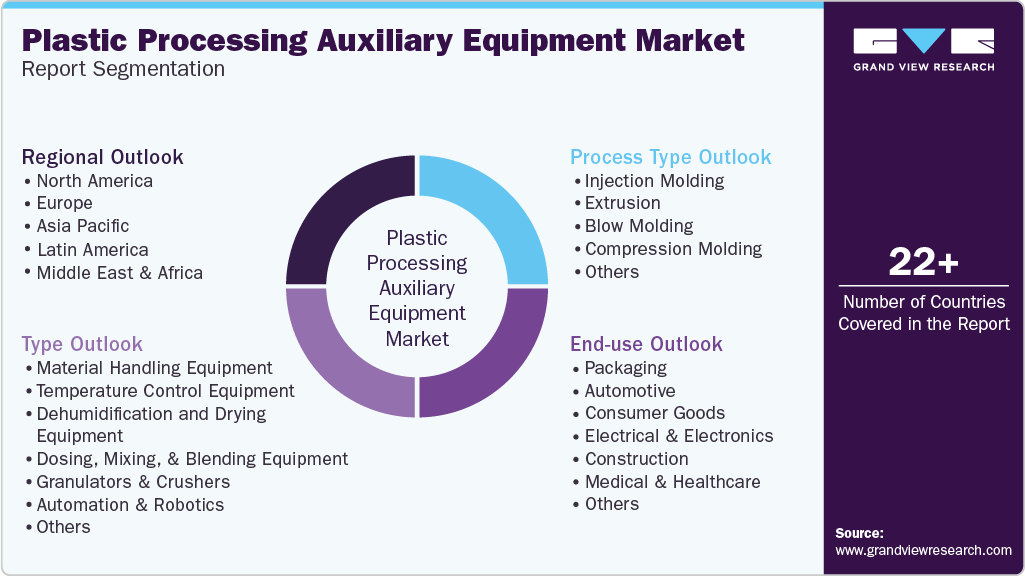
This report forecasts revenue growth at regional, and country levels and provides an analysis of the latest industry trends in each of the sub-segments from 2021 to 2033. For this study, Grand View Research has segmented the global plastic processing auxiliary equipment market report based on type, process type, end-use, and region.
-
Type Outlook (Revenue, USD Million, 2021 - 2033)
-
Material Handling Equipment
-
Temperature Control Equipment
-
Dehumidification and Drying Equipment
-
Dosing, Mixing, & Blending Equipment
-
Granulators & Crushers
-
Automation & Robotics
-
Others
-
-
Process Type Outlook (Revenue, USD Million, 2021 - 2033)
-
Injection Molding
-
Extrusion
-
Blow Molding
-
Compression Molding
-
Others
-
-
End-use Outlook (Revenue, USD Million, 2021 - 2033)
-
Packaging
-
Automotive
-
Consumer Goods
-
Electrical & Electronics
-
Construction
-
Medical & Healthcare
-
Others
-
-
Regional Outlook (Revenue, USD Million, 2021 - 2033)
-
North America
-
U.S.
-
Canada
-
Mexico
-
-
Europe
-
Germany
-
France
-
Spain
-
Italy
-
UK
-
-
Asia Pacific
-
China
-
India
-
Japan
-
South Korea
-
Australia
-
-
Latin America
-
Brazil
-
Argentina
-
-
Middle East and Africa
-
Saudi Arabia
-
UAE
-
South Africa
-
-
Research Methodology
The plastic processing auxiliary equipment market figures in this report are based on a proven research process that combines executive interviews with secondary research from proprietary databases, company filings, and recognized regulatory and institutional sources. Market size is built through value-chain sizing - reconciling supply-side and demand-side estimates - and triangulated with bottom-up and top-down approaches. Every estimate passes multiple levels of expert validation before publication, with each plastic processing auxiliary equipment segment quantified using the revenue-capture definitions in the table below.
Segment Definition
Segment - Type
Revenue Capture Definition
Material Handling Equipment
Revenue is generated from sale of material handling equipment used for automated transport, loading, and storage of plastic resins and processed materials, ensuring uninterrupted feed supply and minimizing manual handling across production lines.
Temperature Control Equipment
Revenue generated from the sale of temperature control equipment including mold temperature controllers, chillers, cooling systems, and heating units used to regulate process temperatures during plastic manufacturing operations.
Dehumidification and Drying Equipment
Revenue generated from the sale of dehumidifying dryers, hopper dryers, desiccant dryers, compressed air dryers, and related moisture removal equipment used to condition plastic resins before processing.
Dosing, Mixing, & Blending Equipment
Revenue generated from the sale of gravimetric feeders, volumetric feeders, mixers, blenders, dosing units, and material proportioning systems used for accurate material preparation in plastic processing.
Granulators & Crushers
Revenue generated from the sale of granulators, crushers, shredders, and size reduction equipment used for recycling plastic scrap, runners, rejected parts, and production waste.
Automation & Robotics
Revenue generated from the sale of robotic systems, take-out robots, sprue pickers, automated handling systems, and process automation equipment used to improve productivity in plastic processing operations.
Others
Revenue generated from the sale of other auxiliary equipment including static mixers, metal separators, dust collectors, color feeders, and ancillary equipment supporting plastic processing operations.
Segment - Process Type
Revenue Capture Definition
Injection Molding
Revenue generated from the sale of auxiliary equipment supplied for injection molding operations, including material handling, drying, temperature control, automation, and process support systems.
Extrusion
Revenue generated from the sale of auxiliary equipment used in extrusion processes for material preparation, cooling, conveying, blending, and automated production support.
Blow Molding
Revenue generated from the sale of auxiliary equipment supplied for blow molding operations, including resin drying, material conveying, cooling, automation, and process control systems.
Compression Molding
Revenue generated from the sale of auxiliary equipment used in compression molding processes to support material preparation, temperature regulation, automation, and material handling.
Others
Revenue generated from the sale of auxiliary equipment supplied for rotational molding, thermoforming, thermo-compression molding, and other plastic processing technologies.
Segment - End Use
Revenue Capture Definition
Packaging
Revenue is generated from high-demand auxiliary systems supporting packaging production lines, where efficiency, material consistency, and high throughput are critical requirements.
Automotive
This segment captures revenue from equipment used in manufacturing automotive plastic components, emphasizing precision, durability, and process reliability.
Consumer Goods
Revenue is derived from auxiliary systems supporting mass production of household and lifestyle products, focusing on operational efficiency and material versatility.
Electrical & Electronics
This segment generates revenue from equipment used in the production of high-precision plastic components requiring controlled processing conditions and material quality.
Construction
Revenue is captured from auxiliary systems supporting the production of pipes, fittings, insulation materials, and structural plastic components used in construction applications.
Medical & Healthcare
This segment accounts for revenue from high-precision, contamination-controlled auxiliary equipment used in manufacturing medical-grade plastic products.
Others
Revenue generated from the sale of plastic processing auxiliary equipment supplied for applications across agriculture, industrial manufacturing, aerospace, textiles, logistics, and other end-use industries not covered under the above segments.
Estimation Model
Layer Name
Key Question
Description
Plastic Processing Demand Layer
Where is plastic processing auxiliary equipment required?
Analyze demand across key plastic processing industries including packaging, automotive, consumer goods, electrical & electronics, construction, and medical & healthcare. Assess plastic production volumes, processing capacity, and manufacturing activity to establish the addressable demand for auxiliary equipment supporting plastic processing operations.
Manufacturing Capacity Expansion Layer
Where is new equipment demand being created?
Evaluate investments in plastic processing facilities, manufacturing capacity expansions, automation upgrades, and new production lines. Assess greenfield projects, plant modernization, and replacement of aging equipment that drive procurement of auxiliary equipment across plastic processing plants.
Product Adoption Layer
Which auxiliary equipment technologies are being deployed?
Segment demand by equipment type, process type, and end-use industry. Apply adoption rates based on production throughput, material characteristics, automation requirements, process efficiency, and manufacturing complexity.
Revenue Conversion Layer
How much market revenue is generated?
Estimate annual shipments of plastic processing auxiliary equipment by equipment type, process type, end-use industry, and region. Quantify revenues generated exclusively from the sale of new auxiliary equipment supplied to plastic processors, OEMs, and manufacturing facilities.
Delivered Customizations
This report has been delivered with the following In-depth customizations
Client Request
Customization Delivered
Value Adds
Competitive Benchmarking
Benchmarked leading plastic processing auxiliary equipment manufacturers based on product portfolio depth, automation capability, technological advancement, geographic presence, and strategic positioning, distinguishing global integrated OEMs from regional and specialized suppliers.
Enabled clear visibility of competitive hierarchy, supporting identification of differentiation gaps, positioning strategies, and potential competitive threats across key market segments.
Regional Segmentation
Refined regional analysis across Asia Pacific, North America, Europe, Latin America, and Middle East & Africa based on plastic processing intensity, manufacturing activity, automation adoption, and industrial investment trends.
Enabled identification of high-growth regions, demand concentration hubs, and region-specific investment opportunities for targeted market expansion.
Opportunity assessment
Evaluated growth opportunities across smart manufacturing adoption, energy-efficient auxiliary systems, recycling-driven plastic processing, retrofit and replacement demand, and Industry 4.0-enabled equipment integration.
Helped prioritize high-value market segments by highlighting areas with strong modernization trends, sustainability focus, and increasing demand for integrated auxiliary solutions.
Frequently Asked Questions About This Report
Based on type, the material handling equipment segment led the market with the largest revenue share of 23.9% in 2025.
Based on process type, the injection molding segment led the market with the largest revenue share of 40.0% in 2025.
Asia Pacific dominated the plastic processing auxiliary equipment market with the largest revenue share of 40.0% in 2025.
China held the largest market share in the Asia Pacific region in 2025.
The global plastic processing auxiliary equipment market, in terms of revenue, is expected to grow at a compound annual growth rate of 4.5% from 2026 to 2033 to reach USD 10.7 billion by 2033.
Which end use segment accounted for the largest plastic processing auxiliary equipment market share?The packaging end use segment led the market with the largest revenue share of 31.2% in 2025.
The global plastic processing auxiliary equipment market size was valued at USD 7.6 billion in 2025 and is estimated at USD 7.9 billion in 2026.
Some of the key players operating in the plastic processing auxiliary equipment market include Fel Plast India, Wittmann, Piovan, Shibaura Machine Co., Ltd., Colortronic GmbH, Conair, Yushin, Motan Colortronic, Sidel, Buss AG, Coperion, Novatec, XIECHENG , AIC Acquisition Company LLC, Bry-Air (Asia) Pvt. Ltd.
Key factors driving the plastic processing auxiliary equipment market are growth in plastic production and processing volumes, demand for enhanced operational efficiency and automation, and technological advancements and industry 4.0 integration.
About the Author(s)
Advanced Interior Materials Research Team
Advanced Materials · Advanced Interior MaterialsThis report was authored by the advanced interior materials research team at Grand View Research - comprising two research analysts, one senior research analyst, and one industry expert - with specialized expertise in the advanced interior materials segment of the advanced materials industry. All findings are based on proprietary advanced materials databases, executive interviews, and regulatory analysis, subject to internal peer review prior to publication.
Last Updated:
Speak to Analyst


Customize this report to your needs - add regions, segments, or data points, with 20% free customization.
Or view our licence options:


ISO 9001:2015 & 27001:2022 Certified
We are GDPR and CCPA compliant! Your transaction & personal information is safe and secure. For more details, please read our privacy policy.


