- Home
- »
- Organic Chemicals
- »
-
PFAS Treatment Market Size & Share Report, 2026-2033GVR Report cover
![PFAS Treatment Market (2026 - 2033)Report]()
PFAS Treatment Market (2026 - 2033)
Size, Share & Trends Analysis Report By Technology (Separation & Concentration, Destruction), By Solution (Water Treatment Systems, Water Treatment Materials & Chemicals), By End-use (Industrial, Commercial), By Region, And Segment Forecasts
Market Size, 2025
$2.8BMarket Estimate, 2026
$3.0BMarket Forecast, 2033
$4.8BCAGR, 2026–2033
7.1%PFAS Treatment Market Summary
The global PFAS treatment market size was estimated at USD 2.8 billion in 2025 and is projected to grow from USD 3.0 billion in 2026 to USD 4.8 billion by 2033, at a CAGR of 7.1% from 2026 to 2033. North America held the largest revenue share of 41.9% in 2025. The growth of the PFAS treatment market is being strongly driven by the growing implementation of stringent environmental regulations and water quality standards across developed and emerging economies.

Key Market Trends & Insights
- By technology: Separation & concentration segment held the largest revenue share of 75.1% in 2025.
- By solution: Water treatment systems segment dominated the market with the largest revenue share of 68.2%.
- By end use: Municipal segment dominated the PFAS treatment market in 2025, accounting for a market share of 59.8%.
Regional Highlights
- Largest regional market: North America (41.9% revenue share, 2025)
- By country: The U.S. held the largest market share in 2025.
Market Size & Forecast
- Market size in 2025: USD 2.8 Billion
- Estimated market size in 2026: USD 3.0 Billion
- Projected market size by 2033: USD 4.8 Billion
- CAGR (2026-2033): 7.1%
The market presents significant growth opportunities through the expansion of municipal water infrastructure, modernization projects, and rising industrial demand for sustainable remediation solutions. Emerging technologies such as electrochemical oxidation, supercritical water oxidation, foam fractionation, and advanced membrane filtration are creating opportunities for companies to offer more efficient contaminant removal and destruction systems.
The PFAS water treatment market is witnessing increased adoption across municipal drinking water systems, industrial wastewater treatment facilities, and environmental remediation projects, creating new avenues for technology innovation and market expansion. Growing investments in industrial wastewater treatment, environmental remediation programs, and ESG-focused sustainability initiatives are also supporting market expansion. Furthermore, rapid urbanization and increasing water quality concerns across Asia Pacific, the Middle East, and Latin America are expected to create substantial long-term opportunities for technology providers and engineering service companies.
Market Dynamics
The PFAS treatment market is experiencing significant growth driven by increasing regulatory scrutiny of per- and polyfluoroalkyl substances (PFAS), growing concerns regarding water contamination, and rising investments in advanced water treatment infrastructure. Governments and environmental agencies across North America, Europe, and Asia Pacific are implementing stricter drinking water standards and remediation requirements for PFAS compounds due to their persistence, bioaccumulation potential, and associated health risks. This has accelerated the adoption of treatment technologies such as granular activated carbon (GAC), ion exchange resins, membrane filtration, electrochemical treatment, and thermal destruction systems across municipal, industrial, and defense-related applications. Additionally, increasing public awareness, ongoing contamination assessments, and legal liabilities associated with PFAS pollution are encouraging utilities, industries, and remediation service providers to invest in effective PFAS removal and destruction solutions, supporting long-term market expansion
The growing implementation of stringent regulations governing PFAS contamination is one of the primary drivers of the PFAS treatment market. Regulatory agencies across North America, Europe, and other developed regions are establishing increasingly strict limits for PFAS concentrations in drinking water, groundwater, wastewater, and industrial discharges. Governments are also expanding monitoring requirements and remediation obligations for municipalities, industrial facilities, military installations, airports, and other sites where PFAS contamination has been identified. As a result, utilities and industrial operators are investing heavily in treatment technologies capable of removing or destroying PFAS compounds to ensure regulatory compliance and minimize environmental liabilities.
Increasing legal actions and environmental accountability measures are accelerating demand for PFAS treatment solutions. Large-scale contamination incidents linked to firefighting foams, industrial manufacturing, landfill leachates, and chemical processing operations have led to substantial remediation programs worldwide. The growing financial and reputational risks associated with PFAS pollution are encouraging organizations to adopt advanced treatment technologies such as activated carbon, ion exchange resins, membrane filtration, and destructive treatment systems. Consequently, regulatory pressure is expected to remain a major growth catalyst for the PFAS treatment market over the forecast period.
The high cost associated with PFAS treatment and destruction remains a significant challenge for market growth. PFAS compounds are highly persistent and resistant to conventional water treatment methods, requiring advanced technologies such as granular activated carbon (GAC), ion exchange systems, reverse osmosis membranes, electrochemical oxidation, plasma treatment, and thermal destruction processes. These systems often involve substantial capital investment, high operating expenses, specialized infrastructure requirements, and ongoing maintenance costs. For smaller municipalities, industrial facilities, and water utilities with limited budgets, the financial burden of implementing comprehensive PFAS treatment systems can be considerable.
The complexity of PFAS chemistry creates technical challenges for treatment providers. Thousands of PFAS compounds exist, each exhibiting different physical and chemical characteristics that influence treatment effectiveness. While many technologies are capable of removing PFAS from water streams, complete destruction of these compounds remains technologically demanding and costly. Disposal and management of PFAS-concentrated waste streams generated during treatment processes further increase operational complexity. These challenges may delay project implementation and limit adoption in certain cost-sensitive markets
The increasing global focus on long-term PFAS remediation presents substantial growth opportunities for technology providers and service companies operating within the PFAS treatment market. Governments, utilities, and industrial stakeholders are allocating significant funding toward water infrastructure upgrades, site remediation programs, and contamination assessment initiatives. Large-scale remediation projects associated with military facilities, airports, manufacturing plants, and municipal water systems are creating strong demand for advanced treatment and monitoring solutions. As regulatory frameworks continue to evolve, the number of sites requiring PFAS remediation is expected to increase significantly, expanding the addressable market for treatment providers.
Growing interest in PFAS destruction technologies represents a major future opportunity. While conventional technologies primarily focus on PFAS removal and concentration, emerging solutions such as electrochemical oxidation, plasma treatment, supercritical water oxidation, advanced oxidation processes, and thermal destruction systems are designed to permanently eliminate PFAS compounds. Increasing investment in these next-generation technologies is expected to accelerate commercialization and improve treatment effectiveness. Companies capable of providing scalable, cost-efficient, and regulatory-compliant destruction solutions are likely to benefit from growing demand as industries and governments seek permanent remediation strategies rather than temporary containment approaches.
Market Concentration & Characteristics
The PFAS treatment market is moderately consolidated, with competition led by established multinational environmental engineering and water technology companies alongside emerging specialized treatment technology providers. Large players such as Veolia, AECOM, Xylem, and CDM Smith maintain strong market positions through extensive infrastructure capabilities, integrated service portfolios, and global operational networks. Meanwhile, innovative companies including Saltworks Technologies Inc., Oxyle, Axine Water Technologies, and Aquagga are strengthening competition through advanced contaminant destruction technologies and niche remediation solutions. The market is characterized by continuous technological innovation, strategic partnerships, pilot-scale validation projects, and increasing focus on sustainable and energy-efficient treatment systems.
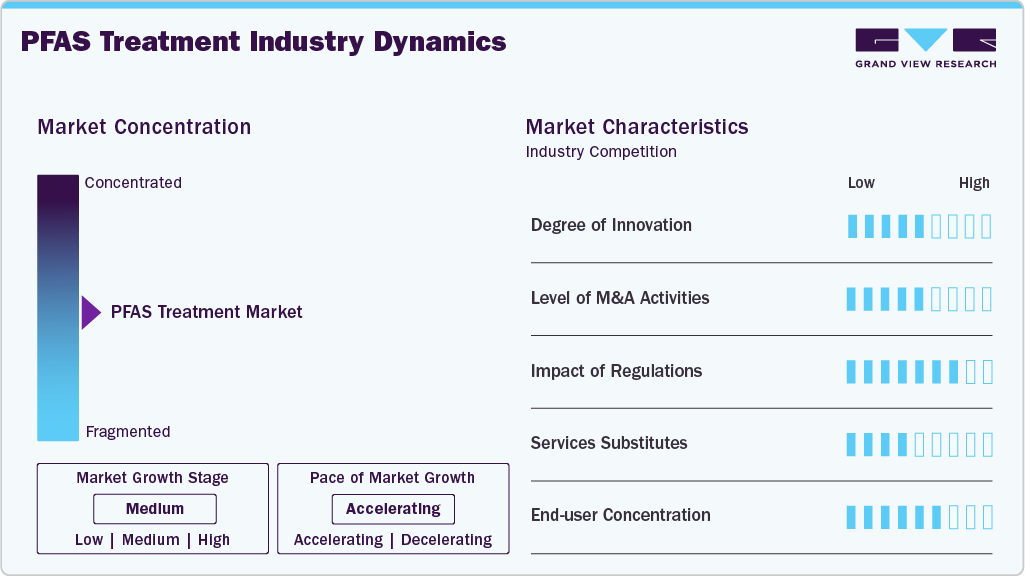
The market is characterized by a high level of regulatory involvement, long project development cycles, and increasing emphasis on customized remediation strategies based on contamination source and concentration levels. Companies are focusing on integrated treatment platforms that combine contaminant removal, destruction, monitoring, and waste management capabilities to improve operational efficiency and regulatory compliance. In addition, growing collaboration between technology developers, engineering firms, municipalities, and industrial operators is accelerating the commercialization of next-generation PFAS destruction technologies. The market continues to evolve with increasing investments in research and development aimed at improving treatment effectiveness, reducing secondary waste generation, and lowering long-term operational costs.
Analyst Perspective
The PFAS treatment market is undergoing a significant transformation as regulatory agencies, municipalities, and industrial operators intensify efforts to address contamination caused by per- and polyfluoroalkyl substances (PFAS). While traditional treatment technologies such as granular activated carbon (GAC), ion exchange resins, and membrane filtration currently account for the majority of installed treatment capacity, the industry's long-term growth is increasingly being driven by the need for permanent PFAS destruction solutions. Growing regulatory scrutiny, expanding monitoring programs, and increasing public awareness regarding the environmental and health impacts of PFAS contamination are accelerating investments in both remediation infrastructure and advanced treatment technologies.
The competitive landscape is evolving from conventional water treatment toward integrated PFAS management solutions encompassing detection, separation, concentration, destruction, and waste disposal. Technology providers capable of offering complete treatment systems, scalable destruction technologies, and cost-effective lifecycle management solutions are expected to gain a competitive advantage. Going forward, rising investments in municipal water infrastructure, industrial wastewater treatment, military site remediation, and emerging PFAS destruction technologies are expected to create substantial growth opportunities across the global PFAS treatment value chain.
Technology Insights
The separation and concentration segment accounted for the largest share of the PFAS treatment market, representing 75.1% of total revenue in 2025, driven by the widespread adoption of technologies such as granular activated carbon, ion exchange resins, membrane filtration, and foam fractionation systems across municipal and industrial water treatment applications. These technologies are extensively utilized due to their established commercial viability, high contaminant removal efficiency, and compatibility with existing water treatment infrastructure. Growing regulatory requirements for PFAS removal from drinking water and wastewater systems continue to support demand for separation and concentration technologies globally.
The destruction segment is projected to grow with a CAGR of 10.1% from 2026 to 2033. Increasing concerns regarding secondary waste generation and the long-term environmental impact of concentrated PFAS waste streams are driving demand for permanent destruction technologies. Advanced treatment methods, including electrochemical oxidation, plasma treatment, supercritical water oxidation, and thermal destruction, are gaining significant attention as industries and municipalities seek sustainable and regulatory-compliant remediation solutions. Continuous investments in research, pilot-scale validation, and commercialization of PFAS destruction technologies are expected to accelerate segment growth over the forecast period.
Solution Insights
The water treatment systems segment accounted for the largest share of the PFAS Treatment market, representing 68.2% of total revenue in 2025. The segment’s growth is supported by increasing investments in advanced treatment infrastructure for municipal water utilities, industrial wastewater facilities, and groundwater remediation projects. Rising adoption of integrated treatment systems incorporating membrane filtration, activated carbon, ion exchange, and advanced oxidation technologies is further contributing to segment expansion. In addition, growing infrastructure modernization initiatives and stricter environmental compliance standards are accelerating demand for high-capacity and energy-efficient water treatment systems.
The water treatment materials & chemicals segment continues to play a critical role in supporting PFAS remediation processes across multiple treatment applications. Materials such as activated carbon, specialty resins, filtration media, and chemical treatment agents are widely utilized for contaminant adsorption, separation, and treatment optimization. Increasing replacement demand for filtration media, rising focus on treatment efficiency, and ongoing advancements in chemical formulations are expected to support steady growth of this segment throughout the forecast period.
End Use Insights
The municipal segment accounted for the largest share of the PFAS treatment market, representing 59.8% of total revenue in 2025. The segment’s leadership is driven by increasing government investments in drinking water infrastructure, rising public health concerns related to PFAS contamination, and stricter regulatory standards for municipal water supplies. Municipal utilities are actively adopting advanced treatment technologies to improve water quality, achieve regulatory compliance, and strengthen long-term environmental sustainability initiatives. Growing infrastructure upgrade projects across developed economies continue to support strong demand within the municipal sector.

The industrial segment is projected to register the fastest CAGR of 8.2% from 2026 to 2033. Rapid industrialization and increasing environmental compliance requirements across industries such as chemicals, semiconductors, textiles, oil & gas, and manufacturing are driving the adoption of advanced PFAS treatment solutions. Industrial facilities are increasingly investing in wastewater treatment systems, groundwater remediation technologies, and sustainable contaminant management solutions to minimize environmental liabilities and meet evolving discharge regulations. Rising ESG commitments and growing focus on sustainable industrial operations are also expected to contribute significantly to segment growth.
Regional Insights
North America for 41.9% of the PFAS Treatment market revenue in 2025. The region’s strong market position is supported by stringent environmental regulations, increasing federal and state-level funding for water infrastructure modernization, and rising investments in groundwater remediation projects. Growing public awareness regarding PFAS contamination and expanding remediation activities across municipal utilities, industrial facilities, airports, and military sites are further accelerating demand for advanced treatment technologies. In addition, the presence of major environmental engineering companies and technology providers continues to strengthen regional market development.

U.S. PFAS Treatment Market Trends
U.S. maintained a leading position in the North America PFAS Treatment market. Municipal utilities and industrial operators are actively adopting technologies such as activated carbon filtration, ion exchange systems, membrane separation, and advanced oxidation processes to comply with evolving PFAS concentration limits. The growing number of remediation projects at defense facilities, manufacturing plants, and contaminated groundwater sites is also supporting strong market expansion across the country.
Europe PFAS Treatment Market Trends
The Europe market is expected to grow at a CAGR of 7.2% during the forecast period.Increasing environmental sustainability initiatives, stricter wastewater discharge regulations, and rising concerns regarding emerging contaminants are driving market growth across the region. European governments and water authorities are investing in advanced treatment infrastructure and sustainable remediation technologies to strengthen drinking water quality standards and industrial wastewater management practices. Growing focus on circular economy strategies and environmental protection policies is further supporting the adoption of advanced PFAS treatment solutions.
PFAS treatment market in Germany is one of the leading markets in Europe due to its strong industrial base, advanced environmental regulations, and increasing investments in sustainable water treatment technologies. Industrial sectors including chemicals, automotive, manufacturing, and electronics are increasingly implementing advanced wastewater treatment and contaminant removal systems to comply with strict environmental standards. In addition, rising focus on groundwater protection and resource-efficient water management is contributing to the growing adoption of PFAS remediation technologies across municipal and industrial applications.
Asia Pacific PFAS Treatment Market Trends
PFAS treatment market in Asia Pacific is projected to witness substantial growth during the forecast period due to rapid industrialization, increasing urban population, and rising investments in municipal and industrial water treatment infrastructure. Growing environmental awareness and tightening government regulations regarding wastewater discharge and drinking water quality are accelerating the adoption of advanced PFAS remediation technologies across the region. Countries such as China, Japan, South Korea, India, and Australia are increasingly investing in groundwater remediation, industrial wastewater treatment, and sustainable water management initiatives to address emerging contaminant concerns.
PFAS treatment market in China is witnessing significant growth due to rapid industrialization, expanding urban water infrastructure, and increasing environmental compliance requirements. Rising concerns regarding industrial wastewater contamination and growing investments in municipal water treatment facilities are supporting demand for advanced PFAS remediation technologies. Government initiatives focused on improving water quality standards and strengthening environmental monitoring systems are further accelerating market development. The country’s expanding manufacturing sector and increasing adoption of sustainable industrial practices are expected to create long-term growth opportunities for treatment technology providers.
Latin America PFAS Treatment Market Trends
PFAS treatment market in Latin America is experiencing gradual growth driven by increasing industrial wastewater treatment requirements and rising investments in water quality improvement initiatives. Countries across the region are strengthening environmental regulations related to industrial discharge and groundwater contamination, particularly in mining, manufacturing, and energy sectors. Municipal authorities are also investing in modernization of water treatment infrastructure to improve access to safe drinking water and support sustainable urban development. Growing awareness regarding emerging contaminants is expected to support future market expansion.
Middle East & Africa PFAS Treatment Market Trends
PFAS treatment market in Middle East & Africa is expanding steadily due to increasing investments in desalination projects, industrial wastewater management, and environmental sustainability initiatives. Rapid urbanization, industrial development, and growing pressure on water resources are encouraging adoption of advanced water treatment technologies across the region. Governments and utilities are focusing on improving water reuse capabilities and strengthening regulatory frameworks related to water quality and environmental protection. In addition, increasing infrastructure investments and industrial diversification strategies are expected to create new opportunities for PFAS treatment solution providers.
Key PFAS Treatment Company Insights
Some key players operating in the market include Veolia, AECOM, Xylem, among others.
-
Veolia is a leading participant in the PFAS treatment market, providing advanced water treatment, wastewater management, and environmental remediation solutions for municipal and industrial applications. The company focuses on technologies such as activated carbon filtration, ion exchange, membrane systems, and advanced oxidation processes to support effective PFAS removal and regulatory compliance. Veolia continues to strengthen its global presence through long-term infrastructure contracts, operational service agreements, and investments in sustainable and energy-efficient treatment technologies. Its strong engineering expertise, integrated environmental service portfolio, and extensive international network support its competitive position in large-scale water treatment and remediation projects.
-
AECOM is a prominent infrastructure and environmental engineering company engaged in PFAS remediation and water treatment projects across municipal, industrial, and defense sectors. The company provides consulting, site assessment, engineering design, groundwater remediation, and environmental compliance services utilizing technologies such as granular activated carbon, ion exchange, and advanced treatment systems. AECOM’s strong regulatory expertise, project management capabilities, and global infrastructure experience enable the company to deliver customized remediation strategies for complex contamination challenges. Its focus on sustainable environmental solutions, digital engineering, and long-term government and utility partnerships continues to support growth in the PFAS treatment market.
Key PFAS Treatment Companies
The following key companies have been profiled for this study on the PFAS Treatment market.
-
AECOM
-
Aquagga
-
Axine Water Technologies
-
CDM Smith, Inc.
-
Gradiant
-
Ovivo
-
Oxyle
-
Saltworks Technologies Inc.
-
Veolia
-
Xylem
Competitive Benchmarking
Category
Operating Strategies
Competitive Edge
Weakness
Established Players (Veolia; AECOM; Xylem; CDM Smith, Inc.; Ovivo, Gradiant)
- Focus on expansion of advanced PFAS treatment portfolios including activated carbon, ion exchange, membrane filtration, and advanced oxidation technologies.
- Significant investments in large-scale municipal and industrial water treatment infrastructure projects to strengthen long-term service contracts.
- Strategic collaborations with utilities, industrial manufacturers, and government agencies to support regulatory compliance and remediation activities.
- Emphasis on integrated water management solutions combining treatment, monitoring, engineering, and operational services.
- Expansion of digital monitoring, automation, and energy-efficient treatment systems to improve operational performance and sustainability
- Strong global presence with extensive engineering, infrastructure, and operational capabilities across municipal and industrial water sectors.
- Advanced technological expertise and broad treatment portfolios enabling comprehensive PFAS remediation solutions.
- Established relationships with regulatory agencies, utilities, and industrial clients supporting long-term project pipelines.
- Financial strength supports continuous investment in research, innovation, and large-scale infrastructure development.
- Strong brand recognition and diversified service offerings across water treatment, environmental remediation, and sustainability solutions
- High capital investment requirements associated with advanced PFAS treatment technologies and infrastructure deployment.
- Complex regulatory compliance requirements due to evolving PFAS standards across different regions.
- Operational challenges related to disposal and destruction of PFAS-contaminated waste streams.
- Dependence on government funding cycles and municipal infrastructure investment programs.
- Intense competition from specialized treatment technology providers and regional environmental engineering firms
Category
Operating Strategies
Competitive Edge
Weakness
Emerging / Regional Players (Saltworks Technologies Inc.; Oxyle; Axine Water Technologies; Aquagga)
- Focus on development of specialized PFAS destruction and high-efficiency contaminant removal technologies.
- Expansion through pilot projects, technology partnerships, and industrial demonstration programs targeting high-growth remediation markets.
- Increasing investments in electrochemical oxidation, supercritical water oxidation, foam fractionation, and advanced separation technologies.
- Emphasis on cost-effective and sustainable PFAS destruction solutions that minimize secondary waste generation.
- Strengthening collaborations with industrial facilities, defense sites, and municipal utilities to accelerate commercial adoption
- Strong specialization in innovative PFAS treatment and destruction technologies addressing emerging regulatory requirements.
- Greater operational flexibility and faster commercialization of next-generation treatment solutions.
- Ability to provide customized remediation systems for complex industrial and contaminated site applications.
- Growing technological innovation capabilities supporting improved treatment efficiency and lower environmental impact.
- Competitive positioning in niche PFAS remediation markets with increasing demand for sustainable treatment solutions.
- Limited global operational footprint and lower market penetration compared to large multinational water treatment companies.
- Smaller financial resources restricting large-scale commercialization and infrastructure expansion.
- Dependence on pilot-scale validation and regulatory approvals for broader technology adoption.
- Lower economies of scale impacting cost competitiveness in large municipal treatment projects.
- Exposure to evolving regulatory standards, technology performance expectations, and funding availability for remediation projects
Recent Developments
-
In February 2026, Veolia strengthened its presence in India by securing two major 15-year operations and maintenance contracts for Mumbai’s Bhandup and Panjrapur water treatment plants. With a combined treatment capacity of 2,910 MLD, the projects represent one of the largest municipal water infrastructure contracts awarded to a French company in India. Through these developments, Veolia expanded its long-term operational footprint in the Indian water sector while reinforcing its position in municipal water treatment, hazardous waste management, and energy services. The facilities are expected to meet more than 60% of Mumbai’s water demand by 2030 while incorporating advanced treatment technologies to enhance operational efficiency and reduce energy consumption.
-
In January 2026, CDM Smith collaborated with Carollo Engineers on PFAS treatment upgrade projects for Broward County to improve drinking water quality and support compliance with emerging environmental regulations. The partnership focused on designing and implementing advanced treatment infrastructure equipped with specialized contaminant removal technologies to address PFAS-related water quality concerns. By combining engineering expertise, treatment optimization capabilities, and infrastructure planning services, the companies aimed to strengthen sustainable municipal water management and support long-term regulatory compliance objectives.
PFAS Treatment Market Report Scope
Report Attribute
Details
Market size in 2025
USD 2.8 billion
Estimated market size in 2026
USD 3.0 billion
Projected market size by 2033
USD 4.8 billion
Growth rate
CAGR of 7.1% from 2026 to 2033
Base year for estimation
2025
Historical data
2021 - 2024
Forecast period
2026 - 2033
Quantitative units
Revenue in USD million/billion and CAGR from 2026 to 2033
Report coverage
Revenue forecast, company ranking, competitive landscape, growth factors, and trends
Segments covered
Technology, solution, end use, region
Regional scope
North America; Europe; Asia Pacific; Latin America; MEA
Country scope
U.S.; Canada; Mexico; Germany; UK; France; Italy; Spain; Sweden; Denmark; Norway; China; India; Japan; South Korea, Saudi Arabia; UAE
Key companies profiled
Veolia; AECOM; Xylem; CDM Smith Inc.; Saltworks Technologies Inc.; Oxyle; Axine Water Technologies; Ovivo; Gradiant; Aquagga
Customization scope
Free report customization (equivalent up to 8 analysts' working days) with purchase. Addition or alteration to country, regional & segment scope.
Pricing and purchase options
Avail customized purchase options to meet your exact research needs. Explore purchase options
Global PFAS Treatment Market Report Segmentation
This report forecasts revenue growth at global, regional, and country levels and provides an analysis of the latest industry trends in each of the sub-segments from 2021 to 2033. For this study, Grand View Research has segmented the global PFAS treatment market report based on technology, solution, end use, and region:

-
Technology Outlook (Revenue, USD Billion, 2021 - 2033)
-
Separation & Concentration
-
Adsorption
-
Membrane
-
Ion Exchange
-
Foam Fractionation
-
Other Separation Methods
-
-
Destruction
-
Thermal
-
Electrochemical
-
Plasma
-
SCWO
-
Ultrasonic
-
Other Destruction Methods
-
-
-
Solution Outlook (Revenue, USD Billion, 2021 - 2033)
-
Water Treatment Systems
-
Water Treatment Materials & Chemicals
-
-
End Use Industry Outlook (Revenue, USD Billion, 2021 - 2033)
-
Industrial
-
Commercial
-
Municipal
-
-
Region Outlook (Revenue, USD Billion, 2021 - 2033)
-
North America
-
U.S.
-
Canada
-
Mexico
-
-
Europe
-
Germany
-
UK
-
France
-
Italy
-
Spain
-
Sweden
-
Denmark
-
Norway
-
-
Asia Pacific
-
China
-
India
-
Japan
-
South Korea
-
-
Latin America
-
Middle East & Africa
-
Saudi Arabia
-
UAE
-
-
Research Methodology
Segment Definition
Segment - Product
Revenue capture definition
Separation & Concentration
Revenue generated from technologies designed to remove, capture, and concentrate PFAS compounds from contaminated water, wastewater, landfill leachate, and industrial process streams. This includes granular activated carbon (GAC), ion exchange resins, reverse osmosis membranes, nanofiltration systems, and other separation technologies that isolate PFAS for subsequent treatment or disposal
Destruction
Revenue generated from technologies designed to permanently degrade and eliminate PFAS compounds rather than simply removing them from water streams. This includes thermal destruction systems, electrochemical oxidation, plasma treatment, supercritical water oxidation, advanced oxidation processes, and other emerging PFAS destruction solutions utilized by municipalities, industries, and remediation service providers
Segment - Solution
Revenue capture definition
Water Treatment Systems
Revenue generated from the sale, installation, operation, and maintenance of PFAS treatment equipment and integrated treatment systems used for drinking water treatment, groundwater remediation, industrial wastewater treatment, and environmental cleanup applications. Revenue is driven by increasing deployment of filtration, membrane, adsorption, and destruction technologies across municipal and industrial facilities
Water Treatment Materials & Chemicals
Revenue generated from consumable materials and specialty chemicals used in PFAS treatment processes, including activated carbon, ion exchange resins, filtration media, treatment reagents, membrane materials, and performance-enhancing chemicals. Revenue is supported by recurring replacement cycles and ongoing operation of PFAS treatment facilities
Segment - End Use
Revenue capture definition
Industrial
Revenue generated from PFAS treatment solutions deployed across manufacturing facilities, chemical processing plants, semiconductor production, metal finishing operations, oil & gas facilities, airports, and other industrial sites where PFAS contamination is present in wastewater, process streams, or groundwater. Demand is driven by regulatory compliance requirements and environmental remediation obligations
Commercial
Revenue generated from PFAS treatment systems and services utilized by commercial establishments such as office complexes, educational institutions, healthcare facilities, hospitality properties, retail centers, and private water utilities seeking to ensure safe water quality and regulatory compliance
Municipal
Revenue generated from PFAS treatment infrastructure installed by municipal water utilities, wastewater treatment facilities, public water systems, and government remediation projects. This segment represents a major source of demand, driven by increasingly stringent drinking water regulations, public health concerns, and investments in long-term water quality improvement initiatives
Estimation Model
Layer Name
Key Question
Description
End-Use Industry Demand Layer
What forms the demand base?
Identify global PFAS contamination sources across municipal water systems, industrial facilities, airports, military installations, landfills, chemical manufacturing plants, semiconductor facilities, and wastewater treatment systems. This layer establishes the addressable demand base by evaluating contaminated water volumes, affected sites, regulatory thresholds, and remediation requirements
PFAS Treatment Adoption Layer
Where are PFAS Treatment used?
Estimate the penetration of PFAS treatment technologies across drinking water treatment, industrial wastewater treatment, groundwater remediation, landfill leachate management, and environmental cleanup projects. Assess adoption levels of separation, concentration, and destruction technologies across regions, industries, and regulatory environments
Consumption Intensity Layer
How much PFAS Treatment is used?
Analyze treatment requirements based on contaminant concentrations, water volumes processed, treatment performance standards, technology selection, media replacement cycles, and destruction requirements. Treatment intensity is influenced by PFAS contamination levels, regulatory compliance targets, water quality characteristics, and site-specific remediation objectives
Revenue Layer
How is market revenue generated?
Market revenue is generated through the sale of PFAS treatment systems, treatment materials, consumables, specialty chemicals, filtration media, engineering services, remediation projects, and long-term operation & maintenance contracts. Revenue is captured from municipal utilities, industrial facilities, government agencies, environmental service providers, defense organizations, and commercial water treatment operators seeking PFAS compliance and remediation solution
Delivered Customizations
This report has been delivered with the following In-depth customizations
Client Request
Customization Delivered
Value Adds
Regional Segmentation
Detailed cross-segmentation analysis assessing PFAS treatment and remediation demand across technologies, mapped against solution categories including water treatment systems and treatment materials & chemicals. The study further evaluates adoption patterns across industrial, commercial, and municipal end-use sectors to identify high-utilization technology-solution combinations and evolving treatment preferences.
Detailed cross-segmentation analysis assessing PFAS treatment and remediation demand across technologies, mapped against solution categories including water treatment systems and treatment materials & chemicals. The study further evaluates adoption patterns across industrial, commercial, and municipal end-use sectors to identify high-utilization technology-solution combinations and evolving treatment preferences.
Competitive Benchmarking
Comparative benchmarking of PFAS treatment technology providers and water treatment solution manufacturers based on technology capabilities, treatment efficiency, product portfolio strength, regulatory compliance expertise, innovation focus, deployment scalability, strategic collaborations, and service offerings. The assessment also evaluates competitive positioning across separation technologies, destruction technologies, and integrated treatment systems.
Assists stakeholders in evaluating supplier and technology partner capabilities while identifying operational, technological, and commercialization strengths across the competitive landscape. Provides actionable intelligence to support vendor selection, partnership strategies, procurement decisions, and differentiation initiatives in the rapidly evolving PFAS remediation market
Opportunity Assessment
Comprehensive assessment of emerging opportunities associated with increasing PFAS contamination monitoring, tightening environmental regulations, expansion of advanced water treatment infrastructure, industrial wastewater remediation demand, and rising adoption of destruction technologies for permanent PFAS elimination. The study additionally evaluates opportunities linked to municipal water safety initiatives and next-generation treatment material development.
Helps identify future revenue opportunities, high-potential treatment applications, and innovation-driven growth areas aligned with increasing regulatory scrutiny and environmental sustainability objectives. Supports long-term strategic planning by highlighting evolving demand trends, technology transition pathways, and commercialization opportunities across the PFAS remediation ecosystem
Frequently Asked Questions About This Report
The global PFAS treatment market size was estimated at USD 2.8 billion in 2025 and is expected to reach USD 3.0 billion in 2026.
The global PFAS treatment market is expected to grow at a compound annual growth rate of 7.1% from 2026 to 2033, reaching USD 4.8 billion by 2033.
Separation & concentration accounted for the largest revenue of 75.1% in 2025, driven by the extensive adoption of established PFAS removal technologies across municipal and industrial water treatment applications. Technologies such as granular activated carbon, ion exchange resins, reverse osmosis, and nanofiltration are widely preferred due to their high removal efficiency, operational reliability, and compatibility with existing treatment infrastructure. Increasing regulatory enforcement related to drinking water safety and industrial wastewater discharge has accelerated deployment of these systems across utilities, manufacturing facilities, airports, and remediation sites.
Key players of the market include Veolia, AECOM, Xylem, CDM Smith, Inc., Saltworks Technologies Inc., Oxyle, Axine Water Technologies, Ovivo, Gradiant, Aquagga.
The PFAS treatment market is primarily driven by the increasing global focus on water quality protection and stricter environmental regulations targeting persistent chemical contaminants. Governments and regulatory agencies are implementing more stringent standards for PFAS levels in drinking water, groundwater, and industrial discharge, compelling municipalities and industries to invest in advanced treatment and remediation technologies. Rising public awareness regarding the environmental and health risks associated with PFAS exposure is further accelerating demand for efficient contaminant removal solutions across municipal utilities, industrial facilities, airports, and defense sites.
The destruction segment is expected to grow the fastest with a CAGR of 10.1% during the forecast period.
The water treatment systems segment accounted for the largest share of the PFAS Treatment market, representing 68.2% of total revenue in 2025.
The municipal segment dominated the PFAS Treatment market with a revenue share of 59.8% in 2025.
The North America PFAS treatment market dominated with a share of 41.9% in 2025.
About the Author(s)
Organic Chemicals Research Team
Bulk Chemicals · Organic ChemicalsThis report was authored by the organic chemicals research team at Grand View Research - comprising two research analysts, one senior research analyst, and one industry expert - with specialized expertise in the organic chemicals segment of the bulk chemicals industry. All findings are based on proprietary bulk chemicals databases, executive interviews, and regulatory analysis, subject to internal peer review prior to publication.
Last Updated:
Speak to Analyst

Need a Tailored Report?
Customize this report to your needs — add regions, segments, or data points, with 20% free customization.
Or view our licence options:


ISO 9001:2015 & 27001:2022 Certified
We are GDPR and CCPA compliant! Your transaction & personal information is safe and secure. For more details, please read our privacy policy.