- Home
- »
- Conventional Energy
- »
-
Natural Gas Market Size & Share, Industry Report, 2033GVR Report cover
![Natural Gas Market Size, Share & Trends Report]()
Natural Gas Market (2026 - 2033) Size, Share & Trends Analysis Report By Type (Pipeline Gas, Liquefied Natural Gas), By Application (Power Generation, Industrial, Residential, Commercial, Transportation), By Region, And Segment Forecasts
- Report ID: GVR-4-68040-859-2
- Number of Report Pages: 120
- Format: PDF
- Historical Range: 2021 - 2024
- Forecast Period: 2026 - 2033
- Industry: Energy & Power
- Report Summary
- Table of Contents
- Segmentation
- Methodology
- Download FREE Sample
-
 Download Sample Report

Natural Gas Market Summary
The global natural gas market size was estimated at USD 895.86 billion in 2025 and is projected to reach USD 1,121.92 billion by 2033, growing at a CAGR of 2.9% from 2026 to 2033. The growth is primarily driven by the rising global demand for cleaner-burning fossil fuels, increasing electricity consumption, and the ongoing transition toward lower-carbon energy systems.
Key Market Trends & Insights
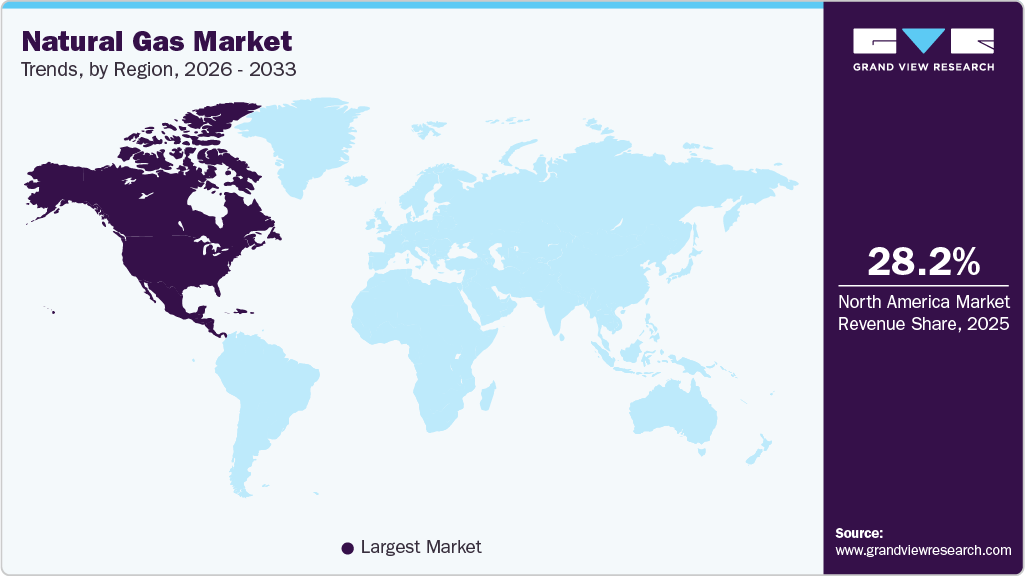
- North America natural gas market held the largest share of approximately 28.22% of the global market in 2025.
- The natural gas market in the United States leads the North American market, accounting for the majority share of regional revenue.
- Based on type, the pipeline gas segment held the highest market share of approximately 69.0% in 2025.
- Based on application, the power generation segment held the highest market share of approximately 39.0% in 2025.
Market Size & Forecast
- 2025 Market Size: USD 895.86 Billion
- 2033 Projected Market Size: USD 1,121.92 Billion
- CAGR (2026-2033): 2.9%
- North America: Largest market in 2025
Natural gas is widely recognized as a transition fuel due to its lower carbon dioxide emissions compared to coal and oil, making it a preferred choice for power generation, industrial operations, and residential heating. Rapid urbanization, expanding industrialization, and strong energy demand across emerging economies are further supporting market expansion, while the growing adoption of liquefied natural gas (LNG) is enhancing fuel accessibility and trade flexibility worldwide.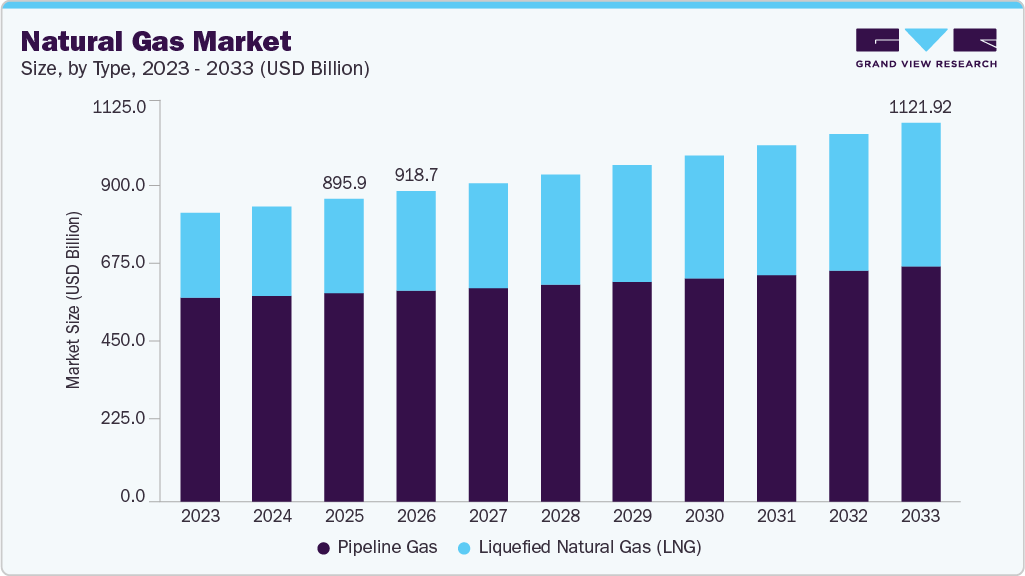
Growing investments from governments, energy producers, and private stakeholders in pipeline infrastructure, LNG liquefaction facilities, storage capacity, and regasification terminals are accelerating market development globally. Strengthening regulatory frameworks, energy diversification strategies, and long-term supply agreements are further supporting market stability and improving energy security. Additionally, advancements in exploration and production technologies, including horizontal drilling and hydraulic fracturing, are increasing recoverable reserves and enhancing operational efficiency. Strategic partnerships between national oil companies, utilities, and international energy firms continue to strengthen supply chains and commercialization pathways, positioning natural gas as a critical component in supporting grid reliability while advancing long-term global decarbonization objectives.
Drivers, Opportunities & Restraints
The natural gas industry is primarily driven by the increasing global demand for cleaner and more efficient energy sources as countries work to reduce greenhouse gas emissions and transition toward lower-carbon energy systems. Natural gas emits significantly less carbon dioxide than coal and oil when used for power generation, making it a critical transition fuel in national decarbonization strategies. Rising electricity consumption, rapid industrialization, and expanding urban infrastructure are further supporting market growth worldwide. Additionally, the growing adoption of liquefied natural gas (LNG) is improving fuel accessibility and enabling flexible energy trade across regions. Supportive government policies promoting fuel switching, energy diversification, and air quality improvement are also accelerating infrastructure investments, including pipelines, storage facilities, and regasification terminals.
Despite these growth drivers, the industry faces several restraints. Price volatility caused by geopolitical tensions, supply-demand imbalances, and disruptions in global trade routes can create uncertainty for buyers and investors. The capital-intensive nature of pipeline and LNG infrastructure development, along with lengthy permitting processes, may delay project execution. Furthermore, increasing competition from renewable energy sources such as solar and wind-coupled with rapidly declining technology costs-could limit long-term demand growth. Methane leakage concerns, stricter environmental regulations, and growing scrutiny of fossil fuel investments may also challenge market expansion, particularly in regions pursuing aggressive net-zero targets.
The industry presents significant opportunities through technological advancements in LNG, floating storage and regasification units (FSRUs), and small-scale liquefaction that enhance supply flexibility and reduce transportation constraints. Expanding natural gas adoption in emerging economies, where energy demand continues to rise, is expected to unlock substantial growth potential. Increasing integration of natural gas with renewable power systems to provide grid stability and backup generation further strengthens its strategic relevance. Moreover, the development of renewable natural gas (RNG) and hydrogen blending initiatives is creating new pathways for decarbonizing existing gas infrastructure. Strategic collaborations between governments, energy companies, and financial institutions are supporting large-scale investments, positioning natural gas as an essential component of a balanced and resilient global energy mix during the transition toward a more sustainable future.
Type Insights
The Pipeline Gas segment accounted for the largest market share of approximately 69.0% in 2025, primarily driven by the extensive global pipeline infrastructure that enables cost-effective, continuous, and high-volume transportation of natural gas. Pipelines remain the most economical method for delivering natural gas over land, particularly across regions with established transmission networks such as North America, Europe, and parts of the Asia Pacific. Utilities and industrial consumers prefer pipeline gas due to its price stability, supply reliability, and lower transportation costs compared to alternative distribution methods. Additionally, long-term supply contracts and regulated tariff structures further strengthen segment dominance, while ongoing investments in cross-border pipelines continue to enhance energy security and regional trade integration.
Meanwhile, the Liquefied Natural Gas (LNG) segment is projected to register the fastest growth at a CAGR of approximately 5.5% during the forecast period, supported by the increasing globalization of natural gas trade and rising demand from regions lacking pipeline connectivity. LNG enables efficient transportation across long distances via marine routes, allowing importing nations to diversify energy sources and reduce dependence on regional suppliers. Growing investments in liquefaction plants, regasification terminals, and floating storage facilities are improving supply flexibility and market accessibility.
Application Insights
The Power Generation segment accounted for the largest market share of approximately 39.0% in 2025, driven by the increasing global demand for reliable and lower-emission electricity sources. Natural gas-fired power plants offer higher efficiency, operational flexibility, and significantly lower carbon emissions compared to coal-based facilities, making them a preferred choice for utilities transitioning toward cleaner energy portfolios. The ability of gas-powered plants to quickly ramp production also makes them ideal for balancing intermittent renewable energy sources such as wind and solar. Additionally, supportive government policies promoting coal-to-gas switching, along with ongoing investments in advanced combined-cycle gas turbine (CCGT) technologies, are further reinforcing the segment’s dominance across both developed and emerging economies.
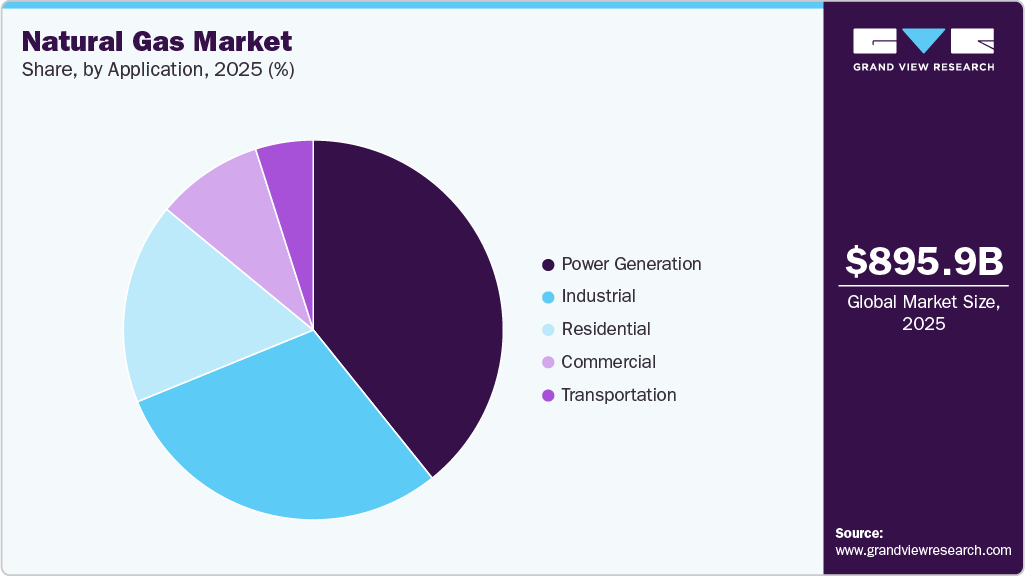
Meanwhile, the Transportation segment is projected to register the fastest growth at a CAGR of approximately 5.2% during the forecast period, supported by the rising adoption of cleaner alternative fuels in the mobility sector. Increasing use of compressed natural gas (CNG) and liquefied natural gas (LNG) in commercial vehicles, buses, and heavy-duty trucks is helping reduce greenhouse gas emissions and urban air pollution. Governments across multiple regions are encouraging the shift toward gas-based fuels through incentives, stricter emission norms, and investments in refueling infrastructure.
Regional Insights
North America accounted for the largest revenue share of approximately 28.22% in 2025, driven by abundant natural gas reserves, advanced extraction technologies, and a well-established pipeline network. The widespread adoption of hydraulic fracturing and horizontal drilling has significantly increased production capacity, positioning the region as a major exporter in the global energy landscape. Strong demand from power generation, industrial manufacturing, and residential heating sectors continues to support market expansion. Additionally, growing investments in liquefied natural gas (LNG) export terminals and cross-border pipeline infrastructure are enhancing trade capabilities and reinforcing North America’s leadership in global supply.
U.S. Natural Gas Market Trends
The natural gas market in the United States leads the North American market, accounting for the majority share of regional revenue. Market growth is fueled by strong domestic production, technological innovation in shale gas extraction, and expanding LNG export capacity. Increasing natural gas utilization in petrochemicals, transportation, and power generation is further reinforcing the country’s dominant position. At the same time, long-term supply agreements continue to strengthen its role in global energy trade.
Asia Pacific Natural Gas Market Trends
The natural gas market in Asia Pacific is supported by rapid industrialization, urban expansion, and rising electricity consumption across major economies such as China, India, and Japan. Governments are actively promoting natural gas as a transition fuel to reduce air pollution and diversify energy mixes. Expanding LNG import capacity, along with new pipeline projects, is improving fuel accessibility and supporting regional adoption across power generation and industrial applications.
Europe Natural Gas Market Trends
The natural gas market in Europe holds a considerable share, supported by its focus on energy diversification and reduced dependence on coal. The region is increasing LNG imports and investing in regasification terminals to enhance supply security amid evolving geopolitical dynamics. Additionally, natural gas is playing a crucial role in supporting renewable energy integration by providing flexible backup power, thereby maintaining grid stability.
Latin America Natural Gas Market Trends
The natural gas market in Latin America is projected to register the fastest CAGR of 4.4% during the forecast period, driven by expanding energy demand, ongoing industrial development, and increasing investments in gas-fired power infrastructure. Countries such as Brazil, Argentina, and Mexico are strengthening pipeline connectivity and LNG capabilities to improve domestic supply and reduce reliance on more carbon-intensive fuels.
Rising government initiatives aimed at improving energy accessibility, coupled with private-sector participation in upstream and midstream projects, are further supporting market expansion. As the region continues to modernize its energy systems and prioritize cost-effective power generation, natural gas is expected to play a pivotal role in meeting future electricity needs while supporting a gradual transition toward lower-emission energy sources.
Middle East & Africa Natural Gas Market Trends
The natural gas market in the Middle East & Africa (MEA) is witnessing steady growth, supported by vast untapped reserves and increasing investments in production and export infrastructure. Several countries are focusing on monetizing gas resources to diversify their economies beyond oil while meeting rising domestic energy demand. Although infrastructure gaps and funding challenges persist in certain areas, expanding international partnerships and large-scale development projects are expected to drive long-term regional adoption.
Key Natural Gas Company Insights
Some of the key players operating in the global natural gas market include Gazprom, ExxonMobil, Shell plc, Chevron Corporation, BP, TotalEnergies, Equinor, ConocoPhillips, Enbridge, and Cheniere Energy, among others.
These companies are actively involved across the natural gas value chain, including upstream exploration and production, midstream transportation, downstream distribution and liquefied natural gas (LNG) exports. Market participants are prioritizing capacity expansion, advanced extraction technologies, and infrastructure modernization to enhance supply reliability and operational efficiency. Strategic investments in LNG terminals, cross-border pipelines, and gas storage facilities are further strengthening global trade networks while improving energy accessibility. Additionally, increasing focus on emission reduction initiatives, methane management, and integration of lower-carbon solutions such as renewable natural gas and hydrogen is encouraging these players to align with evolving sustainability goals, positioning natural gas as a critical component of the global energy transition.
Key Natural Gas Companies:
The following key companies have been profiled for this study on the natural gas market.
- BP
- Cheniere Energy
- Chevron Corporation
- ConocoPhillips
- Enbridge
- Equinor
- ExxonMobil
- Gazprom
- Royal Dutch Shell
- TotalEnergies
Recent Developments
-
In June 2025, Cheniere announced a positive Final Investment Decision (FID) for the construction of Midscale Trains 8 & 9 at its Corpus Christi Liquefaction facility, adding over 3 million tonnes per annum (mtpa) of LNG production capacity. This expansion is part of the company's strategy to increase its total LNG production capacity and strengthen its position in the global market.
Natural Gas Market Report Scope
Report Attribute
Details
Market Definition
The natural gas market represents the global revenue generated from the exploration, production, processing, transportation, and distribution of natural gas used across power generation, industrial operations, residential and commercial heating, and transportation applications.
Market size value in 2026
USD 918.67 billion
Revenue forecast in 2033
USD 1,121.92 billion
Growth rate
CAGR of 2.9% from 2026 to 2033
Base year for estimation
2025
Historical data
2021 - 2024
Forecast period
2026 - 2033
Quantitative units
Revenue in USD million/billion and CAGR from 2026 to 2033
Report coverage
Revenue forecast, competitive landscape, growth factors, and trends
Segments covered
Type, application, region
Regional scope
North America; Europe; Asia Pacific; Latin America; Middle East & Africa
Country scope
U.S.; Canada; Mexico; Germany; UK; France; Italy; Spain; China; India; Japan; Brazil; Argentina; Saudi Arabia; UAE; South Africa
Key companies profiled
Gazprom; ExxonMobil; Shell plc; Chevron Corporation; BP; TotalEnergies; Equinor; ConocoPhillips; Enbridge; Cheniere Energy
Customization scope
Free report customization (equivalent up to 8 analysts working days) with purchase. Addition or alteration to country, regional & segment scope.
Pricing and purchase options
Avail customized purchase options to meet your exact research needs. Explore purchase options
Global Natural Gas Market Report Segmentation
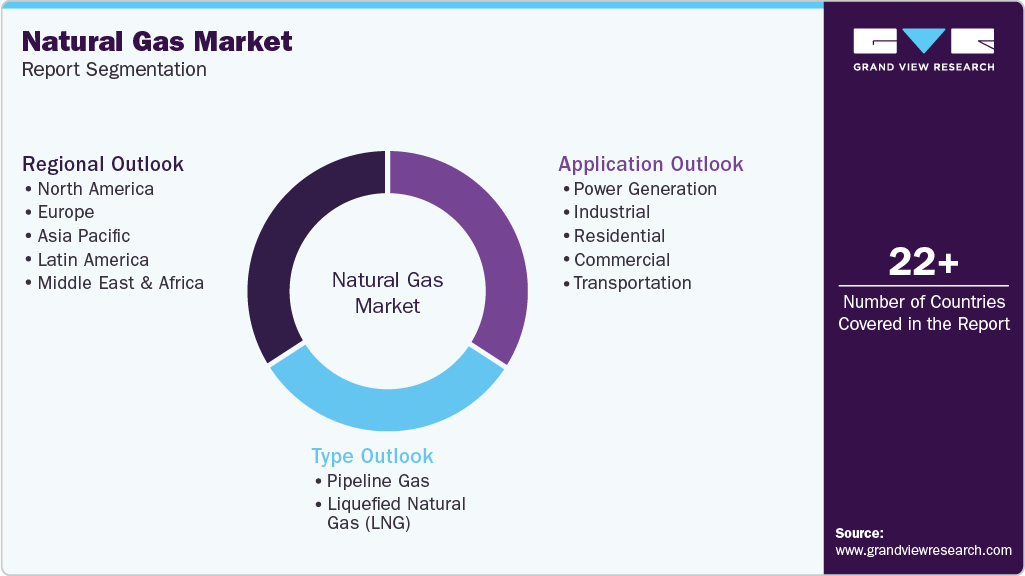
This report forecasts revenue growth at global, regional, and country levels and provides an analysis of the latest industry trends in each of the sub-segments from 2021 to 2033. For this study, Grand View Research has segmented the global natural gas market report on the basis of type, application, and region:
-
Type Outlook (Revenue, USD Billion, 2021 - 2033)
-
Pipeline Gas
-
Liquefied Natural Gas (LNG)
-
-
Application Outlook (Revenue, USD Billion, 2021 - 2033)
-
Power Generation
-
Industrial
-
Residential
-
Commercial
-
Transportation
-
-
Regional Outlook (Revenue, USD Billion, 2021 - 2033)
-
North America
-
U.S.
-
Canada
-
Mexico
-
-
Europe
-
Germany
-
UK
-
France
-
Italy
-
Spain
-
-
Asia Pacific
-
China
-
India
-
Japan
-
-
Latin America
-
Brazil
-
Argentina
-
-
Middle East & Africa
-
Saudi Arabia
-
UAE
-
South Africa
-
-
Frequently Asked Questions About This Report
b. The global natural gas market size was estimated at USD 895.86 billion in 2025 and is expected to reach USD 918.67 billion in 2026.
b. The global natural gas market is expected to grow at a compound annual growth rate of 2.9% from 2026 to 2033 to reach USD 1,121.92 billion by 2033.
b. Based on the type segment, Pipeline Gas held the largest revenue share of over 69% in the natural gas market in 2025.
b. Some of the key vendors operating in the global natural gas market include Gazprom, ExxonMobil, Shell plc, Chevron Corporation, BP, TotalEnergies, Equinor, ConocoPhillips, Enbridge, and Cheniere Energy, among others.
b. The key factors driving the natural gas market include the rising global demand for cleaner-burning fuels, increasing electricity consumption, and the growing transition from coal and oil toward lower-emission energy sources.


Share this report with your colleague or friend.
Need a Tailored Report?
Customize this report to your needs — add regions, segments, or data points, with 20% free customization.


ISO 9001:2015 & 27001:2022 Certified
We are GDPR and CCPA compliant! Your transaction & personal information is safe and secure. For more details, please read our privacy policy.
Trusted market insights - try a free sample
See how our reports are structured and why industry leaders rely on Grand View Research. Get a free sample or ask us to tailor this report to your needs.