Middle East Bio-based Platform Chemicals Market Summary
The Middle East bio-based platform chemicals market size was estimated at USD 353.8 million in 2024 and is projected to reach USD 563.4 million by 2033, growing at a CAGR of 5.4% from 2025 to 2033. The market is driven by increasing government initiatives to diversify economies beyond oil and promote sustainable industrial development.
Key Market Trends & Insights
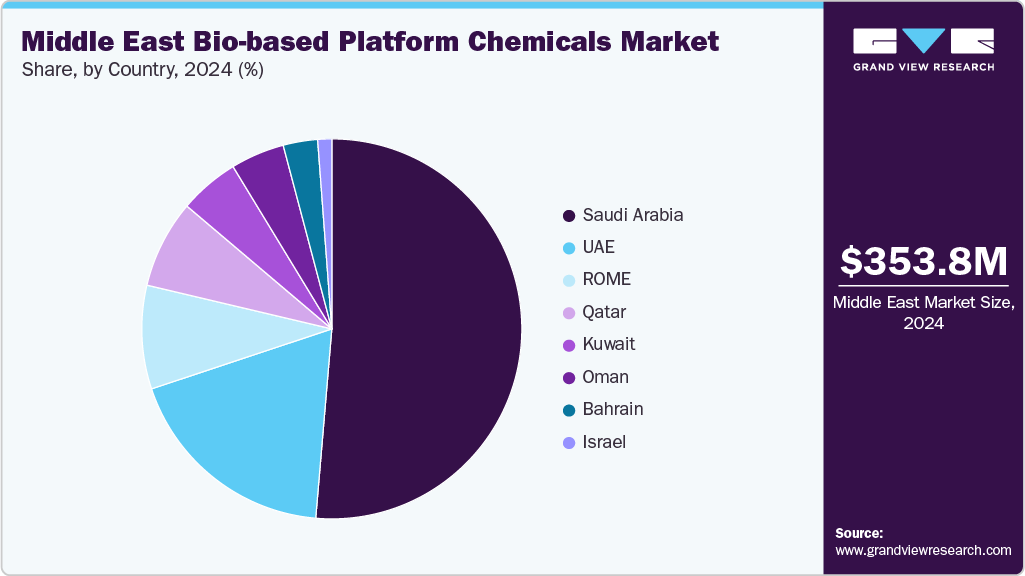
- Saudi Arabia dominated the Middle East bio-based platform chemicals market with the largest revenue share of 51.20% in 2024.
- The market in the UAE is expected to grow at a significant CAGR of 5.4% from 2025 to 2033.
- By Product, the Aspartic Acid segment is expected to grow at the highest CAGR of 7.2% from 2025 to 2033 in terms of revenue.
Market Size & Forecast
- 2024 Market Size: USD 353.8 Million
- 2030 Projected Market Size: USD 563.4 Million
- CAGR (2025-2030): 5.4%
- Saudi Arabia: Largest market in 2024
- UAE: Fastest growing market
Rising investments in bio-refineries and renewable chemical production support the shift toward low-carbon manufacturing. The region’s abundant biomass potential, particularly from agricultural residues, provides a viable feedstock source. In addition, growing demand for eco-friendly materials in packaging, construction, and automotive sectors is accelerating market adoption.
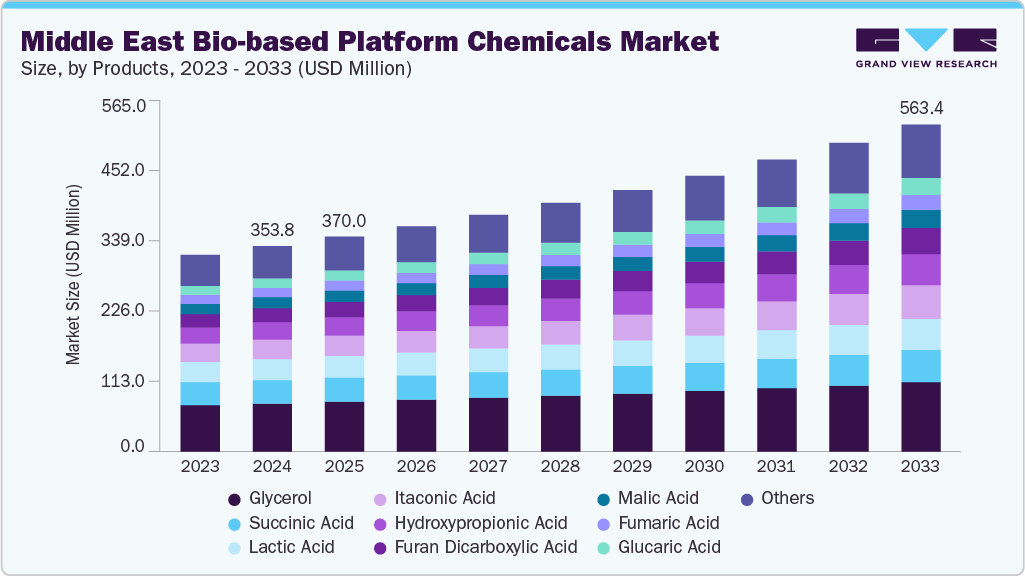
The market is being propelled by the region’s strategic push to integrate advanced chemical manufacturing into its industrial value chain. As part of long-term economic transformation plans, countries such as Saudi Arabia and the UAE invest in next-generation chemical technologies to capture higher-value market segments. Bio-based platform chemicals, derived from renewable sources, are increasingly viewed as a means to reduce dependency on volatile fossil fuel markets while tapping into the growing global demand for sustainable materials. Expanding research partnerships between regional entities and global biotech firms accelerates technology transfer and commercialization.
Another key growth driver is the rising adoption of circular economy principles in industrial operations. Governments and major chemical producers are exploring utilizing agricultural residues, food waste, and other organic feedstocks to produce succinic acid, lactic acid, and 1,4-butanediol. This approach supports environmental objectives and creates new value streams from underutilized resources. In addition, policy frameworks promoting low-emission manufacturing and green export offerings encourage companies to scale up bio-based chemical production, positioning the Middle East as a competitive supplier in the global sustainable chemicals market.
Market Concentration & Characteristics
The Middle East bio-based platform chemicals industry is characterized by its early-stage yet strategically driven growth, with development largely supported by government-led diversification policies and sustainability initiatives. Production is still relatively limited compared to traditional petrochemical outputs, but significant investments in R&D, pilot-scale bio-refineries, and technology partnerships set the foundation for large-scale commercialization. The market benefits from the region’s competitive energy and infrastructure advantages, enabling cost-efficient operations once bio-based processes are scaled.
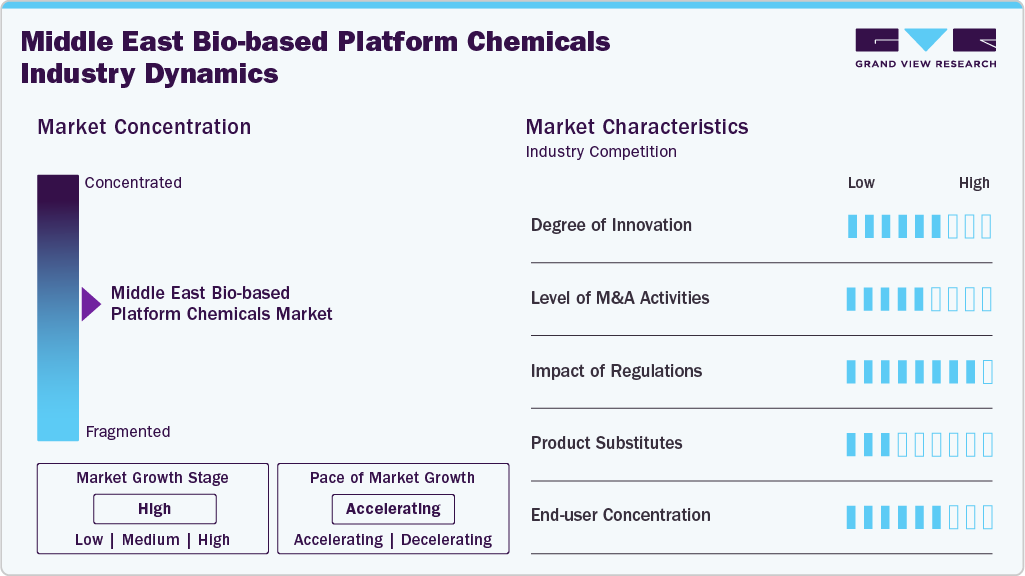
Another defining characteristic is the feedstock potential and export-oriented outlook. While the region lacks large-scale forestry biomass, it has substantial agricultural residues, date palm waste, and other organic by-products suitable for bio-based chemical production. This, coupled with existing world-class logistics and trade networks, positions the Middle East to serve both domestic industries, such as packaging, automotive, and construction, and international markets seeking sustainable chemical imports. However, market development will depend heavily on overcoming technological maturity challenges and aligning bio-based output costs with competitive petrochemical benchmarks.
Products Insights
The glycerol segment dominated the market with a revenue share of 23.5% in 2024. The market is primarily produced as a by-product of biodiesel manufacturing and vegetable oil processing. It serves as a versatile raw material for applications in pharmaceuticals, cosmetics, food additives, and industrial chemicals. Growing biodiesel production in the region and rising demand for natural and sustainable ingredients are boosting glycerol availability and utilization.
Aspartic acid is expected to grow fastest with a CAGR of 7.4% during the forecast period. The segment is driven by its role as a precursor in producing biodegradable polymers such as polyaspartic acid. Derived from renewable feedstocks via fermentation, it is used in applications ranging from water treatment and detergents to pharmaceuticals and food additives. The growing regional focus on sustainable materials and eco-friendly industrial processes drives interest in bio-based aspartic acid. Furthermore, rising collaborations with global biotech firms are expected to accelerate the region's technology adoption and local production capacity.
Country Insights
The Middle Eastmarket is gradually expanding as the region diversifies its chemical industry toward sustainable and renewable production. Supported by government-led initiatives and strategic investments, countries like Saudi Arabia and the UAE are exploring bio-refinery projects and renewable feedstock utilization. A key driver is the push to reduce carbon intensity in manufacturing while capturing value from agricultural residues and organic waste. This shift aligns with global demand for eco-friendly materials, positioning the Middle East as a potential hub for sustainable chemical exports.
Saudi Arabia Bio-based Platform Chemicals Market Trends
The bio-based platform chemicals market in Saudi Arabia is gaining momentum as part of the Kingdom’s Vision 2030 strategy to diversify its economy and advance sustainable manufacturing. Investments in biorefineries and renewable feedstock technologies are enabling the production of key chemicals such as glycerol, lactic acid, and succinic acid. A key driver is the government’s commitment to reducing carbon emissions while creating high-value industrial outputs from agricultural residues and organic waste.
Key Middle East Bio-based Platform Chemicals Company Insights
The market is dominated by key players, such as BASF SE, Cargill Incorporated, DSM-Firmenich, Tate & Lyle, and Evonik Industries AG.
BASF SE
- BASF SE is a chemical production company based in Germany. It offers products to several end-use industries, including agriculture, Oilseeds & Pulses, construction, electronics & electric, energy & resources, pharmaceuticals, and automotive & transportation. It operates through five business segments: performance products, Oilseeds & Pulses, agricultural solutions, functional Products & solutions, and oil & gas. The Oilseeds & Pulses segment specializes in manufacturing products such as petroOilseeds & Pulses, catalysts, intermediates, and monomers. It also provides surface disinfectants for applications, including home care and industrial & institutional, comprising sub-applications such as laundry, dishwashing, food & beverage processing, and industrial cleaning. The company operates through its various subsidiaries and joint ventures in over 80 countries, with more than 353 production sites spread across the globe. It also has 13 operating divisions and around 84 sub-business units worldwide. The company operates in various locations, including Germany, the U.S., Belgium, Brazil, Canada, Chile, the Netherlands, Norway, Poland, Portugal, Korea, Japan, India, Malaysia, the UAE, South Africa, and China.
Key Middle East Bio-based Platform Chemicals Companies:
- Cargill Incorporated
- dsm-firmenich
- GFBIOCHEMICALS
- BASF SE
- Mitsubishi Chemical Group Corporation
- Kemria
- DuPont
- Tate & Lyle
- Braskem
- Evonik Industries AG
- Atkin Chemicals, Inc.
- Champlor
- LyondellBasell Industries Holdings B.V.
- NIPPON SHOKUBAI CO., LTD.
- Novozymes A/S
- SABIC
- Corbion
Recent Developments
-
In February 2025, LG Chem announced 100% plant-based acrylic acid production, a fully biobased alternative to conventional acrylic acid produced via microbial fermentation of vegetable oils. The production of bio-acrylic acid in the second quarter of this year. Production capacity shall ramp up to 100 metric tons (MT) of prototype annually. This innovation, which preserves the same molecular structure and performance as its fossil-derived counterpart, earned the USDA Certified Biobased Product label in 2024.
Middle East Bio-based Platform Chemicals Market Report Scope
|
Report Attribute
|
Details
|
|
Market size value in 2025
|
USD 370.0 million
|
|
Revenue forecast in 2033
|
USD 563.4 million
|
|
Growth rate
|
CAGR of 5.4% from 2025 to 2033
|
|
Base year for estimation
|
2024
|
|
Historical data
|
2021 - 2023
|
|
Forecast period
|
2025 - 2033
|
|
Quantitative units
|
Volume in kilotons, revenue in USD million/billion, and CAGR from 2025 to 2033
|
|
Report coverage
|
Revenue forecast, company ranking, competitive landscape, growth factors, and trends
|
|
Segments covered
|
Products, region
|
|
Regional scope
|
Middle East & Africa
|
|
Country scope
|
Oman; Kuwait; Saudi Arabia; UAE; Qatar; Bahrain; Israel; ROME
|
|
Key companies profiled
|
Cargill Incorporated; DSM-Firmenich; GFBIOCHEMICALS; Mitsubishi Chemical Group Corporation; PTT Global Chemical Public Company Limited; BASF SE; Tate & Lyle; Braskem; Evonik Industries AG; DuPont; Atkin Chemicals, Inc.; Champlor; LyondellBasell Industries Holdings B.V.; NIPPON SHOKUBAI CO., LTD.; SABIC; Corbion; Novozymes A/S.
|
|
Customization scope
|
Free report customization (equivalent up to 8 analysts’ working days) with purchase. Addition or alteration to country, regional & segment scope.
|
|
Pricing and purchase options
|
Avail customized purchase options to meet your exact research needs. Explore purchase options
|
Middle East Bio-based Platform Chemicals Market Report Segmentation
This report forecasts revenue growth at the regional and country levels and provides an analysis of the latest industry trends in each of the sub-segments from 2018 to 2033. For this study, Grand View Research has segmented the Middle East bio-based platform chemicals market report based on product and region:
-
Product Outlook (Volume, Kilotons; Revenue, USD Million, 2021 - 2033)
-
Succinic Acid
-
Malic Acid
-
Hydroxypropionic Acid
-
Glucaric Acid
-
1,3-Propanediol (PDO)
-
1,5-Pentanediamine
-
Furan Dicarboxylic acid
-
Glycerol
-
Aspartic Acid
-
Itaconic Acid
-
Lactic Acid
-
Fumaric Acid
-
1,3-Butanediol
-
1,4-Butanediol
-
Farnesene
-
Isobutanol
-
Regional Outlook (Volume, Kilotons; Revenue, USD Million, 2021 - 2033)
-
Middle East
-
Oman
-
Kuwait
-
Saudi Arabia
-
UAE
-
Qatar
-
Bahrain
-
Israel
-
ROME
Frequently Asked Questions About This Report
b. The Middle East bio-based platform chemicals market size was estimated at USD 353.8 million in 2024 and is expected to reach USD 370.0 million in 2025.
b. The Middle East bio-based platform chemicals market is expected to grow at a compound annual growth rate of 5.4% from 2025 to 2033 to reach USD 563.4 million by 2033.
b. Saudi Arabia dominated the Middle East bio-based platform chemicals market with a share of 51.4% in 2024. This is attributable to increasing investments in bio-refineries and renewable feedstock technologies that are enabling the production of key chemicals such as glycerol, lactic acid, and succinic acid.
b. Some key players operating in the Middle East bio-based platform chemicals market include Cargill Incorporated, dsm-firmenich, GFBIOCHEMICALS, Mitsubishi Chemical Group Corporation, PTT Global Chemical Public Company Limited, BASF SE, Tate & Lyle, Braskem, Evonik Industries AG, DuPont, Atkin Chemicals, Inc., Champlor, LyondellBasell Industries Holdings B.V., NIPPON SHOKUBAI CO., LTD., SABIC, Corbion, and Novozymes A/S.
b. Key factors that are driving the market growth include increasing government initiatives to diversify economies beyond oil and promote sustainable industrial development. Rising investments in bio-refineries and renewable chemical production are supporting the shift toward low-carbon manufacturing.

 Download Sample Report