
- Home
- »
- Medical Devices
- »
-
Medical Billing Outsourcing Market Size Report, 2026-2033GVR Report cover

Medical Billing Outsourcing Market (2026 - 2033)
Size, Share & Trends Analysis Report By Component (In-house, Outsourced), By Service (Front-end, Middle-end, Back-end), By End-use (Hospital, Physician Office), By Region, And Segment Forecasts
Market Size, 2025
$16.6BMarket Estimate, 2026
$18.5BMarket Forecast, 2033
$45.3BCAGR, 2026–2033
13.6%Medical Billing Outsourcing Market Summary
The global medical billing outsourcing market size was valued at USD 16.6 billion in 2025 and is projected to grow from USD 18.5 billion in 2026 to USD 45.3 billion by 2033, growing at a CAGR of 13.6% from 2026 to 2033. North America dominated the global market with the largest revenue share of 49.3% in 2025. Increasing complexity in medical billing, expansion of telehealth services, growing need for revenue cycle management (RCM) optimization, and changing regulatory guidelines are factors contributing to market growth.
 Source: Grand View Research, IR Documents, Primary Interviews, Paid DatabasesTo learn more about this report,
 Download Free Sample Report
 Key Market Trends & Insights
- By component: Outsourced segment led the market with the largest revenue share of 55.7% in 2025.
- Based on services: Front-end services segment led the market with the largest revenue share of 37.9% in 2025.
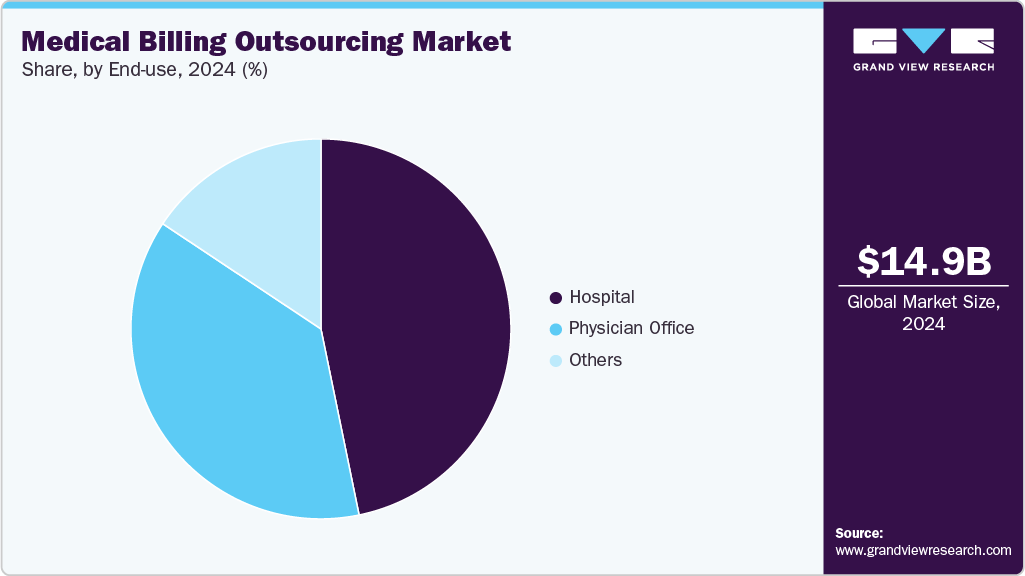
- By end-use: Hospitals segment accounted for the largest market revenue share of 46.7% in 2025.
Regional Highlights
- Largest regional market: North America (49.3% revenue share, 2025)
- Fastest-growing regional market: Asia Pacific (highest CAGR, 2026-2033)
- By country: The U.S. held the largest market share in 2025
Market Size & Forecast
- Market size in 2025: USD 16.6 Billion
- Estimated market size in 2026: USD 18.5 Billion
- Projected market size by 2033: USD 45.3 Billion
- CAGR (2026-2033): 13.6%
Three ways to get this report
Buy it, customize it, or ask a question.Ask an Analyst
A direct answer, usually in 1 working day
- AccessReport author, directly
- Reply timeWithin 1 working day
- No sales callDirect answer only
- FormatEmail reply
- CostFree, no cost
Get the Full Report
What the study covers
- FormatsPDF · Excel · Dashboard
- Timeline2026–2033 annual, 2025 base
- Coverage20+ countries, 5 regions
- Companies10+ key players profiled
Customize the Report
20% free customization
- IncludeCountries, segments, points
- TailorTo your product definition
- ExtendDeeper competitor detail
- OrA fully bespoke study
- Turnaround5–10 working days
Medical billing outsourcing helps lower equipment and software expenses, improving cash flow, and reducing employee size and costs. The increased cost of healthcare, particularly in developed countries, has led to continuous advancements, allowing for the high adoption of modern technology devices and equipment, such as RCM software. The rising patient load and the need to address the increasing records and bills are creating a burden on health practitioners. To counter such a situation, hospitals are outsourcing the clinical billing process, which is expected to drive the market growth.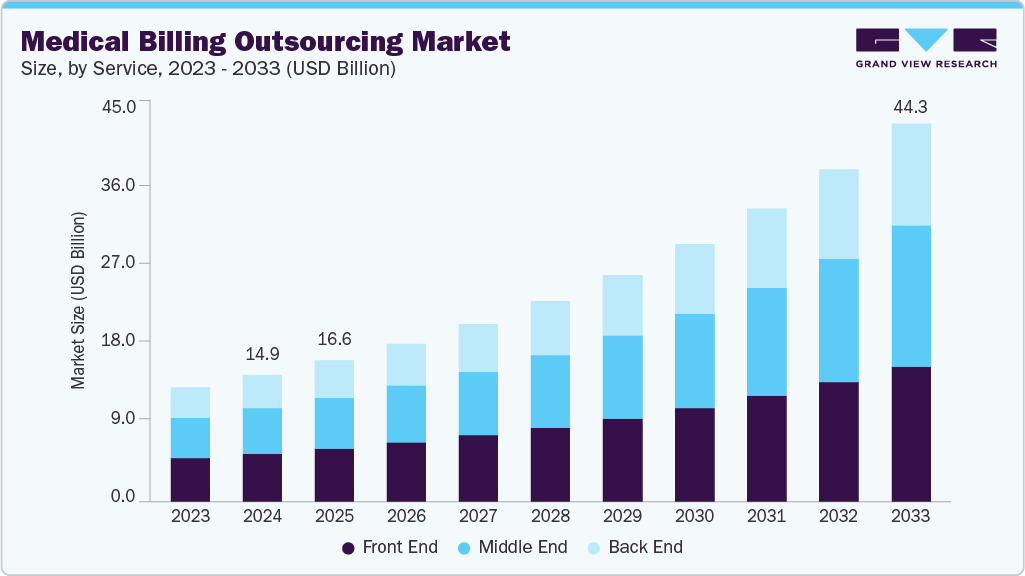 To learn more about this report, Download Free Sample Report
 Owing to the evolving healthcare landscape, healthcare providers increasingly partner with specialized vendors or companies to modernize and optimize their billing operations. For instance, in July 2023, Veradigm secured two multi‑year provider agreements: one with State of Franklin Healthcare Associates across Tennessee and Virginia for expanded RCM services, and another with Total Orthopedics and Sports Medicine in the New York/New Jersey region to enhance billing, scheduling, and digital engagement.
The medical coding classification system is continually evolving, contributing to the market's expansion. Billing for surgical procedures often poses significant challenges for many healthcare professionals and organizations, particularly those lacking access to qualified coding specialists. Thus, healthcare providers, hospitals, clinicians, and physicians increasingly outsource their medical billing and financial management functions to specialized third-party service providers.
The adoption of advanced technologies, coupled with the need for cost, labor, and time efficiency, is driving healthcare providers to prefer outsourcing medical billing services increasingly. Demand for these services is growing as providers seek to minimize errors and reduce internal administrative expenses. Outsourcing enhances organizational revenue by delivering significant savings on infrastructure, payroll, maintenance, procurement, and software updates. In addition, established outsourcing firms provide healthcare organizations with streamlined and transparent processes, ensuring both efficiency and accountability in billing operations.
Market Dynamics
Increasing complexity in medical billing, expansion of telehealth services, growing need for revenue cycle management (RCM) optimization, and changing regulatory guidelines are factors contributing to market growth. Medical billing outsourcing helps lower equipment and software expenses, improving cash flow, and reducing employee size and costs. The increased cost of healthcare, particularly in developed countries, has led to continuous advancements, allowing for the high adoption of modern technology devices and equipment, such as RCM software.
The rising patient load and the need to address the increasing records and bills are creating a burden on health practitioners. To counter such a situation, hospitals are outsourcing the clinical billing process, which is expected to drive the market growth. Owing to the evolving healthcare landscape, healthcare providers increasingly partner with specialized vendors or companies to modernize and optimize their billing operations.
Moreover, the medical coding classification system is continually evolving, contributing to the market's expansion. Billing for surgical procedures often poses significant challenges for many healthcare professionals and organizations, particularly those lacking access to qualified coding specialists. Thus, healthcare providers, hospitals, clinicians, and physicians increasingly outsource their medical billing and financial management functions to specialized third-party service providers.
The adoption of advanced technologies, coupled with the need for cost, labor, and time efficiency, is driving healthcare providers to prefer outsourcing medical billing services increasingly. Demand for these services is growing as providers seek to minimize errors and reduce internal administrative expenses. Outsourcing enhances organizational revenue by delivering significant savings on infrastructure, payroll, maintenance, procurement, and software updates. For instance, in May 2025, U.S.-based R1 announced an investment from Khosla Ventures to accelerate its AI-driven healthcare transformation initiatives, aiming to enhance operational efficiency and innovation across the healthcare revenue cycle through advanced artificial intelligence solutions.
“AI is transforming every corner of the economy, with healthcare being one of the largest sectors of impact. R1 is pioneering the use of AI in healthcare revenue management, and we are excited to partner with them as they leverage AI to simplify the healthcare experience for patients and help providers operate more efficiently.” -Vinod Khosla, founder of Khosla Ventures.
Medical billing outsourcing involves the transfer and management of sensitive patient information, including medical records, insurance details, and financial data. Healthcare providers are anticipated to be hesitant to outsource billing functions due to concerns about data breaches, cyberattacks, unauthorized access, and compliance with regulations such as HIPAA. Any security incident is likely to result in financial penalties, legal liabilities, and reputational damage. For instance, according to the 2024 Healthcare Data Breach Report in January 2025, 725 healthcare data breaches involving 500 or more records were reported, exposing more than 133 million patient records, highlighting the increasing vulnerability of healthcare IT systems to cyber threats. These incidents raise concerns among healthcare providers regarding the protection of sensitive patient information and create challenges for the adoption of healthcare information systems.
The integration of artificial intelligence (AI), robotic process automation (RPA), and machine learning technologies is creating significant opportunities for medical billing outsourcing providers. Healthcare organizations are increasingly seeking solutions that can automate repetitive billing tasks, improve coding accuracy, reduce claim denials, and accelerate reimbursement cycles. Outsourcing firms that offer advanced technology-enabled services are well-positioned to attract healthcare providers seeking to improve operational efficiency. For instance, in May 2025, U.S.-based Hendry Regional Medical Center in Florida leveraged eClinicalWorks’ AI medical scribe, Sunoh.ai, to automate clinical documentation. This deployment reduced end-of-day charting lag by over two hours per provider and accelerated billing workflows.
Moreover, AI-powered billing platforms are expected to analyze large volumes of claims data, identify revenue leakage, predict denial risks, and streamline payment collection processes. As providers continue to prioritize financial optimization and administrative efficiency, outsourcing companies that invest in intelligent automation technologies can differentiate themselves and expand their service offerings. This technological shift is expected to drive long-term growth opportunities across the medical billing outsourcing market.
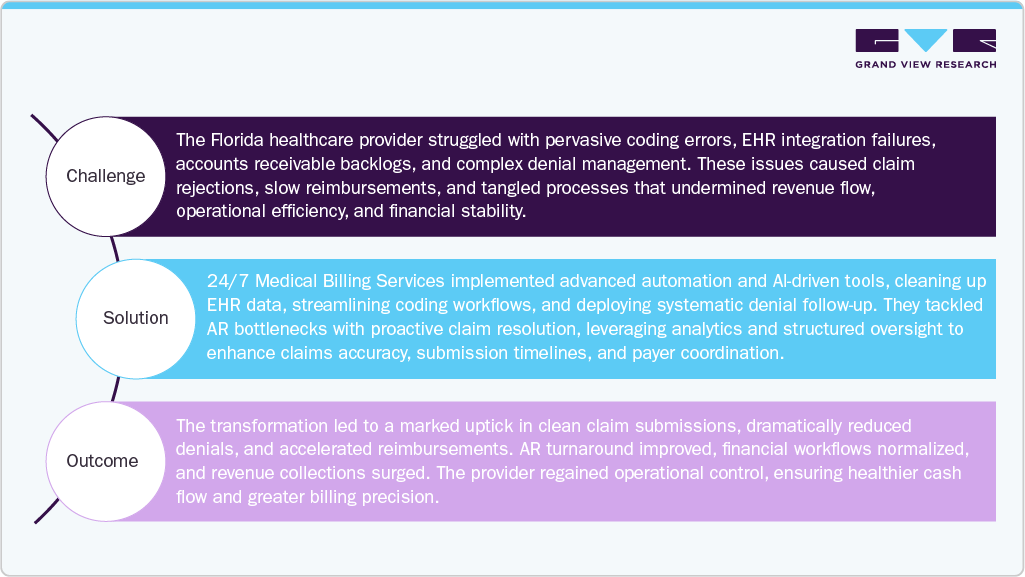
Case Study
The following case study shows how a Florida healthcare provider overcame billing inefficiencies and financial setbacks through expert intervention, driving improved reimbursements and operational performance.
 To learn more about this report, Download Free Sample Report
 Market Concentration & Characteristics
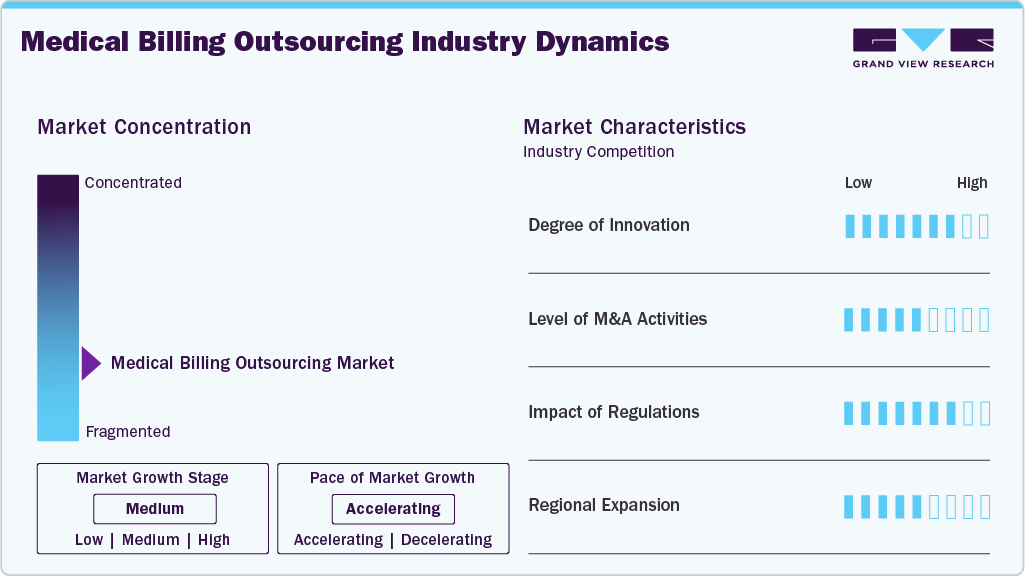
The degree of innovation in the medical billing outsourcing industry is high, primarily driven by integrating artificial intelligence (AI) and machine learning (ML) into billing and revenue cycle management processes. Companies are developing advanced analytics platforms to predict claim denials, automate coding tasks, and enhance billing accuracy. The shift to cloud-based billing systems and AI-driven dashboards enables real-time financial metrics tracking and improves decision-making.
The level of mergers & acquisitions in the medical billing outsourcing industry is moderate as companies aim to expand their service portfolios, client base, and geographic reach. For instance, in January 2024, Veradigm expanded its Revenue Cycle Services portfolio by acquiring Koha Health, enhancing its ambulatory RCM capabilities with musculoskeletal care expertise, streamlining workflows and EHR integration, and reinforcing its commitment to cost-effective, scalable financial management solutions.
 To learn more about this report, Download Free Sample Report
 The impact of regulations in the medical billing outsourcing industry is moderate to high, especially in regions such as the U.S., where laws such as the HIPAA, ACA, and MACRA impose strict data privacy and billing compliance requirements. These laws have increased the demand for specialized outsourcing partners who can ensure the secure handling of patient information and maintain regulatory compliance across diverse payer systems.
Regional expansion in the medical billing outsourcing industry is moderate. Companies target emerging regions, owing to their growing healthcare infrastructure, rising patient volumes, and cost-effective labor. In addition, regional players are forming partnerships with local healthcare providers to cater to country-specific billing regulations and language requirements, expanding their global footprint. For instance, in May 2021, R1 expanded and extended its revenue cycle management partnership with Ascension, reinforcing its role in patient experience technologies, including unified scheduling, payments, and access platforms. It also secured a contract extension through 2031 to enhance its nationwide digital engagement strategy.
Analyst Perspective
The medical billing outsourcing market is characterized by a mix of large, integrated healthcare technology vendors and specialized outsourcing providers competing to address increasing revenue cycle complexity. Established players such as R1 RCM, Oracle, McKesson, Veradigm, eClinicalWorks, and AdvancedMD continue to strengthen their market positions through investments in automation, artificial intelligence, cloud-based billing platforms, and end-to-end revenue cycle management services. Their ability to deliver comprehensive solutions across large healthcare systems, combined with strong interoperability capabilities and extensive customer networks, provides a significant competitive advantage in an increasingly digital healthcare environment.
At the same time, emerging and specialized providers such as Kareo and Promantra are gaining traction by offering flexible, cost-effective, and customized outsourcing services tailored to the needs of physician practices and mid-sized healthcare organizations. These companies are capitalizing on demand for faster implementation, personalized customer support, and specialty-specific billing expertise. As healthcare providers continue to focus on reducing administrative burdens, improving reimbursement performance, and managing evolving regulatory requirements, competition is expected to increasingly center on technology innovation, automation capabilities, service quality, and the ability to deliver measurable financial outcomes.
Component Insights
Based on component, the outsourced segment led the market with the largest revenue share of 55.7% in 2025. In addition, this segment is expected to grow at the fastest CAGR over the forecast period. Outsourcing services have proven highly effective in reducing costs and are particularly well-suited for small and medium-sized healthcare operations. Recent regulations have also added complexity to administrative processes, making outsourcing a beneficial solution for sustaining efficiency and compliance. For instance, according to a survey published by the Medical Group Management Association (MGMA) in May 2023, the average denial rate for medical claims is estimated to be between 5% and 10%. Such factors are anticipated to drive segment growth.
Moreover, many companies are adopting cloud-based medical billing capabilities for enhanced security of patient data. For instance, in July 2024, Odyssey House in Utah implemented Oracle Health’s EHR and behavioural health solutions at its Martindale Clinic. The upgrade automated billing and revenue cycle functions, unified clinical and financial data, streamlined workflows, and enhanced care coordination for patients and providers.
Service Insights
Based on service, the front-end segment led the market with the largest revenue share of 37.9% in 2025. Moreover, middle-end segment is anticipated to grow at the fastest CAGR during the forecast period. Front-end services consist of processes, such as scheduling, preregistration, registration, pre-authorization, and insurance verification. It involves the major functions of medical billing. Managing front-end services helps reduce repetitive work and improve patient experience with quick service. Hence, the demand for outsourcing these services is strong.
The middle-end services segment is expected to experience at the fastest CAGR during the forecast period, driven by the entry of new market participants and increasing awareness among healthcare practitioners. These services have emerged as the most widely outsourced function, mainly due to the sensitive nature of healthcare data and the complexities associated with managing its transfer internally. Outsourcing provides a more efficient and cost-effective solution, enabling providers to address these challenges while ensuring data accuracy, compliance, and operational efficiency.
End-use Insights
Based on end use, the hospitals segment led the market with the largest revenue share of 46.7% in 2025. Moreover, the physician office segment is anticipated to grow at the fastest CAGR during the forecast period. This is primarily due to the increasing demand for financing services in healthcare facilities. For instance, in January 2022, Day Kimball Healthcare partnered with Ensemble Health Partners to manage its full patient financial journey, from scheduling and registration through billing and collections, leveraging Ensemble’s technology and expertise to boost patient experience and financial performance. In addition, Luminis Health, a Maryland-based nonprofit, partnered in December 2022 with VisiQuate to deploy its Denials Management and Revenue Management, integrated with Epic, to deliver real-time, unified hospital and physician billing insights that improve financial operations.
 To learn more about this report, Download Free Sample Report
 The physician office segment is expected to grow at the fastest CAGR over the forecast period, driven by the increasing administrative burden faced by independent practices and small clinics. Physicians are outsourcing billing functions to ensure accuracy and efficiency with declining reimbursement rates and rising regulatory complexities. By leveraging external expertise, practices are anticipated to streamline revenue cycle management, optimize reimbursements, and accelerate payment cycles. Smaller practices benefit significantly, as they often lack the infrastructure or workforce to handle evolving compliance requirements.
Regional Insights
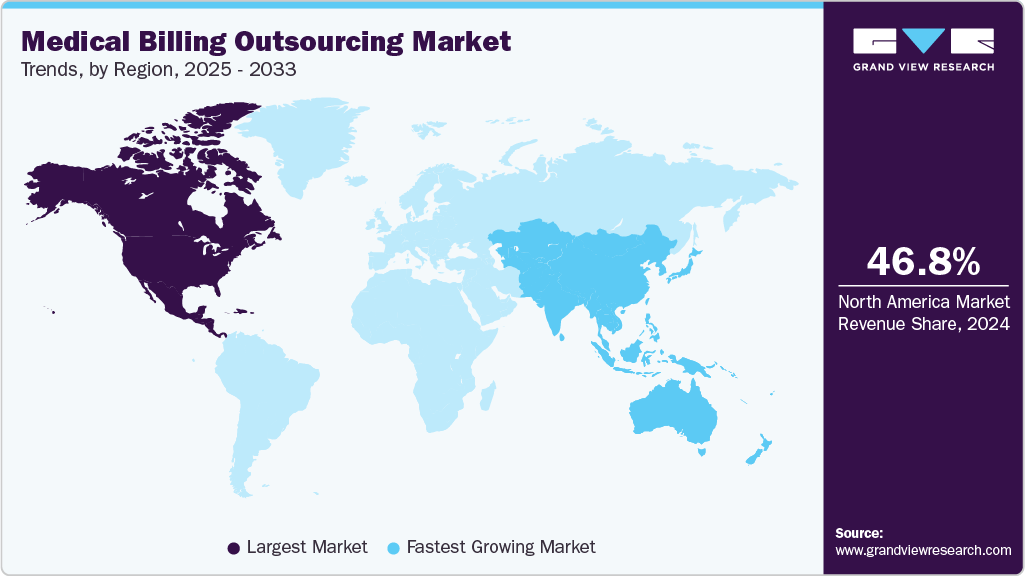
North America dominated the medical billing outsourcing with the largest revenue share of 49.3% in 2025. The dominance is due to the widespread adoption of electronic health records (EHR), high healthcare expenditure, and growing demand for revenue cycle management services. The presence of well-established healthcare infrastructure and strict regulatory frameworks, such as HIPAA, drives healthcare providers to seek professional billing services to ensure compliance. The region’s advanced technological landscape further supports the rapid adoption of AI-based and automated billing solutions.
 To learn more about this report, Download Free Sample Report
 U.S. Medical Billing Outsourcing Market Trends
The medical billing outsourcing market in the U.S. held the largest share in the North America region in 2025, owing to its robust healthcare reimbursement system. The growing pressure on hospitals and clinics to reduce operational costs, manage high claim denial rates, and improve patient care has led to a surge in outsourcing billing services. In addition, frequent changes in coding systems and insurance policies further compel healthcare providers to rely on third-party billing experts to ensure timely and accurate reimbursements.
Europe Medical Billing Outsourcing Market Trends
The medical billing outsourcing market in Europe is expected to grow at a significant CAGR over the forecast period, supported by the rising digital transformation of healthcare systems and increasing pressure to improve billing efficiency. European countries are investing in outsourcing to reduce administrative burdens and improve compliance with evolving regulations. The rise of private healthcare providers and the shift toward value-based care drive demand for the market in this region.
The UK medical billing outsourcing market is anticipated to grow at a significant CAGR over the forecast period, as healthcare providers, especially in the private sector, increasingly outsource non-clinical tasks such as billing to streamline operations. Although the National Health Service (NHS) manages a significant portion of healthcare services, private providers are adopting outsourced billing to improve cash flow and operational transparency. The demand is further driven by the need for digital billing platforms and growing interest in artificial intelligence-based claim processing.
Asia Pacific Medical Billing Outsourcing Market Trends
The medical billing outsourcing market in the Asia Pacific is anticipated to witness at the fastest CAGR during the forecast period. Emerging countries such as India and China are anticipated to register high growth owing to increasing patient populations and improving healthcare infrastructure. Increasing awareness about clinical billing software and the rising adoption of the latest technology are expected to boost the market.
The China medical billing outsourcing market is rising significantly due to its rapidly growing healthcare sector, increasing urbanization, and focus on healthcare IT infrastructure. The country's efforts to modernize its medical billing processes and implement advanced digital tools create opportunities for outsourcing companies. In addition, local providers are exploring partnerships with global firms to improve efficiency and reduce administrative burdens in public and private hospitals.
Latin America Medical Billing Outsourcing Market Trends
The medical billing outsourcing market in Latin America is anticipated to grow at a significant CAGR over the forecast period. Economic development, expanding healthcare access, and growing private healthcare providers are key drivers for the region. Outsourcing is seen as a viable option to manage rising operational costs and improve claim processing accuracy. However, concerns around data security and inconsistent IT infrastructure in some countries are expected to limit growth.
The Brazil medical billing outsourcing market is expected to grow at a substantial CAGR over the forecast period due to factors such as its large population and growing private healthcare sector. The complexity of billing regulations and the need for accurate reimbursement management are prompting private hospitals and clinics to adopt outsourced billing services. In addition, the government's focus on healthcare modernization and the rising penetration of digital tools support market development.
Middle East & Africa Medical Billing Outsourcing Market Trends
The medical billing outsourcing market in the Middle East and Africa is anticipated to grow at a significant CAGR over the forecast period, due to improving healthcare infrastructure, increasing investments in hospital digitization, and the rising presence of private healthcare providers. The demand for efficient billing and revenue cycle management is rising, particularly in the Gulf Cooperation Council (GCC) countries.
The Kuwait medical billing outsourcing market is growing as the country is gradually adopting medical billing outsourcing as part of its broader healthcare digitization strategy. Government initiatives to modernize healthcare services, the expansion of private healthcare facilities, and the rising demand for efficient administrative processes are driving interest in outsourcing. The market is expected to benefit from regional collaborations and increased investment in IT infrastructure in the coming years.
Key Medical Billing Outsourcing Company Insights
The key companies in the industry continuously undertake strategies such as partnerships, technological advancements, mergers, and acquisitions to strengthen their market position. For instance, in March 2022, Omega Healthcare acquired Reventics, an RCM solution developer that provides solutions for provider engagement to improve compliance and physician reimbursement. Furthermore, in May 2023, Aspirion, a leading RCM provider, announced the acquisition of FIRM Revenue Cycle Management Services, Inc.
Key Medical Billing Outsourcing Companies:
The following are the leading companies in the medical billing outsourcing market. These companies collectively hold the largest market share and dictate industry trends.
-
R1RCM Inc.
-
Veradigm, LLC
-
eClinicalWorks
-
Oracle
-
Kareo, Inc.
-
Quest Diagnostics Incorporated
-
AdvancedMD, Inc.
-
Promantra Inc.
-
McKesson Corporation
Competitive Benchmarking
Category
Operating Strategies
Competitive Edge
Weakness
Established Players (R1 RCM Inc., Veradigm, LLC, Oracle, McKesson Corporation, eClinicalWorks, AdvancedMD, Inc.)
Expand medical billing outsourcing and revenue cycle management capabilities through strategic partnerships, platform integration, cloud-based service offerings, and healthcare IT ecosystem expansion. Invest in AI-enabled coding support, claims automation, denial management, analytics, patient engagement tools, and integrated billing solutions to improve reimbursement performance and operational efficiency.
Strong provider networks, extensive healthcare customer bases, and comprehensive service portfolios spanning medical billing, coding, claims management, revenue cycle optimization, and practice management solutions. Established technology infrastructure, interoperability capabilities, regulatory expertise, and the ability to support large hospitals, physician groups, and multi-site healthcare organizations.
Higher service and implementation costs compared to smaller outsourcing providers may limit adoption among independent practices and small healthcare facilities. Large-scale platforms can involve complex integration requirements, longer deployment timelines, and reduced flexibility for highly customized billing workflows.
Emerging & Specialized Players (Kareo, Inc., Quest Diagnostics Incorporated, Promantra Inc.)
Focus on specialized medical billing services, coding support, denial management, accounts receivable management, and outsourced revenue cycle solutions tailored to specific provider segments. Utilize flexible service models, technology-enabled workflows, and customized client support to improve billing accuracy, accelerate collections, and strengthen market penetration.
Greater agility in responding to changing reimbursement requirements and specialty-specific billing challenges. Ability to provide personalized service, faster implementation, competitive pricing structures, and targeted outsourcing solutions for physician practices, specialty clinics, and mid-sized healthcare organizations.
Limited scale, brand recognition, and geographic reach compared to major healthcare IT and revenue cycle management vendors. Smaller technology ecosystems and fewer end-to-end platform capabilities may reduce competitiveness in large health systems and enterprise-level outsourcing contracts.
Recent Developments
-
In May 2025, U.S.-based R1 announced an investment from Khosla Ventures to accelerate its AI-driven healthcare transformation initiatives, aiming to enhance operational efficiency and innovation across the healthcare revenue cycle through advanced artificial intelligence solutions.
“AI is transforming every corner of the economy, with healthcare being one of the largest sectors of impact. R1 is pioneering the use of AI in healthcare revenue management, and we are excited to partner with them as they leverage AI to simplify the healthcare experience for patients and help providers operate more efficiently.”
-Vinod Khosla, founder of Khosla Ventures.
-
In May 2025, U.S.-based Hendry Regional Medical Center in Florida leveraged eClinicalWorks’ AI medical scribe, Sunoh.ai, to automate clinical documentation. This deployment reduced end-of-day charting lag by over two hours per provider and accelerated billing workflows.
“Sunoh.ai streamlines documentation methods for our providers; they can easily access the AI scribe and document on any device, such as a phone, tablet, or laptop. Moreover, the medical transcription software generates the HPI details and inserts them into the appropriate sections of the patient’s progress notes, saving providers substantial time and effort. Sunoh.ai saves our providers more than two hours daily. The AI medical scribe allows providers to lock the progress notes promptly, enabling the billing staff to manage their workflows efficiently. The detailed transcripts also assist billers and coders in identifying missing CPT and ICD codes, ensuring no revenue is lost and improving overall practice workflows.”
-Esteban Gentle, Analyst at Hendry Regional Medical Center.
-
In March 2025, R1 and Palantir launched R37, an advanced AI lab in the U.S., designed to revolutionize healthcare financial performance by automating coding, billing, and denial management processes to boost efficiency, accuracy, and cash flow for health systems.
“R1 is thrilled to partner with Palantir to bring the transformational power of agentic AI to the revenue cycle through R37. With our leading experts in reimbursement and history of automation, this lab will further accelerate investments on behalf of providers and create a new revenue cycle that delivers a faster, frictionless, and more transparent financial experience for both providers and patients.”
-Joe Flanagan, CEO of R1
-
In October 2024, eClinicalWorks unveiled breakthrough AI-powered solutions at its National Conference in Westborough, Massachusetts. The enhancements include RCM automation and patient experience tools, aimed at optimizing practice efficiency.
“After 25 years, our mission remains true and simple: improve healthcare together. We are committed to transforming the healthcare industry with cutting-edge AI-driven technology with a patient-centric approach. We believe that by working together and leveraging these groundbreaking AI enhancements, we can improve patient outcomes, reduce physician burnout, and transform the patient experience.”
-Girish Navani, CEO and cofounder of eClinicalWorks.
-
In October 2024, Oracle introduced Oracle Health Payments, an embedded, PCI-compliant payments platform built on Oracle Cloud Infrastructure. It enabled clinics and hospitals across the U.S. to streamline patient transactions, supporting card and mobile tap payments while reducing fees and automating reconciliation.
“Healthcare providers are looking to minimize unnecessary expenses and enhance security and efficiency in all aspects of their business.”
Seema Verma, Executive Vice President, Oracle.
Medical Billing Outsourcing Market Report Scope
Report Attribute
Details
Market size in 2025
USD 16.6 billion
Estimated market size in 2026
USD 18.5 billion
Projected market size by 2033
USD 45.3 billion
Growth rate
CAGR of 13.6% from 2026 to 2033
Historical data
2021 - 2025
Forecast period
2026 - 2033
Quantitative units
Revenue in USD million/billion and CAGR from 2026 to 2033
Report coverage
Revenue forecast, company ranking, competitive landscape, growth factors, and trends
Segments covered
Component, service, end use, region
Regional scope
North America; Europe; Asia Pacific; Latin America; MEA
Country scope
U.S.; Canada; Mexico; Germany; UK; France; Italy; Spain; Norway; Denmark; Sweden; China; Japan; India; South Korea; Australia; Thailand; Brazil; Argentina; Saudi Arabia; South Africa; UAE; Kuwait
Key companies profiled
R1RCM Inc.; Veradigm, LLC; eClinicalWorks; Oracle; Kareo, Inc.; Quest Diagnostics Incorporated; AdvancedMD, Inc.; Promantra Inc.;
McKesson Corporation
Customization scope
Free report customization (equivalent up to 8 analysts' working days) with purchase. Addition or alteration to country, regional & segment scope.
Pricing and purchase options
Avail customized purchase options to meet your exact research needs. Explore purchase options
Global Medical Billing Outsourcing Market Report Segmentation
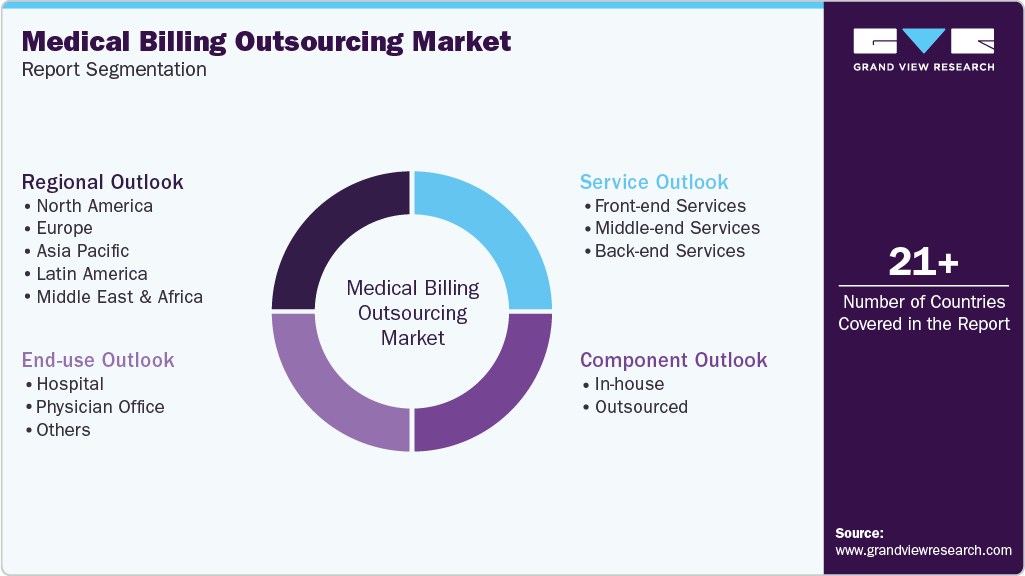
This report forecasts revenue growth at country levels and provides an analysis of the latest industry trends in each of the sub-segments from 2021 to 2033. For this study, Grand View Research has segmented the global medical billing outsourcing market report based on component, service, end-use, and region:
 To learn more about this report, Download Free Sample Report
 -
Component Outlook (Revenue, USD Million, 2021 - 2033)
-
In-house
-
Outsourced
-
-
Service Outlook (Revenue, USD Million, 2021 - 2033)
-
Front-end Services
-
Middle-end Services
-
Back-end Services
-
-
End-use Outlook (Revenue, USD Million, 2021 - 2033)
-
Hospital
-
Physician Office
-
Others
-
-
Regional Outlook (Revenue, USD Million, 2021 - 2033)
-
North America
-
U.S.
-
Canada
-
Mexico
-
-
Europe
-
UK
-
Germany
-
France
-
Italy
-
Spain
-
Sweden
-
Denmark
-
Norway
-
-
Asia Pacific
-
Japan
-
China
-
India
-
Thailand
-
Australia
-
South Korea
-
-
Latin America
-
Brazil
-
Argentina
-
-
MEA
-
South Africa
-
Saudi Arabia
-
UAE
-
Kuwait
-
-
Research Methodology
Segment Definition
Segment - Component
Revenue capture definition
In-House
The in-house segment includes medical billing activities that are managed internally by healthcare organizations using their own billing staff, coders, revenue cycle specialists, and technology infrastructure. Healthcare providers maintain direct control over claims submission, coding, payment collection, denial management, and compliance processes. This model is commonly adopted by organizations seeking greater oversight of their revenue cycle operations.
Outsourced
The outsourced segment comprises medical billing functions delegated to third-party service providers specializing in revenue cycle management and healthcare billing services. Outsourcing firms handle activities such as coding, claims processing, payment posting, denial management, and accounts receivable follow-up on behalf of healthcare providers. This model helps organizations reduce administrative burdens, access specialized expertise, and improve operational efficiency.
Segment - Services
Revenue capture definition
Front End
Front-end services encompass patient-facing administrative processes that occur before or at the point of care. These services include patient registration, insurance verification, eligibility checks, prior authorization, appointment scheduling, demographic data collection, and financial counseling. Effective front-end operations help reduce claim errors and improve reimbursement accuracy.
Middle End
Middle-end services involve clinical and billing activities that occur during and immediately after patient care delivery. These services include medical coding, charge capture, clinical documentation review, coding audits, charge entry, and compliance management. The primary objective of middle-end services is to ensure accurate claim preparation and regulatory compliance before submission to payers.
Back End
Back-end services consist of post-submission revenue cycle activities aimed at securing reimbursement and optimizing financial performance. These services include claims submission, payment posting, denial management, accounts receivable follow-up, appeals processing, collections management, and revenue analytics. Back-end services play a critical role in improving cash flow and minimizing revenue leakage.
Segment - End Use
Revenue capture definition
Hospital
The hospital segment includes public, private, specialty, and multi-specialty hospitals that utilize medical billing outsourcing services to manage complex billing and reimbursement processes. Hospitals often handle high patient volumes, multiple payer relationships, and diverse clinical services, creating significant demand for specialized revenue cycle management support to improve operational efficiency and financial performance.
Physician Office
The physician office segment comprises independent physician practices, group practices, specialty clinics, and outpatient medical offices. These providers outsource billing functions to reduce administrative workloads, improve reimbursement accuracy, manage coding complexities, and gain access to specialized billing expertise without maintaining large internal billing departments.
Others
The others segment includes ambulatory surgical centers (ASCs), diagnostic laboratories, imaging centers, urgent care centers, rehabilitation facilities, long-term care organizations, home healthcare agencies, and other healthcare service providers. These organizations utilize medical billing outsourcing services to streamline revenue cycle operations, enhance collections, and ensure compliance with evolving reimbursement requirements.
Estimation Model
Market Estimation Process:
INFORMATION PROCUREMENT
INFORMATION ANALYSIS
MARKET FORMULATION
VALIDATION & PUBLISHING
The stage involves the procurement of market data or related information via different sources & methodologies.
This step involves analysis & mapping of all the information procured from the previous step. It also encompasses the analysis of data discrepancies observed across various data sources.
The final step entails the placement of data points at appropriate market spaces in an attempt to deduce viable conclusions. Analyst perspective & subject matter expert based heuristic form of market sizing also plays an integral role in this step.
Validation is the most important step in the process. Validation & re-validation via an intricate designed process helps us finalize data-points to be used for final calculations.
The movement from step 1 and step 2 is bi-directional in nature. The process follows a ∞ flow from both the ends. This is an integral data filtration technique used by GVR.
The validation & market formulation steps are also reversible in nature. They are run parallel to ensure data accuracy and process flexibility.
The process of market sizing & data point identification runs throughout the report schedule. The process moves from Step 1&2 to Step 3&4, while keeping the steps 1&2 and 3&4 reversible. The cycle of market sizing & variable identification also keeps repeating until every data point available in the market is published.
Market-specific Research Models:
Consensus-Based Estimates & Forecasting
The medical billing outsourcing market presents emerging to dominant opportunities, featuring global key players like R1RCM Inc.; Veradigm LLC; eClinicalWorks; Oracle; McKesson Corporation. To ensure a holistic approach, the GVR research team adopted a comprehensive methodology, considering multiple companies worldwide and utilizing various variables for data accuracy.
Our methodology included:
Model 1: Commodity Flow Analysis - For public players, annual reports were referenced. For private players, premium paid data sources such as S&P Global, Crunchbase, ZoomInfo, RocketReach, etc., were used for the latest revenue insights.
Model 2: Parent Market Analysis
Model 3: Country-level Multivariate Analysis Assumptions
Model 4: Segment-level Multivariate Analysis Assumptions
Model 5: Medical Billing Outsourcing Market CAGR Calculations
Model 1: Commodity Flow Analysis
Commodity flow analysis was employed to track the movement of medical billing outsourcing through the value chain, from technology providers to end users. This analysis provided insights into demand generation points, intermediary roles, and ultimate consumption patterns.
Delivered Customizations
This report has been delivered with the following In-depth customizations
CLIENT REQUEST
CUSTOMIZATION DELIVERED
VALUE ADDS
Medical Billing Outsourcing Market Adoption & Revenue Cycle Efficiency Analysis
Developed a tailored analysis of the global Medical Billing Outsourcing market focused on outsourced billing operations, claims management, coding services, payment collections, denial management, and reimbursement optimization across hospitals, physician practices, ambulatory care centers, and specialty clinics. The study assessed outsourcing adoption trends, healthcare administrative cost pressures, and digital transformation initiatives influencing billing process modernization.
Enables stakeholders to understand evolving healthcare outsourcing trends, identify high-growth billing service segments, assess operational efficiency opportunities, and evaluate the impact of outsourcing on revenue realization, cost reduction, and long-term market expansion.
Claims Processing, Coding Accuracy & Reimbursement Performance Assessment
Delivered a customized evaluation of medical billing outsourcing utilization trends across patient registration, medical coding, charge capture, claims submission, accounts receivable management, denial resolution, and payment processing services. The analysis assessed reimbursement challenges, payer requirements, automation adoption, coding compliance standards, and demand for technology-enabled billing solutions supporting financial performance improvement.
Provides actionable insights into changing reimbursement dynamics, commercially attractive service categories, and emerging opportunities linked to denial reduction, coding accuracy enhancement, accelerated claims processing, and improved healthcare provider cash flow management.
Healthcare Outsourcing Infrastructure, Technology Integration & Competitive Landscape Assessment
Conducted a focused assessment of the medical billing outsourcing ecosystem, including outsourced and hybrid service models, cloud-based billing platforms, interoperability requirements, regulatory compliance considerations, cybersecurity requirements, and vendor positioning. The analysis evaluated implementation challenges, workforce availability, technology adoption barriers, service scalability, and competitive differentiation strategies among market participants.
Supports strategic planning for outsourcing partnerships, billing technology investments, service expansion initiatives, and market entry strategies by identifying adoption drivers, operational challenges, revenue opportunities, and competitive advantages across the global medical billing outsourcing value chain.
Frequently Asked Questions About This Report
The global medical billing outsourcing market size was valued at USD 16.6 billion in 2025 and is expected to reach USD 18.5 billion in 2026.
The global medical billing outsourcing market is expected to grow at a compound annual growth rate of 13.6% from 2026 to 2033 to reach USD 45.3 billion by 2033.
Some key players operating in the medical billing outsourcing market include R1RCM Inc.; Veradigm, LLC; eClinicalWorks; Oracle; Kareo, Inc.; Quest Diagnostics Incorporated; AdvancedMD, Inc.; Promantra Inc.; and McKesson Corporation
Key factors that are driving the medical billing outsourcing market growth include increasing complexity in medical billing, expansion of telehealth services, growing need for revenue cycle management (RCM) optimization, and changing regulatory guidelines.
Asia Pacific is the fastest-growing region over the forecast period.
The outsourced segment led with a 55.7% revenue share in 2025. In addition this is the fastest-growing segment.
Front-end held the largest revenue share in 2025, while middle end is the fastest-growing area.
Hospital held the largest share over 46.7% in 2025. However, the physician office segment is the fastest-growing segment.
North America held the largest revenue share of 49.3% in the medical billing outsourcing market in 2025. The dominance is due to the widespread adoption of electronic health records (EHR), high healthcare expenditure, and growing demand for revenue cycle management services. The presence of well-established healthcare infrastructure and strict regulatory frameworks such as HIPAA drives healthcare providers to seek professional billing services to ensure compliance.
About the Author(s)
Medical Devices Research Team
Healthcare · Medical DevicesThis report was authored by the medical devices research team at Grand View Research - comprising two research analysts, one senior research analyst, and one industry expert - with specialized expertise in the medical devices segment of the healthcare industry. All findings are based on proprietary healthcare databases, executive interviews, and regulatory analysis, subject to internal peer review prior to publication.
Last Updated:
Speak to Analyst

Customize this report to your needs - add regions, segments, or data points, with 20% free customization.
Or view our licence options:


ISO 9001:2015 & 27001:2022 Certified
We are GDPR and CCPA compliant! Your transaction & personal information is safe and secure. For more details, please read our privacy policy.


