
- Home
- »
- IT Services & Applications
- »
-
Information Technology Service Management Market Report, 2033GVR Report cover

Information Technology Service Management Market (2026 - 2033)
Size, Share & Trends Analysis Report By Component (Solution, Services), By Technology (Configuration, Performance, Network), By Deployment (Cloud, On-premises), By Enterprise Size, By Vertical, By Region, And Segment Forecasts
Market Size, 2025
$15.3BMarket Estimate, 2026
$17.4BMarket Forecast, 2033
$44.6BCAGR, 2026–2033
14.4%Information Technology Service Management (ITSM) Market Summary
The global information technology service management market size was valued at USD 15.3 billion in 2025 and is projected to grow from USD 17.4 billion in 2026 to USD 44.6 billion by 2033, at a CAGR of 14.4% from 2026 to 2033. The market in North America dominated with a revenue share of 39.6% in 2025. The global information technology service management (ITSM) market is growing as organizations focus on improving IT service efficiency and operational performance.
 Source: Grand View Research, IR Documents, Primary Interviews, Paid DatabasesTo learn more about this report,
 Download Free Sample Report
 Key Market Trends & Insights
- By component: Solution segment held a significant 76.3% revenue share in 2025.
- By technology: Network management segment held the largest market share of 27.1% in 2025.
- By deployment: Cloud segment held a significant 68.9% revenue share in 2025.
- By enterprise size: Large enterprises segment held a significant 74.0% revenue share in 2025.
- By vertical: IT & Telecom segment held a significant 22.0% revenue share in 2025.
Regional Highlights
- Largest regional market: North America (39.6% revenue share, 2025)
- Fastest-growing regional market: Asia Pacific (highest CAGR, 2026-2033)
- By country: The U.S. held the largest market share in 2025.
Market Size & Forecast
- Market size in 2025: USD 15.3 Billion
- Estimated market size in 2026: USD 17.4 Billion
- Projected market size by 2033: USD 44.6 Billion
- CAGR (2026-2033): 14.4%
Three ways to get this report
Buy it, customize it, or ask a question.Ask an Analyst
A direct answer, usually in 1 working day
- AccessReport author, directly
- Reply timeWithin 1 working day
- No sales callDirect answer only
- FormatEmail reply
- CostFree, no cost
Get the Full Report
What the study covers
- FormatsPDF · Excel · Dashboard
- Timeline2026–2033 annual, 2025 base
- Coverage20+ countries, 5 regions
- Companies10+ key players profiled
Customize the Report
20% free customization
- IncludeCountries, segments, points
- TailorTo your product definition
- ExtendDeeper competitor detail
- OrA fully bespoke study
- Turnaround5–10 working days
Increasing adoption of cloud computing, automation, and digital transformation initiatives is supporting demand for ITSM solutions. Businesses are also investing in centralized service management platforms to enhance user experience and streamline IT workflows. Organizations are also investing in ITSM solutions to enhance IT service quality and customer satisfaction, while regulatory compliance requirements are prompting further adoption to ensure adherence to these standards. Furthermore, industry regulatory requirements drive organizations to implement ITSM solutions to ensure compliance. These solutions aid in tracking and documenting IT processes, facilitating audits, and demonstrating adherence to industry-specific standards and data protection regulations. To learn more about this report, Download Free Sample Report
 The demand for ITSM is rising, fueled by several key factors. These include the growing complexity of IT systems and infrastructure, necessitating effective management solutions. Organizations also seek to enhance their agility to adapt swiftly to the ever-changing tech landscape. Moreover, there's an increased emphasis on prioritizing customer satisfaction and a heightened awareness of IT security's crucial role in safeguarding sensitive data. ITSM has become integral for efficiently managing IT resources, delivering top-notch services, and ensuring robust cybersecurity practices in today's dynamic business environment.
ITSM is a vital framework for organizations to manage their IT services efficiently, ensuring high-quality service delivery, cost reduction, risk mitigation, and alignment with business objectives. As businesses increasingly embrace digitalization and complex technologies such as cloud computing and AI, ITSM plays a crucial role in enabling organizations to optimize these technologies, enhance user experiences, and drive digital transformation progress. ITSM serves as a multifaceted tool for organizations, aiding in the adoption of new technologies by managing associated risks and dependencies, enhancing the customer experience through streamlined IT support, boosting operational efficiency via process automation and performance insights, reducing costs by eliminating waste, and optimizing resources, and fortifying security by providing a structured approach to IT risk management.
ITSM tools are experiencing increased adoption as they empower IT operations, particularly infrastructure and operations (I&O) managers, to better support the production environment by streamlining the delivery of high-quality IT services. These tools are most commonly utilized within IT service desks and delivery functions but are adaptable for non-I&O departments. These tools offer a range of benefits, including task automation, improved communication, incident and problem management, IT asset tracking, enforced change procedures, compliance adherence, and user self-service capabilities. Thus, ITSM tools enhance organizational efficiency and service quality across various departments, aligning IT practices with business goals.
Market Dynamics
The information technology service management (ITSM) market is expanding as organizations focus on improving IT service efficiency and operational performance. Growing adoption of cloud computing, automation, and digital transformation initiatives is supporting demand for advanced ITSM solutions. Businesses are increasingly implementing centralized platforms to manage IT services and enhance user experiences. Integration challenges with legacy systems and concerns related to data security continue to affect market growth. Ongoing advancements in artificial intelligence and cloud-based technologies are creating new opportunities for innovation and service improvement.
The increasing adoption of artificial intelligence (AI) and machine learning (ML) in IT operations is a significant factor driving the growth of the information technology service management (ITSM) market. Organizations are increasingly deploying AI-enabled ITSM platforms to automate repetitive tasks, streamline incident management processes, and improve service desk productivity. These technologies help reduce manual intervention, accelerate issue resolution, and enhance the overall efficiency of IT service delivery. As IT environments become more complex, businesses are relying on intelligent automation to manage growing workloads and maintain service quality.
Machine learning capabilities are further strengthening ITSM solutions through predictive analytics and proactive monitoring functions. Organizations can identify potential system failures, performance bottlenecks, and service disruptions before they impact business operations, helping minimize downtime and improve reliability. AI-driven chatbots and virtual assistants are also enhancing user experiences by providing faster support and self-service options. As enterprises continue investing in digital transformation and operational efficiency initiatives, demand for advanced ITSM platforms with integrated AI and ML capabilities is expected to increase steadily.
Many organizations continue to rely on legacy IT infrastructure that was not designed to support modern ITSM platforms, creating difficulties during implementation and integration. Connecting new service management solutions with existing applications, databases, and workflows often requires significant time, technical expertise, and financial investment. These complexities can delay deployment timelines and increase project costs, particularly for large enterprises with highly customized IT environments.
The challenge becomes more significant as organizations pursue digital transformation while maintaining uninterrupted business operations. Compatibility issues, data migration concerns, and the risk of service disruptions can discourage businesses from upgrading or replacing existing systems. As a result, some organizations adopt ITSM solutions gradually, which can slow market growth and limit the full realization of service management benefits.
Organizations are increasingly shifting from on-premises systems to cloud-based ITSM platforms to improve scalability, flexibility, and cost efficiency. Cloud deployment enables faster implementation, simplified maintenance, and easier integration with other enterprise applications. These benefits are encouraging businesses of all sizes to modernize their service management environments and adopt advanced ITSM capabilities.
The growing preference for subscription-based software models is further supporting demand for cloud-based ITSM solutions. Small and medium-sized enterprises are increasingly adopting these platforms due to lower upfront costs and reduced infrastructure requirements. As organizations continue their cloud migration initiatives, vendors have significant opportunities to expand their customer base and introduce innovative service management offerings.
Market Concentration & Characteristics
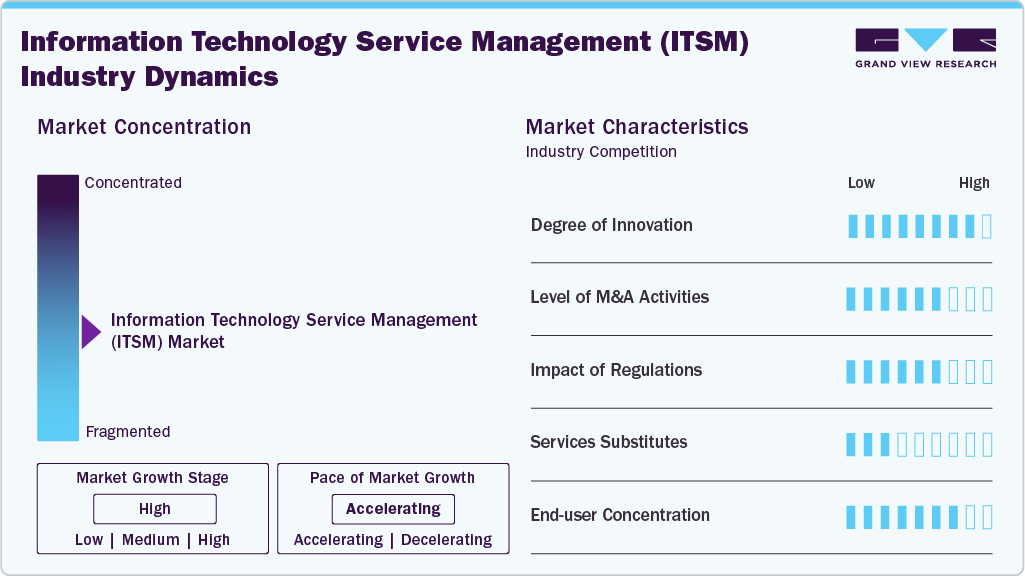
The information technology service management (ITSM) market exhibits a moderately fragmented competitive structure with the presence of several global software providers and numerous specialized vendors. Large companies offer comprehensive ITSM platforms with capabilities spanning incident management, service desk operations, workflow automation, and analytics. The market continues to attract new participants focused on cloud-native and AI-enabled service management solutions. Product differentiation, scalability, and integration capabilities remain important competitive factors. Vendors are actively enhancing their platforms through innovation and strategic partnerships. This competitive environment contributes to a broad range of solution offerings across enterprise requirements.
 To learn more about this report, Download Free Sample Report
 Despite the presence of established companies, no single vendor holds a dominant share of the global ITSM market. Demand is distributed across organizations of different sizes and industries, creating opportunities for both large providers and niche players. Cloud-based deployment models have reduced barriers to entry and increased competition among solution providers. Market participants are expanding their portfolios with enterprise service management, automation, and artificial intelligence capabilities. Mergers and acquisitions occur periodically to strengthen product offerings and geographic reach. As a result, the market remains moderately fragmented with competition driven by innovation, functionality, and customer support.
Analyst Perspective
The Information Technology Service Management (ITSM) market is transitioning from traditional service desk functionality toward intelligent, enterprise-wide service management platforms. Vendors are increasingly embedding artificial intelligence, workflow automation, and analytics capabilities to improve service quality and operational visibility across organizations. The market is witnessing growing demand for cloud-native and SaaS-based solutions as enterprises modernize legacy IT environments and seek greater scalability. Competition is intensifying as established vendors and emerging providers expand their offerings through platform enhancements, strategic partnerships, and acquisitions. Over the forecast period, organizations are expected to prioritize integrated ITSM solutions that support digital workplace initiatives, operational resilience, and cross-functional service management requirements.
Component Insights
Based on component, the solution segment led the market with the significant revenue share of 76.3% in 2025. As technology reliance grows, there's a heightened demand for robust ITSM solutions that streamline operations, often incorporating automation for cost savings and quicker service delivery. Automation enhances efficiency and improves the accuracy and consistency of IT service delivery, resulting in reduced downtime and heightened customer satisfaction. Cloud-based ITSM solutions, offered by vendors such as ServiceNow, BMC, Cherwell Software, Ivanti, Broadcom, and IBM Corporation, are gaining traction due to their integrated capabilities and benefits for enterprises of varying sizes.
The service segment is predicted to foresee significant growth in the forecast years, driven by a rising demand for consulting, implementation, customization, training, and support services. These services play a pivotal role in assisting businesses as they transition to and optimize their utilization of new technologies and business models. Consulting services help assess needs and develop transformation plans, while implementation services facilitate the integration of new technologies. Customization services tailor solutions to specific requirements, and training/support services ensure employees are well-equipped to utilize new tools and models effectively. This growth underscores the crucial role of services in enabling organizations to navigate and thrive in an evolving technological landscape.
Deployment Insights
Based on deployment, the cloud segment led the market with the significant revenue share of 68.9% in 2025. The growth is attributed to cloud-based ITSM solutions offering compelling advantages, including scalability, flexibility, and cost-effectiveness, making them highly attractive to organizations of all sizes. Additionally, the widespread adoption of cloud computing across businesses has fueled the demand for cloud-based ITSM solutions. Furthermore, the growing popularity of DevOps and agile development methodologies have played a significant role in driving the growth of the cloud ITSM market, given their requirement for more adaptable and scalable ITSM solutions.
The on-premises segment is anticipated to witness significant growth in the coming years.Security concerns remain a significant deterrent to cloud migration for many organizations, driven by apprehensions about data and application security in the cloud. The lower initial cost of implementing and maintaining on-premises ITSM solutions particularly appeals to organizations with limited budgets. Organizations with specific custom IT requirements also favor on-premises solutions for greater control. Moreover, some organizations must adhere to HIPAA or PCI DSS regulations, which are more manageable with on-premises ITSM solutions.
Enterprise Size Insights
Based on enterprise size, the large enterprises segment led the market with the largest revenue share of 74.0% in 2025. The segment's rise can be attributable to their intricate IT infrastructures necessitating robust ITSM solutions, alongside their substantial resources for investment. Furthermore, there's a heightened demand among large enterprises for automating IT services, optimizing efficiency, and reducing costs, tasks that ITSM solutions excel at, including incident and problem management. Compliance with HIPAA and PCI DSS regulations is increasingly critical for these enterprises, with ITSM solutions offering valuable incident tracking and reporting features. Thus, enhancing customer service through self-service options and real-time IT operation visibility is a priority, and ITSM solutions facilitate this with knowledge bases, service catalogs, and dashboards.
The SMEs segment is anticipated to exhibit the fastest CAGR over the forecast period. SMEs increasingly depend on IT to efficiently run their operations, encompassing customer relationship management and production automation tasks. This growing reliance on IT services is fueling a heightened demand for ITSM solutions tailored to the specific needs of SMEs. Moreover, the cost-effectiveness of ITSM solutions suits the budget constraints frequently associated with SMEs. Thus, these solutions are renowned for their ease of use, requiring minimal IT expertise for management for SMEs with restricted IT resources.
Vertical Insights
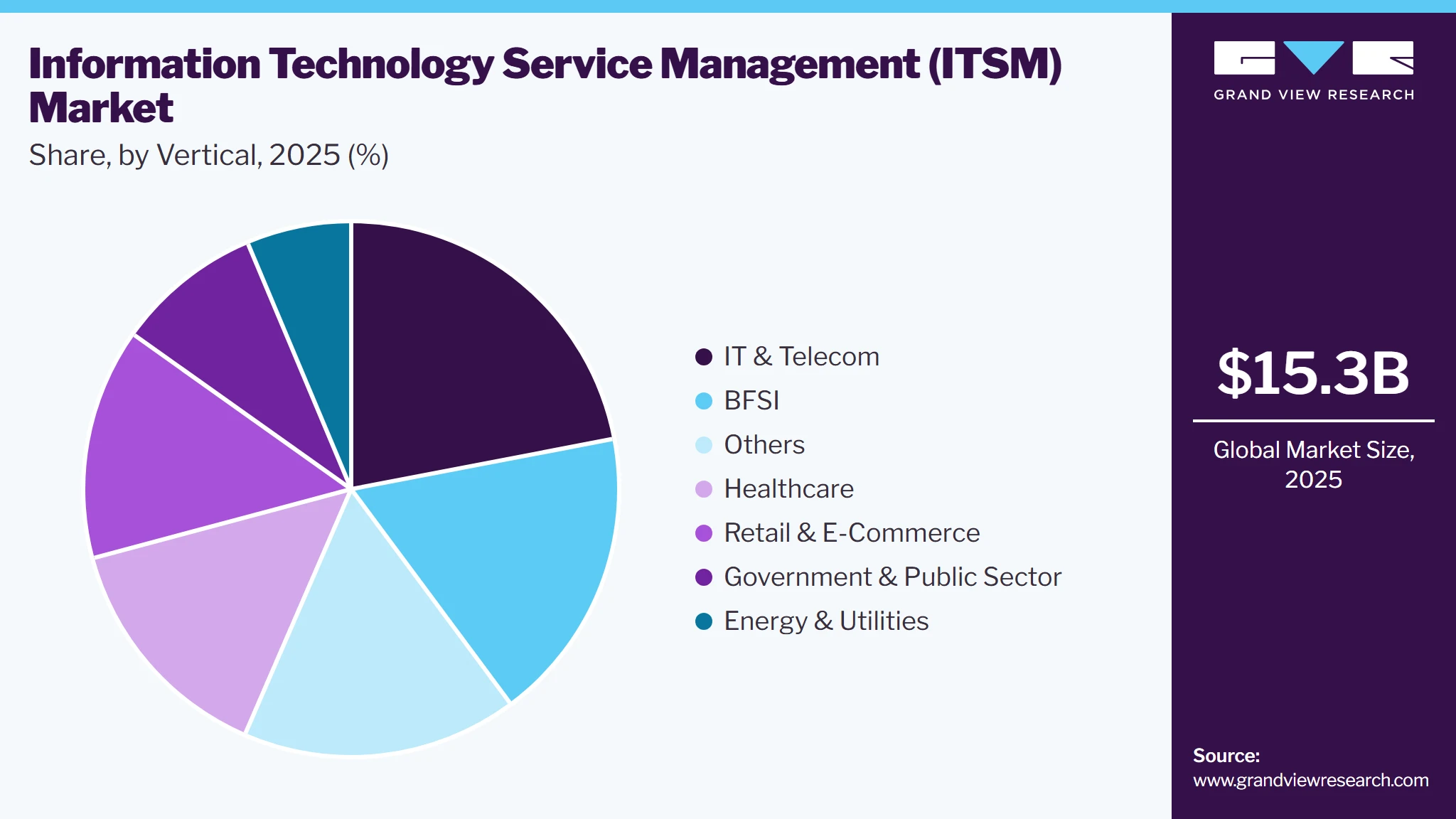
Based on vertical, the IT & Telecom segment led the market with the largest revenue share of 22.0% in 2025. IT & telecom companies rely on ITSM tools and services to enhance service delivery, cut costs, and boost customer satisfaction. This dominance can be attributed to factors such as the rising adoption of cloud technology and digital advancements, a growing inclination towards IT service management outsourcing, heightened emphasis on IT security and compliance, and the continuous pursuit of efficiency and effectiveness in IT service delivery. Thus, the increasing complexity of IT operations and the need for streamlined management solutions to handle diverse IT functions efficiently.
 To learn more about this report, Download Free Sample Report
 The healthcare segment is anticipated to exhibit the fastest CAGR over the forecast period. This growth is driven by several key factors, including the increasing adoption of digital health technologies such as electronic health records (EHRs), telemedicine, and wearable devices. Healthcare organizations also prioritize enhancing patient care, compliance with stringent healthcare regulations such as HIPAA, and cost reduction. ITSM solutions play a pivotal role in assisting healthcare entities by tracking and managing IT assets, auditing IT activities, and safeguarding patient data, thus contributing to the sector's growth and efficiency.
Technology Insights
Based on technology, the network management segment led the market with the largest revenue share of 27.1% in 2025. The high share can be attributed to the growing complexity of IT networks, which necessitates effective monitoring and management. Network management solutions play a vital role in helping organizations identify and resolve network issues, optimize performance, and bolster security. These solutions provide essential network visibility, allowing for problem diagnosis and mitigation while addressing the increasing need for network security in the face of evolving cyber threats. Network management solutions are instrumental in identifying and mitigating security threats, ensuring organizations can safeguard their digital infrastructure effectively. As IT networks evolve, network management solutions remain essential for optimizing performance, enhancing security, and ensuring seamless operations in an ever-changing technological landscape.
The Database Management System (DBMS) segment is predicted to foresee significant growth in the coming years, primarily driven by the surging demand for ITSM solutions that enhance IT infrastructure management. DBMSs play a pivotal role in storing and managing extensive data volumes, a critical requirement for ITSM solutions. The escalating adoption of cloud computing further fuels the segment's growth, offering scalability, flexibility, and cost-effectiveness advantages. Additionally, the increasing need for real-time data insights propels the DBMS segment. DBMSs enable organizations to collect, store, and analyze large volumes of data in real time, enhancing decision-making capabilities. Thus, the growing complexity of IT systems emphasizes the importance of DBMSs, as they provide a centralized data repository to manage IT system intricacies efficiently.
Regional Insights
North America dominated the information technology service management market with the largest revenue share of 39.6% in 2025. This regional leadership is driven by developed countries like Canada and the U.S., which have pioneered ITSM practices with a continuous investment in ITSM solutions. North American organizations are increasingly compelled to enhance IT service delivery and cost-effectiveness, making ITSM solutions a vital asset. Furthermore, the presence of leading ITSM vendors headquartered in North America further solidifies the region's advantageous position in the market.
 To learn more about this report, Download Free Sample Report
 U.S. Information Technology Service Management Market Trends
The information technology service management market in the U.S. held the largest share in the North America region in 2025, driven by the increasing digital transformation across various industries. As organizations continue to adopt cloud computing, AI, and automation, the demand for efficient ITSM solutions to manage IT services, infrastructure, and workflows is rising. The shift towards remote work and hybrid models has further amplified the need for robust ITSM frameworks to ensure seamless IT operations, service delivery, and customer support. Additionally, the growing emphasis on data security, compliance, and integration of advanced technologies like AI and machine learning is expected to fuel market growth.
Europe Information Technology Service Management Market Trends
The ITSM market in the Europe region is expected to witness significant growth over the forecast period, driven by increased digitalization across sectors such as healthcare, manufacturing, and finance. The adoption of cloud services, AI, and automation is encouraging companies to implement ITSM solutions for improved IT infrastructure management and service delivery. Furthermore, the shift towards remote and hybrid work models has heightened the need for robust ITSM frameworks to ensure efficient IT support and seamless user experiences. Rising regulatory requirements, data privacy concerns, and the integration of AI and analytics for enhanced IT service optimization are also key factors propelling market growth.
Asia Pacific Information Technology Service Management Market Trends
The ITSM market in the Asia Pacific region is anticipated to register the fastest CAGR over the forecast period, driven by rapid digital transformation and the expansion of IT infrastructure across emerging economies like India, China, and Southeast Asia. The increasing adoption of cloud computing, AI, and automation is prompting businesses to implement ITSM solutions for better IT service delivery and operational efficiency. The region’s growing tech-savvy workforce and the shift towards remote work have further boosted the demand for effective ITSM frameworks. Additionally, rising investments in digital infrastructure, along with the need for enhanced cybersecurity and compliance, are key factors contributing to market growth.
Key Information Technology Service Management Company Insights
Some key players in the ITSM market, such as Atlassian; BMC Software, Inc.; Broadcom; and Cloud Software Group, Inc are actively working to expand their customer base and gain a competitive advantage. To achieve this, they are pursuing various strategic initiatives, including partnerships, mergers and acquisitions, collaborations, and the development of new products and technologies. This proactive approach allows them to enhance their market presence and innovate in response to evolving security needs.
-
Broadcom Inc. is a global technology company that develops, designs, and supplies a broad range of infrastructure software and semiconductor solutions. Broadcom is known for its software division, which offers solutions like Automic, CA Service Management, and DX Operational Intelligence. These tools provide comprehensive ITSM capabilities, including IT service automation, monitoring, and management. Broadcom's ITSM products are designed to enhance service delivery, streamline IT operations, and improve end-user experiences. The company serves various sectors, including telecommunications, financial services, and manufacturing, leveraging its expertise in software and hardware integration to deliver robust IT solutions.
-
BMC Software, Inc. is a foremost provider of IT solutions specializing in ITSM software. Its flagship ITSM platform, BMC Helix, offers comprehensive capabilities for IT service automation, incident management, asset management, and workflow optimization. BMC Helix leverages AI, machine learning, and cloud technology to provide intelligent, predictive, and user-centric IT services. The company’s solutions are widely used across various industries, including healthcare, finance, and retail, to improve IT operations, enhance service delivery, and drive digital transformation. With decades of expertise, BMC Software, Inc. is recognized for helping organizations modernize their IT infrastructure and streamline complex IT environments.
Key Information Technology Service Management Companies
The following key companies have been profiled for this study on the information technology service management (ITSM) market.
-
Atlassian
-
BMC Software, Inc.
-
Broadcom
-
Cloud Software Group, Inc
-
Freshworks Inc.
-
Hewlett Packard Enterprise Development LP
-
IBM Corporation
-
Ivanti.
-
Open Text
-
ServiceNow.
Competitive Benchmarking
Operating Strategies
Competitive Edge
Weaknesses
Mature Players: IBM Corporation, Hewlett Packard Enterprise Development LP, BMC Software, Inc
- Focus on expanding enterprise accounts, enhancing AI-driven automation capabilities, strengthening global partner ecosystems, and integrating ITSM platforms with broader enterprise software portfolios.
- Strong brand recognition, extensive enterprise customer base, comprehensive product portfolios, global service capabilities, and deep integration with enterprise IT ecosystems.
- Higher implementation costs, complex deployment processes, longer upgrade cycles, greater dependence on legacy customer environments, and slower innovation cycles.
Emerging Players: Atlassian, Freshworks Inc., Ivanti, Cloud Software Group, Inc.
- Focus on cloud-native innovation, competitive pricing, rapid feature development, targeting SMEs and mid-market customers, and expanding market presence through strategic partnerships and acquisitions.
- Agile product innovation, cloud-native architecture, faster deployment, flexible pricing models, user-friendly interfaces, strong focus on customer experience, and rapid feature development.
- Limited global presence, smaller enterprise customer base, fewer advanced capabilities for highly complex environments, lower brand recognition compared to established vendors, and constrained financial resources.
Recent Developments
-
In September 2024, BearingPoint partnered with Swish AI to enhance ITSM through the integration of AI technologies. This collaboration aims to transform the ITSM landscape by leveraging AI to automate service workflows, improve efficiency, and enhance user experiences. BearingPoint, a management and technology consultancy, focuses on delivering digital transformation solutions across various industries, including IT. With this partnership, they intend to streamline IT operations, reduce manual processes, and help clients adapt to an increasingly digital world by embedding intelligent automation into service management functions.
-
In May 2024, SolarWinds Worldwide, LLC. launched "SolarWinds AI," a generative AI engine integrated into its IT Service Management solution, SolarWinds Service Desk. Developed under the "AI by Design" framework, it aims to enhance IT operations by streamlining agent workflows, resolving issues faster, and minimizing downtime. The AI utilizes large language models (LLMs) to summarize ticket histories, suggest responses, and provide real-time solutions, ensuring privacy and security. SolarWinds plans to extend this AI across its observability and IT management solutions to support DevOps, SecOps, and more.
-
In March 2024, The Washington D.C. release of ServiceNow ITSM introduces new features to enhance digital product release management, streamline workforce optimization, and leverage AI. Key updates include the Digital Product Release (DPR) tool for coordinated product delivery, enhanced capabilities in "Now Assist" for AI-powered ITSM, and improved workforce optimization with peer recognition and better work assignment tools. Additional improvements cover service operations, process mining, and knowledge management aimed at boosting efficiency and user experience.
Information Technology Service Management Market Report Scope
Report Attribute
Details
Market size in 2025
USD 15.3 billion
Estimated market size in 2026
USD 17.4 billion
Projected market size by 2033
USD 44.6 billion
Growth rate
CAGR of 14.4% from 2026 to 2033
Base year for estimation
2025
Historical data
2021 - 2024
Forecast period
2026 - 2033
Quantitative units
Revenue in USD million/Million and CAGR from 2026 to 2033
Report coverage
Revenue forecast, company ranking, competitive landscape, growth factors, and trends
Segments covered
Component, technology, deployment, enterprise size, vertical, region
Regional scope
North America; Europe; Asia Pacific; Latin America; MEA
Country scope
U.S.; Canada; Mexico; Germany; UK; France; China; Japan; India; Australia; South Korea; Brazil; KSA; UAE; South Africa
Key companies profiled
Atlassian; BMC Software, Inc.; Broadcom; Cloud Software Group, Inc.; Freshworks Inc.; Hewlett Packard Enterprise Development LP; IBM Corporation; Ivanti.; Open Text; ServiceNow
Customization scope
Free report customization (equivalent up to 8 analysts' working days) with purchase. Addition or alteration to country, regional & segment scope.
Pricing and purchase options
Avail customized purchase options to meet your exact research needs. Explore purchase options
Global Information Technology Service Management Market Report Segmentation
This report forecasts revenue growth at global, regional, and country levels and provides an analysis of the latest industry trends in each of the sub-segments from 2021 to 2033. For this study, Grand View Research has segmented the global information technology service management (ITSM) market report based on component, technology, deployment, enterprise size, vertical, and region:
-
Component Outlook (Revenue, USD Billion, 2021 - 2033)
-
Solution
-
Services
-
-
Technology Outlook (Revenue, USD Billion, 2021 - 2033)
-
Configuration Management
-
Performance Management
-
Network Management
-
Database Management System
-
Other Applications
-
-
Deployment Outlook (Revenue, USD Billion, 2021 - 2033)
-
Cloud
-
On-Premises
-
-
Enterprise Size Outlook (Revenue, USD Billion, 2021 - 2033)
-
SMEs
-
Large Enterprises
-
-
Vertical Outlook (Revenue, USD Billion, 2021 - 2033)
-
BFSI
-
Healthcare
-
Retail & E-commerce
-
IT & Telecom
-
Energy & Utilities
-
Government
-
Others
-
-
Regional Outlook (Revenue, USD Billion, 2021 - 2033)
-
North America
-
U.S.
-
Canada
-
Mexico
-
-
Europe
-
UK
-
Germany
-
France
-
-
Asia Pacific
-
China
-
India
-
Japan
-
Australia
-
South Korea
-
-
Latin America
-
Brazil
-
-
MEA
-
UAE
-
South Africa
-
KSA
-
-
Research Methodology
The information technology service management market figures in this report are based on a proven research process that combines executive interviews with secondary research from proprietary databases, company filings, and recognized regulatory and institutional sources. Market size is built through value-chain sizing - reconciling supply-side and demand-side estimates - and triangulated with bottom-up and top-down approaches. Every estimate passes multiple levels of expert validation before publication, with each information technology service management segment quantified using the revenue-capture definitions in the table below.
Segment Definition
Segment - Component
Revenue Capture Definition
Solution
Revenue generated from the licensing, subscription, deployment, and usage of ITSM software platforms and applications. This includes service desk management, incident management, problem management, change management, asset management, configuration management, workflow automation, knowledge management, and AI-enabled IT service management solutions.
Services
Revenue generated from professional and managed services associated with ITSM implementation and operation. This includes consulting, system integration, customization, deployment, training, support, maintenance, managed ITSM services, and ongoing optimization services provided to ensure effective utilization and performance of ITSM platforms.
Segment- Technology
Revenue Capture Definition
Configuration Management
Revenue generated from ITSM platforms and tools that maintain configuration management databases (CMDBs), track configuration items (CIs), manage asset relationships, and support change and configuration control processes across IT environments.
Performance Management
Revenue generated from ITSM platforms and tools that monitor, measure, analyze, and optimize the performance, availability, and reliability of IT infrastructure, applications, and digital services.
Network Management
Revenue generated from ITSM platforms and tools that monitor, administer, configure, troubleshoot, and optimize enterprise network infrastructure and network-related service operations.
Database Management System
Revenue generated from ITSM platforms and tools that support database monitoring, administration, performance management, availability management, backup management, and database-related service operations.
Other Applications
Revenue generated from ITSM platforms and tools associated with incident management, problem management, change management, service desk operations, knowledge management, asset management, workflow automation, and other IT service management functions.
Segment- Deployment
Revenue Capture Definition
Cloud
Revenue generated from cloud-hosted and Software-as-a-Service (SaaS)-based ITSM platforms delivered through public, private, or hybrid cloud environments.
On-Premises
Revenue generated from ITSM platforms deployed and operated within an organization's own data center and IT infrastructure.
Segment- Enterprise Size
Revenue Capture Definition
SMEs
Revenue generated from ITSM platforms and related services adopted by small and medium-sized enterprises to manage IT operations, service delivery, and infrastructure management activities.
Large Enterprises
Revenue generated from ITSM platforms and related services deployed by large organizations to manage complex IT environments, enterprise-wide service delivery, compliance, and operational requirements.
Segment- Vertical
Revenue Capture Definition
BFSI
Revenue generated from ITSM deployments within banking, financial services, and insurance organizations for managing IT operations, digital services, compliance, and service delivery processes.
Healthcare
Revenue generated from ITSM deployments within hospitals, healthcare providers, clinics, and healthcare networks for managing IT infrastructure, applications, and service operations.
Retail & E-Commerce
Revenue generated from ITSM deployments supporting retail operations, e-commerce platforms, customer-facing applications, and digital commerce infrastructure.
IT & Telecom
Revenue generated from ITSM deployments within information technology companies, managed service providers, software vendors, and telecommunications operators.
Energy & Utilities
Revenue generated from ITSM deployments supporting IT operations, digital infrastructure, and service management requirements within energy and utility organizations.
Government
Revenue generated from ITSM deployments within government agencies and public sector organizations to support IT service delivery, infrastructure management, and digital transformation initiatives.
Others
Revenue generated from ITSM deployments across industries including manufacturing, education, transportation, logistics, media, hospitality, and professional services.
Estimation Model
Layer Name
Key Question
Description
User Base Layer
Who creates demand for Information Technology Service Management solutions?
Identifies the total population of organizations across industries that require IT service management capabilities to support IT operations, service delivery, infrastructure management, and digital transformation initiatives.
Active User Layer
Who actively uses Information Technology Service Management solutions?
Filters the total user base based on ITSM adoption levels, IT maturity, cloud deployment readiness, and active utilization of service management platforms by IT teams and business functions.
Application Consumption Layer
What types of Information Technology Service Management solutions and services are used?
Estimates usage across service desk management, incident management, change management, asset management, configuration management, workflow automation, performance monitoring, and related ITSM applications, reflecting adoption intensity.
Revenue Capture Layer
How is revenue generated in the Information Technology Service Management ecosystem?
Calculates revenue through software licensing, cloud subscriptions, implementation services, consulting, customization, training, support, maintenance, and managed ITSM services across organizations of different sizes and industries.
Delivered Customizations
This report has been delivered with the following In-depth customizations
Client Objective
Customization Delivered
Value Adds
Product Positioning & Competitive Intelligence
Benchmarking of ITSM platforms based on service desk capabilities, workflow automation, AI-enabled functionalities, integration capabilities, pricing models, deployment options, user experience, and competitor strategy analysis.
Supports product differentiation, enables pricing optimization, identifies feature gaps and unmet customer requirements, and strengthens competitive positioning across target markets. Technology & Innovation Assessment
Analysis of emerging technologies in ITSM, including artificial intelligence, machine learning, predictive analytics, cloud-native architectures, low-code automation, and enterprise service management capabilities, along with innovation pipeline and ecosystem assessment.
Identifies future growth opportunities, supports product roadmap development, evaluates technology adoption trends, and strengthens strategic technology investment decisions. Market Entry & Expansion Assessment
Regional demand sizing and forecasting, industry-wise adoption analysis, customer segmentation by organization size and vertical, competitive landscape benchmarking, and regulatory assessment across key markets.
Enables identification of high-growth opportunities, supports go-to-market strategy development, highlights investment priorities and risks, and facilitates data-driven expansion planning. Frequently Asked Questions About This Report
Some key players operating in the information technology service management (ITSM) market include Atlassian; BMC Software, Inc.; Broadcom; Cloud Software Group, Inc.; Freshworks Inc.; Hewlett Packard Enterprise Development LP; IBM Corporation; Ivanti.; Open Text; ServiceNow
Key factors driving the information technology service management market growth include the shift towards cloud-based ITSM solutions and the need for improved IT service delivery.
Asia Pacific is the fastest-growing region over the forecast period.
The global information technology service management market is expected to grow at a CAGR of 14.4% from 2026 to 2033, reaching USD 44.6 billion by 2033.
North America dominated the market in 2025, accounting for over 39.6% share of the global revenue. This regional leadership is driven by developed countries like Canada and the U.S., which have pioneered ITSM practices with continuous investment in ITSM solutions.
IT & telecom segment held the largest share (over 22.0%) in 2025, while the healthcare segment is the fastest-growing vertical.
The solution segment led with a 76.3% revenue share in 2025, while services segment is the fastest-growing component
The network management segment accounted for the largest share of 27.1% in 2025. This growth is driven by increasing IT infrastructure complexity, cloud adoption, and rising demand for network visibility and efficient IT operations.
The cloud segment led with a 68.9% revenue share in 2025 and is also the fastest-growing segment.
The global information technology service management (ITSM) market size was valued at USD 15.3 billion in 2025 and is estimated at USD 17.4 billion for 2026.
About the Author(s)
IT Services & Applications Research Team
Technology · IT Services & ApplicationsThis report was authored by the it services & applications research team at Grand View Research - comprising two research analysts, one senior research analyst, and one industry expert - with specialized expertise in the it services & applications segment of the technology industry. All findings are based on proprietary technology databases, executive interviews, and regulatory analysis, subject to internal peer review prior to publication.
Last Updated:
Speak to Analyst

Customize this report to your needs - add regions, segments, or data points, with 20% free customization.
Or view our licence options:


ISO 9001:2015 & 27001:2022 Certified
We are GDPR and CCPA compliant! Your transaction & personal information is safe and secure. For more details, please read our privacy policy.


