
- Home
- »
- Green Building Materials
- »
-
Insulated Concrete Form Market Size Report, 2026-2033GVR Report cover

Insulated Concrete Form Market (2026 - 2033)
Size, Share & Trends Analysis Report By Product (Polystyrene Foam, Polyurethane Foam, Cement-bonded Wood Fiber), By Application (Residential, Non Residential), By Region, And Segment Forecasts
Market Size, 2025
$999.1MMarket Estimate, 2026
$1,053.8MMarket Forecast, 2033
$1,604.5MCAGR, 2026–2033
6.2%Insulated Concrete Form Market Summary
The global insulated concrete form market size was valued at USD 999.1 million in 2025 and is projected to grow from USD 1,053.8 million in 2026 to USD 1,604.5 million by 2033, at a CAGR of 6.2% from 2026 to 2033, driven by the rising demand for energy-efficient and sustainable construction solutions. The market in North America dominated with a revenue share of 36.6% in 2025. With increasing awareness of environmental sustainability and stringent building energy regulations, ICF systems are gaining traction as they provide superior thermal insulation, reducing heating and cooling costs in residential and commercial structures.
 Source: Grand View Research, IR Documents, Primary Interviews, Paid DatabasesTo learn more about this report,
 Download Free Sample Report
 Key Market Trends & Insights
- By product: Polystyrene foam segment held the largest market share of 61.2% in 2025.
- By application: Residential segment held the largest market share of 65.3% in 2025.
Regional Highlights
- Largest regional market: North America (36.6% revenue share, 2025)
- By country: U.S. held the largest market share in 2025
Market Size & Forecast
- Market size in 2025: USD 999.1 Million
- Estimated market size in 2026: USD 1,053.8 Million
- Projected market size by 2033: USD 1,604.5 Million
- CAGR (2026-2033): 6.2%
Three ways to get this report
Buy it, customize it, or ask a question.Ask an Analyst
A direct answer, usually in 1 working day
- AccessReport author, directly
- Reply timeWithin 1 working day
- No sales callDirect answer only
- FormatEmail reply
- CostFree, no cost
Get the Full Report
What the study covers
- FormatsPDF · Excel · Dashboard
- Timeline2026–2033 annual, 2025 base
- Coverage20+ countries, 5 regions
- Companies10+ key players profiled
Customize the Report
20% free customization
- IncludeCountries, segments, points
- TailorTo your product definition
- ExtendDeeper competitor detail
- OrA fully bespoke study
- Turnaround5–10 working days
In addition, government initiatives promoting green building certifications, such as LEED (Leadership in Energy and Environmental Design) and BREEAM (Building Research Establishment Environmental Assessment Method), have further fueled the adoption of ICFs in modern construction projects.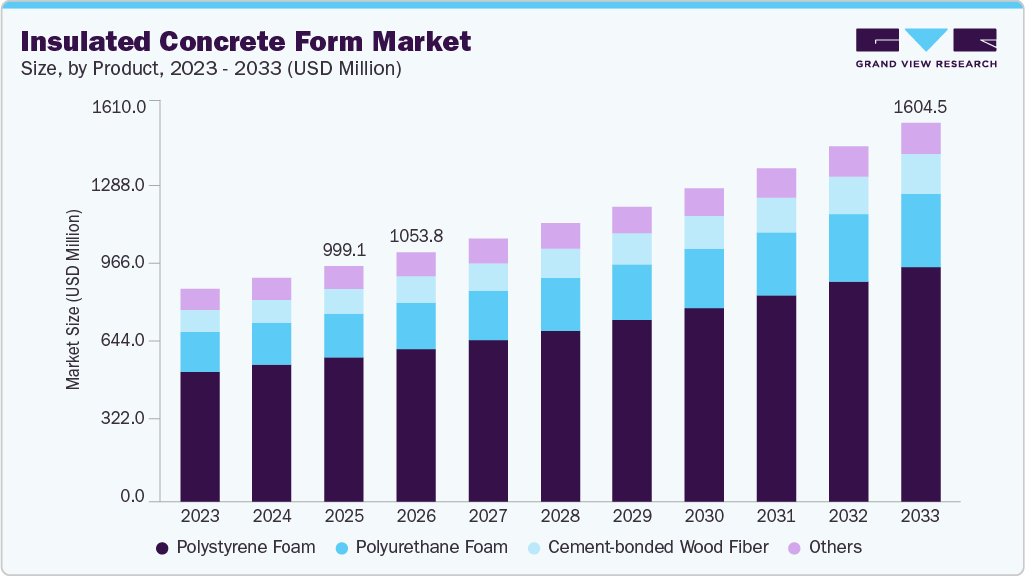 To learn more about this report, Download Free Sample Report
 The rising demand for residential construction is also contributing to market expansion, particularly in North America and Europe, where energy-efficient homes are becoming a priority. ICFs offer soundproofing, fire resistance, and improved indoor air quality, making them highly attractive for housing developments. In addition, with growing urbanization and infrastructure development in emerging economies, governments and private sector investors are incorporating ICFs into large-scale housing and commercial projects to enhance efficiency and sustainability.
Another key factor driving market growth is the superior durability and structural strength of ICFs, making them an ideal choice for disaster-resistant buildings. Regions prone to extreme weather conditions, such as hurricanes, earthquakes, and wildfires, are increasingly adopting ICF technology due to its high impact resistance and enhanced safety features. The long lifespan and reduced maintenance costs of ICF structures compared to traditional building materials make them a cost-effective option for developers and homeowners.
Market Concentration & Characteristics
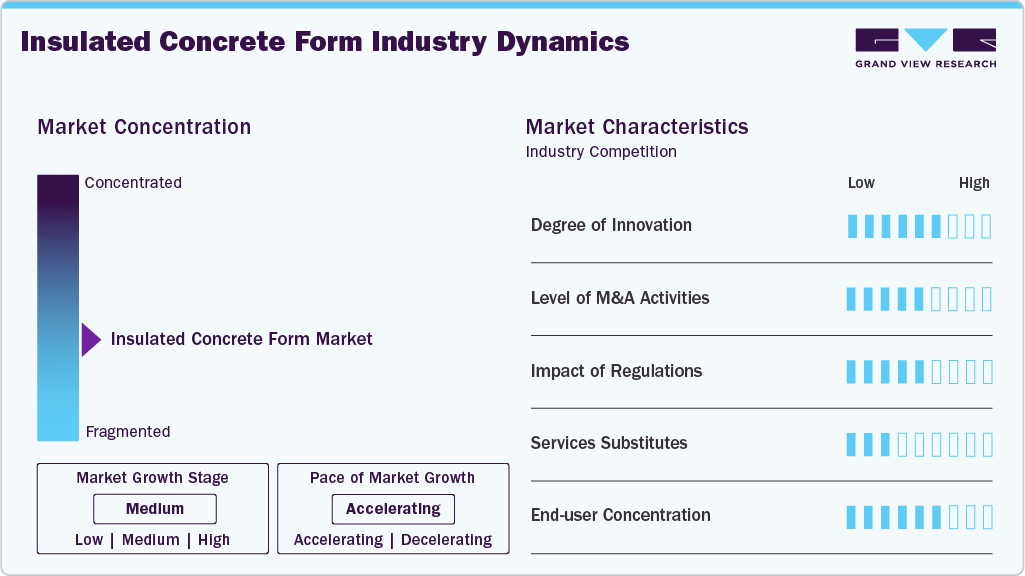
The Insulated Concrete Form (ICF) industry exhibits a moderate to high market concentration, with a few dominant players driving innovation and technological advancements. The industry is characterized by a high degree of innovation, as manufacturers continuously enhance product performance by integrating advanced insulation materials, fire-resistant additives, and improved interlocking designs. The adoption of smart building technologies and energy-efficient construction practices has further encouraged research and development in the sector. In addition, advancements in recycled and sustainable materials for ICF production are gaining traction, aligning with global sustainability initiatives and green building standards.
 To learn more about this report, Download Free Sample Report
 Regulatory frameworks play a crucial role in shaping the ICF market, as building codes and energy-efficiency regulations increasingly favor materials that offer superior insulation and structural durability. Government incentives and certifications, such as LEED (Leadership in Energy and Environmental Design) and Net Zero Energy Building (NZEB) standards, have accelerated the adoption of ICF in both residential and commercial construction. However, service substitutes, such as traditional concrete block construction and precast panels, pose competition, particularly in regions where conventional methods remain cost-effective. Despite this, the end user concentration remains strong in sectors prioritizing energy efficiency, disaster resilience, and long-term cost savings, including residential housing, commercial buildings, and infrastructure projects in disaster-prone areas.
Product Insights
The polystyrene foam segment led the market with the largest revenue share of 61.2% in 2025, driven by its superior insulation properties, durability, and lightweight structure. Polystyrene foam, particularly expanded polystyrene (EPS) and extruded polystyrene (XPS) is widely used in ICF systems for residential, commercial, and industrial construction. The material’s high thermal resistance (R-value) significantly enhances energy efficiency, reducing heating and cooling costs in buildings. As energy regulations become stricter, builders and developers are increasingly adopting polystyrene foam-based ICFs to meet green building certifications such as LEED and BREEAM.
The polyurethane foam segment is expected to grow at the fastest CAGR of 6.5% over the forecast period. Polyurethane foam offers excellent thermal resistance (R-value), reducing heat transfer and enhancing energy efficiency in buildings. As governments worldwide implement stricter energy efficiency regulations and green building standards, the adoption of polyurethane foam-based ICFs has increased.
Application Insights
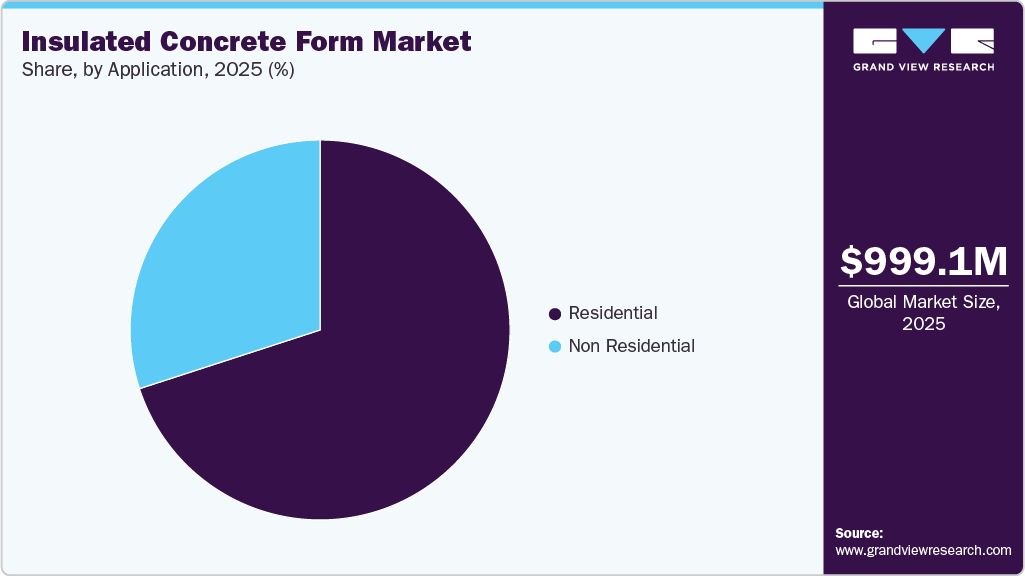
The residential segment dominated the market and accounted for the largest revenue share of 65.3% in 2025, driven by increasing need for disaster-resistant housing, particularly in regions prone to hurricanes, wildfires, and earthquakes. ICF structures provide high impact resistance, superior fire protection, and enhanced structural integrity, making them an ideal choice for residential buildings in disaster-prone areas. In addition, the long lifespan and minimal maintenance requirements of ICF homes make them cost-effective in the long run, further encouraging homeowners and developers to adopt this technology.
 To learn more about this report, Download Free Sample Report
 The non-residential segment is expected to grow at a CAGR of 5.6% over the forecast period. The rise in sustainable and eco-friendly housing trends has played an important role in expanding the commercial ICF market. As consumers become more environmentally conscious, they seek materials that reduce carbon footprints and enhance indoor air quality. ICF structures use recyclable materials and minimize construction waste, aligning with global sustainability goals. In addition, the long-term cost savings associated with lower maintenance and energy expenses make ICF an attractive choice for residential developers and homeowners.
Regional Insights
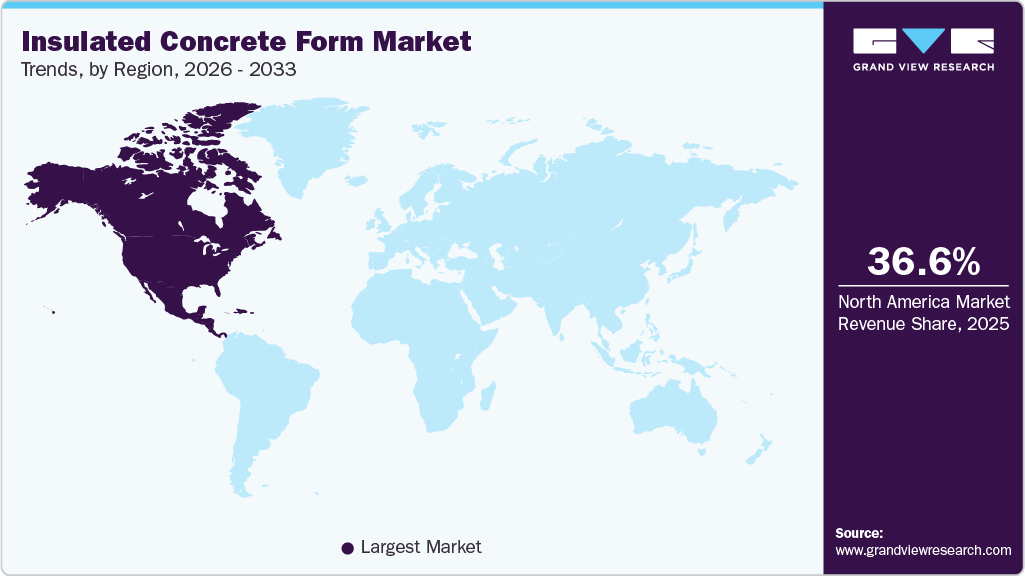
North America insulated concrete form industry dominated the market and accounted for the largest revenue share of about 36.6% in 2025, driven by the rising demand for energy-efficient and sustainable construction materials. With increasing awareness of green building practices and stringent energy regulations, builders and developers are turning to ICF for its superior thermal insulation, durability, and environmental benefits. ICF structures provide enhanced energy efficiency by reducing heating and cooling costs, making them an ideal choice for residential, commercial, and institutional buildings. The adoption of net-zero energy buildings (NZEBs) and Leadership in Energy and Environmental Design (LEED-certified) projects in the U.S. and Canada further supports market expansion.
 To learn more about this report, Download Free Sample Report
 U.S. Insulated Concrete Form Market Trends
The insulated concrete form industry in the U.S. is driven by the rising labor shortages and increasing construction costs that have increased the demand for ICF systems, as they offer ease of installation and reduced labor requirements compared to traditional wood-frame construction. With the construction industry facing a shortage of skilled workers, developers are turning to pre-assembled and modular building systems that streamline the construction process. ICF structures require fewer materials and labor hours, making them an attractive option for both small-scale and large-scale construction projects. Furthermore, advancements in ICF block design and construction techniques have improved their adaptability for a wide range of architectural styles and building applications.
Asia Pacific Insulated Concrete Form Market Trends
The Asia-Pacific (APAC) insulated concrete form industry is experiencing significant growth, driven by the region’s rapid urbanization and increasing demand for energy-efficient construction solutions. The rising population and the expansion of metropolitan areas in countries such as China, India, Japan, and Australia have led to increased investments in residential and commercial infrastructure. Governments across the region are emphasizing sustainable construction practices, promoting the adoption of ICF systems due to their superior thermal insulation, durability, and structural strength. The growing need for disaster-resistant buildings, particularly in earthquake-prone and typhoon-affected regions, has further fueled the demand for ICF, as it offers enhanced resilience compared to traditional construction methods.
The Insulated Concrete Form (ICF) industry in China is experiencing significant growth, driven by rapid urbanization and increasing demand for energy-efficient construction materials. As China continues its large-scale infrastructure development, the need for durable and thermally efficient building solutions has intensified. ICFs, which offer superior insulation, structural strength, and reduced construction time, have become an attractive alternative to traditional building methods. The country’s push toward green building standards, such as China’s Three-Star Rating System for Green Buildings, has further encouraged the adoption of ICFs in residential and commercial projects.
Europe Insulated Concrete Form Market Trends
The Europe insulated concrete form (ICF) industry is driven by the increasing demand for energy-efficient and sustainable construction solutions. With the European Union’s strict energy regulations, such as the Energy Performance of Buildings Directive (EPBD) and Nearly Zero Energy Buildings (NZEB) standards, builders and developers are actively seeking high-performance insulation materials. ICF systems, known for their superior thermal efficiency and airtightness, align with these regulations by reducing heating and cooling costs while enhancing overall building sustainability. In addition, rising environmental awareness and the push for low-carbon construction have further accelerated the adoption of ICF technology across residential, commercial, and institutional sectors.
Germany’s insulated concrete form industry is driven by the ongoing urbanization and housing shortage, which play a significant role in the ICF market expansion. With major cities such as Berlin, Munich, and Hamburg witnessing a surge in residential and mixed-use development projects, there is a rising need for cost-effective and quick-to-assemble building solutions. ICF technology allows for faster construction times compared to traditional methods, enabling developers to meet housing demands efficiently while maintaining high energy performance standards. In addition, the advancements in ICF manufacturing and design have led to increased adoption across Germany’s construction sector. Innovations such as pre-insulated wall panels, reinforced formwork, and integrated smart building technologies make ICF an attractive solution for architects and builders aiming for modern, sustainable, and low-maintenance structures.
Latin America Insulated Concrete Form Market Trends
The Latin America Insulated Concrete Form (ICF) industry is witnessing steady growth, driven by the increasing demand for energy-efficient and sustainable construction materials. As governments and developers prioritize eco-friendly building solutions, ICFs have gained popularity due to their superior thermal insulation, reduced energy consumption, and lower carbon footprint. Countries such as Brazil, Mexico, and Argentina are promoting green building initiatives, encouraging the adoption of advanced construction technologies. In addition, the rise in extreme weather conditions, including hurricanes and high temperatures, has increased the demand for durable and disaster-resistant structures, making ICFs a preferred choice for residential and commercial projects.
Middle East & Africa Insulated Concrete Form Market Trends
The insulated concrete form industry in Middle East & Africa is driven by the rising demand for disaster-resilient and durable buildings, a crucial factor driving the market growth. The MEA region is prone to harsh environmental conditions, including extreme heat, sandstorms, and, in some areas, seismic activity. ICF structures provide high durability, impact resistance, and superior fire protection, making them ideal for long-term construction investments. The ability of ICF to enhance structural integrity while reducing maintenance costs has made it a preferred choice for both private and public sector projects.
Key Insulated Concrete Form Company Insights
Some of the key players operating in the market include Airlite Plastics Company and Amvic Inc.
-
Airlite Plastics Company is a manufacturer of high-performance building materials, specializing in insulated concrete forms (ICFs) and sustainable construction solutions. With a strong commitment to energy-efficient and environmentally friendly products, the company has developed advanced ICF systems that enhance structural integrity and thermal insulation. Airlite Plastics is known for its Fox Blocks® ICF product line, which provides superior strength, soundproofing, and energy efficiency for residential, commercial, and industrial construction.
-
Amvic’s product portfolio includes Amvic ICF Blocks, Amdeck Insulated Floor & Roof Systems, and SilveRboard Insulation Panels, all designed to enhance the thermal and acoustic performance of buildings. With a strong emphasis on green building practices, Amvic’s ICF solutions contribute to LEED certification and other sustainability standards.
BASF and Beco Products Ltd. are some of the emerging market participants in Insulated Concrete Form industry.
-
BASF SE is a global player with a diverse portfolio that extends into construction and building materials, including insulated concrete form (ICF) solutions. The company leverages its expertise in advanced chemistry to develop high-performance insulation materials that improve energy efficiency and building durability. BASF’s Neopor expandable polystyrene (EPS) beads are widely used in ICF manufacturing, offering superior thermal insulation, moisture resistance, and fire protection.
-
Beco Products Ltd. is a key player in the ICF market, specializing in eco-friendly and energy-efficient building solutions. The company is recognized for its Wallform Insulated Concrete Formwork, a highly durable system designed for residential, commercial, and industrial applications. Beco’s ICF products offer excellent thermal insulation, structural stability, and fire resistance, making them ideal for modern construction projects.
Key Insulated Concrete Form Companies:
The following key companies have been profiled for this study on the insulated concrete form market
- Airlite Plastics Company
- Amvic Inc.
- BASF SE
- Beco Products Ltd.
- Durisol UK
- Nudura Corporation
- Quad-Lock Building Systems, Ltd.
- BuildBlock Building Systems, LLC.
- Logix Insulated Concrete Forms Ltd.
- Standard ICF Corporation
Recent Developments
- In September 2022, Amvic Inc. unveiled the Amvic ICF system, an expanded polystyrene (EPS) building block engineered to improve energy efficiency and structural durability in contemporary construction. This graphite-infused ICF incorporates modular interlocking features, allowing for seamless assembly while enhancing the overall strength and stability of buildings.
Insulated Concrete Form Market Report Scope
Report Attribute
Details
Market size in 2025
USD 999.1 million
Estimated market size in 2026
USD 1,053.8 million
Projected market size by 2033
USD 1,604.5 million
Growth rate
CAGR of 6.2% from 2026 to 2033
Base year for estimation
2025
Historical data
2021 - 2024
Forecast period
2026 - 2033
Quantitative units
Revenue in USD Million and CAGR from 2026 to 2033
Report coverage
Revenue forecast, company ranking, competitive landscape, growth factors, and trends
Segments covered
Product, application, region
Regional scope
North America; Europe; Asia Pacific; Latin America; Middle East & Africa
Country scope
U.S.; Canada; Mexico; UK; Germany; France; Italy; Spain; China; India; Japan; Australia, Brazil, Saudi Arabia; UAE
Key companies profiled
Airlite Plastics Company; Amvic Inc.; BASF SE; Beco Products Ltd.; Durisol UK; Nudura Corporation; Quad-Lock Building Systems, Ltd.; BuildBlock Building Systems, LLC.; Logix Insulated Concrete Forms Ltd.; Standard ICF Corporation
Customization scope
Free report customization (equivalent up to 8 analysts’ working days) with purchase. Addition or alteration to country, regional & segment scope.
Pricing and purchase options
Avail customized purchase options to meet your exact research needs. Explore purchase options
Global Insulated Concrete Form Market Report Segmentation
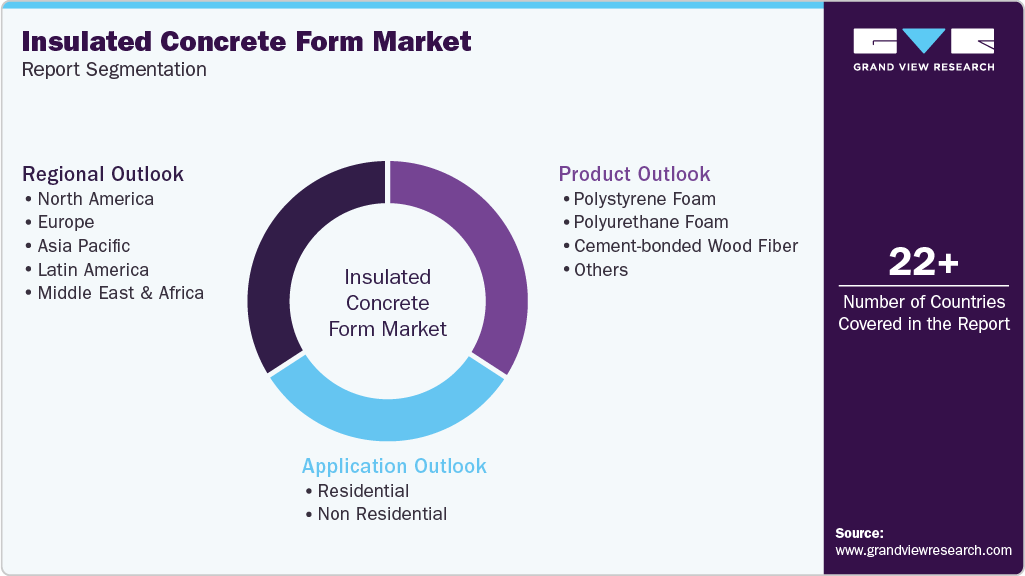
This report forecasts revenue growth at global, regional, and country levels and provides an analysis of the latest industry trends in each of the sub-segments from 2021 to 2033. For this study, Grand View Research has segmented the global insulated concrete form market report based on product, application, and region.
 To learn more about this report, Download Free Sample Report
 -
Product Outlook (Revenue, USD Million, 2021 - 2033)
-
Polystyrene Foam
-
Polyurethane Foam
-
Cement-bonded wood fiber
-
Others
-
-
Application Outlook (Revenue, USD Million, 2021 - 2033)
-
Residential
-
Non Residential
-
-
Regional Outlook (Revenue, USD Million, 2021 - 2033)
-
North America
-
U.S.
-
Canada
-
Mexico
-
-
Europe
-
Germany
-
UK
-
France
-
Italy
-
Spain
-
-
Asia Pacific
-
China
-
Japan
-
India
-
Australia
-
-
Latin America
-
Brazil
-
-
Middle East & Africa
-
Saudi Arabia
-
UAE
-
-
Frequently Asked Questions About This Report
Key factors driving the insulated concrete form market growth include rising acceptance of insulated concrete forms in temperate regions including Europe and North America on account of their superior thermal insulation properties.
The polystyrene foam segment led with a 61.2% revenue share in 2025, while the polyurethane foam segment is the fastest-growing.
The global insulated concrete form market size was valued at USD 999.1 million in 2025 and is estimated at USD 1,053.8 million for 2026.
The global insulated concrete form market is expected to grow at a CAGR of 6.2% from 2026 to 2033, reaching USD 1,604.5 million by 2033.
North America dominated with a 36.6% revenue share in 2025.
The residential segment led with a 65.3% revenue share in 2025, while the non-residential segment is the fastest-growing.
Key players include Airlite Plastics Company; Amvic Inc.; BASF SE; Beco Products Ltd.; Durisol UK; Nudura Corporation; Quad-Lock Building Systems, Ltd.; BuildBlock Building Systems, LLC.; Logix Insulated Concrete Forms Ltd.; Standard ICF Corporation
About the Author(s)
Green Building Materials Research Team
Advanced Materials · Green Building MaterialsThis report was authored by the green building materials research team at Grand View Research - comprising two research analysts, one senior research analyst, and one industry expert - with specialized expertise in the green building materials segment of the advanced materials industry. All findings are based on proprietary advanced materials databases, executive interviews, and regulatory analysis, subject to internal peer review prior to publication.
Last Updated:
Speak to Analyst

Customize this report to your needs - add regions, segments, or data points, with 20% free customization.
Or view our licence options:


ISO 9001:2015 & 27001:2022 Certified
We are GDPR and CCPA compliant! Your transaction & personal information is safe and secure. For more details, please read our privacy policy.


