- Home
- »
- Clinical Diagnostics
- »
-
Infectious Disease Immunoassay Testing Market Report, 2026-2033GVR Report cover
![Infectious Disease Immunoassay Testing Market (2026 - 2033)Report]()
Infectious Disease Immunoassay Testing Market (2026 - 2033)
Size, Share & Trends Analysis Report By Disease Type (Viral Infections, Bacterial Infections, Fungal Infections, Parasitic Infections), By Technology, By Test Type, By End Use, By Region, And Segment Forecasts
Market Size, 2025
$8.9BMarket Estimate, 2026
$9.1BMarket Forecast, 2033
$12.0BCAGR, 2026–2033
4.0%Infectious Disease Immunoassay Testing Market Summary
The global infectious disease immunoassay testing market size was valued at USD 8.9 billion in 2025 and is projected to grow from USD 9.1 billion in 2026 to USD 12.0 billion by 2033, at a CAGR of 4.0% from 2026 to 2033. The market in North America dominated with a revenue share of 47.7% in 2025.

Key Market Trends & Insights
- By disease type: Viral infections segment held the largest market share of 63.0% in 2025.
- By technology: ELISA segment held the largest market share of 34.0% in 2025.
- By test type: Antibody testing segment held the largest market share of 41.2% in 2025.
- By end use: Hospitals segment held the largest market share of 37.7% in 2025.
Regional Highlights
- Largest regional market: North America (47.7% revenue share, 2025)
- Fastest-growing regional market: Asia Pacific (highest CAGR, 2026-2033)
- By country: The U.S. held the largest market share in 2025
Market Size & Forecast
- Market size in 2025: USD 8.9 Billion
- Estimated market size in 2026: USD 9.1 Billion
- Projected market size by 2033: USD 12.0 Billion
- CAGR (2026-2033): 4.0%

Market Dynamics
The increasing burden of infectious diseases remains a significant factor supporting the market growth. The rising incidence of viral, bacterial, fungal, and parasitic infections continues to drive demand for rapid, accurate immunoassay-based diagnostic and serological testing solutions across healthcare settings globally. According to the World Health Organization, approximately 10.7 million people developed tuberculosis globally in 2024, while nearly 1.23 million tuberculosis-related deaths were reported during the year. Moreover, UNAIDS estimated that around 40.08 million people were living with HIV globally in 2025. The growing burden of chronic infectious diseases is driving greater adoption of ELISA, CLIA, rapid antigen tests, and combined antigen/antibody immunoassay technologies across hospitals, diagnostic laboratories, blood banks, and public health screening programs. This has further resulted in the continuous growth of immunoassay infectious diagnostics market.
Respiratory infectious diseases continue to account for a substantial share of global infectious disease testing volumes. According to the U.S. Centers for Disease Control and Prevention (CDC), influenza activity continued to increase across the United States during the 2025 respiratory virus season, with influenza infections growing or likely growing in 47 states as of December 2025. In addition, RSV infections were reported to be growing or likely growing in 32 states, particularly among children aged 0-4 years, while COVID-19 infections were increasing across 31 states. The continued circulation of influenza, RSV, and COVID-19 is generating significant seasonal demand for immunoassay-based infectious disease testing across healthcare settings. The rising prevalence of respiratory viral infections is accelerating the adoption of rapid antigen tests, fluorescent immunoassays, and chemiluminescence immunoassay (CLIA) systems across hospitals, physician offices, and diagnostic laboratories. The increasing focus on early disease detection, respiratory infection surveillance, and outbreak management is further supporting the global growth of the infectious disease immunoassay testing industry.
Sexually transmitted infections and vector-borne diseases are also contributing to the market growth. The WHO estimated that more than 1 million curable sexually transmitted infections are acquired every day globally, including syphilis, gonorrhea, chlamydia, and trichomoniasis. Rising STI prevalence and increasing burden of infections such as HSV-2 and syphilis are strengthening demand for antibody testing and combined antigen/antibody immunoassays across diagnostic laboratories, blood banks, and public health agencies. In addition, increasing dengue outbreaks across the Asia Pacific and Latin America are supporting the adoption of multiplex immunoassays and rapid antigen testing solutions. At the same time, the expansion of infectious disease screening programs continues to increase global immunoassay testing volumes.
The high cost and limited accessibility of advanced immunoassay testing systems remain significant restraints for the infectious disease immunoassay testing industry, particularly in low- and middle-income countries. Automated chemiluminescence immunoassay (CLIA) analyzers, multiplex immunoassay platforms, and fluorescent immunoassay systems require substantial capital investment, specialized laboratory infrastructure, continuous maintenance, and trained personnel to operate efficiently. Smaller hospitals, physician offices, and decentralized diagnostic facilities often face financial constraints that restrict the adoption of advanced immunoassay technologies. In addition, rising costs associated with assay kits, reagents, calibration materials, and quality control procedures continue to create operational and budgetary challenges for healthcare providers and diagnostic laboratories.
Limited accessibility of advanced infectious disease diagnostics in rural and underserved regions also continues to restrain market growth. Several healthcare facilities across emerging economies lack adequate laboratory infrastructure, skilled laboratory professionals, and storage capabilities required for effective immunoassay testing operations. Public health agencies in resource-constrained regions frequently face funding constraints that limit the implementation of large-scale infectious disease screening and surveillance programs. These challenges can delay diagnosis and reduce testing coverage for infectious diseases such as HIV, tuberculosis, dengue, and sexually transmitted infections. As a result, unequal access to advanced immunoassay technologies continues to limit market penetration across several developing healthcare markets.
The growing demand for rapid, multiplex infectious disease diagnostics presents a significant growth opportunity for the infectious disease immunoassay testing industry. Healthcare providers and public health agencies are increasingly adopting rapid antigen tests, multiplex immunoassays, and automated chemiluminescence immunoassay (CLIA) systems to improve early disease detection, outbreak management, and large-scale screening efficiency. The rising focus on decentralized healthcare delivery and infection surveillance is accelerating the adoption of immunoassay-based testing solutions across hospitals, diagnostic laboratories, physician offices, blood banks, and public health agencies. The increasing prevalence of respiratory, sexually transmitted, dengue, and healthcare-associated infections is further driving global demand for high-throughput, rapid infectious disease immunoassays.
Technological advancements in chemiluminescence immunoassays (CLIA), multiplex immunoassays, rapid antigen tests, and fluorescent immunoassay platforms are creating significant growth opportunities in the global market. Companies are increasingly developing high-throughput, multiplex infectious disease testing solutions that simultaneously detect multiple respiratory pathogens, with improved sensitivity and specificity and shorter turnaround times. For instance, an October 202 clinical study evaluating a combined rapid antigen diagnostic test for simultaneous detection of SARS-CoV-2, influenza A/B, and RSV demonstrated specificity exceeding 99% for all three respiratory viruses in symptomatic patients within tertiary care settings. The increasing adoption of multiplex rapid antigen testing solutions is supporting the expansion of respiratory infection surveillance and point-of-care infectious disease testing across hospitals and diagnostic laboratories globally.
Market Concentration & Characteristics
The infectious disease immunoassay testing industry demonstrates a high degree of innovation driven by advancements in automated chemiluminescent immunoassays (CLIA), multiplex immunoassays, and high-sensitivity antigen-detection technologies. Companies are increasingly focusing on improving assay sensitivity and specificity, as well as on automating workflows for infectious disease diagnostics. For instance, in 2025, Fujirebio highlighted advancements in its iTACT immunoassay technology integrated with the Lumipulse CLEIA platform to improve detection sensitivity for hepatitis B and hepatitis C viral antigens by reducing interference from antigen complexes and other interfering substances. Such innovations are supporting the development of more accurate, automated, and high-throughput infectious disease immunoassay testing solutions globally.
The infectious disease immunoassay testing industry is witnessing a moderate to high level of merger and acquisition activity as companies focus on strengthening immunoassay technology capabilities, expanding infectious disease testing portfolios, and improving decentralized diagnostic solutions. For instance, Fujirebio acquired Innogenetics to strengthen its specialty molecular and immunoassay testing capabilities, including infectious disease diagnostics and automated immunoassay technologies. Such acquisitions are supporting the development of advanced infectious disease immunoassay platforms with improved sensitivity, automation, and broader testing menus across hospitals and diagnostic laboratories globally.
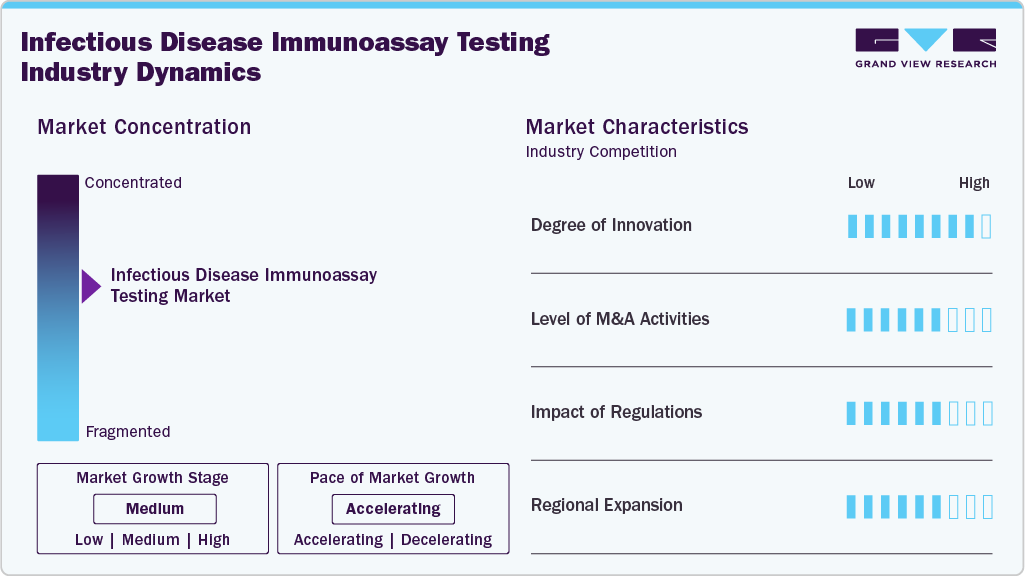
Regulatory frameworks play a significant role in shaping the global market by ensuring the safety, accuracy, and clinical reliability of immunoassay-based diagnostic tests. Regulatory agencies such as the U.S. Food and Drug Administration (FDA), European Medicines Agency (EMA), and other regional health authorities impose stringent requirements for assay validation, clinical performance evaluation, manufacturing quality standards, and post-market surveillance. Updated regulatory frameworks, including the European Union In Vitro Diagnostic Regulation (IVDR), are increasing compliance requirements for manufacturers of ELISA, CLIA, rapid antigen tests, and multiplex immunoassays. These regulations are encouraging companies to invest in high-quality infectious disease testing technologies with improved sensitivity, specificity, and workflow automation across hospitals, diagnostic laboratories, blood banks, and public health agencies.
The infectious disease immunoassay testing industry is experiencing continuous expansion as diagnostic companies strengthen operational capabilities and increase investments in infectious disease testing infrastructure. The rising prevalence of infectious diseases, growing healthcare expenditure, and increasing demand for rapid, accessible diagnostic solutions are driving market participants to expand manufacturing capabilities, distribution networks, and strategic partnerships. Companies are increasingly focusing on developing cost-effective ELISA, CLIA, rapid antigen tests, and multiplex immunoassays to improve infectious disease detection and screening accessibility across healthcare settings. The growing adoption of immunoassay-based infectious disease testing solutions across hospitals, diagnostic laboratories, physician offices, and public health agencies continues to support global market expansion.
Disease Type Insights
The viral infections segment led the market with the largest revenue share of 63.0% in 2025, driven by the increasing global burden of HIV, hepatitis, influenza, RSV, COVID-19, and dengue infections, which require large-scale screening and surveillance. According to the World Health Organization (WHO), approximately 40.8 million people were living with HIV globally in 2024, supporting strong demand for ELISA, CLIA, rapid antigen tests, and combined antigen/antibody immunoassays. In addition, increasing influenza, RSV, and COVID-19 activity during the 2025 respiratory virus season accelerated adoption of multiplex immunoassays and rapid antigen testing solutions across hospitals, diagnostic laboratories, and public health agencies. The growing focus on early viral infection detection and outbreak surveillance continues to support the segment's global dominance.
The fungal infections segment is projected to grow at the fastest CAGR of 4.61% over the forecast period, fueled by the rising prevalence of invasive fungal infections among immunocompromised patient populations, including individuals with HIV/AIDS, cancer, organ transplants, and chronic respiratory diseases. According to a CDC report published in March 2026, more than 6,304 new clinical cases of Candida auris were reported in the United States in 2024, with cases continuing to increase significantly across healthcare facilities. The rising incidence of Candida auris, aspergillosis, and candidiasis is increasing demand for ELISA, CLIA, and antigen-based fungal immunoassay testing solutions across hospitals and diagnostic laboratories, further supporting segment growth globally.
Technology Insights
The ELISA segment led the market with the largest revenue share of 34.0% in 2025, driven by its high sensitivity, cost-effectiveness, ease of operation, and widespread use in routine infectious disease screening programs. Extensive use of ELISA-based assays for the detection of hepatitis, dengue, syphilis, parasitic infections, and healthcare-associated infections across diagnostic laboratories, blood banks, and public health agencies is contributing to the growth of the ELISA infectious disease testing market. According to a report published by the World Health Organization in July 2025, approximately 254 million people worldwide were living with hepatitis B infection, underscoring sustained demand for ELISA-based infectious disease screening and serological testing solutions. In addition, the technology offers high-throughput processing and compatibility with large-scale screening workflows, making it highly suitable for blood donor screening and infectious disease surveillance programs, thereby supporting continued serology testing dominance.
The multiplex immunoassay segment is projected to grow at the fastest CAGR of 10.19% over the forecast period, driven by increasing demand for simultaneous detection of multiple infectious pathogens from a single patient sample, improved diagnostic efficiency, and reduced turnaround time in infectious disease testing workflows. Multiplex immunoassays are increasingly utilized for respiratory infection panels, sexually transmitted infection screening, and blood-borne disease surveillance across hospitals, diagnostic laboratories, and public health agencies. The segment's growth is further supported by the increasing adoption of integrated multiplex rapid testing solutions that simultaneously detect HIV, hepatitis B, and syphilis infections for maternal healthcare and bloodscreening applications. Rising emphasis on outbreak management, infection surveillance, and high-throughput laboratory testing continues to support rapid segment growth globally.
Test Type Insights
The antibody testing segment led the market with the largest revenue share of 41.2% in 2025, driven by its widespread use in infectious disease screening, serological surveillance, blood donor testing, and long-term infection monitoring. Antibody-based immunoassays are widely used to detect HIV, hepatitis, dengue, syphilis, and other viral and bacterial infections in hospitals, diagnostic laboratories, blood banks, and public health agencies. The segment continues to benefit from increasing adoption of automated ELISA and CLIA platforms capable of processing high testing volumes with improved sensitivity and workflow efficiency. In addition, the growing emphasis on preventive healthcare, routine infectious disease screening, and seroprevalence studies continues to support strong global demand for antibody testing solutions.
The combined AG/AB tests segment is projected to grow at the fastest CAGR of 11.19% over the forecast period, driven by increasing demand for early-stage infectious disease detection, improved diagnostic accuracy, and shorter diagnostic windows compared to standalone antigen or antibody tests. Combined antigen/antibody immunoassays are increasingly utilized for HIV, hepatitis, and sexually transmitted infection screening across hospitals, blood banks, diagnostic laboratories, and public health agencies. For instance, a November 2024 study published in the Journal of Medical Virology reported that fourth-generation HIV rapid tests demonstrated enhanced sensitivity and reduced diagnostic window periods by simultaneously detecting HIV p24 antigen and HIV antibodies, supporting the growing adoption of combined Ag/Ab immunoassays in infectious disease screening programs globally.
End Use Insights
The hospitals segment led the market with the largest revenue share of 37.7% in 2025, driven by the high volume of infectious disease testing performed across inpatient, emergency, and critical care settings. Hospitals extensively utilize ELISA, CLIA, rapid antigen tests, fluorescent immunoassays, and multiplex immunoassays for diagnosis and monitoring of respiratory infections, HIV, hepatitis, sexually transmitted infections, and healthcare-associated infections. The segment's growth is further supported by the increasing adoption of high-sensitivity automated CLIA systems in hospital laboratories. For instance, a December 2024 study published in IJID Regions reported thatthe Mindray CL-900i HBsAg chemiluminescence immunoassay demonstrated 97% sensitivity and 100% specificity for hepatitis B surface antigen screening, supporting the growing use of automated CLIA-based infectious disease testing workflows across hospital settings. The increasing emphasis on rapid clinical decision-making, infection surveillance, and outbreak management continues to support the segment's global dominance.

The public health agencies segment is projected to grow at the fastest CAGR of 7.62% over the forecast period, driven by increasing government-led infectious disease surveillance programs, outbreak monitoring initiatives, and expansion of population-scale screening activities for HIV, hepatitis, tuberculosis, sexually transmitted infections, and respiratory diseases. Public health agencies are increasingly adopting ELISA, CLIA, rapid antigen tests, and multiplex immunoassays to support early disease detection and infection control programs. Growth of the segment is further supported by increasing implementation of integrated multiplex rapid immunoassay testing solutions capable of simultaneously detecting HIV, hepatitis B, and syphilis infections in maternal health and community screening programs. Rising focus on pandemic preparedness, blood safety monitoring, and infectious disease surveillance continues to accelerate adoption of immunoassay infectious diagnostics solutions across public health settings globally.
Regional Insights
North America dominated the global infectious disease immunoassay testing market with the largest revenue share of 47.7% in 2025, driven by advanced healthcare infrastructure, high infectious disease testing volumes, the strong presence of leading diagnostic companies, and widespread adoption of automated immunoassay technologies. The region demonstrates high utilization of ELISA, CLIA, rapid antigen tests, fluorescent immunoassays, and multiplex immunoassays across hospitals, diagnostic laboratories, blood banks, and public health agencies. The growing prevalence of respiratory viral infections, sexually transmitted infections, healthcare-associated infections, and chronic viral diseases such as HIV and hepatitis continues to support demand for immunoassay infectious diagnostics solutions. In addition, increasing government funding for infectious disease surveillance, blood safety screening, and outbreak preparedness programs further contributes to regional market dominance.

U.S. Infectious Disease Immunoassay Testing Market Trends
The infectious disease immunoassay testing market in the U.S. accounted for the largest market revenue share in North America in 2025, owing to high adoption of advanced immunodiagnostic technologies, large-scale infectious disease screening programs, and strong healthcare spending. The country continues to witness significant demand for ELISA, CLIA, rapid antigen tests, and multiplex immunoassays for the diagnosis of respiratory infections, HIV, hepatitis, sexually transmitted infections, and healthcare-associated infections. Increasing hospital admissions associated with influenza, RSV, COVID-19, and fungal infections are accelerating the utilization of rapid immunoassay testing solutions across hospitals and emergency care settings. In addition, strong regulatory support for blood donor screening and infectious disease surveillance programs, combined with the growing adoption of automated, high-throughput immunoassay analyzers across clinical laboratories, continues to support immunoassay infectious diagnostics market growth in the country.
Europe Infectious Disease Immunoassay Testing Market Trends
The infectious disease immunoassay testing market in Europe is supported by strong public healthcare systems, rising infectious disease surveillance, and the growing adoption of automated laboratory diagnostics. The region demonstrates extensive utilization of ELISA, CLIA, and multiplex immunoassay technologies for screening and monitoring of HIV, hepatitis, respiratory infections, and sexually transmitted infections. The continued focus on infection prevention, antimicrobial resistance management, and blood safety programs supports the growth of immunoassay-based infectious disease testing across hospitals, public health laboratories, and diagnostic centers. In addition, the implementation of stringent regulatory frameworks, such as the European Union In Vitro Diagnostic Regulation (IVDR), is encouraging the development and commercialization of highly sensitive, clinically validated infectious disease immunoassay solutions across the region.
The UK infectious disease immunoassay testing market is driven by growing demand for rapid infectious disease diagnostics, strong public health surveillance initiatives, and increasing utilization of automated immunoassay testing systems across National Health Service (NHS) laboratories and hospitals. The rising prevalence of respiratory, sexually transmitted, and healthcare-associated infections is driving higher testing volumes for ELISA, CLIA, rapid antigen tests, and multiplex immunoassays. The continued focus on early disease detection, outbreak preparedness, and blood donor screening supports the adoption of immunoassay-based infectious disease diagnostics. In addition, expansion of laboratory modernization initiatives and growing integration of high-throughput automated testing platforms across clinical laboratories are further supporting market growth in the UK.
The infectious disease immunoassay testing market in Germany is supported by advanced laboratory infrastructure, strong healthcare expenditure, and increasing adoption of automated immunodiagnostic technologies. Hospitals, diagnostic laboratories, and public health institutions extensively utilize ELISA, CLIA, and multiplex immunoassays for diagnosis and surveillance of respiratory infections, hepatitis, HIV, and healthcare-associated infections. The rising focus on infection control and antimicrobial resistance monitoring is driving increased demand for rapid, high-sensitivity infectious disease testing solutions. In addition, Germany’s strong presence in the in vitro diagnostics industry and growing investments in laboratory automation and infectious disease surveillance programs continue to support market expansion. The increasing use of high-throughput immunoassay analyzers in centralized laboratories further strengthens demand for infectious disease immunoassay testing solutions in the country.
Asia-Pacific Infectious Disease Immunoassay Testing Market Trends
The infectious disease immunoassay testing market in the Asia Pacific is projected to witness the fastest CAGR during the forecast period, driven by rising infectious disease burden, improved healthcare infrastructure, and increased government initiatives for disease surveillance and screening programs. The growing prevalence of dengue, hepatitis, tuberculosis, respiratory viral infections, and sexually transmitted infections is significantly increasing demand for ELISA, CLIA, rapid antigen tests, and multiplex immunoassays across hospitals and diagnostic laboratories. Expanding healthcare access, rising healthcare expenditure, and increasing awareness regarding early infectious disease diagnosis are further supporting market growth. In addition, the growing adoption of decentralized diagnostic solutions and the expansion of laboratory networks across developing healthcare systems continue to accelerate the utilization of infectious disease immunoassay testing technologies throughout the region.
The Japan infectious disease immunoassay testing market is driven by strong adoption of advanced diagnostic technologies, increasing elderly population, and growing focus on infectious disease surveillance and healthcare preparedness. The country demonstrates significant utilization of automated CLIA systems, ELISA platforms, and multiplex immunoassays for the diagnosis of respiratory infections, hepatitis, and healthcare-associated infections across hospitals and clinical laboratories. The increasing emphasis on high-sensitivity diagnostic testing and workflow automation is supporting the adoption of advanced immunoassay analyzers in centralized laboratory settings. In addition, continuous technological innovation by domestic diagnostic manufacturers and growing investments in laboratory automation are expanding infectious disease immunoassay testing capabilities nationwide.
The infectious disease immunoassay testing market in China is experiencing substantial growth driven by rising infectious disease prevalence, expanding healthcare infrastructure, and increased investments in diagnostic technology development. The growing demand for rapid, large-scale screening for infectious diseases is accelerating the adoption of ELISA, CLIA, rapid antigen tests, and multiplex immunoassays across hospitals, public health laboratories, and diagnostic centers. Increasing government initiatives for infectious disease surveillance, blood safety monitoring, and outbreak preparedness are further supporting market expansion. In addition, the rapid growth of domestic diagnostic manufacturing capabilities and the increasing integration of automated immunoassay analyzers across healthcare facilities continue to strengthen the country's infectious disease testing capacity.
Latin America Infectious Disease Immunoassay Testing Market Trends
The infectious disease immunoassay testing market in Latin America is witnessing steady growth due to the increasing prevalence of dengue, hepatitis, HIV, and other infectious diseases requiring routine screening and surveillance. The growing demand for rapid infectious disease diagnostics and the need to improve access to healthcare services are driving the adoption of ELISA, CLIA, rapid antigen tests, and multiplex immunoassays across hospitals and diagnostic laboratories. Governments and public health agencies are increasingly focusing on expanding infectious disease screening programs and outbreak management initiatives to improve early diagnosis and infection control. In addition, rising investments in laboratory infrastructure and increasing awareness regarding preventive healthcare and blood safety screening are contributing to market growth across the region.
Middle East & Africa Infectious Disease Immunoassay Testing Market Trends
The infectious disease immunoassay testing market in the Middle East & Africa is growing due to the rising burden of infectious diseases, improved healthcare infrastructure, and increased government focus on infectious disease surveillance and screening initiatives. The growing prevalence of hepatitis, HIV, tuberculosis, respiratory infections, and healthcare-associated infections is increasing demand for ELISA, CLIA, rapid antigen tests, and multiplex immunoassays across hospitals and public health laboratories. Expansion of healthcare access, increasing investments in laboratory modernization, and rising implementation of blood donor screening programs are further supporting market growth. In addition, the growing adoption of cost-effective, rapid infectious disease testing solutions in developing healthcare systems continues to support immunoassay infectious diagnostics market expansion across the region.
Key Infectious Disease Immunoassay Testing Company Insights
The infectious disease immunoassay testing industry is moderately consolidated, with leading companies focusing on expanding ELISA, CLIA, rapid antigen tests, fluorescent immunoassays, and multiplex immunoassay portfolios. Market participants are increasingly investing in automated chemiluminescence immunoassay (CLIA) systems, multiplex respiratory infection testing solutions, and rapid antigen technologies to improve diagnostic efficiency and strengthen infectious disease testing capabilities.
The growing focus on workflow automation, high-throughput testing, and decentralized diagnostic solutions is further supporting the adoption of immunoassay-based infectious disease testing across hospitals, diagnostic laboratories, physician offices, blood banks, and public health agencies globally.
Key Infectious Disease Immunoassay Testing Companies
The following key companies have been profiled for this study on the infectious disease immunoassay testing market.
-
Abbott
-
Siemens Healthineers
-
Danaher Corporation (Beckman Colter)
-
bioMerieux SA
-
Quidel Corporation
-
Sysmex Corporation
-
Ortho Clinical Diagnostics
-
Bio-Rad Laboratories, Inc.
-
F. Hoffmann-La Roche AG
-
Becton, Dickinson, and Company
-
Thermo Fisher Scientific, Inc.
Competitive Benchmarking
Operating Strategies
Competitive Edge
Weaknesses
Mature Player: Abbott
- Focus on expansion of automated ELISA, CLIA/CLEIA, rapid antigen, and multiplex immunoassay portfolios for infectious disease diagnostics.
- Strong emphasis on high-throughput laboratory automation, blood screening solutions, and respiratory infection testing platforms.
- Strategic investments in regulatory approvals, product launches, and collaborations with hospitals, public health agencies, and diagnostic laboratories to strengthen infectious disease testing capabilities.
- Strong global distribution networks and large installed base of automated immunoassay analyzers across hospitals and clinical laboratories.
- Broad infectious disease testing portfolios covering HIV, hepatitis, respiratory infections, sexually transmitted infections, and healthcare-associated infections.
- Strong regulatory expertise, brand recognition, and large-scale manufacturing capabilities supporting global commercialization.
- High capital investment and maintenance costs associated with automated immunoassay systems and multiplex testing platforms.
- Regulatory complexities and lengthy clinical validation requirements for infectious disease immunoassays.
- Dependence on centralized laboratory infrastructure may limit penetration across resource-constrained healthcare settings.
Emerging Player: Sysmex Corporation
- Focus on development of rapid infectious disease immunoassays, point-of-care antigen testing solutions, and specialized serological assays.
- Expansion through strategic partnerships, regional collaborations, and product innovation in multiplex infectious disease testing.
- Increasing investments in decentralized diagnostic solutions and workflow-efficient immunoassay technologies targeting hospitals and physician offices.
- Strong innovation capabilities in rapid antigen testing, multiplex immunoassays, and decentralized infectious disease diagnostics.
- Greater flexibility in developing specialized infectious disease screening assays and cost-effective testing solutions.
- Rapid adaptation to evolving infectious disease surveillance requirements and outbreak management needs.
- Smaller installed analyzer base and limited commercialization capabilities compared to established market leaders.
- Dependence on strategic collaborations and regulatory approvals for broader market expansion.
- Limited product diversification and lower penetration across large hospital and centralized laboratory networks.
Recent Developments
-
In July 2025, the World Health Organization (WHO) prequalified the first rapid diagnostic test panel capable of simultaneously detecting HIV, hepatitis B, and syphilis infections. The immunoassay-based rapid testing solution is expected to support expansion of maternal health screening, blood safety programs, and integrated infectious disease surveillance initiatives globally, thereby increasing adoption of rapid antigen and antibody testing technologies.
-
In 2025, Fujirebio highlighted advancements in its Lumipulse chemiluminescence enzyme immunoassay (CLEIA) platform integrated with iTACT technology for infectious disease testing applications. The technology was designed to improve detection sensitivity for hepatitis B and hepatitis C viral antigens by reducing interference from antigen complexes and other substances. The development is supporting growing adoption of high-sensitivity automated CLIA/CLEIA infectious disease immunoassay systems across hospitals, diagnostic laboratories, and blood screening facilities globally.
Infectious Disease Immunoassay Testing Market Report Scope
Report Attribute
Details
Market size in 2025
USD 8.9 billion
Estimated market size in 2026
USD 9.1 billion
Projected market size by 2033
USD 12.0 billion
Growth rate
CAGR of 4.0% from 2026 to 2033
Base year for estimation
2025
Historical data
2021 - 2024
Forecast period
2026 - 2033
Quantitative units
Revenue in USD million/billion and CAGR from 2026 to 2033
Report coverage
Revenue forecast, company ranking, competitive landscape, growth factors, trends
Segments covered
Disease type, technology, test type, end use, region
Regional scope
North America; Europe; Asia Pacific; Latin America; Middle East & Africa
Country scope
U.S.; Canada; Mexico; UK; Germany; France; Italy; Spain; Denmark; Sweden; Norway; China; Japan; India; Australia; South Korea; Thailand; Brazil; Argentina; South Africa; Saudi Arabia; UAE; Kuwait
Key company profiled
Abbott; Siemens Healthineers; Danaher Corporation; bioMérieux; Quidel Corporation; Sysmex Corporation; Ortho Clinical Diagnostics; Bio-Rad Laboratories, Inc.; F. Hoffmann-La Roche AG; Becton; Dickinson, and Company; Thermo Fisher Scientific, Inc.
Customization scope
Free report customization (equivalent to up to 8 analysts working days) with purchase. Addition or alteration to country, regional & segment scope.
Pricing and purchase options
Avail customized purchase options to meet your exact research needs. Explore purchase options
Global Infectious Disease Immunoassay Testing Market Report Segmentation
This report forecasts revenue growth at global, regional, and country levels and provides an analysis of the latest industry trends in each of the sub-segments from 2021 to 2033. For this study, Grand View Research has segmented the global infectious disease immunoassay testing market report based on disease type, technology, test type, technology, and region:
-
Disease Type Outlook (Revenue, USD Million, 2021 - 2033)
-
Viral infections
-
Bacterial infections
-
Fungal infections
-
Parasitic infections
-
-
Technology Outlook (Revenue, USD Million, 2021 - 2033)
-
ELISA
-
CLIA
-
Rapid antigen tests
-
Fluorescent immunoassay
-
Multiplex immunoassay
-
-
Test Type Outlook (Revenue, USD Million, 2021 - 2033)
-
Antigen testing
-
Antibody testing
-
Combined Ag/Ab tests
-
Toxin assays
-
-
End Use Outlook (Revenue, USD Million, 2021 - 2033)
-
Hospitals
-
Diagnostic labs
-
Physician offices
-
Blood banks
-
Public health agencies
-
-
Regional Outlook (Revenue, USD Million, 2021 - 2033)
-
North America
-
U.S.
-
Canada
-
Mexico
-
-
Europe
-
UK
-
Germany
-
France
-
Italy
-
Spain
-
Denmark
-
Sweden
-
Norway
-
-
Asia Pacific
-
Japan
-
China
-
India
-
Australia
-
South Korea
-
Thailand
-
-
Latin America
-
Brazil
-
Argentina
-
-
Middle East & Africa
-
South Africa
-
Saudi Arabia
-
UAE
-
Kuwait
-
-
Delivered Customizations
This report has been delivered with the following In-depth customizations
Client Request
Customization Delivered
Value Adds
Cross-matrix analysis across disease area, immunoassay type, and end user
Developed a multi-dimensional cross-matrix integrating infectious disease indication (HIV, hepatitis, respiratory infections, STIs, tropical diseases), immunoassay platform (ELISA, CLIA, rapid immunoassays, multiplex immunoassays), and end user
Enabled identification of high-growth testing combinations and unmet demand areas across healthcare settings.
Cross-segment analysis by disease burden and testing volume
Developed mapping across high-prevalence infectious diseases, screening programs, and testing settings to evaluate testing intensity and utilization trends.
Provided visibility into high-volume testing applications and future demand drivers.
Comparative assessment of centralized versus decentralized immunoassay testing
Conducted benchmarking of laboratory-based testing and near-patient/point-of-care immunoassay workflows across operational efficiency, accessibility, scalability, and adoption trends.
Supported understanding of decentralized testing expansion and accessibility-driven demand growth.
Public health and epidemiology-linked testing assessment
Evaluated government screening programs, outbreak monitoring initiatives, vaccination-linked testing demand, and epidemiology-driven adoption trends
Supported stronger go-to-market planning aligned with public healthcare initiatives.
Laboratory automation and high-throughput testing benchmarking
Assessed automation penetration across immunoassay analyzers, integrated serology systems, sample handling workflows, and high-volume diagnostic laboratories.
Identified operational efficiency opportunities and automation-led growth areas.
Market attractiveness heat map by country and technology
Developed a scoring framework comparing infectious disease burden, healthcare infrastructure, screening awareness, reimbursement maturity, competition intensity, and immunoassay adoption trends across countries.
Enabled prioritization of expansion markets and resource allocation strategies.
Infectious disease immunoassay testing demand forecasting
Created epidemiology-linked forecasting models integrating disease prevalence, screening initiatives, blood donation volumes, outbreak trends, and diagnostic adoption rates.
Improved forecasting precision and identified high-growth infectious disease testing segments.
Frequently Asked Questions About This Report
Asia Pacific is the fastest-growing region over the forecast period.
The viral infections segment led with a 63.0% revenue share in 2025, while fungal infections is the fastest-growing disease type.
The ELISA segment accounted for the largest revenue share of 33.9% in 2025, while multiplex immunoassay is the fastest-growing technology.
The antibody testing segment held the largest revenue share of 41.2% in 2025, while combined AG/AB tests is the fastest-growing test type.
Hospitals segment held the largest share (over 37.0%) in 2025, while public health agencies is the fastest-growing segment.
The global infectious disease immunoassay testing market size was valued at USD 8.9 billion in 2025 and is estimated at USD 9.1 billion for 2026.
The global infectious disease immunoassay testing market is expected to grow at a CAGR of 4.0% from 2026 to 2033, reaching USD 12.0 billion by 2033.
North America dominated the infectious disease immunoassay testing market with a share of 47.7% in 2025. This is attributable by the advanced healthcare infrastructure, high infectious disease testing volumes, the strong presence of leading diagnostic companies, and widespread adoption of automated immunoassay technologies
Key players include Abbott; Siemens Healthineers; Danaher Corporation; bioMérieux; Quidel Corporation; Sysmex Corporation; Ortho Clinical Diagnostics; Bio-Rad Laboratories, Inc.; F. Hoffmann-La Roche AG; Becton; Dickinson, and Company; Thermo Fisher Scientific, Inc.
Key factors that are driving the market growth include increasing burden of infectious diseases remains a significant factor supporting the market growth. The rising incidence of viral, bacterial, fungal, and parasitic infections continues to drive demand for rapid, accurate immunoassay-based diagnostic and serological testing solutions across healthcare settings globally.
About the Author(s)
Clinical Diagnostics Research Team
Healthcare · Clinical DiagnosticsThis report was authored by the clinical diagnostics research team at Grand View Research - comprising two research analysts, one senior research analyst, and one industry expert - with specialized expertise in the clinical diagnostics segment of the healthcare industry. All findings are based on proprietary healthcare databases, executive interviews, and regulatory analysis, subject to internal peer review prior to publication.
Last Updated:
Speak to Analyst

Need a Tailored Report?
Customize this report to your needs — add regions, segments, or data points, with 20% free customization.
Or view our licence options:


ISO 9001:2015 & 27001:2022 Certified
We are GDPR and CCPA compliant! Your transaction & personal information is safe and secure. For more details, please read our privacy policy.