
- Home
- »
- Digital Media
- »
-
In-app Advertising Market Size & Share Report, 2026-2033GVR Report cover

In-app Advertising Market (2026 - 2033)
Size, Share & Trends Analysis Report By Application (Entertainment, Gaming, Social, Online Shopping, Payment & Ticketing, News), By Type (Banner Ads, Interstitial Ads), By Platform, By Region, And Segment Forecasts
Market Size, 2025
$229.2BMarket Estimate, 2026
$268.2BMarket Forecast, 2033
$461.4BCAGR, 2026–2033
8.1%In-app Advertising Market Summary
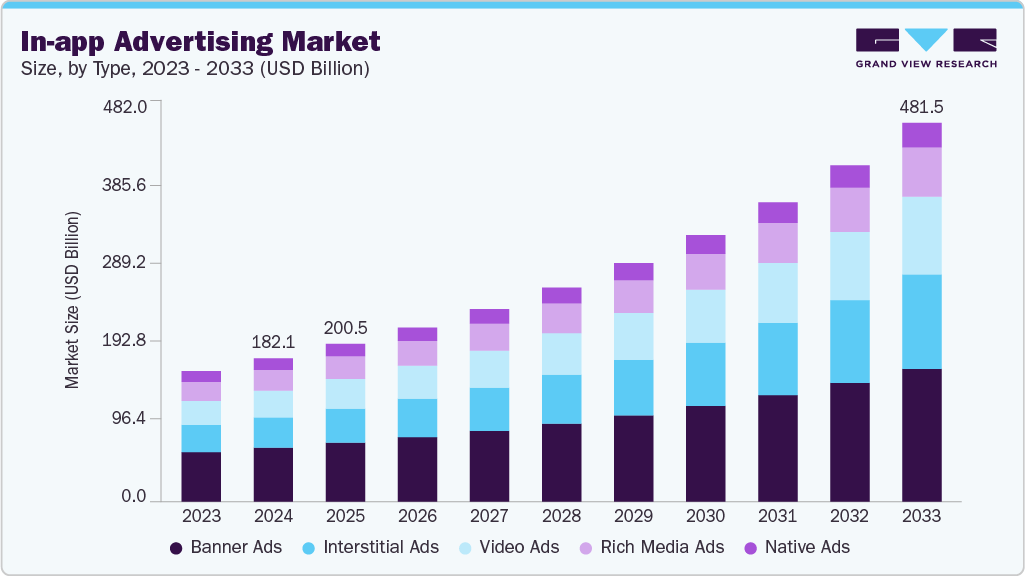
The global in-app advertising market size was valued at USD 229.2 billion in 2025 and is projected to grow from USD 268.2 billion in 2026 to USD 461.4 billion by 2033, at a CAGR of 8.1% from 2026 to 2033. The market in Asia Pacific dominated with a revenue share of 36.1% in 2025. The market is growing due to the rapid expansion of smartphone users, increasing mobile app engagement across gaming, social media, and e-commerce platforms, and rising investments in AI-powered targeted advertising solutions that enhance campaign effectiveness and user engagement.
 Source: Grand View Research, IR Documents, Primary Interviews, Paid DatabasesTo learn more about this report,
 Download Free Sample Report
 Key Market Trends & Insights
- By type: Banner ads segment held the largest market share of 36.0% in 2025.
- By platform: Android segment held the largest market share of 65.3% in 2025.
- By application: Entertainment segment held the largest market share of 24.5% in 2025.
Regional Highlights
- Largest regional market: Asia Pacific (36.1% revenue share, 2025)
- By country: China held the largest market share in 2025
Market Size & Forecast
- Market size in 2025: USD 229.2 Billion
- Estimated market size in 2026: USD 268.2 Billion
- Projected market size by 2033: USD 461.4 Billion
- CAGR (2026-2033): 8.1%
Three ways to get this report
Buy it, customize it, or ask a question.Ask an Analyst
Analyst response in 1 business day
- AccessReport author, directly
- Reply timeWithin 1 working day
- No sales callDirect answer only
- FormatEmail reply
- CostFree, no cost
Get the Full Report
What the study covers
- FormatsPDF · Excel · Dashboard
- Timeline2026–2033 annual, 2025 base
- Coverage20+ countries, 5 regions
- Companies10+ key players profiled
Customize the Report
20% free customization
- IncludeCountries, segments, points
- TailorTo your product definition
- ExtendDeeper competitor detail
- OrA fully bespoke study
- Turnaround5–10 working days
The market is largely driven by the rapid proliferation of smartphones and increased mobile internet penetration. Growing digital engagement, especially among younger demographics, has prompted advertisers to shift budgets from traditional media to mobile platforms to reach consumers more effectively. There is a rising demand for personalized and data-driven advertising experiences from key sectors such as e-commerce, gaming, and entertainment. The emphasis on user engagement and maximizing return on ad spend (ROAS) further motivates companies to adopt an innovative in-app advertising industry. Together, these factors contribute to steady market growth globally.This growth is primarily driven by increasing mobile app usage, enhanced targeting capabilities through data analytics, and rising demand for personalized and engaging ad experiences. A notable trend in the market is the widespread adoption of programmatic advertising and real-time bidding (RTB), enabling advertisers to reach highly targeted audiences with greater efficiency. Advances in artificial intelligence (AI) and machine learning (ML) are enhancing ad personalization, allowing for the dynamic delivery of content based on user behavior, preferences, and engagement patterns. There is also a growing emphasis on privacy-first advertising due to stricter data regulations, which is prompting the use of contextual advertising and consent-based data strategies.
 To learn more about this report, Download Free Sample Report
 Furthermore, the rise of mobile gaming, video streaming, and social media platforms is creating more immersive and engaging ad formats such as rewarded ads, playable ads, and interactive video. These trends highlight the market’s pivot towards user-centric and performance-driven solutions.
Leading companies in the in-app advertising industry are actively investing in advanced analytics platforms and data management technologies to optimize ad performance and ROI. Strategic collaborations with app developers, publishers, and data providers are becoming increasingly important to expand inventory and gain deeper consumer insights. Firms are also focusing on global expansion by entering emerging markets where smartphone penetration and mobile app usage are rapidly increasing.
Additionally, there is a strong push toward sustainable advertising practices, including carbon-conscious digital ad delivery and reduced energy consumption of ad servers. These efforts are positioning companies to stay competitive while aligning with the evolving demands of the in-app advertising industry.
Market Dynamics
The In-app Advertising Market is experiencing significant growth as businesses increasingly leverage mobile applications to engage consumers through personalized, data-driven advertising experiences. In-app advertising solutions include display ads, video ads, native ads, rewarded ads, interstitial ads, and programmatic advertising technologies that enable brands to reach highly targeted audiences. These solutions help advertisers improve user engagement, increase brand visibility, optimize marketing ROI, and drive conversions across a rapidly expanding mobile ecosystem.
The In-app Advertising Market is expanding rapidly due to the increasing adoption of smartphones and growing consumer engagement with mobile applications across gaming, social media, entertainment, e-commerce, and streaming platforms. As users spend more time within mobile apps, advertisers are allocating larger portions of their digital marketing budgets to in-app channels to reach audiences more effectively.
Additionally, advancements in artificial intelligence, machine learning, and programmatic advertising technologies enable advertisers to deliver highly personalized and relevant advertisements based on user behavior and preferences. The ability to measure campaign performance in real time and optimize ad targeting is further accelerating market growth.
Despite strong growth prospects, the In-app Advertising Market faces challenges related to evolving data privacy regulations and increasing consumer concerns regarding data security. Regulations governing user data collection and tracking have limited advertisers’ ability to access detailed consumer insights, impacting ad personalization and targeting effectiveness.
Furthermore, the growing use of ad-blocking technologies and consumer preference for non-intrusive advertising experiences can reduce ad visibility and engagement rates. Maintaining compliance while delivering effective advertising campaigns remains a key challenge for market participants.
The growing adoption of AI-powered advertising platforms is creating substantial opportunities for the In-app Advertising Market. Advertisers are increasingly utilizing artificial intelligence, predictive analytics, and automation tools to improve audience segmentation, campaign optimization, and personalized content delivery.
Moreover, the rapid growth of mobile gaming, connected devices, 5G networks, video streaming applications, and emerging digital economies is generating new advertising inventory and engagement opportunities. The integration of real-time analytics, contextual advertising, and advanced programmatic technologies is expected to further enhance campaign effectiveness, supporting long-term market growth.
Market Concentration & Characteristics
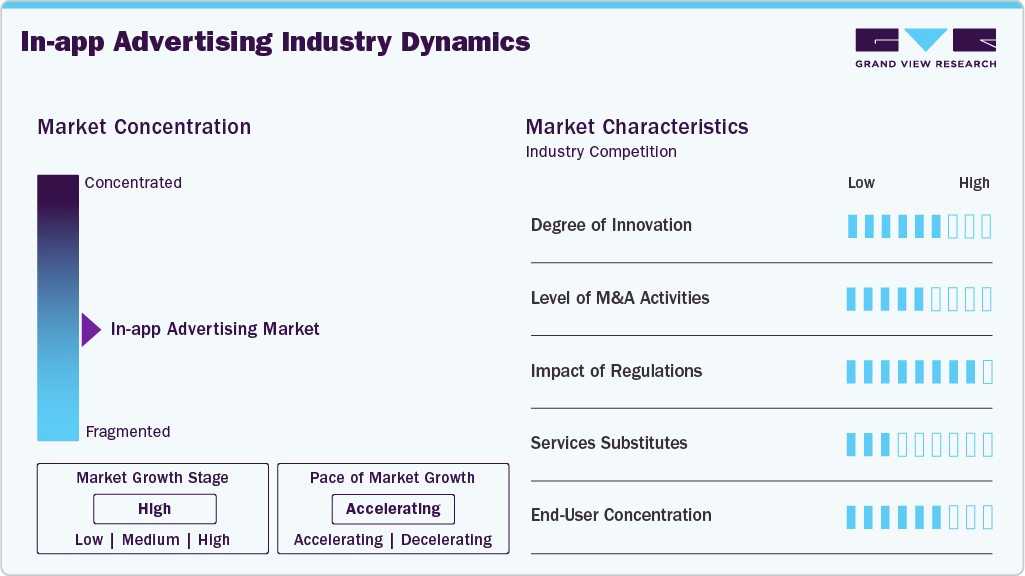
The In-app Advertising Market is highly fragmented, with a large number of advertising technology providers, mobile ad networks, demand-side platforms (DSPs), supply-side platforms (SSPs), programmatic advertising companies, analytics providers, and mobile app monetization platforms competing globally. Key participants include Google, Meta Platforms, AppLovin, Unity Technologies, The Trade Desk, Digital Turbine, ironSource, and InMobi. The market remains competitive due to continuous innovation in AI-driven targeting, programmatic advertising, real-time bidding, and mobile app monetization solutions.
 To learn more about this report, Download Free Sample Report
 Analyst Perspective
The In-app Advertising Market is positioned at the center of the rapidly expanding mobile digital ecosystem, driven by increasing smartphone penetration, rising app usage, and growing advertiser demand for personalized consumer engagement. Brands are increasingly allocating marketing budgets toward in-app channels due to their ability to deliver highly targeted, measurable, and data-driven advertising experiences across gaming, social media, entertainment, e-commerce, and utility applications. The market is benefiting from advancements in artificial intelligence, machine learning, programmatic advertising, real-time bidding, and audience analytics, which enable advertisers to optimize campaign performance and maximize return on investment. As mobile applications continue to capture a larger share of consumer digital attention, in-app advertising has evolved from a supplementary marketing channel into a core component of digital advertising strategies. Furthermore, the ongoing growth of mobile commerce, video content consumption, and emerging advertising formats is expected to further strengthen market expansion and reshape the future of mobile advertising.
Type Insights
Based on type, the Banner Ads segment led the market with the largest revenue share of 36.0% in 2025. The growth is attributed to various benefits, such as being affordable, easy to implement, and supporting all types of applications and mobile devices. Banner Ads help marketers increase traffic, brand awareness, and product sales. The banner ads offer high returns on investments, resulting in numerous growth opportunities for the banner ads segment over the forecast period.
The interstitial ads segment is projected to experience the highest CAGR of 9.5% from 2026 to 2033. Interstitial ads are particularly effective during natural transition points within mobile apps, which enhances user engagement without causing excessive disruption. Advancements in creative optimization and dynamic ad rendering have made interstitials more visually appealing and contextually relevant. The growing emphasis on monetization strategies among mobile app developers is encouraging the adoption of interstitial formats to maximize ad revenue. Interstitial ads are becoming an essential component of in-app advertising strategies.
Application Insights
Based on Application, the Entertainment segment dominated the In-app Advertising Market, accounting for the largest revenue share of 24.5% in 2025. This segment is driven by the rapid growth of video streaming, music streaming, and social entertainment applications, which attract large and highly engaged user bases. These platforms provide advertisers with extensive opportunities to deliver personalized, interactive, and high-visibility advertisements, resulting in improved user engagement and conversion rates. Additionally, the increasing adoption of rewarded video ads, playable ads, and AI-driven ad targeting has enhanced monetization for app developers while maximizing advertising effectiveness.
The online shopping segment is anticipated to grow at the significant CAGR from 2026 to 2033. The rapid surge in mobile commerce, along with the increasing penetration of smartphones and user-friendly e-commerce apps, has significantly boosted in-app ad placements within shopping applications. Retailers and marketplaces are leveraging in-app advertising to personalize user experiences, promote flash sales, and drive product discovery. The growing trend of social commerce and integration of payment gateways within apps also enhances ad conversion rates, making online shopping apps a key driver of in-app advertising industry growth during the forecast period.
Platform Insights
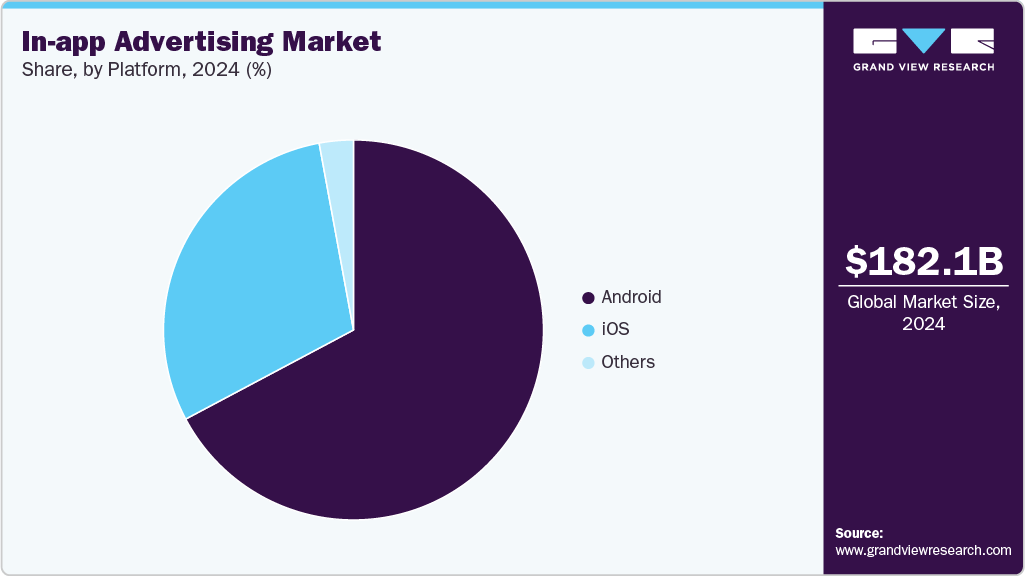
Based on platform, the Android segment led the market with the largest revenue share of 65.3% in 2025. Android is an open-source operating system that allows different devices to run on the Android platform, unlike iOS, which runs only on Apple devices. The advertisers usually target high-end Android devices based on device models to target high quality users. The increasing focus on data privacy and developing enhanced advertising solutions is offering numerous growth opportunities for the Android platform segment in the future. As a result, Android remains a fundamental component of the industry.
 To learn more about this report, Download Free Sample Report
 The iOS segment is expected to experience the fastest growth from 2026 to 2033. This growth is driven by the high spending power of iOS users, making the platform highly attractive. Apple's tightly controlled app ecosystem ensures higher user engagement and app retention, which boosts ad viewability and performance. The widespread adoption of in-app purchases and subscription models on iOS apps creates opportunities for native advertising and monetization strategies that are less intrusive yet highly effective. These factors are expected to significantly increase the demand for in-app advertising on the iOS platform across global markets.
Regional Insights
North America in-app advertising market accounted for a share of over 30.3% in 2025.. The growth is attributed to the large number of smartphone users coupled with the rising popularity of mobile streaming services such as Hulu, Amazon Prime, Netflix, and other popular video streaming services have increased the potential for in-app advertising industry in the region. The rapidly growing gaming market and substantial growth in mobile shopping, owing to its ability to offer a better shopping experience, are expected to fuel the growth of in-app advertising industry in North America.
U.S. In-app Advertising Market Trends
The in-app advertising market in the U.S. is experiencing growth with the largest market share of over 89% in 2025, driven by the widespread adoption of mobile apps across sectors such as e-commerce and finance. The increasing digital screen time among consumers and the proliferation of smartphones have created a robust ecosystem for advertisers to deliver personalized content directly within apps. U.S. advertisers are leveraging AI and machine learning technologies to enable real-time bidding and hyper-targeted ad placements. The presence of major tech companies and ad tech platforms in the region has accelerated innovation in immersive ad formats like interactive video and augmented reality ads, further fueling market growth.
Europe In-app Advertising Market Trends
The in-app advertising market in Europe is expected to grow at a CAGR of over 6%, due to increasing mobile penetration and strict data privacy regulations. The implementation of the General Data Protection Regulation (GDPR) has led to greater transparency and accountability in data usage, encouraging advertisers to adopt consent-based advertising strategies. The expansion of 5G networks across major European economies is improving app performance and enabling richer, real-time ad formats such as interactive video and augmented reality ads. These trends are collectively driving the growth of the in-app advertising market across Europe.
The UK in-app advertising market is experiencing steady growth, driven by the country’s high smartphone penetration and increasing mobile app usage. UK advertisers are rapidly shifting budgets from traditional media to mobile platforms to better engage a tech-savvy, on-the-go population. The rise of mobile commerce and digital banking is also fueling demand for personalized, in-app advertising experiences. Leading players in the UK market, including Google and Meta are investing in AI-powered ad delivery and advanced analytics to optimize ad performance. These factors collectively contribute to the continued expansion of the in-app advertising industry.
The in-app advertising market in Germany is driven by the country’s strong digital infrastructure and a tech-savvy population. The rising popularity of mobile commerce and digital banking apps in Germany is encouraging brands to invest in performance-driven ad formats like native and video ads. Germany’s stringent data privacy regulations under the GDPR are accelerating the adoption of contextual and consent-based advertising models. With a growing emphasis on user experience and transparency, the German in-app advertising market remains highly competitive and poised for continued expansion.
Asia-Pacific In-app Advertising Market Trends
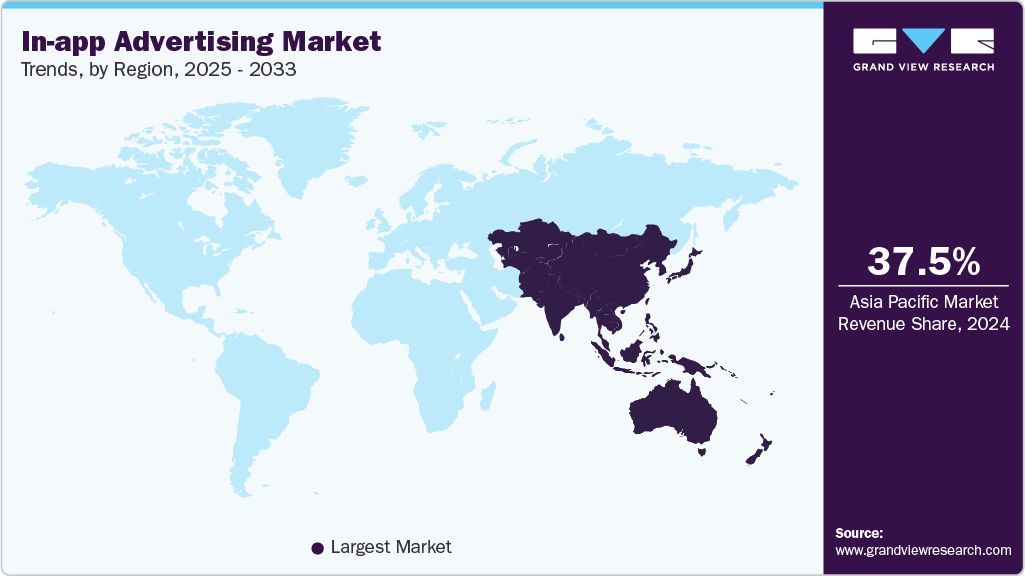
Asia Pacific dominated the In-app Advertising Market with the largest revenue share of 36.1% in 2025, driven by rising smartphone penetration and a surge in digital content consumption. Localized advertising strategies and culturally relevant content are enabling brands to better connect with diverse audiences across the region. The rapid growth of e-commerce platforms and mobile gaming apps is providing new and scalable advertising inventories for marketers. The in-app advertising market in the Asia Pacific is expanding rapidly, with advertisers and publishers focusing heavily on mobile-first strategies to tap into this digitally dynamic region.
 To learn more about this report, Download Free Sample Report
 The In-app Advertising Market in the China held the largest share in the Asia Pacific region in 2025. China in-app advertising market is driven by its massive mobile user base and the dominance of domestic super apps. Government initiatives promoting the digital economy and innovation have further encouraged businesses to shift marketing budgets toward mobile channels. Local advertisers are increasingly leveraging rich media formats, influencer collaborations, and mini-program ads to capture consumer attention. These drivers collectively support China’s dynamic and rapidly expanding in-app advertising industry.
The in-app advertising market in India is also experiencing rapid growth, propelled by the country’s booming digital ecosystem and widespread smartphone adoption. The availability of affordable mobile data plans and increased time spent on mobile apps have further accelerated in-app advertising. Government initiatives promoting digital inclusion, such as Digital India, are also contributing to the expansion of mobile usage and app-based engagement. Due to these trends, India’s in-app advertising market is growing at a fast pace and is expected to continue its upward trajectory in the coming years.
Key In-app Advertising Companies Insights
Key players operating in the in-app advertising market are undertaking various initiatives to strengthen their presence and increase the reach of their products and services. Strategies such as expansion activities and partnerships are key in propelling the market growth.
Key In-app Advertising Companies:
The following are the leading companies in the in-app advertising market. These companies collectively hold the largest market share and dictate industry trends.
- Google LLC
- Meta
- Apple Inc.
- Unity Technologies
- AppLovin.
- InMobi
- Chartboost, Inc.
- Liftoff, Inc.
- Smaato, Inc.
- Digital Turbine, Inc.
Competitive Benchmarking
Category
Operating Strategies
Competitive Edge
Weakness
Established Players (Google LLC, Meta Platforms, Inc., Apple Inc., AppLovin Corporation, Unity Technologies Inc.)
- Expand advertising ecosystems through AI-powered targeting, programmatic advertising, real-time bidding, mobile ad networks, app monetization platforms, and cross-platform advertising solutions.
- Strengthen market leadership through acquisitions, data analytics capabilities, developer partnerships, and continuous innovation in ad formats and measurement technologies.
- Strong global advertiser and publisher networks, extensive user data ecosystems, advanced AI and machine learning capabilities, large-scale advertising inventories, robust financial resources, and established brand recognition.
- Increasing privacy regulations, dependence on mobile platform policies, ad fraud concerns, rising competition from specialized ad-tech providers, and evolving data protection requirements.
Emerging Players (InMobi, Digital Turbine, Chartboost, Liftoff, Smaato)
- Focus on niche advertising solutions such as mobile app monetization, user acquisition, contextual advertising, rewarded ads, programmatic advertising, and performance marketing.
- Invest in AI-driven optimization, privacy-centric advertising technologies, and advanced audience engagement tools.
- Strong specialization in mobile advertising, greater agility in innovation, customized solutions for advertisers and app developers, and rapid adoption of emerging advertising technologies.
- Limited global scale compared to major technology platforms, dependence on third-party app ecosystems, challenges in attracting large advertising budgets, and increasing competitive pressure from dominant market participants
Recent Developments
-
In June 2025, Unity Technologies launched the Unity Audience Hub, a privacy-first advertising solution that combines federated insights from Unity’s ad ecosystem with trusted third-party data to deliver highly relevant audiences for brand campaigns across mobile and connected TV (CTV). Initial beta testing showed over 100% increase in engagement rates, demonstrating improved ad performance for developers and marketers.
-
In April 2025, Meta Platforms announced the global rollout of in-app advertising on its Threads platform, making ads available to all eligible advertisers in over 30 countries, including the United States. According to the company, this phased expansion aims to balance user experience with advertiser effectiveness, marking a significant step in Meta’s efforts to monetize its emerging social media app. Ads will appear natively within user feeds, labeled as “Sponsored” posts, and are part of Meta’s broader strategy to expand its in-app advertising ecosystem beyond Facebook and Instagram.
-
In February 2025, Apple enhanced its Search Ads platform by introducing deep linking capabilities, enabling advertisers to direct users to specific in-app destinations within iOS 18-supported apps. This update applies to ad placements on the Today tab, Search tab, and search results, allowing for more personalized and context-driven ad experiences. By integrating deep links into custom product pages, advertisers can significantly improve user engagement and conversion rates. As iOS 18 adoption increases, developers and marketers are encouraged to update their strategies to take full advantage of this advanced targeting feature.
In-app Advertising Market Report Scope
Report Attribute
Details
Market size in 2025
USD 229.2 billion
Estimated market size in 2026
USD 268.2 billion
Projected market size by 2040
USD 461.4 billion
Growth rate
CAGR of 8.1% from 2026 to 2040
Base year for estimation
2025
Historical data
2021 - 2024
Forecast period
2026 - 2040
Quantitative units
Revenue in USD million/billion and CAGR from 2026 to 2040
Report coverage
Revenue forecast, company ranking, competitive landscape, growth factors, and trends
Segments covered
Type, Platform, Application and Region
Regional scope
North America; Europe; Asia Pacific; Latin America; MEA
Country scope
U.S.; Canada; Mexico; Germany; U.K; France; China; Japan; India; South Korea; Australia; Brazil; Saudi Arabia; South Africa; UAE;
Key companies profiled
Google LLC, Meta, Apple Inc., Unity Technologies, AppLovin, InMobi
Chartboost, Inc., Liftoff, Inc., Smaato, Inc., Digital Turbine, Inc.
Customization scope
Free report customization (equivalent up to 8 analysts' working days) with purchase. Addition or alteration to country, regional & segment scope.
Pricing and purchase options
Avail customized purchase options to meet your exact research needs. Explore purchase options
Global In-app Advertising Market Report Segmentation
This report forecasts revenue growth at the global, regional, and country levels and provides an analysis of the latest technology trends in each of the sub-segments from 2021 to 2033. For this study, Grand View Research has segmented the global in-app advertising market report based on type, platform, application, and region:
 To learn more about this report, Download Free Sample Report
 -
Type Outlook (Revenue, USD Billion, 2021 - 2033)
-
Banner Ads
-
Interstitial Ads
-
Rich Media Ads
-
Video Ads
-
Native Ads
-
-
Platform Outlook (Revenue, USD Billion, 2021 - 2033)
-
Android
-
iOS
-
Others
-
-
Application Outlook (Revenue, USD Billion, 2021 - 2033)
-
Entertainment
-
Gaming
-
Social
-
Online Shopping
-
Payment & Ticketing
-
News
-
Others
-
-
Regional Outlook (Revenue, USD Billion, 2021 - 2033)
-
North America
-
U.S.
-
Canada
-
-
Europe
-
UK
-
Germany
-
France
-
Italy
-
Spain
-
Russia
-
Netherlands
-
-
Asia Pacific
-
China
-
Japan
-
India
-
South Korea
-
Australia
-
-
Latin America
-
Brazil
-
Mexico
-
Argentina
-
-
Middle East & Africa
-
Saudi Arabia
-
UAE
-
South Africa
-
-
Research Methodology
The in-app advertising market figures in this report are based on a proven research process that combines executive interviews with secondary research from proprietary databases, company filings, and recognized regulatory and institutional sources. Market size is built through value-chain sizing - reconciling supply-side and demand-side estimates - and triangulated with bottom-up and top-down approaches. Every estimate passes multiple levels of expert validation before publication, with each in-app advertising segment quantified using the revenue-capture definitions in the table below.
Segment Definition
Segment - Type
Revenue capture definition
Baner Ads
Revenue in this segment is generated through the placement of banner advertisements within mobile applications across gaming, social media, entertainment, e-commerce, and utility platforms. Banner ads are displayed in fixed positions on app screens, enabling advertisers to increase brand visibility, user engagement, and traffic generation through targeted and programmatic advertising campaigns.
Interstitial Ads
Revenue in this segment is generated through the delivery of interstitial advertisements that appear as full-screen ads at natural transition points within mobile applications, such as between game levels, content pages, or app activities. These ads provide high visibility and engagement opportunities for advertisers, helping drive brand awareness, user acquisition, and conversion rates across various mobile app categories.
Rich Media Ads
Revenue in this segment is generated through the deployment of rich media advertisements within mobile applications, incorporating interactive elements such as videos, animations, expandable content, playable ads, and immersive experiences. These ads enhance user engagement, improve brand interaction, and increase conversion rates by delivering dynamic and visually compelling advertising experiences across various mobile app categories.
Video Ads
Revenue in this segment is generated through the delivery of video advertisements within mobile applications, including in-stream, rewarded, and full-screen video formats. These ads enable advertisers to capture user attention through engaging visual content, enhancing brand awareness, user engagement, and conversion rates across gaming, entertainment, social media, and other mobile app categories.
Native Ads
Revenue in this segment is generated through the placement of native advertisements that seamlessly integrate with the design, content, and user experience of mobile applications. These ads match the app’s look and feel, enabling advertisers to deliver non-disruptive promotional content that enhances user engagement, improves ad relevance, and drives higher click-through and conversion rates.
Segment - Platform
Revenue capture definition
Android
Revenue in this segment is generated through the delivery of in-app advertisements on Android-based mobile applications across categories such as gaming, social media, entertainment, e-commerce, and utilities. Advertisers leverage Android’s extensive user base and advanced targeting capabilities to reach diverse audiences, enhance brand visibility, drive user engagement, and improve campaign performance through personalized advertising experiences.
iOS
Revenue in this segment is generated through the delivery of in-app advertisements on iOS-based mobile applications across gaming, entertainment, social media, e-commerce, and lifestyle categories. Advertisers utilize iOS platforms to engage a highly active and premium user base, leveraging advanced ad formats and data-driven targeting strategies to enhance brand awareness, user engagement, and conversion performance.
Others
Revenue in this segment is generated through the delivery of in-app advertisements on alternative mobile operating systems and connected platforms, including emerging mobile ecosystems and specialized devices. These platforms enable advertisers to expand audience reach, increase brand exposure, and engage users through targeted advertising campaigns across diverse digital environments.
Segment - Application
Revenue capture definition
Entertainment
Revenue in this segment is generated through the placement of in-app advertisements within entertainment applications, including video streaming, music streaming, content-sharing, and digital media platforms. Advertisers leverage these apps' large and highly engaged user bases to enhance brand visibility, increase audience engagement, and drive conversions through personalized and interactive advertising formats.
Gaming
Revenue in this segment is generated through the placement of in-app advertisements within mobile gaming applications, including banner ads, rewarded ads, interstitial ads, and video advertisements. Advertisers utilize gaming platforms to reach highly engaged users, increase brand awareness, drive app installs, and enhance customer acquisition through immersive and interactive advertising experiences.
Social
Revenue in this segment is generated through the placement of in-app advertisements within social networking applications, where users actively engage with content, communities, and digital interactions. Advertisers leverage advanced audience targeting, personalized ad delivery, and interactive ad formats to enhance brand visibility, increase user engagement, and drive conversions across highly active social media platforms.
Online Shopping
Revenue in this segment is generated through the placement of in-app advertisements within online shopping and e-commerce applications, enabling brands and retailers to promote products, offers, and services to highly targeted consumers. These advertising solutions help increase product visibility, drive customer engagement, enhance purchase intent, and improve conversion rates through personalized and data-driven marketing campaigns.
Payment & Ticketing
Revenue in this segment is generated through the placement of in-app advertisements within payment, banking, wallet, and ticketing applications, where users frequently engage in financial transactions and service bookings. Advertisers leverage these platforms to deliver targeted promotional content, enhance brand visibility, and drive customer engagement through personalized offers, rewards, and location-based advertising campaigns.
News
Revenue in this segment is generated through the placement of in-app advertisements within news and media applications, where users regularly consume real-time news, articles, and digital content. Advertisers utilize these platforms to reach highly engaged audiences, enhance brand awareness, and drive user engagement through targeted display, native, video, and programmatic advertising formats.
Others
Revenue in this segment is generated through the placement of in-app advertisements across other application categories, including education, health & fitness, travel, productivity, utility, and lifestyle apps. These platforms enable advertisers to reach niche and diverse user groups, enhance brand visibility, and drive engagement through targeted and contextually relevant advertising campaigns.
Estimation Model
Layer Name
Key Question
Description
Addressable Mobile App User Layer
Which users can be reached through in-app advertising?
Identify the global smartphone and tablet user base actively engaging with mobile applications across gaming, social media, entertainment, shopping, finance, news, and utility app categories that provide advertising inventory.
Ad-Supported App Ecosystem Layer
Which applications generate advertising opportunities?
Apply penetration rates for ad-supported mobile applications across Android and iOS platforms, including gaming, video streaming, social networking, e-commerce, and other app categories that monetize through advertising.
Advertising Engagement Layer
Which app users are exposed to and interact with ads?
Estimate active advertising impressions based on user engagement levels, app usage frequency, ad viewability, click-through rates, video completions, and interactions across banner, native, video, rich media, and interstitial ad formats.
Monetization Layer
How much revenue is generated?
Multiply total ad impressions, clicks, and engagement volumes by average advertising rates (CPM, CPC, CPA, and CPV) across various ad formats, app categories, and regions to estimate total In-app advertising market revenue
Delivered Customizations
This report has been delivered with the following In-depth customizations
CLIENT REQUEST
CUSTOMIZATION DELIVERED
VALUE ADDS
Competitive Landscape, Platform Benchmarking & Advertising Technology Assessment Across Mobile Ad Networks, Programmatic Platforms, App Monetization Providers
Conducted an in-depth assessment of leading in-app advertising platforms, mobile ad networks, demand-side platforms (DSPs), supply-side platforms (SSPs), app monetization providers, and programmatic advertising vendors. Analyzed competitive positioning, advertising capabilities, technology offerings, monetization strategies, and recent strategic developments across the in-app advertising ecosystem.
Enables stakeholders to evaluate competitive intensity, identify market leaders, benchmark platform capabilities, assess partnership opportunities, and understand evolving competitive dynamics within the digital advertising value chain.
In-app Advertising Adoption Trends, Advertiser Spending Patterns, User Engagement Analysis, and Demand Assessment Across Gaming, Social Media, Entertainment, E-commerce, Payment, News, and Other Mobile Application Categories
Evaluated advertising adoption trends across key application categories including gaming, social media, entertainment, online shopping, payment & ticketing, and news applications. Assessed demand for banner ads, video ads, native ads, rich media ads, interstitial ads, programmatic advertising, and AI-driven audience targeting solutions
Provides actionable insights into high-growth advertising formats, advertiser spending patterns, user engagement trends, and monetization opportunities to support strategic decision-making and market expansion initiatives.
Mobile Advertising Innovation, Emerging Technology Trends, Revenue Opportunity Mapping, and Future Growth Assessment Across AI-Driven Advertising, Programmatic Platforms, Advanced Targeting Solutions, Video Advertising, and Next-Generation App Monetization Models
Assessed the impact of artificial intelligence, machine learning, programmatic advertising, predictive analytics, real-time bidding, privacy-focused targeting, and advanced measurement technologies on the In-app Advertising Market. Identified emerging opportunities across mobile gaming, video streaming, social networking, and e-commerce applications
Supports growth and investment strategies by highlighting emerging technology trends, identifying attractive revenue opportunities, evaluating future market potential, and understanding key factors driving long-term growth in the In-app Advertising Market.
Frequently Asked Questions About This Report
The global in-app advertising market was valued at USD 229.2 billion in 2025 and is expected to reach USD 268.2 billion in 2026.
The global in-app advertising market is expected to grow at a compound annual growth rate of 8.1% from 2026 to 2033 to reach USD 461.4 billion by 2033.
The key players in the Google LLC, Meta, Apple Inc., Unity Technologies, AppLovin., InMobi, Chartboost, Inc., Liftoff, Inc., Smaato, Inc. , Digital Turbine, Inc.
Key factors that are driving the in-app advertising market growth include growing smartphone usage, increased time spent on mobile apps, rising adoption of social media and gaming platforms, and advancements in AI-based targeting and programmatic advertising.
Asia Pacific dominated the in-app advertising market with a share of over 36.1% in 2025.
Asia-Pacific is the fastest growing region over the forecast period from 2026 to 2033.
Android segment leads with 65.3% market share in 2025 due to its large global smartphone user base, extensive app ecosystem, and increasing mobile advertising opportunities across emerging markets.
Banner Ads leads the market with 36.0% market shar ein 2025, while Rich Media Ads is the fastest growing segment in the market.
Entertainment leads the market with 24.5% market share in 2025, while Gaming is the fastest-growing segment in the market.
About the Author(s)
Digital Media Research Team
Technology · Digital MediaThis report was authored by the digital media research team at Grand View Research - comprising two research analysts, one senior research analyst, and one industry expert - with specialized expertise in the digital media segment of the technology industry. All findings are based on proprietary technology databases, executive interviews, and regulatory analysis, subject to internal peer review prior to publication.
Last Updated:
Speak to Analyst

Customize this report to your needs - add regions, segments, or data points, with 20% free customization.
Or view our licence options:


ISO 9001:2015 & 27001:2022 Certified
We are GDPR and CCPA compliant! Your transaction & personal information is safe and secure. For more details, please read our privacy policy.


