
- Home
- »
- Next Generation Technologies
- »
-
HR Software Market Size And Share Report, 2026-2033GVR Report cover

HR Software Market (2026 - 2033)
Size, Share & Trends Analysis Report By Type (Core HR, Talent Management), By Organization Size (Large Enterprises, Small & Medium Enterprises), By Deployment (Hosted, On-premise), By End-use, By Region, And Segment Forecasts
Market Size, 2025
$20.5BMarket Estimate, 2026
$23.0BMarket Forecast, 2033
$56.3BCAGR, 2026–2033
13.7%HR Software Market Summary
The global HR software market size was valued at USD 20.5 billion in 2025 and is projected to grow from USD 23.0 billion in 2026 to USD 56.3 billion by 2033, at a CAGR of 13.7% from 2026 to 2033. North America dominated the global market, accounting for the largest revenue share of 34.7% in 2025. The HR software market is primarily driven by the increasing need for workforce automation, rising adoption of cloud-based HR platforms, growing focus on employee experience and engagement, demand for real-time workforce analytics, and the need for organizations to improve talent acquisition, retention, and compliance management.
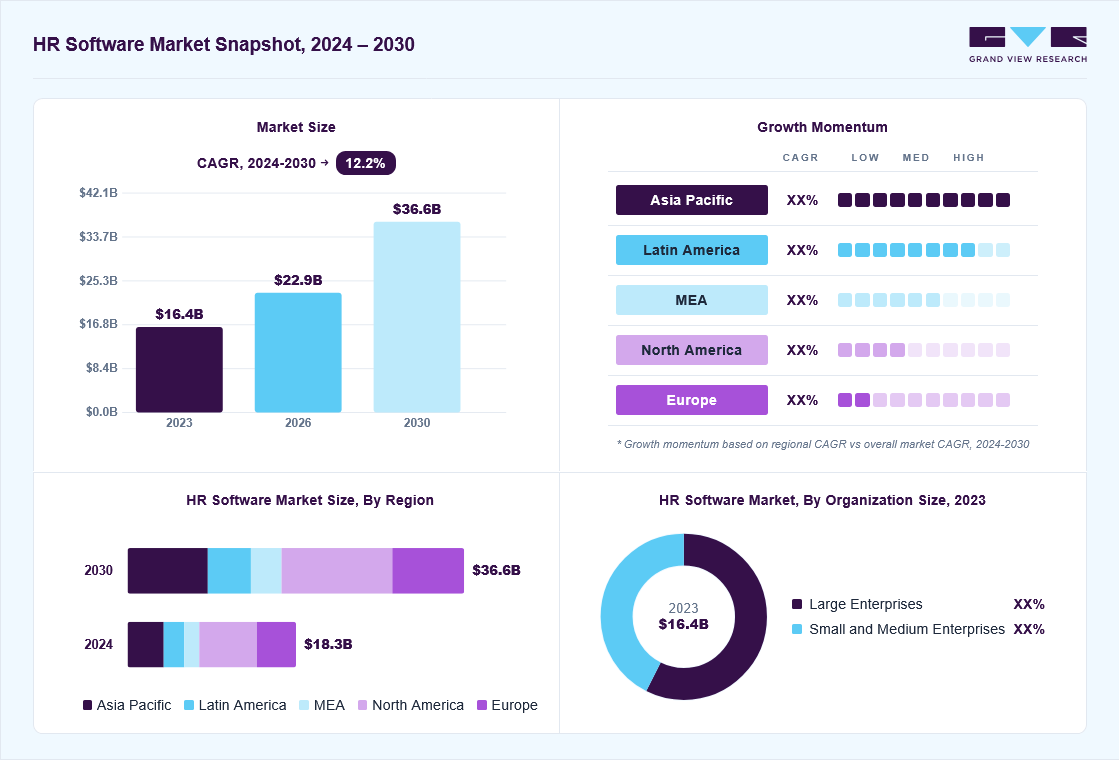 Source: Grand View Research, IR Documents, Primary Interviews, Paid DatabasesTo learn more about this report,
 Download Free Sample Report
 Key Market Trends & Insights
- By type: Core HR segment accounted for the largest market share of 33.4% in 2025.
- By organization size: Large enterprises segment accounted for the highest share of 58.0% in 2025.
- By deployment: On-premises segment dominated the market with a share of 57.8% in 2025.
- By end use: IT & telecom segment dominated the market in 2025.
Regional Highlights
- Largest regional market: North America (34.7% revenue share in 2025)
- Fastest growing regional market: Asia Pacific (highest CAGR 15.7%, 2026-2033)
- By Country: U.S. held the largest market share in 2025.
Market Size & Forecast
- Market size in 2025: USD 20.5 Billion
- Estimated market size in 2026: USD 23.0 Billion
- Projected market size by 2033: USD 56.3 Billion
- CAGR (2026-2033): 13.7%
Three ways to get this report
Buy it, customize it, or ask a question.Ask an Analyst
A direct answer, usually in 1 working day
- AccessReport author, directly
- Reply timeWithin 1 working day
- No sales callDirect answer only
- FormatEmail reply
- CostFree, no cost
Get the Full Report
What the study covers
- FormatsPDF · Excel · Dashboard
- Timeline2026–2033 annual, 2025 base
- Coverage20+ countries, 5 regions
- Companies10+ key players profiled
Customize the Report
20% free customization
- IncludeCountries, segments, points
- TailorTo your product definition
- ExtendDeeper competitor detail
- OrA fully bespoke study
- Turnaround5–10 working days
Companies are increasingly moving away from on-premise systems to cloud-based platforms due to their scalability, flexibility, and cost-effectiveness. These platforms enable organizations to manage HR functions such as payroll, recruitment, and employee performance from any location, providing real-time data access and reducing the need for extensive IT infrastructure, thereby driving market growth. Artificial intelligence (AI) and machine learning (ML) are transforming HR software by enabling more sophisticated data analytics, automation of repetitive tasks, and predictive insights. AI-driven tools are being used for talent acquisition, where they can screen resumes, analyze job descriptions, and match candidates more effectively. ML algorithms help in identifying trends in employee performance and engagement, allowing HR professionals to make data-driven decisions and personalize the employee experience, thereby fueling market growth. To learn more about this report, Download Free Sample Report
 Furthermore, improving employee experience has become a central focus in HR, driving the demand for software that supports personalized engagement, wellness initiatives, and continuous feedback mechanisms. This trend reflects a broader shift towards recognizing the importance of employee satisfaction and retention, with HR software evolving to offer tools that foster a more engaged and motivated workforce.
The increasing adoption of mobile HR solutions is another key trend, fueled by the rise of remote work and the need for on-the-go access to HR services. Mobile apps that allow employees to manage tasks like leave requests, payroll access, and training participation from their smartphones are becoming essential. This trend highlights the growing importance of mobility and convenience in the HR tech landscape.
Moreover, the trend toward advanced analytics and reporting tools within HR software is gaining momentum. Organizations are leveraging these tools to gain deeper insights into workforce metrics, track performance indicators, and forecast hiring needs. This trend emphasizes the growing importance of strategic, data-driven HR planning, aligning HR functions more closely with broader business objectives.
Market Dynamics
The HR software market is experiencing robust growth, driven by the rapid digital transformation of human resources functions, the increasing adoption of cloud-based Human Capital Management (HCM) solutions, and the growing demand for AI-enabled workforce management. Organizations across industries are modernizing HR operations to streamline recruitment, payroll, talent management, employee engagement, and compliance while supporting hybrid work environments. Advancements in artificial intelligence, predictive analytics, and automation are further enhancing HR decision-making, improving employee experiences, and enabling organizations to manage increasingly complex and distributed workforces.
Organizations are increasingly replacing legacy HR systems with cloud-based platforms that offer greater scalability, flexibility, and lower infrastructure costs. Cloud deployment enables businesses to access HR applications remotely, simplify software updates, and integrate HR functions such as payroll, recruitment, performance management, and workforce analytics into a unified platform. This shift is particularly strong among small and medium-sized enterprises (SMEs), which are adopting SaaS-based HR solutions to reduce implementation costs and improve operational efficiency.
Additionally, artificial intelligence is transforming HR operations by automating repetitive tasks, enhancing candidate screening, enabling predictive workforce planning, and delivering personalized employee experiences. AI-powered chatbots, skills analytics, and intelligent talent management tools are helping organizations improve hiring quality, employee retention, and workforce productivity. These advancements continue to drive investment in next-generation HR software solutions.
HR software platforms manage highly sensitive employee information, including payroll records, personal identification, performance data, and benefits information. As organizations increasingly migrate HR data to cloud environments, concerns related to cybersecurity, data breaches, and unauthorized access remain significant challenges for both vendors and end users.
Additionally, HR software providers must comply with evolving labor laws, payroll regulations, and data privacy frameworks across multiple countries. Frequent regulatory updates require continuous software modifications and localization, increasing development costs and implementation complexity. Organizations operating globally often face additional challenges in maintaining compliance across different jurisdictions, which can slow adoption and increase deployment costs.
Organizations are placing greater emphasis on data-driven workforce planning and employee experience as they compete for skilled talent. Modern HR software platforms are increasingly integrating workforce analytics, predictive modeling, and AI-powered insights to help HR leaders make informed decisions related to hiring, succession planning, employee engagement, and retention. This creates substantial opportunities for vendors offering advanced analytics and intelligent decision-support capabilities.
Furthermore, the growing focus on employee well-being, learning and development, internal mobility, and personalized career growth is expanding demand for next-generation HR platforms. Vendors that combine generative AI, employee engagement tools, learning management, and workforce intelligence into integrated cloud-based solutions are well-positioned to capture future market growth across enterprises of all sizes.
Market Concentration & Characteristics
The HR software market is moderately fragmented, comprising global HCM vendors, enterprise software providers, payroll solution providers, and cloud-based HR technology companies. The market is characterized by a high degree of innovation, driven by advancements in AI, generative AI, cloud computing, predictive analytics, RPA, and API integrations, enabling intelligent and automated HR operations. The market is witnessing moderate-to-high M&A activity, with vendors acquiring AI, talent management, payroll, and workforce analytics companies to expand cloud capabilities and strengthen their product portfolios.
 To learn more about this report, Download Free Sample Report
 Regulatory influence is high, driven by labor laws, payroll regulations, data privacy requirements, and employment compliance standards. Product substitution is low due to high switching costs and deep integration with enterprise HR processes. Demand is diversified across academia, BFSI, government, healthcare, IT & telecom, manufacturing, retail, and other industries, supported by workforce digitalization, cloud HCM adoption, hybrid work, and growing demand for AI-enabled HR solutions.
Analyst Perspective
The HR software market is experiencing strong structural growth, driven by increasing digital transformation of HR functions, rising adoption of cloud-based HCM platforms, and growing demand for AI-powered workforce management solutions. Organizations are investing in HR software to streamline recruitment, payroll, talent management, employee engagement, and compliance while supporting hybrid work and data-driven decision-making. Continued cloud adoption among enterprises and SMEs, along with advancements in AI and workforce analytics, is expected to sustain long-term market growth.
Type Insights
Based on type, the core HR segment led the market with the largest revenue share of 33.4% in 2025 and is expected to grow at a considerable CAGR over the forecast period, due to its essential role in managing fundamental HR functions such as payroll, benefits administration, and employee records. As organizations increasingly recognize the need for streamlined, integrated systems to handle these critical tasks efficiently, core HR solutions have become fundamental to operational success, thereby driving segment growth.
The talent management segment is expected to record a significant CAGR of over 14% from 2024 to 2030, due to the increasing focus on optimizing workforce performance and development. Organizations are investing more in advanced talent management solutions to attract, retain, and foster top talent amidst a competitive job market. These tools enhance recruitment processes, employee development, and performance evaluation, aligning talent strategies with business goals and improving overall organizational effectiveness. The growing recognition of talent management's impact on business success drives this rapid growth.
End-use Insights
Based on end use, the IT & Telecom segment led the market with the largest revenue share of 21.5% in 2025 and is expected to grow at a considerable CAGR over the forecast period, due to the industry's rapid growth and high demand for efficient human resource management. Companies in this sector often have large, diverse workforces and complex HR needs, driving the adoption of advanced HR software solutions to streamline operations, manage talent, and ensure compliance. Additionally, the fast-paced nature of the IT & telecom industry necessitates robust HR systems that can handle recruitment, performance management, and employee engagement effectively, contributing to the segment's leading market share.
The retail segment is anticipated to expand at a significant CAGR from 2024 to 2030, due to the sector's increasing need for efficient workforce management solutions amid evolving consumer demands and market conditions. As retailers expand their operations and adapt to trends such as omnichannel retailing, they require advanced HR systems to manage large, dynamic teams, streamline recruitment, optimize scheduling, and enhance employee engagement. The rise in automation and data-driven HR practices is also driving the adoption of sophisticated HR software in retail, facilitating better management of both front-line and corporate staff.
Deployment Insights
Based on deployment, the on-premises segment dominated the market with the largest revenue share of 57.8% in 2025, due to the preference of many organizations for maintaining control over their HR data and systems within their IT infrastructure. On-premise solutions offer greater customization, enhanced security, and compliance with strict data regulations, which appeals to enterprises with specific security requirements or complex HR processes. Additionally, established companies with existing IT infrastructure often find on-premise systems more aligned with their operational needs and integration capabilities.
 To learn more about this report, Download Free Sample Report
 The hosted segment is estimated to register the highest CAGR from 2024 to 2030, owing to its flexibility, scalability, and lower upfront costs compared to on-premise solutions. Hosted HR software allows organizations to access and manage their HR functions via the cloud, reducing the need for extensive internal IT infrastructure and maintenance. This model supports remote and hybrid work environments, offers easier updates and integrations, and provides scalability for growing businesses, making it an attractive option for companies seeking efficient and adaptable HR management solutions.
Organization Size Insights
Based on organization size, the large enterprises segment dominated the market with the largest revenue share of 58.0% in 2025, owing to their extensive and complex human resource needs. These organizations often require comprehensive and scalable HR solutions to manage large and diverse workforces, integrate with existing enterprise systems, and comply with various regulatory requirements. Their larger budgets and greater emphasis on optimizing HR processes and analytics contribute to the high revenue share in this segment.
The small and medium enterprises segment is estimated to register the highest CAGR from 2024 to 2030, due to the increasing adoption of digital solutions among SMEs. As these businesses seek to enhance their HR capabilities and streamline processes without substantial investments, they are increasingly turning to affordable, scalable HR software solutions. Additionally, the growing availability of cloud-based and subscription-based HR software makes these solutions more accessible and cost-effective for SMEs, driving their rapid growth in the market.
Regional Insights
North America dominated the HR software market, accounting for the largest revenue share of 34.7% in 2025, driven by the high adoption of advanced HR technologies, a mature market with substantial investments in digital transformation, and the presence of numerous leading HR software providers. Companies in this region are increasingly leveraging sophisticated HR systems to improve workforce management, compliance, and operational efficiency.
 To learn more about this report, Download Free Sample Report
 U.S. HR Software Market Trends
The HR software market in the U.S. held the largest share in the North America region in 2025, fueled by the strong demand for innovative HR solutions from a diverse range of enterprises seeking to enhance their workforce management capabilities. The country's robust technology infrastructure, combined with a focus on integrating AI and automation into HR processes, drives the adoption of advanced HR software solutions.
Asia Pacific HR Software Market Trends
The HR Software Market in Asia Pacific accounted for a significant revenue share of over 21% in 2023, due to its dynamic economic development, a large and diverse workforce, and the increasing need for HR software to streamline human resources functions. As businesses in this region expand and modernize, there is a growing emphasis on digital tools to manage complex HR operations efficiently.
India HR software market is estimated to record the highest CAGR from 2024 to 2030, due to the significant growth in the IT and services sectors, coupled with a focus on digitizing HR processes to support rapid business expansion. The rising demand for cloud-based HR solutions and advanced analytics is driving the adoption of innovative HR technologies across various industries.
The HR software market in China is projected to grow at a CAGR from 2024 to 2030. China's HR software market benefits from its large industrial base and the ongoing digital transformation across businesses. The need for sophisticated HR systems to handle a vast and diverse workforce, combined with efforts to enhance operational efficiency and compliance, contributes to the market's growth.
Japan HR software market is projected to grow at a CAGR from 2024 to 2030. Japan's market is growing as businesses seek advanced HR solutions to address challenges related to an aging workforce, productivity, and compliance. The country's emphasis on technological innovation and automation in HR processes is driving the adoption of state-of-the-art HR software.
Europe HR Software Market Trends
The HR software market in the Europe region is anticipated to register a CAGR of around 10% from 2024 to 2030. The growth is supported by stringent regulatory requirements, a strong focus on digital transformation, and the increasing adoption of HR technologies to navigate complex labor laws and enhance organizational efficiency. European companies are investing in HR software to improve compliance and streamline HR operations.
The UK HR software market is projected to grow at a CAGR from 2024 to 2030, driven by a need for compliance with evolving labor regulations, the rise of remote and hybrid working models, and a significant investment in digital HR solutions. Companies are adopting HR software to manage diverse workforces, improve employee engagement, and enhance operational efficiency.
The HR software market in Germany is estimated to record a CAGR from 2024 to 2030, due to the country's strong industrial sector, high emphasis on efficient HR management, and adoption of digital technologies to meet complex regulatory and operational needs. The focus on enhancing productivity and managing large-scale workforces drives the demand for advanced HR systems.
Middle East & Africa (MEA) HR Software Market Trends
The MEA HR software market is anticipated to grow at the highest CAGR of around 12% from 2024 to 2030, fueled by the increased investments in infrastructure, modernization of HR practices, and the need for scalable solutions to manage diverse and expanding workforces. The region's economic diversification and focus on digital transformation are driving the adoption of HR software.
The HR software market in Saudi Arabia accounted for a considerable revenue share in 2023, due to government initiatives promoting digital transformation, increased investment in technology, and a growing need for efficient HR management systems.
Key HR Software Company Insights
Some key players operating in the market are NetSuite, Inc. and IBM Corporation.
-
NetSuite, Inc., is a provider of cloud-based enterprise resource planning (ERP) and business management software. The company offers a comprehensive suite of integrated business applications, including ERP, financial management, CRM (Customer Relationship Management), and e-commerce solutions. Its cloud-based platform is designed to streamline business operations, enhance visibility, and support scalability for organizations of all sizes.
-
IBM Corporation is a technology and consulting company renowned for its broad portfolio of technology and services, including cloud computing, artificial intelligence (AI), data analytics, and enterprise software. The company provides a wide range of solutions, including hardware, software, and consulting services, catering to various industries and business needs. IBM's software offerings include solutions for business automation, data management, and security.
Talentsoft, and UKG, Inc. are some emerging market participants in the market.
-
Talentsoft is a provider of cloud-based talent management and human resources (HR) software solutions. The company specializes in providing an integrated suite of HR solutions designed to manage various aspects of the employee lifecycle. Its offerings include talent acquisition, performance management, learning and development, and succession planning. The company has a strong presence in Europe and is expanding its reach globally.
-
UKG, Inc. is a provider of human capital management (HCM) and workforce management solutions. The company offers a comprehensive range of HR, payroll, and workforce management solutions, including core HR, talent management, time and attendance, and workforce analytics. UKG focuses on delivering solutions that enhance employee experience, streamline HR operations, and drive organizational success. With a strong global presence, UKG serves a diverse range of industries and has a reputation for innovative technology and customer service.
Key HR Software Companies
The following key companies have been profiled for this study on the HR software market.
-
Accenture plc
-
Cezanne HR Limited
-
IBM Corporation
-
NetSuite, Inc.
-
Zellis Group
-
PwC
-
SAP SE
-
Talentsoft
-
UKG, Inc.
-
Workday Inc.
Competitive Benchmarking
Category
Operating Strategies
Competitive Edge
Weakness
Established Players (SAP SE, Workday Inc., UKG, Inc., IBM Corporation, Oracle NetSuite, Accenture plc)
- Focus on comprehensive Human Capital Management (HCM) platforms covering Core HR, payroll, talent management, workforce planning, employee experience, analytics, and AI-driven HR automation.
- Invest heavily in cloud innovation, generative AI, acquisitions, global expansion, and strategic partnerships with consulting firms and system integrators to serve large enterprises and multinational organizations.
- Strong global presence, extensive enterprise customer base, broad HCM product portfolios, advanced AI and analytics capabilities, robust compliance support, and deep integration with ERP, finance, and business applications.
- High R&D investment enables continuous innovation in workforce intelligence, automation, and employee experience.
- High implementation and subscription costs, lengthy deployment cycles, product complexity, and significant customization requirements.
- Dependence on large enterprise customers can slow adoption among SMEs, while integration with legacy systems may increase deployment complexity and total cost of ownership.
Emerging & Specialized Players (Cezanne HR Limited, Talentsoft, Zellis Group, PwC HR Solutions)
- Focus on niche HR software capabilities, including cloud-native HR management, payroll outsourcing, employee engagement, regional compliance, learning management, and mid-market HCM solutions.
- Emphasize flexible deployment, faster implementation, industry-specific functionality, and localized regulatory compliance for SMEs and regional enterprises.
- Greater agility, faster product innovation, competitive pricing, industry-specific expertise, localized compliance capabilities, and stronger customer support.
- Cloud-native architectures enable rapid deployment and ease of use while addressing the requirements of mid-sized organizations and regional markets.
- Limited global reach, smaller customer base, and lower R&D budgets compared with leading enterprise vendors.
- Narrower product portfolios, fewer ecosystem integrations, and lower brand recognition can limit competitiveness in large multinational deployments and complex enterprise transformation projects.
Recent Developments
-
In May 2024, Cezanne HR Limited launched its new payroll solution, Cezanne Payroll, enhancing its HRIS offerings with an integrated, native payroll tool. This solution streamlines payroll processing by combining HR and payroll data in a single system, ensuring compliance with UK regulations and HMRC recognition for RTI submissions.
-
In April 2024, Zellis Group launched HCM Cloud 8.0, a major update aimed at enhancing HR and payroll operations. The new version features advanced Power BI dashboard enhancements for better visibility on pay diversity, automatic National Minimum Wage calculations, and improvements to the Zellis Intelligence Platform (ZIP) for better data management and integration.
-
In April 2023, Pocket smHRt Tech Pvt. Ltd. launched "Digital Bharat 2.0," a mission designed to help SMEs in India digitalize their HRMS and payroll systems using WhatsApp in regional languages. This initiative offers an intuitive, easy-to-use platform for managing HR and payroll tasks, including compliance with various regulations.
HR Software Market Report Scope
Report Attribute
Details
Market size in 2025
USD 20.5 billion
Estimated market size in 2026
USD 23.0 billion
Projected market size by 2033
USD 56.3 billion
Growth rate
CAGR of 13.7% from 2026 to 2033
Base year for estimation
2025
Historical data
2021 - 2024
Forecast period
2026 - 2033
Quantitative units
Revenue in USD million and CAGR from 2026 to 2033
Report coverage
Revenue forecast, company ranking, competitive landscape, growth factors, and trends
Segments covered
Type, organization size, deployment, end-use, region
Regional scope
North America; Europe; Asia Pacific; Latin America; MEA
Country scope
U.S.; Canada; Mexico; UK; Germany; France; Italy; Spain; China; Australia; Japan; India; South Korea; Brazil; South Africa; Saudi Arabia; UAE
Key companies profiled
Accenture plc; Cezanne HR Limited; IBM Corporation; NetSuite, Inc.; Zellis Group; PwC; SAP SE; Talent soft; UKG, Inc.; Workday Inc.
Customization scope
Free report customization (equivalent up to 8 analysts' working days) with purchase. Addition or alteration to country, regional & segment scope.
Pricing and purchase options
Avail customized purchase options to meet your exact research needs. Explore purchase options
Global HR Software Market Report Segmentation
This report forecasts and estimates revenue growth at the global, regional, and country levels along with analyzes the latest market trends and opportunities in each one of the sub-segments from 2021 to 2033. For this study, Grand View Research has further segmented the global HR software market report based on type, organization size, deployment, end-use, and region.
-
Type Outlook (Revenue, USD Million, 2021 - 2033)
-
Core HR
-
Employee Collaboration & Engagement
-
Recruiting
-
Talent Management
-
Workforce Planning & Analytics
-
Others
-
-
Organization Size Outlook (Revenue, USD Million, 2021 - 2033)
-
Large Enterprises
-
Small and Medium Enterprises
-
-
Deployment Outlook (Revenue, USD Million, 2021 - 2033)
-
Hosted
-
On-premise
-
-
End-use Outlook (Revenue, USD Million, 2021 - 2033)
-
Academia
-
BFSI
-
Government
-
Healthcare
-
IT & Telecom
-
Manufacturing
-
Retail
-
Others
-
-
Regional Outlook (Revenue, USD Million, 2021 - 2033)
-
North America
-
U.S.
-
Canada
-
Mexico
-
-
Europe
-
Germany
-
UK
-
France
-
-
Asia Pacific
-
Japan
-
China
-
India
-
Australia
-
South Korea
-
-
Latin America
-
Brazil
-
-
Middle East and Africa (MEA)
-
UAE
-
Saudi Arabia
-
South Africa
-
-
Research Methodology
The HR Software market figures in this report are based on a proven research process that combines executive interviews with secondary research from proprietary databases, company filings, and recognized regulatory and institutional sources. Market size is built through value-chain sizing - reconciling supply-side and demand-side estimates - and triangulated with bottom-up and top-down approaches. Every estimate passes multiple levels of expert validation before publication, with each HR Software segment quantified using the revenue-capture definitions in the table below.
Segment Definition
Segment - Type
Revenue capture definition
Core HR
Revenue is generated through the licensing, subscription, implementation, and maintenance of core HR software used for employee records management, payroll, benefits administration, time and attendance, and compliance management.
Employee Collaboration & Engagement
Revenue is generated through the sale and subscription of software that facilitates employee communication, engagement surveys, feedback management, recognition programs, internal collaboration, and workforce experience platforms.
Recruiting
Revenue is generated through applicant tracking systems (ATS), recruitment automation, candidate sourcing, interview scheduling, onboarding, and recruitment marketing software.
Talent Management
Revenue is generated through software solutions for performance management, learning and development, succession planning, career development, compensation management, and employee training.
Workforce Planning & Analytics
Revenue is generated through workforce planning, predictive analytics, HR analytics dashboards, labor forecasting, organizational planning, and workforce optimization software.
Others
Revenue is generated through HR software modules such as expense management, employee wellness, workforce scheduling, travel management, document management, compliance tools, and other ancillary HR applications.
Segment - Organization Size
Revenue capture definition
Large Enterprises
Revenue is captured from large organizations purchasing enterprise-scale HR software, including subscriptions, licenses, implementation, customization, consulting, integration, and ongoing support services.
Small and Medium Enterprises (SMEs)
Revenue is captured from SMEs adopting cloud-based or on-premise HR software through subscription fees, software licensing, implementation, and value-added support services.
Segment - Deployment
Revenue capture definition
Hosted (Cloud-based)
Revenue is generated through subscription-based Software-as-a-Service (SaaS), cloud hosting fees, platform management, software updates, and cloud infrastructure services for HR software.
On-premise
Revenue is generated through perpetual software licenses, implementation, customization, maintenance contracts, upgrades, and technical support for software deployed within customer-owned infrastructure.
Segment - End Use
Revenue capture definition
Academia
Revenue is captured from educational institutions adopting HR software for faculty and staff management, payroll, recruitment, workforce planning, attendance, and compliance.
BFSI
Revenue is captured from banks, financial institutions, and insurance companies implementing HR software for workforce management, payroll, compliance, talent management, and employee engagement.
Government
Revenue is captured from government agencies and public sector organizations deploying HR software for civil workforce administration, payroll, recruitment, compliance, and performance management.
Healthcare
Revenue is captured from hospitals, clinics, healthcare systems, and medical organizations using HR software for workforce scheduling, credential management, payroll, recruitment, and compliance.
IT & Telecom
Revenue is captured from IT services, software companies, and telecommunications providers investing in HR software for talent acquisition, employee lifecycle management, workforce analytics, and performance management.
Manufacturing
Revenue is captured from manufacturing companies implementing HR software for workforce scheduling, payroll, compliance, labor management, safety tracking, and employee performance management.
Retail
Revenue is captured from retail companies using HR software for employee scheduling, payroll, recruitment, workforce management, performance monitoring, and labor compliance.
Others
Revenue is captured from industries such as hospitality, transportation, logistics, energy, construction, professional services, media, and non-profit organizations utilizing HR software for workforce administration and talent management.
Estimation Model
Layer Name
Key Question
Description
Enterprise Demand & End-User Layer
Who drives demand for HR software?
Represents the demand side of the HR software market, including enterprises across BFSI, IT & telecom, healthcare, manufacturing, retail, government, education, professional services, hospitality, and other industries. Demand is driven by increasing workforce digitization, hybrid and remote work models, regulatory compliance requirements, talent shortages, employee experience initiatives, workforce productivity improvement, and the growing need to automate HR processes across organizations of all sizes.
Technology & Digital Enablement Layer
What technologies enable HR software?
Includes the core technologies powering modern HR software, such as cloud computing, Software-as-a-Service (SaaS), artificial intelligence (AI), machine learning (ML), generative AI, robotic process automation (RPA), predictive analytics, workforce analytics, mobile applications, APIs, low-code/no-code platforms, cybersecurity solutions, identity and access management, conversational AI, and integration technologies that enable intelligent, connected, and data-driven HR operations.
HR Software Platforms & Solution Delivery Layer
How is HR software deployed and delivered?
Covers the platforms and solutions used to manage the employee lifecycle, including Core HR, payroll, benefits administration, recruiting, applicant tracking systems (ATS), onboarding, talent management, learning management systems (LMS), workforce management, employee engagement platforms, workforce analytics, performance management, compensation management, and HR service delivery platforms. It also includes cloud deployment, on-premise deployment, implementation, customization, integration, and managed HR services delivered by software vendors and system integrators.
Revenue Generation & Monetization Layer
How is revenue generated in the HR software market?
Revenue in the HR software market is generated through subscription-based Software-as-a-Service (SaaS) offerings, perpetual software licensing, cloud hosting fees, implementation and deployment services, customization, consulting, system integration, technical support, maintenance contracts, managed HR services, training, and premium analytics or AI-enabled modules. Additional recurring revenue is generated through platform upgrades, API integrations, and value-added HR services delivered under long-term enterprise contracts.
Delivered Customizations
This report has been delivered with the following In-depth customizations
Client Request
Customization Delivered
Value Adds
Market Sizing, Competitive Landscape & Growth Opportunity Assessment
Assessed the global HR software market size, historical and forecast growth trends, and detailed segmentation by type (Core HR, Recruiting, Talent Management, Workforce Planning & Analytics, Employee Collaboration & Engagement, Others), deployment (Hosted, On-premise), organization size (Large Enterprises, SMEs), end use (BFSI, Healthcare, Government, IT & Telecom, Manufacturing, Retail, Academia, Others), and region.
Supports strategic market entry and expansion decisions, identifies high-growth segments such as AI-powered talent management, cloud HCM, and workforce analytics, improves product portfolio planning, enables data-driven investment decisions, and strengthens long-term revenue forecasting.
Competitive Benchmarking & Strategic Positioning Analysis
Benchmarked leading HR software providers, including SAP SE, Workday Inc., IBM Corporation, among others, based on HCM capabilities, AI integration, cloud platform strength, payroll and workforce management features, customer base, geographic presence, partner ecosystem, and innovation strategy.
Supports competitive differentiation, identifies technology and product gaps, enhances pricing and go-to-market strategies, improves partnership and acquisition planning, and strengthens positioning in cloud-based and AI-enabled HR software markets.
Regional Market Demand & Enterprise Adoption Analysis
Analyzed regional demand across North America, Europe, Asia Pacific, Latin America, and the Middle East & Africa, evaluating workforce digitization, cloud adoption, labor regulations, enterprise software spending, hybrid work adoption, HR digital transformation, AI adoption, and government initiatives supporting workforce modernization.
Supports regional expansion strategy; identifies high-growth markets, improves localization and compliance strategies, enables region-specific product development, and strengthens long-term global growth planning.
Frequently Asked Questions About This Report
The global HR software market size was valued at USD 20.5 billion in 2025 and is estimated at USD 23.0 billion in 2026
The global HR software market is expected to grow at a CAGR of 13.7% from 2026 to 2033, reaching USD 56.3 billion by 2033.
Some key players operating in the HR software market include Accenture plc, Cezanne HR Limited, IBM Corporation, NetSuite, Inc., Zellis Group, PwC, SAP SE, Talentsoft, UKG, Inc., Workday Inc.
The HR software market in North America accounted for a significant revenue share of over 34.7% in 2025, driven by the high adoption of advanced HR technologies, a mature market with substantial investments in digital transformation, and the presence of numerous leading HR software providers.
Key factors that are driving HR software market growth include the widespread adoption of cloud-based solutions, increasing adoption of mobile HR solutions and the trend towards advanced analytics and reporting tools within HR software.
The core HR segment accounted for the largest market share of 33.4% in 2025.
The large enterprises segment accounted for the highest share of 58.0% in 2025.
The on-premises segment dominated the market with a share of 57.8% in 2025.
The IT & telecom segment dominated the market in 2025.
About the Author(s)
Next Generation Technologies Research Team
Technology · Next Generation TechnologiesThis report was authored by the next generation technologies research team at Grand View Research - comprising two research analysts, one senior research analyst, and one industry expert - with specialized expertise in the next generation technologies segment of the technology industry. All findings are based on proprietary technology databases, executive interviews, and regulatory analysis, subject to internal peer review prior to publication.
Last Updated:
Speak to Analyst

Customize this report to your needs - add regions, segments, or data points, with 20% free customization.
Or view our licence options:


ISO 9001:2015 & 27001:2022 Certified
We are GDPR and CCPA compliant! Your transaction & personal information is safe and secure. For more details, please read our privacy policy.


