
- Home
- »
- Advanced Interior Materials
- »
-
Flooring Market Size, Share And Trends Report, 2026-2033GVR Report cover
![Flooring Market (2026 - 2033)Report]()
Flooring Market (2026 - 2033)
Size, Share & Trends Analysis Report By Product (Vitrified Tiles, Luxury Vinyl Tiles, Ceramic Tiles, Carpet, Vinyl, LVT, Wood & Laminate), By Application (Non-Residential, Non-Residential), By Region, And Segment Forecasts
Market Size, 2025
$385.6BMarket Estimate, 2026
$411.9BMarket Forecast, 2033
$634.8BCAGR, 2026–2033
6.4%Flooring Market Summary
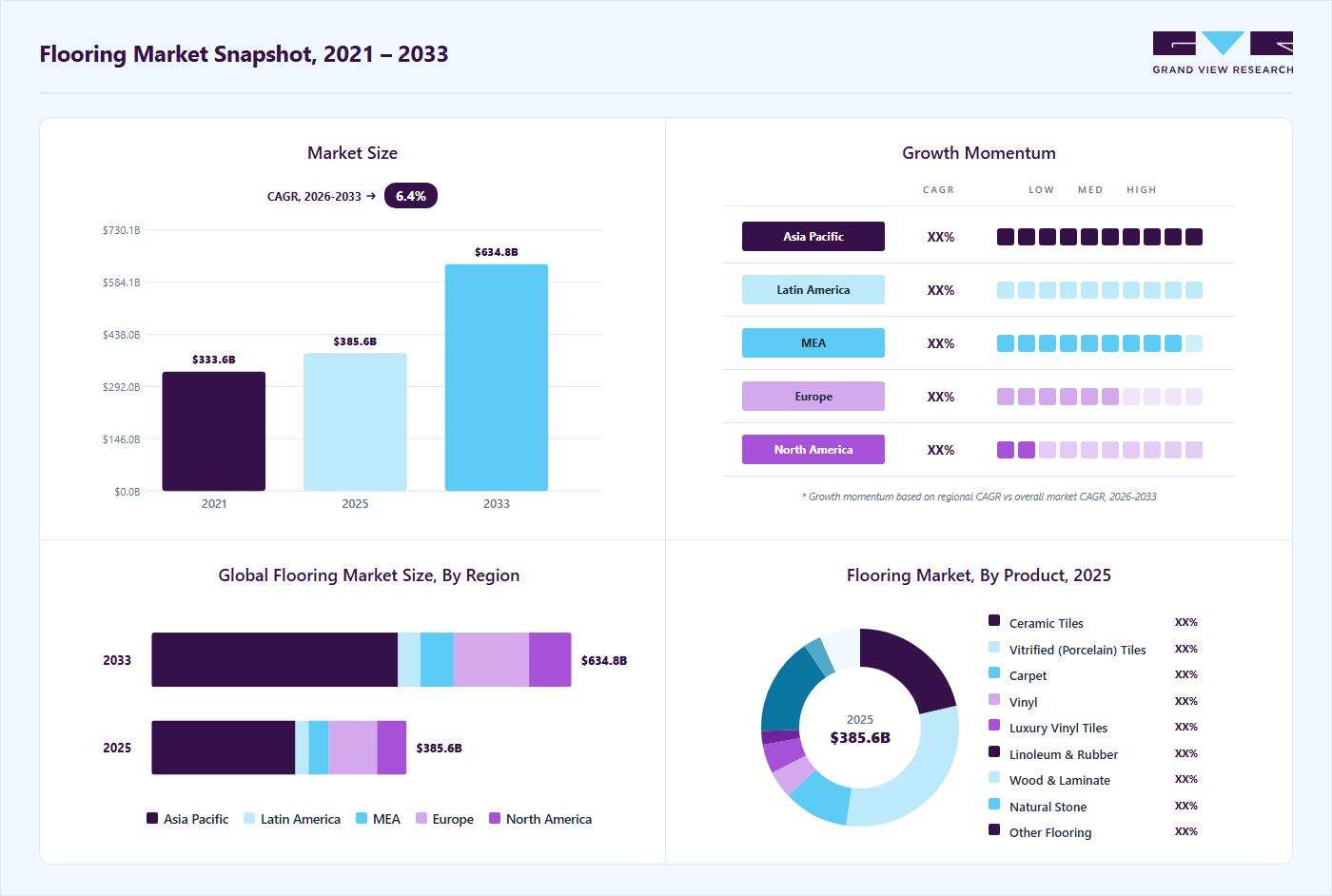
The global flooring market size was valued at USD 385.6 billion in 2025 and is projected to grow from USD 411.9 billion in 2026 to USD 634.8 billion by 2033, at a CAGR of 6.4% from 2026 to 2033. Asia Pacific dominated the market, accounting for a revenue share of 56.4% in 2025. Increasing demand for aesthetically appealing, durable, and high-performance floor-covering solutions, coupled with evolving consumer preferences for floor designs, textures, and finishes, has supported the expansion of the flooring industry in recent years.
Key Market Trends & Insights
- By product: Vitrified (Porcelain) tiles segment held the largest market share of 30.8% in 2025.
- By application: Non-residential segment held the largest market share of 52.3% in 2025.
Regional Highlights
- Largest regional market: Asia Pacific (56.4% revenue share, 2025)
- Fastest-growing regional market: Asia Pacific (fastest CAGR, 2026-2033)
Market Size & Forecast
- Market size in 2025: USD 385.6 Billion
- Estimated market size in 2026: USD 411.9 Billion
- Projected market size by 2033: USD 634.8 Billion
- CAGR (2026-2033): 6.4%
Three ways to get this report
Buy it, customize it, or ask a question.Ask an Analyst
A direct answer, usually in 1 working day
- AccessReport author, directly
- Reply timeWithin 1 working day
- No sales callDirect answer only
- FormatEmail reply
- CostFree, no cost
Get the Full Report
What the study covers
- FormatsPDF · Excel · Dashboard
- Timeline2026–2033 annual, 2025 base
- Coverage20+ countries, 5 regions
- Companies10+ key players profiled
Customize the Report
20% free customization
- IncludeCountries, segments, points
- TailorTo your product definition
- ExtendDeeper competitor detail
- OrA fully bespoke study
- Turnaround5–10 working days
The expansion of office and commercial spaces, industrial development, and rapid urbanization across emerging economies are contributing to the growth of the flooring industry. Rising population and accelerated infrastructure development in developing countries are creating opportunities for flooring products across residential, commercial, and industrial applications. In addition, rising disposable incomes are enabling consumers to allocate more spending toward home improvement, comfort, and interior aesthetics. The continued development of high-end residential properties, along with the growing preference for single-family homes, is further supporting the adoption of premium and value-added flooring solutions.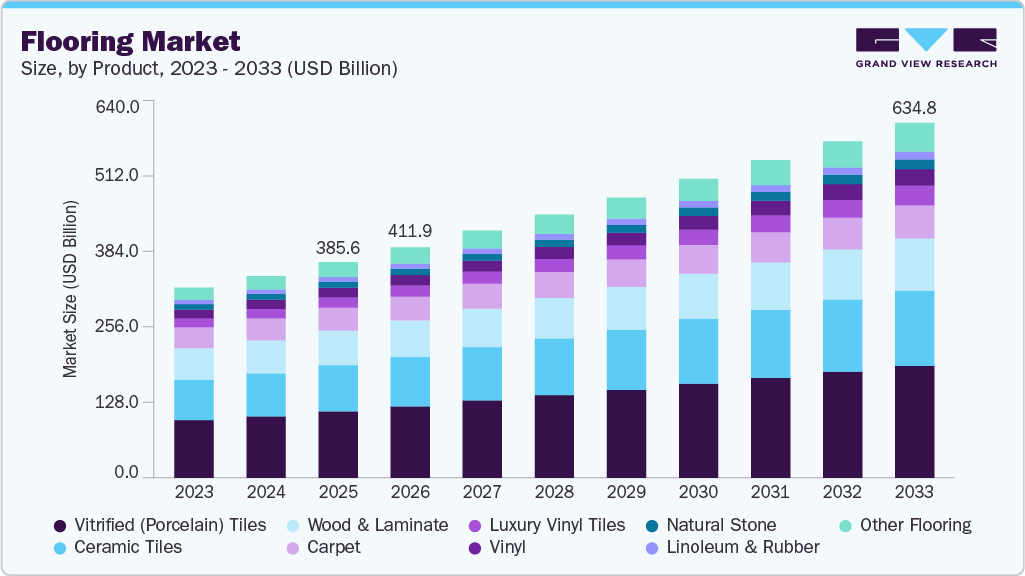
Technological advancements in easy-to-install flooring systems, the availability of innovative construction solutions, and increasing emphasis on environmentally sustainable products are further shaping the industry. Manufacturers are increasingly focusing on products that offer improved durability, ease of installation, low maintenance, and enhanced design flexibility. In parallel, evolving regulatory requirements related to the production, use, installation, and recycling of flooring materials are encouraging the adoption of more sustainable manufacturing practices and products with improved environmental performance.
Consumer preferences are shifting toward flooring solutions that combine aesthetics, functionality, and ease of maintenance. Demand for improved designs, textures, colors, and finishes is encouraging product innovation across flooring categories. Furthermore, increasing awareness of indoor comfort and acoustic performance is driving the use of flooring and floor-insulation solutions that reduce noise transmission and improve the acoustic environment in residential and commercial spaces. These trends, together with ongoing construction and renovation activities, are expected to support the continued global market expansion.
Market Dynamics
The flooring market is supported by expanding global construction activity, urbanization, and continued investments in residential and commercial infrastructure. However, rising environmental and health concerns related to VOCs, phthalates, and certain flooring materials may constrain adoption and increase compliance costs. At the same time, growing emphasis on sustainability, circularity, and low-carbon construction is creating opportunities for recyclable, low-emission, bio-based, and recycled-content flooring solutions. Regulatory developments and green building initiatives are further encouraging manufacturers to improve product sustainability and lifecycle performance.
The expansion of the global construction industry, supported by rapid urbanization, population growth, rising disposable incomes, and increasing investments in residential and commercial infrastructure, is strengthening demand for flooring products. Growing construction activity in emerging economies is driving the development of residential complexes, commercial establishments, hospitality facilities, and other infrastructure, creating opportunities for new flooring installations.
According to Oxford Economics, global construction output was projected to reach USD 13.3 trillion in 2025, with the Asia-Pacific region accounting for a significant share of global construction activity. The linkage between construction activity and flooring demand is also evident from industry developments. Continued investments in buildings and infrastructure, particularly across emerging economies, are therefore expected to support flooring demand over the forecast period. Furthermore, renovation and remodeling activities in developed markets are driving replacement demand.
Growing environmental and health concerns associated with certain flooring materials, particularly PVC and vinyl products, may restrain market growth. Flooring materials and associated adhesives can emit volatile organic compounds (VOCs) and may contain plasticizers such as phthalates, raising concerns regarding indoor air quality and prolonged exposure. The U.S. Environmental Protection Agency (EPA) has identified vinyl flooring and other floor coverings as relevant exposure conditions in its assessment of diisononyl phthalate (DINP), particularly for young children.
In addition, a 2025 EPA assessment estimated that vinyl flooring sold annually in Washington could contribute 4,500-16,800 metric tons of phthalates to indoor environments. Increasing awareness of these environmental and health impacts is encouraging consumers, builders, and commercial property owners to consider low-emission and phthalate-free alternatives. Manufacturers are consequently investing in safer formulations, recyclable materials, and products with reduced chemical emissions. However, stricter regulations concerning chemical content, indoor air quality, and product sustainability may increase compliance and manufacturing costs, potentially constraining market growth.
Increasing emphasis on sustainability, circularity, and low-carbon construction is creating opportunities for flooring manufacturers to develop recyclable, low-emission, and bio-based products. The EU Construction Products Regulation (EU) 2024/3110, which became applicable in January 2026, introduces sustainability-related requirements and Digital Product Passports, increasing the importance of product-level environmental and lifecycle information. This regulatory shift is likely to favor manufacturers offering flooring solutions with higher recycled content, improved recyclability, and transparent environmental credentials. Industry developments indicate growing investment in this area. Tarkett used 160,000 tons of recycled materials in its products in 2025, representing 20% of its raw materials, and has set a target of reaching 30% recycled content by 2030. The company has also expanded its low-carbon flooring solutions to include bio-attributed materials and recyclable products. Increasing adoption of green building certifications and circular construction practices is therefore expected to create opportunities for premium sustainable flooring products across residential and commercial applications.
Market Concentration & Characteristics
The global flooring market is characterized by moderate to high market concentration, with several established players maintaining significant market positions, particularly across developed economies. The market remains highly competitive, with manufacturers focusing on product innovation, sustainability, durability, and design differentiation. Advancements in flooring technologies, including digital printing, enhanced wear resistance, and improved performance characteristics in luxury vinyl tiles (LVT), are expanding product offerings and enhancing consumer appeal. Increasing adoption of rigid-core vinyl, recycled rubber, bio-based polymers, and other sustainable materials is further shaping product development. In addition, growing emphasis on environmental certifications and green building standards is encouraging manufacturers to improve product sustainability and resource efficiency.
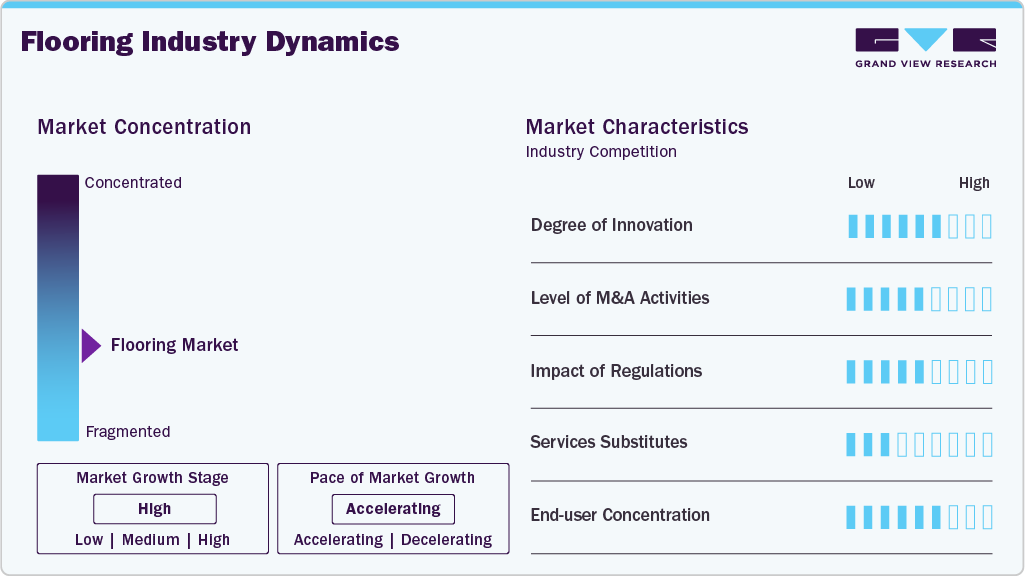
Mergers and acquisitions, strategic partnerships, and collaborations remain important strategies for strengthening geographic presence, expanding product portfolios, and accessing new technologies. Regulatory requirements related to VOC emissions, worker safety, chemical content, and sustainable sourcing are also influencing manufacturing processes and raw material selection. Although alternatives such as floor coatings, laminates, and modular carpets are available, their applications remain relatively specialized and do not pose a significant threat to major flooring categories. The market serves a diverse end-user base, with residential construction, commercial real estate, hospitality, and institutional infrastructure representing key demand centers globally.
Analyst Perspective
The global flooring market is expected to witness steady growth, driven by construction, urbanization, and renovation activities. Demand is shifting toward durable, convenient, flexible, and sustainable flooring solutions. Luxury vinyl tiles, rigid-core, engineered, and resilient flooring are gaining popularity. Manufacturers are focusing on improved product performance, aesthetics, and sustainability. Green building initiatives are encouraging the use of recycled and low-emission materials. Raw material price fluctuations and evolving regulations may impact production costs. Increasing sustainability requirements may influence market strategies and profit margins. Overall, the market is expected to remain competitive, with innovation and sustainable products driving opportunities.
Product Insights
The vitrified (porcelain) tile segment dominated the flooring industry, accounting for 30.8% of the global revenue share in 2025. The segment's strong position is supported by the superior strength, durability, and low water absorption of porcelain tiles compared with conventional ceramic tiles. Their dense and highly compact composition provides greater resistance to temperature fluctuations, moisture, mold, and bacterial growth, making them suitable for a wide range of residential and commercial environments. In addition, high resistance to fading, staining, and surface wear contributes to their long service life and relatively low maintenance requirements. The availability of porcelain tiles in a broad range of colors, patterns, textures, and finishes further enhances their design versatility, enabling their use in kitchens, bathrooms, living spaces, retail establishments, offices, and hospitality facilities.
The luxury vinyl tiles (LVT) segment is expected to grow at the fastest CAGR of 8.4% over the forecast period. Growth is supported by increasing preference for durable, cost-effective, and design-flexible flooring solutions. LVT products can replicate the appearance of premium materials such as wood and stone while offering resistance to moisture, wear, and impact, making them increasingly attractive across residential and commercial spaces.
Application Insights
The non-residential segment dominated the flooring market, accounting for 52.3% of global revenue in 2025, supported by sustained construction, renovation, and refurbishment activities across commercial, institutional, hospitality, healthcare, educational, and industrial facilities. The growing development of offices, retail spaces, hotels, healthcare facilities, and industrial establishments is driving demand for flooring solutions that combine durability, aesthetic appeal, ease of maintenance, and efficient installation. In addition, commercial and institutional users increasingly prioritize flooring with high resistance to heavy foot traffic, moisture, stains, and wear, particularly in high-use environments.
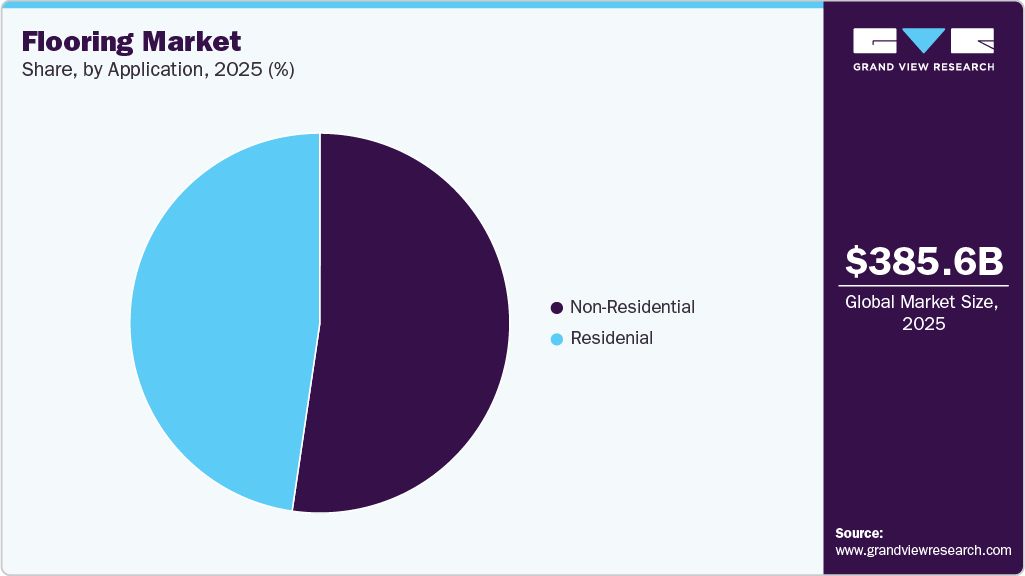
The residential segment is expected to grow at the fastest CAGR of 6.6% over the forecast period, supported by increasing residential construction, rising household spending on interior improvements, and growing renovation and remodeling activities. Homeowners are increasingly seeking flooring solutions that enhance the visual appeal of interiors while offering durability, comfort, ease of maintenance, and long-term value. The growing availability of products in diverse designs, textures, colors, and finishes is further broadening consumer choice and supporting the adoption of premium flooring solutions. In addition, luxury vinyl tiles (LVT), laminate, and engineered wood are gaining traction due to their ability to replicate the appearance of natural materials while offering relatively easy installation and maintenance.
Regional Insights
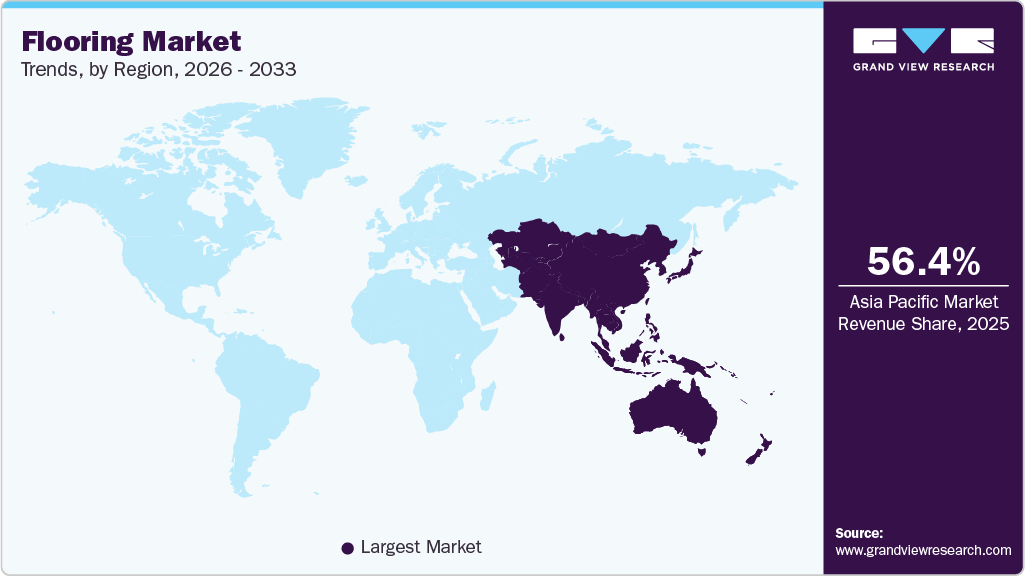
Asia Pacific dominated the global flooring market, accounting for 56.4% of the total revenue share in 2025, and is expected to grow at the fastest CAGR over the forecast period. The region's leading position is supported by rapid urbanization, expanding residential construction, and continued development of commercial and infrastructure projects. Increasing investments in affordable housing, smart cities, transportation infrastructure, and urban redevelopment are creating opportunities for new flooring installations. In addition, the expansion of tourism and hospitality infrastructure across major regional economies is driving demand for durable, aesthetically appealing flooring solutions. Rising household incomes and improving living standards are further encouraging expenditure on home construction, renovation, and interior upgrades.
China Flooring Market Trends
The China flooring market accounted for around 35.0% revenue share of Asia Pacific in 2025. China’s market is supported by its large construction base, urban redevelopment, and continued demand for residential and commercial flooring products. The market is also increasingly influenced by sustainability and product-quality requirements. China expanded its government procurement policy supporting green building materials to 101 cities as of January 2025, covering projects such as hospitals, schools, office buildings, affordable housing, and urban renewal, and requiring that qualifying green building materials be used in government-funded projects.
North America Flooring Market Trends
North America is poised to experience steady growth at a CAGR of 4.6% during the forecast period. The market growth is supported by residential renovation and remodeling, replacement of aging flooring, and continued investment in commercial properties. Demand is also benefiting from advancements in resilient flooring technologies, particularly luxury vinyl tiles (LVT), rigid-core, and hybrid flooring products that offer durability, moisture resistance, design flexibility, and ease of installation. Product innovation is evident among major manufacturers. For instance, in 2025, Mohawk Industries introduced PVC-free hard-surface flooring alternatives, including SolidTech R and PureTech, which feature recycled plastic bottles and renewable, plant-based content, respectively. The increasing emphasis on sustainable construction and indoor environmental quality is further encouraging the adoption of low-emission, recycled-content flooring products.
The U.S. flooring market is supported by residential remodeling and replacement activity, as well as demand from commercial construction and refurbishment. Consumers continue to seek flooring products that combine aesthetics, durability, ease of maintenance, and installation convenience, supporting demand for hardwood, engineered wood, LVT, laminate, and hybrid flooring. The commercial sector, including healthcare, retail, hospitality, education, and office properties, represents another important application area.
Europe Flooring Market Trends
Europe represented the second-largest flooring industry, accounting for around 19.0% of the global revenue share in 2025. The market is being shaped by sustainability objectives, building renovation, and regulations concerning the environmental performance of construction products. Renovation and refurbishment of Europe's aging residential and commercial building stock remain important sources of replacement demand, particularly across Western Europe. The revised Energy Performance of Buildings Directive (EU/2024/1275), which came into force in May 2024 and requires EU Member States to establish national building renovation plans, is expected to support renovation activity across the region, particularly for energy-inefficient buildings. Flooring products that offer acoustic insulation, thermal performance, durability, low emissions, and improved recyclability are gaining attention in residential and commercial applications. Manufacturers are consequently expanding recycled-content, recyclable, and low-emission product portfolios to align with evolving regulatory and sustainability requirements.
Key Flooring Company Insights
The global flooring market is characterized by the presence of several established manufacturers with broad product portfolios, extensive distribution networks, and significant geographic reach. Key players compete through product innovation, design differentiation, strategic acquisitions, and expansion into high-growth flooring categories, including luxury vinyl tile (LVT), resilient flooring, laminate, and engineered wood. Sustainability is also becoming an important area of differentiation, with manufacturers investing in recycled materials, recyclable products, low-emission formulations, and circular product solutions.
Key Flooring Companies
The following key companies have been profiled for this study on the flooring market.
-
Mohawk Industries, Inc.
-
Tarkett, S.A.
-
AFI Licensing
-
Burke Flooring Products, Inc.
-
Forbo Flooring
-
Shaw Industries, Inc.
-
Interface, Inc.
-
Gerflor
-
Mannington Mills, Inc.
-
Polyflor
-
RAK Ceramics
-
Crossville Inc.
-
Atlas Concorde S.P.A.
-
Porcelanosa Group
-
Kajaria Ceramics Limited
Recent Developments
-
In February 2026, Interface, Inc. launched noravant™, a PVC-free resilient rubber flooring platform designed to combine high performance, design flexibility, and a low carbon footprint. The launch strengthens Interface's position in resilient flooring while highlighting the industry's shift toward PVC-free, low-carbon, and circular flooring solutions
-
In July 2025, Tarkett S.A. launched the Acczent Chambray collection, adding 22 new colors to its heterogeneous vinyl sheet flooring portfolio. The collection is designed for demanding healthcare and education environments and features a 32-mil wear layer and Techtonic XD surface protection. The launch strengthened Tarkett's position in resilient commercial flooring by expanding its design offering while combining durability, stain and scratch resistance, and sustainability attributes.
Flooring Market Report Scope
Report Attribute
Details
Market size in 2025
USD 385.6 billion
Estimated market size in 2026
USD 411.9 billion
Projected market size by 2033
USD 634.8 billion
Growth rate
CAGR of 6.4% from 2026 to 2033
Base year for estimation
2025
Historical data
2021 - 2024
Forecast period
2026 - 2033
Quantitative units
Revenue in USD million/billion, volume in million square meters, and CAGR from 2026 to 2033
Report coverage
Revenue forecast, volume forecast, company ranking, competitive landscape, growth factors, and trends
Segments covered
Product, application, region
Regional scope
North America; Europe; Asia Pacific; Central & South America; Middle East & Africa
Country scope
U.S.; Canada; Mexico; Germany; UK; France; Italy; Spain; Russia; Romania; Czech Republic; Portugal; Ukraine; Slovakia; Hungary; China; India; Japan; Indonesia; South Korea; Australia; Philippines; Vietnam; Brazil; Argentina; Peru; Colombia; Chile; Saudi Arabia; UAE; Israel; Qatar; South Africa; Egypt; Morocco
Key companies profiled
Mohawk Industries, Inc.; Tarkett, S.A.; AFI Licensing; Burke Flooring Products, Inc.; Forbo Flooring; Shaw Industries, Inc.; Interface, Inc.; Gerflor; Mannington Mills, Inc.; Polyflor; RAK Ceramics; Crossville Inc.; Atlas Concorde S.P.A.; Porcelanosa Group; Kajaria Ceramics Limited
Customization scope
Free report customization (equivalent up to 8 analysts’ working days) with purchase. Addition or alteration to country, regional & segment scope.
Pricing and purchase options
Avail customized purchase options to meet your exact research needs. Explore purchase options
Global Flooring Market Report Segmentation
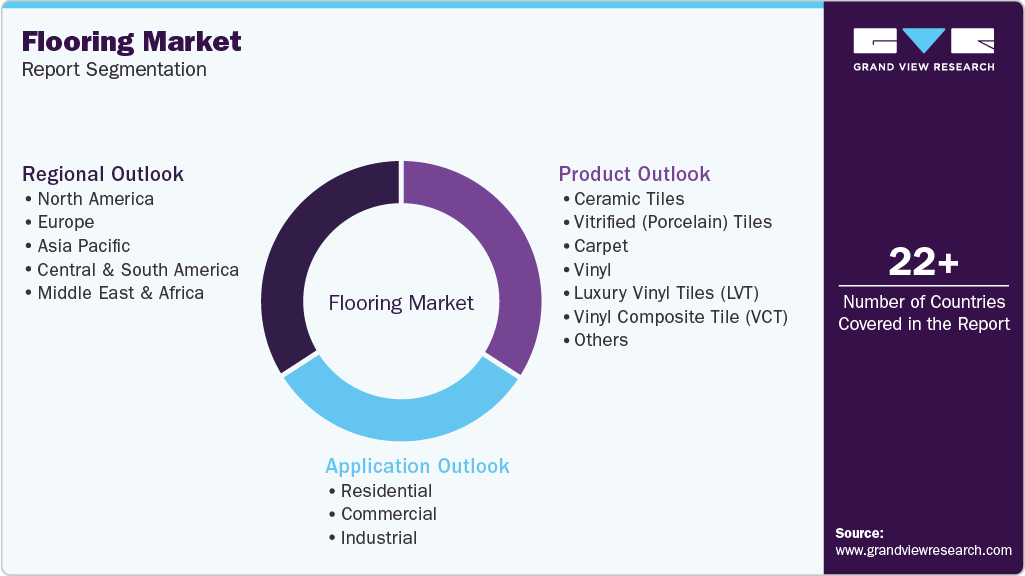
This report forecasts revenue & volume growth at the global, regional, and country levels and provides an analysis of the latest industry trends in each of the sub-segments from 2021 to 2033. For this study, Grand View Research has segmented the global flooring market report based on product, application, and region:
-
Product Outlook (Volume, Million Square Meters; Revenue, USD Million/Billion, 2021 - 2033)
-
Ceramic Tiles
-
Vitrified (Porcelain) Tiles
-
Carpet
-
Vinyl
-
Luxury Vinyl Tiles (LVT)
-
Vinyl Composite Tile (VCT)
-
Linoleum/Rubber
-
Wood & Laminate
-
Other Flooring Materials
-
-
Application Outlook (Volume, Million Square Meters; Revenue, USD Million/Billion, 2021 - 2033)
-
Residential
-
Non-residential
-
Commercial
-
Industrial
-
-
-
Regional Outlook (Volume, Million Square Meters; Revenue, USD Million/Billion, 2021 - 2033)
-
North America
-
U.S.
-
Canada
-
Mexico
-
-
Europe
-
Germany
-
UK
-
France
-
Italy
-
Spain
-
Russia
-
Romania
-
Czech Republic
-
Portugal
-
Ukraine
-
Slovakia
-
Hungary
-
-
Asia Pacific
-
China
-
Japan
-
India
-
South Korea
-
Australia
-
Indonesia
-
Philippines
-
Vietnam
-
-
Central & South America
-
Brazil
-
Argentina
-
Peru
-
Colombia
-
Chile
-
-
Middle East & Africa
-
Saudi Arabia
-
UAE
-
Israel
-
Egypt
-
Qatar
-
South Africa
-
Morocco
-
-
Frequently Asked Questions About This Report
The global flooring market size was estimated at USD 385.6 billion in 2025 and is expected to reach USD 411.9 billion in 2026.
The global flooring market is expected to grow at a compound annual growth rate of 6.4% from 2026 to 2033 to reach USD 634.8 billion by 2033.
The non residential application segment dominated the market and accounted for 52.3% of the revenue share in 2025 in the market, driven by strong construction activity across commercial, institutional, and industrial facilities
Some of the key players operating in the flooring market include Mohawk Industries, Inc., Tarkett, S.A., AFI Licensing, Burke Flooring Products, Inc., Firbo Flooring, Shaw Industries, Inc., Interface, Inc., Gerflor, Mannington Mills, Inc., Polyflor, RAK Creamics, Crossville Inc., Atlas Concorde S.P.A., Porcelanosa Group, Kajaria Ceramics Limited
The key factors driving the flooring market include rapid urbanization, increased construction activities across residential and commercial sectors, rising demand for aesthetically appealing and durable flooring materials, and growing investments in renovation and remodeling projects.
Asia Pacific dominated with a 56.4% revenue share in 2025.
Vitrified (Porcelain) tile held the largest revenue share in 2025, while Luxury vinyl tiles is the fastest-growing segment.
About the Author(s)
Advanced Interior Materials Research Team
Advanced Materials · Advanced Interior MaterialsThis report was authored by the advanced interior materials research team at Grand View Research - comprising two research analysts, one senior research analyst, and one industry expert - with specialized expertise in the advanced interior materials segment of the advanced materials industry. All findings are based on proprietary advanced materials databases, executive interviews, and regulatory analysis, subject to internal peer review prior to publication.
Last Updated:
Speak to Analyst


Customize this report to your needs - add regions, segments, or data points, with 20% free customization.
Or view our licence options:


ISO 9001:2015 & 27001:2022 Certified
We are GDPR and CCPA compliant! Your transaction & personal information is safe and secure. For more details, please read our privacy policy.


