
- Home
- »
- Next Generation Technologies
- »
-
Facial Recognition Market Size & Share Report, 2026-2033GVR Report cover

Facial Recognition Market (2026 - 2033)
Size, Share & Trends Analysis Report By Technology (2D, 3D, Facial Analytics), By Application (Access Control, Security & Surveillance), By End Use (Retail & E-commerce, Media & Entertainment, BFSI), By Region, And Segment Forecasts
Market Size, 2025
$7.4BMarket Estimate, 2026
$8.5BMarket Forecast, 2033
$19.6BCAGR, 2026–2033
12.8%Facial Recognition Market Summary
The global facial recognition market size was valued at USD 7.4 billion in 2025 and is projected to grow from USD 8.5 billion in 2026 to USD 19.6 billion by 2033, growing at a CAGR of 12.8% from 2026 to 2033. The market in North America dominated with a revenue share of 36.0% in 2025. Technology is improving, evolving, and expanding at an explosive rate. Technologies such as biometrics are extensively used to enhance security.
Key Market Trends & Insights
- By technology: 3D segment held the largest market share, approximately 38.0%, in 2025.
- By end use: Retail & e-commerce segment accounted for the highest revenue share of 22.0% in 2025.
- By application: Access control segment accounted for the largest share of 36.0%, in 2025.
Regional Highlights
- Largest regional market: North America (36.0% revenue share, 2025)
- Fastest-growing regional market: Asia Pacific (highest CAGR, 2026-2033)
Market Size & Forecast
- Market size in 2025: USD 7.4 Billion
- Estimated market size in 2026: USD 8.5 Billion
- Projected market size by 2033: USD 19.6 Billion
- CAGR (2026-2033): 12.8%
Three ways to get this report
Buy it, customize it, or ask a question.Ask an Analyst
Analyst response in 1 business day
- AccessReport author, directly
- Reply timeWithin 1 working day
- No sales callDirect answer only
- FormatEmail reply
- CostFree, no cost
Get the Full Report
What the study covers
- FormatsPDF · Excel · Dashboard
- Timeline2026–2033 annual, 2025 base
- Coverage20+ countries, 5 regions
- Companies10+ key players profiled
Customize the Report
20% free customization
- IncludeCountries, segments, points
- TailorTo your product definition
- ExtendDeeper competitor detail
- OrA fully bespoke study
- Turnaround5–10 working days
Facial recognition is widely used across applications such as access control, attendance tracking, security, and surveillance. Biometrics are universal, unique, and measurable, making them suitable for security solutions. Various biometric modalities, including fingerprints, iris recognition, face recognition, speech recognition, and others, are used for unique identification. Facial recognition technology is a type of image recognition technology that has gained wide acceptance over the years. This technology leverages a connected or digital camera to detect faces in captured images, then quantifies image features to match them against templates stored in the database.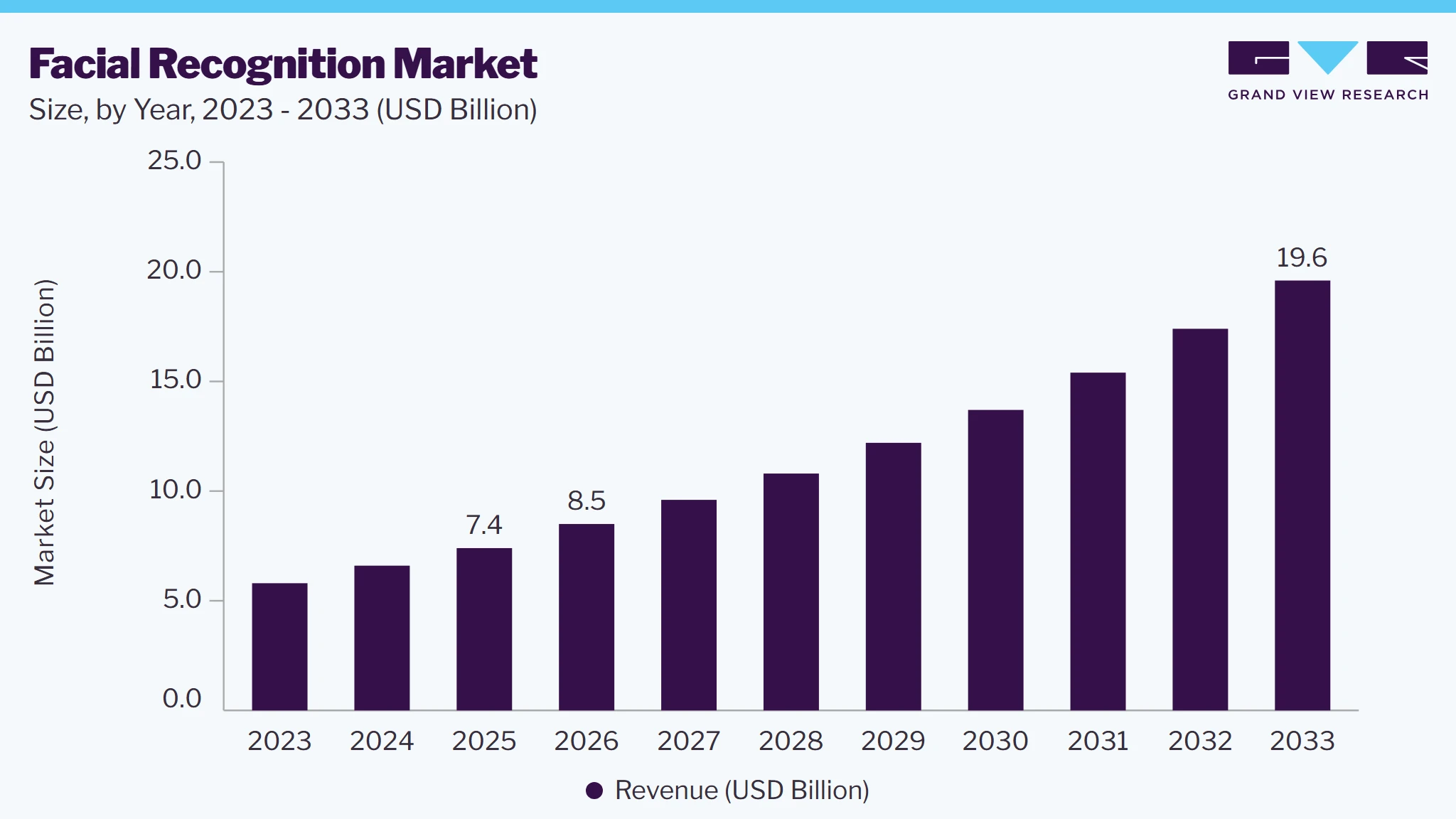 Source: Grand View Research, IR Documents, Primary Interviews, Paid DatabasesTo learn more about this report,
 Download Free Sample Report
 Facial recognition technology is versatile and is rapidly adopted by various end users. For instance, in 2025, the Dubai government standardized a biometric identity system for all its citizens using face recognition technology. Once enrolled via their cellphones, tourists don’t need to show any identification cards and can stay at various hotels without difficulty.
The increasing adoption of facial recognition technology across various applications is a driving force for market growth. The border authorities use this technology to verify identities, especially at airports and transit hubs. Law enforcement agencies also use face recognition software to scan faces captured on CCTV and find the targeted person. For instance, the UK police have aggressively expanded the use of Live Facial Recognition (LFR) in public areas, transit hubs, and events, resulting in over 1,300 arrests. A recent pilot program from October 2025 to March 2026 led to more than 170 arrests and successfully reduced targeted crime by 10.5%, prompting the Home Office to propose rolling out the technology nationally. Consequently, the rising adoption of technology by the law enforcement sector is substantially contributing to market growth.
Smartphones are another application where the technology has gained prominent adoption. In smartphones, facial recognition is used to unlock the phone, sign in to mobile apps, and verify payments. Prominent smartphone companies, including Samsung smartphones and iPhones, use facial recognition technology for access control. Other smartphone companies, namely OnePlus, Oppo, Motorola, Huawei, and LG, use 2D technology and iris scanners for scanning the user’s face.
Market Dynamics
The market is experiencing significant growth across different sectors and applications. One of the primary market drivers is the growing number of government investments worldwide in border control, criminal investigation, and national security programs that use biometric technology. Increased adoption of smartphones and other smart devices with facial authentication is another market driver. An increased demand for contactless systems across the financial, healthcare, and other transportation/logistics industries is another factor driving demand for facial recognition. With improvements in the image-capturing technology used, specifically artificial intelligence, machine learning, and deep learning technologies, the system has become increasingly more efficient. Furthermore, there has been an increase in cases involving identity theft and cybercrime.
Despite the growing use of this technology, some issues associated with facial recognition could impede the market's growth. One of the key factors affecting the market's future growth is the growing awareness of privacy and data security. Stringent government policies governing the use of personal information in business operations could be a major factor restricting market growth. The use of facial recognition technology helped alleviate some skepticism about algorithmic bias and errors in identification. High initial and maintenance costs could further limit the implementation of the technology, especially for SMEs. Apart from that, cybersecurity risks, such as data theft and access to sensitive biometric information, pose a major risk to organizations considering adopting this technology. In addition, difficult technical conditions are a critical issue in facial recognition.
The market presents significant growth opportunities driven by ongoing technological advancements and expanding application areas. The development of machine learning techniques, artificial intelligence algorithms, and cloud-based technologies enables more precise recognition and better real-time identification. Moreover, the growing popularity of smart cities worldwide increases the number of use cases for public safety, traffic management, and surveillance. Sectors including healthcare, retail, hospitality, finance, and others are actively implementing biometric authentication to enhance security and streamline processes. The shift towards the deployment of contactless access control and digital identity solutions is another factor promoting market expansion. Investments made in developing mobile payment platforms, e-commerce security, and management solutions for remote employees are providing numerous growth opportunities. Moreover, new markets in emerging economies will be created through digital transformation projects.
Analysts Perspective
Facial recognition is gaining popularity for access control and individual identification, particularly for government, consumer electronics, financial services, healthcare, and enterprise security applications. The incorporation of AI, ML, and deep learning is improving the accuracy of image capture, reconstruction, comparison, and identification. Although facial recognition raises issues such as data privacy, cybersecurity, and regulatory compliance, prioritizing security is expected to drive market growth.
Technology Insights
The 3D segment held the largest market share of above 38.0% in 2025. The advent of advanced technologies, such as cloud-based solutions and facial analytics, is expected to boost market growth. Facial analytics capabilities in facial recognition software enable users to identify where a face appears in a video or image, along with its attributes. For instance, Amazon Rekognition can analyze facial characteristics, including mood, visual geometry, eyes open or closed, and hair color. These attributes help customers organize millions of images using metadata tags. Facial analytics provides high accuracy and detection efficiency. Therefore, it is increasingly used in education and research, retail, healthcare, and police services to determine gender, age, height, and other facial characteristics.
The accuracy of 3D technology in facial recognition systems encourages their deployment for public safety applications, such as border protection and surveillance. 3D recognition systems are preferred over 2D systems in high-security spaces like airports. For instance, Chenega Europe Ltd., a wholly owned subsidiary of Chenega Corporation, provides long-range LiDAR-enabled 3D facial recognition for identity acquisition and verification. The company specializes in professional delivery services for military and intelligence operations, and its 3D biometric surveillance technology is used by a government in the Middle East to enhance airport surveillance capabilities.
The facial analytics segment primarily comprises multiple gas extractors and is estimated to grow at a CAGR of over 20.0% during the forecast period. Facial analytics involve analyzing facial features, expressions, and patterns to gain insights into individuals' emotions, demographics, and behavior. The improved accuracy and performance of facial recognition algorithms have driven the adoption of facial analytics across industries such as security, retail, healthcare, and marketing.
End Use Insights
Retail & e-commerce dominated the market, accounting for approximately 22.0% of revenue in 2025. The retail and e-commerce sectors have rapidly adopted face recognition technology to enhance operational efficiency and improve the in-store experience. Previously, customers made payments via various methods, including cash, cards, and QR codes. These payment methods involve diverse POS terminal systems and high staff involvement.
At the same time, adopting facial recognition technology for payment methods eliminates the need for various pieces of hardware. Shoppers can quickly pay the bill by scanning their faces on smart devices or at kiosks, resulting in a more secure, faster, and user-friendly payment experience. It also offers a unique authentication service that identifies and authenticates faces from user databases and, with advancements in computer vision-based machine learning algorithms, can easily find the shopper's face across the entire database.
For instance, the expansion of facial recognition-based payment systems across retail and food service locations in 2024. Steak ’n Shake partnered with PopID to deploy facial recognition payment technology across hundreds of restaurant locations in the U.S., allowing customers to authenticate purchases using their facial biometrics. Similarly, Grupo Ítalo Supermercados in Brazil introduced facial recognition payments through the Pay face platform to accelerate checkout processes and enhance customer convenience. These initiatives demonstrate the growing commercialization of biometric payment solutions across the retail ecosystem.
The healthcare segment is expected to grow at a CAGR of over 17.0% during the forecast period. Healthcare organizations handle sensitive patient information and valuable medical resources, prioritizing security. Facial recognition technology provides an additional layer of security by ensuring that only authorized individuals have access to restricted areas or confidential data. By integrating facial recognition with existing security systems, healthcare facilities can strengthen their overall security infrastructure, deter potential threats, and mitigate the risk of unauthorized access or data breaches.
Due to law enforcement and security requirements, the government sector is expected to grow moderately over the forecast period. Owing to the technology's non-intrusive nature, it is also used for covert monitoring by governmental agencies. This technology is widely used in banking and finance to counter fraud, catering to a substantial market share. This technology is also used in the retail and e-commerce segments to enhance sales. For instance, facial recognition systems have been deployed across airport security checkpoints and border control operations to facilitate faster passenger verification and enhance security screening. In addition, government institutions are increasingly leveraging biometric technologies for access control, surveillance, and law enforcement applications, supporting sustained market growth.
Application Insights
The access control segment dominated the market, accounting for approximately 36.0% of revenue in 2025, owing to the growing number of companies focusing on enhancing their access control systems. For instance, in September 2024, Alcatraz AI introduced the Rock X, its latest facial authentication system for both indoor and outdoor access control deployments. The platform employs artificial intelligence to enable effortless, seamless facial authentication and seamlessly integrates with the organization's existing security systems. This platform delivers efficient performance even under adverse lighting conditions, helping companies enhance physical security while providing a good user experience. These developments show increased investments made by players in the development of facial recognition technology-based access control platforms.
On the other hand, the security & surveillance segment is expected to grow at a significant CAGR of over 19.0% over the forecast period, driven by increased adoption of facial recognition technology in security and surveillance systems and its implementation in high-security areas. For instance, law enforcement agencies use security and surveillance systems to find missing children or uncover criminals’ faces. Also, business owners prefer installing facial recognition-based security systems to monitor people and identify them upon arrival at their stores. Furthermore, airports are increasingly deploying facial recognition technology at security checkpoints, as people are less likely to commit crimes when monitored through security systems. Thus, this technology deters the possibility of crime in public spaces.
Regional Insights
North America dominated the market, accounting for approximately 36.0% of revenue in 2025. The major factor contributing to regional growth is the wide implementation of facial recognition technology in security and surveillance systems. In addition, the growing adoption of facial recognition technology across various U.S. departments, including homeland security, Justice, and Defense, is boosting market growth. For instance, MorphoTrust, a subsidiary of IDEMIA, is one of the most prominent vendors of biometric products and services in the U.S. It has developed facial recognition systems for state and federal law enforcement agencies, state DMVs, state departments, and airports. Key European markets, including the UK, France, and Germany, are expected to drive the regional market significantly over the forecast period.
 To learn more about this report, Download Free Sample Report
 Key players have partnered with retailers, distributors, and system integrators to market and sell their products to a large customer base. For instance, in April 2024, Facephi partnered with Santander Bank Polska to deploy biometric digital onboarding and identity verification solutions, enabling secure customer authentication and streamlined account-opening processes. Such collaborations highlight the increasing adoption of facial recognition technologies across the financial services sector to enhance security, reduce fraud, and improve customer experience, thereby supporting overall market growth.
Asia Pacific Facial Recognition Market Trends
The facial recognition market in the Asia Pacific is expected to grow at a CAGR of over 19.0% during the forecast period. Facial recognition technology is widely used in developing countries like India to solve investigation cases. For instance, in 2024, the Unique Identification Authority of India (UIDAI) introduced a new biometric authentication process for Aadhaar users via its Aadhaar FaceRD application, which enables face recognition-based authentication. This method is being widely adopted across many fields, including banking, telecom, public distribution systems, and government social welfare schemes. Such projects have created significant opportunities for companies operating in the facial recognition technology space across the Asia Pacific.
Facial recognition technology is the digital mapping of an individual's facial geometry using biometrics. The facial geometry includes features such as the width of the nose, the distance between the eyes, and the distance between the forehead and the chin, among others. These measurements are then used to create a mathematical formula called a facial signature. The stored signature is used to compare the physical structure of an individual's face to verify their identity. Facial recognition is a robust method for safeguarding data, as it is used for authentication to unlock mobile devices.
This technology has significantly enhanced business operations, including access and authentication, identity fraud prevention, and account and service accessibility. As a result, facial recognition platforms have become increasingly popular across several industry verticals, including banking and financial services, retail and e-commerce, automotive and transportation, media and entertainment, IT and telecom, government and the public sector, and others. For instance, in airports, biometric self-boarding gates that use facial recognition technology to verify passenger identity by capturing their photos have been deployed in several countries.
Key Facial Recognition Company Insights
Vendors in the market are undertaking numerous strategic initiatives, including acquisitions and mergers, collaborations, new product development, and partnerships with other prominent players. Continuous R&D to offer product differentiation is expected to be the major success factor for industry participants. For instance, companies such as Ayonix Corporation specialize in offering face recognition technology in sectors such as banking, hospitality, and retail.
Some vendors are also focusing on collaboration and acquisitions to expand their product offerings and gain a competitive edge. For instance, in April 2024, Facephi collaborated with Santander Bank Polska for implementing cutting-edge biometric identity verification and digital onboarding technology solutions. In this way, Facephi's facial biometric technologies were incorporated into the bank's customer onboarding and authentication processes to enhance security and the digital customer experience. This collaboration reflects the current trend in the financial industry of deploying facial recognition-based identity verification solutions driven by digital transformation efforts and regulatory requirements. These kinds of strategic collaborations are anticipated to help expand in the regional markets.
Recent Developments
-
In April 2024, Facephi partnered with Santander Bank Polska to deploy biometric identity verification and digital onboarding solutions. The collaboration aims to enhance customer authentication, reduce fraud, and improve the digital banking experience through facial recognition technology.
-
In May 2024, Steak ’n Shake announced the deployment of PopID's facial recognition payment platform across a significant portion of its restaurant network in the United States, enabling customers to complete transactions through facial biometric authentication.
-
In 2024, Grupo Ítalo Supermercados in Brazil expanded the use of Payface's facial recognition payment system, allowing customers to make purchases through biometric authentication and supporting the growing adoption of facial recognition in the retail sector.
Key Facial Recognition Companies
The following key companies have been profiled for this study on the facial recognition market.
-
Aware, Inc.
-
Ayonix Corporation
-
Thales
-
Fujitsu
-
FacePhi
-
NEC Corporation
-
Onfido
-
TECH5
Facial Recognition Market Report Scope
Report Attribute
Details
Market size in 2025
USD 7.4 billion
Estimated market size in 2026
USD 8.5 billion
Projected market size by 2033
USD 19.6 billion
Growth rate
CAGR of 12.8% from 2026 to 2033
Historical data
2021 - 2025
Forecast period
2026 - 2033
Quantitative units
Revenue in USD billion, and CAGR from 2026 to 2033
Report coverage
Revenue forecast, company ranking, competitive landscape, growth factors, and trends
Segments covered
Technology, application, end use, region
Regional Scope
North America; Europe; Asia Pacific; Latin America; MEA
Country Scope
U.S.; Canada; UK; Germany; France; Japan; China; India; Australia; South Korea; Brazil; Mexico; Saudi Arabia; South Africa; UAE
Key companies profiled
Aware, Inc.; Ayonix Corporation; Thales; Fujitsu; FacePhi; NEC Corporation; Onfido; TECH5
Customization scope
Free report customization (equivalent up to 8 analysts working days) with purchase. Addition or alteration to country, regional & segment scope.
Pricing and purchase options
Avail of customized purchase options to meet your exact research needs. Explore purchase options
Global Facial Recognition Market Report Segmentation
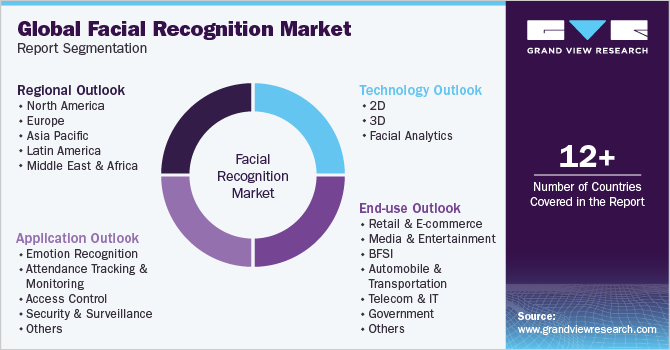
This report forecasts revenue growth at global, regional, and country levels and provides an analysis of the latest industry trends in each of the sub-segments from 2021 to 2033. For this study, Grand View Research has segmented the global facial recognition market report based on technology, application, end use, and region:
 To learn more about this report, Download Free Sample Report
 -
Technology Outlook (Revenue in USD Billion, 2021 - 2033)
-
2D
-
3D
-
Facial Analytics
-
-
Application Outlook (Revenue in USD Billion, 2021 - 2033)
-
Emotion Recognition
-
Attendance Tracking and Monitoring
-
Access Control
-
Security & Surveillance
-
Others
-
-
End-use Outlook (Revenue in USD Billion, 2021 - 2033)
-
Retail & E-commerce
-
Media & Entertainment
-
BFSI
-
Automobile & Transportation
-
Telecom & IT
-
Government
-
Healthcare
-
Others
-
-
Regional Outlook (Revenue in USD Billion, 2021 - 2033)
-
North America
-
U.S.
-
Canada
-
Europe
-
UK
-
Germany
-
France
-
Asia Pacific
-
Japan
-
China
-
India
-
Australia
-
South Korea
-
Latin America
-
Brazil
-
Mexico
-
Middle East & Africa
-
South Africa
-
Saudi Arabia
-
UAE
-
Frequently Asked Questions About This Report
North America dominated with a revenue share of 36.0% in 2025
Key factors that are driving the facial recognition market growth include technological advancements such as 3D recognition systems and cloud-based solutions and the growing adoption of face recognition in different verticals.
The global facial recognition market size was valued at USD 7.4 billion in 2025 and is expected to reach USD 8.5 billion in 2026.
3D segment held the largest market share, approximately 38.0%, in 2025.
Some key players operating in the facial recognition market include Aware, Inc.; Ayonix Corporation; Thales; Fujitsu; FacePhi; NEC Corporation; Onfido; TECH5
The global facial recognition market is expected to grow at a compound annual growth rate of 12.8% from 2026 to 2033 to reach USD 19.6 billion by 2033.
About the Author(s)
Next Generation Technologies Research Team
Technology · Next Generation TechnologiesThis report was authored by the next generation technologies research team at Grand View Research - comprising two research analysts, one senior research analyst, and one industry expert - with specialized expertise in the next generation technologies segment of the technology industry. All findings are based on proprietary technology databases, executive interviews, and regulatory analysis, subject to internal peer review prior to publication.
Last Updated:
Speak to Analyst

Customize this report to your needs - add regions, segments, or data points, with 20% free customization.
Or view our licence options:


ISO 9001:2015 & 27001:2022 Certified
We are GDPR and CCPA compliant! Your transaction & personal information is safe and secure. For more details, please read our privacy policy.


