
- Home
- »
- Next Generation Technologies
- »
-
E-cigarette And Vape Market Size & Share Report 2026-2033GVR Report cover

E-cigarette And Vape Market (2026 - 2033)
Size, Share & Trends Analysis Report By Product (Disposable, Rechargeable, Modular Devices), By Category, By Distribution Channel (Online, Retail Store), By Region (NA, Europe, APAC, Latin America, MEA), And Segment Forecasts
Market Size, 2025
$45.7BMarket Estimate, 2026
$59.2BMarket Forecast, 2033
$462.1BCAGR, 2026–2033
34.1%E-cigarette And Vape Market Summary
The global e-cigarette and vape market size was valued at USD 45.7 billion in 2025 and is projected to grow from USD 59.2 billion in 2026 to USD 462.1 billion by 2033, at a CAGR of 34.1% from 2026 to 2033. The market in North America dominated with a revenue share of 43.5% in 2025. The public's growing understanding of e-cigarettes being safer than traditional cigarettes, particularly among younger people, is forecasted to fuel market expansion due to numerous studies conducted by medical institutions and associations.
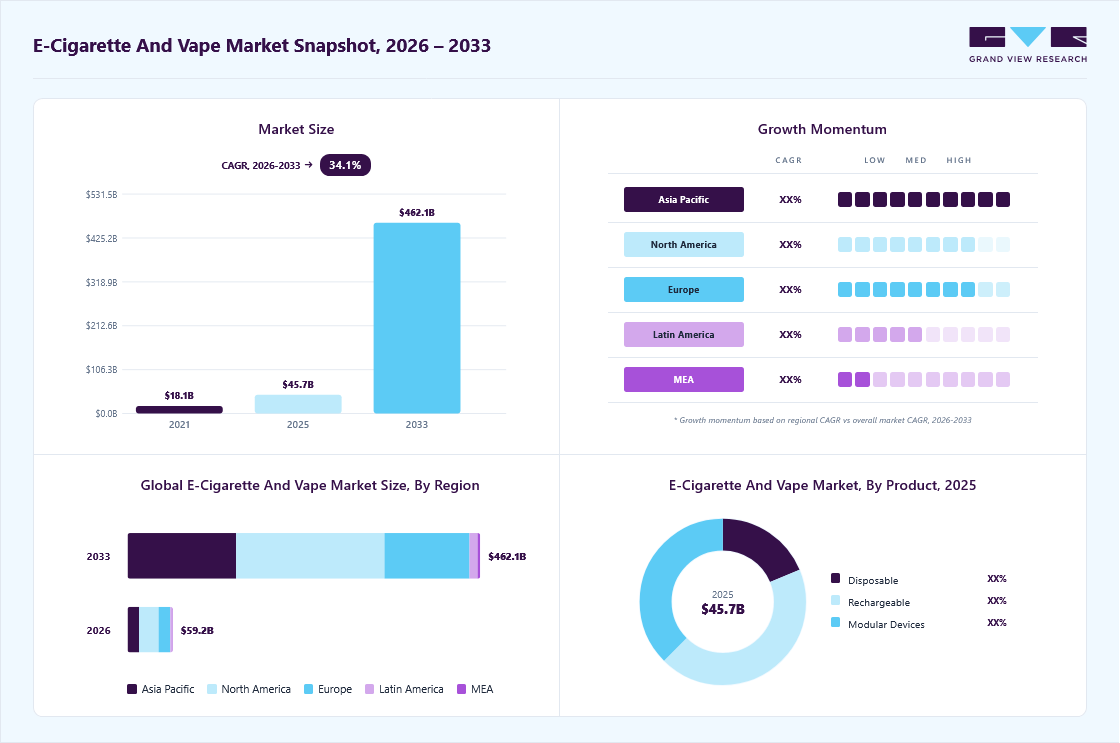 Source: Grand View Research, IR Documents, Primary Interviews, Paid DatabasesTo learn more about this report,
 Download Free Sample Report
 Key Market Trends & Insights
- By distribution channel: Retail store segment held the largest market share of 80.9% in 2025.
- By product: Rechargeable segment held the largest market share of 43.7% in 2025.
- By category: Closed segment held the largest market share in 2025.
Regional Highlights
- Largest regional market: North America (43.5% revenue share, 2025)
- Fastest-growing regional market: Asia Pacific (highest CAGR, 2026-2033)
- By country: The U.S. held the largest market share in 2025
Market Size & Forecast
- Market size in 2025: USD 45.7 Billion
- Estimated market size in 2026: USD 59.2 Billion
- Projected market size by 2033: USD 462.1 Billion
- CAGR (2026-2033): 34.1%
Three ways to get this report
Buy it, customize it, or ask a question.Ask an Analyst
Analyst response in 1 business day
- AccessReport author, directly
- Reply timeWithin 1 working day
- No sales callDirect answer only
- FormatEmail reply
- CostFree, no cost
Get the Full Report
What the study covers
- FormatsPDF · Excel · Dashboard
- Timeline2026–2033 annual, 2025 base
- Coverage20+ countries, 5 regions
- Companies10+ key players profiled
Customize the Report
20% free customization
- IncludeCountries, segments, points
- TailorTo your product definition
- ExtendDeeper competitor detail
- OrA fully bespoke study
- Turnaround5–10 working days
The global e-cigarette and vape market continues to expand as consumer demand shifts toward reduced-risk nicotine alternatives and lifestyle-oriented consumption formats. Increasing awareness regarding smoke-free products, combined with declining conventional cigarette consumption in several developed markets, is encouraging adult smokers to transition toward vaping devices. Growth is also supported by expanding retail penetration and rising adoption across emerging regions.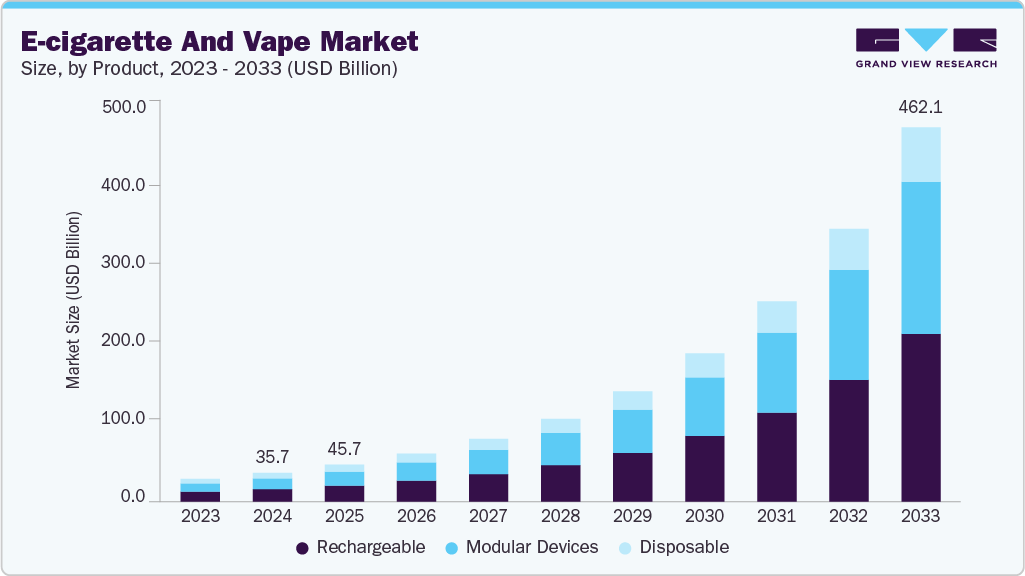 To learn more about this report, Download Free Sample Report
 Technological innovation is playing a central role in reshaping product competitiveness and user experience. Manufacturers are increasingly focusing on smart chipsets, enhanced coil systems, longer battery life, and improved safety mechanisms to differentiate products and support premiumization. Several new device launches featured dual-mesh coil technology and high-capacity rechargeable systems designed to improve vapor performance and device longevity, demonstrating rapid innovation cycles within the industry. For instance, in January 2026, Vaporesso, a leading vaping brand, introduced VIBE SE 2, a 4.5 mL fill pod with 1400 mAH battery. The device utilizes mesh technology with 0.6 ohm and 0.8 ohm resistance options. Companies are also integrating advanced control features and performance optimization technologies to deliver consistent flavor and customizable nicotine delivery, reflecting a shift toward high-performance and technologically sophisticated devices.
Investment activity across the vape ecosystem is strengthening as companies’ scale production, develop enabling technologies, and expand distribution networks. In February 2026, UK-based vape retailer VPZ announced a multi-million-pound investment program to expand manufacturing capacity, add a new production line, and open 40 additional retail stores, highlighting confidence in long-term market demand despite regulatory tightening.
The regulatory landscape remains one of the most influential factors shaping global market dynamics, with governments implementing stricter oversight related to product usage, marketing, and public health protections. The regulatory pressure surrounding disposable vape products, particularly the implementation of disposable vape bans across several countries such as the UK, Australia, New Zealand, and others is increasing. Governments are introducing these restrictions primarily due to rising environmental concerns related to electronic waste, improper battery disposal, and the growing usage of disposable vapes among underage consumers.
Despite growth opportunities, the market faces notable restraints that may limit expansion momentum. Regulatory uncertainty, rising taxation, and potential product bans create operational risks and discourage long-term investment planning in certain jurisdictions. Environmental concerns related to disposable vape waste, alongside ongoing debates regarding health impacts and youth usage, continue to generate negative public perception. Industry outlook reports indicate that tightening restrictions and policy uncertainty across several Asian markets such as Malaysia, India, and South Korea are clouding business visibility for manufacturers and retailers, forcing companies to redesign portfolios and strengthen compliance strategies to sustain growth
Product Insights
The rechargeable segment accounted for the highest market share of 43.7% in 2025. Rechargeable devices are predicted to become more popular due to their affordability and ability to do away with the requirement for ongoing supply purchases like cartridges. Additionally, clients who make their e-liquid can avoid buying pre-filled cartridges. Particularly seasoned smokers find that buying recharged e-cigarettes is cost-effective. Rechargeable e-cigarettes are also becoming increasingly popular among young people in many important countries because they emit less smoke and can be charged even through a USB port.
The modular devices segment is anticipated to register a significant growth rate over the forecast period. The devices’ high-level customization capabilities to combine various functions and components are the primary driving force behind demand. Depending on individual needs, these parts and components change the flavor and volume of vapor the device produces. The regular organization of various vaping events, including vape conferences and competitions, boosts the region's need for modular devices.
Category Insights
The closed segment held the largest market share in 2025, owing to its convenience, portability, and ease of use. These devices attract new and casual users through simple operation and wide availability across retail and online channels. Manufacturers continue to expand product lines with sleek designs and diverse flavor options, enhancing consumer appeal and repeat purchases. However, the growing popularity of disposable vapes has prompted regulatory scrutiny in several regions due to youth usage and environmental concerns. Despite such challenges, closed systems maintain strong market momentum, supported by their accessibility and evolving semi-closed or recyclable formats that align with emerging sustainability standards.
The open segment is projected to grow at the fastest CAGR over the forecast period. Open systems, which include refillable tanks and customizable mods, cater to experienced consumers seeking greater control over vapor production, flavor variety, and nicotine strength. Their refillable nature encourages long-term engagement and recurring purchases of e-liquids and accessories, offering better margins for specialty retailers. Although their share is smaller in volume terms, open systems are gaining renewed interest as regulations tighten on disposable products. This category also drives technological innovation, with ongoing developments in heating elements, temperature control, and sustainable materials. Moving forward, open systems are expected to achieve steady growth, supported by rising consumer demand for personalization, performance, and eco-friendly vaping alternatives.
Distribution Channel Insights
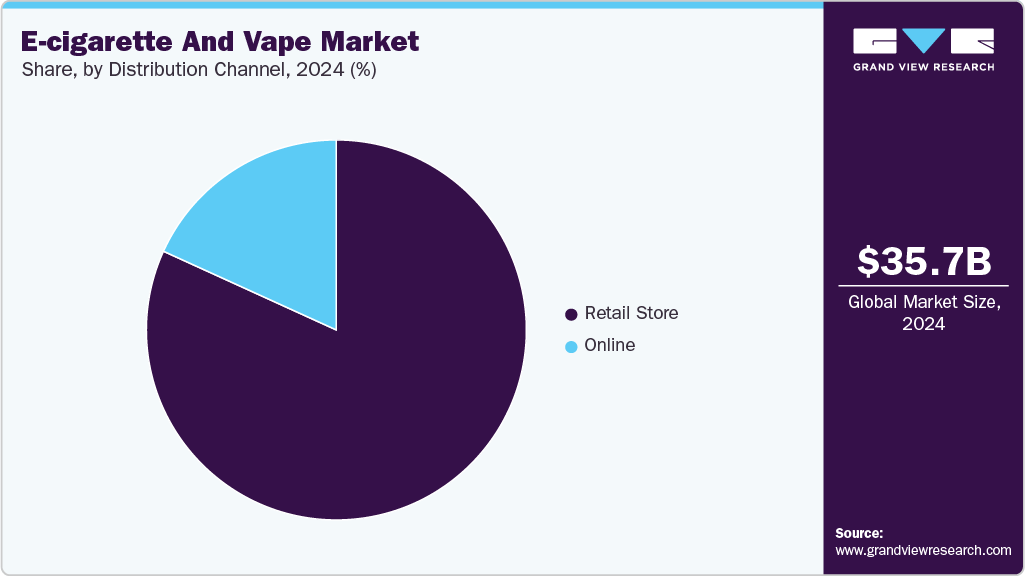
The retail store segment accounted for the highest market share of 80.9% in 2025. E-cigarettes were formerly offered for sale in retail locations like vape shops and gas stations. These stores helped clients choose from a variety of equipment and e-liquids. Vape shops are allowing clients to try out and test these devices before making a purchase decision, which is contributing to the retail store category's growth during the projection period.
 To learn more about this report, Download Free Sample Report
 The online segment is anticipated to register the fastest growth rate over the forecast period. People are increasingly buying e-cigarettes and vape products online because of the advantages of competitive pricing, convenience, and a greater selection of goods available on online marketplaces. The Asia Pacific region has seen the emergence of numerous internet stores selling e-cigarettes. The region has also experienced an increase in the market for e-cigarette goods, which has prompted vendors to offer e-cigarettes for sale online.
Regional Insights
The North America e-cigarette and vape market accounted for the largest market share of 43.5% in 2025. The North American e-cigarette and vape market is undergoing a structural transformation led by product standardization and evolving consumer preferences. The region is witnessing a notable transition from open-system devices to closed pods due to their convenience and consistency in nicotine delivery. Major retail chains have reintroduced shelf space for regulated vaping brands, aligning with FDA-compliant formulations. The rise of synthetic nicotine and tobacco-free alternatives is also shaping the market’s innovation cycle. Increasing awareness around smoke-free alternatives has spurred active participation from both traditional tobacco giants and independent vape brands.
 To learn more about this report, Download Free Sample Report
 U.S. E-cigarette And Vape Market Trends
The U.S. market is increasingly defined by regulatory recalibration and the emergence of age-restricted retail frameworks. Companies are focusing on flavor moderation, recyclable pod designs, and nicotine transparency to align with evolving FDA scrutiny. The market has seen growing traction for tech-integrated vape devices offering Bluetooth connectivity and usage tracking, particularly among adult users seeking personalized consumption experiences. Cross-industry collaborations, between tech startups and nicotine product manufacturers, are redefining consumer engagement models.
Europe E-cigarette And Vape Market Trends
The Europe E-cigarette and vape market is expected to grow at a CAGR of 32.8% during the forecast period. Europe’s e-cigarette and vape market reflects a mature yet innovation-driven ecosystem shaped by the Tobacco Products Directive (TPD). The growing emphasis on harm reduction as a public health approach has fostered positive sentiment toward regulated vaping. Markets such as France, the Netherlands, and Italy are embracing a broader retail presence, including pharmacies and specialty vape boutiques. Flavor diversification and plant-based nicotine substitutes are emerging as new growth frontiers, especially in countries promoting sustainable packaging and traceable ingredient sourcing.
Germany’s vaping landscape is evolving with a focus on quality assurance and eco-conscious product development. The rise of German-engineered vape hardware and temperature-controlled coils underscores the country’s precision manufacturing strengths. The market is shifting toward refillable systems as consumers seek customization and cost efficiency. Regulatory alignment with EU safety standards continues to shape product certification and distribution strategies.
The UK represents one of the most progressive markets for e-cigarettes globally, with vaping increasingly positioned as a harm-reduction tool by public health agencies. NHS-backed initiatives supporting smokers’ transition to vaping have fostered broad acceptance. Local brands are innovating with hybrid nicotine salts and long-fill e-liquids, while the online retail channel remains a dominant distribution mode. Environmental concerns have also driven momentum toward biodegradable vape components and returnable pod programs.
Asia Pacific E-cigarette And Vape Market Trends
The Asia-Pacific region is growing at the fastest CAGR during the forecast period. The APAC region showcases a multi-speed market where regulatory diversity and cultural acceptance drive distinct national trajectories. The proliferation of compact, cost-effective vape pens appeals to urban millennial demographics. Governments in select markets are re-evaluating taxation and import frameworks to formalize the segment. A surge in domestic manufacturing hubs, especially in Southeast Asia, is fostering self-reliance and export-oriented growth. Marketing strategies increasingly emphasize lifestyle branding over traditional nicotine positioning.
As the manufacturing powerhouse of the global vape ecosystem, China continues to dominate hardware innovation while tightening its domestic policy controls. Local companies are investing in next-generation atomization technologies and ceramic coil systems to enhance vapor efficiency. The recent state-led consolidation of vape producers under licensed frameworks has improved product traceability and export compliance. Chinese brands are increasingly focusing on premium international markets through cross-border e-commerce channels.
Japan’s vaping market is distinguished by its strong lean toward heat-not-burn (HNB) devices, which are more culturally and legally accepted than traditional e-cigarettes. Innovation is centered on tobacco-heating sticks with precise temperature control and cleaner aerosol output. The collaboration between technology firms and tobacco companies has yielded proprietary HNB platforms optimized for Japanese consumer preferences. Urban convenience stores remain a dominant sales channel due to Japan’s compact retail infrastructure.
India’s e-cigarette market, despite regulatory constraints, is seeing renewed policy discussions around nicotine alternatives in public health dialogues. The underground demand for herbal and nicotine-free vapes indicates an unmet appetite for harm-reduction products. Domestic startups are exploring non-nicotine vaporization categories such as ayurvedic or wellness-based formulations. Parallelly, the rise of tech-enabled smoking cessation programs and mobile applications reflects a latent potential for a regulated, wellness-oriented vape market in the future.
Key E-cigarette and Vape Company Insights
Some of the major players in the E-Cigarette and Vape Market include Altria Group, Inc., British American Tobacco, Imperial Brands, International Vapor Group, Japan Tobacco Inc., NicQuid, JUUL Labs, Inc., Philip Morris International Inc., R.J. Reynolds Vapor Company, Shenzhen IVPS Technology Co., Ltd., and Shenzhen KangerTech Technology Co., Ltd., owing to their extensive product portfolios, strong distribution networks, and continuous investments in smoke-free and next-generation nicotine delivery technologies. These companies have established technological and regulatory leadership by advancing product designs such as closed-pod systems, nicotine salt formulations, heat-not-burn devices, and smart vapes with integrated usage analytics. Their strategic focus on sustainable product engineering, recyclable hardware, and bio-based e-liquids reinforces their alignment with evolving environmental and health standards. Furthermore, their collaborations with technology developers, investment in R&D centers, and market adaptation strategies across regulated and emerging economies continue to strengthen their global presence and competitiveness in the evolving vaping ecosystem.
-
JUUL Labs, Inc. is involved in the development, manufacture, and sale of e-cigarettes. The company’s product portfolio includes JUULpods, devices, and accessories. The company offers an Electronic Nicotine Delivery System (ENDS), which is designed as a substitute for combustible cigarettes for adult smokers.
-
British American Tobacco p.l.c. is a manufacturer, marketer, and distributor of cigarettes and other tobacco and nicotine products. The company offers vapor products such as e-cigarettes and tobacco heating products. The company sells its products in over 200 markets across the Americas, Europe, Asia Pacific, and the MEA.
Key E-cigarette And Vape Companies:
The following key companies have been profiled for this study on the e-cigarette and vape market.
- Altria Group, Inc.
- British American Tobacco
- Imperial Brands
- International Vapor Group
- Japan Tobacco Inc.
- NicQuid
- JUUL Labs, Inc.
- Philip Morris International Inc.
- R.J. Reynolds Vapor Company
- Shenzhen IVPS Technology Co., Ltd.
- Shenzhen KangerTech Technology Co., Ltd.
Recent Developments
-
In February 2026, PerfectVape introduced its new refillable disposable vape, Monster 80K. The Monster 80K has a massive capacity of 80,000 puffs and comes with a comes with a 1000 mAh rechargeable battery. The product is compatible with e-liquid as well as salt nic e-liquids.
-
In February 2026, Greentank Technologies, a leader in advanced vaporization technology, launched three all-in-one vape devices. The lineup includes GT Fuse, GT Palm Pro, and GT A20 MAX vapes designed to enhance flexibility, performance, and consumer experience.
E-cigarette And Vape Market Report Scope
Report Attribute
Details
Market size in 2025
USD 45.7 billion
Estimated market size in 2026
USD 59.2 billion
Projected market size by 2033
USD 462.1 billion
Growth rate
CAGR of 34.1% from 2026 to 2033
Base year for estimation
2025
Historical data
2021 - 2024
Forecast period
2026 - 2033
Quantitative units
Revenue in USD million/billion, and CAGR from 2026 to 2033
Report coverage
Revenue forecast, company ranking, competitive landscape, growth factors, and trends
Segments covered
Product, category, distribution channel, region
Regional scope
North America; Europe; Asia Pacific; Latin America; MEA
Country scope
U.S.; Canada; Mexico; Germany; UK; France; China; Japan; India; South Korea; Australia; Brazil; KSA; UAE; South Africa
Key companies profiled
Altria Group, Inc.; British American Tobacco; Imperial Brands; International Vapor Group; Japan Tobacco Inc.; NicQuid; JUUL Labs, Inc.; Philip Morris International Inc.; R.J. Reynolds Vapor Company; Shenzhen IVPS Technology Co., Ltd.; Shenzhen KangerTech Technology Co., Ltd.
Customization scope
Free report customization (equivalent up to 8 analysts working days) with purchase. Addition or alteration to country, regional & segment scope.
Pricing and purchase options
Avail customized purchase options to meet your exact research needs. Explore purchase options
Global E-cigarette And Vape Market Report Segmentation
This report forecasts revenue growth at the global, regional, and country levels and provides an analysis of the latest Market Trends in each of the sub-segments from 2021 to 2033. For this study, Grand View Research has segmented the global e-cigarette and vape market report based on product, category, distribution channel, and region.
Global E-cigarette And Vape Market Report - Table of Contents
Chapter 1. Methodology and Scope
1.1. Market Segmentation and Scope
1.2. Research Methodology
1.2.1. Information Procurement
1.3. Information or Data Analysis
1.4. Methodology
1.5. Research Scope and Assumptions
1.6. Market Formulation & Validation
1.7. Country Based Segment Share Calculation
1.8. List of Data Sources
Chapter 2. Executive Summary
2.1. Market Outlook
2.2. Segment Outlook
2.3. Competitive Insights
Chapter 3. E-cigarette And Vape Market Variables, Trends, & Scope
3.1. Market Lineage Outlook
3.2. Market Dynamics
3.2.1. Market Driver Analysis
3.2.2. Market Restraint Analysis
3.2.3. Industry Challenge
3.3. E-cigarette And Vape Market Analysis Tools
3.3.1. Industry Analysis - Porter’s
3.3.1.1. Bargaining power of the suppliers
3.3.1.2. Bargaining power of the buyers
3.3.1.3. Threats of substitution
3.3.1.4. Threats from new entrants
3.3.1.5. Competitive rivalry
3.3.2. PESTEL Analysis
3.3.2.1. Political landscape
3.3.2.2. Economic landscape
3.3.2.3. Social landscape
3.3.2.4. Technological landscape
3.3.2.5. Environmental landscape
3.3.2.6. Legal landscape
Chapter 4. E-cigarette And Vape Market: Product Estimates & Trend Analysis
4.1. Segment Dashboard
4.2. E-cigarette And Vape Market: Product Movement Analysis, 2025 & 2033 (USD Million)
4.3. Disposable
4.3.1. Disposable Market Revenue Estimates and Forecasts, 2021 - 2033 (USD Million)
4.4. Rechargeable
4.4.1. Rechargeable Market Revenue Estimates and Forecasts, 2021 - 2033 (USD Million)
4.5. Modular Devices
4.5.1. Modular Devices Market Revenue Estimates and Forecasts, 2021 - 2033 (USD Million)
Chapter 5. E-cigarette And Vape Market: Category Estimates & Trend Analysis
5.1. Segment Dashboard
5.2. E-cigarette And Vape Market: Category Movement Analysis, 2025 & 2033 (USD Million)
5.3. Open
5.3.1. Open Market Revenue Estimates and Forecasts, 2021 - 2033 (USD Million)
5.4. Closed
5.4.1. Closed Market Revenue Estimates and Forecasts, 2021 - 2033 (USD Million)
Chapter 6. E-cigarette And Vape Market: Distribution Channel Estimates & Trend Analysis
6.1. Segment Dashboard
6.2. E-cigarette And Vape Market: Distribution Channel Movement Analysis, 2025 & 2033 (USD Million)
6.3. Online
6.3.1. Online Market Revenue Estimates and Forecasts, 2021 - 2033 (USD Million)
6.4. Retail Store
6.4.1. Retail Store Market Revenue Estimates and Forecasts, 2021 - 2033 (USD Million)
6.4.2. Convenience Store
6.4.2.1. Convenience Store Market Revenue Estimates and Forecasts, 2021 - 2033 (USD Million)
6.4.3. Drug Stores
6.4.3.1. Drug Stores Market Revenue Estimates and Forecasts, 2021 - 2033 (USD Million)
6.4.4. News Stands
6.4.4.1. News Stands Market Revenue Estimates and Forecasts, 2021 - 2033 (USD Million)
6.4.5. Tobacconist
6.4.5.1. Tobacconist Market Revenue Estimates and Forecasts, 2021 - 2033 (USD Million)
6.4.6. Specialty E-cigarette Stores
6.4.6.1. Specialty E-cigarette Stores Market Revenue Estimates and Forecasts, 2021 - 2033 (USD Million)
Chapter 7. E-cigarette And Vape Market: Regional Estimates & Trend Analysis
7.1. E-cigarette And Vape Market Share, By Region, 2025 & 2033 (USD Million)
7.2. North America
7.2.1. North America E-cigarette And Vape Market Estimates and Forecasts, 2021 - 2033 (USD Million)
7.2.2. U.S.
7.2.2.1. U.S. E-cigarette And Vape Market Estimates and Forecasts, 2021 - 2033 (USD Million)
7.2.3. Canada
7.2.3.1. Canada E-cigarette And Vape Market Estimates and Forecasts, 2021 - 2033 (USD Million)
7.2.4. Mexico
7.2.4.1. Mexico E-cigarette And Vape Market Estimates and Forecasts, 2021 - 2033 (USD Million)
7.3. Europe
7.3.1. Europe E-cigarette And Vape Market Estimates and Forecasts, 2021 - 2033 (USD Million)
7.3.2. UK
7.3.2.1. UK E-cigarette And Vape Market Estimates and Forecasts, 2021 - 2033 (USD Million)
7.3.3. Germany
7.3.3.1. Germany E-cigarette And Vape Market Estimates and Forecasts, 2021 - 2033 (USD Million)
7.3.4. France
7.3.4.1. France E-cigarette And Vape Market Estimates and Forecasts, 2021 - 2033 (USD Million)
7.4. Asia Pacific
7.4.1. Asia Pacific E-cigarette And Vape Market Estimates and Forecasts, 2021 - 2033 (USD Million)
7.4.2. China
7.4.2.1. China E-cigarette And Vape Market Estimates and Forecasts, 2021 - 2033 (USD Million)
7.4.3. Japan
7.4.3.1. Japan E-cigarette And Vape Market Estimates and Forecasts, 2021 - 2033 (USD Million)
7.4.4. India
7.4.4.1. India E-cigarette And Vape Market Estimates and Forecasts, 2021 - 2033 (USD Million)
7.4.5. South Korea
7.4.5.1. South Korea E-cigarette And Vape Market Estimates and Forecasts, 2021 - 2033 (USD Million)
7.4.6. Australia
7.4.6.1. Australia E-cigarette And Vape Market Estimates and Forecasts, 2021 - 2033 (USD Million)
7.5. Latin America
7.5.1. Latin America E-cigarette And Vape Market Estimates and Forecasts, 2021 - 2033 (USD Million)
7.5.2. Brazil
7.5.2.1. Brazil E-cigarette And Vape Market Estimates and Forecasts, 2021 - 2033 (USD Million)
7.6. Middle East and Africa
7.6.1. Middle East and Africa E-cigarette And Vape Market Estimates and Forecasts, 2021 - 2033 (USD Million)
7.6.2. UAE
7.6.2.1. UAE E-cigarette And Vape Market Estimates and Forecasts, 2021 - 2033 (USD Million)
7.6.3. KSA
7.6.3.1. KSA E-cigarette And Vape Market Estimates and Forecasts, 2021 - 2033 (USD Million)
7.6.4. South Africa
7.6.4.1. South Africa E-cigarette And Vape Market Estimates and Forecasts, 2021 - 2033 (USD Million)
Chapter 8. Competitive Landscape
8.1. Company Categorization
8.2. Company Market Positioning
8.3. Company Heat Map Analysis
8.4. Company Profiles/Listing
8.4.1. Altria Group, Inc.
8.4.1.1. Participant’s Overview
8.4.1.2. Financial Performance
8.4.1.3. Product Benchmarking
8.4.1.4. Strategic Initiatives
8.4.2. British American Tobacco
8.4.2.1. Participant’s Overview
8.4.2.2. Financial Performance
8.4.2.3. Product Benchmarking
8.4.2.4. Strategic Initiatives
8.4.3. Imperial Brands
8.4.3.1. Participant’s Overview
8.4.3.2. Financial Performance
8.4.3.3. Product Benchmarking
8.4.3.4. Strategic Initiatives
8.4.4. International Vapor Group
8.4.4.1. Participant’s Overview
8.4.4.2. Financial Performance
8.4.4.3. Product Benchmarking
8.4.4.4. Strategic Initiatives
8.4.5. Japan Tobacco Inc.
8.4.5.1. Participant’s Overview
8.4.5.2. Financial Performance
8.4.5.3. Product Benchmarking
8.4.5.4. Strategic Initiatives
8.4.6. NicQuid
8.4.6.1. Participant’s Overview
8.4.6.2. Financial Performance
8.4.6.3. Product Benchmarking
8.4.6.4. Strategic Initiatives
8.4.7. JUUL Labs, Inc.
8.4.7.1. Participant’s Overview
8.4.7.2. Financial Performance
8.4.7.3. Product Benchmarking
8.4.7.4. Strategic Initiatives
8.4.8. Philip Morris International Inc.
8.4.8.1. Participant’s Overview
8.4.8.2. Financial Performance
8.4.8.3. Product Benchmarking
8.4.8.4. Strategic Initiatives
8.4.9. R.J. Reynolds Vapor Company
8.4.9.1. Participant’s Overview
8.4.9.2. Financial Performance
8.4.9.3. Product Benchmarking
8.4.9.4. Strategic Initiatives
8.4.10. Shenzhen IVPS Technology Co., Ltd.
8.4.10.1. Participant’s Overview
8.4.10.2. Financial Performance
8.4.10.3. Product Benchmarking
8.4.10.4. Strategic Initiatives
8.4.11. Shenzhen KangerTech Technology Co., Ltd.
8.4.11.1. Participant’s Overview
8.4.11.2. Financial Performance
8.4.11.3. Product Benchmarking
8.4.11.4. Strategic InitiativesList of Tables
Table 1 Global E-cigarette And Vape Market size estimates & forecasts 2021 - 2033 (USD Million)
Table 2 Global E-cigarette And Vape Market, by region 2021 - 2033 (USD Million)
Table 3 Global E-cigarette And Vape Market, by Product 2021 - 2033 (USD Million)
Table 4 Global E-cigarette And Vape Market, by Category 2021 - 2033 (USD Million)
Table 5 Global E-cigarette And Vape Market, by Distribution Channel 2021 - 2033 (USD Million)
Table 6 Disposable market, by region 2021 - 2033 (USD Million)
Table 7 Rechargeable market, by region 2021 - 2033 (USD Million)
Table 8 Modular Devices market, by region 2021 - 2033 (USD Million)
Table 9 Open market, by region 2021 - 2033 (USD Million)
Table 10 Closed market, by region 2021 - 2033 (USD Million)
Table 11 Online market, by region 2021 - 2033 (USD Million)
Table 12 Retail Store market, by region 2021 - 2033 (USD Million)
Table 13 Convenience Store market, by region 2021 - 2033 (USD Million)
Table 14 Drug Stores market, by region 2021 - 2033 (USD Million)
Table 15 News Stands market, by region 2021 - 2033 (USD Million)
Table 16 Tobacconist market, by region 2021 - 2033 (USD Million)
Table 17 Specialty E-cigarette Stores market, by region 2021 - 2033 (USD Million)
Table 18 North America E-cigarette And Vape Market, by Product 2021 - 2033 (USD Million)
Table 19 North America E-cigarette And Vape Market, by Category 2021 - 2033 (USD Million)
Table 20 North America E-cigarette And Vape Market, by Distribution Channel 2021 - 2033 (USD Million)
Table 21 U.S. E-cigarette And Vape Market, by Product 2021 - 2033 (USD Million)
Table 22 U.S. E-cigarette And Vape Market, by Category 2021 - 2033 (USD Million)
Table 23 U.S. E-cigarette And Vape Market, by Distribution Channel 2021 - 2033 (USD Million)
Table 24 Canada E-cigarette And Vape Market, by Product 2021 - 2033 (USD Million)
Table 25 Canada E-cigarette And Vape Market, by Category 2021 - 2033 (USD Million)
Table 26 Canada E-cigarette And Vape Market, by Distribution Channel 2021 - 2033 (USD Million)
Table 27 Mexico E-cigarette And Vape Market, by Product 2021 - 2033 (USD Million)
Table 28 Mexico E-cigarette And Vape Market, by Category 2021 - 2033 (USD Million)
Table 29 Mexico E-cigarette And Vape Market, by Distribution Channel 2021 - 2033 (USD Million)
Table 30 Europe E-cigarette And Vape Market, by Product 2021 - 2033 (USD Million)
Table 31 Europe E-cigarette And Vape Market, by Category 2021 - 2033 (USD Million)
Table 32 Europe E-cigarette And Vape Market, by Distribution Channel 2021 - 2033 (USD Million)
Table 33 UK E-cigarette And Vape Market, by Product 2021 - 2033 (USD Million)
Table 34 UK E-cigarette And Vape Market, by Category 2021 - 2033 (USD Million)
Table 35 UK E-cigarette And Vape Market, by Distribution Channel 2021 - 2033 (USD Million)
Table 36 Germany E-cigarette And Vape Market, by Product 2021 - 2033 (USD Million)
Table 37 Germany E-cigarette And Vape Market, by Category 2021 - 2033 (USD Million)
Table 38 Germany E-cigarette And Vape Market, by Distribution Channel 2021 - 2033 (USD Million)
Table 39 France E-cigarette And Vape Market, by Product 2021 - 2033 (USD Million)
Table 40 France E-cigarette And Vape Market, by Category 2021 - 2033 (USD Million)
Table 41 France E-cigarette And Vape Market, by Distribution Channel 2021 - 2033 (USD Million)
Table 42 Asia Pacific E-cigarette And Vape Market, by Product 2021 - 2033 (USD Million)
Table 43 Asia Pacific E-cigarette And Vape Market, by Category 2021 - 2033 (USD Million)
Table 44 Asia Pacific E-cigarette And Vape Market, by Distribution Channel 2021 - 2033 (USD Million)
Table 45 China E-cigarette And Vape Market, by Product 2021 - 2033 (USD Million)
Table 46 China E-cigarette And Vape Market, by Category 2021 - 2033 (USD Million)
Table 47 China E-cigarette And Vape Market, by Distribution Channel 2021 - 2033 (USD Million)
Table 48 India E-cigarette And Vape Market, by Product 2021 - 2033 (USD Million)
Table 49 India E-cigarette And Vape Market, by Category 2021 - 2033 (USD Million)
Table 50 India E-cigarette And Vape Market, by Distribution Channel 2021 - 2033 (USD Million)
Table 51 Japan E-cigarette And Vape Market, by Product 2021 - 2033 (USD Million)
Table 52 Japan E-cigarette And Vape Market, by Category 2021 - 2033 (USD Million)
Table 53 Japan E-cigarette And Vape Market, by Distribution Channel 2021 - 2033 (USD Million)
Table 54 Australia E-cigarette And Vape Market, by Product 2021 - 2033 (USD Million)
Table 55 Australia E-cigarette And Vape Market, by Category 2021 - 2033 (USD Million)
Table 56 Australia E-cigarette And Vape Market, by Distribution Channel 2021 - 2033 (USD Million)
Table 57 South Korea E-cigarette And Vape Market, by Product 2021 - 2033 (USD Million)
Table 58 South Korea E-cigarette And Vape Market, by Category 2021 - 2033 (USD Million)
Table 59 South Korea E-cigarette And Vape Market, by Distribution Channel 2021 - 2033 (USD Million)
Table 60 Latin America E-cigarette And Vape Market, by Product 2021 - 2033 (USD Million)
Table 61 Latin America E-cigarette And Vape Market, by Category 2021 - 2033 (USD Million)
Table 62 Latin America E-cigarette And Vape Market, by Distribution Channel 2021 - 2033 (USD Million)
Table 63 Brazil E-cigarette And Vape Market, by Product 2021 - 2033 (USD Million)
Table 64 Brazil E-cigarette And Vape Market, by Category 2021 - 2033 (USD Million)
Table 65 Brazil E-cigarette And Vape Market, by Distribution Channel 2021 - 2033 (USD Million)
Table 66 MEA E-cigarette And Vape Market, by Product 2021 - 2033 (USD Million)
Table 67 MEA E-cigarette And Vape Market, by Category 2021 - 2033 (USD Million)
Table 68 MEA E-cigarette And Vape Market, by Distribution Channel 2021 - 2033 (USD Million)
Table 69 UAE E-cigarette And Vape Market, by Product 2021 - 2033 (USD Million)
Table 70 UAE E-cigarette And Vape Market, by Category 2021 - 2033 (USD Million)
Table 71 UAE E-cigarette And Vape Market, by Distribution Channel 2021 - 2033 (USD Million)
Table 72 KSA E-cigarette And Vape Market, by Product 2021 - 2033 (USD Million)
Table 73 KSA E-cigarette And Vape Market, by Category 2021 - 2033 (USD Million)
Table 74 KSA E-cigarette And Vape Market, by Distribution Channel 2021 - 2033 (USD Million)
Table 75 South Africa E-cigarette And Vape Market, by Product 2021 - 2033 (USD Million)
Table 76 South Africa E-cigarette And Vape Market, by Category 2021 - 2033 (USD Million)
Table 77 South Africa E-cigarette And Vape Market, by Distribution Channel 2021 - 2033 (USD Million)List of Figures
Fig. 1 E-cigarette And Vape Market Segmentation
Fig. 2 Market research deployment mode
Fig. 3 Information procurement
Fig. 4 Primary research pattern
Fig. 5 Market research approaches
Fig. 6 Value chain-based sizing & forecasting
Fig. 7 Parent market analysis
Fig. 8 Market formulation & validation
Fig. 9 E-cigarette And Vape Market snapshot
Fig. 10 E-cigarette And Vape Market segment snapshot
Fig. 11 E-cigarette And Vape Market competitive landscape snapshot
Fig. 12 Market research deployment mode
Fig. 13 Market driver relevance analysis (Current & future impact)
Fig. 14 Market restraint relevance analysis (Current & future impact)
Fig. 15 E-cigarette And Vape Market: Product outlook key takeaways (USD Million)
Fig. 16 E-cigarette And Vape Market: Product movement analysis 2025 & 2033 (USD Million)
Fig. 17 Disposable market revenue estimates and forecasts, 2021 - 2033 (USD Million)
Fig. 18 Rechargeable market revenue estimates and forecasts, 2021 - 2033 (USD Million)
Fig. 19 Modular Devices market revenue estimates and forecasts, 2021 - 2033 (USD Million)
Fig. 20 E-cigarette And Vape Market: Category outlook key takeaways (USD Million)
Fig. 21 E-cigarette And Vape Market: Category movement analysis 2025 & 2033 (USD Million)
Fig. 22 Open market revenue estimates and forecasts, 2021 - 2033 (USD Million)
Fig. 23 Closed market revenue estimates and forecasts, 2021 - 2033 (USD Million)
Fig. 24 E-cigarette And Vape Market: Distribution Channel outlook key takeaways (USD Million)
Fig. 25 E-cigarette And Vape Market: Distribution Channel movement analysis 2025 & 2033 (USD Million)
Fig. 26 Online market revenue estimates and forecasts, 2021 - 2033 (USD Million)
Fig. 27 Retail Store market revenue estimates and forecasts, 2021 - 2033 (USD Million)
Fig. 28 Convenience Store market revenue estimates and forecasts, 2021 - 2033 (USD Million)
Fig. 29 Drug Stores market revenue estimates and forecasts, 2021 - 2033 (USD Million)
Fig. 30 News Stands market revenue estimates and forecasts, 2021 - 2033 (USD Million)
Fig. 31 Tobacconist market revenue estimates and forecasts, 2021 - 2033 (USD Million)
Fig. 32 Specialty E-cigarette Stores market revenue estimates and forecasts, 2021 - 2033 (USD Million)
Fig. 33 Regional marketplace: Key takeaways
Fig. 34 E-cigarette And Vape Market: Regional outlook, 2025 & 2033 (USD Million)
Fig. 35 North America E-cigarette And Vape Market estimates and forecasts, 2021 - 2033 (USD Million)
Fig. 36 U.S. E-cigarette And Vape Market estimates and forecasts, 2021 - 2033 (USD Million)
Fig. 37 Canada E-cigarette And Vape Market estimates and forecasts, 2021 - 2033 (USD Million)
Fig. 38 Mexico E-cigarette And Vape Market estimates and forecasts, 2021 - 2033 (USD Million)
Fig. 39 Europe E-cigarette And Vape Market estimates and forecasts, 2021 - 2033 (USD Million)
Fig. 40 UK E-cigarette And Vape Market estimates and forecasts, 2021 - 2033 (USD Million)
Fig. 41 Germany E-cigarette And Vape Market estimates and forecasts, 2021 - 2033 (USD Million)
Fig. 42 France E-cigarette And Vape Market estimates and forecasts, 2021 - 2033 (USD Million)
Fig. 43 Asia Pacific E-cigarette And Vape Market estimates and forecasts, 2021 - 2033 (USD Million)
Fig. 44 Japan E-cigarette And Vape Market estimates and forecasts, 2021 - 2033 (USD Million)
Fig. 45 China E-cigarette And Vape Market estimates and forecasts, 2021 - 2033 (USD Million)
Fig. 46 India E-cigarette And Vape Market estimates and forecasts, 2021 - 2033 (USD Million)
Fig. 47 Australia E-cigarette And Vape Market estimates and forecasts, 2021 - 2033 (USD Million)
Fig. 48 South Korea E-cigarette And Vape Market estimates and forecasts, 2021 - 2033 (USD Million)
Fig. 49 Latin America E-cigarette And Vape Market estimates and forecasts, 2021 - 2033 (USD Million)
Fig. 50 Brazil E-cigarette And Vape Market estimates and forecasts, 2021 - 2033 (USD Million)
Fig. 51 MEA E-cigarette And Vape Market estimates and forecasts, 2021 - 2033 (USD Million)
Fig. 52 KSA E-cigarette And Vape Market estimates and forecasts, 2021 - 2033 (USD Million)
Fig. 53 UAE E-cigarette And Vape Market estimates and forecasts, 2021 - 2033 (USD Million)
Fig. 54 South Africa E-cigarette And Vape Market estimates and forecasts, 2021 - 2033 (USD Million)
Fig. 55 Strategy framework
Fig. 56 Company CategorizationFrequently Asked Questions About This Report
The global e-cigarette and vape market size was valued at USD 45.7 billion in 2025 and is estimated at USD 59.2 billion for 2026.
Asia Pacific is the fastest-growing region over the forecast period.
Key factors that are driving the e-cigarette & vape market growth include the consumer demand shifts toward reduced-risk nicotine alternatives and lifestyle-oriented consumption formats, increasing awareness regarding smoke-free products, combined with declining conventional cigarette consumption in several developed markets, is encouraging adult smokers to transition toward vaping devices.
The closed segment held the largest revenue share in 2025, while open is the fastest-growing category.
Key players include Altria Group, Inc.; British American Tobacco; Imperial Brands; International Vapor Group; Japan Tobacco Inc.; NicQuid; JUUL Labs, Inc.; Philip Morris International Inc.; R.J. Reynolds Vapor Company; Shenzhen IVPS Technology Co., Ltd.; Shenzhen KangerTech Technology Co., Ltd.
The global e-cigarette and vape market is expected to grow at a CAGR of 34.1% from 2026 to 2033, reaching USD 462.1 billion by 2033.
The rechargeable segment in the e-cigarette & vape market accounted for the highest market share of 43.7% in 2025. Rechargeable devices are predicted to become more popular due to their affordability and ability to do away with the requirement for ongoing supply purchases like cartridges.
The retail store segment accounted for the highest e-cigarette & vape market share of 80.9% in 2025. Retail shops are allowing clients to try out and test these devices before making a purchase decision, which is contributing to the retail store category's growth during the projection period.
North America dominated the global e-cigarette and vape market with a share of 43.5% in 2025.
About the Author(s)
Next Generation Technologies Research Team
Technology · Next Generation TechnologiesThis report was authored by the next generation technologies research team at Grand View Research - comprising two research analysts, one senior research analyst, and one industry expert - with specialized expertise in the next generation technologies segment of the technology industry. All findings are based on proprietary technology databases, executive interviews, and regulatory analysis, subject to internal peer review prior to publication.
Last Updated:
Speak to Analyst

Customize this report to your needs - add regions, segments, or data points, with 20% free customization.
Or view our licence options:


ISO 9001:2015 & 27001:2022 Certified
We are GDPR and CCPA compliant! Your transaction & personal information is safe and secure. For more details, please read our privacy policy.


