
- Home
- »
- Medical Devices
- »
-
Dental Veneers Market Size, Share & Growth Report, 2033GVR Report cover

Dental Veneers Market (2026 - 2033) Size, Share & Trends Analysis Report By Material (Ceramic-based, Resin-based), By Method (Traditional Veneers, Ultra-Thin/No-Prep Veneers, Palatal Veneers), By Durability (Permanent Restorations), By End Use, By Region, And Segment Forecasts
Market Size, 2025
$7.9BMarket Estimate, 2026
$8.5BMarket Forecast, 2033
$14.3BCAGR, 2026–2033
7.7%Dental Veneers Market Summary
The global dental veneers market size was valued at USD 7.9 billion in 2025 and is projected to grow from USD 8.5 billion in 2026 to USD 14.3 billion by 2033, at a CAGR of 7.7% from 2026 to 2033. North America dominated the industry with the largest revenue share of 47.2% in 2025. The global market is experiencing steady growth due to increasing demand for cosmetic dentistry.
 Source: Grand View Research, IR Documents, Primary Interviews, Paid DatabasesTo learn more about this report,
 Download Free Sample Report
 Key Market Trends & Insights
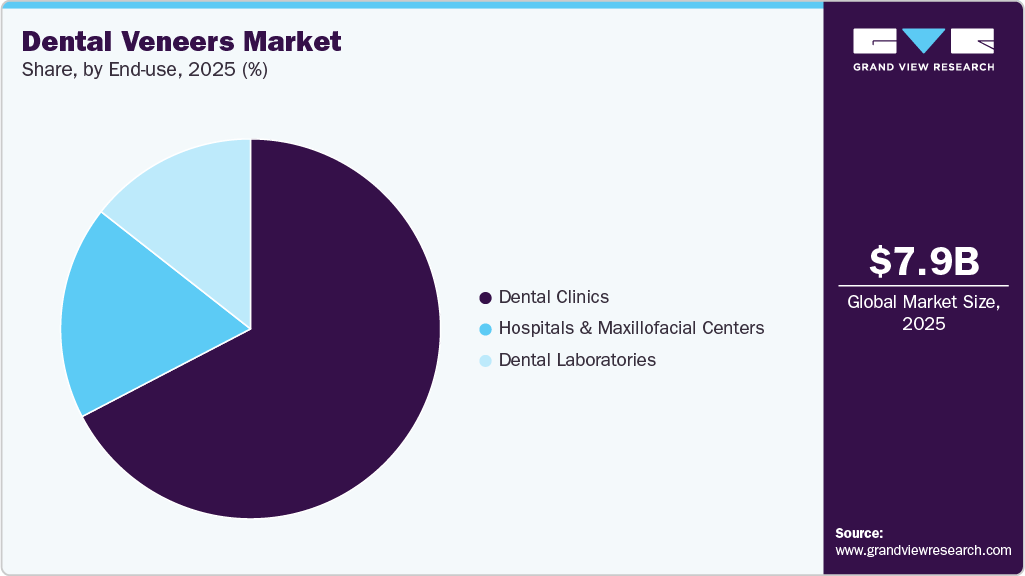
- By end-use: Dental clinics segment led the market with the largest revenue share of 67.3% in 2025.
- By method: Traditional (prep) veneers segment led the market with the largest revenue share of 64.6% in 2025.
- By material: Ceramic-based (indirect) segment led the market with the largest revenue share of 60.2% in 2025.
- By durability: Permanent restorations segment led the market with the largest revenue share in 2025.
Regional Highlights
- Largest regional market: North America (47.2% revenue share, 2025)
- Fastest-growing regional market: Asia Pacific (highest CAGR, 2026-2033)
- The dental veneers industry in the U.S. held the largest revenue share in 2025.
Market Size & Forecast
- Market size in 2025: USD 7.9 Billion
- Estimated market size in 2026: USD 8.5 Billion
- Projected market size by 2033: USD 14.3 Billion
- CAGR (2026-2033): 7.7%
Three ways to get this report
Buy it, customize it, or ask a question.Ask an Analyst
A direct answer, usually in 1 working day
- AccessReport author, directly
- Reply timeWithin 1 working day
- No sales callDirect answer only
- FormatEmail reply
- CostFree, no cost
Get the Full Report
What the study covers
- FormatsPDF · Excel · Dashboard
- Timeline2026–2033 annual, 2025 base
- Coverage20+ countries, 5 regions
- Companies10+ key players profiled
Customize the Report
20% free customization
- IncludeCountries, segments, points
- TailorTo your product definition
- ExtendDeeper competitor detail
- OrA fully bespoke study
- Turnaround5–10 working days
Consumers are becoming more conscious about their appearance, especially their smiles, due to the growing influence of social media, digital interactions, and professional image standards. Dental veneers offer a quick and effective solution for improving tooth color, shape, and alignment, making them a preferred choice over more complex orthodontic procedures.Advancements in dental materials and technology are also contributing to market growth. Modern veneers, such as porcelain and composite options, are more durable, natural-looking, and minimally invasive compared to earlier alternatives. Improved digital imaging and CAD/CAM technologies allow for precise customization, faster procedures, and better patient outcomes, which increases adoption among both dentists and patients. For instance, in May 2025, an MDPI published study highlighted that CAD/CAM technology is transforming veneer production by enabling precise, efficient, and minimally invasive dental procedures. Digital intraoral scanning improves accuracy in veneer design and fabrication, with CAD/CAM veneers showing high clinical success rates, including up to 99.83% survival and around 92% long-term performance over 10 years. These technological and material advancements are strengthening the adoption of dental veneers by enhancing treatment efficiency, reliability, and patient satisfaction, thereby supporting sustained market growth.
 To learn more about this report, Download Free Sample Report
 Increasing replacement of aged, stained, and failed composite restorations with durable, aesthetic ceramic veneers enabled by digital intraoral scanning workflows. For instance, in May 2025, an MDPI article highlights a case study, which involved a 35-year-old male patient who presented with aesthetic concerns regarding his smile due to stained, worn, and cracked direct resin composite restorations extending from the maxillary right first premolar to the left first premolar. The primary objective of the treatment was to enhance smile aesthetics and restore functional and visual harmony by replacing the existing composite restorations with ceramic veneers. The treatment approach included careful clinical evaluation followed by a digital workflow, where final impressions were taken using an intraoral scanner instead of conventional impression materials, supporting improved precision and patient comfort. The case was selected due to the extent of restoration required and the patient’s suitability for a fully digital impression technique. In conclusion, the replacement of aged composite veneers with ceramic veneers using intraoral scanning demonstrated a modern, minimally invasive, and efficient approach, resulting in improved esthetics, better material durability, and enhanced patient satisfaction. This case reflects the growing clinical shift toward digital, minimally invasive restorative dentistry, supporting broader adoption of ceramic veneers and intraoral scanning technologies in modern cosmetic dental practice.
Rising disposable income, particularly in emerging economies, is a significant factor supporting the growth of the industry. As household incomes increase, consumers experience greater financial flexibility and a higher capacity for discretionary spending. For instance, according to the People Research on India’s Consumer Economy, rising income levels are expected to shift India from an aspirational-led to a middle-class-driven economy. The economy is projected to grow from USD 2.2 trillion in 2021 to USD 7.1 trillion by 2031, with consumer spending increasing to nearly USD 5.2 trillion over the same period. This steady rise in purchasing power is expected to drive greater adoption of elective cosmetic dental procedures, thereby supporting sustained growth in the industry.
SWOT Analysis
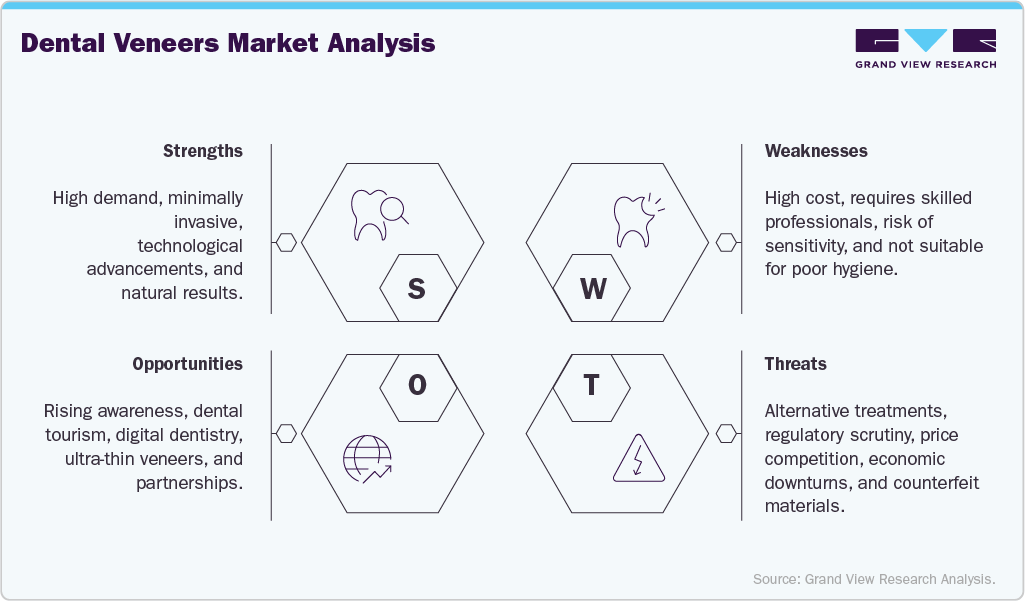
The industry is growing steadily due to rising demand for cosmetic dentistry and minimally invasive smile enhancement procedures supported by advanced digital technologies. However, high treatment costs and the need for skilled professionals remain key limitations. Opportunities are increasing with growing awareness, dental tourism, and innovations such as ultra-thin veneers. At the same time, the market faces threats from alternative treatments, price competition, and economic sensitivity.
 To learn more about this report, Download Free Sample Report
 Growth Scenario
The growth scenarios for the industry are supported by increasing demand for minimally invasive cosmetic dentistry and the rising preference for aesthetically enhanced smiles. In a baseline scenario, the market is expected to grow steadily due to consistent adoption of veneers in dental clinics and cosmetic practices, particularly in urban and developed healthcare markets.
In a high-growth scenario, expansion is accelerated by advancements such as ultra-thin veneer technologies and improved clinical accessibility, including the establishment of specialized labs that support faster testing, manufacturing, and distribution of veneers. For instance, in November 2024, Boston Micro Fabrication (BMF) launched the UltraThineer Lab at its U.S. headquarters in Maynard, Massachusetts, to support testing, manufacturing, and sales of Zirconia UltraThineer veneers. The facility uses proprietary projection micro stereolithography (PµSL) technology to produce ultra-thin cosmetic veneers, up to three times thinner than traditional options. This expansion aims to help dentists offer the world’s thinnest custom dental veneers across the U.S. This kind of infrastructure development reduces turnaround time and enhances adoption rates among dental professionals.
In a slower-growth scenario, market expansion is limited by high procedural costs, insurance exclusions for cosmetic procedures, and affordability constraints in emerging markets. Overall, the dental veneers market demonstrates strong growth potential driven by innovation, improved service ecosystems, and increasing consumer focus on aesthetic dental outcomes.
Market Dynamics
The increasing influence of social media and celebrity culture is significantly driving the demand for dental veneers. Platforms such as Instagram, TikTok, and YouTube have increased awareness of cosmetic dental procedures by promoting aesthetically appealing smiles through influencers, celebrities, and digital content creators. Consumers, particularly younger populations, are becoming more conscious about dental appearance and are seeking cosmetic dentistry solutions to improve confidence and personal image. In addition, the growing popularity of smile makeover trends and before-and-after transformation content is encouraging patients to opt for veneers as a long-term aesthetic solution. Dental clinics and cosmetic dentists are also using social media marketing to attract new patients, further supporting the growth of the industry.
The high cost of dental veneer procedures is a major factor limiting the growth of the industry. Veneer treatments often involve expensive materials, advanced dental equipment, and multiple clinical visits, which increase the overall treatment cost for patients. Premium options such as porcelain veneers are especially costly due to their durability, customized design, and aesthetic quality. As cosmetic dentistry procedures are usually not covered by insurance policies, many middle- and low-income consumers find veneers financially unaffordable. This cost barrier is particularly significant in developing regions where awareness of cosmetic dentistry is increasing, but spending capacity remains limited.
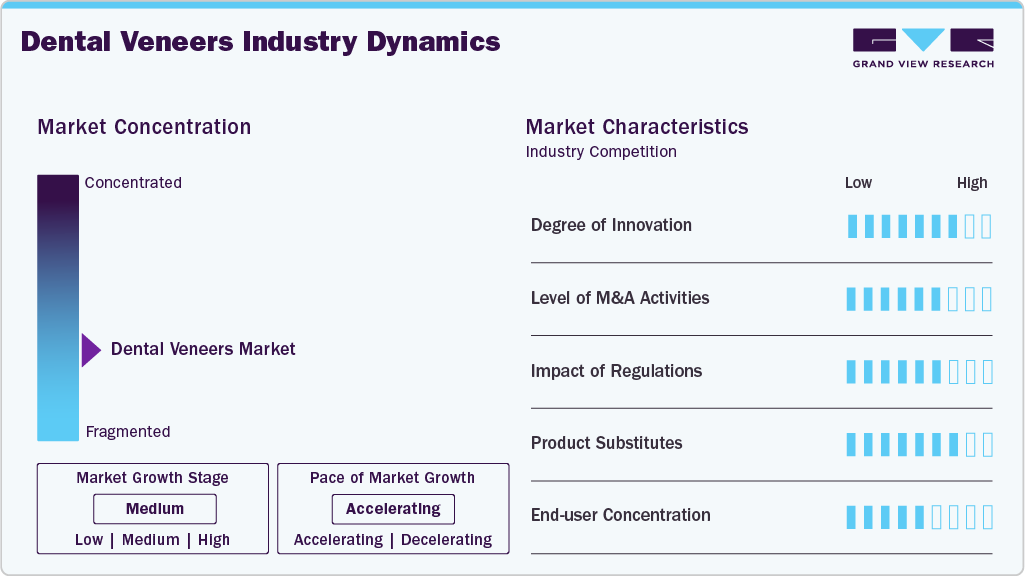
Market Concentration & Characteristics
The industry shows a moderate to high degree of innovation, mainly driven by advancements in materials and digital dentistry technologies. New materials such as zirconia, lithium disilicate, and advanced composite resins have improved durability, aesthetics, and patient comfort. In addition, technologies such as CAD/CAM systems and 3D imaging allow precise customization and faster production of veneers. These innovations enhance treatment outcomes and reduce procedure time, increasing adoption among patients and dentists.
The industry experiences a moderate to high level of mergers, acquisitions, and partnerships. Key players actively engage in collaborations to expand their technological capabilities and market presence. For instance, in March 2026, LongueVue Capital, in partnership with Swaney Group Capital, made a strategic investment in Apex Dental Laboratory Group to expand its national dental lab platform. Apex operates 16 labs across the U.S. and offers a wide range of products, including veneers, crowns, and advanced dental restorations, supported by innovative proprietary brands. This trend of strategic investments and partnerships is expected to strengthen market consolidation and enhance competitive positioning within the industry.
 To learn more about this report, Download Free Sample Report
 Regulation has a moderate impact on the industry. Since veneers are categorized under cosmetic dentistry, regulatory requirements are generally less stringent compared to critical medical devices. However, standards related to material safety, biocompatibility, and clinical procedures must still be followed. Guidelines from dental associations and health authorities influence treatment practices and product approvals.
The industry faces strong competition from several substitute treatments, which significantly impacts market concentration. Alternatives such as teeth whitening, dental crowns, orthodontic treatments, bonding, and implants can address similar aesthetic or functional concerns. These substitutes often vary in cost, durability, and invasiveness, giving patients multiple choices based on their needs and budget.
The industry shows a relatively high concentration at the end-use level, with dental clinics dominating service delivery. Dental clinics account for a major share of procedures due to their accessibility, cost-effectiveness, and availability of specialized professionals. Most patients prefer visiting independent or private dental clinics rather than hospitals for cosmetic treatments, as clinics offer shorter waiting times and personalized services. This creates a concentrated demand channel where a large portion of revenue is generated through clinics
Material Insights
The ceramic-based (indirect) segment dominated the market in 2025. Materials such as lithium disilicate, feldspathic porcelain, and zirconia-reinforced lithium silicate (ZLS) became widely preferred because they provide natural tooth-like translucency, high stain resistance, and strong mechanical strength. Feldspathic porcelain remained highly demanded for premium smile makeover procedures due to its superior aesthetic customization and ultra-natural appearance. Meanwhile, ZLS materials experienced increasing adoption as they combine the optical benefits of lithium disilicate with enhanced fracture resistance and durability. In addition, the growing demand for long-lasting, minimally invasive, and aesthetically advanced cosmetic dental procedures continued to strengthen the market position of ceramic-based dental veneers worldwide.
The resin-based (direct/indirect) segment is expected to grow at the significant rate during the forecast period. Materials such as nanofilled composites and hybrid ceramics are gaining strong adoption because they offer improved aesthetics, enhanced polish retention, and better mechanical strength compared to traditional resin materials. Nanofilled composites are particularly preferred for direct veneer procedures as they provide a natural appearance, smooth surface finish, and easier chairside application with reduced treatment time.
Method Insights
The traditional (prep) veneers segment dominated the market in 2025 due to its strong clinical reliability, long-term durability, and ability to deliver highly aesthetic, customized smile-restoration results. Dentists widely prefer these veneers because the enamel preparation process improves bonding strength, fit accuracy, and long-term stability compared to no-prep alternatives. Traditional veneers are especially effective for treating severe tooth discoloration, chipped teeth, uneven spacing, worn enamel, and complex cosmetic corrections. In addition, ceramic materials such as lithium disilicate and feldspathic porcelain are most used in prep veneers, further supporting their demand due to superior aesthetics and stain resistance.
The ultra-thin / no-prep veneers segment is expected to grow at the fastest rate during the forecast period. These veneers require little to no enamel removal, making them a more conservative and comfortable treatment option compared to traditional prep veneers. In addition, advancements in ultra-thin ceramic materials and adhesive bonding technologies have improved the strength, durability, and aesthetic appearance of no-prep veneers, increasing their adoption among cosmetic dentists globally. For instance, in November 2025, study highlights the potential of ultrathin veneers as a minimally invasive solution for treating deep intrinsic tooth discolouration, which cannot be corrected through conventional whitening treatments. Unlike crowns or aggressive bleaching procedures that require significant enamel removal, ultrathin veneers preserve more natural tooth structure while effectively improving aesthetics. This advancement is expected to support growing patient preference for conservative cosmetic dental treatments with better long-term tooth health outcomes.
Compared to traditional veneers, ultrathin offers:
-
No-prep technique, preserving the underlying tooth and enamel
-
Excellent long-term results and strong bonding
-
Natural aesthetics due to porcelain transparency
-
Minimal drilling, no injections and reversibility
Durability Insights
The permanent restorations segment held a dominant share of the market in 2025, driven by higher durability, improved aesthetics, and long-term cost-effectiveness compared to temporary alternatives. These restorations are widely preferred by both patients and clinicians due to their stability, reduced need for replacement, and ability to deliver consistent cosmetic outcomes over time. For instance, in September 2025, Veenstra Family Dental reported that porcelain veneers are widely regarded as highly successful cosmetic dental treatment with strong long-term clinical performance. Evidence from long-term follow-up studies shows that around 96% of porcelain veneers remain functional after five years, while survival rates generally stay above 90% at 10-12 years, depending on patient hygiene, occlusion, and case selection. These strong long-term survival outcomes further reinforce the preference for permanent restorations, as their proven durability and predictable aesthetic performance continue to support sustained adoption in cosmetic dentistry.
The trial or transitional veneers segment is expected to witness the fastest growth during the forecast period, driven by increasing demand for minimally invasive and reversible aesthetic solutions in cosmetic dentistry. These veneers allow patients and clinicians to evaluate fit, appearance, and comfort before committing to permanent restorations, thereby improving treatment confidence and reducing the risk of dissatisfaction or rework.
End Use Insights
The dental clinics segment dominated with the largest revenue share in 2025 due to the rapid expansion of private dental practices, increasing availability of cosmetic dentistry services, and growing patient preference for specialized, outpatient-based aesthetic treatments. Dental clinics are the primary providers of veneer procedures because they offer advanced cosmetic solutions such as smile design, digital impressions, and chairside CAD/CAM fabrication, which improve treatment accuracy and reduce turnaround time. For instance, in February 2026, Clove Dental launched 48 new clinics in a single day, expanding its network to 715 centers across 26 cities in India, marking its 15th year of operations. The company stated this is the largest single-day expansion by any dental chain in the country, reflecting the rapid growth of organized dentistry. This strong expansion of organized dental clinic networks, combined with the rising adoption of advanced digital dentistry technologies, continues to reinforce the dominance of dental clinics in the global dental veneers market.
 To learn more about this report, Download Free Sample Report
 The dental laboratories segment is expected to grow at the significant rate during the forecast period. Dental laboratories are continuously advancing innovation and excellence within dental restoration techniques by integrating new materials such as lithium disilicate and zirconia-based ceramics, improving fit precision, color matching, and durability. Growing collaboration between dental clinics and specialized laboratories also enhances efficiency, reduces chair time, and ensures consistent quality outcomes. For instance, in May 2026, Leixir Dental Laboratory Group launched two new specialty labs, SimplyARCH Studio and Signature Esthetic Studio, to advance innovation in full-arch restorations and premium esthetic dentistry. These labs focus on advanced digital workflows, clinical collaboration, and predictable, high-quality restorative outcomes for clinicians. As a result, the expansion of technologically advanced dental labs is significantly accelerating the growth of this segment.
Regional Insights
The North America dental veneers market held the largest revenue share of 47.2% in 2025 due to a combination of strong economic, technological, and consumer-driven factors. High disposable income levels in the region allow individuals to spend more on cosmetic dental procedures, including veneers, which are often considered elective treatments. In addition, there is a well-established dental healthcare infrastructure with access to advanced technologies and skilled professionals, enabling high-quality and efficient treatments.
 To learn more about this report, Download Free Sample Report
 U.S. Dental Veneers Market Trends
The dental veneers market in the U.S. is witnessing significant growth. A key driver is the increasing availability of specialized training programs and continuing education initiatives for dental professionals. For instance, in March 2026, MINISH Veneers USA will host a three-day Continuing Education (CE) course from May 8 to 10, 2026, at the VITA North America training center in California. The program aims to train dental professionals in minimally invasive, biomimetic veneer techniques through hands-on sessions, reflecting growing demand for advanced restorative dentistry skills in North America. This growing focus on advanced training and skill development is expected to accelerate the adoption of modern veneer techniques.
Europe Dental Veneers Market Trends
The dental veneers market in Europe is growing due to its well-established regulatory environment. Strong and clear regulations across European countries ensure high standards for product safety, quality, and clinical effectiveness. Regulatory bodies require thorough testing, certification, and compliance before veneers can be marketed, which builds trust among dental professionals and patients. This trust supports higher adoption of advanced cosmetic dental procedures, including veneers.
The UK dental veneers market is growing due to the country having a well-developed dental care system supported by both public and private providers, which ensures broad access to cosmetic dentistry services. There is also a high level of awareness among consumers regarding dental aesthetics, driven by social media influence and increasing focus on personal appearance.
The dental veneers market in France is steadily expanding, driven by the continuous advancements in dental materials such as porcelain and composite resins. Modern porcelain veneers offer high durability, stain resistance, and a natural tooth-like appearance, making them a preferred choice among patients seeking long-lasting aesthetic solutions. At the same time, improvements in composite materials have made them more cost-effective, easier to apply, and suitable for minimally invasive procedures. These innovations allow dental professionals to deliver better precision, improved bonding strength, and enhanced patient comfort.
Asia Pacific Dental Veneers Market Trends
The dental veneers market in Asia Pacific is gaining momentum, driven by the growing influence of social media and celebrity culture, which has significantly shaped consumer preferences toward enhanced appearance and smile correction. Platforms such as Instagram and YouTube promote idealized beauty standards, encouraging individuals to seek treatments like dental veneers to improve their confidence and visual appeal. In addition, a large population base, improving disposable incomes, and expanding access to advanced dental care services further support market growth. Countries such as China, India, South Korea, and Japan are witnessing increased adoption of cosmetic dental procedures.
The China dental veneers market is growing rapidly, driven by a combination of strong demand, expanding dental infrastructure, and rising consumer awareness of aesthetic dentistry. Also, the rapid growth of the middle-class population, which has increased spending on cosmetic dental procedures. Urbanization and higher disposable incomes, particularly in major cities such as Beijing, Shanghai, and Guangzhou, are encouraging individuals to seek advanced dental treatments, including veneers, for improved appearance and confidence. For instance, according to the World Bank Group, China’s urban population increased from 64% in 2020 to 66% in 2024. This steady rise reflects ongoing urbanization, supported by economic development and migration from rural to urban areas. These factors are strengthening market growth and are expected to support the continued expansion of the dental veneers market in China over the coming years.
Latin America Dental Veneers Market Trends
The dental veneers market in Latin America is growing at a moderate pace, driven by its large population, growing dental tourism industry, and increasing demand for cosmetic dentistry. A major factor supporting regional growth is the lower cost of dental veneer procedures compared to the U.S. Patients from international markets are choosing Latin American countries for cost-effective yet high-quality care. According to the Medical Tourism Corporation (MTC), dental treatment costs in Brazil are significantly lower than in the U.S., with savings of up to 88%. For instance, porcelain veneers cost around USD 540 in Brazil compared to USA 2,500 in the U.S., while zirconia veneers are priced at about USD 600 versus USD 2,500. This cost advantage is driving the growth of dental tourism in Brazil. This price advantage, combined with improving service standards, continues to drive market expansion across the region.
Middle East & Africa Dental Veneers Market Trends
The dental veneers market in the Middle East & Africa is expected to grow strongly during the forecast period. The Dental Veneers Program plays an important role in strengthening the market by ensuring proper clinical training and certification for dental professionals. This program helps maintain high treatment standards, improves patient safety, and builds trust among consumers. For instance, in January 2026, CAPP launched a DHA-approved Dental Veneers Program in Dubai, UAE, designed to provide structured clinical training for dentists. The program emphasizes live patient treatment and supervised clinical decision-making instead of lecture-based learning. Training is conducted at Dr. Sulaiman Al Habib Hospital in Dubai.
Key Highlights
-
DHA-approved program aligned with official dental standards
-
Live patient clinical training - 20 veneers per participant
-
Limited seats available to maintain training quality
-
All-inclusive pricing with no hidden costs
Such initiatives are expected to enhance clinical competency across the region and support the long-term growth and standardization of the MEA market.
Key Dental Veneer Company Insights
Some of the key companies in the dental veneers market include Glidewell, COLTENE Group, Dentsply Sirona, Ivoclar Vivadent, Ultradent Products Inc., and MicroDental Laboratories. Organizations are focusing on increasing customer base to gain a competitive edge in the industry. Therefore, key players are taking several strategic initiatives, such as product launches and partnerships with other major companies.
Key Dental Veneer Companies
The following key companies have been profiled for this study on the dental veneers market.
-
Glidewell
-
COLTENE Group
-
Dentsply Sirona
-
Ivoclar Vivadent
-
Ultradent Products Inc.
-
MicroDental Laboratories
-
Premier Dental Co
-
MINISH
-
BMF Boston Micro Fabrication
-
New Stetic
-
Straumann Group
Competitive Benchmarking
Operating Strategies
Competitive Edge
Weaknesses
Mature Players: Glidewell, COLTENE Group, Dentsply Sirona, Ivoclar Vivadent, and Ultradent Products Inc.
- Focus on expanding digital dentistry capabilities through CAD/CAM systems, intraoral scanners, and advanced veneer materials.
- Strengthening collaborations with dental clinics, cosmetic dentistry chains, laboratories, and dental education institutes to improve product adoption and training programs.
- Strong global brand recognition and extensive distribution networks across dental clinics, laboratories, and hospitals.
- Broad product portfolios including porcelain veneers, composite veneers, bonding agents, CAD/CAM materials, and digital workflow solutions.
- Premium pricing of advanced veneer materials and digital systems limits adoption among small and mid-sized dental clinics.
- High competition from regional low-cost veneer manufacturers and dental laboratories.
Emerging Players: MicroDental Laboratories, Premier Dental Co, MINISH, and BMF Boston Micro Fabrication
- Invest in digital manufacturing technologies such as 3D printing and precision fabrication to improve customization and production efficiency.
- Expand customer reach through partnerships with regional distributors, dental laboratories, and independent cosmetic dentists.
- Competitive pricing advantages supported by lower operational and manufacturing costs.
- Increasing adoption of digital dentistry and customized veneer production technologies.
- Limited global brand recognition and smaller distribution networks compared to established multinational companies.
- Lower investment capacity for advanced R&D, large-scale marketing, and clinical validation studies.
Recent Developments
-
December 2025, Maltepe Dental Clinic strengthened its digital smile design with premium Emax veneer to cater to rising international patient demand.
-
In March 2025, Perfect Smile Spa launched advanced composite veneers designed to deliver quick and minimally invasive smile enhancements. The new solution offers natural-looking results for chipped, discolored, or misshapen teeth, strengthening the clinic’s position in cosmetic dentistry innovation.
-
In May 2025, MINISH Technology expanded its global presence by hosting a dental seminar in Los Angeles, marking a key step in its North American growth after its Tokyo launch. The event attracted over 80 U.S. dentists and showcased its advanced veneer system, clinical applications, and plans to establish a provider network in the region.
-
In December 2024, Premier Dental launched the VeneerNow Injectable Matrix System to simplify anterior composite restorations and improve chairside efficiency. The system enables clinicians to create natural-looking composite veneers with minimal clean-up, offering compatibility with both flowable and packable materials for consistent esthetic outcomes.
-
In April 2024, Boston Micro Fabrication (BMF) received FDA 510(k) clearance for its UltraThineer 3D-printed dental veneer material. The approval supports the commercialization of ultra-thin cosmetic veneers, enhancing precision and expanding advanced dental treatment options.
Dental Veneers Market Report Scope
Report Attribute
Details
Market size value in 2025
USD 7.9 billion
Estimated market size in 2026
USD 8.5 billion
Projected market size by 2033
USD 14.3 billion
Growth rate
CAGR of 7.7% from 2026 to 2033
Base year for estimation
2025
Actual estimates/Historical data
2021 - 2024
Forecast period
2026 - 2033
Market representation
Revenue in USD billion and CAGR from 2026 to 2033
Segments covered
Material, method, durability, end use, region
Regional scope
North America; Europe; Asia Pacific; Latin America; Middle East & Africa
Country scope
U.S.; Canada; Mexico; UK; Germany; France; Italy; Spain; Denmark; Sweden; Norway; Japan; China; India; Thailand; Australia; South Korea; Brazil; Argentina; South Africa; Saudi Arabia; UAE; Kuwait
Key companies profiled
Glidewell; COLTENE Group; Dentsply Sirona; Ivoclar Vivadent; Ultradent Products Inc.; MicroDental Laboratories; Premier Dental Co; MINISH; BMF Boston Micro Fabrication; Straumann Group; New Stetic
Customization scope
Free report customization (equivalent up to 8 analyst’s working days) with purchase. Addition or alteration to country, regional & segment scope
Pricing and purchase options
Avail customized purchase options to meet your exact research needs. Explore purchase options
Global Dental Veneers Market Report Segmentation
This report forecasts revenue growth at global, regional & country levels and provides an analysis of the latest industry trends in each of the sub-segments from 2021 to 2033. For this study, Grand View Research has segmented the global dental veneers market report based on material, method, durability, end-use, and region:
 To learn more about this report, Download Free Sample Report
 -
Material Outlook (Revenue, USD Billion, 2021 - 2033)
-
Ceramic-Based (Indirect)
-
Lithium Disilicate
-
Feldspathic Porcelain
-
Zirconia-Reinforced Lithium Silicate (ZLS)
-
-
Resin-Based (Direct/Indirect)
-
Nanofilled Composites
-
Hybrid Ceramics
-
-
-
Method Outlook (Revenue, USD Billion, 2021 - 2033)
-
Traditional (Prep) Veneers
-
Ultra-Thin / No-Prep Veneers
-
Palatal Veneers
-
-
Durability Outlook (Revenue, USD Billion, 2021 - 2033)
-
Permanent Restorations
-
Trial / Transitional Veneers
-
Removable Veneers (Clip-ons)
-
-
End Use Outlook (Revenue, USD Billion, 2021 - 2033)
-
Dental Clinics
-
Hospitals & Maxillofacial Centers
-
Dental Laboratories
-
-
Regional Outlook (Revenue, USD Billion, 2021 - 2033)
-
North America
-
U.S.
-
Canada
-
Mexico
-
-
Europe
-
UK
-
Germany
-
France
-
Italy
-
Spain
-
Denmark
-
Sweden
-
Norway
-
-
Asia Pacific
-
Japan
-
China
-
India
-
Thailand
-
Australia
-
South Korea
-
-
Latin America
-
Brazil
-
Argentina
-
-
Middle East & Africa
-
South Africa
-
Saudi Arabia
-
UAE
-
Kuwait
-
-
About the Author(s)
Medical Devices Research Team
Healthcare · Medical DevicesThis report was authored by the medical devices research team at Grand View Research - comprising two research analysts, one senior research analyst, and one industry expert - with specialized expertise in the medical devices segment of the healthcare industry. All findings are based on proprietary healthcare databases, executive interviews, and regulatory analysis, subject to internal peer review prior to publication.
Last Updated:
Speak to Analyst

Customize this report to your needs - add regions, segments, or data points, with 20% free customization.
Or view our licence options:


ISO 9001:2015 & 27001:2022 Certified
We are GDPR and CCPA compliant! Your transaction & personal information is safe and secure. For more details, please read our privacy policy.


