
- Home
- »
- Next Generation Technologies
- »
-
Creator Economy Market Size, Share, Industry Report, 2033GVR Report cover

Creator Economy Market (2026 - 2033)
Size, Share & Trends Analysis Report By End-use, By Platform Type (Video Streaming, Blogging Platform, Podcasting Platform), By Creative Service, By Revenue Channel, By Region, And Segment Forecasts
Market Size, 2025
$252.3BMarket Estimate, 2026
$310.4BMarket Forecast, 2033
$1,345.5BCAGR, 2026–2033
23.3%Creator Economy Market Summary
The global creator economy market size was valued at USD 252.3 billion in 2025 and is projected to grow from USD 310.4 billion in 2026 to USD 1,345.5 billion by 2033, growing at a CAGR of 23.3% from 2026 to 2033. The market in North America dominated with a revenue share of 33.2% in 2025. The market is driven by the adoption of digital platforms that enable individuals to produce, distribute, and monetize content directly to audiences worldwide.
 Source: Grand View Research, IR Documents, Primary Interviews, Paid DatabasesTo learn more about this report,
 Download Free Sample Report
 Key Market Trends & Insights
- Based on platform type: The video streaming segment led the market with the largest revenue share of 52.2% in 2025.
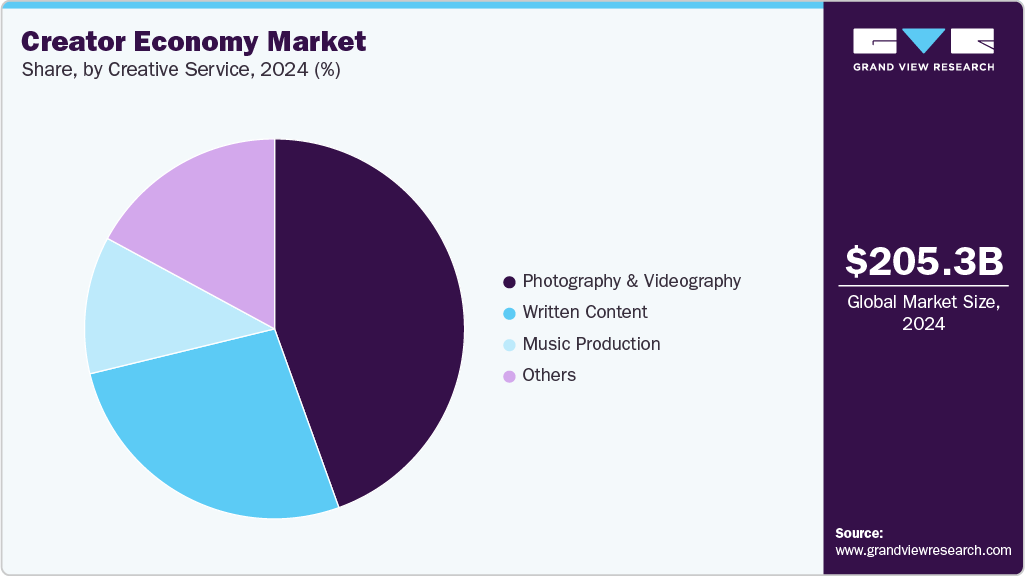
- Based on creative service: The photography & videography segment led the market with the largest revenue share of 44.3% in 2025.
- Based on revenue channel: The advertising segment led the market with the largest revenue share of 36% in 2025.
- Based on end use: The individual content creators segment led the market with the largest revenue share of 57.2% in 2025.
Regional Highlights
- Largest regional market: North America (33.2% revenue share, 2025)
- Fastest-growing regional market: Asia Pacific (highest CAGR, 2026-2033)
- By country: The U.S held the largest market share in 2025.
Market Size & Forecast
- Market size in 2025: USD 252.3 Billion
- Estimated market size in 2026: USD 310.4 Billion
- Projected market size by 2033: USD 1345.5 Billion
- CAGR (2026-2033): 23.3%
Three ways to get this report
Buy it, customize it, or ask a question.Ask an Analyst
Analyst response in 1 business day
- AccessReport author, directly
- Reply timeWithin 1 working day
- No sales callDirect answer only
- FormatEmail reply
- CostFree, no cost
Get the Full Report
What the study covers
- FormatsPDF · Excel · Dashboard
- Timeline2026–2033 annual, 2025 base
- Coverage20+ countries, 5 regions
- Companies10+ key players profiled
Customize the Report
20% free customization
- IncludeCountries, segments, points
- TailorTo your product definition
- ExtendDeeper competitor detail
- OrA fully bespoke study
- Turnaround5–10 working days
Social media’s penetration, combined with the rise of influencer culture, allows creators to build strong personal brands and diverse revenue streams through sponsorships, subscriptions, and affiliate marketing. Technological improvements in content creation tools and easier access to global markets have lowered barriers for emerging creators, establishing a dynamic ecosystem where entrepreneurship and creativity intersect. In addition, increasing consumer demand for authentic and personalized content encourages ongoing innovation and diversification within the creator economy, further accelerating market expansion.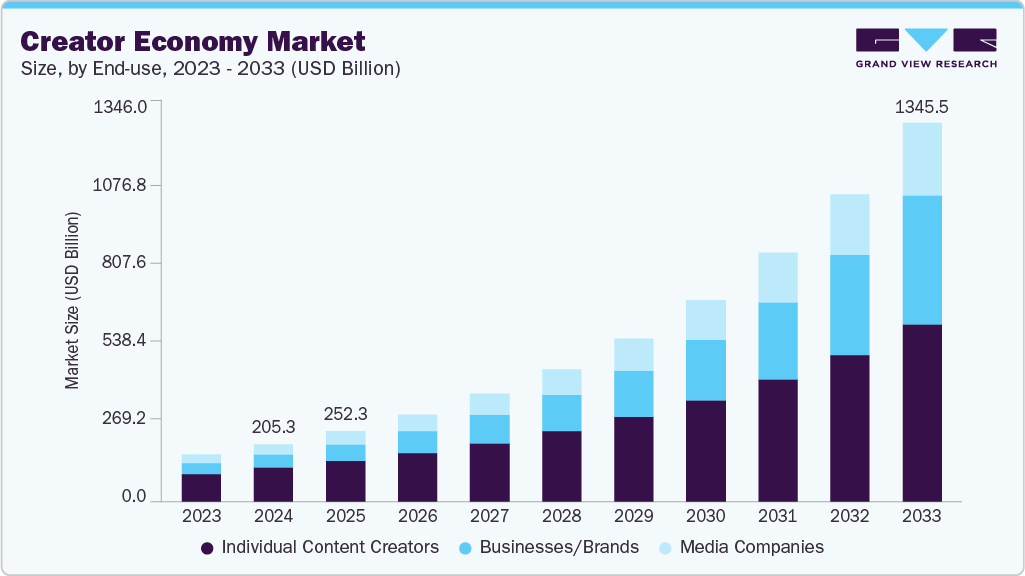 To learn more about this report, Download Free Sample Report
 Moreover, the growth is driven by continuous innovation in monetization models and platform features that enhance creator independence and profitability. Increasing integration of AI-powered tools automates content production, audience engagement, and data analytics, allowing creators to scale output and refine strategies more efficiently. In addition, brand partnerships are shifting focus toward authentic, niche micro-creators who generate higher engagement within targeted communities, expanding collaboration opportunities across industries. The blending of social interaction and e-commerce continues, as creators leverage shoppable content and live sales to convert audience attention directly into revenue.
Furthermore, increasing internet access and mobile device usage globally support the scalability of the creator economy, drawing diverse populations into creator ecosystems beyond traditional markets. Platforms are evolving with improved analytics, community-building features, and cross-platform strategies to meet the complex demands of creators and brands alike. Advances in blockchain, digital ownership, and creator-led commerce provide new models for revenue and audience relationships. Together, these factors enable the sustainable expansion of the market as the creator economy transforms the digital content landscape into a multi-billion-dollar industry.
Market Dynamics
The creator economy market is experiencing substantial growth driven by the increasing consumption of digital content, rising adoption of influencer marketing strategies, and the expanding availability of creator monetization platforms. Businesses are increasingly partnering with creators to enhance brand visibility, improve customer engagement, and deliver more authentic marketing campaigns, accelerating investments across creator-focused ecosystems worldwide. Furthermore, advancements in AI-powered content creation tools, audience analytics, creator commerce solutions, and subscription-based monetization models are enabling creators to scale their operations, diversify revenue streams, and transform content creation into sustainable digital businesses.
The creator economy market is being driven by the growing consumer preference for personalized, authentic, and niche digital content across social media, video streaming, podcasts, newsletters, and online communities. The creator economy comprises influencers, educators, gamers, writers, musicians, and other digital entrepreneurs who monetize their audiences through advertising, sponsorships, subscriptions, affiliate marketing, merchandise sales, and direct fan contributions. The rapid expansion of platforms such as YouTube, Instagram, TikTok, Patreon, and Substack is significantly increasing opportunities for individuals to build audiences and generate sustainable income.
As brands allocate larger portions of marketing budgets to influencer partnerships and community-based advertising, creators are becoming essential channels for customer engagement and product promotion. At the same time, advancements in artificial intelligence, content production software, analytics, and e-commerce tools are enabling creators to scale operations more efficiently. These integrated platforms provide monetization, audience management, and commerce capabilities that support the continued expansion of the global creator economy.
Despite robust growth, the creator economy market faces several challenges related to income volatility and reliance on platform-controlled ecosystems. Many creators depend heavily on social media algorithms and platform policies to maintain visibility and monetization. Changes in content recommendation systems, advertising rules, or account restrictions can significantly affect audience reach and earnings.
Revenue inconsistency is another major concern, particularly for emerging creators who may struggle to secure sponsorships, maintain subscriber growth, or diversify income streams. Increasing competition across content categories makes it more difficult to attract and retain audiences. In addition, creators must manage production costs, legal compliance, taxation, and intellectual property protection. Mental burnout and pressure to produce continuous content also pose challenges that may limit long-term sustainability in the market.
The rapid development of AI-powered content tools embedded financial services, and direct-to-consumer commerce platforms presents significant opportunities for the creator economy market. Artificial intelligence solutions for video editing, script generation, translation, graphic design, and audience analysis are reducing production time and enabling creators to reach broader global audiences.
At the same time, fintech platforms offering payment processing, tax management, business banking, and creator financing are helping creators operate as scalable digital businesses. Platforms such as Shopify, Kajabi, and Stripe are enabling creators to sell courses, memberships, merchandise, and digital products directly to consumers. As ownership-driven monetization models continue to expand, the creator economy is expected to experience substantial growth across both developed and emerging markets.
Market Concentration & Characteristics
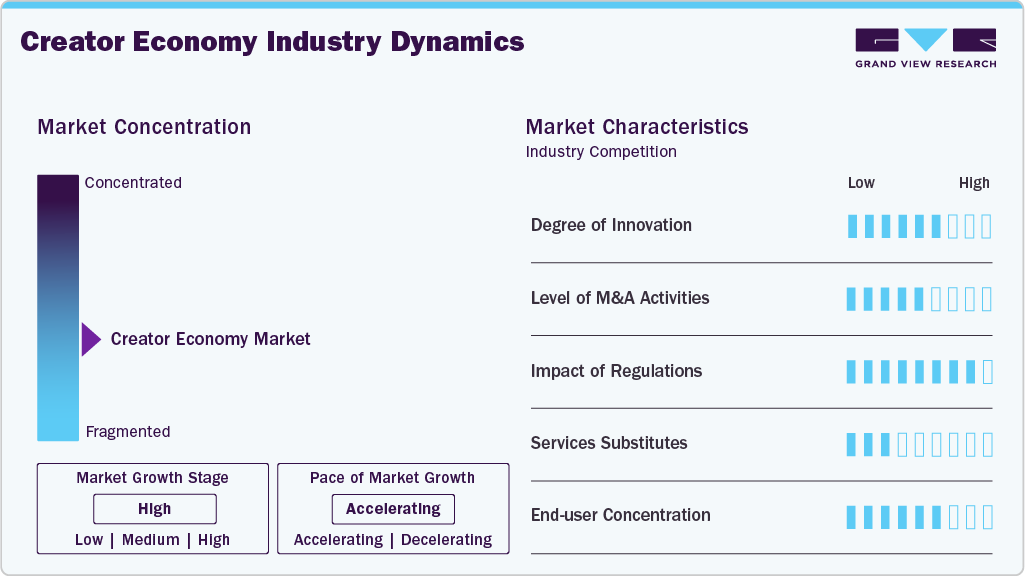
The Creator Economy Market is highly fragmented, with a broad mix of social media platforms, creator monetization providers, e-commerce companies, fintech firms, and software developers competing to support influencers, content creators, educators, gamers, and digital entrepreneurs worldwide. Leading companies such as Meta Platforms, Alphabet Inc., ByteDance, Patreon, and Shopify leverage large global user bases, integrated monetization ecosystems, advanced analytics tools, and strong payment infrastructure to maintain their competitive positions. At the same time, numerous startups and niche platforms intensify market competition by offering specialized solutions for newsletters, podcast monetization, community management, online course creation, and creator-focused financial services.
 To learn more about this report, Download Free Sample Report
 The Creator Economy Market faces competition from alternative monetization and digital business models, such as traditional media networks, e-commerce marketplaces, and independent business websites that allow individuals and brands to generate revenue without relying on dedicated creator economy platforms. In some cases, creators may choose to monetize through personal websites, standalone online stores, or direct consulting and coaching services, reducing their dependence on social media platforms and specialized creator monetization tools.
Analyst Perspective
The creator economy market is being propelled by a powerful combination of digital content consumption growth, increasing creator monetisation opportunities, and the ongoing decentralization of media and commerce. As brands continue to reallocate marketing expenditures toward influencer-led campaigns and consumers increasingly seek authentic, community-driven content experiences, creators are emerging as critical channels for audience engagement and customer acquisition. The market's long-term growth potential will be driven by platforms that enable creators to diversify revenue streams through advertising, subscriptions, brand partnerships, affiliate commerce, and digital product sales. Furthermore, advancements in AI-powered content creation, audience analytics, and creator management tools are lowering barriers to entry while enhancing scalability, positioning the creator economy as a rapidly expanding pillar of the broader digital economy.
End-use Insights
Based on end use, the individual content creators segment led the market with the largest revenue share of 57.2% in 2025 of global revenue, owing to leveraging platform democratization and direct audience monetization across diverse verticals such as lifestyle, gaming, fitness, and education. Their agility in adopting new formats and building authentic engagement drives audience loyalty and consistent revenue streams through tips, merchandising, and ad-sharing programs. The low barrier to entry and availability of accessible creation tools encourage a continuous influx of new creators. Personalized content strategies and the ability to quickly respond to trends enable these creators to capture and convert large, international audiences. The breadth and diversity of independent creators contribute to sustained monetization and high overall market participation.
 To learn more about this report, Download Free Sample Report
 The businesses/brands segment is predicted to experience significant growth during the forecast period. Businesses and brands increasingly invest in creator-led campaigns and branded content initiatives, using data-driven strategies for influencer partnerships and sponsored storytelling. As consumer trust shifts toward authentic micro-influencer endorsements and value-driven narratives, brands are moving away from traditional advertising and deploying co-creation models with content creators to boost engagement. Automation tools streamline campaign management, while platforms introduce comprehensive analytics for impact tracking. Brands diversify revenue through digital product launches, webinars, and online communities, harnessing creator expertise to enter new markets.
Platform Type Insights
Based on platform type, the video streaming segment led the market with the largest revenue share of 52.2% in 2025. Video streaming platforms such as YouTube, Twitch, and emerging short-form apps dominate revenue generation due to broad user reach and multifaceted monetization. Viewers prefer video for its immediacy, interactivity, and expressive depth, driving the popularity of live streams, product reviews, gaming sessions, and educational content. Streamers generate income from ad revenue, tipping, paid subscriptions, and sponsored integrations. Advanced AI content discovery and recommendation systems enable surface creator content to relevant audiences, boosting engagement and monetization.
The podcasting platform segment is expected to grow at a significant CAGR during the forecast period. Podcasts engage diverse audiences through accessible, on-demand content tailored for multitasking and community-building. Growth in branded podcasts, subscription models, and advertising integration supports diversified revenue streams for both creators and platforms. The ability to build niche audiences and deepen engagement through serialized storytelling sets podcasts apart from other media. Streaming services and audio platforms invest in exclusive show deals and analytics for better audience targeting. Increased adoption of smart speakers and in-vehicle audio connectivity extends the market reach for podcasting.
Revenue Channel Insights
Based on revenue channel, the advertising segment led the market with the largest revenue share of 36% in 2025 and is expected to grow at the fastest CAGR over the forecast period, due to high ROI in influencer marketing, branded content, and native ad partnerships. Platforms deploy automated ad insertion, real-time bidding, and contextual ad placements that optimize return for both brands and creators. Increasing investment in data analytics and campaign measurement supports targeted outreach and improved conversion rates. The authenticity of creator endorsements and the ability to engage niche communities reinforce advertising’s leading role. Innovation in shoppable content and integrated commerce further amplifies advertising-driven revenues.
The subscription segment is anticipated to grow at the fastest CAGR during the forecast period. The rise of subscription-based platforms empowers creators to secure recurring income while delivering exclusive experiences, tutorials, and content bundles to dedicated followers. Flexible payment structures allow fans to support the creators directly, enhancing financial stability and creative independence. Community-building features such as Q&As, private chats, and early releases increase subscribers' engagement. Platforms continue to innovate with tiered access, bundled services, and bundled community benefits, diversifying offerings and increasing subscriber loyalty.
Creative Service Insights
Based on creative service, the photography & videography segment led the market with the largest revenue share of 44.3% in 2025. Creators specializing in photography and videography capitalize on the growing demand for high-quality visual content across social media, advertising, and digital storytelling. Platforms supporting image and short-form video sharing enable direct monetization through licensing, paid collaborations, and premium content offerings. Tools for editing, distribution, and analytics empower visual creators to optimize their workflows and expand audience exposure. The prevalence of visually driven digital marketing by brands, agencies, and independent businesses further supports revenue growth in this segment.
The music production segment is expected to grow significantly during the forecast period. Music creators benefit from streaming platforms, digital distribution, and direct-to-fan monetization, including digital sales, virtual concerts, and crowdfunded projects. Integration of royalty tracking and licensing systems increases transparency and income opportunities for independent musicians. AI-powered music composition and audio editing advances simplify content creation, encouraging new entrants and diversifying genre experimentation. Social media challenges, sound branding, and influencer-driven music promotion drive discoverability for new releases, while virtual collaborations expand potential reach.
Regional Insights
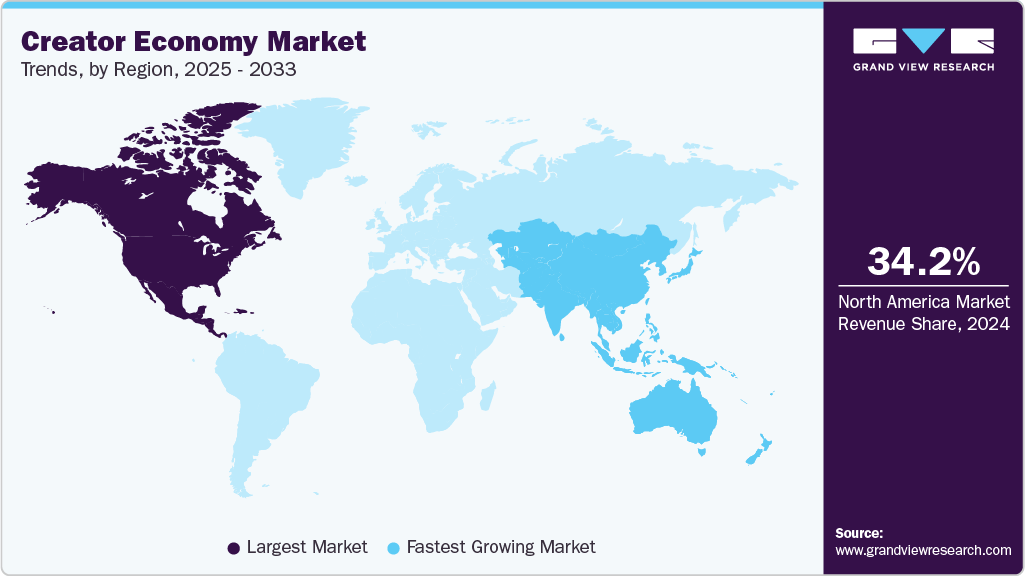
North America dominated the creator economy market with the largest revenue share of 33.2% in 2025 due to high digital adoption, cultural entrepreneurship, and established creator platforms with global reach. Strong investment flows and favorable legal frameworks support innovation in monetization tools, content rights management, and creator-platform relationships. The region benefits from mature advertising ecosystems and collaborative partnerships between tech companies and content creators. Early adoption of emerging formats, such as NFTs and AR experiences, provides new monetization channels.
 To learn more about this report, Download Free Sample Report
 U.S. Creator Economy Market Trends
The creator economy market in the U.S. held the largest share in the North America region in 2025, driven by a strong pipeline of creative talent, technology start-ups, and diversified revenue models for creators. The U.S. hosts content incubators, multimedia production studios, and accelerator programs that support emerging creators in turning passion projects into sustainable businesses. Corporate brands allocate significant budgets to creator collaborations and influencer marketing, driving innovation in branded content and direct-to-fan commerce.
Europe Creator Economy Market Trends
The creator economy market in Europe is expected to grow significantly over the forecast period, driven by increasing creator adoption of multilingual content, cross-border brand partnerships, and platform localization. Regulations supporting digital rights, fair compensation, and data privacy encourage participation from both creators and consumers. Expansion of influencer networks in verticals such as fashion, travel, and sustainability fuels partnerships across industries. Online education and knowledge-sharing content tailored for European audiences add new growth avenues.
Asia Pacific Creator Economy Market Trends
The creator economy industry in the Asia Pacific region is anticipated to grow at the fastest CAGR over the forecast period, driven by high mobile internet penetration, youthful demographics, and a thriving e-commerce environment. Regional platforms and super-apps introduce innovative creator monetization tools such as live gifting, social commerce integration, and virtual fan clubs. Online marketplaces and collaborative content formats lower barriers for new creators in hyper-local and niche categories. National campaigns supporting digital entrepreneurship and creator upskilling contribute to sector dynamism. The growing pool of multilingual, culturally diverse creators enhances the region's global influence and revenue potential.
Key Creator Economy Company Insights
Some key companies in the creator economy industry are ByteDance Ltd., Meta Platforms, Inc., Patreon, and Vimeo.com, Inc.
-
ByteDance Ltd. operates a diverse portfolio of content platforms, with TikTok as its flagship app, serving billions of users worldwide. The company integrates advertising, e-commerce, and content strategies to support creator monetization and brand partnerships, driving substantial revenue growth. Its global expansion focuses on enhancing user engagement through AI-powered content recommendation and localized experiences. ByteDance Ltd. continues to invest in advanced AI technologies to improve content creation, distribution, and personalized interactions within the creator economy.
-
Meta Platforms, Inc. delivers a broad suite of social media and digital content services, enabling creators and businesses to engage audiences across platforms such as Facebook, Instagram, and WhatsApp. The company emphasizes AI-driven tools for audience analytics, content optimization, and monetization solutions, supporting diverse creator communities. It integrates e-commerce and advertising features to enhance creator revenue streams and brand collaborations. Continuous development of augmented reality and interactive content further expands creator opportunities within its ecosystem.
Key Creator Economy Companies
The following key companies have been profiled for this study on the creator economy market.
-
Google LLC
-
ByteDance Ltd.
-
Meta Platforms, Inc.
-
Patreon
-
Amazon.com, Inc.
-
Substack Inc.
-
Canva
-
Baron App, Inc.
-
Vimeo.com, Inc.
-
Ko-fi Labs
Competitive Benchmarking
Operating Strategies
Competitive Edge
Weaknesses
Mature Players: Google LLC; ByteDance Ltd.; Meta Platforms, Inc.; Amazon.com, Inc.
- Focus on expanding creator ecosystems through strategic partnerships across social media, e-commerce, fintech, and content production tools.
- Invest heavily in research and development to deliver advanced AI-powered creation tools, enhanced monetization features, and scalable community management platforms.
- Strong global presence and large creator communities support market leadership.
- Ability to deliver end-to-end platforms with content creation, monetization, and audience management tools.
- Broad platform ecosystems and legacy business structures can make it more challenging to respond quickly to changing creator preferences and emerging monetization trends.
- Large organizational frameworks may slow feature rollouts and reduce flexibility compared with specialized creator-focused startups.
Emerging Players: Patreon; Substack Inc.; Baron App, Inc.; Ko-fi Labs
- Limited financial resources and smaller user bases can constrain large-scale platform expansion and product development
- Lower brand recognition and creator trust may hinder adoption compared with established global platforms.
- Faster go-to-market allows swift integration of new content formats and revenue models.
- Tailored, creator-focused offerings help these companies stand out in niche areas of the creator economy.
- Constrained capital and a modest market footprint can limit investments in platform scaling and advanced feature development.
- Weaker brand visibility and lower creator confidence may slow adoption relative to well-established global platforms.
Recent Developments
-
In March 2025, the government of India announced the establishment of a USD 1 billion fund alongside an allocation of approximately USD 47 million to the Indian Institute of Creative Technology, aimed at adapting innovation and skill development within the creative industries. In addition, the WAVES 2025 summit was launched to provide further support and networking opportunities for content creators. This momentum is important for advancing India’s strategic objective of becoming a leading global exporter of digital content.
-
In March 2025, UNESCO and the Knight Center for Journalism in the Americas collaboratively organized a comprehensive training program targeting leading content creators and journalists. The initiative attracted over 10,000 participants who engaged in sessions focused on adapting audience trust, ethically influencing public opinion, and developing compelling content to enhance media and information literacy. This collaboration reflects ongoing efforts to strengthen journalistic standards and promote responsible communication in the digital age.
-
In February 2025, Gushcloud International partnered with Azure Capital Partners to establish the Azure-Gushcloud Entertainment Finance Fund. This fund is designed to offer structured financial support to digital creators, facilitating the expansion of their brand collaborations, content monetization, and licensing activities on a global scale. The initiative aims to empower creators by providing the necessary capital resources to accelerate growth and maximize revenue opportunities within the evolving digital entertainment ecosystem.
Creator Economy Market Report Scope
Report Attribute
Details
Market size value in 2025
USD 252.3 billion
Market size value in 2026
USD 310.4 billion
Revenue forecast in 2033
USD 1,345.5 billion
Growth rate
CAGR of 23.3% from 2026 to 2033
Base year for estimation
2025
Historical data
2021 - 2024
Forecast period
2026 - 2033
Quantitative units
Revenue in USD million/billion and CAGR from 2026 to 2033
Report coverage
Revenue forecast, company ranking, competitive landscape, growth factors, and trends
Segments covered
Platform Type, Creative Service, Revenue Channel, End Use, region
Regional scope
North America; Europe; Asia Pacific; Latin America; MEA
Country scope
U.S.; Canada; Mexico; Germany; UK; France; China; Japan; India; South Korea; Australia; Brazil; Saudi Arabia; South Africa; UAE
Key companies profiled
Google LLC; ByteDance Ltd.; Meta Platforms, Inc.; Patreon; Amazon.com, Inc.; Substack Inc.; Canva; Baron App, Inc.; Vimeo.com, Inc.; Ko-fi Labs
Customization scope
Free report customization (equivalent up to 8 analysts' working days) with purchase. Addition or alteration to country, regional & segment scope.
Pricing and purchase options
Avail customized purchase options to meet your exact research needs. Explore purchase options
Global Creator Economy Market Report Segmentation
This report forecasts revenue growth at global, regional, and country levels and provides an analysis of the latest industry trends in each of the sub-segments from 2021 to 2033. For this study, Grand View Research has segmented the global creator economy market report based on end-use, platform type, creative service, revenue channel, and region.
-
End-use Outlook (Revenue, USD Billion, 2021 - 2033)
-
Individual Content Creators
-
Businesses/Brands
-
Media Companies
-
-
Platform Type Outlook (Revenue, USD Billion, 2021 - 2033)
-
Video Streaming
-
Blogging Platform
-
Podcasting Platform
-
Others
-
-
Creative Service Outlook (Revenue, USD Billion, 2021 - 2033)
-
Written Content
-
Photography & Videography
-
Music Production
-
Others
-
-
Revenue Channel Outlook (Revenue, USD Billion, 2021 - 2033)
-
Advertising
-
Subscriptions
-
Tips/Donations
-
Affiliate Marketing
-
Brand Partnerships
-
Others
-
-
Regional Outlook (Revenue, USD Billion, 2021 - 2033)
-
North America
-
U.S.
-
Canada
-
Mexico
-
-
Europe
-
Germany
-
UK
- France
-
-
Asia Pacific
-
China
-
Japan
-
India
-
South Korea
-
Australia
-
-
Latin America
-
Brazil
-
-
Middle East and Africa (MEA)
-
UAE
-
KSA
-
South Africa
-
-
Research Methodology
Segment Definition
Segment - Platform Type
Revenue capture definition
Video Streaming
Video streaming platforms are digital channels that enable creators to distribute and monetize video-based content to audiences through on-demand or live-streaming formats. These platforms support audience engagement, content discovery, advertising, subscriptions, and other monetization mechanisms for creators and media organizations.
Blogging Platform
Blogging platforms are online publishing environments that allow individuals and organizations to create, manage, and distribute written content across diverse topics and industries. These platforms provide tools for content creation, audience development, search engine visibility, and revenue generation through various monetization models.
Podcasting Platform
Podcasting platforms are digital services that facilitate the hosting, distribution, streaming, and monetization of audio-based content. They enable creators to reach listeners through episodic audio programming while supporting advertising, subscriptions, sponsorships, and audience analytics.
Others
The others segment includes emerging and niche content distribution platforms such as newsletters, community-based platforms, social audio networks, and interactive creator ecosystems. These platforms address specialized audience engagement requirements and provide alternative content monetization opportunities.
Segment - Creative Service
Revenue capture definition
Written Content
Written content refers to the creation of text-based materials, including articles, blogs, newsletters, scripts, and educational resources intended for digital or traditional distribution. This service supports audience engagement, information dissemination, brand communication, and content marketing initiatives.
Photography & Videography
Photography and videography encompass the production of visual content through still images and video formats for commercial, entertainment, educational, and promotional purposes. These services play a critical role in enhancing audience engagement and supporting digital storytelling strategies.
Music Production
Music production involves the creation, recording, editing, and distribution of audio content, including music tracks, sound effects, and audio compositions. The segment supports artists, content creators, brands, and media organizations in developing professional audio experiences for various applications.
Others
The others segment includes creative services such as graphic design, animation, illustration, voice-over production, and digital art creation. These services enhance content quality, brand identity, and audience engagement across multiple digital channels.
Segment - Revenue Channel
Revenue capture definition
Advertising
Advertising refers to revenue generated through the placement of promotional content, display advertisements, sponsored messages, or video ads within creator-generated content. This model enables creators and platform operators to monetize audience reach and engagement at scale.
Subscriptions
Subscriptions involve recurring payments made by users to access exclusive content, premium features, or ad-free experiences offered by creators or platforms. This revenue model provides predictable income streams and supports long-term audience relationships.
Tips/Donations
Tips and donations represent voluntary financial contributions made directly by audiences to support creators and their content. This monetization channel allows creators to generate revenue through community support without requiring mandatory payment structures.
Affiliate Marketing
Affiliate marketing is a performance-based revenue model in which creators earn commissions by promoting third-party products or services and driving customer actions. This channel enables creators to monetize audience influence while supporting brand marketing objectives.
Brand Partnerships
Brand partnerships involve formal collaborations between creators and organizations to develop sponsored content, promotional campaigns, or co-branded initiatives. These arrangements provide creators with revenue opportunities while enabling brands to access targeted and engaged audiences.
Others
The others segment includes alternative monetization channels such as merchandise sales, licensing agreements, digital product sales, crowdfunding, and event-based revenue generation. These channels help creators diversify income sources and reduce dependence on traditional monetization models.
Segment - End Use
Revenue capture definition
Individual Content Creators
Individual content creators are independent professionals or influencers who produce and distribute content across digital platforms to engage audiences and generate revenue. This segment includes creators operating independently across various content formats and monetization strategies.
Businesses/Brands
Businesses and brands utilize content creation platforms and services to support marketing, customer engagement, brand awareness, and lead generation objectives. These organizations increasingly leverage creator-driven content strategies to strengthen digital presence and audience connections.
Media Companies
Media companies are organizations engaged in the production, distribution, and monetization of content across digital, broadcast, and publishing channels. These entities leverage creator platforms and content ecosystems to expand audience reach, diversify revenue streams, and enhance content delivery capabilities.
Estimation Model
Creator Base Layer
Active Platform Layer
Monetization Layer
Revenue Generation Layer
Who creates digital content?
Who actively engages on creator platforms?
Who generates revenue from content creation?
How much revenue is generated?
Identify the global population of individuals producing content across social media, video-sharing, blogging, podcasting, livestreaming, and other creator platforms. This layer defines the total creator ecosystem, including professional, semi-professional, and emerging creators participating in digital content creation.
Apply platform participation and activity rates to the total creator base using metrics such as monthly active creators, content publishing frequency, and platform engagement levels. This step derives the digitally active creator population that consistently utilizes creator economy platforms and tools.
Apply creator monetization rates based on advertising participation, subscriptions, donations, affiliate marketing, merchandise sales, and brand collaborations. This layer converts active creators into revenue-generating creators who participate in one or more monetization channels.
Multiply monetized creators by blended annual creator earnings and platform-generated revenue across advertising, subscriptions, sponsorships, affiliate commissions, digital product sales, and commerce transactions. Add platform service revenues, creator tools, and ecosystem-related expenditures to estimate the total Creator Economy Market value.
Delivered Customizations
This report has been delivered with the following In-depth customizations
Client Request
Customization Delivered
Value Adds
Go-to-Market Strategy for a Creator-Focused Fintech Solution
Assessment of creator income patterns, cash flow challenges, and financing needs
Analysis of payment processing, tax management, and business banking solutions
Identified unmet financial service opportunities
Supported product-market fit and partnership strategy
Strategic Analysis of AI Tools for Content Creation and Productivity
Benchmarking of AI-based video editing, script generation, translation, and design tools
Analysis of pricing, usability, and integration capabilities
Identified high-demand AI use cases
Supported product innovation and feature prioritization
About the Author(s)
Next Generation Technologies Research Team
Technology · Next Generation TechnologiesThis report was authored by the next generation technologies research team at Grand View Research - comprising two research analysts, one senior research analyst, and one industry expert - with specialized expertise in the next generation technologies segment of the technology industry. All findings are based on proprietary technology databases, executive interviews, and regulatory analysis, subject to internal peer review prior to publication.
Last Updated:
Speak to Analyst

Customize this report to your needs - add regions, segments, or data points, with 20% free customization.
Or view our licence options:


ISO 9001:2015 & 27001:2022 Certified
We are GDPR and CCPA compliant! Your transaction & personal information is safe and secure. For more details, please read our privacy policy.


