
- Home
- »
- Next Generation Technologies
- »
-
Corporate Learning Management System Market Report, 2033GVR Report cover

Corporate Learning Management System Market (2026 - 2033)
Size, Share & Trends Analysis Report By Component (Software, Services), By Deployment (Cloud, On-premises), By End User (Healthcare, Banking, Financial Services, and Insurance (BFSI)), By Region, And Segment Forecasts
Market Size, 2025
$11.3BMarket Estimate, 2026
$13.4BMarket Forecast, 2033
$46.1BCAGR, 2026–2033
19.3%Corporate Learning Management System Market Summary
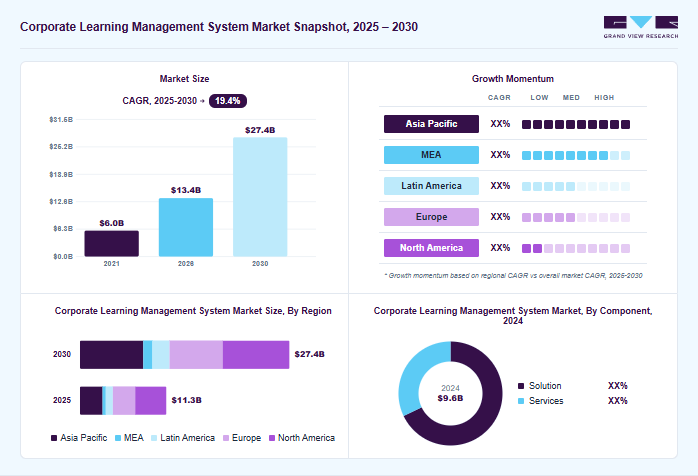
The global corporate learning management system market size was valued at USD 11.3 billion in 2025 and is projected to grow from USD 13.4 billion in 2026 to USD 46.1 billion by 2033, at a CAGR of 19.3% from 2026 to 2033. dominated the market, accounting for a revenue share of 36.2% in 2025. The corporate learning management system (LMS) market is experiencing strong growth due to increasing enterprise investments in employee upskilling and workforce development.
 Source: Grand View Research, IR Documents, Primary Interviews, Paid DatabasesTo learn more about this report,
 Download Free Sample Report
 Key Market Trends & Insights
- By component: solution segment held a significant 67.7% revenue share in 2025.
- By deployment: Cloud segment held the largest revenue share in 2025.
- By end user: IT and Telecommunication segment held a significant 34.0% revenue share in 2025.
Regional Highlights
- Largest regional market: North America (36.2% revenue share, 2025)
- Fastest growing regional market: Asia Pacific (highest CAGR, 2026-2033)
- By country: The U.S. held the largest market share in 2025.
Market Size & Forecast
- Market size in 2025: USD 11.3 Billion
- Estimated market size in 2026: USD 13.4 Billion
- Projected market size by 2033: USD 46.1 Billion
- CAGR (2026-2033): 19.3%
Three ways to get this report
Buy it, customize it, or ask a question.Ask an Analyst
Analyst response in 1 business day
- AccessReport author, directly
- Reply timeWithin 1 working day
- No sales callDirect answer only
- FormatEmail reply
- CostFree, no cost
Get the Full Report
What the study covers
- FormatsPDF · Excel · Dashboard
- Timeline2026–2033 annual, 2025 base
- Coverage20+ countries, 5 regions
- Companies10+ key players profiled
Customize the Report
20% free customization
- IncludeCountries, segments, points
- TailorTo your product definition
- ExtendDeeper competitor detail
- OrA fully bespoke study
- Turnaround5–10 working days
The adoption of cloud-based LMS platforms, AI-powered learning solutions, and remote training programs is accelerating market expansion across industries. The shift toward remote and hybrid work models has accelerated the adoption of cloud-based learning management system (LMS) platforms, allowing companies to deliver consistent and accessible training to distributed teams. This trend is particularly strong in industries with strict compliance requirements or rapidly changing skill needs, such as healthcare, finance, IT, and manufacturing.Corporate LMS adoption in the corporate sector is a growing need for upskilling and reskilling. As automation and digital transformation reshape job roles, companies are leveraging LMS tools to close skill gaps and align employee capabilities with evolving business demands. The LMS has evolved from a static course repository into a dynamic platform that supports interactive, personalized, and performance-driven learning experiences.
 To learn more about this report, Download Free Sample Report
 Moreover, modern corporate LMS platforms are increasingly integrated with technologies like artificial intelligence and analytics to deliver tailored learning paths, track employee progress, and provide insights into training effectiveness. These features enable HR and L&D departments to design more strategic and impactful learning programs. Mobile learning and microlearning are also shaping the future of corporate training. Employees prefer short, flexible content that can be accessed on demand, especially via mobile devices. LMS providers are responding with mobile-optimized platforms and engaging formats such as video modules, simulations, and gamified lessons.
Market Dynamics
The global corporate learning management system (LMS) market is driven by increasing digitalization, evolving workforce training requirements, and growing adoption of online learning solutions across organizations. Rising investments in employee development and continuous learning are supporting market expansion across industries. Moreover, ongoing technological advancements and changing business needs are expected to create sustained growth opportunities during the forecast period.
The increasing adoption of digital learning and training solutions across enterprises is a major factor driving the growth of the corporate learning management system market. Organizations are increasingly replacing traditional classroom-based training with digital platforms to improve accessibility, reduce training costs, and provide employees with flexible learning opportunities. These solutions enable businesses to deliver consistent training programs across multiple locations while supporting continuous learning and skill development.
Corporate LMS platforms help organizations centralize learning content, monitor employee progress, and streamline the administration of training programs. They also support a wide range of learning formats, including self-paced courses, virtual instructor-led sessions, and mobile learning, making training more accessible and efficient. As businesses continue to prioritize workforce development, operational efficiency, and digital transformation, the adoption of corporate LMS solutions is expected to increase steadily across industries, supporting long-term market growth.
The adoption of corporate learning management system (LMS) solutions can be restrained by the high costs associated with implementation, customization, and ongoing maintenance. Organizations often need to invest in software deployment, employee training, system upgrades, and technical support, which can be a significant burden, particularly for small and medium-sized enterprises (SMEs). These upfront and recurring costs may delay or limit LMS adoption.
In addition, integrating LMS platforms with existing enterprise systems, such as human resource management systems (HRMS), customer relationship management (CRM) platforms, and other business applications, can be complex and time-consuming. Compatibility issues, data migration challenges, and the need for technical expertise may increase implementation timelines and costs. These factors can slow adoption, particularly among organizations with limited IT resources or budget constraints.
The increasing integration of artificial intelligence (AI) and advanced analytics into corporate learning platforms is creating significant growth opportunities for the corporate learning management system (LMS) market. AI-powered LMS solutions can deliver personalized learning paths, recommend relevant training content, automate administrative tasks, and provide insights into learner performance. These capabilities help organizations improve employee engagement, learning outcomes, and overall training efficiency.
The growing demand for continuous learning and skills development is encouraging organizations to invest in intelligent and scalable learning platforms. Emerging technologies such as AI, machine learning, and learning analytics are enabling more adaptive and data-driven training experiences, allowing businesses to better address evolving workforce needs. As enterprises continue to modernize their learning strategies, the adoption of AI-enabled LMS solutions is expected to create substantial market opportunities during the forecast period.
Market Concentration & Characteristics
The global corporate learning management system (LMS) market is moderately fragmented, with the presence of established enterprise software providers, cloud-based LMS vendors, and specialized learning technology companies. No single company holds a dominant position, as competition is distributed among multiple global and regional players. Vendors offer a broad range of solutions to address the diverse learning and training requirements of organizations across industries. The availability of industry-specific and customizable platforms further increases the number of active market participants. This competitive landscape contributes to the market's moderately fragmented structure.
 To learn more about this report, Download Free Sample Report
 Market participants compete by focusing on product innovation, strategic partnerships, acquisitions, and geographic expansion to strengthen their market presence. Companies are continuously enhancing their platforms by improving functionality, scalability, and integration with enterprise applications. The increasing adoption of cloud-based technologies and advanced digital learning capabilities is further intensifying competition. Vendors are also expanding their service portfolios to meet evolving customer requirements and improve user experience. These strategies are expected to maintain a competitive and moderately fragmented market throughout the forecast period.
Analyst Perspective
The corporate learning management system market is expected to witness strong growth as organizations increasingly prioritize digital training, upskilling, and reskilling initiatives. Demand is being supported by the shift toward cloud-based learning platforms, mobile learning, and AI-enabled personalized learning experiences. Large vendors continue to expand their offerings through integrations, analytics, and automation, while niche players compete with specialized and industry-focused solutions. The market remains highly competitive, with vendor differentiation driven by ease of deployment, user experience, content management, and ROI. The market outlook remains positive, with sustained growth expected as enterprises continue investing in workforce development and learning transformation.
Component Insights
Based on component, solution segment led the market with a significant revenue share of 67.7% in 2025. The segment is growing due to enhanced technological features in chatbot software, like mobile platform compatibility, cloud-based deployment, interference engine, multilingual capabilities, Natural Language Processing (NLP), Application Programming Interface (API), and single point of search.Compared to rule-based chatbots, artificial intelligence software-powered chatbots are the most sophisticated since machine-learning chatbots are typically more conversational, data-driven, and predictive. No matter how the inquiries are expressed, the AI software-based chatbots cannot only comprehend the patient's intent but also provide precise responses. For instance, they can schedule consultations and use a symptom checker to diagnose the illness.
The service segment is expected to grow at a CAGR of 20.1% over the forecast period. The service component in corporate language learning management plays a critical role in ensuring the effectiveness, scalability, and personalization of language programs. It includes instructional support, content customization, progress tracking, and administrative coordination. Services such as onboarding, needs analysis, and learner assessments help tailor learning paths to business goals. Continuous support via tutors, coaches, or AI-driven platforms fosters engagement and retention. Integration with HR systems enables performance alignment and reporting. Technical support ensures smooth delivery across platforms. Additionally, periodic reviews and feedback loops enhance program relevance. These services collectively improve learning outcomes and ROI for corporations.
Deployment Insights
Based on deployment, the cloud segment led the market with the largest revenue share of 54.7% in 2025. Cloud deployment in corporate language learning management enables scalable, on-demand access to training resources across global teams. It facilitates centralized content delivery, ensuring consistent learning experiences regardless of location. With real-time data analytics, HR and L&D teams can track learner progress, assess engagement, and tailor content. Integration with enterprise systems (e.g., HRIS, CRM) enhances automation and efficiency. Cloud platforms also support mobile learning, crucial for remote or hybrid workplaces. Enhanced data security and compliance features meet corporate governance standards. Cost-effectiveness arises from reduced infrastructure needs and pay-as-you-go models. Overall, cloud deployment accelerates language skill development while aligning with corporate digital transformation strategies.
 To learn more about this report, Download Free Sample Report
 The on-premises segment is expected to grow at a significant CAGR over the forecast period. On-premise deployment in corporate language learning management offers full control over data security, making it ideal for organizations with strict compliance or regulatory needs. It allows for extensive customization to align with internal systems and specific training workflows. Companies maintain direct ownership of infrastructure, enabling tailored updates and integration. However, it requires significant IT resources for maintenance, support, and scalability. Offline access may be more reliable in locations with limited internet connection. While it provides strong internal data governance, initial setup costs are higher compared to cloud solutions. It suits large enterprises with complex IT environments or sensitive data handling. Overall, it prioritizes security and control over flexibility and scalability.
End User Insights
Based on end user, the IT and Telecommunication segment led the market with a significant revenue share of 34.0% in 2025. The need for seamless global collaboration and customer service drives the growth. Multinational teams rely on language skills to enhance cross-border communication and reduce misinterpretations in technical documentation and client interactions. These organizations often adopt AI-powered and cloud-based learning platforms for scalability, personalization, and real-time progress tracking. Integration with internal HR and LMS systems allows tailored training paths aligned with job roles and regional needs. Cybersecurity awareness has also prompted secure language learning environments. Moreover, upskilling in English and other key languages supports competitive positioning in outsourcing and global support functions. Mobile-accessible content and microlearning formats are preferred to suit dynamic work schedules. Overall, language learning fosters agility, operational efficiency, and stronger client engagement.
The healthcare segment is expected to witness significant growth over the forecast period. In the healthcare sector, Language Learning Management Systems (LLMS) are increasingly adopted to enhance communication between staff and patients from diverse linguistic backgrounds. These systems support compliance with regulatory requirements related to patient care and safety. For multinational healthcare providers, LLMS ensures consistent training across regions. It also facilitates the onboarding of non-native employees and improves staff collaboration. With medical terminology being complex, specialized language modules are vital. Hospitals use LLMS to reduce interpretation errors and improve patient satisfaction. Moreover, the rise in telehealth demands clear communication, further emphasizing language training. LLMS in healthcare also aids in meeting accreditation standards and boosting overall operational efficiency.
Regional Insights
North America dominated the corporate learning management system market with the largest revenue share of 36.2% in 2025. The corporate LMS market in North America is experiencing prominent growth, driven by increasing globalization, multilingual workforce demands, and the need for consistent brand messaging across regions. Corporations are investing in LMS solutions to streamline translation workflows, enhance cross-border collaboration, and comply with localization standards. The rise of e-learning, remote work, and AI-powered language tools further accelerates adoption. Key sectors fueling this growth include technology, healthcare, and legal services.
 To learn more about this report, Download Free Sample Report
 U.S. Corporate Learning Management System Market Trends
The corporate learning management system market in the U.S. held the largest share in the North America region in 2025.
Europe Corporate Learning Management System Market Trends
The corporate learning management system (LMS) industry in Europe is being shaped by the continent's emphasis on cultural preservation and multilingual inclusivity. European companies are prioritizing seamless communication with diverse internal teams and external stakeholders, leading to a rise in centralized language platforms. The EU’s support for digital language infrastructure, especially under initiatives like CEF eTranslation, is also propelling adoption. Additionally, regional enterprises are leveraging LMS tools to expand into non-English-speaking markets more efficiently.
Asia Pacific Corporate Learning Management System Market Trends
The Asia Pacific corporate learning management system (LMS) industry is anticipated to register the fastest CAGR over the forecast period. Corporate LMS is experiencing steady growth, driven by increasing globalization, multilingual workforces, and cross-border business operations. Companies are adopting LMS to enhance communication efficiency, compliance, and employee training across diverse linguistic regions. The rise of remote and hybrid work models further fuels demand for scalable digital language solutions. Additionally, regulatory requirements and diversity initiatives are prompting firms to invest in structured language management strategies.
Key Corporate Learning Management System Company Insights
Prominent firms have used product launches and developments, followed by expansions, mergers and acquisitions, contracts, agreements, partnerships, and collaborations as their primary business strategy to increase their market share. The companies have used various techniques to enhance market penetration and boost their position in the competitive industry.
-
Teledyne FLIR designs, develops, manufactures, markets, and distributes SWIR technologies that enhance perception and awareness. The company brings innovative sensing solutions into daily life through thermal imaging, visible-light imaging, video analytics, measurement and diagnostics, and advanced threat detection systems. Teledyne FLIR offers a diversified portfolio that serves a number of applications in government & defense, industrial, and commercial markets. The company’s products help first responders and military personnel protect and save lives, promote efficiency within the trades, and innovate consumer-facing technologies.
-
Hamamatsu Photonics develops and manufactures advanced optical sensors, including high-speed and high-sensitivity photomultiplier tubes. The company produces photodiodes, photo ICs, image sensors, and various opto-semiconductor devices. It also creates specialized systems for life science, medical, and semiconductor industries. Additionally, Hamamatsu designs high-power semiconductor lasers and conducts fundamental and applied research on light. The Global Strategic Challenge Center drives long-term strategic initiatives to ensure sustainable growth.
Key Corporate Learning Management System Companies:
The following are the leading companies in the corporate learning management system market. These companies collectively hold the largest market share and dictate industry trends.
- Accenture
- Adobe
- Oracle
- SAP
- Hermes Logistics Technologies
- McGraw Hill
- Emphasis
- Xerox Corporation
- Berlitz Corporation
- Speexx
- Blackboard Inc.
Competitive Benchmarking
Operating Strategies
Competitive Edge
Weaknesses
Mature Players: Accenture, Adobe, Oracle, SAP, Xerox Corporation
- Focus on strengthening market leadership through continuous product innovation, AI-enabled learning capabilities, cloud-based deployments, strategic partnerships, acquisitions, and expansion across global enterprise customers.
- Strong global brand recognition, extensive enterprise customer base, comprehensive product portfolios, established partner networks, robust R&D capabilities, and the ability to support complex organizational requirements at scale.
- Higher implementation and subscription costs, longer deployment timelines, greater product complexity, and comparatively lower flexibility for highly specialized or niche customer requirements.
Emerging Players: Hermes Logistics Technologies, McGraw Hill, Emphasis
- Focus on expanding market presence through niche industry solutions, rapid product enhancements, flexible deployment models, competitive pricing, and customer-centric service offerings.
- High operational agility, faster innovation cycles, specialized industry expertise, customizable solutions, cost-effective offerings, and the ability to respond quickly to evolving customer needs.
- Limited geographic reach, smaller customer base, lower brand recognition, constrained financial and R&D resources, and reduced ability to compete for large enterprise contracts compared with established vendors.
Recent Developments
-
In March 2024, Accenture launched Accenture LearnVantage, a comprehensive technology learning and training platform designed to help clients and their employees rapidly reskill and upskill in technology, data, and AI. Backed by a $1 billion investment over three years and the acquisition of Udacity, LearnVantage delivers personalized, AI-powered learning experiences and industry-specific training at scale. The platform collaborates with leading technology and learning partners to address critical skills gaps, empowering organizations to achieve greater business value in the AI economy.
-
In September 2023, Hermes Logistics Technologies launched the Hermes Learning Management System (LMS), the first digital training platform tailored for the air cargo industry. This innovative LMS centralizes training content, enabling users to enhance digital proficiency, streamline onboarding, and optimize software implementation. Already praised by customers like Groundforce Portugal, the LMS sets a new standard for efficient, cost-effective training in air cargo operations.
Corporate Learning Management System Market Report Scope
Report Attribute
Details
Market size in 2025
USD 11.3 billion
Estimated Market size in 2026
USD 13.4 billion
Projected Market size by 2033
USD 46.1 billion
Growth rate
CAGR of 19.3% from 2026 to 2033
Base year for estimation
2025
Historical data
2021 - 2024
Forecast period
2026 - 2033
Quantitative units
Revenue in USD million/Million and CAGR from 2026 to 2033
Report coverage
Revenue forecast, company ranking, competitive landscape, growth factors, and trends
Segments covered
Component, deployment, end user, and region
Regional scope
North America; Europe; Asia Pacific; Latin America; MEA
Country scope
U.S.; Canada; Mexico; Germany; UK; France; China; Japan; India; Australia; South Korea; Brazil; KSA; UAE; South Africa
Key companies profiled
Accenture; Adobe; Oracle; SAP; Hermes Logistics Technologies; McGraw Hill; Emphasis; Xerox Corporation; Berlitz Corporation; Speexx; Blackboard Inc.
Customization scope
Free report customization (equivalent up to 8 analysts' working days) with purchase. Addition or alteration to country, regional & segment scope.
Pricing and purchase options
Avail customized purchase options to meet your exact research needs. Explore purchase options
Global Corporate Learning Management System Market Report Segmentation
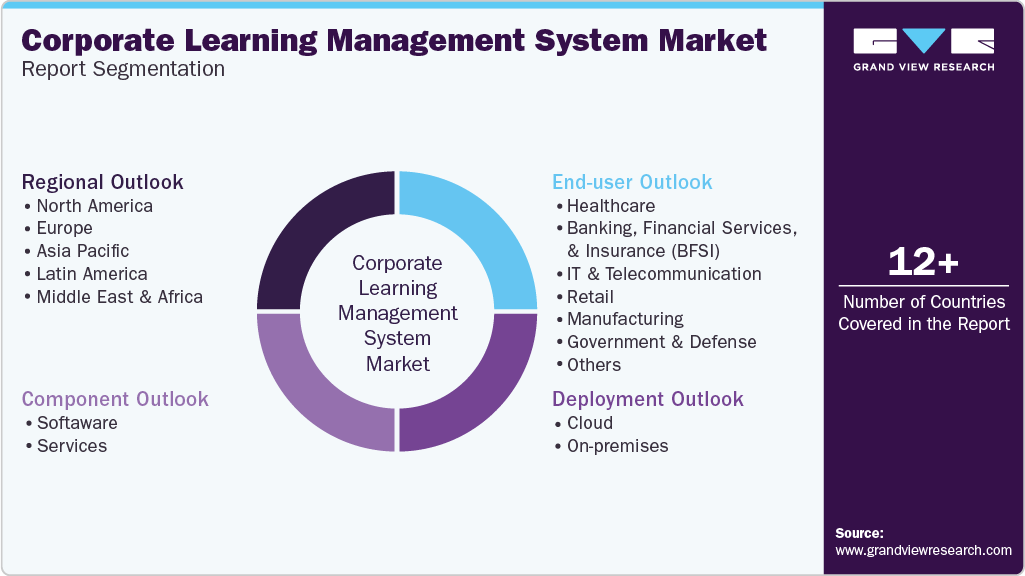
This report forecasts revenue growth at the global, regional, and country levels and provides an analysis of the latest industry trends in each of the sub-segments from 2021 to 2033. For this study, Grand View Research has segmented the global corporate learning management system market report based on component, deployment, end use, and region:
 To learn more about this report, Download Free Sample Report
 -
Component Outlook (Revenue, USD Million, 2021 - 2033)
-
Software
-
Services
-
-
Deployment Outlook (Revenue, USD Million, 2021 - 2033)
-
Cloud
-
On-premises
-
-
End User Outlook (Revenue, USD Million, 2021 - 2033)
-
Healthcare
-
Banking, Financial Services, and Insurance (BFSI)
-
IT and Telecommunication
-
Retail
-
Manufacturing
-
Government & Defense
-
Others
-
-
Regional Outlook (Revenue, USD Million, 2021 - 2033)
-
North America
-
U.S.
-
Canada
-
Mexico
-
-
Europe
-
UK
-
Germany
-
France
-
-
Asia Pacific
-
China
-
Japan
-
India
-
South Korea
-
Australia
-
-
Latin America
-
Brazil
-
-
Middle East and Africa (MEA)
-
Kingdom of Saudi Arabia (KSA)
-
UAE (United Arab Emirates)
-
South Africa
-
-
Research Methodology
The corporate learning management system market figures in this report are based on a proven research process that combines executive interviews with secondary research from proprietary databases, company filings, and recognized regulatory and institutional sources. Market size is built through value-chain sizing - reconciling supply-side and demand-side estimates - and triangulated with bottom-up and top-down approaches. Every estimate passes multiple levels of expert validation before publication, with each corporate learning management system segment quantified using the revenue-capture definitions in the table below.
Segment Definition
Segment - Component
Revenue Capture Definition
Software
Revenue generated from the licensing and subscription of corporate LMS software platforms for learning content management, course delivery, learner tracking, and training administration.
Services
Revenue generated from implementation, integration, consulting, customization, technical support, maintenance, and managed services related to LMS deployment and operation.
Segment - Deployment
Revenue Capture Definition
Cloud
Revenue generated from cloud-based LMS deployments accessed through hosted or Software-as-a-Service (SaaS) delivery models.
On-premises
Revenue generated from LMS solutions deployed within an organization's internal IT infrastructure and managed on-site.
Segment – End User
Revenue Capture Definition
Healthcare
Revenue generated from LMS adoption by healthcare organizations for employee education, clinical training, certification management, and regulatory compliance.
Banking, Financial Services, and Insurance (BFSI)
Revenue generated from the use of LMS platforms by financial institutions to support employee onboarding, compliance programs, and professional development.
IT and Telecommunication
Revenue generated from LMS implementation across IT and telecommunications organizations for technical training, certification, and workforce skill enhancement.
Retail
Revenue generated from LMS adoption by retail businesses for onboarding, product knowledge, sales enablement, and customer service training.
Manufacturing
Revenue generated from LMS deployment in manufacturing organizations for operational training, safety programs, technical skill development, and compliance management.
Government & Defense
Revenue generated from LMS adoption by government bodies and defense organizations for workforce development, policy training, and professional education.
Others
Revenue generated from LMS implementation across industries including education, transportation, hospitality, energy & utilities, media, construction, and other commercial sectors.
Estimation Model
Layer Name
Key Question
Description
End-user Layer
Who creates demand for Corporate Learning Management System (LMS) solutions?
Identifies organizations that require corporate LMS platforms, including enterprises across industries such as BFSI, healthcare, IT & telecommunications, manufacturing, retail, government, and other sectors to support employee training and learning initiatives.
Adoption / Usage Layer
Who actively adopts Corporate Learning Management System (LMS) solutions?
Filters the addressable market based on enterprise digital transformation, workforce development initiatives, remote and hybrid work adoption, regulatory training requirements, and investments in employee learning and development.
Deployment & Solution Layer
How are Corporate Learning Management System (LMS) solutions deployed?
Estimates market adoption across deployment models (cloud and on-premises), solution components (software and services), and enterprise learning environments used to deliver, manage, and track corporate training programs.
Revenue Capture Layer
How is revenue generated in the Corporate Learning Management System (LMS) ecosystem?
Calculates revenue generated from LMS software subscriptions and licenses, implementation, consulting, customization, integration, technical support, maintenance, managed services, and other value-added offerings associated with corporate learning platforms.
Delivered Customizations
This report has been delivered with the following In-depth customizations
Client Objective
Custom Research Modules Delivered
Strategic Value / Business Impact
Market Entry & Expansion Assessment
Regional demand sizing and forecasting
Customer segmentation and buying behavior analysis
Competitive landscape benchmarking
Identified high-growth market opportunities
Supported go-to-market strategy development
Enabled data-driven expansion planning
Product Positioning & Competitive Intelligence
Product benchmarking and feature comparison
Pricing and value proposition analysis
Competitor strategy evaluation
Improved product differentiation strategy
Supported pricing optimization
Enhanced competitive positioning
Technology & Innovation Assessment
Emerging technology trend analysis
Technology adoption readiness assessment
Ecosystem and partnership mapping
Identified future growth areas
Supported innovation roadmap planning
Strengthened strategic partnership decisions
Frequently Asked Questions About This Report
Asia Pacific is the fastest-growing region over the forecast period.
Solution held the largest share of 67.7% in 2025, while Services is the fastest-growing model.
Cloud held the largest revenue share in 2025 and is the fastest-growing area.
The global corporate learning management system market size was valued at USD 11.3 billion in 2025 and is estimated at USD 13.4 billion for 2026.
The global corporate learning management system market is expected to grow at a CAGR of 19.3% from 2026 to 2033, reaching USD 46.1 billion by 2033.
Some key players operating in the corporate LMS market include Accenture; Adobe; Oracle; SAP; Hermes Logistics Technologies; McGraw Hill; Emphasis; Xerox Corporation; Berlitz Corporation; Speexx; Blackboard Inc.
North America dominated the corporate learning management system market with a share of 36.2% in 2025. The corporate Learning Management System (LMS) market is witnessing significant growth as organizations increasingly invest in digital training infrastructure to support employee development. The shift toward remote and hybrid work models has accelerated the adoption of cloud-based LMS platforms, allowing companies to deliver consistent and accessible training to distributed teams
Key factors that are driving the market growth include corporate LMS adoption in the corporate sector is the growing need for upskilling and reskilling. As automation and digital transformation reshape job roles, companies are leveraging LMS tools to close skill gaps and align employee capabilities with evolving business demands
About the Author(s)
Next Generation Technologies Research Team
Technology · Next Generation TechnologiesThis report was authored by the next generation technologies research team at Grand View Research - comprising two research analysts, one senior research analyst, and one industry expert - with specialized expertise in the next generation technologies segment of the technology industry. All findings are based on proprietary technology databases, executive interviews, and regulatory analysis, subject to internal peer review prior to publication.
Last Updated:
Speak to Analyst

Customize this report to your needs - add regions, segments, or data points, with 20% free customization.
Or view our licence options:


ISO 9001:2015 & 27001:2022 Certified
We are GDPR and CCPA compliant! Your transaction & personal information is safe and secure. For more details, please read our privacy policy.


