- Home
- »
- Advanced Interior Materials
- »
-
Copper Flat Rolled Products Market Size Report, 2026-2033GVR Report cover
![Copper Flat Rolled Products Market (2026 - 2033)Report]()
Copper Flat Rolled Products Market (2026 - 2033)
Size, Share & Trends Analysis Report By Product (Copper Sheets, Copper Strips, Copper Plates), By End Use (Construction, Automotive, Industrial Machinery), By Region (North America, Europe, Asia Pacific, Latin America, MEA), And Segment Forecasts
Market Size, 2025
$28.8BMarket Estimate, 2026
$30.3BMarket Forecast, 2033
$45.9BCAGR, 2026–2033
6.1%Copper Flat Rolled Products Market Summary
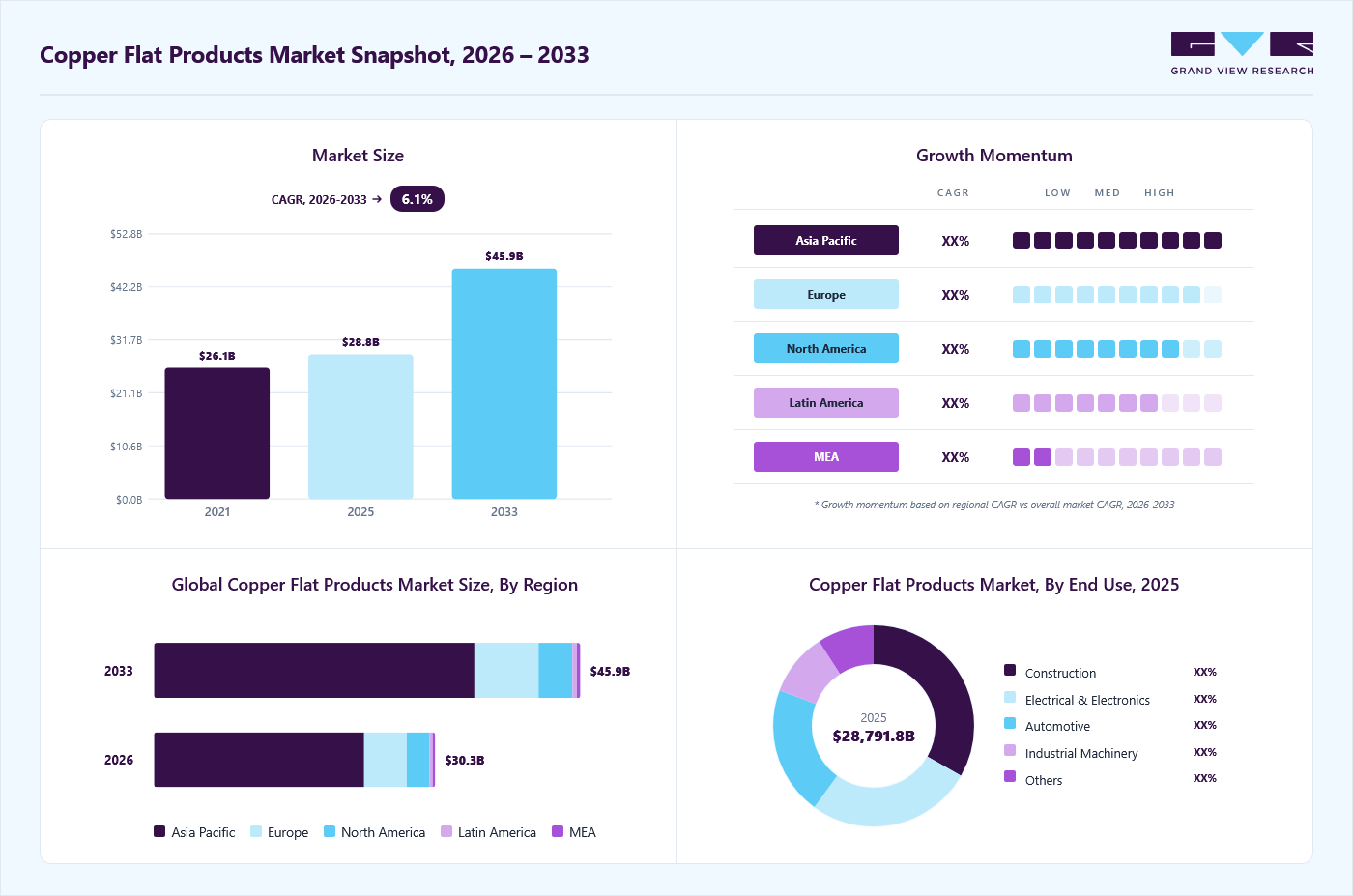
The global copper flat rolled products market size was valued at USD 28.8 billion in 2025 and is projected to grow from USD 30.3 billion in 2026 to USD 45.9 billion by 2033, at a CAGR of 6.1% from 2026 to 2033. Asia Pacific held the largest global revenue share 75.2% in 2025. The global market is witnessing robust growth, propelled mainly by rising demand across the electrical and electronics sector, expanding infrastructure development, and the accelerating shift toward electric mobility.
Key Market Trends & Insights
- By product: Copper sheets held the largest revenue share of 43.7% in 2025.
- By end use: Construction held the largest revenue share of 33.2% in 2025.
Regional Highlights
- Largest regional market: Asia Pacific (75.2% revenue share, 2025)
- By country: The China held the largest market share in 2025.
Market Size & Forecast
- Market size 2025: USD 28.8 Billion
- Estimated market size in 2026: USD 30.3 Billion
- Projected market size by 2033: USD 45.9 Billion
- CAGR (2026-2033): 6.1%
The products are preferred due to their high-performance, miniaturized, and energy-efficient components. Copper’s excellent electrical conductivity makes it an essential material for printed circuit boards (PCBs), connectors, busbars, and transformer windings. The rapid rollout of 5G infrastructure and the proliferation of smart home and IoT devices have further accelerated the use of copper foils and strips, particularly in compact, high-frequency components where performance and reliability are critical.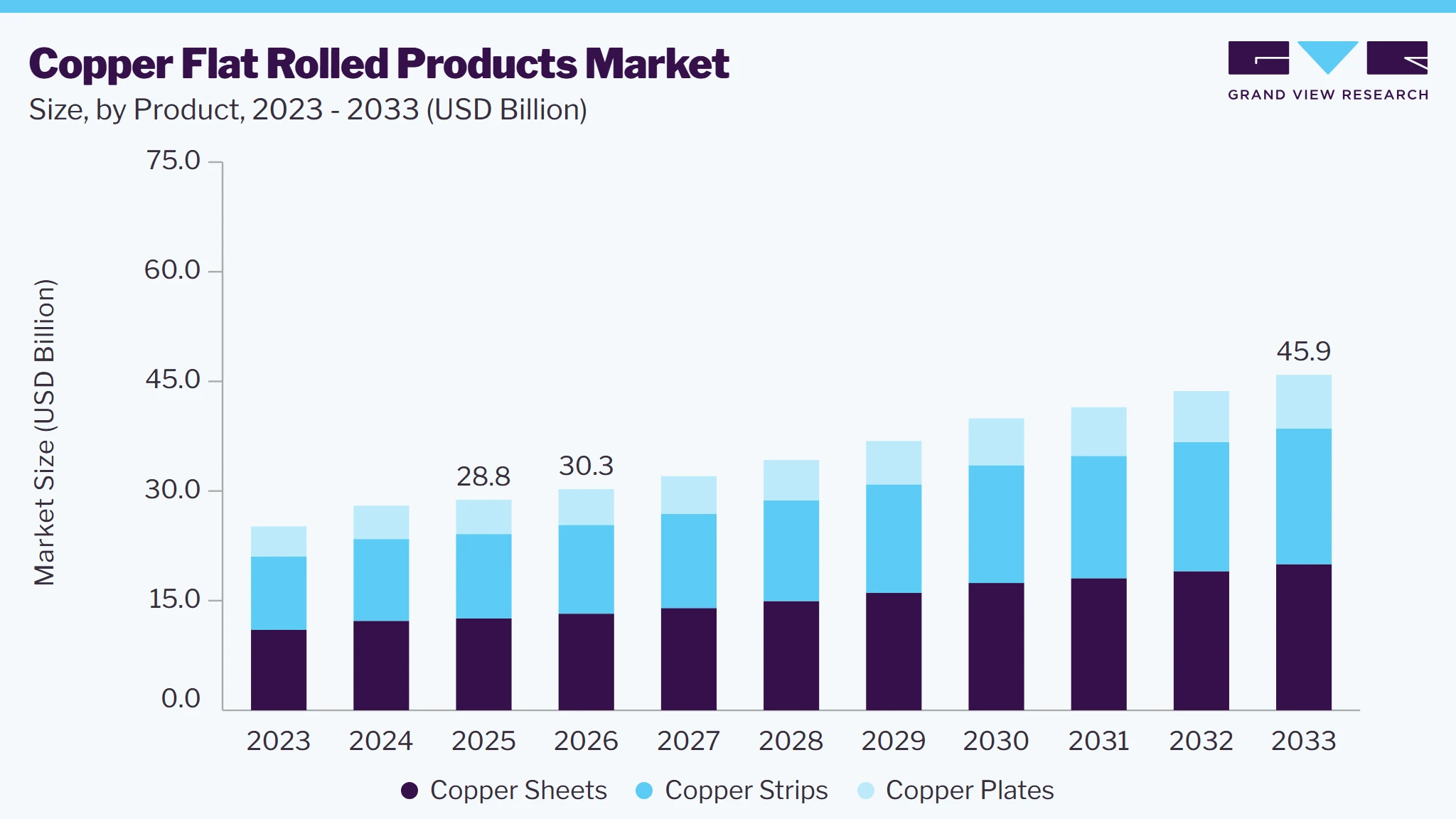
Technological innovations in electric vehicles and energy infrastructure design further amplify the demand for flat-rolled copper products. The advancement of high-efficiency electric drivetrains, battery management systems, and next-generation charging infrastructure requires materials with exceptional electrical conductivity, thermal performance, and durability, which are key characteristics of copper. As solid-state batteries and high-voltage EV architectures gain traction, precision-engineered copper foils and sheets become increasingly critical.
Market Dynamics
The global shift toward electrification is a major growth driver for the copper flat rolled products market. Copper sheets, strips, and plates are essential materials in power generation, transmission, distribution, and electrical equipment due to their superior electrical conductivity and durability. Rapid urbanization, industrial expansion, grid modernization initiatives, and rising investments in power infrastructure are driving demand for copper-based components, including busbars, transformers, switchgear, motors, and electrical connectors. As countries continue to strengthen electricity networks and improve energy efficiency, consumption of these products is expected to increase steadily across both developed and emerging economies.
The accelerating deployment of renewable energy systems and electric vehicles (EVs) is further supporting market growth. Solar photovoltaic installations, wind turbines, battery energy storage systems, EV batteries, charging infrastructure, and power electronics require significant volumes of copper strips and sheets for efficient power transmission and thermal management. According to the International Energy Agency (IEA), global renewable energy capacity additions continue to expand at record levels, while EV adoption is growing rapidly across major automotive markets.
Fluctuations in copper prices represent a significant restraint for the copper flat rolled products market. Since copper accounts for most production costs, changes in global copper concentrate availability, mining output, geopolitical developments, energy costs, and supply-demand imbalances directly affect manufacturing economics. Price volatility creates uncertainty for producers and end users, making long-term procurement planning more challenging. Additionally, rising raw material costs can compress profit margins for manufacturers while increasing product prices for customers in construction, automotive, and industrial sectors. These factors may temporarily affect purchasing decisions and limit market expansion during periods of elevated copper price fluctuations.
The rapid growth of electric vehicles, battery systems, power electronics, and advanced electronic devices presents a significant opportunity for the copper flat rolled products market. EVs require substantially higher copper content than conventional vehicles, particularly in battery packs, busbars, connectors, inverters, and charging systems. Similarly, increasing demand for data centers, telecommunications infrastructure, consumer electronics, and industrial automation systems is driving the consumption of precision copper strips and sheets. As manufacturers continue developing high-performance electrical and electronic systems with improved efficiency and miniaturization requirements, the demand for high-conductivity copper flat rolled products is expected to increase significantly, creating long-term growth opportunities for producers worldwide.
Analyst Perspective
Copper flat rolled products have become indispensable to the global electrification trend, with demand increasingly driven by electric vehicles, renewable energy systems, power infrastructure, and advanced electronics. While copper price volatility and energy costs remain key challenges, strong investments in grid modernization, clean energy, and transportation electrification continue to support long-term market growth. As the energy transition accelerates, copper flat rolled products are evolving from conventional industrial materials into strategic enablers of modern electrical and energy infrastructure.
Product Insights
Copper sheets dominated the copper flat rolled products industry in 2025, accounting for 43.7% of total revenue. Their leadership position is supported by widespread use across construction, industrial equipment, power infrastructure, HVAC systems, and architectural applications. Copper sheets offer excellent corrosion resistance, thermal conductivity, durability, and formability, making them a preferred material for roofing, cladding, heat exchangers, and electrical components. Growing investments in infrastructure development and renewable energy installations continue to sustain demand for copper sheets across both developed and emerging economies.
Copper strips are projected to register the fastest CAGR of 6.3% during the forecast period. The segment's growth is primarily driven by increasing adoption in electrical and electronic applications, particularly in transformers, switchgear, connectors, motors, and power distribution systems. Rising production of electric vehicles, battery systems, charging infrastructure, and advanced consumer electronics is further accelerating demand for high-precision copper strips. As global electrification and digitalization trends intensify, copper strips are expected to grow robustly due to their critical role in efficient power transmission and electrical connectivity.
End Use Insights
Construction emerged as the largest end-use segment in 2025, accounting for 33.2% of the copper flat rolled products market. They are extensively utilized in roofing, cladding, plumbing systems, HVAC equipment, electrical wiring, and architectural applications owing to their durability, corrosion resistance, and long service life. Ongoing urbanization, commercial construction activities, infrastructure modernization projects, and growing investments in sustainable buildings continue to support demand from the construction sector, particularly across the Asia Pacific, North America, and the Middle East.
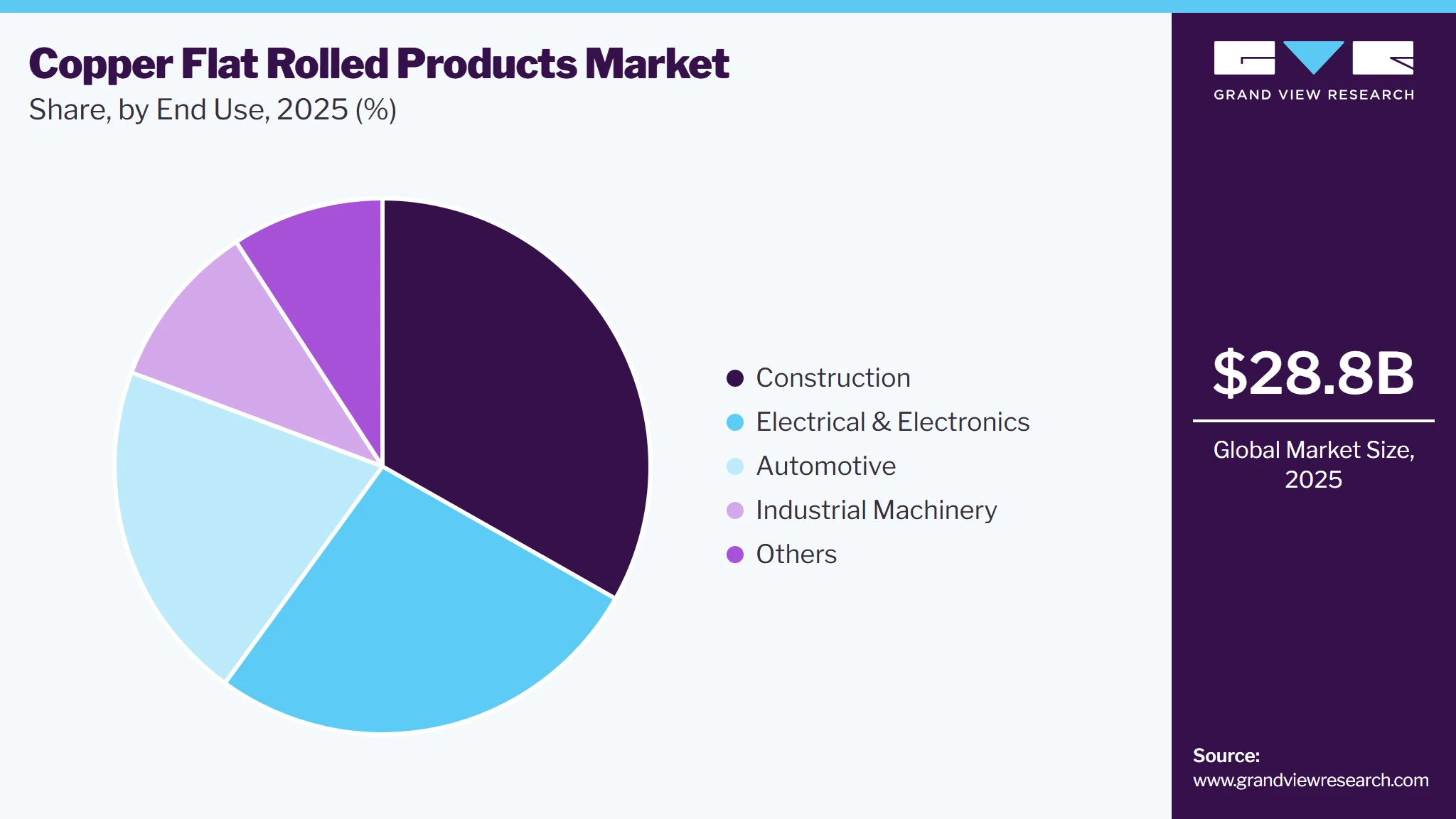
Electrical & electronics is expected to record the fastest CAGR of 6.4% during the forecast period. The segment's growth is driven by rising investments in power transmission and distribution networks, renewable energy systems, electric vehicles, data centers, telecommunications infrastructure, and advanced electronic devices. Copper sheets, strips, and plates are essential for manufacturing busbars, connectors, transformers, switchgear, circuit components, and battery systems due to their superior electrical conductivity. The accelerating global transition toward electrification and digital infrastructure is expected to make electrical & electronics the fastest-growing end-use segment in the market.
Regional Insights
Asia Pacific held the largest global revenue share 75.2% in 2025. It is also the fastest-growing market for copper flat rolled products, supported by rapid industrialization, urbanization, and infrastructure development across major economies. China, India, Japan, South Korea, and Southeast Asian countries continue to invest heavily in renewable energy projects, electric vehicle manufacturing, transmission networks, consumer electronics, and industrial automation. The region also serves as a global manufacturing hub for electrical equipment and electronic components, resulting in substantial demand for copper strips and sheets.

North America Copper Flat Rolled Products Market Trends
The North America copper flat rolled products industry is witnessing steady growth, supported by increasing investments in power infrastructure, renewable energy projects, electric vehicle manufacturing, and grid modernization initiatives. Copper sheets, strips, and plates are widely utilized in transformers, switchgear, charging infrastructure, battery systems, and electrical distribution networks due to their superior conductivity and durability. Additionally, rising construction activity across residential, commercial, and industrial sectors continues to support demand for copper products used in wiring, roofing, HVAC systems, and plumbing applications.
U.S. Copper Flat Rolled Products Market Trends
The U.S. copper flat rolled products industry remains the largest contributor to regional demand, driven by strong consumption from construction, automotive, electrical equipment, and renewable energy sectors. The rapid expansion of data centers, grid upgrades, battery manufacturing facilities, and electric vehicle production is increasing the requirement for high-performance copper strips and sheets. Furthermore, federal investments supporting clean energy projects, semiconductor manufacturing, and domestic industrial production are expected to strengthen copper consumption.
Europe Copper Flat Rolled Products Market Trends
The Europe copper flat rolled products industry’s growth is primarily driven by the region's aggressive decarbonization goals, electrification initiatives, and growing investments in renewable energy infrastructure. Demand for copper flat rolled products is increasing across electric vehicle production, battery manufacturing, offshore wind projects, solar installations, and grid expansion programs. The region's strong focus on circular economy practices and copper recycling is helping ensure raw material availability while reducing environmental impact. In addition, modernization of aging electrical infrastructure and growing adoption of energy-efficient technologies continue to create favorable conditions for market expansion.
Latin America Copper Flat Rolled Products Market Trends
The Latin America copper flat rolled products industry is benefiting from increasing investments in construction, power transmission, renewable energy, and industrial development projects. Countries such as Brazil, Mexico, and Chile are witnessing growing demand for copper products used in electrical systems, industrial equipment, telecommunications infrastructure, and transportation networks. The expansion of solar and wind energy installations, coupled with rising urbanization and infrastructure spending, is supporting the consumption of copper flat rolled products.
Middle East & Africa Copper Flat Rolled Products Market Trends
The Middle East & Africa market is expanding due to ongoing investments in infrastructure development, power generation, urban construction, and industrial diversification programs. Large-scale projects across the Gulf Cooperation Council (GCC) countries are driving demand for copper products in electrical networks, commercial buildings, transportation systems, and renewable energy installations. In Africa, growing electrification efforts, transmission network expansion, and industrialization initiatives are creating additional opportunities for copper flat rolled products.
Key Copper Flat Rolled Products Company Insights
Some of the key players operating in the market include Aurubis AG, KME Group, and Wieland Group.
-
Aurubis AG, headquartered in Hamburg, Germany, is one of the world's leading providers of non-ferrous metals and a major copper recycler. With a history dating back to 1866, the company specializes in producing copper cathodes, wire rods, continuous cast shapes, profiles, and flat rolled products in copper and copper alloys. Aurubis operates production sites across Europe and the USA, serving a global customer base in various electronics, automotive, and construction industries.
-
KME Group, based in Florence, Italy, is a prominent copper and copper alloy manufacturer. Formed from the merger of several European copper producers, including Kabelmetal AG and Tréfimétaux SA, KME offers a wide range of products, including rolled copper, tubes, bars, and cables. The company serves various industrial sectors worldwide with production facilities in Germany, France, Italy, and the Netherlands.
-
Wieland Group, headquartered in Ulm, Germany, is a leading global manufacturer of semi-finished copper and copper alloy products. Founded in 1820, the company produces sheets, strips, rods, tubes, and foils, serving electronics, automotive, and construction industries. Wieland operates at over 80 locations worldwide, including production sites in Asia, Europe, and the USA, employing approximately 9,400 people.
Key Copper Flat Rolled Products Companies
The following key companies have been profiled for this study on the copper flat rolled products market.
-
Atlantic Copper
-
Aurubis AG
-
Boway Alloy
-
Heyco Metals
-
Hindalco Industries Ltd.
-
KEMPER GmbH
-
KME Group
-
Linlong New Materials
-
ThyssenKrupp Materials NA
-
Wieland Group
Competitive Benchmarking
Operating Strategies
Competitive Edge
Weakness
Mature Players: Aurubis AG; KME Group; Wieland Group; Hindalco Industries Ltd.; Atlantic Copper
- Mature participants in the copper flat rolled products market typically operate large-scale, vertically integrated value chains spanning copper sourcing, smelting, refining, rolling, alloy development, and downstream fabrication. Their strategies focus on supplying a broad portfolio of copper sheets, strips, plates, and specialty alloys to construction, electrical & electronics, automotive, industrial machinery, and energy sectors. These companies emphasize capacity expansion, product innovation, recycling capabilities, and long-term customer partnerships to support demand from electrification, renewable energy, and industrial infrastructure markets.
- These companies benefit from strong economies of scale, diversified product portfolios, established customer relationships, and extensive global manufacturing and distribution networks. Their integrated operations provide greater control over raw material procurement, production quality, and supply reliability. Additionally, advanced metallurgical expertise, strong recycling infrastructure, and the ability to serve multiple end-use industries enable them to maintain competitive positions in both commodity and value-added copper flat rolled products.
- Large integrated producers are exposed to fluctuations in copper prices, energy costs, and global economic cycles that influence demand from construction, industrial, and automotive sectors. Their capital-intensive operations require continuous investments in modernization, environmental compliance, and sustainability initiatives. Additionally, trade policy changes, import competition, and evolving customer requirements for low-carbon and recycled copper products can create operational and margin pressures.
Growing / Specialized Players: Boway Alloy; Heyco Metals; KEMPER GmbH; Linlong New Materials; ThyssenKrupp Materials NA
- Specialized participants in the copper flat rolled products market focus on high-performance copper alloys, precision strips, engineered materials, and application-specific solutions serving electrical & electronics, automotive, telecommunications, industrial equipment, and renewable energy industries. Their strategies emphasize product customization, precision manufacturing, technical collaboration, and the development of specialty copper materials that meet demanding performance requirements. Many pursue growth through niche applications, advanced alloy development, and expansion into emerging electrification-related markets.
- Competitive strengths include expertise in precision rolling technologies, specialized alloy formulations, and the ability to provide customized products for highly technical applications. Their focused operating models often enable faster product development, greater manufacturing flexibility, and stronger customer engagement in niche markets. Many specialized players also benefit from strong relationships with electronics, connectors, EV components, and industrial equipment manufacturers that require stringent material specifications and consistent product quality.
- Compared with larger integrated producers, specialized companies generally operate with narrower product portfolios and more concentrated end-use exposure. Their performance may be more sensitive to demand fluctuations within specific industries such as electronics, telecommunications, or automotive components. In addition, limited raw material integration and smaller production scales can create challenges related to procurement costs, capacity expansion, and competition from larger global copper producers with broader manufacturing capabilities and distribution networks.
Recent Developments
-
On May 11, 2026, Aurubis AG announced that nearly 90% of its strategic investment program, approximately USD 1.94 billion, had been executed. Key projects include the ramp-up of the Richmond multimetal recycling facility in the U.S., the Complex Recycling Hamburg project, and the expansion of the Bulgaria copper tankhouse, which is expected to increase refined copper production capacity by approximately 50% to 340,000 tons per year.
-
On January 27, 2026, Hindalco Industries commissioned a 170,000-tons-per-annum Flat Rolled Products (FRP) facility and battery-grade foil plant in Odisha with an investment of approximately USD 520 million. The facility is intended to support electric mobility, energy storage, advanced manufacturing, and domestic value-added metal production.
-
In March 2026, Atlantic Copper's CirCular recycling project was recognized as a strategic project by the European Commission. Backed by an investment of approximately USD 513 million, the facility is scheduled to become operational in 2026 and will process up to 60,000 tons of electronic waste and metal-rich materials annually, recovering copper and other critical metals for industrial applications.
Copper Flat Rolled Products Market Report Scope
Report Attribute
Details
Market definition
The copper flat rolled products market size represents refined copper usage/demand in the various end uses.
Market size in 2025
USD 28.8 billion
Estimated market size in 2026
USD 30.3 billion
Projected market size by 2033
USD 45.9 billion
Growth rate
CAGR of 6.1% from 2026 to 2033
Base year for estimation
2025
Historical data
2021 - 2024
Forecast period
2026 - 2033
Quantitative units
Revenue in USD billion, volume in kilotons, and CAGR from 2026 to 2033
Report coverage
Revenue forecast, volume forecast, competitive landscape, growth factors, and trends
Segments covered
Product, end use, region
Regional scope
North America; Europe; Asia Pacific; Latin America; Middle East & Africa
Country scope
U.S.; Canada; Mexico; Germany; UK; France; Russia; Turkey; China; India; Japan; South Korea; Brazil; Saudi Arabia; UAE
Key companies profiled
Atlantic Copper; Aurubis AG; Boway Alloy; Heyco Metals; Hindalco Industries Ltd.; KEMPER GmbH; KME Group; Linlong New Materials; ThyssenKrupp Materials NA; Wieland Group
Customization scope
Free report customization (equivalent up to 8 analysts working days) with purchase. Addition or alteration to country, regional & segment scope.
Pricing and purchase options
Avail customized purchase options to meet your exact research needs. Explore purchase options
Global Copper Flat Rolled Products Market Report Segmentation
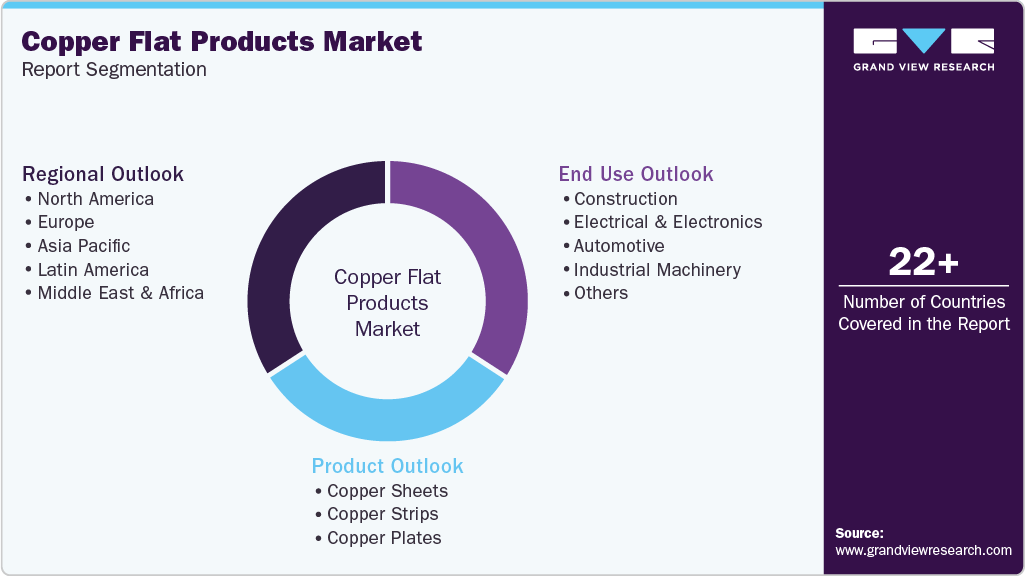
This report forecasts the global, country, and regional volume & revenue growth and analyzes the latest trends in each sub-segment from 2021 to 2033. For this study, Grand View Research has segmented the global copper flat rolled products market report based on product, end use, and region:
-
Product Outlook (Volume, Kilotons; Revenue, USD Billion, 2021 - 2033)
-
Copper Sheets
-
Copper Strips
-
Copper Plates
-
-
End Use Outlook (Volume, Kilotons; Revenue, USD Billion, 2021 - 2033)
-
Construction
-
Electrical & Electronics
-
Automotive
-
Industrial Machinery
-
Others
-
-
Regional Outlook (Volume, Kilotons; Revenue, USD Billion, 2021 - 2033)
-
North America
-
U.S.
-
Canada
-
Mexico
-
-
Europe
-
Germany
-
UK
-
France
-
Russia
-
Turkey
-
-
Asia Pacific
-
China
-
India
-
Japan
-
South Korea
-
-
Latin America
-
Brazil
-
-
Middle East & Africa
-
Saudi Arabia
-
UAE
-
-
Research Methodology
Segment Definition
Segment - Product
Revenue capture definition
Copper Sheets
Includes revenue generated from flat-rolled copper products manufactured in sheet form, typically supplied in thicker gauges and used in construction, roofing, architectural applications, industrial equipment, heat exchangers, and general fabrication. Covers pure copper and copper alloy sheets.
Copper Strips
Includes revenue generated from narrow-width flat-rolled copper products supplied in coil or strip form. These products are widely used in electrical and electronic components, connectors, terminals, lead frames, transformers, motors, telecommunications equipment, and automotive electrical systems. Covers pure copper and copper alloy strips.
Copper Plates
Includes revenue generated from heavy-gauge flat-rolled copper products manufactured as plates. These products are primarily used in industrial machinery, power generation equipment, marine applications, heavy engineering, molds, welding equipment, and high-performance industrial components. Covers pure copper and copper alloy plates.
Segment - End Use
Revenue capture definition
Construction
Covers copper flat rolled products used in building and infrastructure applications, including roofing, cladding, facades, gutters, flashing, plumbing systems, HVAC equipment, architectural structures, and other construction-related components.
Electrical & Electronics
Includes copper sheets, strips, and plates used in electrical and electronic applications such as connectors, terminals, busbars, lead frames, circuit components, transformers, switchgear, motors, generators, telecommunications equipment, and consumer electronics.
Automotive
Covers copper flat rolled products used in passenger vehicles, commercial vehicles, electric vehicles, and transportation equipment, including battery components, busbars, electrical connectors, terminals, heat exchangers, radiators, motor components, and power distribution systems.
Industrial Machinery
Includes copper flat rolled products utilized in industrial equipment and manufacturing operations, such as heat exchangers, industrial machinery, welding systems, power equipment, process industry equipment, tooling, and heavy engineering applications.
Others
Covers all other end-use applications, including aerospace & defense, marine, renewable energy systems, consumer goods, telecommunications infrastructure, railway equipment, medical devices, and other specialized industrial and engineering applications.
Estimation Model
Layer Name
Key Question
Description
Copper Consumption Layer
Which industries consume copper flat rolled products?
Identify the total copper demand and production volumes across major end-use industries, including electrical & electronics, construction, automotive, industrial machinery, renewable energy, telecommunications, and consumer goods. This layer establishes the overall addressable market based on copper-intensive applications.
Flat Rolled Product Eligibility Layer
Which applications require copper sheets, strips, or plates?
Apply product-specific filters to determine the share of copper demand served by flat rolled products. Focus on applications such as busbars, connectors, transformers, switchgear, EV battery components, roofing materials, heat exchangers, power distribution equipment, industrial machinery, and electronic components where copper sheets, strips, and plates are the preferred material forms.
End-Use Adoption Layer
How much of the demand is captured by copper flat rolled products?
Apply industry-specific penetration rates based on technical requirements, conductivity standards, durability needs, and manufacturing preferences. This layer evaluates the extent to which copper flat rolled products are adopted across construction, electrical & electronics, automotive, industrial machinery, and other end-use sectors versus alternative materials or product forms.
Revenue Layer
How is market revenue generated?
Multiply copper flat rolled product volumes by average selling prices (ASP) for sheets, strips, and plates while incorporating regional price variations, alloy premiums, thickness specifications, processing charges, and value-added services. This layer converts product demand into market revenue and reflects the commercial value generated across the copper flat rolled products value chain.
Delivered Customizations
This report has been delivered with the following In-depth customizations
Client Request
Customization Delivered
Value Adds
Regional Segmentation
Detailed country- and region-level analysis covering electrical infrastructure development, renewable energy installations, electric vehicle production growth, construction activity, industrial manufacturing expansion, grid modernization investments, and copper consumption trends across North America, Europe, Asia Pacific, Latin America, and Middle East & Africa.
Help clients identify high-growth regional markets, evaluate demand trends across key end-use industries, optimize geographic expansion strategies, and assess region-specific growth opportunities for copper flat rolled products.
Pricing Analysis
Detailed pricing assessment covering refined copper price movements, copper cathode procurement costs, alloying element price fluctuations, rolling and processing costs, energy expenses, logistics costs, trade policy impacts, and regional pricing variations for copper sheets, strips, and plates.
Help clients evaluate pricing structures, optimize sourcing and procurement strategies, assess margin fluctuations, and understand the impact of raw material and energy cost volatility on overall market competitiveness.
Opportunity Assessment
Strategic evaluation of emerging growth opportunities across electric vehicles, battery manufacturing, renewable energy infrastructure, power transmission & distribution networks, data centers, consumer electronics, industrial machinery, and sustainable construction applications requiring high-performance copper flat rolled products.
Assists clients in identifying untapped revenue streams, evaluating future investment potential, understanding evolving end-use demand patterns, and prioritizing expansion opportunities in high-growth application sectors.
Frequently Asked Questions About This Report
Some of the key vendors in the global copper flat rolled products market are Atlantic Copper, Aurubis AG, Boway Alloy, Heyco Metals, Hindalco Industries Ltd., KEMPER GmbH, KME Group, Linlong New Materials, ThyssenKrupp Materials NA, and Wieland Group.
The demand for copper flat rolled products in the construction industry is driven by rapid urbanization, expanding infrastructure development, smart city initiatives, and the increasing adoption of sustainable and energy-efficient building solutions.
Asia Pacific dominated with a 75.2% revenue share in 2025 of the copper flat rolled products market.
Asia Pacific region is fastest growing region with a CAGR of 6.2% over the forecast period.
China accounted for over 54% in 2025 of the Asia Pacific copper flat rolled products market.
By end use, the electrical & electronics segment is expected to grow at a CAGR of 6.4% over the forecast period.
The global copper flat rolled products market size was estimated at USD 28.8 billion in 2025 and is expected to reach USD 30.3 billion in 2026.
The global copper flat rolled products market is expected to grow at a compound annual growth rate of 6.1% from 2026 to 2033, reaching USD 45.9 billion by 2033.
By product, copper sheets dominated the market with a revenue share of 43.7% in 2025.
About the Author(s)
Advanced Interior Materials Research Team
Advanced Materials · Advanced Interior MaterialsThis report was authored by the advanced interior materials research team at Grand View Research - comprising two research analysts, one senior research analyst, and one industry expert - with specialized expertise in the advanced interior materials segment of the advanced materials industry. All findings are based on proprietary advanced materials databases, executive interviews, and regulatory analysis, subject to internal peer review prior to publication.
Last Updated:
Speak to Analyst

Need a Tailored Report?
Customize this report to your needs — add regions, segments, or data points, with 20% free customization.
Or view our licence options:


ISO 9001:2015 & 27001:2022 Certified
We are GDPR and CCPA compliant! Your transaction & personal information is safe and secure. For more details, please read our privacy policy.