
- Home
- »
- HVAC & Construction
- »
-
Construction Equipment Rental Market Size Report, 2033GVR Report cover

Construction Equipment Rental Market (2026 - 2033)
Size, Share & Trends Analysis Report By Product (Earth Moving Machinery, Concrete & Road Construction Machinery), By Drive Type (ICE, Electric), By Region, And Segment Forecasts
Market Size, 2025
$213.7BMarket Estimate, 2026
$224.3BMarket Forecast, 2033
$339.0BCAGR, 2026–2033
6.1%Construction Equipment Rental Market Summary
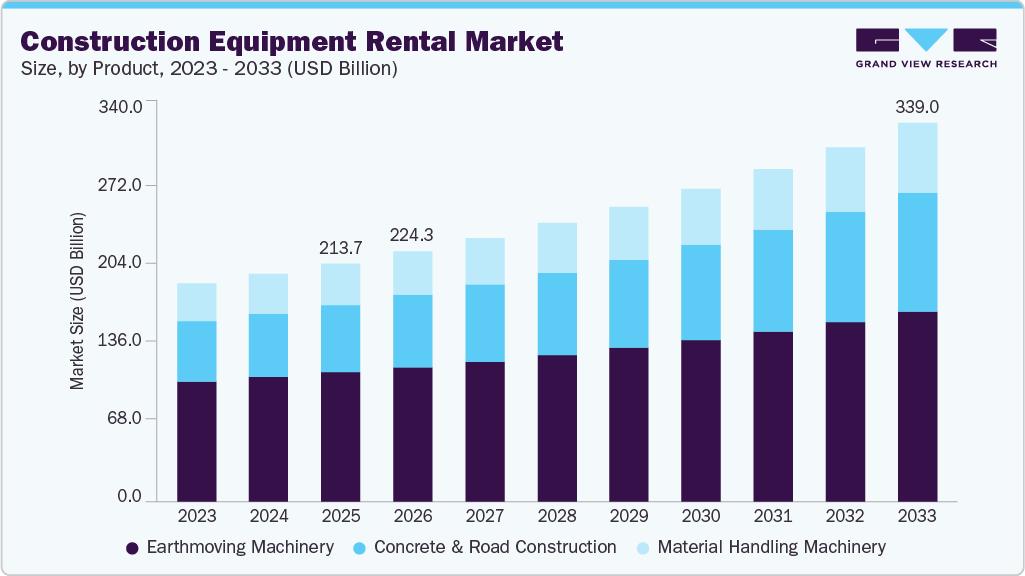
The global construction equipment rental market size was valued at USD 213.7 billion in 2025 and is projected to grow from USD 224.3 billion in 2026 to USD 339.0 billion by 2033, at a CAGR of 6.1% from 2026 to 2033. Asia Pacific dominated the market, with a revenue share of 50.5% in 2025. Construction of new commercial and residential infrastructure owing to rapid urbanization is expected to encourage the rental construction companies and contractors.
 Source: Grand View Research, IR Documents, Primary Interviews, Paid DatabasesTo learn more about this report,
 Download Free Sample Report
 Key Market Trends & Insights
- By product: Earth moving machinery segment held the largest market share of 54.2% in 2025.
- By drive type: ICE segment held the largest market share of 79.8% in 2025.
Regional Highlights
- Largest regional market: Asia Pacific (50.5% revenue share, 2025)
- By country: The U.S. held the largest market share in 2025.
Market Size & Forecast
- Market size in 2025: USD 213.7 Billion
- Estimated market size in 2026: USD 224.3 Billion
- Projected market size by 2033: USD 339.0 Billion
- CAGR (2026-2033): 6.1%
Three ways to get this report
Buy it, customize it, or ask a question.Ask an Analyst
Analyst response in 1 business day
- AccessReport author, directly
- Reply timeWithin 1 working day
- No sales callDirect answer only
- FormatEmail reply
- CostFree, no cost
Get the Full Report
What the study covers
- FormatsPDF · Excel · Dashboard
- Timeline2026–2033 annual, 2025 base
- Coverage20+ countries, 5 regions
- Companies10+ key players profiled
Customize the Report
20% free customization
- IncludeCountries, segments, points
- TailorTo your product definition
- ExtendDeeper competitor detail
- OrA fully bespoke study
- Turnaround5–10 working days
In addition, increasing government focus on upgrading existing public infrastructure is also increasing demand for equipment, including excavators, loaders, and dump trucks, among others, for construction work. Thus, increasing infrastructure development activities across the globe is anticipated to increase demand for the rental of earthmoving and material handling equipment, thereby driving the global market growth.
The rising cost of new construction machinery is encouraging construction companies and contractors to adopt equipment rental solutions more widely. In addition, advancements in construction technologies and the growing adoption of automation are supporting market expansion. Telematics systems are gaining traction across the construction equipment rental industry as rental companies increasingly recognize their potential to improve fleet visibility and operational efficiency. These systems enable remote monitoring of equipment usage, location, and performance, allowing providers to optimize fleet management and implement proactive maintenance practices. The integration of Internet of Things devices and sensors into rental equipment is further enhancing these capabilities by providing real-time data on fuel consumption, equipment condition, and operator safety. By leveraging this information, rental companies can make data-driven decisions, reduce equipment downtime, and improve overall fleet utilization.
 To learn more about this report, Download Free Sample Report
 Rental companies can also differentiate their offerings by providing customized equipment configurations and attachments tailored to specific project requirements. Customized equipment solutions can address the varying demands of infrastructure development, high-rise construction, and specialized industrial projects. By supplying machinery configured for specific applications, rental providers can help customers improve operational efficiency, productivity, and project execution. This approach also enables large rental companies to serve diverse customer requirements while strengthening their competitive positioning through specialized equipment solutions and value-added services.
Advancements in online rental platforms and mobile applications are further streamlining the equipment rental process for both owners and renters. Digital platforms enable equipment owners to showcase their inventories to a broader customer base, improve equipment visibility, and increase opportunities to secure rental agreements. These platforms are particularly beneficial for small and regional rental companies, enabling them to promote specialized equipment, reach new customers, and build market visibility through equipment quality and service capabilities. The increasing digitalization of equipment rental processes is improving transparency, accessibility, and convenience while supporting greater competition and expanding the range of equipment available to customers.
Market Dynamics
The construction equipment rental market is being driven by rising equipment acquisition costs, increasing construction activity, and growing demand for cost-effective machinery solutions. Rental models enable contractors to access advanced equipment while reducing upfront capital expenditure, maintenance costs, and equipment ownership requirements. Technological advancements are further transforming the market, with telematics, Internet of Things (IoT) devices, and connected sensors enabling real-time monitoring of equipment utilization, location, fuel consumption, and operating conditions. These capabilities are helping rental companies improve fleet management, optimize equipment utilization, and implement predictive maintenance strategies. The availability of customized equipment configurations and specialized attachments is also creating opportunities for rental providers to address project-specific requirements across infrastructure, commercial, and industrial construction. In addition, online rental platforms and mobile applications are improving equipment discovery, booking, and fleet visibility, particularly for small and regional providers. However, equipment maintenance requirements, logistics costs, and fluctuations in construction activity may influence rental demand and profitability.
The construction equipment rental market is benefiting from a structural shift toward capital-efficient operating models, as contractors increasingly favor rental solutions over equipment ownership to improve return on invested capital (ROIC) and reduce asset intensity. High equipment acquisition costs, extended payback periods, and the rapid technological obsolescence of heavy machinery are making ownership less economically attractive. Consequently, rental adoption is increasing across key equipment categories, including earthmoving, lifting, and material handling machinery.
The growing complexity and variability of construction project pipelines are further supporting rental demand. Contractors often experience fluctuating equipment utilization across infrastructure, commercial, and industrial projects, which can result in underused and financially inefficient owned fleets. Rental solutions enable contractors to scale equipment capacity according to project requirements and construction schedules, making them particularly valuable for large infrastructure programs and time-sensitive urban development projects.
In addition, stricter regulations related to emissions, safety, and equipment efficiency are encouraging fleet modernization. Rental providers can reduce the compliance burden on end users by continuously upgrading their fleets with newer, more technologically advanced, and regulation-compliant machinery. The integration of telematics, Internet of Things (IoT)-enabled fleet management, and predictive maintenance systems is further improving equipment utilization, minimizing downtime, and enhancing the operational efficiency of rental models.
The construction equipment rental market is constrained by its strong dependence on cyclical construction activity, as rental demand fluctuates with infrastructure investment, real estate development, and broader macroeconomic conditions. These fluctuations can create revenue volatility and affect fleet utilization for rental operators. In addition, the high costs associated with fleet acquisition, maintenance, transportation, and periodic equipment upgrades place considerable capital pressure on rental companies, particularly small and mid-sized operators, limiting their ability to expand fleet capacity and geographic coverage.
Low equipment utilization resulting from idle periods, complex logistics, and the geographic dispersion of construction sites can further affect asset productivity and profitability. Rental providers also face higher lifecycle costs due to equipment damage, improper usage, and frequent maintenance requirements associated with multiple end users. The availability of used and refurbished construction equipment provides a lower-cost alternative to rental services, particularly for small contractors and short-duration projects. Furthermore, intense price competition in a fragmented market can limit pricing flexibility and compress rental margins. A shortage of skilled operators and technicians with expertise in advanced, sensor-enabled machinery may also hinder the effective deployment of modern rental fleets in certain regions.
The construction equipment rental market is poised to benefit from increasing infrastructure development across emerging and developed economies, supported by government investments in transportation infrastructure, urban housing, industrial corridors, and other large-scale development projects. These initiatives are generating sustained demand for flexible and project-specific equipment solutions, particularly in rapidly urbanizing markets where contractors require machinery for varying project durations and workloads.
Digital transformation presents another significant opportunity for rental companies. The integration of Internet of Things (IoT)-enabled telematics, artificial intelligence (AI)-based fleet optimization, and predictive maintenance technologies is enabling providers to improve equipment utilization, minimize downtime, and enhance fleet management efficiency. In parallel, online rental marketplaces and platform-based business models are improving equipment accessibility, pricing transparency, and customer reach, creating opportunities to serve small and medium-sized enterprises (SMEs) and subcontractors more effectively.
The increasing demand for sustainable and energy-efficient machinery is also creating opportunities for rental providers to expand their fleets of electric and hybrid equipment. Rental models can facilitate the adoption of low-emission equipment by allowing customers to access newer technologies without significant upfront investments. In addition, expanding construction activity in renewable energy, data centers, and smart infrastructure projects is increasing demand for specialized, high-performance, and technologically advanced equipment.
Market Concentration & Characteristics
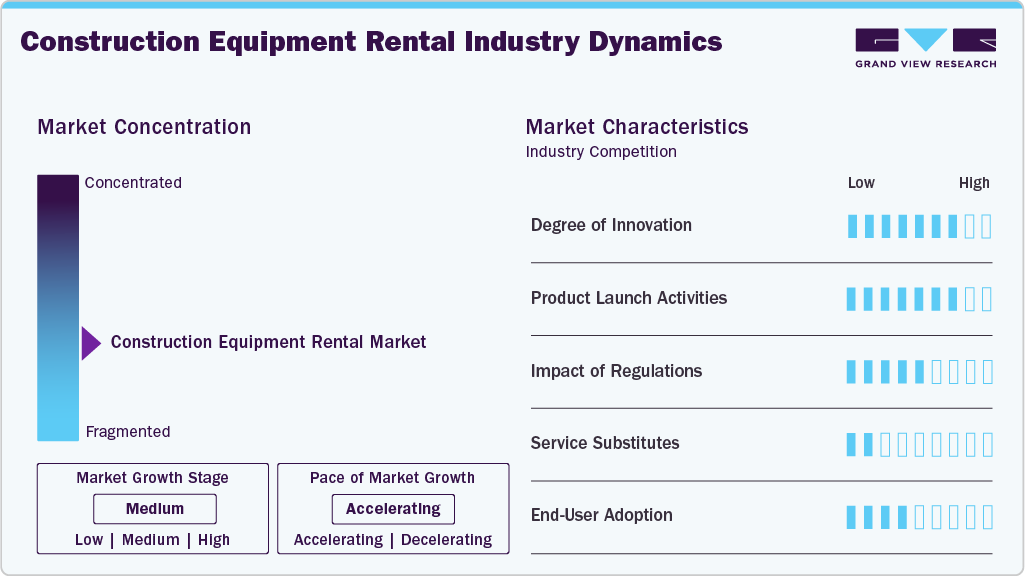
The construction equipment rental market is moderately fragmented, with a combination of major global rental companies and numerous regional and local providers. Leading participants, including United Rentals, Ashtead Group (Sunbelt Rentals), Herc Rentals, and Loxam Group, maintain strong market positions through extensive equipment fleets, broad branch networks, digital rental platforms, and established relationships with construction contractors and infrastructure developers. Their scale enables efficient fleet management and a diversified range of equipment across earthmoving, material handling, aerial work platforms, and power generation. At the regional level, numerous small and mid-sized rental companies continue to serve localized demand, particularly across residential and small-scale commercial construction projects. The project-driven nature of construction activity and the need for rapid availability of equipment further support the presence of local providers.
 To learn more about this report, Download Free Sample Report
 The competitive landscape is gradually evolving toward greater consolidation, with larger rental companies pursuing acquisitions and partnerships to expand geographic coverage, strengthen fleet capabilities, and improve operational efficiency. At the same time, digitalization is becoming an important source of competitive differentiation, with organized providers adopting telematics-based fleet monitoring, online rental platforms, and predictive maintenance technologies. Increasing infrastructure investment, urban development, and equipment rental penetration across emerging markets are expected to intensify competition and support the expansion of organized rental providers.
Analyst Perspective
The construction equipment rental market is expected to grow at a steady pace, supported by sustained infrastructure investment, urbanization, industrial expansion, and increasing mechanization across emerging economies. The demand for excavators, loaders, cranes, material-handling equipment, and road construction machinery rental is expected to remain high, owing to governments and private developers continuing to invest in transportation, energy, industrial, and urban infrastructure. The market is shifting toward higher-value, technologically advanced machinery. Construction equipment providers are increasingly integrating telematics, automation, machine-control systems, remote diagnostics, and fuel-efficient powertrains to improve productivity and reduce operating costs. Electrification is also emerging as a strategic growth area, although high upfront rental costs, charging infrastructure limitations, and battery performance remain barriers to adoption.
Product Insights
The earth moving machinery segment dominated the construction equipment rental industry, accounting for 54.2% of revenue in 2025, driven by rising demand for rental equipment across large-scale mining, road construction, port development, and oil and gas projects. Equipment such as excavators is widely rented because it provides contractors and operators with the flexibility to access high-capacity machinery without significant upfront capital investment. Rental models also enable users to scale equipment deployment according to project requirements while avoiding the long-term ownership and maintenance costs associated with heavy machinery. In addition, stricter emissions regulations are encouraging rental providers to modernize their fleets with more fuel-efficient, environmentally friendly equipment, further supporting the adoption of newer earth-moving machinery.
The concrete and road construction equipment segment is projected to grow at the fastest CAGR of 7.0% during the forecast period, driven by increasing investments in highway and road infrastructure, rising vehicle volumes, and the need to expand and modernize transportation networks. Large-scale infrastructure development programs are generating sustained demand for equipment used in road construction and concrete applications. For instance, the Indian Ministry of Road Transport and Highways has undertaken several major expressway projects, including the Delhi-Mumbai Expressway, Bengaluru-Chennai Expressway, and Ganga Expressway. In addition, the growing requirement to maintain and upgrade existing civil infrastructure, including high-rise buildings and other urban structures, is expected to increase the demand for rental equipment. The flexibility of rental models allows contractors to access specialized concrete and road construction machinery for project-specific requirements without committing substantial capital to equipment ownership.
Drive Type Insights
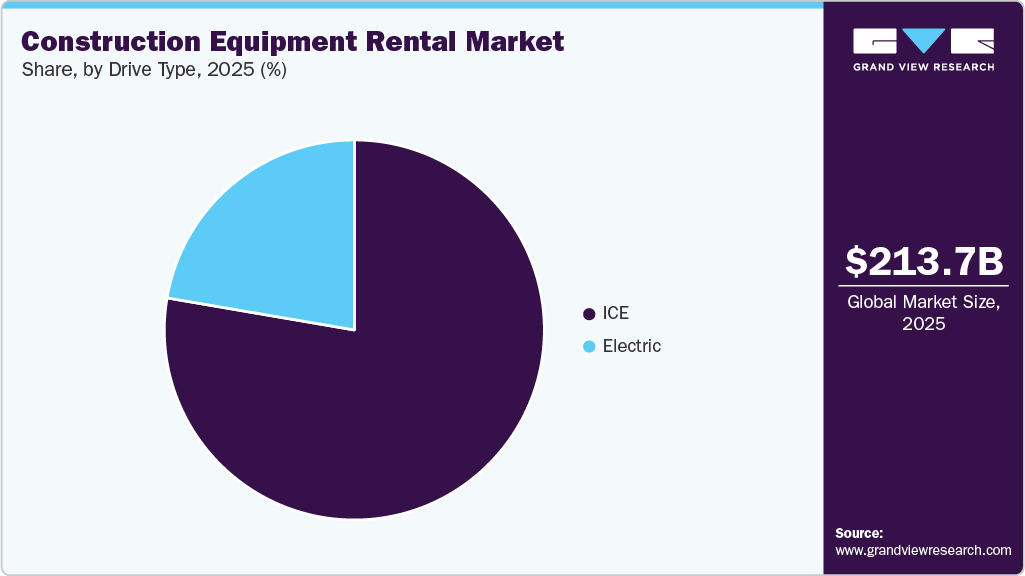
The internal combustion engine (ICE) segment accounted for the largest market share of 79.8% in 2025, supported by the widespread availability of diesel and gasoline fueling infrastructure worldwide. Construction companies and rental providers often operate across regions with varying levels of infrastructure development and adoption of electric equipment, making the availability of established fueling networks an important factor in equipment selection. ICE-powered machinery enables contractors to maintain operations across locations without depending on charging infrastructure or making significant investments in electrical systems. In addition, the established supply chain for conventional fuels and the ability to refuel equipment quickly support the continued use of ICE-powered construction machinery, particularly for large-scale and remote construction projects.
 To learn more about this report, Download Free Sample Report
 The electric segment is projected to grow at the fastest CAGR of 6.5% during the forecast period, driven by increasing emphasis on emissions reduction, environmental sustainability, and the adoption of cleaner construction technologies. Stricter emissions standards and sustainability targets are encouraging construction companies and equipment rental providers to transition toward low- and zero-emission machinery. Companies are also introducing new and powerful electric alternatives to traditional ICE machinery. For instance, in February 2025, Volvo Construction Equipment upgraded its 23-ton EC230 Electric excavator, significantly improving battery performance and extending operating time to a full day on a single charge. The upgraded battery-electric excavator combines enhanced efficiency, safety, and operator performance with zero exhaust emissions, reduced noise, lower vibration, and instant torque. Electric construction equipment offers benefits such as reduced direct emissions, lower noise levels, and potentially lower operating and maintenance costs, making it increasingly suitable for urban construction, indoor applications, and environmentally sensitive projects. Continued advancements in battery technology, charging infrastructure, and electric equipment design are expected to further support the adoption of electric construction machinery during the forecast period.
Regional Insights
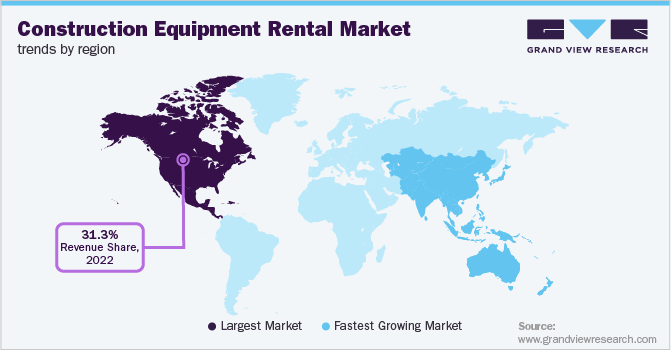
The Asia Pacific construction equipment rental market accounted for the largest revenue share of 50.5% in 2025, supported by rapid urbanization, expanding infrastructure development, and rising equipment ownership costs across both developed and emerging economies. In China, rental providers are expanding their operations to support large-scale construction projects, urban development, and smart infrastructure initiatives. India is also experiencing increasing demand for rental equipment, supported by ongoing investments in transportation infrastructure, urban development, and industrial projects. Although the fragmented nature of the regional rental industry poses challenges for fleet management and operational efficiency, sustained activity across the real estate, road construction, and energy sectors is expected to support market expansion.
 To learn more about this report, Download Free Sample Report
 China's construction equipment rental market led Asia Pacific, with a revenue share of 27.9% in 2025, supported by continued investment in construction and infrastructure development. Government spending on urban development, transportation networks, railways, and road connectivity is generating demand for a wide range of rental machinery. Increasing emphasis on environmental compliance is also encouraging contractors to adopt newer and more fuel-efficient equipment, including machinery available through rental channels. In addition, the growing adoption of digital equipment rental platforms and fleet management technologies is improving equipment accessibility, streamlining booking processes, and enhancing fleet utilization, making rental solutions increasingly attractive to contractors of all sizes.
North America Construction Equipment Rental Market Trends
The North America construction equipment rental industry accounted for a significant share of 30.1% in 2025, supported by increasing infrastructure investment, construction activity, and the growing preference for equipment rental over ownership. The U.S. is the region’s largest market, with government-backed infrastructure development initiatives driving demand for rental machinery across transportation, commercial, and industrial projects. Contractors are increasingly outsourcing equipment requirements to rental providers to improve capital efficiency, access modern machinery, and reduce fleet ownership and maintenance costs. In addition, the integration of telematics, connected equipment, and digital rental platforms is enhancing fleet visibility, equipment utilization, and service efficiency, further strengthening the attractiveness of rental solutions.
The U.S. construction equipment rental market maintained a dominant revenue share of 89.6% in 2025, driven by sustained activity across residential and non-residential construction, labor constraints, and the increasing adoption of project-based equipment procurement. Contractors are increasingly relying on rental providers to access equipment that meets project-specific requirements, thereby improving asset utilization and controlling capital expenditure. The growing emphasis on sustainability is also encouraging the adoption of newer, fuel-efficient, lower-emission machinery through rental fleets. Meanwhile, leading rental companies are expanding their equipment portfolios and investing in digital platforms, online services, and customer-focused solutions to improve equipment accessibility, streamline rental processes, and strengthen customer retention.
Europe Construction Equipment Rental Market Trends
The Europe construction equipment rental industry represented a lucrative regional revenue share of 15.4% in 2025, supported by high rental penetration across countries such as Germany, France, and the UK. Construction companies are increasingly adopting rental solutions to improve cost efficiency, operational flexibility, and access to modern equipment while reducing the capital requirements associated with ownership. The regional market is also benefiting from the growing adoption of telematics, machine diagnostics, and low-emission technologies, which are enhancing equipment performance and fleet management. In addition, urban redevelopment, infrastructure modernization, and energy-efficient construction projects are generating sustained demand for both short- and long-term equipment rental solutions.
The UK construction equipment rental market is expected to expand significantly with a CAGR of 3.7% in the coming years, driven by continued activity in commercial construction, road rehabilitation, and large-scale transportation infrastructure projects. Fluctuating project schedules and varying equipment requirements are encouraging contractors to increasingly rely on rental providers for flexible access to machinery. Furthermore, growing emphasis on emissions reduction and sustainable construction practices is supporting demand for newer, lower-carbon equipment available through rental fleets. These trends are expected to create additional opportunities for rental providers offering technologically advanced and environmentally efficient machinery.
Key Construction Equipment Rental Company Insights
Key players operating in the construction equipment rental market are undertaking various initiatives to strengthen their presence and increase the reach of their products and services. Strategies such as expansion activities and partnerships are key in propelling the market growth.
-
Ahern Rentals, acquired by United Rentals in December 2022, operates as part of United Rentals’ equipment rental network in the U.S. Specializing in construction equipment rentals, the company offers a vast fleet exceeding 40,000 units of high-reach gear, including boom lifts and scissor lifts, alongside general tools, heavy machinery, lawn equipment, and homeowner items. It serves commercial/residential builders, industrial firms, utilities, municipalities, and DIY customers.
-
Liebherr-International AG, along with its subsidiaries, manufactures and supplies construction machinery. The company offers a range of products, including commercial freezing and refrigeration equipment, domestic appliances, crawler cranes, mobile cranes, deep foundation machines, maritime cranes, and port equipment. It also offers mobile construction cranes, aerospace systems, mining equipment, tower cranes, concrete technology, material handling equipment, transportation systems, machine tools, and automation components & systems.
Key Construction Equipment Rental Companies
The following key companies have been profiled for this study on the construction equipment rental market.
-
Boels Rental (Cramo)
Competitive Benchmarking
Operating Strategies
Competitive Edge
Weaknesses
Mature Players: United Rentals, Inc.; Caterpillar Inc.; Liebherr International AG; Finning International Inc.
- Mature players operate large-scale, diversified rental fleets covering earthmoving, aerial work platforms, material handling, power generation, and specialized construction equipment across residential, commercial, industrial, and infrastructure projects.
- Strategic focus is on fleet optimization, geographic expansion through branch networks, digital rental platforms, and long-term contracts with large construction contractors and infrastructure developers.
- Strong economies of scale enable cost efficiency in procurement, maintenance, and fleet utilization.
- Extensive branch networks and logistics capabilities support rapid equipment availability and high service reliability across regions.
- Advanced digital platforms, telematics integration, and predictive maintenance systems enhance operational efficiency and customer experience.
- High capital intensity and large fleet ownership expose companies to cyclical demand risks in construction markets.
- Complex organizational structures can reduce agility in responding to localized or niche equipment requirements.
- Heavy dependence on large infrastructure and commercial projects increases exposure to macroeconomic downturns.
Emerging Players: Ahern Rentals Inc.; AKTIO Corporation; Byrne Equipment Rental.
- Emerging players primarily focus on localized rental services for small- and mid-sized contractors, residential construction, and short-term project requirements.
- Strategies emphasize flexible rental terms, quick equipment availability, and competitive pricing to capture price-sensitive demand segments.
- High operational flexibility enables rapid response to local demand fluctuations and customized service offerings.
- Lower overhead costs allow competitive pricing compared to large multinational rental firms.
- Strong local relationships with contractors enhance repeat business and customer stickiness.
- Limited fleet scale restricts the ability to serve large infrastructure and multinational construction projects.
- Constrained access to capital limits fleet modernization and technology adoption.
- Weak geographic diversification increases vulnerability to regional construction downturns and demand volatility.
Recent Developments
-
In December 2025, SILA, India's real estate platform with over 15 years of expertise, 30,000+ employees, including 1,000+ trained operators, and operations in 125+ cities, has launched a Material Handling Equipment (MHE) Rental Solutions division in partnership with Nilkamal, an equipment manufacturer, targeting the manufacturing and warehousing sectors. This initiative offers an all-electric fleet of forklifts and specialized rental equipment through flexible models, including full-service Wet Lease, hands-on Dry Lease, and Annual Maintenance Contracts, with an emphasis on operational efficiency, sustainability, and nationwide support.
-
In February 2024, United Rentals, an equipment rental company, partnered with Raiven, a procurement and supply chain management platform for contractors and facility managers, to integrate its extensive fleet of construction, industrial, and general equipment into Raiven's marketplace. The collaboration enables Raiven users, comprising over 3,000 contractors in the mechanical, electrical, and plumbing sectors, to access United Rentals' inventory through an intuitive, cloud-based platform powered by AI algorithms, streamlining purchasing, securing competitive pricing, and improving efficiency amid rising costs and supply chain challenges.
Construction Equipment Rental Market Report Scope
Report Attribute
Details
Market size in 2025
USD 213.7 billion
Estimated market size in 2026
USD 224.3 billion
Projected market size by 2033
USD 339.0 billion
Growth rate
CAGR of 6.1% from 2026 to 2033
Base year for estimation
2025
Historical data
2021 - 2024
Forecast period
2026 - 2033
Quantitative units
Revenue in USD million/billion, and CAGR from 2026 to 2033
Report coverage
Revenue forecast, company market position analysis, competitive landscape, growth factors, and trends
Segments covered
Product, drive type, region
Regional scope
North America; Europe; Asia Pacific; Latin America; Middle East & Africa
Country scope
U.S.; Canada; Mexico; Germany; UK; France; Italy; Spain; China; Japan; India; South Korea; Australia; Brazil; Saudi Arabia; South Africa; UAE
Key companies profiled
AKTIO Corporation; Caterpillar Inc.; Byrne Equipment Rental; Boels Rental (Cramo); Finning International Inc.; Liebherr-International AG; Kanamoto Co., Ltd.; Maxim Crane Works, L.P.; United Rentals, Inc.
Customization scope
Free report customization (equivalent to up to 8 analysts working days) with purchase. Addition or alteration to country, regional & segment scope.
Pricing and purchase options
Avail of customized purchase options to meet your exact research needs. Explore purchase options
Global Construction Equipment Rental Market Report Segmentation
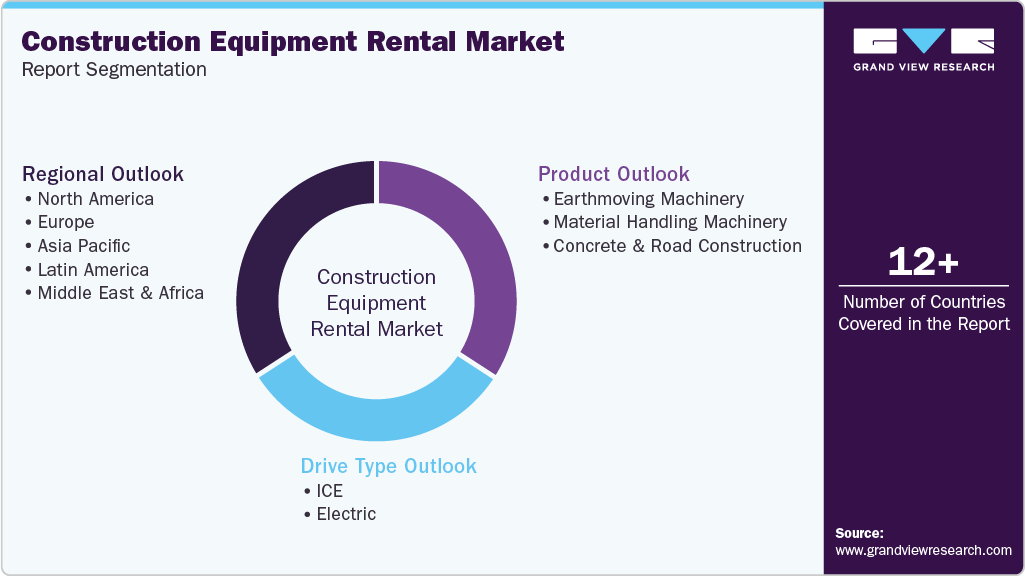
This report forecasts revenue growth at the global, regional & country levels and provides an analysis of the latest industry trends in each of the sub-segments from 2021 to 2033. For this study, Grand View Research has segmented the global construction equipment rental market report based on product, drive type, and region:
 To learn more about this report, Download Free Sample Report
 -
Product Outlook (Revenue, USD Million/Billion, 2021 - 2033)
-
Earth Moving Machinery
-
Material Handling Machinery
-
Concrete & Road Construction Machinery
-
-
Drive Type Outlook (Revenue, USD Million/Billion, 2021 - 2033)
-
ICE
-
Electric
-
-
Regional Outlook (Revenue, USD Million/Billion, 2021 - 2033)
-
North America
-
U.S.
-
Canada
-
Mexico
-
-
Europe
-
Germany
-
UK
-
France
-
Italy
-
Spain
-
-
Asia Pacific
-
China
-
Japan
-
India
-
South Korea
-
Australia
-
-
Latin America
-
Brazil
-
-
Middle East and Africa (MEA)
-
Saudi Arabia
-
UAE
-
South Africa
-
-
Delivered Customizations
Client Request
Customization Delivered
Value Adds
Construction Equipment Rental Market Analysis
Segmentation of the rental market across earthmoving, material handling, concrete, and road construction equipment
Demand assessment by end-use sectors, including residential, commercial, infrastructure, and industrial projects
Evaluation of rental penetration trends vs equipment ownership across regions
Identified high growth opportunities in infrastructure-led rental demand
Supported fleet expansion strategy and utilization optimization for rental companies
Infrastructure Project Demand & Utilization Study
Analysis of equipment utilization patterns across large-scale infrastructure and urban development projects
Assessment of short term vs long term rental contracts and seasonal demand fluctuations
Evaluation of digital rental platforms and fleet management technologies
Improved visibility into demand cyclicality and utilization efficiency drivers
Enabled pricing optimization and contract structuring strategies
Competitive Landscape Assessment
Benchmarking of leading construction equipment rental companies
Fleet composition analysis and service differentiation comparison
Evaluation of regional player strategies, partnerships, and consolidation trends
Supported competitive positioning and market entry strategy
Identified consolidation opportunities and underserved regional markets
Frequently Asked Questions About This Report
Key factors that are driving the construction equipment rental market growth include growing access to advanced and updated technology, and improved customer service.
The earthmoving machinery segment led with a 54.2% revenue share in 2025, while the concrete & road construction segment is the fastest-growing.
The ICE segment held the largest revenue share in 2025, while the electric segment is the fastest-growing.
The global construction equipment rental market size was valued at USD 213.7 billion in 2025 and is estimated at USD 224.3 billion for 2026.
The global construction equipment rental market is expected to grow at a CAGR of 6.1% from 2026 to 2033, reaching USD 339.0 billion by 2033.
Asia Pacific dominated with a 50.5% revenue share in 2025.
Key players include AKTIO Corporation, Caterpillar Inc., Byrne Equipment Rental, Boels Rental (Cramo), Finning International Inc., Liebherr-International AG, Kanamoto Co., Ltd., Maxim Crane Works, L.P., and United Rentals, Inc.
About the Author(s)
HVAC & Construction Research Team
Technology · HVAC & ConstructionThis report was authored by the hvac & construction research team at Grand View Research - comprising two research analysts, one senior research analyst, and one industry expert - with specialized expertise in the hvac & construction segment of the technology industry. All findings are based on proprietary technology databases, executive interviews, and regulatory analysis, subject to internal peer review prior to publication.
Last Updated:
Speak to Analyst

Customize this report to your needs - add regions, segments, or data points, with 20% free customization.
Or view our licence options:


ISO 9001:2015 & 27001:2022 Certified
We are GDPR and CCPA compliant! Your transaction & personal information is safe and secure. For more details, please read our privacy policy.


