- Home
- »
- Next Generation Technologies
- »
-
Computer Aided Dispatch Market Size Report, 2026-2033GVR Report cover
![Computer Aided Dispatch Market (2026 - 2033)Report]()
Computer Aided Dispatch Market (2026 - 2033)
Size, Share & Trends Analysis Report By Component (Software, Services), By Vertical (Public Safety, Government & Defense, Transportation, Power & Utilities, Healthcare), By Region, And Segment Forecasts
Market Size, 2025
$2.5BMarket Estimate, 2026
$2.8BMarket Forecast, 2033
$6.2BCAGR, 2026–2033
11.9%Computer Aided Dispatch Market Summary
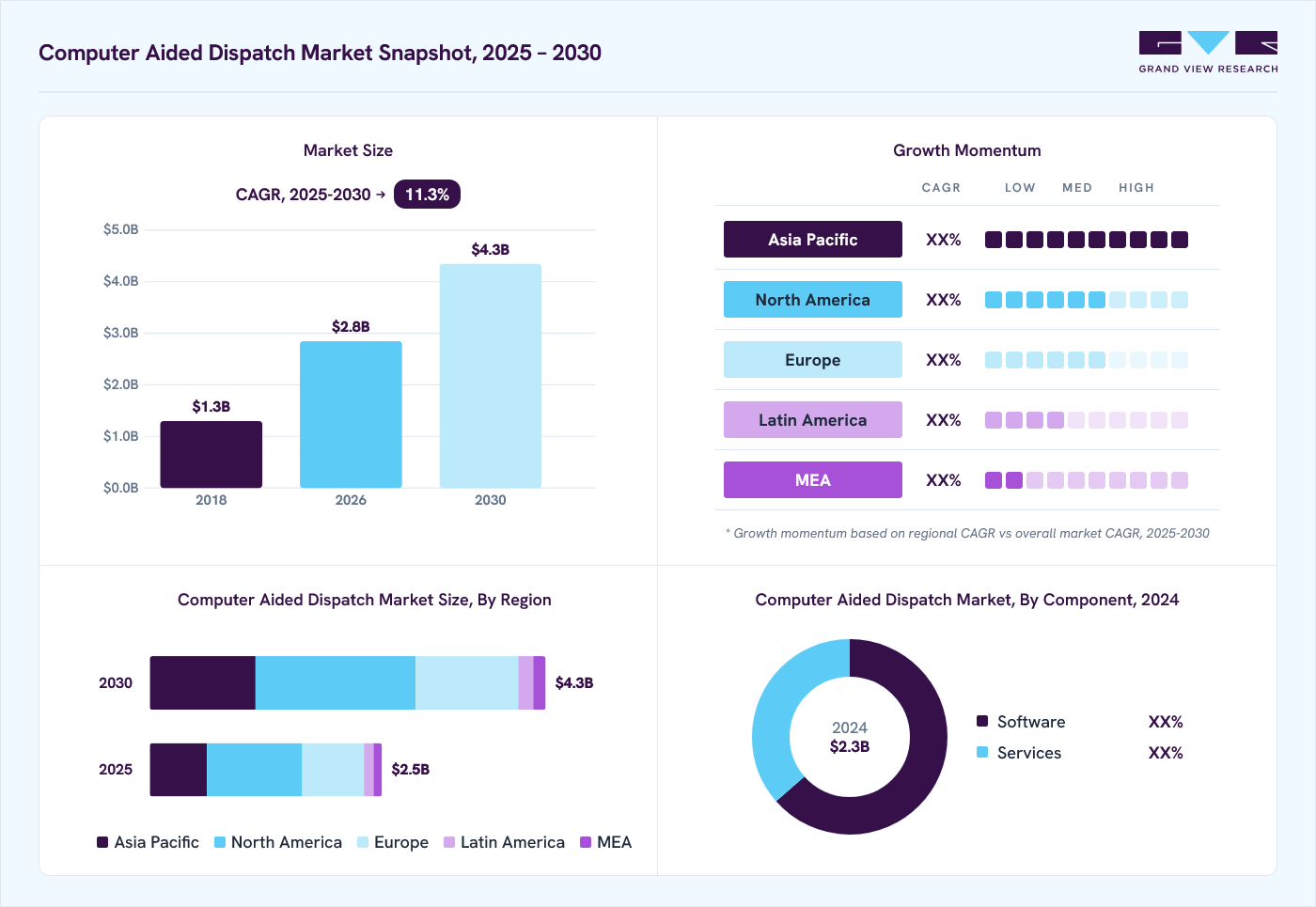
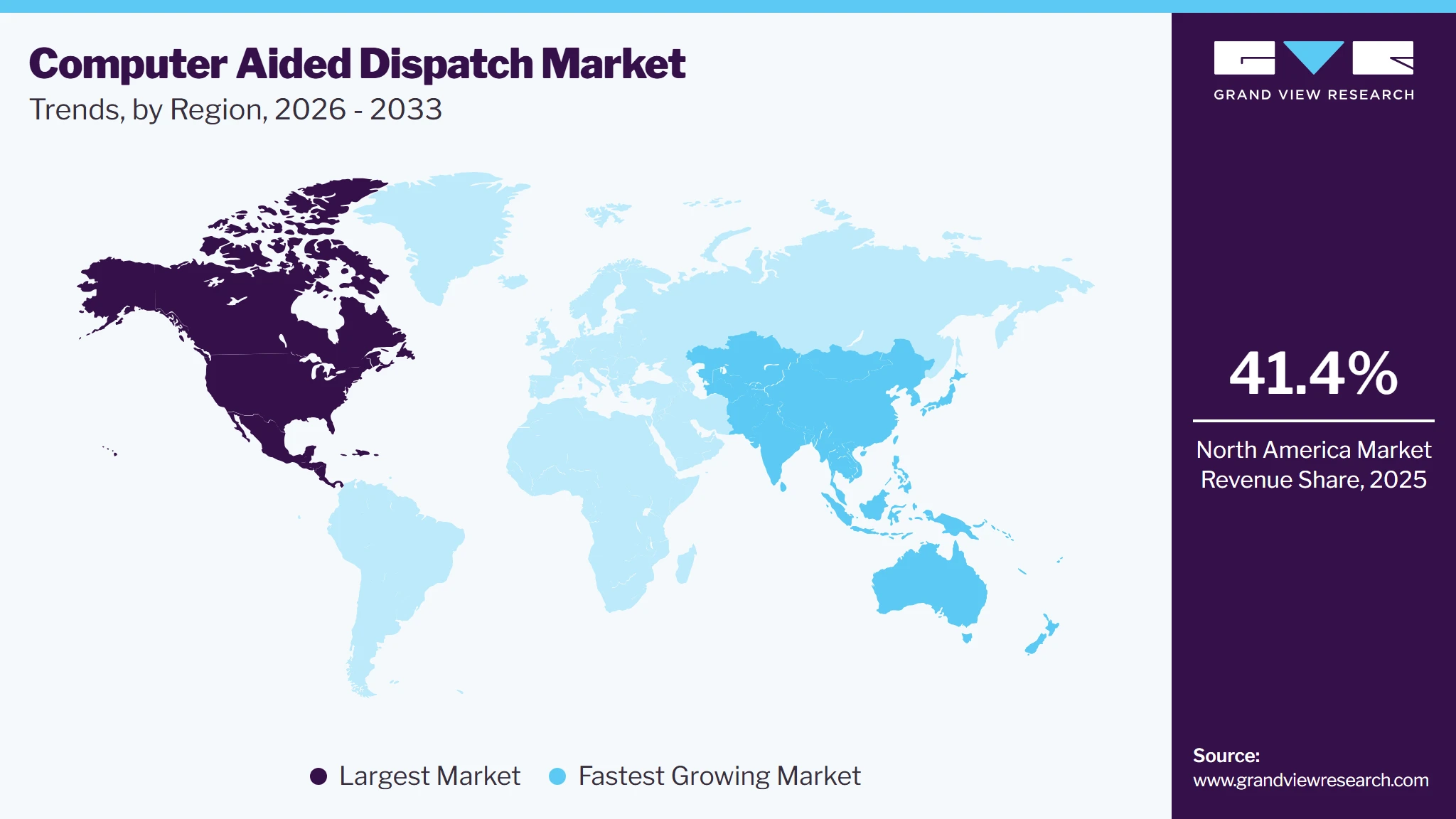
The global computer aided dispatch market size was valued at USD 2.5 billion in 2025 and is projected to grow from USD 2.8 billion in 2026 to USD 6.2 billion by 2033, at a CAGR of 11.9% from 2026 to 2033. North America dominated the market, accounting for a revenue share of 41.4% in 2025. The computer aided dispatch market is driven by the increasing modernization of public safety communication infrastructure, geographic information systems (GIS), and the rising demand for real-time incident management and emergency response coordination.
Key Market Trends & Insights
- By component: The software segment dominated the market, with a share of 64.2% in 2025.
- By vertical: The public safety segment accounted for the largest market share of 28.7% in 2025.
Regional Highlights
- Largest regional market: North America (41.4% revenue share in 2025)
- Fastest growing regional market: Asia Pacific (highest CAGR 13.3%, 2026-2033)
- By Country: The U.S. held the largest market share in 2025
Market Size & Forecast
- Market size in 2025: USD 2.5 Billion
- Estimated market size in 2026: USD 2.8 Billion
- Projected market size by 2033: USD 6.2 Billion
- CAGR (2026-2033): 11.9%
The demand for computer-aided dispatch (CAD) systems is also expected to grow as government regulations and policies evolve and companies continue investing in innovation and advancements in CAD solutions. Moreover, public and private agencies' growing adoption of cloud-based CAD software is estimated to bolster global market growth.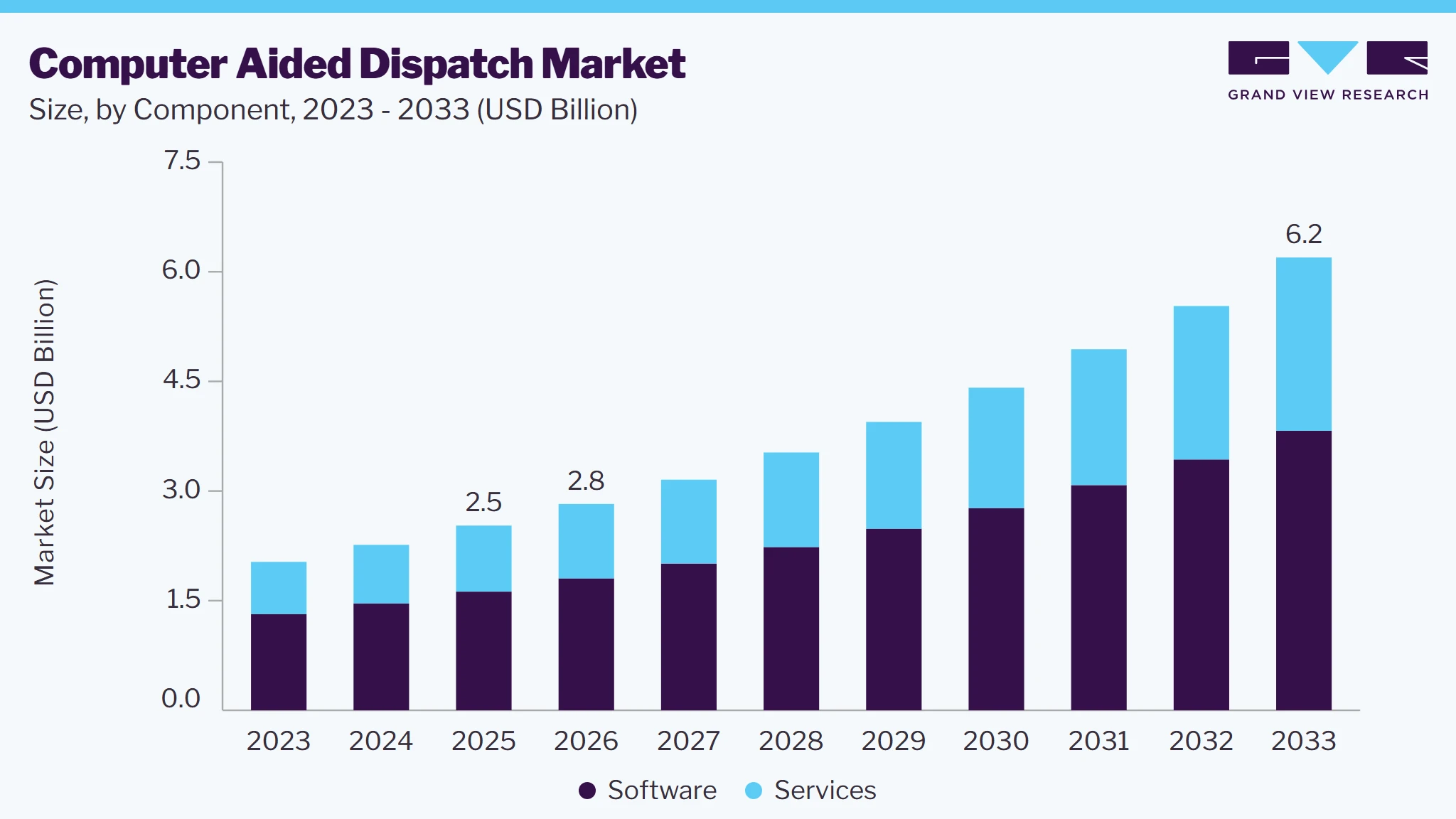
The 911 operators and dispatchers use computer-aided dispatch solutions to record incident calls, arrange the dispatch, accurately dispatch the responders, and obtain updates on the location and status of responders on the field. Multiple law enforcement and other government agencies increasingly embrace CAD solutions to manage emergencies effectively. These agencies continue to focus on ensuring a quick response to threats associated with criminal activities and natural calamities. As a result, the adoption of CAD software is anticipated to witness steady growth over the forecast period.
Conventionally, Public Safety Answering Points (PSAP), also called public safety radio systems and dispatch centers, were established and operated by standalone agencies. However, with the introduction and adoption of different CAD solutions across different agencies, dispatch systems, and the teams operating these systems are confronting incompatibility and interoperability issues. To overcome this problem, public safety agencies, especially in developed economies, are opting for a single point of contact. Such an approach would address the interoperability issues and reduce the overall operating costs incurred by these PSAPs. Thus, the rising consolidation of PSAPs is anticipated to hinder the global computer-aided dispatch market growth from 2025 to 2030.
CAD solutions act as human interfaces to push-to-talk (PTT) dispatch systems. CAD solutions thereby enable effective group communication among connected resources during mission-critical operations. Several facilities and agencies deploy CAD solutions for both operational and administrative purposes. CAD solutions are considered critical to mission-critical operations. They are generally deployed by public safety and first responder agencies, including police departments, crisis management centers, emergency medical service providers, fire departments, transport service providers, military forces, and federal agencies. The rising incidences of terror attacks worldwide are key factors propelling the demand for CAD solutions that help limit the damage post-terror attacks. The rising incidences of terrorist attacks and governments’ willingness to invest in developing robust communication infrastructure drive market growth.
The CAD platform would support features such as GIS-based call-taking and GPS-based police vehicle dispatch to assist with emergency calls. The project would showcase the capabilities of next-generation 911 (NG911) network standards, which help in identifying callers’ locations and exchanging information between dispatching centers and public safety agencies, including police departments, emergency medical services, fire departments, and disaster management teams, among others.
Moreover, having realized that people need immediate responses from law enforcement agencies, emergency medical services, and natural disaster management teams during critical situations, prominent market players, such as Motorola Solutions, Inc. and CentralSquare Technologies, have introduced CAD solutions that can help the public safety agencies in improving their responses by responding in real-time.
In the global computer aided dispatch market, the adoption of Artificial Intelligence (AI) and Machine Learning (ML) is transforming emergency response systems. These technologies enhance decision-making by analyzing vast datasets in real-time, predicting resource needs, and automating routine tasks. AI-driven analytics optimize incident prioritization, while ML algorithms improve response times and efficiency. Additionally, AI facilitates seamless integration with next-generation technologies, such as NG911, to process multimedia inputs like video and text, making CAD systems more intelligent, adaptive, and effective in handling complex scenarios.
Urbanization and smart city initiatives drive the growth of the global computer aided dispatch industry by increasing the need for efficient emergency response systems to support dense and interconnected urban areas. These initiatives focus on integrating advanced technologies, such as real-time tracking and AI-driven dispatching, to improve public safety and infrastructure management. As cities grow, the demand for CAD systems to streamline emergency communication, optimize resource allocation, and enhance incident management becomes a critical component of urban development and smart city planning.
Market Dynamics
The computer aided dispatch market is witnessing substantial growth driven by advancements in emergency communication technologies, cloud computing, artificial intelligence (AI), Geographic Information Systems (GIS), and real-time incident management solutions. The growing need for rapid incident response, optimized resource allocation, and enhanced situational awareness is accelerating the deployment of advanced CAD platforms to support mission-critical operations and multi-agency coordination. The increasing investments in smart city initiatives, public safety modernization programs, critical infrastructure protection, and disaster management capabilities are creating new opportunities across the global computer-aided dispatch ecosystem.
The increasing deployment of next-generation emergency response infrastructure is a major driver for the computer aided dispatch market. Public safety agencies are modernizing legacy dispatch environments to improve operational efficiency, accelerate response times, and enhance coordination during critical incidents. The transition toward digital communication networks, integrated command centers, and advanced dispatch technologies is encouraging organizations to invest in sophisticated platforms capable of managing complex emergency workflows with greater precision and reliability.
The growing adoption of real-time location tracking, GIS-enabled mapping, automated call prioritization, and centralized communication systems is strengthening dispatch capabilities across emergency operations. These technologies enable dispatch personnel to make faster, data-driven decisions while improving resource allocation during incidents. Increasing government funding for emergency preparedness initiatives and modernization programs is further supporting the implementation of advanced dispatch solutions, contributing to sustained demand for computer aided dispatch platforms worldwide.
The complexity involved in integrating modern dispatch platforms with existing legacy infrastructure remains a significant restraint for the computer-aided dispatch market. Many public safety organizations continue to operate outdated communication systems, records databases, and operational software that were not designed to support advanced digital dispatch functionalities. Achieving seamless interoperability often requires extensive customization, system upgrades, and technical expertise, increasing deployment challenges for agencies.
Integration projects frequently involve substantial implementation timelines, operational disruptions, and compatibility concerns across multiple departments and communication networks. Agencies must ensure uninterrupted emergency response capabilities during the transition to new platforms, complicating modernization efforts. Concerns related to data migration, cybersecurity compliance, and interoperability testing can further delay adoption decisions, limiting the pace at which organizations replace or upgrade existing dispatch environments.
The increasing adoption of artificial intelligence-powered decision support platforms presents a significant opportunity for the computer aided dispatch market. AI-enabled technologies are transforming dispatch operations by providing intelligent incident classification, predictive resource allocation, automated risk assessment, and real-time operational recommendations. These capabilities help dispatch centers process large volumes of incoming information more efficiently while supporting faster, more accurate decision-making in emergency situations.
The advances in machine learning, predictive analytics, and automated workflow orchestration are enabling dispatch systems to proactively identify patterns, optimize resource deployment, and improve situational awareness. Organizations are increasingly exploring AI-driven solutions to enhance operational effectiveness while reducing dispatcher workload and response delays. As emergency management strategies become more data-centric, demand for intelligent dispatch platforms capable of delivering actionable insights is expected to create substantial opportunities for technology providers.
Market Concentration & Characteristics
The computer aided dispatch market is moderately concentrated, with several established public safety software providers and emergency communication technology companies competing across law enforcement, fire services, emergency medical services (EMS), transportation, utilities, and government agencies. Market expansion is driven by increasing investments in emergency response modernization, cloud-based dispatch platforms, and real-time incident management solutions. Companies are focusing on interoperability, strategic partnerships, and portfolio expansion to strengthen their market presence. Vendors are increasingly investing in AI-enabled dispatch systems, GIS-integrated platforms, mobile responder applications, and predictive analytics technologies to enhance response coordination, situational awareness, and operational efficiency.
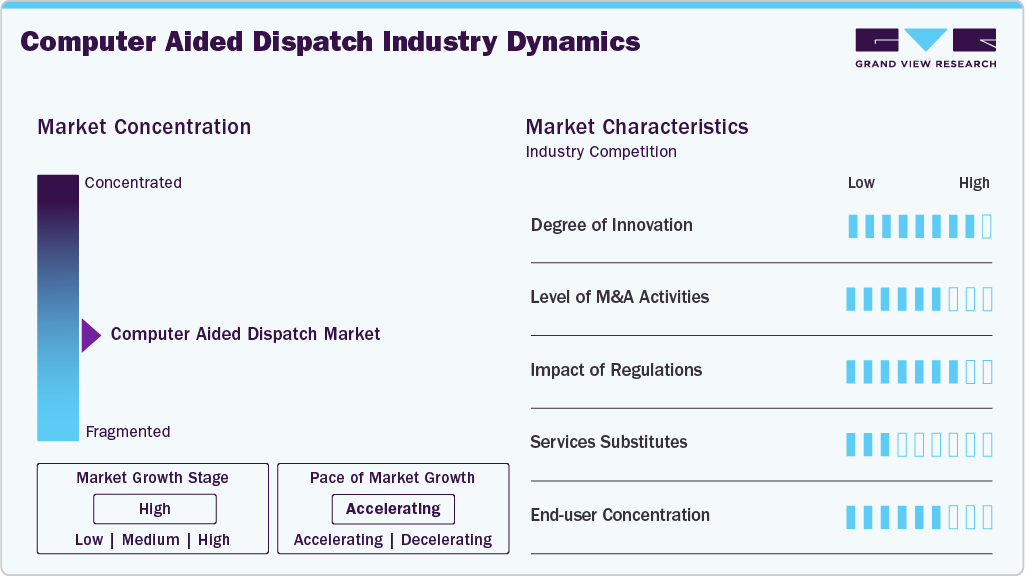
The market is characterized by a high degree of innovation, supported by advancements in artificial intelligence, cloud-native architectures, automated resource allocation, and real-time location intelligence. Merger and acquisition activity remains moderately high, with leading vendors acquiring specialized emergency communication and analytics providers to strengthen their technology capabilities. The threat from substitutes remains low, as manual dispatch processes and legacy systems lack the automation and coordination capabilities of modern dispatch platforms. Regulatory influence remains high due to public safety communication standards, cybersecurity requirements, and interoperability mandates, which continue to shape technology adoption across the market.
Analyst Perspective
The computer aided dispatch market is experiencing significant expansion, driven by the increasing demand for rapid emergency response coordination, ongoing advancements in public safety communication technologies, and the growing adoption of digital dispatch platforms. The rising deployment of advanced dispatch solutions, including AI-powered decision support, cloud-based architectures, GIS-integrated mapping, and real-time incident management systems, is further enhancing operational effectiveness across law enforcement, fire services, emergency medical services, transportation, utilities, and government agencies. As organizations increasingly prioritize situational awareness, interoperability, predictive analytics, and resource optimization initiatives, computer aided dispatch solution providers are well-positioned to capitalize on emerging opportunities, reinforcing long-term market expansion and sustained revenue generation across the global public safety ecosystem.
Component Insights
The software segment dominated the computer aided dispatch industry with a revenue share of 63.5% in 2024. This high share is attributable to a wide preference for CAD solutions across various public safety components such as disaster management and healthcare emergencies. The demand for computer aided dispatch software across Fire, Police, and Emergency Medical Services (EMS) agencies is growing rapidly. As a result, it is anticipated to showcase remarkable growth in the software segment over the forecast period.
The surge in the adoption of CAD software solutions across several private and public agencies has increased the demand for various services associated with CAD solutions. These services include installation and integration, support, and training. Moreover, governments in emerging countries such as India, China, and Brazil invest heavily in deploying CAD software to provide high public safety. Thus, with the rising investments to deploy CAD solutions, the demand for associated services is expected to grow significantly over the forecast period.
The service segment is estimated to register the fastest CAGR from 2025 to 2030. The market constantly evolves, with new features, integrations, and enhancements regularly introduced. Service providers stay up-to-date with the latest CAD technologies and developments, offering system upgrades, software updates, and maintenance services. Organizations can rely on these service providers to keep their CAD systems optimized, secure, and compatible with emerging technologies.
Vertical Insights
The public safety segment held the highest market share of 28.3% in 2024. This high share is attributed to several public safety departments across the globe deploying computer aided dispatch systems to achieve maximum efficiencies in dispatch operations. Increasing the use of CAD technology to ensure efficient dispatch services in verticals such as public safety, government, transportation, utilities, and healthcare, is expected to drive the growth. In 2024, the public safety vertical attained the largest market share among all vertical segments in the global market due to the high adoption of computer aided dispatch software for various public safety components such as fire safety, crime control, and other critical components. Also, increasing the employment of detectives and police officers is further estimated to boost segment growth over the forecast period.
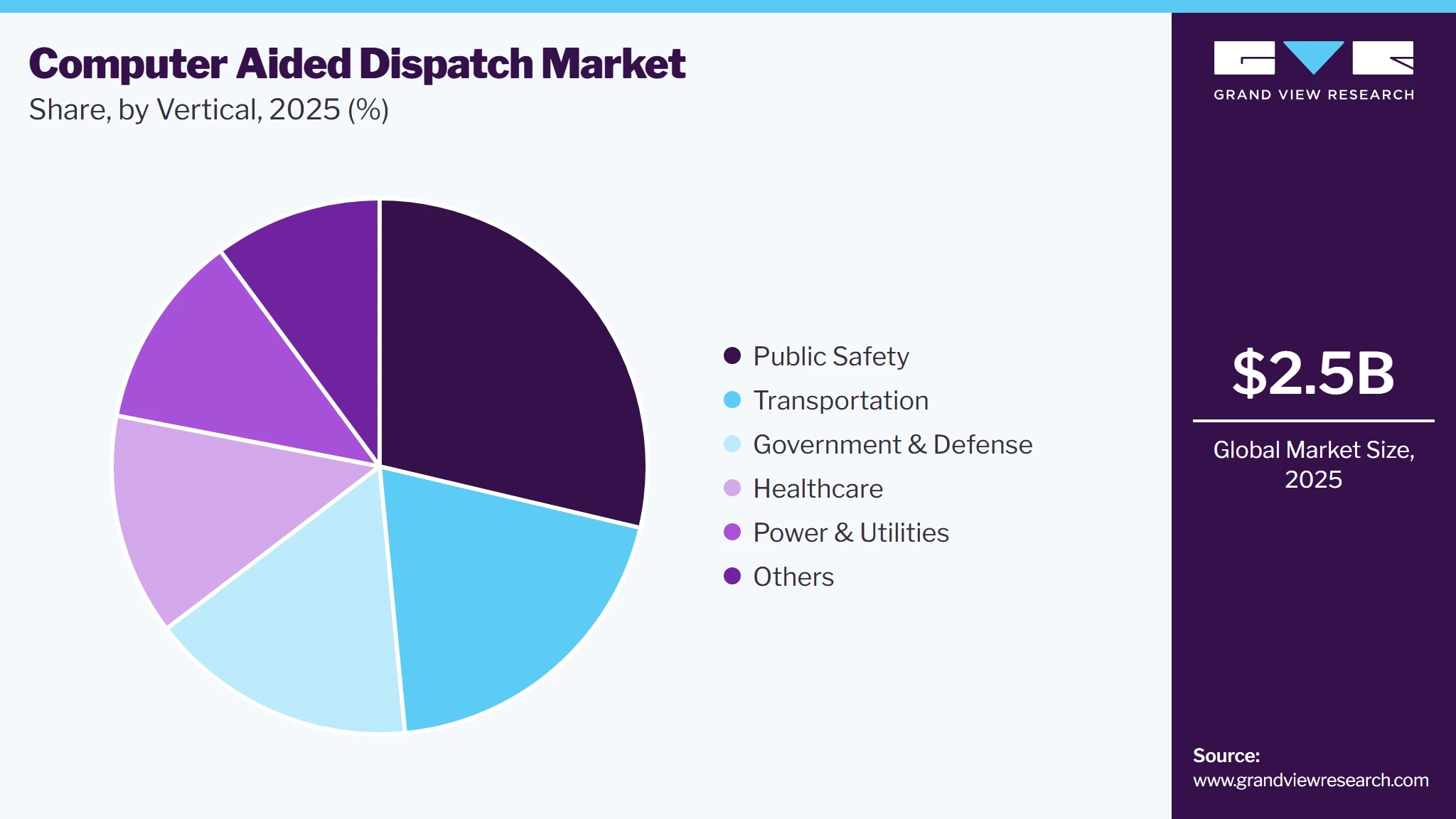
Moreover, the demand for computer aided dispatch solutions has also witnessed a notable increase across other verticals such as transportation, government and defense, power and utilities, and healthcare. The healthcare segment is estimated to register the fastest CAGR from 2025 to 2030, owing to the soaring need to manage emergency medical services efficiently. Besides, computer aided dispatch solutions are also used for other healthcare facilities to accurately track staff involvement during incidents and dispatch work schedules to admitted and visiting patients. Moreover, the transportation segment is estimated to see significant growth in the global market owing to the rising demand for CAD solutions across airports and railway stations.
Regional Insights
North America the computer aided dispatch market accounted for the largest market share of 41.1% in 2024. It is attributed to the increasing demand for public safety solutions, changing regulations and policies, and the presence of advanced networking and communication infrastructure. Moreover, the presence of large market players and a high focus on investing in emergency services components by the federal government is expected to increase the adoption of CAD solutions in the region. Also, rising year-on-year defense spending in the U.S. is estimated to augment the country's CAD software adoption for defense components.
U.S. Computer Aided Dispatch Market Trends
The U.S. computer aided dispatch market dominated the regional computer aided dispatch industry as modern computer-assisted dispatch systems allow public safety and law enforcement agencies to obtain real-time information on current incidents; state governments and public safety agencies are investing in modernizing their call management systems. For instance, Scotts Bluff County in Nebraska used computer-assisted dispatch systems across multiple public safety verticals to reduce response times and better serve citizens.
Asia Pacific Computer Aided Dispatch Market Trends
Asia Pacific computer aided dispatch market is projected to demonstrate growth at the fastest CAGR from 2025 to 2030 in the computer aided dispatch industry. Continued urbanization and evolving government policies encourage adopting emergency dispatch software in emerging economies. The constant communication and networking infrastructure rollout is also expected to drive the market over the forecast period. Additionally, local governments' growing focus and investments in deploying public safety software in emerging countries such as India are further anticipated to fuel the market growth from 2025 to 2030.
Key Computer Aided Dispatch Company Insights
Some of the key players operating in the market include Hexagon AB; Motorola Solutions, Inc.; and Avtec Inc.
-
Motorola Solutions, Inc. is a global provider of mission-critical communications and analytics solutions, catering primarily to public safety and enterprise sectors. The company’s portfolio includes land mobile radio (LMR) systems, video surveillance, command center software, and next-generation 911 (NG911) solutions. It leverages advanced technologies such as AI and cloud-based services to enhance communication, safety, and operational efficiency. With a strong presence worldwide, Motorola Solutions, Inc. continues to innovate and expand through strategic acquisitions and partnerships, solidifying its leadership in the critical communications market.
CARBYNE and Mark43 are some of the emerging market participants in the target market.
-
Mark43 is a cloud-based public safety software company providing a modern, integrated suite of solutions for law enforcement, emergency responders, and public safety agencies. Its offerings include records management systems (RMS), CAD, and analytics tools, all designed to enhance operational efficiency and data-driven decision-making.
Key Computer Aided Dispatch Companies:
The following are the leading companies in the computer aided dispatch market.
- CENTRALSQUARE
- Avtec Inc.
- Harris
- CARBYNE
- CODY Systems
- Corti
- DoubleMap
- Southern Software, Inc.
- Hexagon AB
- Mark43
- Nuance Communications, Inc.
- RapidDeploy, Inc.
- Motorola Solutions, Inc.
- Traumasoft
- Tyler Technologies
- Priority Dispatch Corp.
- eso
- Verint Systems Inc.
- ZETRON
- ZOLL Medical Corporation
Competitive Benchmarking
Category
Operating Strategies
Competitive Edge
Weakness
Established Players (Hexagon AB; Motorola Solutions, Inc.; and Avtec Inc.)
- Focus on expanding integrated emergency response platforms through interoperability, cloud, and GIS partnerships.
- Invest heavily in AI-enabled dispatch capabilities to enhance real-time incident coordination.
- Strong government relationships, extensive deployments, and proven public safety technology expertise.
- Ability to provide secure, interoperable, end-to-end dispatch solutions for mission-critical operations.
- Dependence on legacy customer environments can slow next-generation platform transitions.
- Large organizational structures may reduce agility in the face of emerging cloud-native competitors.
Emerging Players (CARBYNE and Mark43)
- Emerging players focus on developing cloud-native dispatch platforms with flexible deployment capabilities.
- Invest in AI-driven analytics and mobile applications for differentiated offerings.
- Agile development processes enable rapid feature innovation and customer customization.
- Modern cloud architectures support scalable, cost-effective dispatch platform deployments.
- A limited customer base reduces brand recognition among large public agencies.
- Smaller financial resources can restrict expansion and long-term technology investments.
Recent Development
-
In August 2024, CARBYNE and Axon Enterprise, Inc. announced a partnership to integrate CARBYNE’s advanced 9-1-1 caller data with Axon Enterprise, Inc.'s Fusus platform, enabling seamless data sharing and improved situational awareness for emergency response teams. This collaboration combines real-time 9-1-1 data, AI-powered features, and security camera feeds to enhance decision-making and streamline emergency response processes, paving the way for next-generation public safety solutions.
-
In July 2024, Priority Dispatch Corp. announced a partnership with GoodSAM Platform to integrate its Automated External Defibrillators (AED) registry into the ProQA software, enhancing emergency response capabilities by providing dispatchers with access to both fixed and mobile AED locations. This collaboration aims to improve cardiac emergency response times, empowering dispatchers to direct callers to the nearest available AED, potentially saving lives during critical situations.
-
In March 2023, Motorola Solutions' PremierOne computer-aided dispatch (CAD) software was successfully integrated by Peel Regional Police to strengthen safety measures for officers and the approximately 1.4 million residents in the Peel region. This cutting-edge CAD system, PremierOne, is pivotal in facilitating real-time communication and fostering better collaboration between dispatchers and field personnel. Its advanced capabilities enable the seamless sharing of time-sensitive and critical information among various agencies, leading to heightened operational efficiency and more effective response strategies.
-
In February 2023, Zetron acquired GeoConex, a long-standing computer-aided dispatch (CAD) solution partner. This strategic acquisition aims to enable closer integration between the two companies’ respective 911 technologies, which complement each other. By joining forces, Zetron and GeoConex will enhance their capabilities in delivering comprehensive CAD solutions for emergency services, further empowering efficient and seamless emergency response operations.
-
In September 2022, Harris, a global software provider and acquirer focusing on vertical markets, expanded its public sector offerings by acquiring Cushing Systems Inc. (CSI), a leading public safety software provider. This strategic acquisition further enhances Harris' portfolio in the public sector domain, enabling them to provide comprehensive and advanced solutions for public safety organizations. By incorporating CSi's expertise and software solutions, Harris aims to strengthen its position as a trusted provider of innovative software solutions tailored specifically for the public safety sector.
-
In August 2022, Mark43, a cloud-native public safety software provider, announced a groundbreaking partnership with the Tennessee Highway Patrol (THP), a Tennessee Department of Public Safety and Homeland Security division, to introduce integrated Computer-Aided Dispatch (CAD) and mobile capabilities. Implementing Mark43's CAD system will encompass many advanced features, including a mobile dispatch application, powerful analytics tools, and multiple user interfaces. This collaborative effort marks a significant step forward in leveraging cutting-edge technology to bolster public safety and optimize emergency response operations to benefit the communities served.
Computer Aided Dispatch Market Report Scope
Report Attribute
Details
Market size in 2024
USD 2.3 billion
Estimated market size in 2026
USD 2.8 billion
Projected market size by 2030
USD 4.3 billion
Growth rate
CAGR of 11.3% from 2025 to 2030
Actual data
2017 - 2024
Forecast period
2025 - 2030
Quantitative units
Revenue in USD million/billion and CAGR from 2025 to 2030
Report coverage
Revenue forecast, company ranking, competitive landscape, growth factors, and trends
Segments covered
Component, vertical, region
Regional scope
North America; Europe; Asia Pacific; Latin America; MEA
Country scope
U.S.; Canada; Mexico; UK; Germany; Italy; France; China; Japan; India; South Korea; Australia; Brazil; UAE; Kingdom of Saudi Arabia (KSA); South Africa
Key companies profiled
Avtec Inc.; Harris; CARBYNE; CENTRALSQUARE; CODY Systems; Corti; DoubleMap; eso; Hexagon AB; Mark43; Motorola Solutions, Inc.; Nuance Communications, Inc.; Priority Dispatch Corp.; RapidDeploy, Inc.; Southern Software, Inc.; Traumasoft; Tyler Technologies; Verint Systems Inc.; ZETRON; ZOLL Medical Corporation
Customization scope
Free report customization (equivalent up to 8 analysts working days) with purchase. Addition or alteration to country, regional & segment scope.
Pricing and purchase options
Avail customized purchase options to meet your exact research needs. Explore purchase options
Global Computer Aided Dispatch Market Report Segmentation
This report forecasts revenue growth at global, regional, and country levels and provides an analysis of the latest industry trends in each of the sub-segments from 2021 to 2033. For this study, Grand View Research has segmented the global computer aided dispatch market report based on component, vertical, and region:

-
Component Outlook (Revenue, USD Million, 2021 - 2033)
-
Software
-
On-premise
-
Cloud-based
-
-
Services
-
-
Vertical Outlook (Revenue, USD Million, 2021 - 2033)
-
Public Safety
-
Government & Defense
-
Transportation
-
Power & Utilities
-
Healthcare
-
Others
-
-
Regional Outlook (Revenue, USD Million, 2021 - 2033)
-
North America
-
U.S.
-
Canada
-
Mexico
-
-
Europe
-
UK
-
Germany
-
France
-
Italy
-
-
Asia Pacific
-
China
-
India
-
Japan
-
South Korea
-
Australia
-
-
Latin America
-
Brazil
-
-
Middle East & Africa (MEA)
-
UAE
-
Kingdom of Saudi Arabia (KSA)
-
South Africa
-
-
Research Methodology
The computer aided dispatch market figures in this report are based on a proven research process that combines executive interviews with secondary research from proprietary databases, company filings, and recognized regulatory and institutional sources. Market size is built through value-chain sizing - reconciling supply-side and demand-side estimates - and triangulated with bottom-up and top-down approaches. Every estimate passes multiple levels of expert validation before publication, with each computer aided dispatch segment quantified using the revenue-capture definitions in the table below.
Segment Definition
Segment - Component
Revenue capture definition
Software
Revenue is generated from computer aided dispatch software platforms used for incident management, call handling, resource allocation, unit tracking, GIS mapping, real-time communication, and emergency response coordination. This segment is driven by the increasing adoption of cloud-based dispatch systems, AI-enabled decision-support tools, and integrated public-safety communication technologies.
Services
Revenue is captured from consulting, implementation, integration, training, maintenance, technical support, and managed services associated with computer aided dispatch solutions. This segment is driven by growing demand for system modernization, interoperability enhancement, cybersecurity management, and ongoing optimization of dispatch operations.
Segment - Vertical
Revenue capture definition
Public Safety
Revenue is generated from computer aided dispatch solutions deployed by law enforcement agencies, fire departments, emergency medical services (EMS), and public safety answering points (PSAPs). This segment is driven by increasing investments in emergency response modernization, Next Generation 911 initiatives, and real-time incident management capabilities.
Government & Defense
Revenue is generated from dispatch platforms used by government agencies, military organizations, homeland security departments, and emergency management authorities to coordinate personnel, assets, and critical response activities. This segment is driven by rising focus on national security, disaster preparedness, and mission-critical communication infrastructure.
Transportation
Revenue is generated from dispatch solutions used for fleet coordination, transit operations, traffic incident management, and transportation emergency response activities. This segment is driven by growing demand for real-time vehicle tracking, operational efficiency, and intelligent transportation management systems.
Power & Utilities
Revenue is captured from dispatch systems utilized by electric utilities, water utilities, gas providers, and field service organizations to coordinate workforce operations and manage service disruptions. This segment is driven by increasing infrastructure modernization efforts, grid reliability initiatives, and the need for rapid outage response management.
Healthcare
Revenue is generated from dispatch platforms used by hospitals, ambulance service providers, healthcare networks, and emergency medical response organizations for patient transportation and emergency coordination. This segment is driven by increasing demand for faster emergency response, improved patient care coordination, and efficient resource deployment.
Others
Revenue is captured from computer aided dispatch solutions deployed across sectors such as education, airports, ports, industrial facilities, campus security, and private emergency response organizations. This segment is driven by growing requirements for centralized communication, incident management, and operational coordination across complex environments.
Estimation Model
Layer Name
Key Question
Description
Emergency Response Demand Layer
Who are the potential adopters?
Identifies the total addressable customer base requiring dispatch solutions, including law enforcement agencies, fire departments, emergency medical services, public safety answering points, transportation authorities, utilities, defense organizations, and government emergency management agencies.
Communication Infrastructure Enablement Layer
Who can deploy dispatch solutions?
Adoption is influenced by the availability of emergency communication networks, dispatch centers, cloud infrastructure, GIS platforms, mobile connectivity, interoperability frameworks, cybersecurity capabilities, and investments in public safety modernization initiatives.
Operational Deployment Layer
Where are dispatch solutions actively utilized?
Applies adoption levels across environments requiring real-time incident coordination, including police operations centers, fire command centers, EMS dispatch facilities, transportation control rooms, utility response centers, military operations centers, and emergency management agencies.
Revenue Generation Layer
How is revenue generated?
Revenue is generated through software licensing, cloud subscriptions, implementation services, system integration, maintenance contracts, technical support, training programs, software upgrades, analytics modules, mobile applications, and recurring managed service offerings.
Delivered Customizations
This report has been delivered with the following In-depth customizations
Client Request
Customization Delivered
Value Adds
Emergency Response Infrastructure Optimization & Operational Efficiency Assessment
Conducted detailed evaluation of emergency communication infrastructure across law enforcement, fire services, EMS, transportation agencies, and public safety centers, integrating computer aided dispatch platforms, GIS technologies, interoperability frameworks, and operational management systems to optimize response coordination and dispatch efficiency.
Improves incident management, enhances response effectiveness, optimizes resource utilization, reduces operational delays, and supports long-term public safety performance.
Cloud-Based Dispatch Deployment & Interoperability Integration Strategy
Assessed deployment of cloud-based computer aided dispatch solutions across emergency communication centers and government agencies, integrating mobile responder applications, GIS mapping platforms, real-time communication systems, data-sharing frameworks, and cybersecurity capabilities to improve operational connectivity and coordination.
Enhances operational visibility, improves interoperability, enables faster decision-making, supports digital modernization, and strengthens the effectiveness of emergency communication.
AI-Driven Incident Management & Predictive Response Planning
Evaluated implementation of artificial intelligence-powered dispatch platforms, predictive analytics systems, automated incident prioritization technologies, real-time location intelligence solutions, and resource optimization frameworks to improve emergency response effectiveness, operational reliability, and mission-critical decision-making capabilities.
Enables proactive response planning, improves resource allocation, reduces operational costs, increases efficiency, and supports scalable emergency management operations.
Frequently Asked Questions About This Report
North America dominated the computer-aided dispatch market with a share of 41.4% in 2025.
Some key players operating in the computer aided dispatch market include Avtec Inc, Caliber Public Safety, Carbyne, CentralSquare, Cody Systems, Corti, DoubleMap, ESO, Harris Computer, Hexagon Safety & Infrastructure, Mark43, Inc., Motorola Solutions, Inc., Nuance Communications, Inc., Priority Dispatch Corp, RapidDeploy, Inc., Southern Software, Inc., Spillman Technologies, Inc, Traumasoft, Tyler Technologies, Verint Systems Inc.(NowForce), Zetron, and Zoll Medical Corporation.
Key factors that are driving the market growth include growing emphasis on public safety, continued digitization, emergence of connected devices, and growing adoption of cloud-based CAD software by public and private agencies.
The global computer aided dispatch market size was valued at USD 2.5 billion in 2025 and is estimated at USD 2.8 billion for 2026.
The global computer aided dispatch market is expected to grow at a CAGR of 11.9% from 2026 to 2033, reaching USD 6.2 billion by 2033.
The software segment dominated the market, with a share of 64.2% in 2025.
The public safety segment accounted for the largest market share of 28.7% in 2025.
The Asia Pacific is expected to grow at the fastest CAGR from 2026 to 2033.
About the Author(s)
Next Generation Technologies Research Team
Technology · Next Generation TechnologiesThis report was authored by the next generation technologies research team at Grand View Research - comprising two research analysts, one senior research analyst, and one industry expert - with specialized expertise in the next generation technologies segment of the technology industry. All findings are based on proprietary technology databases, executive interviews, and regulatory analysis, subject to internal peer review prior to publication.
Last Updated:
Speak to Analyst

Customize this report to your needs — add regions, segments, or data points, with 20% free customization.
Or view our licence options:


ISO 9001:2015 & 27001:2022 Certified
We are GDPR and CCPA compliant! Your transaction & personal information is safe and secure. For more details, please read our privacy policy.