- Home
- »
- Consumer F&B
- »
-
Coffee Market Size, Share And Trends Report, 2026-2033GVR Report cover
![Coffee Market (2026 - 2033)Report]()
Coffee Market (2026 - 2033)
Size, Share & Trends Analysis Report By Product (Roasted, Instant, Ready To Drink), By Distribution Channel (B2B, B2C), By Product By Distribution Channel (Beans, Ground Coffee, Coffee Pods, RTD, Instant), By Region, And Segment Forecasts
Market Size, 2025
$249.3BMarket Estimate, 2026
$263.5BMarket Forecast, 2033
$380.3BCAGR, 2026–2033
5.4%Coffee Market Summary
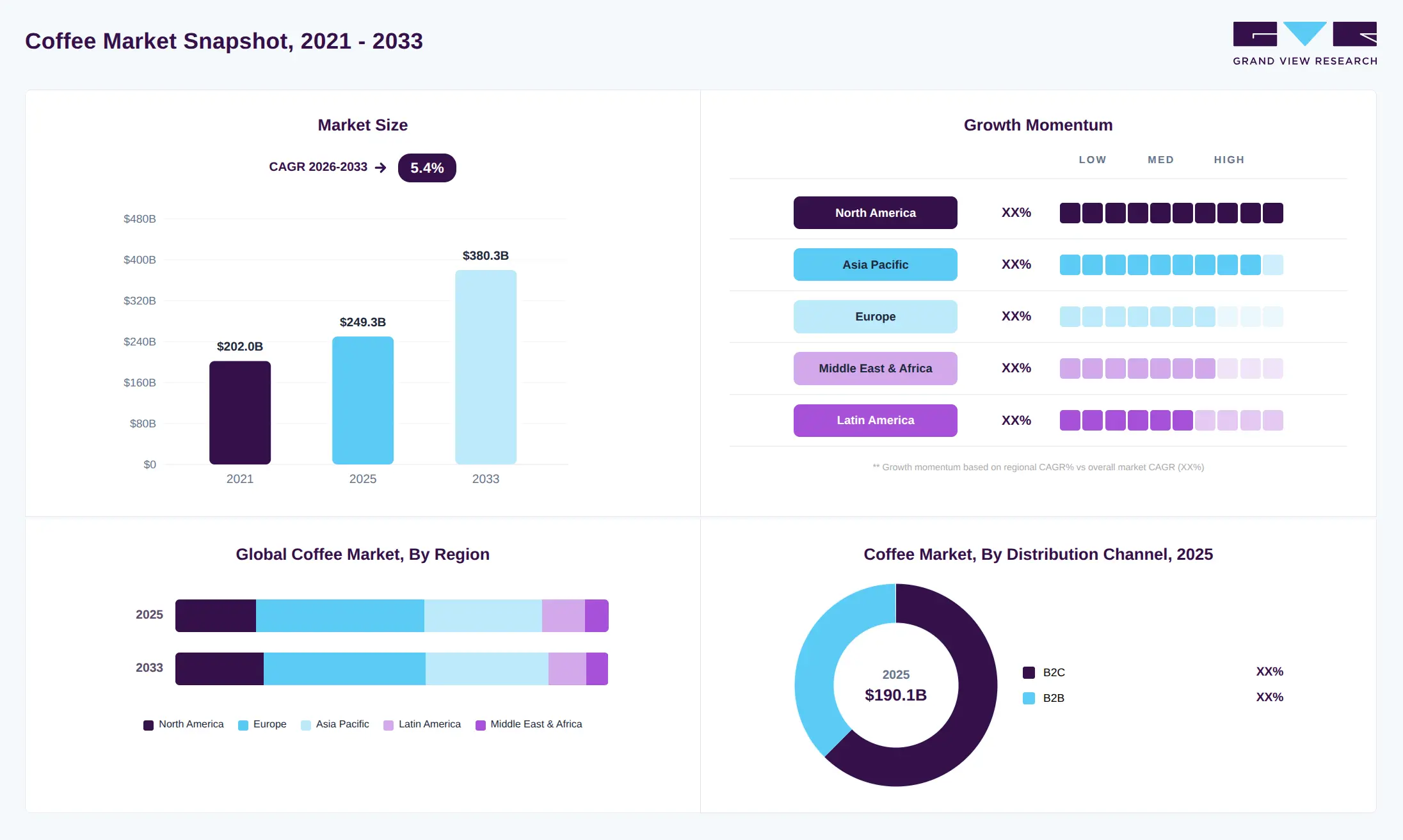
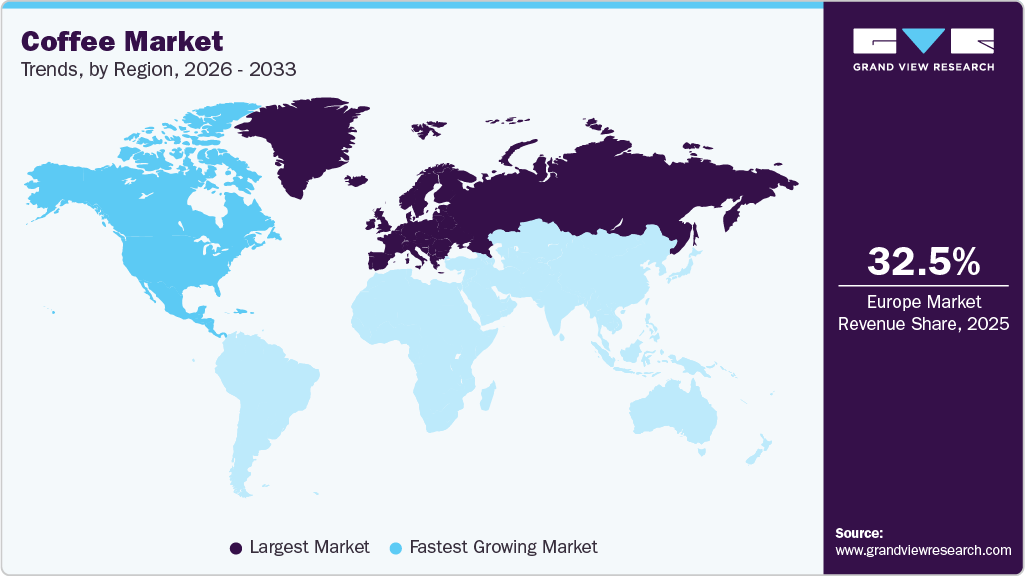
The global coffee market size was valued at USD 249.3 billion in 2025 and is projected to grow from USD 263.5 billion in 2026 to USD 380.3 billion by 2033, at a CAGR of 5.4% from 2026 to 2033. The Europe held the largest share of 32.5% of the global market in 2025. Coffee is one of the most consumed beverages worldwide, and its popularity continues to grow, particularly in emerging markets such as Asia Pacific.
Key Market Trends & Insights
- By product: Roasted coffee accounted for the largest share of 53.5% in 2025.
- By distribution channel: B2C segment account for the largest share of 62.5% in 2025.
Regional Highlights
- Largest regional market: Europe (32.5% revenue share, 2025)
- Fastest-growing regional market: North America (highest CAGR, 2026-2033).
- By country: The Germany led the Europe market in 2025.
Market Size & Forecast
- Market size in 2025: USD 249.3 Billion
- Estimated market size in 2026: USD 263.5 Billion
- Projected market size by 2033: USD 380.3 Billion
- CAGR (2026-2033): 5.4%
Increasing disposable incomes, changing lifestyles, and a rising coffee culture among consumers across the globe are contributing to the overall growth of the market. A 2024 report published by the National Coffee Association (NCA) highlighted that coffee was the most consumed beverage in the U.S. after water, recording the daily consumption among adults to be 67%, which was 49% higher than in 2004. Consistent consumer demand and evolving consumer preferences have led to a significant increase in market growth.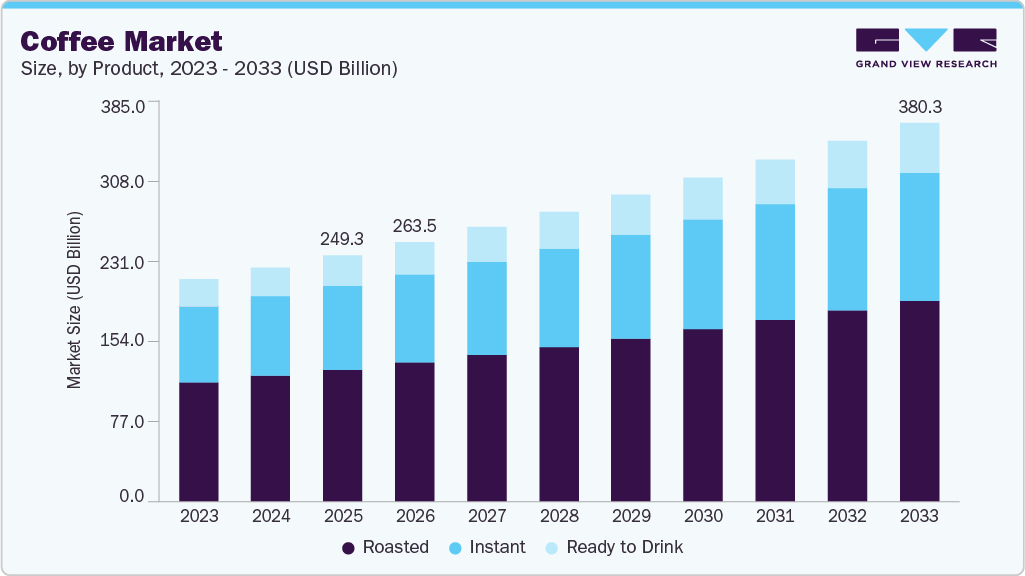
Factors such as the increasing demand for specialty and gourmet coffees, organic and sustainable sourcing, and the popularity of premium and single-origin coffee varieties impact market dynamics. Specialty coffee and gourmet coffee are often associated with higher quality and unique flavor profiles. Consumers are increasingly willing to pay a premium for these coffees, which drives up the overall value of the coffee market. This demand for specialty and gourmet coffee boosts revenue and profitability for coffee producers, roasters, and retailers. In addition, the rise of convenient coffee formats such as coffee pods and capsules has transformed the market.
Consumers are increasingly prioritizing high-quality and ethically produced coffee, evident in rising demand for specialty, single-origin, organic, and sustainably sourced varieties. This premiumization trend signifies a greater consumer willingness to invest in superior products, thereby stimulating notable market growth. Brazil, Vietnam, and Colombia are among the leading coffee-producing countries, and their production levels influence market dynamics. In December 2024, the USDA forecasted strong 2024/25 global coffee production. Brazil was expected to lead with 66.4 million bags, followed by Vietnam and Colombia. China’s consumption surged by nearly 150% over ten years, projected to reach 6.3 million bags. This increased supply was anticipated to meet growing global demand across commodity and premium segments. Changing demographics, including shifts in age distribution and lifestyles, influence the coffee market. According to a survey The Fall 2021 National Coffee Data Trends (NCDT) found that 65% of Millennials (aged 25 to 39) and 46% of Gen Z-ers (aged 18 to 24) reported consuming coffee in the previous day. Consequently, younger generations, such as millennials and Gen Z, are more likely to be avid coffee consumers and have specific preferences regarding specialty coffee, sustainable sourcing, and unique flavors. The aging population and their evolving tastes impact the market; as older adults may seek milder or decaffeinated options.
Market Dynamics
Cold coffee formats are one of the fastest-growing categories in the market. Consumption of non-espresso-based beverages (which include frozen blended coffees, cold brew, and nitro coffees), jumped by nearly 42%, from 12% of adults in 2020 to 17% in 2025. This at-home cold coffee trend is also visible in equipment ownership, as the share of Americans with a slow-drip cold brew setup at home grew from 7% in 2020 to 11% in 2025. 28% of American adults consumed a non-espresso-based beverage, reflecting strong and sustained mainstream appeal for cold coffee formats.
Younger generations are entering the coffee category through cold coffee, and it is becoming a part of their daily routine, with two out of three young people drinking it regularly. Outside the home, the ready-to-drink coffee segment is the fastest-growing coffee category globally, expanding at double-digit rates. This is fueled not only by the growing preference for cold but also by the demand for convenience, especially among younger consumers.
Coffee prices have reached all-time high levels, reflecting fundamental supply-demand imbalances that have persisted for over two years. Mild Arabica prices reached $13.2 per KG in late 2025, representing a 70.1% increase from January 2024 levels. Robusta prices stood at approximately $5.4 per KG, up 9% year-over-year, though Robusta's more modest price increase reflects the differential supply situation between the two market segments.
Consumer Insights
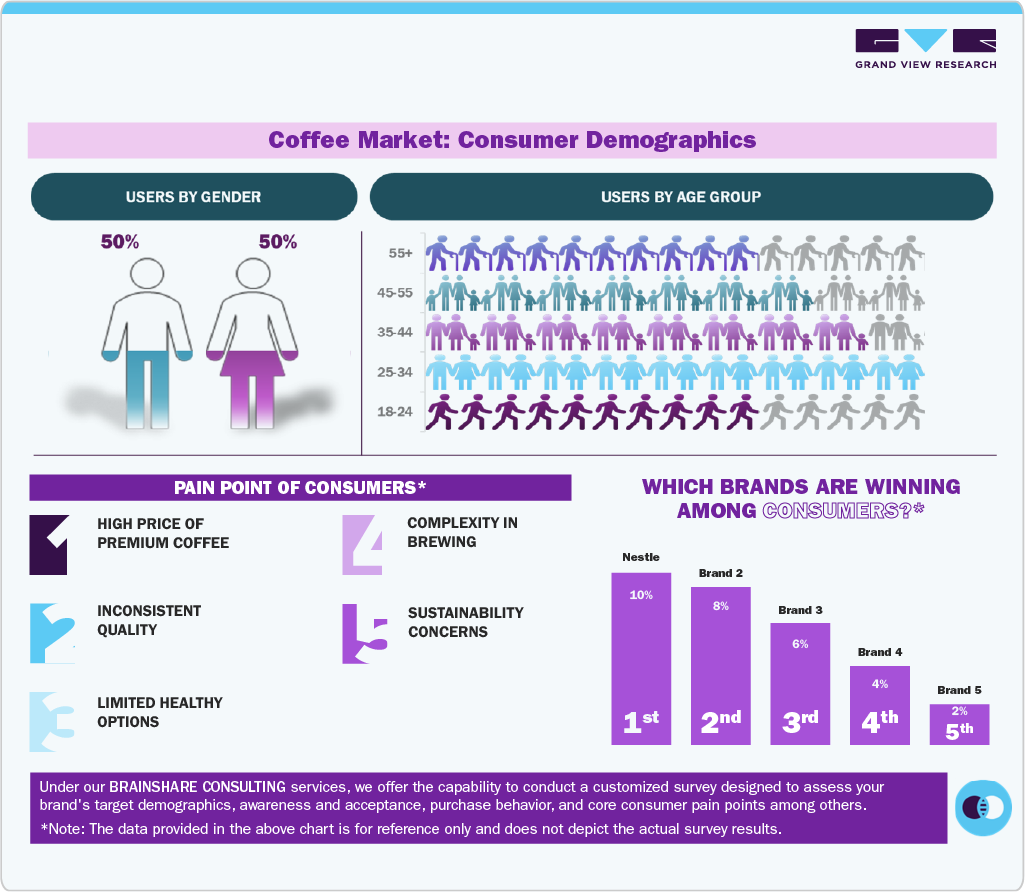
Young consumers, especially millennials and Gen Z, prefer artisanal brews, specialty beans, and café-style experiences that emphasize flavor authenticity and ethical sourcing. Rising interest in sustainable farming, organic labels, and traceable supply chains also influences purchasing decisions. Convenience remains central, driving strong demand for ready-to-drink (RTD) coffees, single-serve pods, and instant variants tailored for busy lifestyles. Social media trends and influencer-driven café culture further accelerate trials and adoption of innovative coffee formats.
Moreover, in the coffee industry, product substitutes are increasingly influencing consumer choices and market dynamics. Alternatives such as tea, matcha, and herbal infusions offer varied flavors and caffeine levels, appealing to those seeking different taste experiences or health benefits. In addition, plant-based coffee substitutes, such as chicory and barley-based drinks, cater to individuals with dietary restrictions or those avoiding caffeine. The rise of ready-to-drink beverages and functional drinks, which blend coffee with other ingredients such as protein or vitamins, also serves as a substitute for traditional coffee.
As coffee consumption is increasing globally, the Robusta coffee market is gaining increased relevance as consumers and manufacturers seek stronger flavors, competitive pricing, and higher caffeine content. Demand for premium, fine-grade Robusta is also rising as improved processing enhances taste consistency. Its expanding use in blends, instant coffee, RTD beverages, and value-focused product lines strengthens market penetration. Growing adoption in emerging economies further positions Robusta as a strategic component of global coffee industry growth.
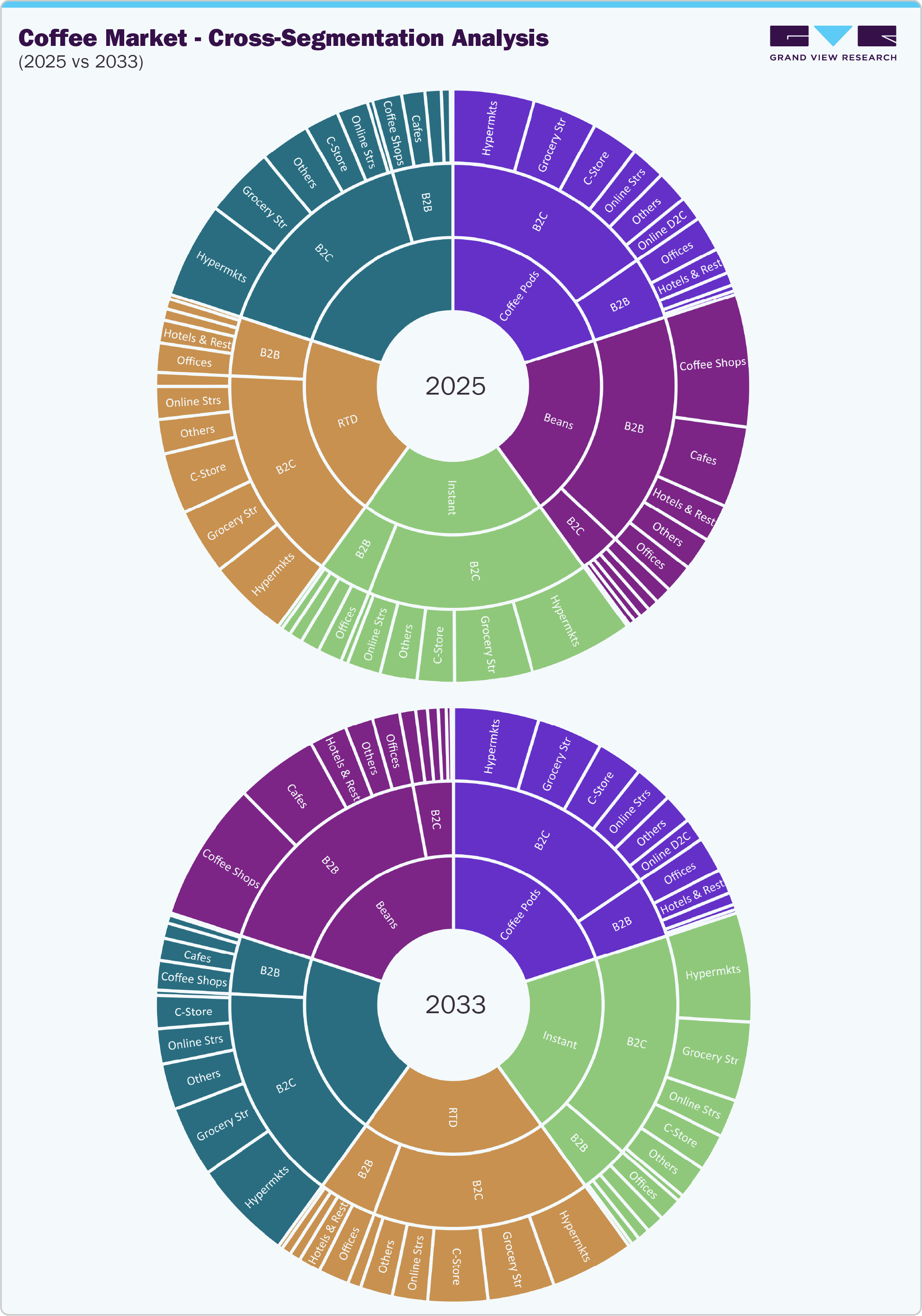
Cross-Segmentation Analysis
This MECE-based segmentation analysis provides a multidimensional view of market demand by evaluating the intersection of product × distribution channel categories. This approach uncovers high-growth and high-value combinations, identifies shifting consumption patterns across products, and highlights whitespace opportunities that are often overlooked in standalone segment analysis. The analysis maps revenue contribution, adoption trends, pricing dynamics, and growth rates across each cross-sectional layer to help stakeholders identify high-value customer-product alignments, optimize portfolio positioning, strengthen go-to-market strategies, and prioritize investments toward the most rapidly expanding demand segments.
Product Insights
The roasted coffee market accounted for a share of 53.5% of the global revenue in 2025, driven by the expansion of international coffee chains, such as Starbucks, and the globalization of coffee culture. Coffee chains have popularized freshly roasted coffee, emphasizing its premium quality and distinct flavor profiles. In addition, the growing interest in craft and specialty coffee has led to consumers seeking unique and high-quality coffee experiences, fueling the demand for artisan, distinctly sourced coffee beans. Moreover, the rise in home brewing has aided market growth positively, as consumers are investing in high-quality products and brewing equipment to replicate the coffee shop experience at home.
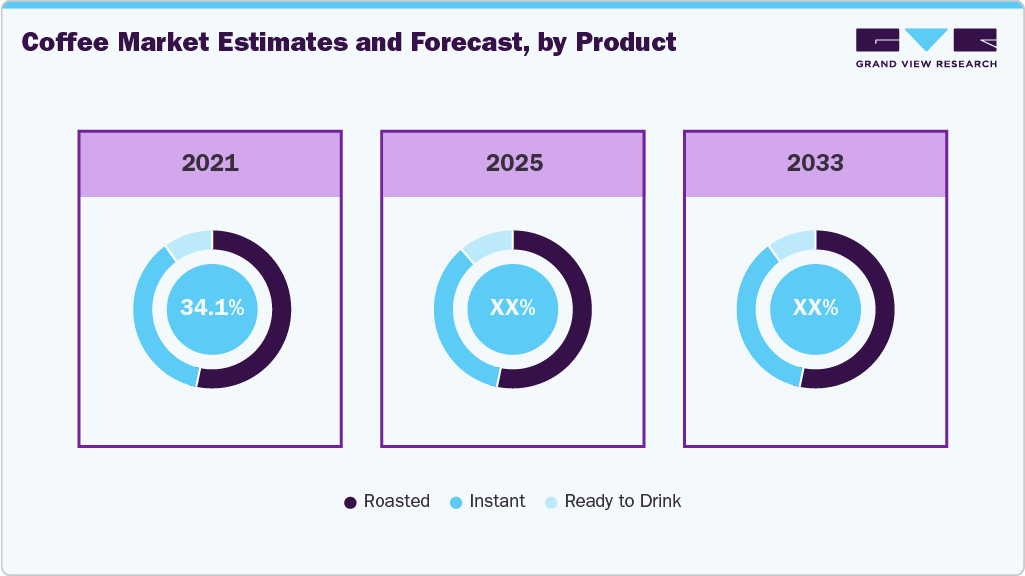
Ready-to-drink coffee market is projected to grow at a CAGR of 6.4% from 2026 to 2033. In 2024, the NCA also highlighted that ready-to-drink coffee was the third most popular preparation method used, with consumption increasing from 8% to 15% among daily consumers. The rising demand for convenience-focused coffee options aligns with busy consumer lifestyles, providing convenient options without brewing or coffee shop waits. The varied flavors and formulations, along with diverse brewing types, have significantly boosted the popularity of these beverages, catering to varied consumer preferences.
Within the broader coffee market, the Arabica coffee market continues to strengthen as consumers increasingly favor smoother flavor profiles, premium aromas, and specialty-grade offerings. Growing interest in high-quality beans, single-origin varieties, and ethically sourced Arabica has driven manufacturers to expand premium product lines, including RTD and specialty blends. As Arabica remains central to café-style beverages and innovation-led formats, its rising demand complements the overall market shift toward quality differentiation and premiumization.
Distribution Channel Insights
The sales of coffee through the B2C channel accounted for a share of 62.5% of the global revenue in 2025. The global rise of specialty coffee culture has led to an increased demand for unique and high-quality coffee beans among consumers. B2C channels allow consumers to explore and purchase specialty coffees directly from hypermarkets & supermarkets, convenience stores, specialty stores, or online platforms. The growth of e-commerce has facilitated direct-to-consumer sales models further. Coffee producers, roasters, and brands can now sell their products directly to consumers through online platforms, reaching a wider audience and bypassing traditional retail channels.
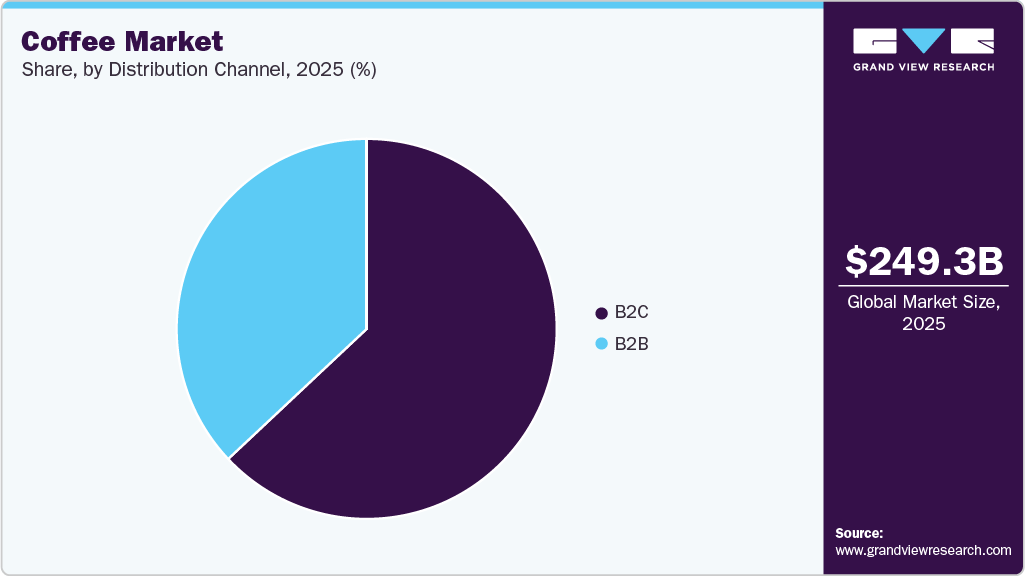
Moreover, the green coffee market is also benefiting from this strong B2C expansion, as more consumers show interest in unroasted beans for customization, home roasting, and specialty brewing. Growing awareness of origin, processing methods, and sustainability has increased demand for traceable green coffee sourced directly from producers. E-commerce platforms further accelerate this trend by offering wider bean varieties, transparent sourcing information, and subscription models, strengthening consumer engagement and supporting premium market growth.
The coffee sales through B2B channels are projected to grow at a CAGR of 4.8% from 2026 to 2033. Out-of-home revenue generated through diverse commercial establishments significantly surpasses at-home consumption, relying on efficient B2B distribution to meet consistent demand from cafes, hotels, and offices. The expansion of café culture and specialty coffee, coupled with rising urbanization, necessitates reliable B2B supply chains for high-quality beans and equipment. Moreover, product innovation, including premium instant and RTD coffee, drives B2B demand for varied product ranges. Efficiency, scale, and a growing emphasis on sustainability and corporate responsibility further fuel the expansion of these crucial B2B channels in both emerging and mature markets.
Regional Insights
The North America coffee market accounted for a considerable share of the global market share in 2025. The growing popularity and consumption of roasted coffee in the region are driving the market. The introduction of coffee chains such as Starbucks in North America has made roasted coffee increasingly sought-after, from light roast to dark roast. These chains offer roasted coffee based on customers’ varying individual tastes and preferences, thus fueling the market growth.
U.S. Coffee Market Trends
The coffee market in the U.S. led the North America coffee market with the largest revenue share of around 80% in 2025. In December 2024, the USDA reported that the U.S. imported the second-largest volume of coffee beans. Imports were projected to increase by 800,000 bags, reaching 22.3 million bags, driven by rising domestic consumption. Moreover, a 2025 article published by Balance Coffee indicated that the daily cumulative consumption of coffee in the U.S. was 400 million cups per day, driven by the widespread presence of local cafes and major chains such as Starbucks and Dunkin’, alongside aggressive brand expansions. The increasing demand for specialty and premium coffees, driven by younger demographics favoring diverse styles and ethical sourcing, also contributes to this growth. The expansion of e-commerce and ready-to-drink options enhances convenience, while coffee’s health benefits contribute to its sustained popularity despite challenges from volatile bean prices and supply chain disruptions.
Europe Coffee Market Trends
The coffee market in Europe led the global market with the largest revenue share of 32.5% in 2025, driven by the significant increase in consumption at specialty coffee shops in Western Europe, which provide primarily high-quality coffees. In April 2024, the Center for the Promotion of Imports (CBI) reported that the European branded coffee shop market grew significantly in 2022, reaching over 40,000 outlets that offer premium or specialty coffee, reflecting growing consumer demand for higher-quality brews. European coffee shops are at the forefront of specialty coffee innovation, driven by increasing consumer interest in diverse taste profiles and origin traceability. Producers are further developing unique cultivation methods and brand narratives behind their coffee, aiding the growth of coffee culture in the region. Emerging trends such as varied processing techniques and the rise of organic certifications are offering significant opportunities for diversification within the market.
In addition, the instant coffee market is experiencing renewed momentum in Europe as consumers seek convenient yet premium options. Innovations such as micro-ground blends, single-origin instant variants, and sustainably packaged formats are enhancing product appeal. This segment complements the region’s specialty culture by offering quality-focused, fast-preparation alternatives for busy urban consumers.
The coffee market in Germany led the Europe market in 2024. According to the CBI, Germany was the largest European importer of organic green coffee in 2023, accounting for 44% of total imports at 58 thousand tons, reflecting the robust coffee culture and high per capita consumption of 169 liters annually in the country. The country also boasts a significant coffee roasting industry. Growth in specialty and organic coffee is notable, underpinned by a strong focus on sustainability and quality that drives market growth in the country.
The coffee market in the UKis projected to grow lucratively over the forecast period, witnessing a considerable shift toward specialty and premium coffees. As stated in a report from the British Coffee Association, approximately 95 million cups of coffee are consumed daily in the UK, amounting to an astounding total of 2.8 billion cups annually. A substantial majority of adults, exceeding 80%, engage in regular coffee consumption, with the average individual consuming three cups per day.
Asia Pacific Coffee Market Trends
The Asia Pacific coffee market is projected to grow at a CAGR of 5.9% over the forecast period from 2026 to 2033. Coffee culture is gaining traction in many Asian countries, driven by the influence of Western coffee trends and the rise of a younger, more cosmopolitan population. Urban areas have seen a surge in the popularity of coffee shops. The Asia Pacific region has a large population of young people who are more open to adopting global trends. This demographic is increasingly drawn to the café culture and the experience of specialty coffees.
The coffee market in Japan led the Asia Pacific coffee market in 2025, spurred by the burgeoning coffee culture and a growing preference for specialty coffee. This shift towards higher quality and specialty blends has elevated the demand for premium roasted coffee beans, as consumers seek unique flavors and distinct profiles in their coffee experiences. According to Tokyoesque, Japan was a significant global importer of coffee in 2022, hosting giant coffee chains, such as Starbucks, Excelsior Café, Tully’s Coffee, and Doutor, along with traditional shops (Kissaten).
Key Coffee Company Insights
The coffee market is a highly competitive market characterized by several international brands and local companies. Major players are innovating with premium and specialty offerings, sustainable sourcing, and convenient ready-to-drink options to stand out. Besides, local cafes and restaurants are trying to offer the best coffee experience to their customers with wider flavor profiles backed by exotic and organic coffee beans and other ingredients.
-
Nestlé is a multinational food and beverage company that leverages its strong brand portfolio and international presence to maintain a dominant position. In 2025, Nescafé and coffee enhancers were key growth contributors. The largest growth contributor was Nescafé soluble, with continued strong momentum behind cold coffee via Nescafé Espresso Concentrate and ready-to-drink coffee. Companies' soluble coffee/coffee systems revenue grew by 2.95% when compared to 2025.
-
Starbucks Coffee Company is renowned for its premium coffee offerings and distinctive café experience. The company’s product range includes a variety of coffee beverages, teas, pastries, and merchandise, catering to a diverse customer base. Starbucks operates through company-owned stores and licensed outlets. Collectively revenue of the company increased by 2.8% to reach USD 37.18 billion in 2025.
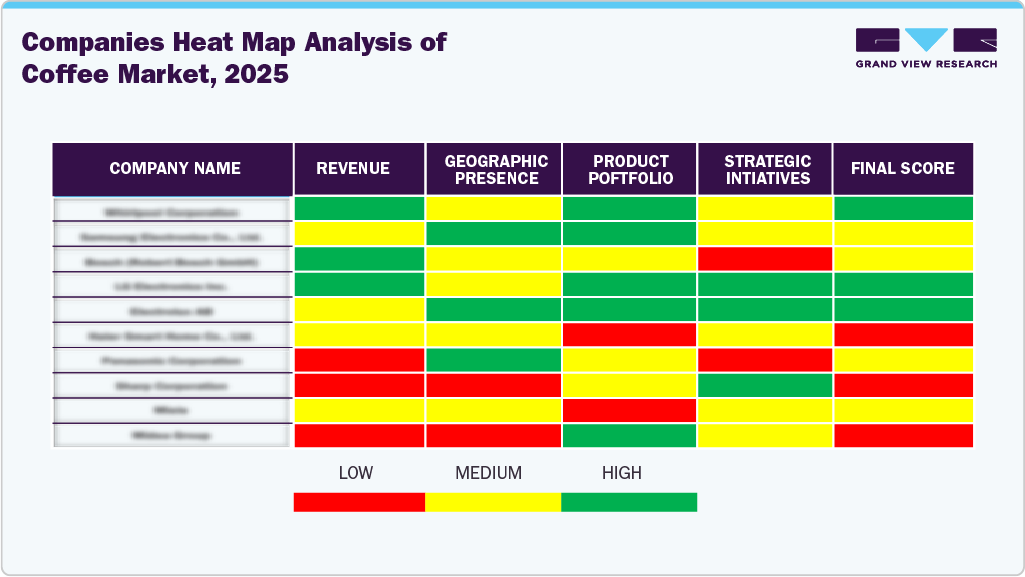
Key Coffee Companies:
The following key companies have been profiled for this study on the coffee market.
- Nestlé
- Starbucks Coffee Company
- JDE Peet's
- Tchibo GmbH
- LUIGI LAVAZZA SPA
- Strauss Coffee BV
- The J.M. Smucker Company
- Melitta Group
- UCC UESHIMA COFFEE CO., LTD.
- Massimo Zanetti Beverage Group
Recent Developments
-
In April 2026, Starbucks formed a joint venture with Boyu Capital to accelerate growth in China through localized operations, digital expansion, and faster store scaling. The partnership combines Starbucks’ global brand strength with Boyu’s local market expertise to enhance competitiveness and support long-term expansion across China. The partnership supports Starbucks’ ambition to expand its China footprint from approximately 8,000 stores to as many as 20,000 stores over time.
-
In April 2026, Nestlé and Starbucks launched Starbucks Coffee Craft concentrate to strengthen their position in the rapidly growing global cold coffee market and expand premium at-home coffee consumption occasions. The launch reflects both companies’ strategy to capture younger consumers seeking convenience, personalization, and premium cold coffee formats, while further expanding the reach of the Global Coffee Alliance across retail and ready-to-drink coffee segments. The product will initially launch in Japan, South Korea, and the UK before expanding across Europe and Asia.
-
In September 2025, Coffee Island entered the Maharashtra (India) market by launching two cafés in Pune at Amanora Mall and Tribeca Highstreet in partnership with Vita Nova, strengthening its India footprint and introducing its European coffee culture to the city’s dynamic café scene. The openings featured signature beverages, food menus, and retail products.
-
In April 2025, Starbucks announced plans to hire more baristas and reduce automation deployment, following unexpected financial results and a 1% global sales decline. This strategy, initiated by CEO Brian Niccol, aimed to regain customer loyalty in its largest market, the US.
-
In April 2025, Nestlé expanded its Nescafé Ready-to-Drink cold coffee range to India, the MENA region, and Brazil. This initiative targeted young, fast-paced consumers, with cold coffee driving double-digit growth, particularly among Gen Z and Millennials.
-
In March 2025, UCC Ueshima Coffee Co. in Japan began mass-producing coffee roasted with green hydrogen. This innovation, costing approximately 1 billion yen, aimed to reduce CO2 emissions and enhance coffee flavors, with initial sales targeting upscale channels such as hotels and airlines.
-
In November 2024, Nestlé launched a new Nescafé Classic soluble coffee range in Central and Eastern Europe. This innovative product, available in caramel and hazelnut, was designed to dissolve perfectly in both hot and cold water, catering to younger consumers’ increasing preference for cold and flavored coffee beverages.
-
In October 2024, Starbucks Coffee Company expanded its global effort to protect the future of coffee by adding two new coffee innovation farms in Guatemala and Costa Rica, with future investments planned for Africa and Asia. This initiative aimed to increase productivity, improve farmer profitability, and mitigate climate change impacts on Arabica coffee.
-
In September 2024, Massimo Zanetti Beverage USA (MZB-USA) partnered with Ultramar Caffè - La Natura Lifestyle to install a new aluminum espresso capsule packaging line at its Suffolk, Virginia facility. This initiative aimed to meet the growing US demand, with a projected annual capacity of 100 million capsules.
-
In April 2024, QuattroR acquired a 50% stake in Massimo Zanetti Beverage Group S.p.A. (Italy) through a significant capital increase. This partnership aimed to accelerate the Group’s growth, consolidate its European leadership, and strengthen its global presence in the coffee industry.
-
In February 2024, Tchibo GmbH (Germany) partnered with Enveritas to achieve 100% “responsibly” sourced coffee by 2027. This initiative, targeting 75,000 small farmers in origins such as Guatemala and Vietnam, aims to enhance sustainability beyond existing certifications through agroforestry and climate-resilient varieties.
-
In January 2024, JDE Peet’s completed the acquisition of Maratá’s coffee & tea business in Brazil. This strategic move enhanced JDE Peet’s presence and national coverage in Brazil, a key market offering significant growth potential, by complementing its existing brand portfolio.
Coffee Market Report Scope
Report Attribute
Details
Market size in 2025
USD 249.3 billion
Projected market size by 2033
USD 263.5 billion
Projected market size by 2033
USD 380.3 billion
Growth rate
CAGR of 5.4% from 2026 to 2033
Actual data
2021 - 2025
Forecast period
2026 - 2033
Quantitative units
Revenue in USD million/billion and CAGR from 2026 to 2033
Report coverage
Revenue forecast, company ranking, competitive landscape, growth factors, and trends
Segments covered
Product, distribution channel, product by distribution channel, region
Regional scope
North America; Europe; Asia Pacific; Central & South America; Middle East & Africa
Country scope
U.S.; Canada; Mexico; Germany; UK; France; Italy; Spain; Netherlands; China; Japan; India; South Korea; Australia; Brazil; South Africa; Saudi Arabia
Key companies profiled
Nestlé; Starbucks Coffee Company; JDE Peet’s; Tchibo GmbH; LUIGI LAVAZZA SPA; Strauss Coffee BV; The J.M. Smucker Company; Melitta Group; UCC UESHIMA COFFEE CO., LTD.; Massimo Zanetti Beverage Group
Customization scope
Free report customization (equivalent up to 8 analysts’ working days) with purchase. Addition or alteration to country, regional & segment scope.
Pricing and purchase options
Avail customized purchase options to meet your exact research needs. Explore purchase options
Global Coffee Market Report Segmentation
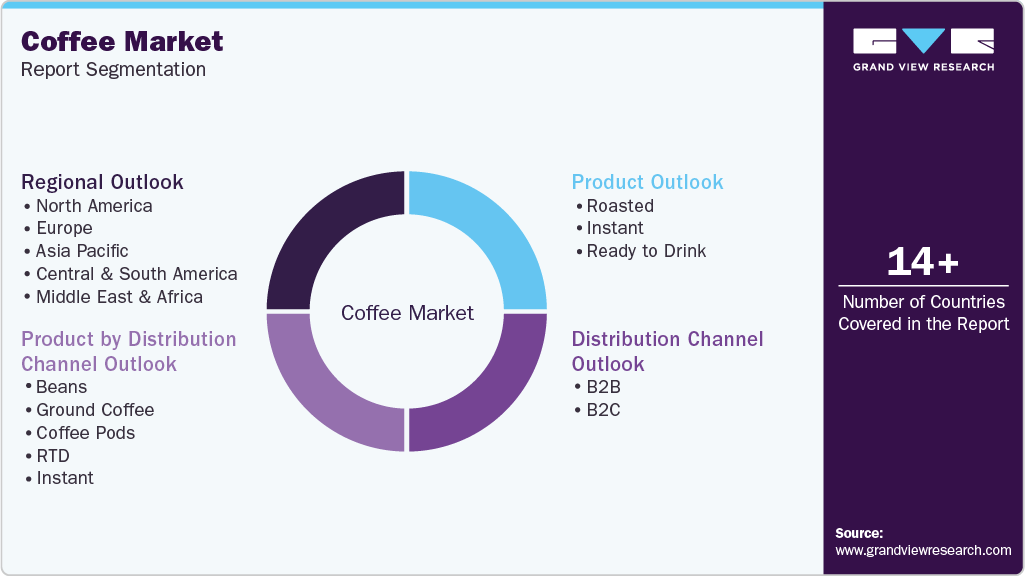
This report forecasts revenue growth at global, regional & country levels and provides an analysis of the latest trends and opportunities in each of the sub-segment from 2021 to 2033. For this study, Grand View Research has segmented the coffee market based on product, distribution channel, product by distribution channel, and region.
-
Product Outlook (Revenue, USD Billion, 2021 - 2033)
-
Roasted
-
Roast & Ground
-
Pods & Capsules
-
Whole Beans
-
-
Instant
-
Ready to Drink
-
-
Distribution Channel Outlook (Revenue, USD Billion, 2021 - 2033)
-
B2B
-
Cafes
-
Hotels & Restaurants
-
Offices
-
Bakeries and coffee shops
-
Others
-
-
B2C
-
Grocery Stores/Supermarkets
-
Hypermarkets
-
Convenience Stores
-
Online Retailers
-
Online Direct-to-Consumer (DTC)
-
Others
-
-
-
Product By Distribution Channel Outlook (Revenue, USD Billion, 2021 - 2033)
-
Beans
-
B2C
-
Grocery Stores/Supermarkets
-
Hypermarkets
-
Convenience Stores
-
Online Retailers
-
Online Direct-to-Consumer (DTC)
-
Others
-
-
B2B
-
Cafes
-
Hotels & Restaurants
-
Offices
-
Bakeries and coffee shops
-
Others
-
-
-
Ground Coffee
-
B2C
-
Grocery Stores/Supermarkets
-
Hypermarkets
-
Convenience Stores
-
Online Retailers
-
Online Direct-to-Consumer (DTC)
-
Others
-
-
B2B
-
Cafes
-
Hotels & Restaurants
-
Offices
-
Bakeries and coffee shops
-
Others
-
-
-
Coffee Pods
-
B2C
-
Grocery Stores/Supermarkets
-
Hypermarkets
-
Convenience Stores
-
Online Retailers
-
Online Direct-to-Consumer (DTC)
-
Others
-
-
B2B
-
Cafes
-
Hotels & Restaurants
-
Offices
-
Bakeries and coffee shops
-
Others
-
-
-
RTD
-
B2C
-
Grocery Stores/Supermarkets
-
Hypermarkets
-
Convenience Stores
-
Online Retailers
-
Online Direct-to-Consumer (DTC)
-
Others
-
-
B2B
-
Cafes
-
Hotels & Restaurants
-
Offices
-
Bakeries and coffee shops
-
Others
-
-
-
Instant
-
B2C
-
Grocery Stores/Supermarkets
-
Hypermarkets
-
Convenience Stores
-
Online Retailers
-
Online Direct-to-Consumer (DTC)
-
Others
-
-
B2B
-
Cafes
-
Hotels & Restaurants
-
Offices
-
Bakeries and coffee shops
-
Others
-
-
-
-
Regional Outlook (Revenue, USD Billion, 2021 - 2033)
-
North America
-
U.S.
-
Canada
-
Mexico
-
-
Europe
-
Germany
-
UK
-
France
-
Italy
-
Spain
-
Netherlands
-
-
Asia Pacific
-
China
-
Japan
-
India
-
South Korea
-
Australia
-
-
Central & South America
-
Brazil
-
-
Middle East & Africa
-
South Africa
-
Saudi Arabia
-
-
Frequently Asked Questions About This Report
Europe dominated with a 32.5% revenue share in 2025.
North America is the fastest-growing region over the forecast period.
The B2C segment led with a 62.5% revenue share in 2025.
Key players include Nestlé; Starbucks Coffee Company; JDE Peet’s; Tchibo GmbH; LUIGI LAVAZZA SPA; Strauss Coffee BV; The J.M. Smucker Company; Melitta Group; UCC UESHIMA COFFEE CO., LTD.; Massimo Zanetti Beverage Group.
The global coffee market size was valued at USD 249.3 billion in 2025 and is estimated at USD 263.5 billion for 2026.
The global coffee market is expected to grow at a CAGR of 5.4% from 2026 to 2033, reaching USD 380.3 billion by 2033.
Increasing disposable incomes, changing lifestyles, and a rising coffee culture among consumers across the globe is contributing to the overall growth of the market.
Roasted coffee accounted for a share of 53.5% of the global revenue in 2025, driven by the expansion of international coffee chains, such as Starbucks, and the globalization of coffee culture.
About the Author(s)
Consumer F&B Research Team
Consumer Goods · Consumer F&BThis report was authored by the consumer f&b research team at Grand View Research - comprising two research analysts, one senior research analyst, and one industry expert - with specialized expertise in the consumer f&b segment of the consumer goods industry. All findings are based on proprietary consumer goods databases, executive interviews, and regulatory analysis, subject to internal peer review prior to publication.
Last Updated:
Speak to Analyst

Customize this report to your needs — add regions, segments, or data points, with 20% free customization.
Or view our licence options:


ISO 9001:2015 & 27001:2022 Certified
We are GDPR and CCPA compliant! Your transaction & personal information is safe and secure. For more details, please read our privacy policy.