- Home
- »
- Next Generation Technologies
- »
-
Cloud Gaming Market Size, Share & Trends Report, 2033GVR Report cover
![Cloud Gaming Market (2026 - 2033)Report]()
Cloud Gaming Market (2026 - 2033)
Size, Share & Trends Analysis Report By Type (File Streaming, Video Streaming), By Device (Smartphones, Tablets, Smart TVs), By Gamer Type, By Region, And Segment Forecasts
Market Size, 2025
$3.4BMarket Estimate, 2026
$4.9BMarket Forecast, 2033
$62.9BCAGR, 2026–2033
43.7%Cloud Gaming Market Summary
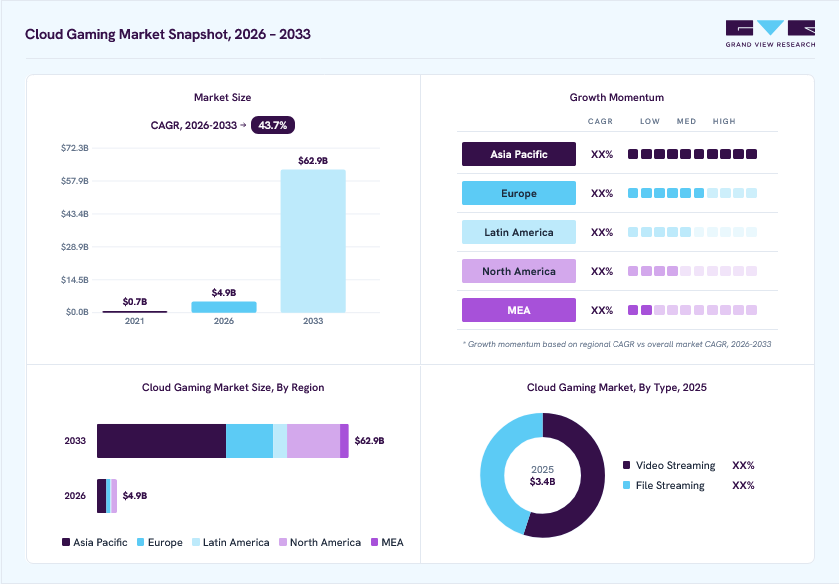
The global cloud gaming market size was valued at USD 3.4 billion in 2025 and is projected to grow from USD 4.9 billion in 2026 to USD 62.9 billion by 2033, at a CAGR of 43.7% from 2026 to 2033. Asia Pacific dominated the market, accounting for a revenue share of 47.5% in 2025. The market is driven by the rapid expansion of high-speed internet connectivity and the widespread deployment of 5G networks, which enable low-latency, high-quality game streaming.
Key Market Trends & Insights
- By type: Video streaming segment dominated the market, with a share of 54.9% in 2025.
- By device: Gaming consoles segment accounted for the largest market share of 51.8% in 2025.
- By gamer type: Casual gamer segment held the largest market share in 2025.
Key Market Trends & Insights
- Largest regional market: Asia Pacific (47.5% revenue share in 2025)
- By Country: The U.S. held the largest market share in 2025
Market Size & Forecast
- Market size in 2025: USD 3.4 Billion
- Estimated market size in 2026: USD 4.9 Billion
- Projected market size by 2033: USD 62.9 Billion
- CAGR (2026-2033): 43.7%
Rising investments by technology companies, game publishers, and telecom operators in cloud-based gaming ecosystems are driving market expansion by improving accessibility, scalability, and content availability across multiple devices. In addition, the cost-effectiveness of cloud gaming plays a pivotal role, as it eliminates the need for costly hardware, enabling broader access to premium gaming experiences. The rising use of smartphones as primary gaming devices further accelerates the market expansion, alongside the availability of expansive game libraries and subscription-based models that offer flexibility and value. These factors are expected to present lucrative growth opportunities for market expansion.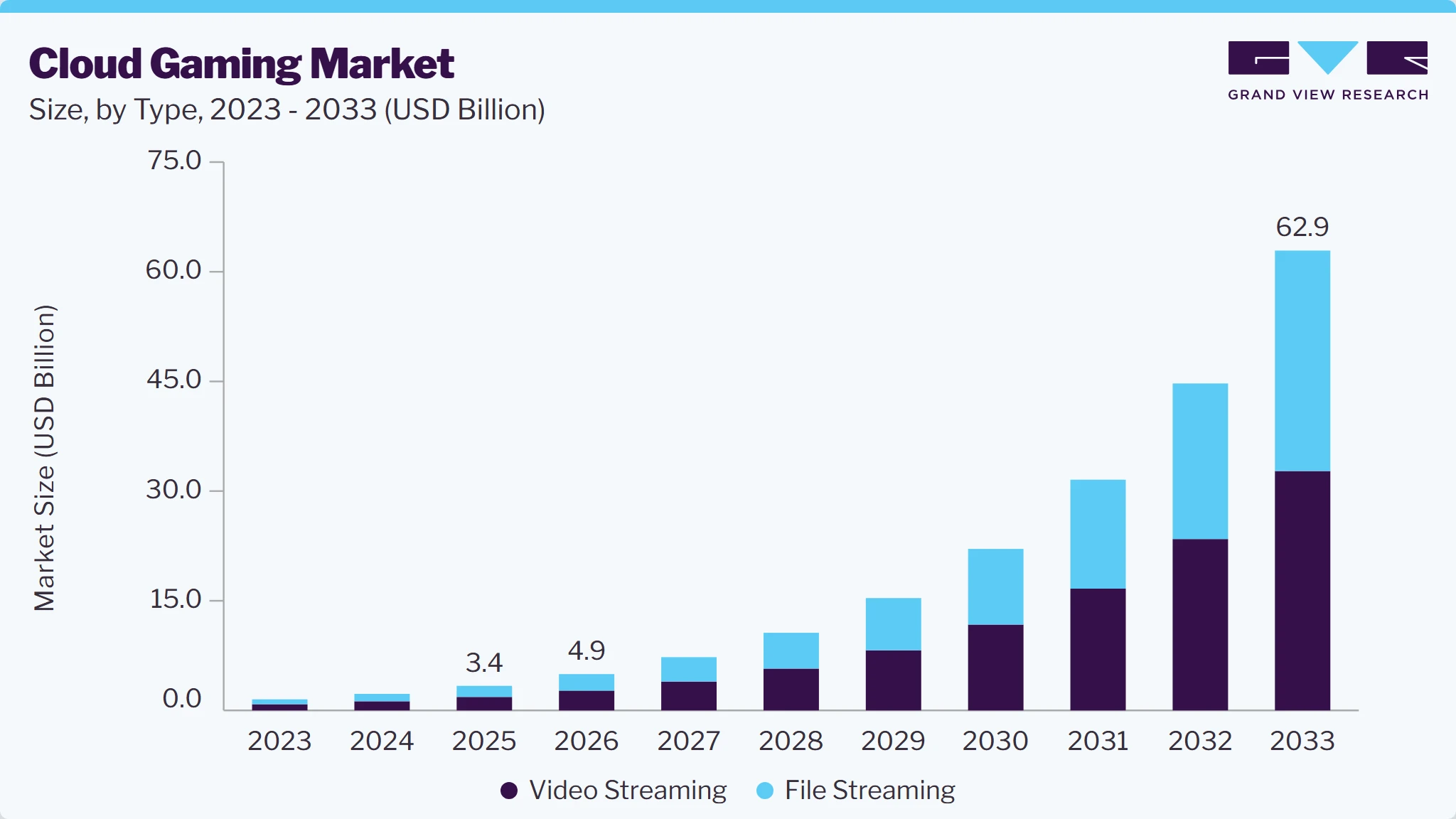
The cross-platform gameplay is gaining traction in the cloud gaming industry, driven by growing consumer demand for seamless and flexible gaming experiences. By enabling users to initiate gameplay on one device, such as a smartphone, and continue uninterrupted on another, such as a tablet, PC, or smart TV, platforms are removing traditional hardware limitations. This functionality is powered by a centralized cloud infrastructure that ensures real-time synchronization of user data and game progress. This trend is expected to play a crucial role in shaping long-term user loyalty and driving sustained growth in the competitive cloud gaming industry landscape.
Furthermore, AI and machine learning are playing a key role in boosting the cloud gaming industry growth, owing to their ability to enhance user experience and backend efficiency significantly. Gamers are increasingly seeking smoother performance, dynamic gameplay, and personalized experiences, and AI technologies are playing a crucial role in fulfilling these demands. From real-time graphics enhancement to intelligent matchmaking and content recommendations, AI enables scalable, responsive, and more immersive gaming, which aligns perfectly with the cloud’s dynamic infrastructure. These factors are driving the cloud gaming industry's growth.
Furthermore, the trend toward cloud-native game development is expanding because developers are beginning to realize the unique potential of the cloud beyond just streaming. Designing games specifically for cloud platforms allows for innovative features such as massive real-time multiplayer, dynamic world updates, and advanced AI behavior, which are difficult to implement in traditional gaming formats. This growing shift is leading developers to transition from porting games to designing cloud-first, thereby driving the market expansion.
Moreover, the growing strategic partnerships between cloud gaming services and smart device manufacturers are significantly enhancing the accessibility of cloud gaming by integrating gaming capabilities directly into everyday devices. For instance, in January 2025, LG Electronics and Xbox announced a significant partnership to enhance cloud gaming experiences on LG Smart TVs. This collaboration introduces the Xbox app and a new Gaming Portal on select LG TVs, allowing Xbox Game Pass Ultimate subscribers to stream hundreds of games directly from the cloud. Such strategies by key companies are expected to drive the cloud gaming industry expansion in the coming years.
Market Dynamics
The cloud gaming market is witnessing rapid growth driven by advancements in cloud computing, edge computing, 5G connectivity, artificial intelligence, and high-performance content delivery networks (CDNs). The growing shift toward digital entertainment consumption, increasing demand for device-independent gaming experiences, and rising adoption of subscription-based gaming services are accelerating market expansion. The increasing investments in hyperscale data centers, network infrastructure modernization, game streaming technologies, and strategic partnerships between cloud service providers, game publishers, and telecommunications companies are expected to continue driving strong growth in the cloud gaming market across casual, action, simulation, sports, and multiplayer gaming applications.
The widespread deployment of 5G networks is significantly improving the performance of cloud-based gaming services by reducing latency, increasing bandwidth availability, and enhancing streaming stability. Unlike traditional network infrastructures, 5G supports real-time transmission of high-resolution gaming content, allowing users to access premium gaming experiences across smartphones, tablets, smart TVs, and PCs without requiring high-end hardware. This advancement is strengthening the accessibility of cloud-delivered gaming services across both developed and emerging markets.
Telecommunications providers are increasingly collaborating with gaming platform operators to optimize network performance for interactive entertainment applications. The integration of edge computing infrastructure with 5G networks further minimizes response times by processing data closer to end users. These technological developments are improving gameplay quality, supporting multiplayer experiences, and encouraging greater consumer adoption of subscription-based gaming platforms, thereby reinforcing market demand across various device ecosystems.
The performance of cloud-based gaming services remains heavily dependent on consistent internet connectivity, creating challenges in regions with inadequate broadband infrastructure or unstable network conditions. Connectivity interruptions, packet loss, network congestion, and fluctuating bandwidth can degrade gameplay quality, leading to latency issues, reduced visual performance, and a disrupted user experience. These limitations can undermine customer satisfaction and diminish the appeal of cloud-delivered gaming services in underserved markets.
The significant disparities in internet quality between urban and rural areas continue to affect service accessibility worldwide. While advanced markets benefit from high-speed fiber networks and widespread 5G coverage, many regions still face infrastructure constraints that hinder seamless game streaming. As cloud gaming relies entirely on continuous data transmission between remote servers and end-user devices, network-related challenges remain a critical barrier to broader market penetration.
The increasing deployment of edge computing infrastructure presents a substantial opportunity for cloud gaming service providers seeking to enhance user experiences. By positioning computing resources closer to end users, edge technologies can significantly reduce latency, improve responsiveness, and support high-quality game streaming across geographically distributed markets. This capability is becoming increasingly important as consumers demand seamless access to resource-intensive games across multiple connected devices.
The investments in distributed data centers and intelligent network architectures are enabling service providers to expand their reach while maintaining performance standards. Edge-enabled platforms can efficiently handle growing volumes of gaming traffic, support advanced graphics rendering, and facilitate real-time multiplayer interactions. As technology companies, telecommunications operators, and cloud infrastructure providers continue expanding edge deployments, new opportunities are emerging to deliver premium gaming experiences to a broader global audience.
Market Concentration & Characteristics
The cloud gaming market is moderately concentrated, comprising global cloud infrastructure providers, gaming platform operators, telecommunications companies, game publishers, content streaming technology providers, and specialized cloud gaming service providers. The market is expanding due to increasing demand for device-independent gaming experiences, rising adoption of subscription-based content delivery models, and growing consumer preference for instant access to high-quality games without expensive hardware investments. Strategic partnerships between cloud service providers, telecommunications operators, gaming companies, and content developers are becoming increasingly common as organizations seek to enhance service performance and user engagement. Continuous advancements in cloud computing, edge computing, graphics streaming capabilities, and low-latency content delivery systems are emerging as key competitive strategies across the market.
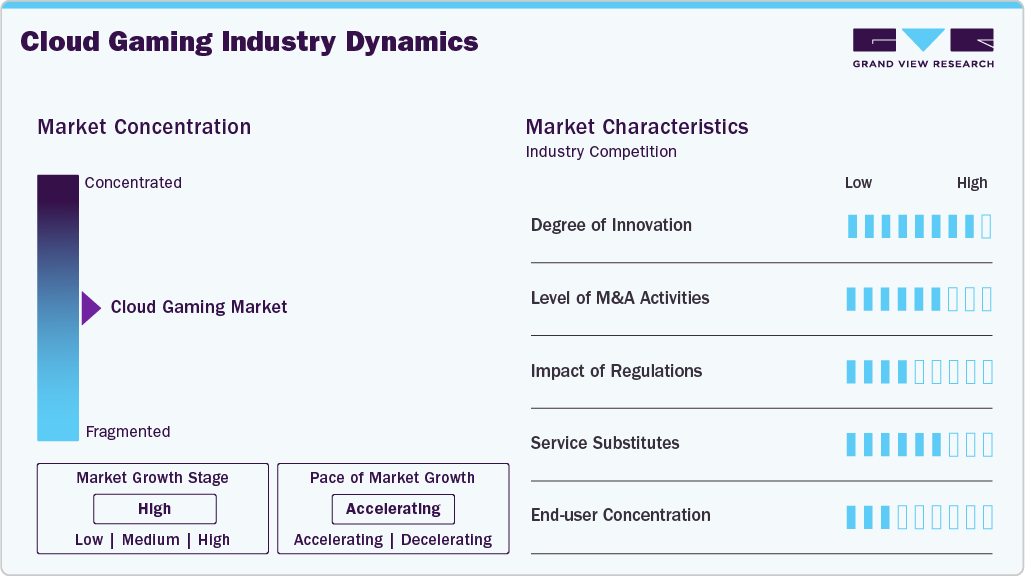
The market is characterized by a very high level of innovation, driven by ongoing developments in edge computing architectures, artificial intelligence-based network optimization, advanced video compression technologies, adaptive streaming solutions, and cross-platform gaming ecosystems. The industry is witnessing moderate merger and acquisition activity as companies seek to strengthen cloud infrastructure capabilities, expand gaming content portfolios, and enhance their competitive positioning within digital entertainment ecosystems. Competition from traditional console gaming, PC gaming, mobile gaming, downloadable game distribution models, and locally installed gaming platforms remains significant, particularly among users seeking maximum performance consistency and content ownership. Increasing investments in hyperscale data centers, 5G network deployment, distributed computing infrastructure, and next-generation game streaming technologies are expected to further strengthen the market landscape.
Analyst Perspective
The cloud gaming market is experiencing significant expansion driven by the increasing adoption of cloud computing, edge computing, 5G connectivity, and advanced game-streaming technologies. The industry is benefiting from the growing demand for device-independent gaming experiences, instant access to premium gaming content, and subscription-based service models, which enable users to play high-quality games without investing in expensive hardware. Increasing investments in hyperscale data centers, network infrastructure modernization, and cloud-native gaming platforms are enabling broader deployment of cloud gaming services. Strategic collaborations among cloud service providers, telecommunications companies, and game publishers are expanding content availability while improving accessibility across diverse geographic regions. As broadband penetration and 5G coverage continue to expand globally, cloud gaming platforms are becoming increasingly capable of delivering seamless, high-quality gaming experiences, reinforcing long-term adoption across the digital entertainment ecosystem.
Type Insights
Based on type, the video streaming segment led the market with the largest revenue share of 54.9% in 2025 and is expected to grow at a significant CAGR over the forecast period, owing to the increasing demand for on-demand, high-quality entertainment. The popularity of platforms such as Netflix, Amazon Prime, and YouTube has led to a cultural shift towards streaming media, encouraging gamers to seek similar experiences with games. The growing advancements in cloud infrastructure and internet speeds, particularly 5G, enable high-definition game streaming without expensive hardware. This convenience, coupled with the ability to access a vast library of games through subscription models, is driving the integration of gaming with existing video streaming services, further expanding the market.
The file streaming segment is expected to witness the highest CAGR of over 45% from 2025 to 2033, driven by the growing need for seamless, instant access to game files and content without needing physical downloads or storage. As internet speeds improve and cloud infrastructure becomes more reliable, gamers can access and play their games from any device with minimal latency, reducing the burden on local storage. This trend is particularly relevant in a world increasingly reliant on cloud storage, where gamers can switch between devices without losing progress, fostering a more flexible and accessible gaming experience.
Gamer Type Insights
Based on gamer type, the casual gamer segment dominated the market with the largest revenue share of 53.2% in 2025, owing to the accessibility and convenience that cloud gaming offers. With no need for high-end gaming hardware, casual gamers can easily access a wide range of games through subscription services such as Xbox Cloud Gaming, Google Stadia, and Amazon Luna, which allow them to play on smartphones, tablets, or smart TVs. The appeal lies in the ability to play games on the go, the low barrier to entry, and the lack of need for consoles or powerful PCs. Moreover, the growing availability of affordable, casual-friendly game libraries and the increasing popularity of mobile gaming are driving segmental growth.
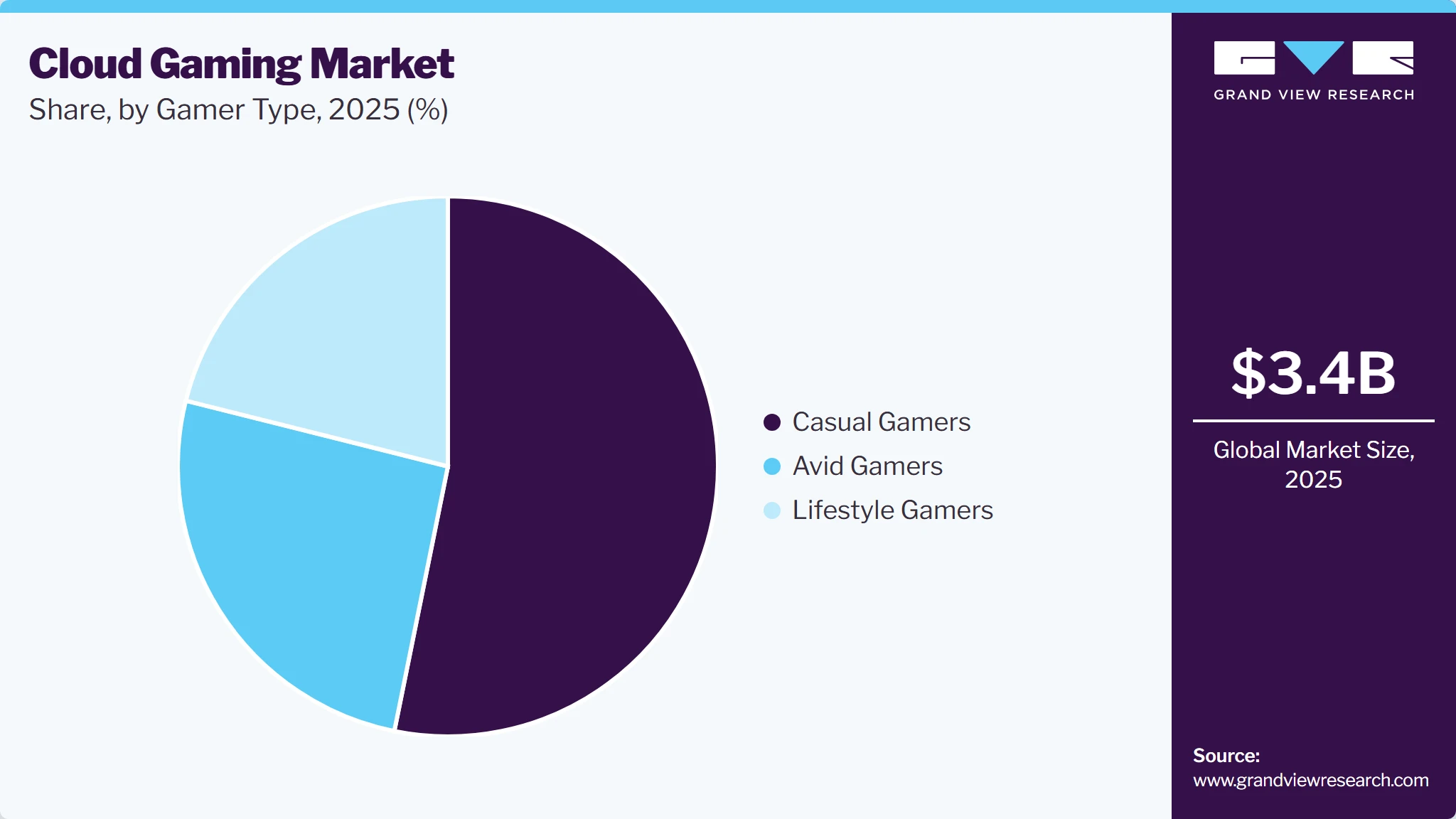
The avid gamers segment is expected to witness a significant CAGR from 2025 to 2033, owing to their demand for high-quality, immersive gaming experiences without the constraints of expensive hardware. Cloud gaming services such as GeForce NOW and Xbox Cloud Gaming enable them to access AAA titles with high-definition graphics and low-latency performance, often on multiple devices like smartphones, tablets, or laptops. The ability to instantly access games without long download times or hardware upgrades appeals to avid gamers who are looking for seamless, flexible, and high-performance gaming experiences. With the increasing availability of 5G and advanced cloud computing technologies, the segment is expected to grow significantly in the coming years.
Device Insights
Based on device, the gaming consoles segment led the market with the largest revenue share of 51.8% in 2025, fueled by the evolution of consoles that integrate cloud gaming capabilities, offering players the option to stream games directly to their devices. In addition, the push towards digital-only games, coupled with more affordable and efficient cloud gaming services, is also driving the shift away from physical discs and towards streaming as the preferred method for gaming, thereby driving segmental growth.
The smartphone segment is expected to witness the highest CAGR from 2025 to 2033, owing to the increasing power of mobile devices, which can now handle high-quality game streaming. The widespread availability of 5G networks offers faster and more reliable connections, reducing latency and improving game quality. Moreover, smartphones' ubiquity andthe ubiquity of smartphones and their ability to serve as all-in-one gaming devices are key drivers in this segment’s growth.
Regional Insights
Asia Pacific dominated the cloud gaming market with the largest revenue share of 47.5% in 2025, primarily driven by the region's advanced technological infrastructure, including widespread access to 5G and fiber-optic networks, which enable seamless, high-quality gaming experiences. Furthermore, partnerships between tech giants andhardware manufacturers have boosted the accessibility of cloud gaming on a range of devices, including smartphones, smart TVs, and gaming consoles. The region’s gaming culture, combined with a growing demand for mobile and cross-platform play, also fuels the rapid growth of the cloud gaming market.

U.S. Cloud Gaming Market Trends
The cloud gaming market in the U.S. accounted for the highest share of over 87% in 2024, owing to the country’s advanced digital infrastructure, including widespread 5G and fiber-optic networks, which support high-quality, low-latency gaming. The growing adoption of cloud gaming is further fueled by the versatility of services that allow gamers to access content across multiple devices, such as smartphones, consoles, and smart TVs. These factors are expected to drive the market growth in the U.S.
Europe Cloud Gaming Market Trends
The cloud gaming market in Europe is expected to grow at a CAGR of over 43% from 2025 to 2033. Increased internet speeds, a strong gaming culture, and a growing appetite for immersive gaming experiences drive this growth. Subscription-based services are gaining popularity, offering cost-effective access to a wide range of games. In addition, the integration of cloud gaming with other entertainment platforms is enhancing user engagement and expanding the reach of services.
The UK cloud gaming market is expected to grow at a significant rate in the coming years, driven by high broadband and 5G penetration, enabling seamless, low-latency gaming experiences across multiple devices. Furthermore, the UK's gaming culture, driven by a youthful demographic and the growing popularity of esports, is fueling demand for flexible, high-quality gaming solutions, particularly on smart TVs and mobile platforms.
The cloud gaming market in Germany is fueled by its well-developed internet infrastructure, providing the foundation for smooth, high-performance gaming experiences. Germany’s focus on sustainability and minimalism is also driving the popularity of digital solutions that eliminate the need for physical consoles.
Asia Pacific Cloud Gaming Market Trends
The cloud gaming market in Asia Pacific accounted for the largest market share of over 45% in 2024, driven by substantial investments in 5G infrastructure and the widespread adoption of smartphones. The region is seeing a surge in demand for cloud gaming owing to the affordability of cloud gaming platforms, and the increasing number of mobile users is further fueling market growth, making high-quality gaming accessible to a broader audience.
Japan cloud gaming market is gaining traction, fueled by high-speed internet and 5G connectivity, enabling seamless gaming experiences across various devices such as smartphones, smart TVs, and consoles. Technological innovations in cloud computing and streaming technologies enhance game quality and accessibility. Moreover, the rising demand for enhanced gaming experiences and the growing popularity of esports are contributing to the market's expansion.
The cloud gaming market in China held the largest share in the Asia Pacific region in 2025. The cloud gaming market in China is rapidly expanding, supported by growing advancements in 5G infrastructure, improvements in smartphone technology, and robust cloud services. Subscription-based gaming models are gaining popularity, offering cost-effective access to a vast library of games. The growing integration with streaming platforms also enhances user engagement and expands the reach of cloud gaming services in the country, thereby driving market growth.
Key Cloud Gaming Company Insights
Some key players operating in the market include Amazon Web Services, Inc. and NVIDIA Corporation.
-
Amazon Web Services, Inc., a subsidiary of Amazon.com, is a cloud infrastructure provider, offering a broad set of services, including computing, storage, databases, AI, and machine learning. In the cloud gaming space, AWS supports game developers and publishers through services such as Amazon GameLift, a managed service for deploying, operating, and scaling multiplayer game servers.
-
NVIDIA Corporation is a global player in graphics processing technologies and AI computing. It has become a key player in cloud gaming through its GeForce NOW platform, which allows users to stream high-end games to low-power devices. The company is investing in AI and generative technologies for gaming, including collaborations with key companies to integrate AI-powered avatars and storytelling tools into the gaming ecosystem.
Ubitus K.K. and Backbone Labs are some emerging market participants in the cloud gaming market.
-
Ubitus K.K. specializes in cloud gaming technology, GPU virtualization, and AI-driven solutions. The company offers a comprehensive cloud gaming platform, GameCloud, capable of streaming AAA titles across various devices, including consoles, PCs, and mobile platforms.
-
Backbone Labs is a U.S.-based technology company specializing in mobile gaming. The company offers the Backbone One controller and the Backbone app, which consolidates cloud gaming, remote play, and native mobile games into a single accessible portal. Backbone has partnered with major platforms such as NVIDIA GeForce NOW, Xbox Cloud Gaming, and PlayStation Remote Play, enabling users to play console-quality games on their smartphones.
Key Cloud Gaming Companies
The following key companies have been profiled for this study on the cloud gaming market.
-
Amazon Web Services, Inc.
-
Apple Inc.
-
Backbone Labs
-
Electronic Arts, Inc.
-
Google LLC
-
Intel Corporation
-
International Business Machines Corporation (IBM Corporation)
-
Microsoft Corporation
-
NVIDIA Corporation
-
Sony Interactive Entertainment
-
Ubitus K.K.
-
Tencent Holdings Ltd.
Competitive Benchmarking
Operating Strategies
Competitive Edge
Weaknesses
Established Players (Amazon Web Services, Inc., Electronic Arts, Inc., NVIDIA Corporation)
- Focus on expanding cloud gaming ecosystems through partnerships in content, infrastructure, and telecom.
- Invest heavily in streaming technologies, edge computing, and multi-device gaming accessibility.
- Strong global infrastructure presence supports reliable, low-latency game streaming services.
- Extensive game libraries and established user bases strengthen competitive positioning.
- Dependence on substantial infrastructure investments increases operational costs across regions.
- Large organizational structures may slow platform innovation and service deployment.
Emerging Players (Ubitus K.K. and Backbone Labs)
- Focus on niche cloud gaming services through regional content partnerships.
- Invest in platform optimization technologies to improve streaming quality across devices.
- Greater flexibility enables rapid adoption of innovative cloud gaming technologies.
- Specialized offerings target underserved user segments with tailored gaming experiences.
- Limited infrastructure resources restrict service scalability across multiple geographic markets.
- Smaller content portfolios reduce competitiveness against established gaming platform providers.
Recent Developments
-
In March 2025, Amazon Web Services, Inc. (AWS) introduced Amazon GameLift Streams, a managed service enabling developers to stream games at up to 1080p resolution and 60 frames per second to any device with a WebRTC-enabled browser. This capability supports a variety of 3D engines with minimal to no code modification, allowing for quick deployment and testing.
-
In January 2025, NVIDIA Corporation announced plans to launch its GeForce NOW cloud gaming service in India by the first half of the year. The service will be powered by a new data center equipped with GeForce RTX 4080 GPUs, enabling gamers to stream AAA titles in 4K resolution at 60fps without needing high-end hardware.
-
In March 2024, Ubitus K.K. announced a strategic investment from NVIDIA Corporation to enhance its generative AI and cloud gaming capabilities across Asia. This partnership aimed to leverage NVIDIA's accelerated computing to advance Ubitus' AI-driven solutions.
Cloud Gaming Market Report Scope
Report Attribute
Details
Market size in 2025
USD 3.4 billion
Estimated market size in 2026
USD 4.9 billion
Projected market size by 2033
USD 62.9 billion
Growth rate
CAGR of 43.7% from 2026 to 2033
Base year for estimation
2025
Historical data
2021 - 2024
Forecast period
2026 - 2033
Quantitative units
Revenue in USD million, and CAGR from 2026 to 2033
Report coverage
Revenue forecast, company ranking, competitive landscape, growth factors, and trends
Segments covered
Type, device, gamer type, region
Regional scope
North America; Europe; Asia Pacific; Latin America; MEA
Country scope
U.S.; Canada; U.K.; Germany; France; Italy; Spain; China; Japan; India; South Korea; Australia; Brazil; Mexico; Saudi Arabia; UAE; South Africa
Key companies profiled
Amazon Web Services, Inc.; Apple Inc.; Backbone Labs; Electronic Arts, Inc.; Google LLC; Intel Corporation; IBM Corporation; Microsoft Corporation; NVIDIA Corporation; Sony Interactive Entertainment; Ubitus K.K.; Tencent Holdings Ltd.
Customization scope
Free report customization (equivalent up to 8 analysts' working days) with purchase. Addition or alteration to country, regional & segment scope.
Pricing and purchase options
Avail customized purchase options to meet your exact research needs. Explore purchase options
Global Cloud Gaming Market Report Segmentation
This report forecasts revenue growth at the global, regional, and country levels and provides an analysis of the latest technological trends in each of the sub-segments from 2021 to 2033. For this study, Grand View Research has segmented the global cloud gaming market report based on type, device, gamer type, and region:

-
Type Outlook (Revenue, USD Million, 2021 - 2033)
-
File Streaming
-
Video Streaming
-
-
Device Outlook (Revenue, USD Million, 2021 - 2033)
-
Smartphones
-
Tablets
-
Gaming Consoles
-
PCs & Laptops
-
Smart TVs
-
Head-Mounted Displays
-
-
Gamer Type Outlook (Revenue, USD Million, 2021 - 2033)
-
Casual Gamers
-
Avid Gamers
-
Lifestyle Gamers
-
-
Regional Outlook (Revenue, USD Million, 2021 - 2033)
-
North America
-
U.S.
-
Canada
-
-
Europe
-
UK
-
Germany
-
France
-
Italy
-
Spain
-
-
Asia Pacific
-
China
-
Japan
-
India
-
South Korea
-
Australia
-
-
Latin America
-
Brazil
-
Mexico
-
-
Middle East & Africa
-
Saudi Arabia
-
South Africa
-
UAE
-
-
Research Methodology
The cloud gaming market figures in this report are based on a proven research process that combines executive interviews with secondary research from proprietary databases, company filings, and recognized regulatory and institutional sources. Market size is built through value-chain sizing-reconciling supply-side and demand-side estimates-and triangulated with bottom-up and top-down approaches. Every estimate passes multiple levels of expert validation before publication, with each cloud gaming segment quantified using the revenue-capture definitions in the table below.
Segment Definition
Segment - Type
Revenue capture definition
File Streaming
Revenue is generated through cloud gaming services that stream game assets and executable files to user devices while utilizing local hardware resources for processing and rendering. This segment is driven by reduced storage requirements, faster game access, improved content delivery efficiency, and growing demand for flexible gaming experiences.
Video Streaming
Revenue is captured through cloud gaming platforms that process and render games on remote servers before transmitting gameplay as real-time video streams to user devices. This segment is driven by increasing adoption of device-independent gaming, advancements in network infrastructure, and demand for instant access to premium games.
Segment - Device
Revenue capture definition
Smartphones
Revenue is generated through cloud gaming services accessed via smartphones, enabling users to play high-quality games without requiring advanced mobile hardware. This segment is driven by growing smartphone penetration, expanding 5G connectivity, increasing mobile gaming engagement, and demand for gaming accessibility across locations.
Tablets
Revenue is captured through cloud gaming platforms optimized for tablets, which offer larger displays and enhanced portability for gaming. This segment is driven by increasing consumer preference for mobile entertainment, improved wireless connectivity, and demand for convenient gaming across multiple environments.
Gaming Consoles
Revenue is generated through cloud gaming services integrated with gaming consoles, allowing users to stream games directly without extensive downloads or local installations. This segment is driven by the adoption of subscription services, the expansion of digital gaming ecosystems, and the demand for seamless content accessibility.
PCs & Laptops
Revenue is captured through cloud gaming platforms accessible via desktop and laptop computers, enabling users to play graphically intensive games without requiring expensive hardware upgrades. This segment is driven by demand for cost-effective gaming, cross-platform compatibility, and access to extensive game libraries.
Smart TVs
Revenue is generated through cloud gaming applications available on smart televisions, allowing users to access games directly through internet-connected displays. This segment is driven by rising smart TV adoption, improved streaming performance, and demand for console-like gaming experiences without dedicated hardware.
Head-Mounted Displays
Revenue is generated through cloud gaming services that support head-mounted displays, enabling immersive gaming experiences via remotely rendered content. This segment is driven by growing interest in virtual reality applications, advancements in cloud rendering technologies, and increasing demand for interactive digital environments.
Segment – Gamer Type
Revenue capture definition
Casual Gamers
Revenue is generated from users who occasionally play games and prefer accessible, easy-to-use cloud gaming services without significant hardware investments. This segment is driven by convenience, affordable subscriptions, broad game availability, and the increasing adoption of digital entertainment platforms.
Avid Gamers
Revenue is captured from highly engaged players who spend substantial time gaming and seek access to advanced titles, competitive experiences, and premium content. This segment is driven by demand for high-performance streaming, extensive game libraries, and seamless multi-device accessibility.
Lifestyle Gamers
Revenue is generated by consumers who incorporate gaming into their daily entertainment routines and social interactions across multiple devices. This segment is driven by increasing adoption of digital lifestyles, demand for on-demand content access, and the growing popularity of connected gaming ecosystems.
Estimation Model
Layer Name
Key Question
Description
Gaming User Base Layer
Who are the potential adopters?
Identifies the total addressable user base, including casual, avid, mobile, console, and PC gamers; esports participants; subscription gaming users; and digital entertainment consumers seeking access to high-quality gaming experiences without substantial hardware investments.
Connectivity Readiness Layer
Who can access cloud gaming services?
Adoption is determined by factors such as broadband availability, 5G network coverage, internet speed, latency, access to cloud-enabled devices, affordability of subscription services, and the availability of supporting digital infrastructure for seamless game streaming.
Platform Utilization Layer
Who actively uses cloud gaming platforms?
Applies adoption levels across environments where cloud gaming services are actively utilized, including smartphones, tablets, PCs and laptops, gaming consoles, smart TVs, head-mounted displays, subscription gaming platforms, digital entertainment ecosystems, and cross-platform gaming applications.
Revenue Generation Layer
How is revenue generated?
Revenue is generated through subscription-based gaming services, game-streaming platform memberships, premium content access fees, pay-per-play models, cloud infrastructure services, game licensing agreements, advertising revenue, in-game purchases, telecommunications partnerships, and recurring revenue from cloud-based gaming ecosystems and content distribution platforms.
Delivered Customizations
This report has been delivered with the following In-depth customizations
Client Request
Customization Delivered
Value Adds
Cloud Gaming Platform Deployment Assessment & Infrastructure Feasibility Evaluation
Conducted detailed evaluation of cloud gaming platforms across mobile, PC, console, smart TV, and cross-platform gaming environments, integrating cloud computing infrastructure, edge computing capabilities, content delivery networks, game-streaming technologies, and low-latency network architectures to optimize gameplay performance and user accessibility
Enables seamless gaming experiences, reduces hardware dependency, improves service accessibility, and enhances user engagement across multiple devices.
Multi-Platform Gaming Ecosystem Integration Strategy
Assessed deployment of cloud gaming services across smartphones, tablets, PCs, gaming consoles, smart TVs, and connected digital ecosystems, integrating subscription management platforms, content distribution systems, telecommunications infrastructure, user analytics platforms, and cross-device gaming capabilities.
Enhances user retention, improves platform interoperability, supports broader content accessibility, and enables seamless gaming experiences across diverse devices.
AI-Driven Streaming Optimization & Network Infrastructure Planning
Evaluated implementation of advanced game-streaming platforms, AI-powered network optimization solutions, adaptive bitrate streaming technologies, edge computing architectures, cloud resource management systems, and centralized gaming service delivery platforms.
Enables scalable service delivery, improves streaming quality, reduces latency, increases platform efficiency, and supports data-driven gaming ecosystem strategies.
Frequently Asked Questions About This Report
The global cloud gaming market size was estimated at USD 3.4 billion in 2025 and is expected to reach USD 4.9 billion in 2026.
Asia Pacific dominated the cloud gaming market with a share of 47.5% in 2025
Some key players operating in the cloud gaming market include Amazon Web Services Inc.; Apple, Inc.; Electronic Arts, Inc.; Google Inc.; Intel Corporation; International Business Machines Corporation; Microsoft Corporation; NVIDIA Corporation; Sony Interactive Entertainment LLC; and Ubitus Inc.
Key factors driving the cloud gaming market growth include growing penetration of high-speed internet, rising adoption of smart devices, increasing utilization of gaming as a service, and digital transformation in the media & entertainment industry.
The global cloud gaming market is expected to grow at a compound annual growth rate of 43.7% from 2026 to 2033 to reach USD 62.9 billion by 2033.
The video streaming segment led with a 54.9% revenue share in 2025, while the file streaming is the fastest-growing segment.
The gaming consoles segment led with a 51.8% revenue share in 2025.
The casual gamers segment led with a 53.2% revenue share in 2025.
About the Author(s)
Next Generation Technologies Research Team
Technology · Next Generation TechnologiesThis report was authored by the next generation technologies research team at Grand View Research - comprising two research analysts, one senior research analyst, and one industry expert - with specialized expertise in the next generation technologies segment of the technology industry. All findings are based on proprietary technology databases, executive interviews, and regulatory analysis, subject to internal peer review prior to publication.
Last Updated:
Speak to Analyst

Customize this report to your needs — add regions, segments, or data points, with 20% free customization.
Or view our licence options:


ISO 9001:2015 & 27001:2022 Certified
We are GDPR and CCPA compliant! Your transaction & personal information is safe and secure. For more details, please read our privacy policy.