
- Home
- »
- Clothing, Footwear & Accessories
- »
-
Climbing Gym Market Size & Share, Industry Report, 2033GVR Report cover

Climbing Gym Market (2026 - 2033) Size, Share & Trend Analysis Report By Gym Type (Bouldering, Top Rope Climbing, Lead Climbing, and Trad Climbing), By Location (Indoor, Outdoor), By End User (Children, Teenager), By Region, And Segment Forecasts
Climbing Gym Market Summary
The global climbing gym market size was estimated at USD 3.63 billion in 2025 and is projected to reach USD 7.40 billion by 2033, growing at a CAGR of 9.3% from 2026 to 2033. The industry is experiencing significant growth, driven by many factors that cater to changing lifestyles and preferences.
Key Market Trends & Insights
- North America held the largest share of the global climbing gym market in 2025, accounting for 36.8%.
- The European climbing gym market is experiencing significant growth, projecting a CAGR of 8.9% from 2026 to 2033.
- By gym type, the bouldering segment in the global climbing gym market held the largest market share in 2025, accounting for 41.0%.
- By location, the indoor climbing gym market held the largest share, accounting for a share of 63.5% in 2025.
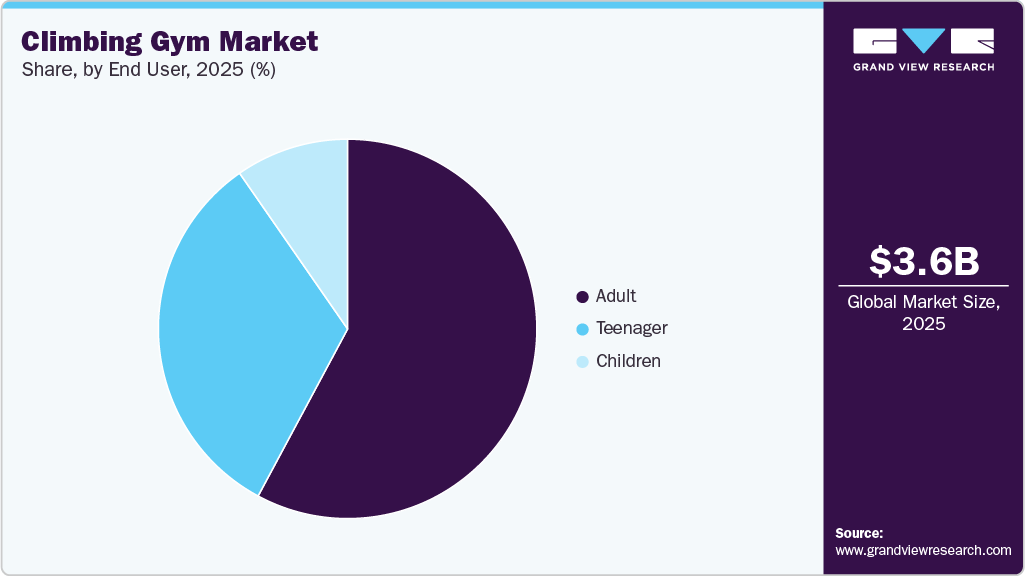
- By end-user, the adults segment dominated the end use category in 2025, with a share of 57.8%.
Market Size & Forecast
- 2025 Market Size: USD 3.63 Billion
- 2033 Projected Market Size: USD 7.40 Billion
- CAGR (2026-2033): 9.3%
- North America: Largest market in 2025
Three ways to get this report
Buy it, customize it, or ask a question.Ask an Analyst
A direct answer, usually in 1 working day
- AccessReport author, directly
- Reply timeWithin 1 working day
- No sales callDirect answer only
- FormatEmail reply
- CostFree, no cost
Get the Full Report
What the study covers
- FormatsPDF · Excel · Dashboard
- Timeline2026–2033 annual, 2025 base
- Coverage20+ countries, 5 regions
- Companies10+ key players profiled
Customize the Report
20% free customization
- IncludeCountries, segments, points
- TailorTo your product definition
- ExtendDeeper competitor detail
- OrA fully bespoke study
- Turnaround5–10 working days
One of the primary reasons for this expansion is the increased popularity of outdoor sports. As more individuals seek recreational activities that promote physical fitness and well-being, climbing has emerged as a favored choice. The trend is particularly pronounced in regions such as North America and Europe, where climbing gyms have become prevalent. Moreover, installing bouldering structures in public spaces encourages community engagement and combats sedentary lifestyles, further enhancing the attractiveness of climbing as a sport.Growing awareness of physical and mental well-being is encouraging individuals to adopt activities that deliver comprehensive health benefits. Climbing gyms address this demand by combining full-body strength training, cardiovascular exertion, flexibility, and cognitive engagement in a single activity. Unlike conventional gym workouts, climbing emphasizes problem-solving, balance, and coordination, making it particularly appealing to consumers seeking variety, skill development, and long-term engagement. This multidimensional fitness proposition has helped climbing gyms attract participants across children, young adults, and older age groups, driving consistent footfall and membership growth.
 Source: Grand View Research, IR Documents, Primary Interviews, Paid DatabasesTo learn more about this report,
 Download Free Sample Report
 Urbanization has emerged as a major structural driver of the climbing gym industry. As cities expand and access to natural rock faces and outdoor climbing locations becomes limited, especially in metropolitan regions, indoor climbing gyms are filling a critical gap. These facilities provide year-round access to climbing in controlled, climate-independent environments, significantly lowering entry barriers for beginners. Modern gyms offer a range of formats, including bouldering, top-rope climbing, and lead climbing, catering to varying skill levels and interests. In addition to physical activity, climbing gyms have evolved into social hubs, hosting community events, training programs, and competitions that strengthen member engagement and foster loyalty. This social dimension differentiates climbing gyms from traditional fitness centers and supports higher retention rates.
The inclusion of sport climbing in the Olympic Games has further accelerated market momentum. Since climbing’s debut on the Olympic stage, the sport has gained heightened legitimacy and global exposure, encouraging participation at grassroots and amateur levels. Increased media coverage and athlete visibility have inspired younger demographics to take up climbing, while also attracting investment from sponsors, sports organizations, and real estate developers. This institutional recognition has contributed to the professionalization of climbing gyms, with operators expanding facilities, upgrading equipment, and standardizing training programs to meet rising expectations.
Technological advancement is playing a growing role in enhancing the climbing gym experience. Operators are increasingly investing in modular and reconfigurable wall systems that allow frequent route changes, keeping the activity fresh and challenging for regular users. Interactive climbing walls, augmented feedback systems, and digital performance tracking tools enable climbers to monitor progress, set goals, and compare results, increasing engagement and motivation. These technologies also allow gyms to personalize experiences for different user segments, from recreational climbers to competitive athletes, improving customer satisfaction and retention.
Brand Market Share Insights
In the global climbing gym market, operators are increasingly reassessing their portfolios and reallocating investments to capture growth across distinct participation segments, including premium experience gyms, entry-level/community-focused facilities, and the rapidly expanding adult and men’s participation segments. At the premium end, this shift is reflected in the development of large-format climbing gyms that emphasize advanced wall design, professional route setting, high-end amenities, and curated community experiences. These facilities cater to experienced climbers and higher-income consumers seeking exclusivity, progression-focused training, and long-term skill development. Meanwhile, mass-market and lifestyle-oriented climbing gyms are expanding rapidly by lowering entry barriers through beginner-friendly bouldering formats, flexible memberships, and frequent route refreshes. Operators are experimenting with modular walls, varied textures, and creative problem-setting to keep experiences fresh and accessible, appealing to fitness-focused users looking for affordable, engaging alternatives to traditional gyms.
 To learn more about this report, Download Free Sample Report
 Consumer Insights into the Climbing Gym
Demand for climbing gyms is gaining strong momentum globally, driven by rising health awareness, urban lifestyles, and growing interest in experiential fitness. As consumers increasingly seek workouts that combine physical conditioning with mental engagement, climbing gyms are benefiting from their ability to deliver strength training, cardiovascular exercise, flexibility, and problem-solving in a single activity. Urbanization plays a central role, as limited access to natural climbing environments in cities fuels demand for safe, organized indoor alternatives. Modern climbing gyms are evolving beyond niche sports facilities into lifestyle-oriented fitness destinations that emphasize community, social interaction, and skill progression.
Key participation trends include growing interest in beginner-friendly formats such as bouldering, flexible membership models, and structured coaching programs that lower entry barriers. Technological integration is also shaping the market, with gyms adopting modular wall systems, digital route setting, performance tracking apps, and interactive climbing experiences to improve engagement and retention. Sustainability considerations are increasingly influencing gym development, with operators investing in energy-efficient lighting, recycled materials, and environmentally responsible construction practices. Consumers value safety standards, facility quality, instructor expertise, and community culture when choosing a climbing gym.
 To learn more about this report, Download Free Sample Report
 Demographically, the most active participants are young to mid-career adults aged 25-44, driven by fitness motivation, disposable income, and preference for social workout formats. Participation is also expanding among families, teenagers, and corporate wellness groups, broadening the consumer base. While early adoption was concentrated among male climbers, the market is becoming more gender-balanced, supported by inclusive programming and beginner-focused offerings. Digital discovery through social media, fitness influencers, and word-of-mouth continues to drive awareness, while flexible pricing, class packages, and hybrid fitness lifestyles support sustained growth in the climbing gym market.
Gym Type Insights
The bouldering gym accounted for the largest share of 41.0% of the global revenue in 2025. Unlike rope climbing facilities, bouldering gyms do not require harnesses or belay systems, making them more approachable for beginners and encouraging spontaneous participation. This simplicity lowers entry barriers, supports higher throughput of users, and enables operators to establish facilities in smaller urban spaces, contributing to faster adoption across cities. Demand for bouldering gyms is further supported by rising disposable incomes and growing interest in lifestyle-driven fitness experiences that combine physical challenge with social interaction. Bouldering emphasizes short, dynamic climbs that focus on strength, technique, and problem-solving, making it attractive to younger consumers seeking engaging and time-efficient workouts.
To learn more about this report, Download Free Sample Report The top rope climbing segment is projected to grow at the fastest CAGR of 9.8% from 2026 to 2033. Top rope climbing is widely perceived as a safer and more structured entry point into the sport, as climbers are securely attached to a rope anchored from above, reducing fear of falls and injury. This makes the format particularly attractive for first-time participants, youth programs, school groups, and corporate team-building activities, all of which are expanding customer bases for climbing gyms globally.
Growth is further driven by rising disposable incomes and increasing willingness to spend on guided, instructor-led fitness experiences that emphasize progression and skill mastery. Top rope gyms benefit from formal training routes, certification programs, and coaching-led sessions that encourage repeat visits and long-term memberships. The format is also favored in regions where climbing is introduced through clubs, schools, or recreational centers, reinforcing steady participation growth.
Location Insights
The indoor climbing gym market accounted for the largest share of 63.5% of the revenue in 2025. The growth of indoor climbing gyms is primarily driven by several key factors that cater to consumers' evolving preferences, particularly in urban areas. One of the most significant drivers is the increased popularity of indoor recreational activities. As urbanization continues to limit access to natural climbing sites, more individuals are seeking indoor alternatives that provide a safe and controlled environment for climbing. This shift is further supported by a growing interest in adventure sports, which has made climbing an appealing option for fitness enthusiasts looking for engaging and physically demanding workouts. The mental health benefits associated with climbing, such as stress relief and enhanced focus, also attract a diverse demographic, contributing to the increased participation rates in indoor climbing facilities.
Another crucial factor driving the growth of indoor climbing gyms is the integration of advanced technologies and smart features into climbing walls. Innovations such as interactive climbing walls, real-time performance analytics, and augmented reality elements significantly enhance the climber's experience, making it more engaging and immersive. These technological advancements attract new climbers and retain existing members by providing personalized feedback and gamification elements that appeal to younger generations. Moreover, the rise of competitive climbing, bolstered by its inclusion in global events such as the Olympics, has further fueled interest in indoor gyms as training facilities for aspiring athletes. The combination of these factors creates a robust environment for the growth of indoor climbing gyms, positioning them as a mainstream fitness option in today's health-conscious society.
 To learn more about this report, Download Free Sample Report
 The outdoor climbing gym market is projected to grow at the fastest CAGR of 9.5% from 2026 to 2033. One of the primary drivers is the increasing popularity of outdoor sports. As more individuals seek unique and adventurous ways to stay active, outdoor climbing offers an exhilarating experience combining physical challenge with nature's beauty. This trend is particularly appealing to younger generations who prioritize experiences over material possessions. The rise in outdoor recreation has led to a greater demand for facilities that provide structured training and access to climbing routes, thereby contributing to the growth of outdoor climbing gyms.
Another significant factor is the growing awareness of health and wellness among consumers. Climbing is recognized not only as a physically demanding activity but also as a means to improve mental well-being. Engaging in outdoor activities has been linked to reduced stress levels, enhanced mood, and improved overall health. Outdoor climbing gyms cater to this demand by offering programs that promote fitness while fostering a connection with nature. In addition, many outdoor gyms are implementing family-friendly initiatives and youth programs, which encourage participation from younger climbers and families, further expanding their customer base. This emphasis on inclusivity and community engagement solidifys the role of outdoor climbing gyms as vital components of the broader fitness landscape.
End User Insights
Adults represent the largest segment of the climbing gym market, accounting share of 57.8% of the global revenue in 2025. Adult climbers are drawn to climbing gyms for their ability to deliver full-body workouts, stress relief, and mental engagement within a structured and social environment. Unlike traditional gyms, climbing facilities offer skill progression, measurable challenges, and community interaction, which align well with adult preferences for purposeful and engaging fitness activities. Climbing gyms continue to appeal to adult participants by offering professionally designed routes, varied difficulty levels, and well-maintained facilities that allow users to assess wall design, safety systems, route complexity, and overall gym quality firsthand. Personalized coaching, beginner-to-advanced training programs, and certification pathways support long-term engagement and repeat visits.
 To learn more about this report, Download Free Sample Report
 Children segment is projected to grow at the fastest CAGR of 9.5% from 2026 to 2033. Climbing gyms provide a safe and engaging environment for children to develop physical skills, build confidence, and improve coordination. Many facilities have introduced specialized programs designed for younger climbers that focus on fun and skill development while ensuring safety through appropriate equipment and supervision. The growing awareness among parents regarding the importance of physical activity for children's health is driving more families to seek out climbing as a recreational option. As climbing becomes integrated into school programs and community activities, the child segment is expected to witness significant growth during projected timeline.
Regional Insights
The North America climbing gym market accounted for the market share of 36.8% in 2025, driven by rising disposable incomes, increasing health and wellness awareness, and a well-established culture of recreational and adventure sports. Consumers in North America increasingly view climbing gyms as lifestyle fitness destinations that combine physical training, mental challenge, and social interaction, rather than as niche sports facilities. Market growth is further reinforced by high adoption of structured fitness memberships, corporate wellness programs, and youth and adult training initiatives. Social media exposure, athlete visibility, and climbing-related digital content continue to fuel interest and trial participation, particularly among younger adults.
 To learn more about this report, Download Free Sample Report
 U.S. Climbing Gym Market Trends
The U.S. led the North American climbing gym market in 2025, holding the largest market share with 84.0% of the region’s total revenue. A significant factor contributing to the growth of climbing gyms in the U.S. is the integration of advanced technologies into climbing experiences. Innovations such as interactive walls with digital tracking and performance analytics enhance user engagement and provide personalized feedback for climbers. This technological advancement attracts new participants and retains existing members by offering immersive experiences that appeal to younger generations. Moreover, including climbing in global events like the Olympics has raised awareness and legitimacy for the sport, leading to increased investments in climbing facilities nationwide.
The climbing gym market in Canada is projected to register a healthy CAGR of 7.2% during the forecast period from 2026 to 2033, supported by rising participation in indoor recreational sports, increasing consumer preference for experiential fitness formats, and strong government emphasis on active lifestyle initiatives. The country’s climbing gym ecosystem continues to benefit from a well-established outdoor climbing culture, which has accelerated the transition of consumers toward indoor facilities offering year-round accessibility despite harsh seasonal weather conditions. Growing demand for community-oriented fitness environments, particularly among millennials, Gen Z consumers, and young families, is encouraging operators to expand premium bouldering and hybrid climbing concepts across major urban centers such as Toronto, Vancouver, Calgary, and Montreal. In addition, climbing gyms in Canada are increasingly integrating yoga studios, strength-training zones, cafés, and youth training programs to improve member retention and diversify revenue streams. The market is also shaped by stringent building safety codes, standardized wall engineering regulations, and equipment compliance requirements enforced through organizations such as the Climbing Wall Association (CWA), which enhances consumer confidence and operational professionalism across the sector.
Europe Climbing Gym Market Trends
The Europe led the market and accounted for the market share of 30.0% in 2025, driven by a strong emphasis on structured training, safety standards, and community-oriented participation. Many climbing gyms operate as part of local sports clubs or federations, offering coaching programs, youth development pathways, and competitive leagues that encourage long-term engagement. Sustainability plays a more pronounced role in Europe than any other regions, with gym operators increasingly investing in energy-efficient buildings, recycled holds, and environmentally responsible operations to align with consumer values. High participation among young adults, students, and families, combined with widespread digital booking systems and membership models, continues to reinforce Europe’s position as a mature yet steadily expanding market for climbing gyms.
The UK climbing gym market is anticipated to expand at a robust CAGR of 9.2% between 2026 and 2033, driven by rapid consumer adoption of indoor bouldering as a mainstream urban fitness activity and the growing popularity of social wellness experiences. The market has witnessed strong momentum following climbing’s inclusion in the Olympic Games, which significantly increased awareness and participation among younger demographics and first-time climbers. Major metropolitan areas including London, Manchester, Birmingham, and Bristol are experiencing accelerated development of boutique and large-format climbing centers positioned as lifestyle destinations rather than purely athletic facilities. UK consumers increasingly favor flexible fitness memberships and skill-based recreational activities, encouraging operators to invest in technologically advanced climbing walls, app-based booking systems, beginner-friendly training zones, and corporate wellness partnerships. Furthermore, the country’s strong emphasis on health & safety compliance, risk assessment standards, and regulated operational procedures under the Health and Safety Executive (HSE) framework has supported professionalization within the industry. Rising investments from private equity-backed fitness operators and increasing integration of climbing within educational and youth engagement programs are further strengthening long-term market expansion.
Climbing gym market in Germany is expected to witness steady growth at a CAGR of 9.8% from 2026 to 2033, supported by the country’s strong sports participation culture, increasing health consciousness, and rising demand for structured indoor athletic experiences. Germany has emerged as one of Europe’s most mature climbing markets, characterized by high consumer engagement in both recreational and competitive climbing activities. Demand is particularly strong in cities such as Berlin, Munich, Hamburg, and Cologne, where urban consumers are increasingly seeking alternatives to traditional gyms that offer physical, social, and mental wellness benefits simultaneously. The market is also benefiting from the country’s deep-rooted mountaineering and alpine sports heritage, which has fostered widespread acceptance of climbing across multiple age groups. German climbing facilities are increasingly emphasizing sustainability through energy-efficient infrastructure, eco-friendly construction materials, and low-carbon operational practices, aligning with broader national environmental priorities. In addition, rigorous engineering certifications, workplace safety standards, and compliance requirements related to climbing wall installations and equipment maintenance contribute to high operational reliability and consumer trust, positioning Germany as a technologically advanced and quality-driven climbing gym market.
The climbing gym market in France is forecast to grow at an impressive CAGR of 8.7% between 2026 and 2033, fueled by strong youth participation, increasing urbanization, and the rapid expansion of premium indoor bouldering chains across major cities. France has become one of the fastest-growing climbing destinations in Europe due to the sport’s rising cultural relevance and growing appeal as a social and recreational activity among young professionals and students. Cities such as Paris, Lyon, Marseille, and Toulouse are witnessing significant investments in modern climbing facilities that combine fitness, entertainment, hospitality, and coworking experiences within integrated urban lifestyle formats. The French market is also benefiting from strong institutional support for sports participation, including public initiatives promoting physical activity and youth engagement in alternative sports disciplines. Consumer demand for wellness-focused leisure activities and low-barrier entry sports has accelerated adoption among female participants and beginners, leading operators to prioritize inclusive facility designs and guided training programs. Additionally, France maintains strict safety and operational regulations for sports infrastructure, including mandatory inspection protocols and standardized climbing equipment certifications, which continue to strengthen industry credibility and encourage sustained investment across the market.
Asia Pacific Climbing Gym Market Trends
The climbing gym market in Asia Pacific is projected to grow at the fastest CAGR of 10.3% from 2026 to 2033, driven by rapid urbanization, rising disposable incomes, and growing awareness of fitness and recreational sports across the region. Increasing adoption of active lifestyles among younger consumers, particularly in metropolitan areas, is fueling demand for indoor climbing facilities as accessible and engaging fitness alternatives. Countries across East and Southeast Asia are witnessing a surge in interest in experiential sports, with climbing gyms benefiting from their appeal as both a physical workout and a social activity.
The climbing gym market in the China is projected to grow at the fastest CAGR of 10.7% from 2026 to 2033, supported by changing leisure habits and rising interest in skill-based fitness activities. Urban consumers are increasingly seeking experiential workouts that offer both physical challenge and social engagement, positioning climbing gyms as an attractive alternative to conventional fitness centers. The appeal is particularly strong among younger demographics who value novel, community-oriented activities that can be shared through digital platforms. Growth in China is also being shaped by expanding sports consumption and increased investment in modern recreational infrastructure. Shopping malls, mixed-use developments, and lifestyle complexes are increasingly integrating climbing gyms to enhance footfall and experiential value. In addition, the growing popularity of youth training programs and school-linked sports activities is introducing climbing at an early age, supporting long-term participation.
The climbing gym market in India is projected to experience rapid growth throughout the forecast period, driven by rising fitness awareness, increasing youth participation in adventure sports, and the growing emergence of experiential recreational formats in metropolitan cities. The market remains at a relatively nascent stage compared to Western economies; however, climbing gyms are gaining traction across urban centers such as Mumbai, Bengaluru, Delhi NCR, Pune, Hyderabad, and Chennai due to rising disposable incomes and shifting consumer preferences toward alternative fitness activities. The increasing influence of global fitness trends, social media-driven sports culture, and climbing’s Olympic recognition has significantly improved visibility among younger demographics and affluent urban consumers. Operators are increasingly positioning climbing facilities as premium lifestyle and community spaces by integrating cafés, coworking zones, children’s activity areas, and wellness programs to broaden consumer appeal. The market is also benefiting from growing participation in school-level sports programs and corporate wellness initiatives that encourage physical activity and team-based recreation. Although regulatory frameworks for climbing infrastructure are still developing, rising adoption of international safety certifications, standardized equipment sourcing, and professionally trained instructors is contributing to improved operational standards and stronger consumer confidence across the industry.
Japan’s climbing gym market is expected to demonstrate notable growth from 2026 to 2033, supported by increasing interest in compact urban fitness formats, strong consumer affinity for skill-based recreational activities, and the continued popularity of competitive climbing across the country. Japan has developed a highly sophisticated indoor climbing culture, particularly in densely populated metropolitan areas such as Tokyo, Osaka, Yokohama, and Nagoya, where space-efficient bouldering gyms have become increasingly popular among office workers, students, and young professionals seeking convenient fitness options. The market has benefited significantly from the country’s strong Olympic engagement and the global recognition of Japanese climbers, which has elevated the sport’s visibility and aspirational value among domestic consumers. Japanese operators are distinguished by their focus on advanced route-setting techniques, high service quality, and premium customer experiences, often integrating digital training systems, automated access management, and highly efficient facility layouts. In addition, Japan’s stringent construction regulations, disaster resilience requirements, and safety-focused operational standards contribute to exceptionally high-quality infrastructure across climbing facilities. Growing demand for wellness-oriented leisure experiences and stress-relief activities in high-density urban environments is further expected to support sustained market expansion over the coming years.
Middle East & Africa Climbing Gym Market Trends
The climbing gym market in MEA is anticipated to witness significant growth during the forecast period from 2026 to 2033, driven by rising urbanization, increasing investment in premium fitness infrastructure, and growing consumer interest in experiential indoor recreation. Countries across the Gulf Cooperation Council (GCC), particularly the UAE and Saudi Arabia, are emerging as key regional growth hubs due to expanding wellness economies, higher disposable incomes, and strong government initiatives promoting sports participation and active lifestyles under long-term national development programs such as Saudi Vision 2030. The market is increasingly benefiting from the development of mixed-use lifestyle destinations, entertainment complexes, and family-oriented recreation centers incorporating climbing walls and adventure-based activities.
Central & South America Climbing Gym Market Trends
The Central & South America climbing gym market is projected to record notable growth from 2026 to 2033, supported by rising awareness of adventure sports, expanding middle-class participation in organized fitness activities, and increasing urban demand for community-driven recreational experiences. Countries such as Brazil, Mexico, Chile, Colombia, and Argentina are witnessing growing interest in indoor climbing due to increasing exposure to global sports trends, social media influence, and the rising popularity of Olympic climbing disciplines among younger demographics. Urban consumers are increasingly gravitating toward climbing gyms as multifunctional wellness spaces that combine fitness, entertainment, and social interaction, particularly within large metropolitan centers, including São Paulo, Mexico City, Santiago, and Buenos Aires
Key Climbing Gym Companies:
The following key companies have been profiled for this study on the climbing gym market.
- Movement Climbing Centers
- Central Rock Gym (CRG)
- Touchstone Climbing
- Vertical Endeavors
- Brooklyn Boulders
- Sender One Climbing
- Climb So iLL
- Momentum Climbing Gym
- High Point Climbing
- MetroRock
Recent Developments
-
In March 2026, Central Rock Gym Expands Presence in New York with Troy Facility Launch: Central Rock Gym announced the opening of its new climbing facility in Troy, New York, featuring approximately 45-foot climbing walls, dedicated bouldering areas, fitness zones, yoga studios, and advanced training infrastructure. The launch reflects the growing integration of climbing gyms within urban redevelopment projects and highlights increasing consumer demand for multifunctional experiential fitness destinations across North America.
-
In March 2026, Hexrock Climbing Nears Opening in Sarasota, Florida: Hexrock Climbing confirmed the final development phase of its approximately 24,000 sq. ft. climbing gym in Sarasota, Florida, ahead of its planned early 2026 opening. The facility is designed to include rope climbing walls, bouldering sections, fitness training spaces, and youth activity programs, demonstrating rising investment in secondary-city climbing infrastructure within the U.S. market.
-
In February 2026, Momentum Indoor Climbing Announces Third Houston-Area Facility: Momentum Indoor Climbing revealed expansion plans for a third Houston-area climbing gym, reinforcing the continued growth strategy adopted by major climbing gym chains despite broader economic pressures within the fitness industry. The expansion aims to address rising participation in indoor climbing and increasing demand for community-oriented fitness experiences in major metropolitan regions.
-
In December 2025, Equilibrium Climbing Station Launches Premium Facility in Bengaluru, India: Equilibrium Climbing Station inaugurated its new 8,200 sq. ft. climbing facility in Whitefield, Bengaluru, featuring climbing walls, recovery zones, strength-training infrastructure, and café spaces integrated into a lifestyle-focused format. The launch highlights the rapid evolution of India’s climbing gym market toward premium experiential fitness and community-centric recreation concepts.
Global Climbing Gym Market Report Scope
Report Attribute
Details
Market value size in 2026
USD 3.97 billion
Revenue Forecast in 2033
USD 7.40 billion
Growth rate (Revenue)
CAGR of 9.3% from 2026 to 2033
Actual data
2021 - 2025
Forecast period
2026 - 2033
Quantitative (Revenue) units
Revenue in USD million/billion, and CAGR from 2026 to 2033
Report coverage
Revenue forecast, company ranking, competitive landscape, growth factors, and trends
Segments covered
Gym type, location, end use, region
Regional Scope
North America; Europe; Asia-Pacific; Central & South America; Middle East & Africa
Country scope
U.S.; Canada; Mexico; Germany; UK; France; Italy; Spain; China; India; Japan; Australia & New Zealand; South Korea; Brazil; South Africa
Key companies profiled
Movement Climbing Centers; Central Rock Gym (CRG); Touchstone Climbing; Vertical Endeavors; Brooklyn Boulders; Sender One Climbing; Climb So iLL; Momentum Climbing Gym; High Point Climbing; MetroRock
Customization scope
Free report customization (equivalent up to 8 analysts’ working days) with purchase. Addition or alteration to country, regional & segment scope.
Pricing and purchase options
Avail customized purchase options to meet your exact research needs. Explore purchase options
Global Climbing Gym Market Report Segmentation
This report forecasts revenue growth at the global, regional, and country levels and provides an analysis of the latest industry trends and opportunities in each of the sub-segments from 2021 to 2033. For this study, Grand View Research has segmented the global climbing gym market report based on gym type, location, end user, and region.
 To learn more about this report, Download Free Sample Report
 -
Gym Type Outlook (Revenue, USD Million, 2021 - 2033)
-
Bouldering
-
Top Rope Climbing
-
Lead Climbing
-
Trad Climbing
-
Others
-
-
Location Outlook (Revenue, USD Million, 2021 - 2033)
-
Indoor
-
Outdoor
-
-
End User Outlook (Revenue, USD Million, 2021 - 2033)
-
Children
-
Teenager
-
Adult
-
-
Regional Outlook (Revenue, USD Million, 2021 - 2033)
-
North America
-
U.S.
-
Canada
-
Mexico
-
-
Europe
-
Germany
-
UK
-
France
-
Italy
-
Spain
-
-
Asia Pacific
-
China
-
India
-
Japan
-
South Korea
-
Australia & New Zealand
-
-
Central & South America
-
Brazil
-
-
Middle East & Africa
-
South Africa
-
-
Frequently Asked Questions About This Report
The global climbing gym market was valued at USD 3.6 billion in 2025 and is expected to reach USD 3.9 billion in 2026.
The global climbing gym market is expected to grow at a CAGR of 9.3% from 2026 to 2033 to reach USD 7.4 billion by 2033.
Bouldering gyms segment dominated the climbing gym market in 2025, accounting for 41.0% revenue share.
Some of the key players operating in the market include Movement Climbing Centers; Central Rock Gym (CRG); Touchstone Climbing; Vertical Endeavors; Brooklyn Boulders; Sender One Climbing; Climb So iLL; Momentum Climbing Gym; High Point Climbing; MetroRock
The climbing gym market is experiencing significant growth, driven by many factors that cater to changing lifestyles and preferences. One of the primary reasons for this expansion is the increased popularity of outdoor sports. As more individuals seek recreational activities that promote physical fitness and well-being, climbing has emerged as a favored choice. The trend is particularly pronounced in regions such as North America and Europe, where climbing gyms have become prevalent. Moreover, installing bouldering structures in public spaces encourages community engagement and combat sedentary lifestyles, further enhancing the attractiveness of climbing as a sport.
About the Author(s)
Clothing, Footwear & Accessories Research Team
Consumer Goods · Clothing, Footwear & AccessoriesThis report was authored by the clothing, footwear & accessories research team at Grand View Research - comprising two research analysts, one senior research analyst, and one industry expert - with specialized expertise in the clothing, footwear & accessories segment of the consumer goods industry. All findings are based on proprietary consumer goods databases, executive interviews, and regulatory analysis, subject to internal peer review prior to publication.
Last Updated:
Speak to Analyst


Customize this report to your needs - add regions, segments, or data points, with 20% free customization.
Or view our licence options:


ISO 9001:2015 & 27001:2022 Certified
We are GDPR and CCPA compliant! Your transaction & personal information is safe and secure. For more details, please read our privacy policy.


