
- Home
- »
- Communication Services
- »
-
Chatbot Market Size, Share & Growth, Industry Report, 2033GVR Report cover

Chatbot Market (2026 - 2033) Size, Share & Trends Analysis Report By Offering (Solution, Services), By Type (Standalone, Web-based), By Medium (Contact Centers, Social Media), By Business Function, By Application, By Vertical, By Region, And Segment Forecasts
Market Size, 2025
$9.6BMarket Estimate, 2026
$11.8BMarket Forecast, 2033
$41.2BCAGR, 2026–2033
19.6%Chatbot Market Summary
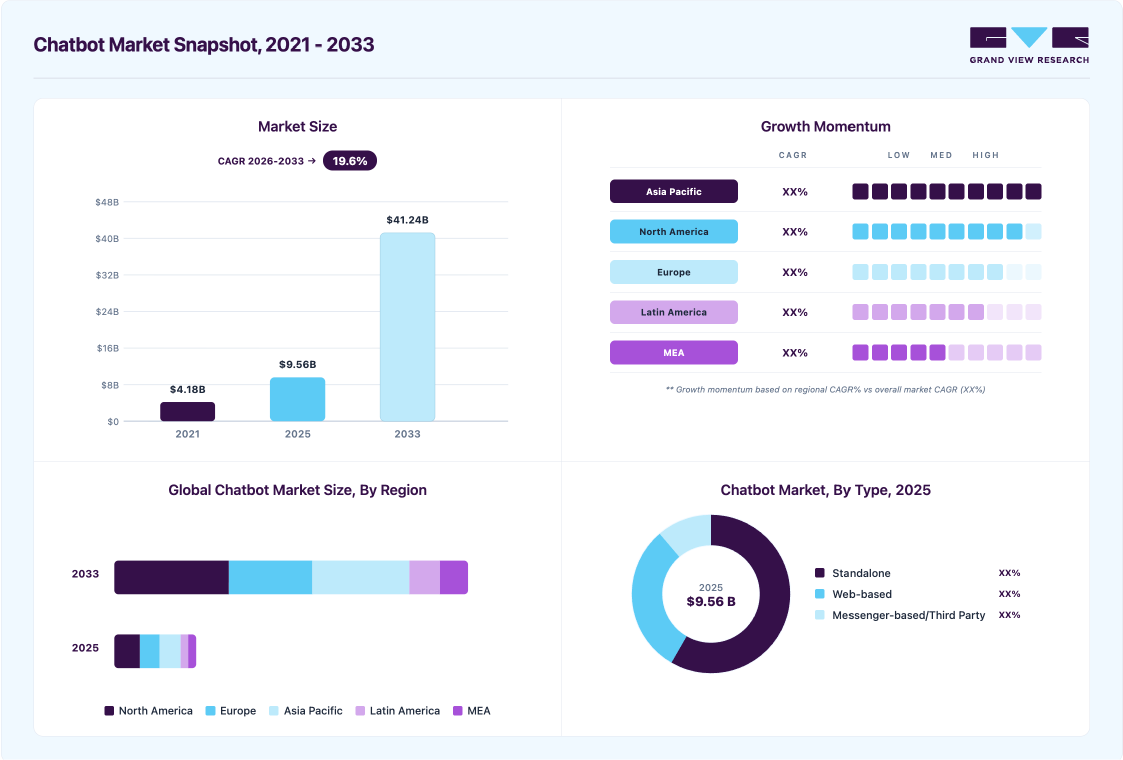
The global chatbot market size was estimated at USD 9.6 billion in 2025 and is projected to grow from USD 11.8 billion in 2026 to USD 41.2 billion by 2033, at a CAGR of 19.6% from 2026 to 2033. North America held the largest share of 31.3% of the global market in 2025. The market is experiencing significant growth due to advancements in artificial intelligence and machine learning.
 Source: Grand View Research, IR Documents, Primary Interviews, Paid DatabasesTo learn more about this report,
 Download Free Sample Report
 Key Market Trends & Insights
- By offering: Solution segment led the market and held the largest revenue share of over 61.8% in 2025.
- By type: Standalone segment led the market and held the largest revenue share of over 58.2% in 2025.
- By medium: Mobile applications segment held the largest revenue share in 2025.
- By vertical: Retail and e-commerce segment held the largest revenue share in 2025.
- By application: Customer service segment held the largest revenue share in 2025.
Regional Highlights
- Largest regional market: North America (31.3% revenue share, 2025)
- By country: The U.S. held the largest revenue share in 2025.
Market Size & Forecast
- Market size in 2025: USD 9.6 Billion
- Estimated market size in 2026: USD 11.8 Billion
- Projected market size by 2033: USD 41.2 Billion
- CAGR (2026-2033): 19.6%
Three ways to get this report
Buy it, customize it, or ask a question.Ask an Analyst
A direct answer, usually in 1 working day
- AccessReport author, directly
- Reply timeWithin 1 working day
- No sales callDirect answer only
- FormatEmail reply
- CostFree, no cost
Get the Full Report
What the study covers
- FormatsPDF · Excel · Dashboard
- Timeline2026–2033 annual, 2025 base
- Coverage20+ countries, 5 regions
- Companies10+ key players profiled
Customize the Report
20% free customization
- IncludeCountries, segments, points
- TailorTo your product definition
- ExtendDeeper competitor detail
- OrA fully bespoke study
- Turnaround5–10 working days
Furthermore, increasing adoption of AI chatbots across customer service, e-commerce, banking, and healthcare sectors is accelerating the market growth significantly. Businesses are increasingly adopting chatbots to enhance customer interactions and streamline operations. These virtual assistants provide 24/7 availability, reducing response times and improving user satisfaction. Industries such as e-commerce, banking, and healthcare are particularly benefiting from these innovations. The integration of natural language processing has enabled chatbots to handle complex queries with greater accuracy. This has expanded their use beyond customer support to areas like sales and internal operations.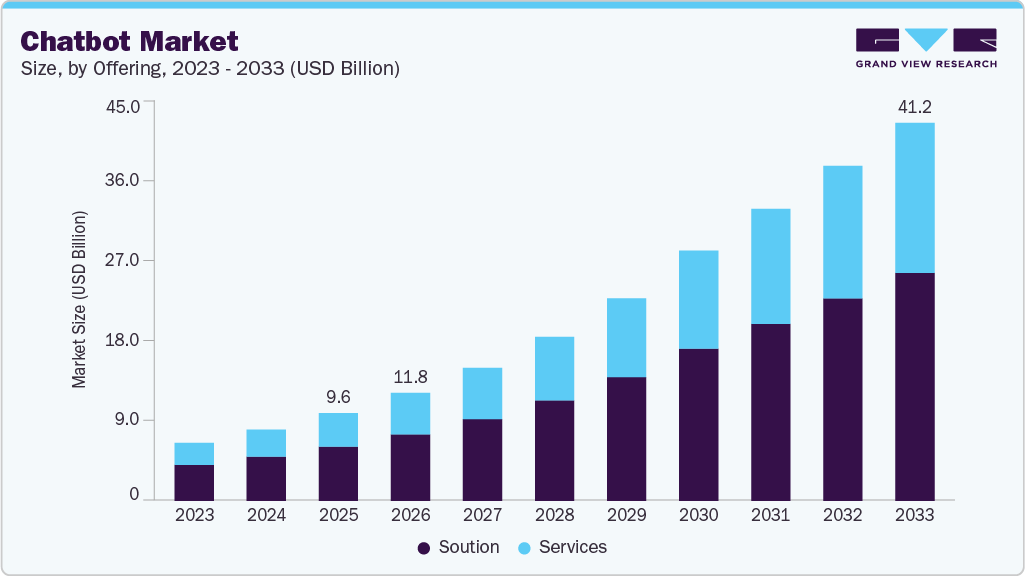 To learn more about this report, Download Free Sample Report
 Consumer preferences for instant and personalized interactions are driving the adoption of chatbot solutions. Companies are utilizing chatbots to gather insights and improve engagement through conversational marketing. The rise of messaging platforms and Sales & Marketing-enabled technologies has broadened the reach of these tools. Startups and established firms alike are investing heavily in artificial intelligence (AI) to create advanced chatbot solutions. Moreover, multilingual support has allowed businesses to cater to diverse audiences, fueling global expansion. This adaptability positions chatbots as essential tools for organizations aiming to enhance efficiency and reach.
The market is also witnessing growth due to cost-saving potential and scalability of chatbot solutions. Small and medium enterprises are implementing these tools to compete with larger players and optimize resources. Integration with analytics tools helps companies assess chatbot performance and refine user experiences. As regulatory compliance becomes more stringent, secure and complaint-bot solutions are gaining attention. Emerging trends, including Sales & Marketing bots and augmented reality integrations, are expected to propel future innovations. With continuous investment and technological progress, the chatbot market shows no signs of slowing down. Additionally, the rising adoption of AI chatbots is enabling organizations to deliver more intelligent, contextual, and personalized customer interactions, further strengthening the growth of the AI chatbot market
Market Dynamics
Businesses across industries are increasingly adopting AI-powered chatbot solutions to improve customer support efficiency and automate communication processes. Organizations are integrating conversational AI platforms into websites, mobile applications, and messaging services to deliver faster response times and reduce dependence on manual support operations. Advancements in natural language processing (NLP) and machine learning technologies are enabling chatbots to provide accurate, context-aware, and personalized customer interactions. Enterprises are also focusing on improving service scalability and operational efficiency through intelligent automation platforms. This growing emphasis on digital customer engagement is significantly supporting chatbot market expansion worldwide.
The rising deployment of AI-powered virtual assistants across banking, healthcare, retail, telecom, and e-commerce sectors is further strengthening market growth. Businesses are increasingly using chatbots for customer query handling, appointment scheduling, technical support, product recommendations, and transaction assistance. In parallel, organizations are prioritizing cost optimization and round-the-clock customer service capabilities to improve user experience and retention rates. The growing adoption of cloud-based AI platforms and enterprise digital transformation initiatives is also accelerating chatbot integration across customer interaction channels. Continuous innovation in conversational AI technologies is expected to remain a major long-term growth driver for the chatbot market.
Data privacy concerns act as a significant restraint on the chatbot market due to the increasing volume of sensitive user data processed during interactions. Chatbots often handle personal, financial, and behavioral information, which raises concerns regarding unauthorized access, data leakage, and misuse. Organizations are required to ensure strict compliance with data protection regulations such as GDPR and other regional privacy laws, which increases implementation complexity. Any failure in safeguarding user data can lead to reputational damage and loss of customer trust, limiting widespread adoption.
In addition, the integration of chatbots across multiple platforms and third-party systems increases the risk of data exposure and security vulnerabilities. Many enterprises remain cautious about deploying fully autonomous conversational systems in critical applications due to concerns over data storage, processing transparency, and AI model training practices. The need for robust encryption, secure infrastructure, and continuous monitoring adds operational burden and slows down deployment, particularly in highly regulated industries such as banking, healthcare, and government services.
The expansion of omnichannel engagement strategies is creating strong opportunities for the chatbot market. Organizations are increasingly focusing on delivering consistent and connected customer interactions across multiple platforms such as websites, mobile applications, social media channels, and messaging services. Chatbots are being integrated into these touchpoints to ensure real-time, automated, and continuous communication, which improves responsiveness and accessibility for users.
This approach enables businesses to maintain continuity of conversation across different channels, reduce response gaps, and ensure a unified customer journey regardless of the platform used. It also helps companies manage large interaction volumes more efficiently while maintaining consistent service quality and reducing dependency on human agents. As enterprises continue to strengthen their digital engagement frameworks, the demand for advanced chatbot solutions with seamless omnichannel integration capabilities is expected to grow steadily.
Market Concentration & Characteristics
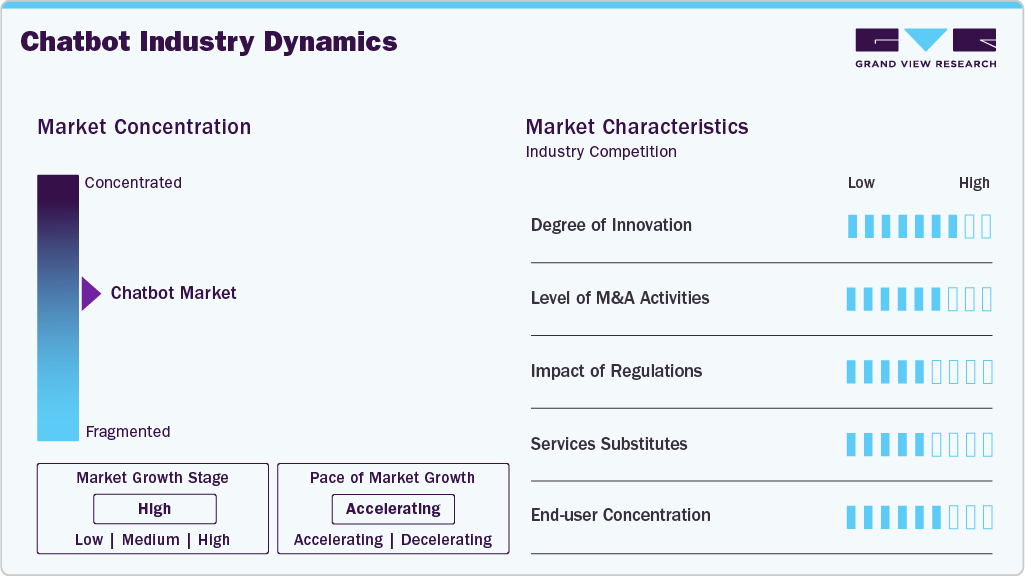
The chatbot market shows a moderate level of concentration with gradual movement toward consolidation. A limited number of global technology companies hold a strong position due to advanced AI capabilities, scalable cloud infrastructure, and integrated digital ecosystems. At the same time, several smaller and specialized vendors continue to serve niche and industry-specific requirements, which maintains competitive diversity. This combination of dominant platforms and fragmented participation prevents full market concentration. Over time, platform-based offerings from large players are increasing competitive pressure on smaller providers, especially in enterprise deployments where integration capability and scalability are critical selection factors.
 To learn more about this report, Download Free Sample Report
 Rapid advancements in generative AI and natural language processing are improving chatbot accuracy, contextual understanding, and interaction quality. Demand is driven by the need for operational efficiency and improved digital engagement across customer-facing and internal business functions. Although alternative communication channels remain available, chatbots are increasingly preferred due to scalability, automation capability, and cost efficiency, supporting steady market expansion. Continuous improvements in conversational intelligence are also enabling more complex use cases, which is widening deployment across multiple industries and strengthening long-term adoption momentum.
Offering Insights
In terms of Offering, the solution segment dominates the Chatbot market is anticipated to hold 61.84% in 2025. These solutions include AI-powered platforms that deliver personalized, context-aware responses to users. Enterprises are focusing on deploying chatbots for customer service, lead generation, and employee support functions. Market leaders are enhancing their offerings by integrating advanced features such as machine learning and multilingual capabilities. These developments have positioned chatbot solutions as indispensable for improving operational efficiency and user engagement.
The services segment of the chatbot market is growing rapidly as organizations prioritize managed and cloud-based solutions. Service providers are increasingly offering support for chatbot deployment, customization, and integration into existing systems. Demand for consulting services is also rising as businesses seek guidance on leveraging chatbot technology effectively. Subscription-based and pay-as-you-go models have made these services more accessible to small and medium enterprises. This trend underscores the importance of services in scaling chatbot adoption and maximizing their benefits across industries.
Type Insights
Standalone chatbots dominate the market in 2025 because they function independently, offering greater control and customization options. Their ability to operate without integration into other platforms appeals to businesses seeking specific functionalities. These chatbots are often used in industries requiring tailored solutions, such as customer support and retail. Their offline capabilities make them reliable for environments where internet connectivity is limited. This combination of flexibility and reliability has solidified their position as a preferred choice in many sectors.
Web-based chatbots are growing in popularity due to their ease of deployment and cross-device accessibility via browsers. They integrate well with existing web platforms, enabling real-time customer interactions. Cloud technology advancements support their scalability, reducing the need for significant infrastructure investments. Businesses value their ability to enhance user experiences by providing seamless, on-demand service. This trend shows a shift toward more flexible and accessible solutions in the chatbot market.
Medium Insights
On the basis of Medium, mobile applications segment accounted for highest revenue in 2025 and is anticipated to hold the leading share throughout the forecast period. The mobile application segment dominates the chatbot market due to the rapid proliferation of smartphones and the increasing preference for mobile-first digital interactions among consumers. Businesses are integrating AI-powered chatbots into mobile applications to provide real-time customer assistance, personalized recommendations, and seamless service delivery. Mobile apps enable chatbots to leverage device features such as notifications, location services, and user behavior data to enhance engagement and improve response accuracy.
Social media chatbots are growing as businesses increasingly utilize platforms such as Facebook, Instagram, and Twitter for customer interaction. These chatbots help companies manage customer inquiries, marketing campaigns, and even sales through social channels. The ability to engage directly with large audiences in real time is driving this growth. Social media chatbots offer businesses the opportunity to enhance brand visibility and customer service. Their integration into social platforms aligns with the growing trend of using digital communication tools for business interactions.
Business function Insights
Based on the Business function, the Sales and marketing segment is accounted to have highest revenue share in 2025. Sales and marketing functions dominate the use of chatbots due to their effectiveness in automating customer interactions. Chatbots handle lead generation, marketing campaigns, and customer relationship management, significantly improving sales processes. By delivering personalized recommendations and nurturing leads, they help businesses increase conversion rates. These chatbots are instrumental in driving marketing strategies by engaging users instantly. The high demand for automation in sales and marketing has led to this function becoming a dominant force in chatbot use.
Finance-related chatbots are growing as financial institutions look for ways to improve operational efficiency and customer service. These chatbots help with automating tasks like financial planning, account management, and personalized investment advice. With the growing need for customer support in the finance sector, chatbots are becoming a valuable tool. They offer personalized insights and real-time solutions to clients, making financial services more accessible. This growth shows a shift toward more automated and user-friendly solutions in the finance industry. Moreover, the increasing deployment of AI chatbots is enabling financial institutions to deliver intelligent, automated, and personalized banking and investment support to customer
Application Insights
Customer service dominates the chatbot market in 2025 due to the increasing adoption of AI-powered chatbots by businesses to automate customer interactions, provide 24/7 support, reduce operational costs, and improve response times across digital channels. They are the dominant force in the chatbot industry, as they improve response times and reduce the workload of human agents. These bots provide 24/7 support, handle high volumes of inquiries, and efficiently resolve basic customer issues. Their ability to deliver instant responses makes them critical for businesses aiming to streamline operations and boost customer satisfaction. Industries such as e-commerce, telecom, and hospitality are increasingly relying on chatbots to handle frequently asked customer queries and provide rapid responses. The ability of customer service chatbots to deliver scalable, efficient, and automated support has reinforced their leading role in the chatbot market.
Chatbots in payment processing are rapidly growing within the chatbot industry due to the rising demand for secure, automated transactions. These bots assist with bill payments, fund transfers, and transaction updates, improving the overall efficiency of financial operations. Their integration into digital wallets and banking apps is expanding, offering users greater convenience and control over their financial activities. The increasing popularity of mobile payments and online banking has accelerated the adoption of payment processing chatbots. This growth highlights the chatbot industry's broader shift toward automating financial services and enhancing customer experience.
Vertical Insights
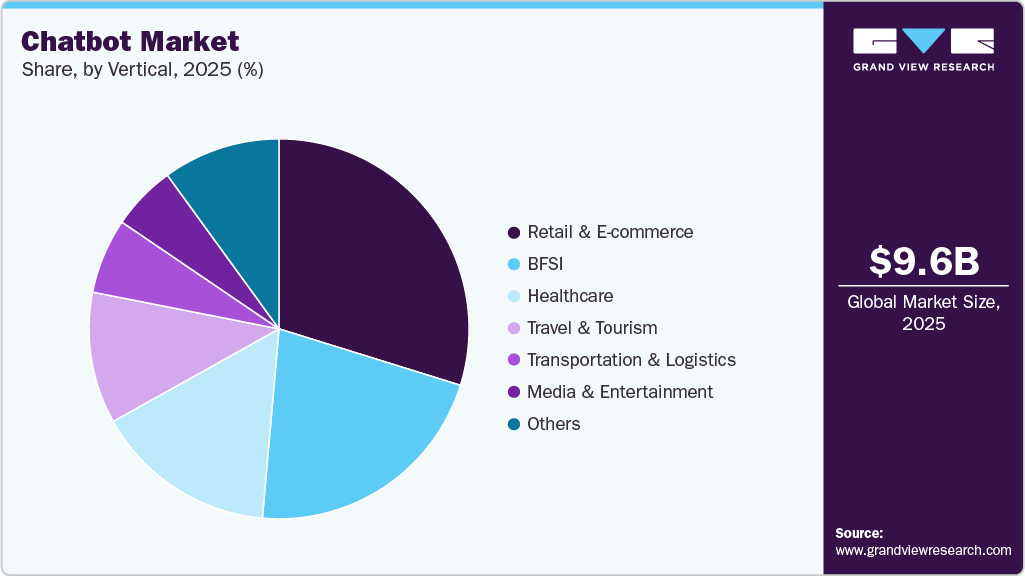
Retail and e-commerce dominate the chatbot market in 2025, with chatbots enhancing shopping experiences by providing personalized recommendations and assisting with order tracking. These bots streamline customer interactions, from product searches to post-purchase support, driving customer satisfaction and sales. Chatbots in this sector help retailers manage high traffic during peak shopping seasons and reduce response times. Their integration into e-commerce platforms has become crucial for maintaining competitiveness in the market. Retail and e-commerce businesses increasingly rely on chatbots to improve operational efficiency and enhance the shopping experience.
 To learn more about this report, Download Free Sample Report
 Chatbots in the BFSI sector are growing as financial institutions embrace digital transformation. These chatbots provide services such as account management, fraud detection, and claim processing, improving both customer experience and operational efficiency. The growing complexity of financial products and services drives the need for automation in customer support. As BFSI companies continue to focus on innovation, chatbots will play an increasingly important role in shaping customer interactions.
Regional Insights
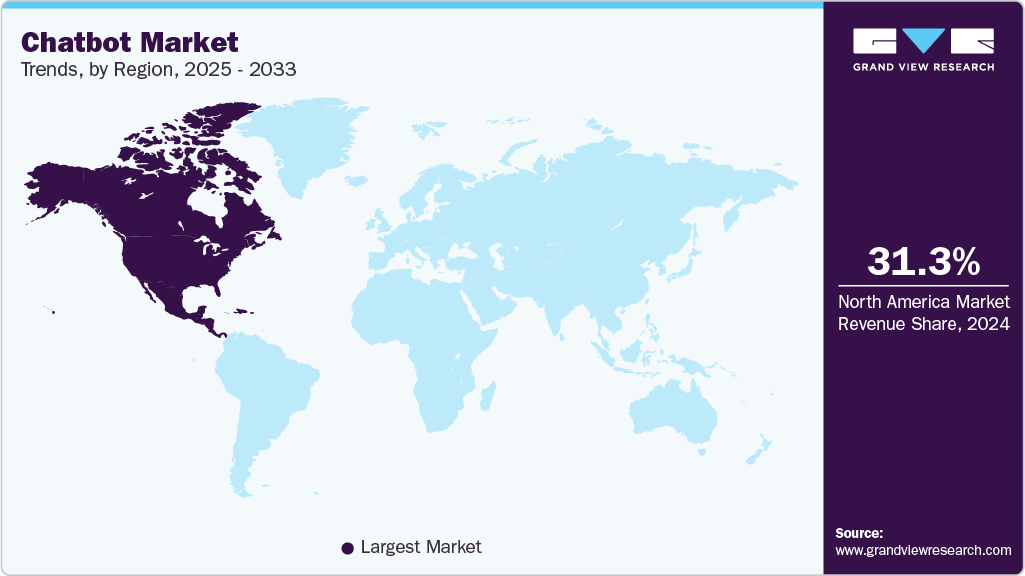
North America leads the global chatbot market accounting for leading share of 31.27% in 2025. The chatbot market in North America is marked by significant investment in AI and automation technologies. Companies across various sectors, including retail and banking, are leveraging chatbots to improve customer service and optimize operations. The region is home to some of the largest chatbot development companies, driving innovation and setting trends. As businesses continue to prioritize digital transformation, the chatbot market in North America is expected to experience sustained growth. Furthermore, the rapid adoption of AI chatbots by enterprises to deliver scalable, data-driven, and personalized customer interactions is reinforcing the growth of the region significantly.
 To learn more about this report, Download Free Sample Report
 U.S. Chatbot Market Trends
In the U.S. the chatbot industry is thriving due to a strong emphasis on customer experience and operational efficiency. Enterprises across industries, from finance to retail & e-commerce, are increasingly integrating chatbots for tasks like lead generation, customer support, and data management. The widespread use of AI and machine learning technologies is propelling the adoption of more advanced chatbot solutions.
Europe Chatbot Market Trends
The chatbot market in Europe is growing steadily as businesses embrace digital solutions to enhance customer engagement. AI-driven chatbots are increasingly being adopted across sectors such as retail and finance. The region's strong regulatory focus on data privacy and security has made companies cautious yet keen on chatbot solutions.
Asia Pacific Chatbot Market Trends
The chatbot market in Asia Pacific is expanding rapidly, driven by the region’s technological growth and digitalization. Countries such as China, India, and Japan are adopting chatbots for customer service, e-commerce, and financial services. With a growing internet user base and mobile-first adoption, chatbots are becoming crucial for businesses looking to engage customers efficiently. The region’s strong focus on innovation and digital transformation continues to fuel the widespread adoption of chatbot solutions.
Key Chatbot Company Insights
Some of the key companies in the Chatbot market include IBM Corporation, Nuance Communications, Inc. Botsify Inc. and others. Organizations are focusing on increasing customer base to gain a competitive edge in the industry. Therefore, key players are taking several strategic initiatives, such as mergers and acquisitions, and partnerships with other major companies.
-
Nuance Communications has developed powerful conversational AI solutions for businesses. Their chatbot technology focuses on natural language understanding, allowing for more human-like interactions. Nuance’s AI is widely used in industries such as finance and customer service. The company continues to innovate in AI-driven chatbots, enhancing customer engagement and improving operational efficiency.
-
IBM Corporation provides Watson Assistant, an AI platform that helps businesses create chatbots to respond to customer questions. It works with websites and mobile apps, making it easy for companies to offer support. Watson Assistant helps improve customer service by providing more personalized responses. IBM continues to enhance this technology to make it even more efficient.
Key Chatbot Companies:
The following key companies have been profiled for this study on the chatbot market.
- 7. ai, Inc.
- Acuvate
- Aivo
- Artificial Solutions
- Botsify Inc.
- Creative Virtual Ltd.
- eGain Corporation
- IBM Corporation
- Inbenta Technologies Inc.
- Next IT Corp.
- Nuance Communications, Inc.
- OpenAI
Competitive Benchmarking
Operating Strategies
Competitive Edge
Weaknesses
Mature Players: IBM Corporation; Nuance Communications, Inc.; eGain Corporation
- Focus on enterprise-grade platforms with deep integration into existing systems and long-term customer contracts.
- Continuous investment in AI capabilities supported by partnerships and acquisitions to strengthen ecosystem presence and scalability.
- Strong enterprise trust built through long-term client relationships, global presence, and proven deployment at scale.
- Advanced AI capabilities combined with integrated platforms and large ecosystem partnerships, enabling end-to-end solutions.
- Slower adaptability to rapid AI-driven innovation compared to agile startups, due to complex legacy systems and large organizational structures.
- Higher costs and limited flexibility for small and mid-sized customers.
Emerging Players: OpenAI; Botsify Inc.; Aivo; Acuvate; 7.ai, Inc.
- Focus on niche use cases and agile development to quickly launch and upgrade chatbot solutions based on market needs.
- Use cloud-based, low-code/no-code, and subscription models to scale faster and attract SMEs and mid-sized enterprises.
- Strong capability to address niche and underserved use cases with highly customized chatbot solutions.
- Ability to innovate rapidly by leveraging latest AI models and experimenting with new features ahead of larger vendors.
- Limited financial resources and smaller customer bases restrict large-scale deployments and global expansion.
- Lower brand recognition and trust compared to established vendors, especially in enterprise-grade implementations.
Recent Developments
-
In October 2025, IBM introduced an updated version of its watsonx Assistant for Z featuring an agentic AI framework designed to enhance enterprise chatbot capabilities. The upgrade enables the AI assistant to understand conversational context, automate multi-step workflows, and support IT teams managing IBM Z mainframes through conversational interactions and intelligent automation
-
In February 2025, OpenAI launched “Deep Research,” an advanced AI capability integrated into ChatGPT that autonomously browses the web and generates detailed, cited reports for users. This feature allows the chatbot to analyze text, images, and PDFs while conducting multi-step research tasks, enabling businesses and professionals to obtain expert-level insights within minutes through conversational AI
-
In September 2025, Botsify Inc. launched an AI-powered agentic platform designed to build and deploy intelligent conversational AI agents. The new platform replaces the traditional drag-and-drop chatbot builder with an LLM-driven conversational interface that allows users to create and manage AI agents through natural language commands, integrate with over 5,000 applications, and enable file and web-search-based responses for real-time customer interactions.
-
In January 2024, IBM Corporation and SAP, a software company in Europe, are collaborating to develop generative AI solutions, including AI-powered chatbots, to enhance supply chain, finance, and sales operations for consumer-packaged goods and retail industries. These solutions will optimize store-level assortments, improve transportation planning, and automate order settlement, driving efficiency and reducing costs.
Chatbot Market Report Scope
Report Attribute
Details
Market size in 2025
USD 9.6 billion
Estimated Market size in 2026
USD 11.8 billion
Projected Market size by 2033
USD 41.2 billion
Growth rate
CAGR of 19.6% from 2026 to 2033
Base year for estimation
2025
Historical data
2021 - 2024
Forecast period
2026 - 2033
Quantitative units
Revenue in USD million/billion and CAGR from 2026 to 2033
Report coverage
Revenue forecast, company ranking, competitive landscape, growth factors, and trends
Segment scope
Offering, type, medium, business function, application, vertical, region
Region scope
North America; Europe; Asia Pacific; Latin America; Middle East & Africa
Country scope
U.S.; Canada; Mexico; Germany; UK; France; China; Japan; India; Australia; South Korea; Brazil; KSA; UAE; South Africa
Key companies profiled
7.ai, Inc; Acuvate; Aivo; Artificial Solutions; Botsify Inc.; Creative Virtual Ltd.; eGain Corporation; IBM Corporation; Inbenta Technologies Inc.; Next IT Corp.; Nuance Communications, Inc.; OpenAI
Customization scope
Free report customization (equivalent up to 8 analysts’ working days) with purchase. Addition or alteration to country, regional & segment scope
Pricing and purchase options
Avail customized purchase options to meet your exact research needs. Explore purchase options
Global Chatbot Market Report Segmentation
This report forecasts revenue growth at global, regional, and country levels and provides an analysis of the latest industry trends and opportunities in each of the sub-segments from 2021 to 2033. For this study, Grand View Research has segmented the global chatbot market report in terms of offering, type, medium, business function, application, vertical, and region:
-
Offering Outlook (Revenue, USD Million, 2021 - 2033)
-
Solution
-
Services
-
-
Type Outlook (Revenue, USD Million, 2021 - 2033)
-
Standalone
-
Web-based
-
Messenger-based/Third Party
-
-
Medium Outlook (Revenue, USD Million, 2021 - 2033)
-
Contact Centers
-
Websites
-
Social Media
-
Mobile Applications
-
-
Business Function Outlook (Revenue, USD Million, 2021 - 2033)
-
IT Services
-
HR Services
-
Sales & Marketing
-
Finance
-
-
Application Outlook (Revenue, USD Million, 2021 - 2033)
-
Customer Services
-
Branding & Advertising
-
Personal Assistance
-
Data Privacy & Compliance
-
Payment Processing
-
Others
-
-
Vertical Outlook (Revenue, USD Million, 2021 - 2033)
-
Healthcare
-
Retail & E-commerce
-
BFSI
-
Media & Entertainment
-
Travel & Tourism
-
Transportation & Logistics
-
Others
-
-
Regional Outlook (Revenue, USD Million, 2021 - 2033)
-
North America
-
U.S.
-
Canada
-
Mexico
-
-
Europe
-
UK
-
Germany
-
France
-
-
Asia Pacific
-
China
-
Japan
-
India
-
Australia
-
South Korea
-
-
Latin America
-
Brazil
-
-
Middle East & Africa (MEA)
-
KSA
-
UAE
-
South Africa
-
-
Delivered Customizations
This report has been delivered with the following In-depth customizations
Client Request
Customization Delivered
Value Adds
Technology & Innovation Assessment
- Emerging technology trend analysis.
- Innovation pipeline evaluation.
- Technology adoption readiness assessment.
- Ecosystem and partnership mapping.
- Identifies future growth opportunities driven by AI and automation advancements.
- Supports roadmap planning for chatbot and conversational AI evolution.
- Evaluates readiness for commercial deployment of new technologies.
- Strengthens decisions on strategic partnerships and ecosystem integration.
Product Positioning & Competitive Intelligence
- Product benchmarking and feature comparison.
- Pricing and value proposition analysis.
- Brand perception and customer preference study
- Competitor strategy evaluation.
- Improve differentiation between competing chatbot platforms.
- Supports pricing strategy optimization and positioning clarity.
- Identifies gaps in competitor offerings and unmet customer needs.
- Enhancing competitive decision-making in product development.
Market Entry & Expansion Assessment
- Regional demand sizing and forecasting.
- Customer segmentation and buying behavior analysis.
- Competitive landscape benchmarking.
- Regulatory and distribution channel assessment.
- Identifies high-growth regions and priority markets for expansion.
- Supports go-to-market strategy development for new deployments.
- Highlights regulatory and operational risks across geographies.
- Enables data-driven investment and expansion planning.
Frequently Asked Questions About This Report
Key factors include increasing adoption of AI chatbots across customer service, e-commerce, banking, and healthcare sectors.
North America dominated with a 31.3% revenue share in 2025.
The solution segment led with a revenue share of over 61.8% in 2025.
The global chatbot market size was estimated at USD 9.6 billion in 2025 and is projected to reach USD 11.8 billion for 2026.
The global chatbot market is expected to grow at a CAGR of 19.6% from 2026 to 2033, reaching USD 41.2 billion.
Key players include OpenAI, Botsify Inc., Aivo, Acuvate, 7.ai, Inc., IBM Corp, eGain Corporation, Artificial Solutions, Nuance Communications, Inbenta, Next IT Corp., and Creative Virtual.
The standalone segment held the largest market share of over 58.2% in 2025.
Mobile applications segment held the largest revenue share in 2025.
About the Author(s)
Communication Services Research Team
Technology · Communication ServicesThis report was authored by the communication services research team at Grand View Research - comprising two research analysts, one senior research analyst, and one industry expert - with specialized expertise in the communication services segment of the technology industry. All findings are based on proprietary technology databases, executive interviews, and regulatory analysis, subject to internal peer review prior to publication.
Last Updated:
Speak to Analyst

Customize this report to your needs - add regions, segments, or data points, with 20% free customization.
Or view our licence options:


ISO 9001:2015 & 27001:2022 Certified
We are GDPR and CCPA compliant! Your transaction & personal information is safe and secure. For more details, please read our privacy policy.


