- Home
- »
- Conventional Energy
- »
-
Carbon Dioxide Market Size And Share Report, 2026-2033GVR Report cover
![Carbon Dioxide Market (2026 - 2033)Report]()
Carbon Dioxide Market (2026 - 2033)
Size, Share & Trends Analysis Report By Source (Hydrogen, Ethyl Alcohol, Ethylene Oxide, Substitute Natural Gas ), By Application (Food & Beverage, Oil & Gas, Medical, Rubber, Firefighting), By Region, And Segment Forecasts
Market Size, 2025
$12.6BMarket Estimate, 2026
$13.4BMarket Forecast, 2033
$20.0BCAGR, 2026–2033
5.9%Carbon Dioxide Market Summary
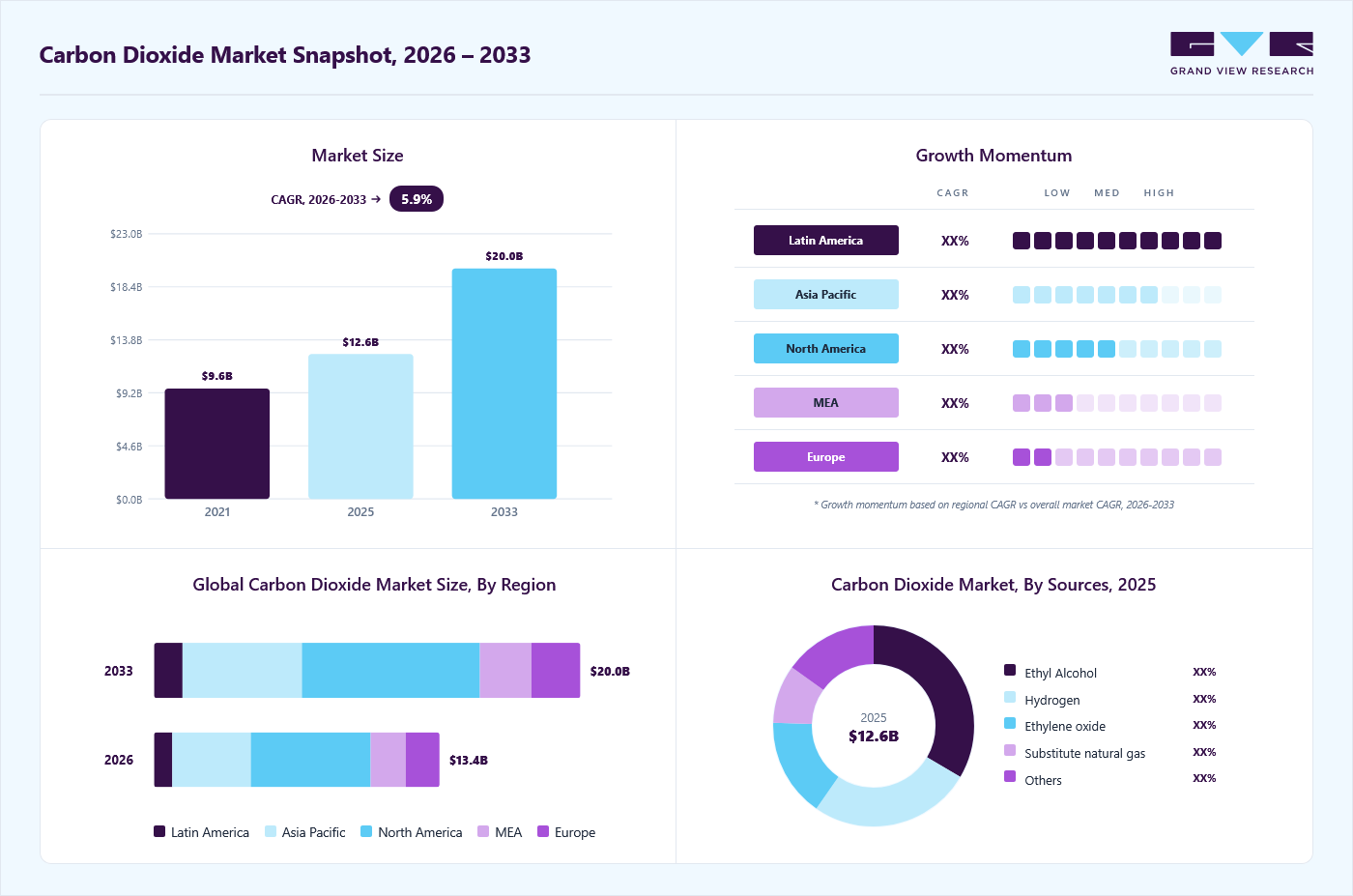
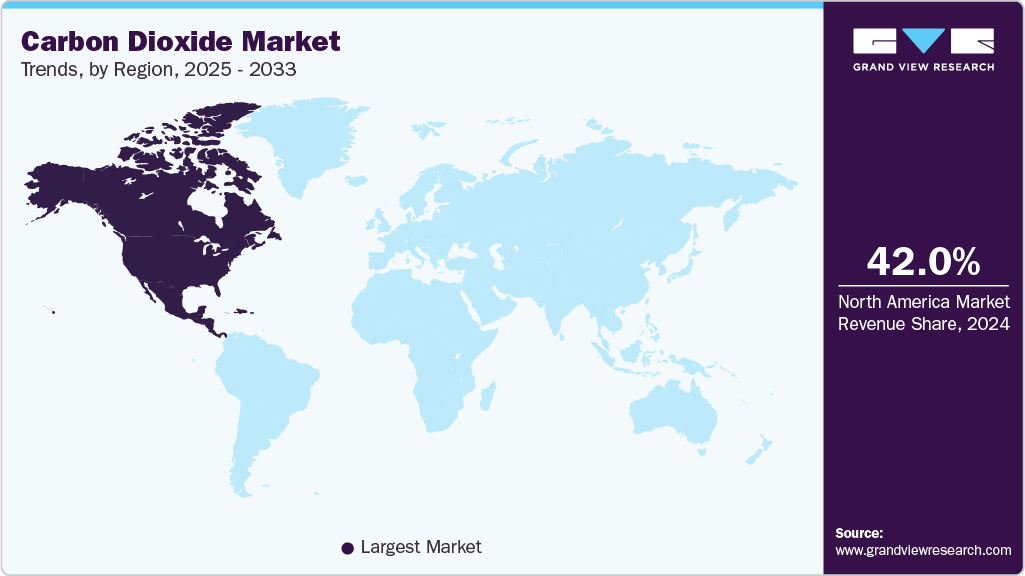
The global carbon dioxide market size was estimated at USD 12.6 billion in 2025 and is projected to grow from USD 13.4 billion in 2026 to USD 20.0 billion by 2033, growing at a CAGR of 5.9% from 2026 to 2033. The North America carbon dioxide market held the largest share of 42.0% of the global market in 2025. The increasing application of carbon dioxide (CO2) in enhanced oil recovery (EOR) is primarily driven by depleting oil reserves and a heavy reliance on crude oil imports, especially in Asia.
Key Market Trends & Insights
- By source: Ethyl alcohol segment led the market with the largest revenue share of 33.4% in 2025.
- By application: Food & beverage segment led the market with the largest revenue share of 41.5% in 2025.
Regional Highlights
- Largest regional market: North America (42.0% revenue share, 2025)
- By country: The U.S. held the largest market share in 2025.
Market Size & Forecast
- Market size in 2025: USD 12.6 Billion
- Estimated market size in 2026: USD 13.4 Billion
- Projected market size by 2033: USD 20.0 Billion
- CAGR (2026-2033): 5.9%
Declining oil reserves and a heavy reliance on crude oil imports, particularly in the Asia Pacific region, have fueled the adoption of EOR methods to maximize extraction efficiency. Rising global demand for crude oil and natural gas is further widening the supply-demand gap, making EOR more critical. In addition, supportive government policies, infrastructure development initiatives, and financial incentives in countries like India, China, Indonesia, and Malaysia are encouraging foreign investment and advancing the use of CO₂ in EOR applications in the oil & gas industry.
The carbon dioxide industry is expected to grow significantly due to its increasing adoption in enhanced oil recovery (EOR) technologies, particularly gas injection methods. Key drivers include fluctuating crude oil prices, a rising number of mature oil wells, and the growing need to extract hydrocarbons from unconventional reserves like tight sands and carbonate formations.
Technological advancements in CO₂-based EOR, including innovations that capture and reuse CO₂ from production processes, enhance recovery rates while reducing environmental impact. This dual benefit, higher oil output and lower emissions, makes CO₂-EOR an attractive solution. In addition, government-backed initiatives in Asia Pacific and Latin America, along with favorable tax regimes, are accelerating foreign investments and infrastructure development. While North America currently leads due to its established unconventional energy sector, high-growth markets like Asia Pacific, Central & South America, and the Middle East are poised to gain a larger share due to rapid industrialization and policy support.
The use of CO2 in the medical field is becoming increasingly important worldwide. CO2 gas is primarily employed as an insufflation agent in various surgical procedures, including arthroscopy, endoscopy, and laparoscopy. It helps inflate and stabilize cavities within the human body, improving the visibility of the surgical area. In addition, CO2 is utilized during surgeries to enhance blood flow to the brain and assist with respiration. For medical applications, CO2 is supplied with specially designed chromium-plated steel cylinders equipped with valves.
The harmful effects of carbon emissions in the atmosphere are significant contributors to global climate change. While countries worldwide have invested heavily in reducing carbon pollution by introducing innovations in Carbon Capture and Storage (CCS) technology and implementing carbon pricing in some areas, many nations still need to achieve their climate goals.
Carbon capture, utilization, and storage (CCUS) is a technology designed to lower emissions from various industries, including steel production, power generation, refining, iron production, cement manufacturing, and petrochemicals. Carbon sequestration technologies encompass capturing, transporting, storing, and utilizing carbon emissions.
Carbon emissions in the atmosphere are among the major causes of global climate change. Although countries around the world have invested heavily in efforts to curb carbon pollution by introducing innovations in CCS technology and implementing carbon taxes in some considered, most of the countries still stand at a serious phase of not achieving the targeted climate goals. Various governments have taken subsequent steps to reduce carbon emissions from the power sector and are making continuous efforts to curb the greenhouse gas emissions from power plants. The provision of the cap-and-trade system, which puts a price on carbon emissions, is stimulating the CCS installations across several industries, such as power generation, chemical processing, oil & gas, iron & steel, and others.
Despite its negative impact on climate change, carbon dioxide can also be utilized in several ways, including as a feedstock for various industrial processes and as a potential fuel source. One approach to understanding these opportunities is to examine the existing research on carbon capture and utilization technologies. Carbon capture technologies have the potential to significantly reduce emissions from industrial processes such as power generation and cement production. In contrast, utilization technologies can transform captured carbon into valuable Sources such as building materials, chemicals, and fuels.
Market Dynamics
Carbon dioxide (CO₂) continues to play a critical role across multiple industries, including food & beverages, healthcare, chemicals, oil & gas, metal fabrication, water treatment, and agriculture. The market is witnessing steady growth due to increasing demand for carbonation in beverages, industrial processing applications, medical gases, enhanced oil recovery operations, and controlled atmosphere packaging. Furthermore, advancements in carbon capture, utilization, and storage (CCUS) technologies are creating new opportunities for CO₂ commercialization. Growing industrialization, food processing activities, and investments in sustainable carbon management solutions are expected to support long-term market growth.
The increasing consumption of carbonated beverages, packaged foods, and industrial gases is a major factor driving demand for carbon dioxide globally. CO₂ is extensively utilized in beverage carbonation, food preservation, freezing applications, modified atmosphere packaging, and pH control processes. Rising urbanization, changing consumer lifestyles, and expanding food processing industries have significantly increased demand for food-grade carbon dioxide across both developed and emerging economies.
In addition, growing industrial activities continue to support market expansion. Carbon dioxide is widely used in metal fabrication, welding, chemical processing, water treatment, and enhanced oil recovery operations. The increasing need for industrial gases in manufacturing sectors, coupled with rising investments in food production and processing infrastructure, is expected to sustain demand for carbon dioxide over the forecast period. Furthermore, the growing healthcare industry utilizes medical-grade CO₂ in minimally invasive surgeries, respiratory stimulation, and pharmaceutical applications, creating additional growth opportunities
Stringent environmental regulations and growing pressure to reduce greenhouse gas emissions remain key challenges for the carbon dioxide market. Governments and regulatory bodies worldwide are implementing stricter carbon reduction targets, emissions trading systems, and sustainability mandates to mitigate climate change. While carbon dioxide is a commercially valuable industrial gas, its association with greenhouse gas emissions has increased scrutiny on industries generating large volumes of CO₂.
Additionally, supply disruptions resulting from plant shutdowns, fertilizer production fluctuations, and industrial operational constraints can significantly affect carbon dioxide availability. Since a substantial portion of commercial CO₂ supply is captured as a by-product from ammonia, hydrogen, ethanol, and chemical production facilities, disruptions in these industries can create temporary shortages and price volatility. Such supply uncertainties may impact end-use industries that rely heavily on a stable carbon dioxide supply chain.
The rapid development of carbon capture, utilization, and storage (CCUS) technologies is creating significant growth opportunities for the carbon dioxide market. Industries are increasingly investing in technologies that capture CO₂ emissions from power plants, refineries, cement plants, and industrial facilities for utilization in commercial applications. Captured carbon dioxide can be used in enhanced oil recovery, food processing, chemical manufacturing, synthetic fuels, building materials, and agricultural applications, creating new revenue streams while supporting sustainability objectives.
Growing investments in decarbonization initiatives, net-zero commitments, and government incentives for carbon management projects are further accelerating market development. In addition, advancements in carbon utilization technologies are expanding the range of high-value applications for captured CO₂. Increasing collaboration between industrial gas companies, energy producers, and technology developers is expected to improve commercialization opportunities and strengthen the role of carbon dioxide within the emerging circular carbon economy.
Analyst Perspective
The carbon dioxide market is evolving from a conventional industrial gas market into a strategically important carbon management ecosystem, where control over supply sources and purification infrastructure increasingly determines competitive advantage. While food & beverage remains the largest demand center, the market’s long-term growth is being reinforced by rising consumption in enhanced oil recovery (EOR) and medical applications, both of which require reliable, high-purity CO₂ supply and are less vulnerable to economic fluctuations. The next phase of industry value creation is likely to come from companies that can secure captive CO₂ streams from hydrogen, ethanol, and industrial processing facilities while integrating carbon capture and utilization capabilities, effectively transforming carbon dioxide from an industrial by-product into a monetizable resource within the broader decarbonization economy.
Market Concentration & Characteristics
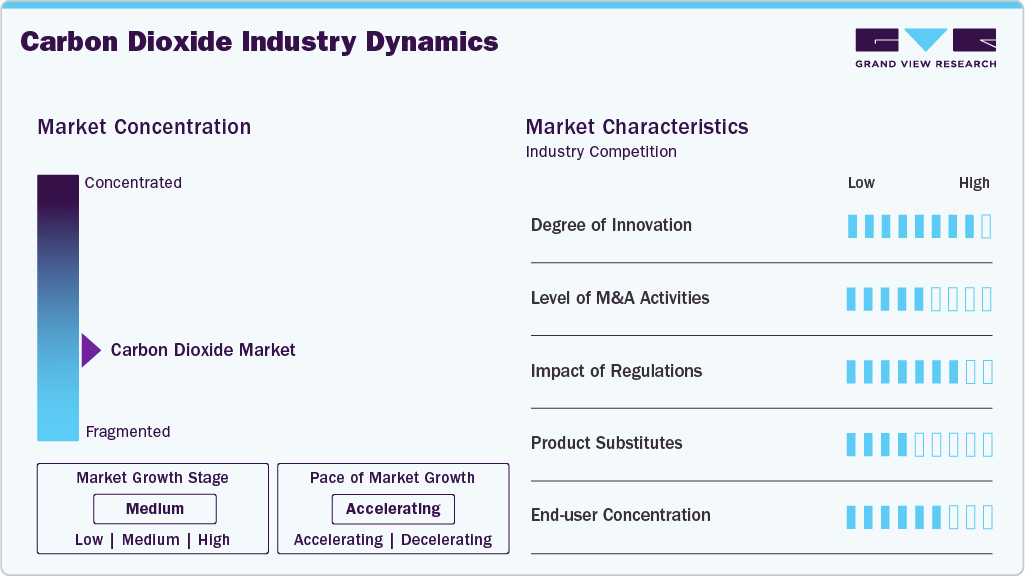
The carbon dioxide industry is moderately fragmented, with dominance by a few large, vertically integrated industrial gas and chemical producers. These leading companies leverage economies of scale, in-house CO₂ sourcing from natural gas processing, ammonia plants, and fermentation processes, as well as extensive global distribution networks to maintain strong competitive positions. Their integration across the CO₂ value chain, from capture and purification to liquefaction and distribution, ensures cost efficiency, consistent Source quality, and reliable supply to key end-use sectors such as food and beverage, healthcare, Rubber, welding, and metal fabrication, and enhanced oil recovery.
At the same time, emerging players in the Asia-Pacific and Middle East regions are expanding their market share in the carbon dioxide industry by capitalizing on abundant natural gas reserves, cost-effective industrial infrastructure, and rising domestic demand across key sectors. These regional producers, supported by strategic investments in CO₂ capture, purification, and liquefaction facilities within industrial clusters, are targeting price-sensitive markets and high-volume applications such as food processing, beverage carbonation, metal fabrication, and Rubber. This evolving dynamic, marked by global consolidation among established industrial gas giants and regional growth fueled by feedstock and energy cost advantages, continues to reshape the competitive landscape of the carbon dioxide industry.
However, the carbon dioxide industry faces several challenges, with one major restraint being the increasing environmental and regulatory scrutiny over CO₂ emissions and its role as a greenhouse gas. Although much of the market utilizes captured CO₂ from industrial processes, concerns over lifecycle emissions, carbon intensity, and climate change impact have led to stricter regulatory frameworks, particularly in Europe and North America. These evolving regulations are pushing producers to invest in low-carbon capture technologies and to demonstrate carbon neutrality or net-negative emissions, especially for applications in food-grade CO₂ and enhanced oil recovery (EOR).
Source Insights
TBased on source, the ethyl alcohol segment led the market with the largest revenue share of 33.4% in 2025 and is expected to continue to grow at the fastest CAGR over the forecast period. This is attributed to the easy availability of carbon dioxide (CO2) as a long-term and reliable source. Furthermore, the increasing global demand for food-grade CO2 will drive its production from ethyl alcohol in the coming years. Carbon dioxide is produced as a byproduct during the fermentation of ethyl alcohol. In addition, the combustion of ethanol also generates CO2 and water vapor. The CO2 obtained from these processes is mainly used in food and beverage applications, such as chilling, carbonation, freezing, and cooling.
The substitute natural gas segment is expected to grow at a significant CAGR from during the forecast period, due to limited availability and price volatility of conventional natural gas, prompting countries, especially in North America and Europe, to explore alternative sources to ensure energy security and supply stability. SNG, produced from coal through thermochemical processes like gasification and the water-gas shift reaction, offers a reliable substitute that is compatible with existing natural gas infrastructure, including pipelines and storage systems. In addition, the increasing demand for natural gas across sectors such as power generation, transportation, residential heating, and industrial applications is pushing the development of scalable and sustainable alternatives. SNG also provides an opportunity for carbon dioxide capture during the conversion process, aligning with decarbonization goals.
Carbon dioxide is produced as a by-product in the hydrogen source ion process. Several methods produce enhanced hydrogen, including biological, thermochemical, and electrolytic processes. Carbon dioxide is also generated from various sources and utilized in multiple applications. During the forecast period, ongoing research and development efforts to efficiently generate CO2 from diverse sources are expected to drive market growth. Factors such as supply and demand, sourcing costs, emission regulations, transportation, and competition all influence carbon dioxide prices. When many suppliers offer carbon dioxide for specific applications, prices may decrease due to increased competition.
Application Insights
Based on application, the food & beverage segment led the market with the largest revenue share of 41.5% in 2025, due to its growing use in cryogenic freezing. This method provides greater flexibility in temperature control compared to mechanical refrigeration. Cryogenic cooling and freezing using CO2 is often favored for bakery, confectionery, meat, and seafood Sources, as it enhances capacity, preserves aromas and nutrients more effectively, and maintains the food's natural taste, color, and overall quality. CO2 is commonly used in modified atmosphere packaging (MAP) to extend the shelf life of food. Sources. This packaging method creates a controlled environment for various foods, including meat, fruits, salads, and certain bakery items, helping to prevent spoilage and maintain freshness. In addition, CO2 is employed in controlled atmosphere storage (CAS) to manage insects and pests in long-term storage facilities.
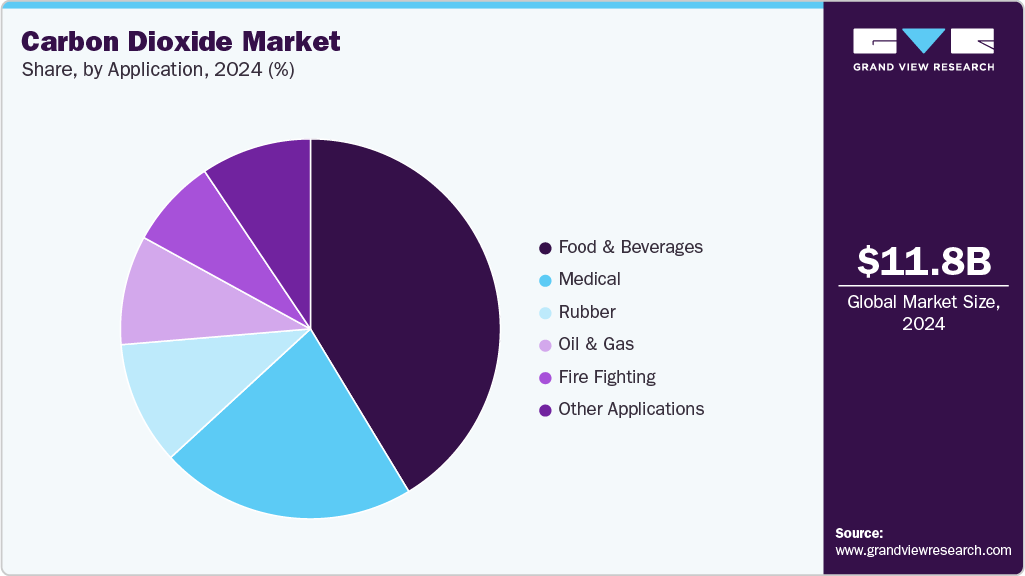
The medical segment is expected to grow at the fastest CAGR of 6.6% from 2025 to 2033. Carbon dioxide plays a vital role in the medical field, used both in pure form and in specialized gas mixtures for applications such as anesthesia, respiratory stimulation, and minimally invasive surgeries like laparoscopy and endoscopy. It also supports cryotherapy and cryopreservation by achieving extremely low temperatures necessary for tissue and sample storage. The use of CO₂ in medical gas mixtures like carbogen aids in treating chronic respiratory conditions. Growing demand from advanced healthcare systems in developed nations, along with the expansion of medical infrastructure in emerging economies, is driving the market.
Regional Insights
North America dominated the carbon dioxide market with the largest revenue share of 42.0% in 2025, driven by the expanding industrial sector and rising demand from the oil & gas industry, particularly for enhanced oil recovery (EOR) applications. The U.S. is seeing a surge in CO₂-EOR projects, supported by favorable policies like the FUTURE Act, which promotes carbon capture and utilization from power plants and industrial sources. In addition, innovative technologies, such as those by CarbonCure in Canada, are using captured CO₂ in sustainable construction materials, further expanding market applications. The food & beverage industry also contributes to demand with its use of CO₂ in preservation and carbonation. These diverse applications and supportive legislative frameworks are expected to propel CO₂ market growth in the region.
U.S. Carbon Dioxide Market Trends
The carbon dioxide market in the U.S. held the largest share of 75% in the North America region in 2025. The carbon dioxide market in the U.S. is poised for significant growth, driven by rapid industrialization and expanding oil & gas activities, particularly in enhanced oil recovery (EOR). CO₂ is widely used in EOR operations to reduce oil viscosity and improve extraction efficiency through CO₂ flooding techniques. The market is further supported by government initiatives like the FUTURE Act, which promotes carbon capture from power and industrial sources for use in oil recovery. In addition, the growing medical sector, fueled by an aging population and rising health concerns, is boosting demand for medical-grade CO₂ in applications such as insufflation during minimally invasive surgeries and respiratory therapies.
Asia Pacific Carbon Dioxide Market Trends
The carbon dioxide market in Asia Pacific is witnessing significant growth, driven by increasing industrialization, urbanization, and a strong push toward environmental sustainability. Countries like China, India, Japan, and South Korea are among the world’s largest emitters of greenhouse gases due to their heavy reliance on coal, oil, and gas for energy production and manufacturing. As a result, there is a rising demand for carbon trading mechanisms to help reduce emissions cost-effectively. Governments in the region are implementing carbon pricing policies, such as China’s national Emissions Trading System (ETS), the largest of its kind, launched in 2021. Additionally, the region is home to many large corporations seeking to meet net-zero targets, driving interest in voluntary carbon credits. The Asia Pacific's vulnerability to climate change impacts like rising sea levels and extreme weather also intensifies pressure for climate action, making carbon markets a crucial tool in transitioning toward low-carbon economies across the region.
The China carbon dioxide market accounted for the largest market revenue share in Asia Pacific in 2024, driven by rising demand across oil recovery, food & beverage, medical, and industrial sectors. The country’s focus on reducing greenhouse gas emissions has spurred investments in large-scale CO₂ capture projects, such as Sinopec’s EOR-based plant, expected to inject over 10 million tons of CO₂ over 15 years. China's position as a leading soft drink producer and food exporter fuels strong demand for food-grade CO₂, intensifying market competition. Strategic moves like Guanggang Gas’s acquisition of Linde Wuhu’s CO₂ plant reflect growing capacity expansion. In addition, industrial growth is boosting CO₂ usage in fire suppression systems to meet safety regulations.
Europe Carbon Dioxide Market Trends
The carbon dioxide market in Europe accounted for the third largest revenue share of 11.9% in 2024, driven by the region being the third largest carbon dioxide industry globally, with the UK leading regional demand, followed by Germany, France, Spain, and Italy. The food & beverage sector is the primary consumer, particularly in beer, and food preservation applications such as packaging salads and meat. Carbon dioxide is also widely used in medical procedures like laparoscopy and enhanced oil recovery. The UK's strong food and drink industry, generating over USD 140 billion annually, significantly drives CO₂ demand. In addition,
The Germany carbon dioxide market is anticipated to grow at the fastest CAGR during the forecast period. The Germany is a key contributor to Europe’s market, driven by high CO₂ usage in beer Sourceion supported by the country's large beer consumption. At the same time, Germany is actively investing in research to reduce carbon emissions and explore new industrial applications for CO₂, aligning with its shift toward renewable energy and sustainability goals.
Middle East & Africa Carbon Dioxide Market Trends
The carbon dioxide market in the Middle East & Africa is experiencing strong growth, driven by rising oil & gas exploration activities and the increasing adoption of Enhanced Oil Recovery (EOR) and Improved Oil Recovery (IOR) technologies. The demand for CO₂ in refrigeration and cooling is also rising due to the growing consumption of packaged and frozen food, fueled by harsh climatic conditions and limited agricultural land. In addition, expanding healthcare infrastructure and increasing awareness are boosting the use of CO₂ in medical applications. While rising health concerns like obesity may slightly restrain the packaged food segment, growing consumption of carbonated beverages, especially in GCC countries, continues to drive CO₂ demand. Saudi Arabia is witnessing EOR demonstration projects and refinery expansions, further supporting long-term market growth.
Latin America Carbon Dioxide Market Trends
The carbon dioxide market in Latin America is witnessing steady growth, largely driven by the expansion of the oil & gas sector supported by rising foreign and government investments. The region’s healthcare industry, particularly in Brazil and Argentina, is boosting demand for medical-grade CO₂ in applications like respiratory therapy and minimally invasive surgeries. CO₂ is also widely used in beer production, and with Brazil ranking as the third-largest beer producer globally, the growing number of microbreweries is expected to support market growth. In addition, countries like Brazil and Colombia, known for their rubber, are fueling demand for dry ice, a solid form of CO₂, used in industrial cleaning via dry ice blasting technology.
Key Carbon Dioxide Company Insights
Some of the key players operating in the carbon dioxide industry include Evonik and Kao Corporation.
-
Evonik, headquartered in Essen, Germany, is a leading global chemical company and a dominant, mature player in the carbon dioxide industry. With decades of amine and surface chemistry expertise, Evonik offers an extensive portfolio of Carbon Dioxide and its derivatives, including primary, Ethyl Alcohol, and Ethylene Oxide amines tailored for a wide range of industrial and specialty applications. Evonik’s Carbon Dioxide delivers essential performance attributes such as emulsification, hydrophobicity, anti-static behavior, surface activity, and corrosion inhibition, making them indispensable in end-use industries like agriculture as adjuvants, personal and home care as conditioning agents, oil & gas as corrosion inhibitors, textiles, and Rubber. Backed by vertically integrated Sourceion and global manufacturing sites, Evonik ensures consistent quality, robust supply chains, and regional responsiveness. Its advanced R&D centers, particularly in Germany, the U.S., and Asia, focus on green chemistry, sustainable synthesis methods, and performance optimization tailored to customer-specific needs. Evonik also leads the development of eco-friendly fatty amine solutions, including biogenic and low-VOC formulations.
KLK OLEO and Indo Amines Limited are emerging market participants in the carbon dioxide industry.
-
KLK OLEO, headquartered in Malaysia, is an emerging and dynamic player in the global market, steadily expanding its presence across key regions such as Asia-Pacific, Europe, and the Americas. Traditionally recognized for its strength in oleochemicals, KLK OLEO is increasingly integrating advanced fatty amine technologies into its Source portfolio to address the growing demand for high-performance, sustainable, and biodegradable surfactants. Its Carbon Dioxide is used extensively in personal care, home care, agriculture, Oil & Gas, and Rubber applications. Through strategic investments, vertical integration, and technology collaborations, KLK OLEO is enhancing its capability to deliver consistent quality, regulatory-compliant, and customized fatty amine solutions tailored to global customer needs. The company emphasizes sustainability, leveraging renewable feedstocks and green chemistry principles to support environmentally responsible sourcing. In addition, KLK OLEO offers comprehensive value-added services such as technical consultation, application development, and supply chain reliability, positioning itself as a trusted and agile partner in the evolving global carbon dioxide industry.
Key Carbon Dioxide Companies:
The following key companies have been profiled for this study on the carbon dioxide market.
-
Acail Gas
-
Air Liquide
-
Air Sources and Chemicals, Inc.
-
Greco Gas Inc.
-
Linde AG
-
Messer Group
-
Sicgil India Limited
-
SOL Group
-
Quimetal
-
Taiyo Nippon Sanso Corporation
Competitive Benchmarking
Category
Operating Strategies
Competitive Edge
Weakness
Established Players (Air Liquide, Linde plc, Air Products and Chemicals, Inc., Messer, Praxair Inc., Celanese Corporation, Sipchem Company)
- Focus on expanding industrial gas production capacities and strengthening integrated carbon dioxide supply networks.
- Invest in carbon capture, utilization, and storage (CCUS) technologies to enhance sustainability and secure long-term CO₂ supply.
- Strengthen long-term supply agreements with food & beverage, healthcare, chemical, manufacturing, and oil & gas industries.
- Expand geographic footprint through acquisitions, strategic partnerships, and air separation unit (ASU) investments while improving operational efficiency and logistics capabilities
- Extensive global manufacturing infrastructure and distribution networks ensure reliable supply across multiple regions.
- Diversified customer base across food processing, healthcare, chemicals, welding, and energy sectors reduces dependence on any single industry.
- Strong financial capabilities support investments in production expansion, carbon capture technologies, and sustainability initiatives.
- Established regulatory expertise and long-standing customer relationships strengthen market leadership
- High capital expenditure requirements for production facilities, transportation, and storage infrastructure.
- Exposure to fluctuations in industrial production levels, energy costs, and feedstock availability.
- Increasing regulatory pressure related to carbon emissions and environmental compliance can raise operational costs.
- Large organizational structures may reduce agility in addressing niche regional opportunities.
Emerging Players (Axcel Gases, American Gas Products)
- Focus on regional industrial gas distribution and customized carbon dioxide supply solutions for local customers.
- Emphasize flexible service offerings, quick response times, and tailored supply agreements across food processing, beverage carbonation, welding, and industrial applications.
- Strengthen market presence through distributor partnerships and targeted expansion in underserved regions.
- Invest selectively in logistics capabilities and specialty gas solutions to enhance customer retention.
- Strong regional market knowledge and closer customer relationships enable personalized service.
- Greater operational flexibility and faster decision-making compared to multinational competitors.
- Ability to address niche market requirements and provide customized supply solutions.
- Competitive pricing strategies support penetration into local industrial and commercial markets.
- Limited production capacity and geographic reach compared to global industrial gas leaders.
- Greater dependence on regional economic conditions and local demand fluctuations.
- Lower financial resources for large-scale infrastructure investments and technology development.
- Limited participation in advanced carbon capture and sustainability initiatives compared to established market leaders.
Recent Developments
-
In April 2025, Air Liquide is actively contributing to the market growth through its involvement in the Porthos CO₂ Transportation and Storage Project in Rotterdam, Europe's largest industrial port. As one of the key industrial partners, Air Liquide is implementing its CRYOCAP carbon capture technology at its hydrogen plant in Rozenburg to reduce CO₂ emissions by 50%. The investment in public-private Porthos initiative will capture, transport, and store up to 2.5 million tonnes of CO₂ annually, expandable to 10 million tonnes, in depleted gas fields beneath the North Sea. This marks the first time CO₂ will be stored in such a reservoir in Europe. By leveraging its expertise in carbon capture and storage (CCS), Air Liquide is helping decarbonize hard-to-abate industries and supporting the region’s transition to low-carbon industrial operations, aligning with the EU’s goal of carbon neutrality by 2050.
-
In April 2023, Linde has signed a long-term agreement with ExxonMobil for the off-take and permanent storage of up to 2.2 million metric tons of CO₂ annually from its upcoming clean hydrogen Sourceion facility in Beaumont, Texas, set to start operations in 2025. This CO₂ capture supports Linde’s supply of low-carbon hydrogen to OCI Global's blue ammonia plant and other industrial users across the U.S. Gulf Coast. The deal highlights growing momentum in carbon capture and storage (CCS), with ExxonMobil acting as the storage provider. This collaboration significantly contributes to decarbonizing industrial operations, marking a notable development in the carbon dioxide industry as CCS becomes a central tool in emission reduction strategies.
Carbon Dioxide Market Report Scope
Report Attribute
Details
Market size value in 2025
USD 12.6 billion
Market size value in 2026
USD 13.4 billion
Revenue forecast in 2033
USD 20.0 billion
Growth rate
CAGR of 5.9% from 2026 to 2033
Base year for estimation
2025
Historical data
2021 - 2024
Forecast period
2026 - 2033
Quantitative units
Revenue in USD million/billion and CAGR from 2026 to 2033
Report coverage
Revenue forecast, company ranking, competitive landscape, growth factors, and trends
Segments covered
Source, Application, region
Regional scope
North America; Europe; Asia Pacific; Latin America; MEA
Country scope
U.S.; Canada; Mexico; Germany; UK; France; Italy; Spain; China; Japan; India; South Korea; Brazil; Argentina; Saudi Arabia; South Africa.
Key companies profiled
Air Liquide; Linde plc; Air Products and Chemicals, Inc.; Celanese Corporation; Messer; Air Products and Chemicals, Inc.; Sipchem Company; Axcel Gases; Praxair Inc.; American Gas Products
Customization scope
Free report customization (equivalent up to 8 analysts' working days) with purchase. Addition or alteration to country, regional & segment scope.
Pricing and purchase options
Avail customized purchase options to meet your exact research needs. Explore purchase options
Global Carbon Dioxide Market Report Segmentation
This report forecasts revenue growth at global, regional, and country levels and provides an analysis of the latest industry trends in each of the sub-segments from 2021 to 2033. For this study, Grand View Research has segmented the global carbon dioxide market report based on source, application, and region:

-
Source Outlook (Volume, Kilotons; Revenue, USD Million, 2021 - 2033)
-
Hydrogen
-
Ethyl Alcohol
-
Ethylene Oxide
-
Substitute Natural Gas
-
Other Sources
-
-
Application Outlook (Volume, Kilotons; Revenue, USD Million, 2021 - 2033)
-
Fruit & Vegetables
-
Oil & Gas
-
Medical
-
Rubber
-
Firefighting
-
Other Applications
-
-
Regional Outlook (Volume, Kilotons; Revenue, USD Million, 2021 - 2033)
-
North America
-
U.S.
-
Canada
-
Mexico
-
-
Europe
-
Germany
-
UK
-
France
-
Italy
-
Spain
-
-
Asia Pacific
-
China
-
India
-
Japan
-
South Korea
-
-
Latin America
-
Brazil
-
Argentina
-
-
Middle East & Africa
-
Saudi Arabia
-
South Africa
-
-
Research Methodology
Segment Definition
Segment - Source
Revenue capture definition
Hydrogen
Revenue is primarily generated through the commercial sale of carbon dioxide recovered as a by-product of hydrogen production processes, particularly steam methane reforming. Income is captured through long-term supply agreements with food & beverage, industrial gas, healthcare, and manufacturing customers, supported by integrated gas distribution networks
Ethyl Alcohol
As one of the largest CO₂ sources, revenue is captured through the recovery and purification of carbon dioxide generated during ethanol fermentation. Demand from beverage carbonation, food processing, dry ice manufacturing, and industrial applications supports stable revenue streams, while increasing biofuel production continues to strengthen supply availability
Ethylene Oxide
Revenue is generated through the sale of purified carbon dioxide recovered from ethylene oxide manufacturing operations. The captured CO₂ is supplied to industrial, chemical processing, water treatment, and specialty gas markets through contract-based supply arrangements and merchant gas sales channels
Substitute Natural Gas
Revenue is earned through the commercialization of carbon dioxide generated from substitute natural gas and gasification processes. Revenue streams are supported by industrial gas distribution, enhanced oil recovery projects, chemical manufacturing applications, and emerging carbon utilization initiatives
Others
Revenue is predominantly generated from carbon dioxide recovered from ammonia plants, fertilizer production, refineries, natural gas processing facilities, and carbon capture systems. Long-term industrial contracts, merchant gas sales, and sustainability-focused carbon utilization projects contribute significantly to revenue generation within this segment
Segment - Application
Revenue capture definition
Food & Beverage
The dominant revenue channel captures income through the sale of food-grade carbon dioxide used in beverage carbonation, food preservation, modified atmosphere packaging, freezing, chilling, and dry ice production. Long-term supply agreements with beverage manufacturers, food processors, and packaging companies represent a major source of revenue
Oil & Gas
Revenue is generated through the supply of carbon dioxide for enhanced oil recovery (EOR), reservoir pressure maintenance, well stimulation, and energy production applications. Large-scale industrial contracts and pipeline transportation agreements contribute significantly to revenue capture within this segment
Medical
Revenue is earned through the sale of medical-grade carbon dioxide utilized in minimally invasive surgical procedures, respiratory stimulation, cryotherapy, laboratory applications, and pharmaceutical manufacturing. Strict quality standards and regulatory requirements enable premium pricing and stable demand from healthcare institutions
Rubber
Revenue is captured through the use of carbon dioxide in rubber processing, polymer manufacturing, specialty foam production, and industrial processing applications. Demand is driven by manufacturing activity and industrial production requirements across automotive and consumer goods industries
Fire Fighting
Revenue is generated through the supply of carbon dioxide for fire suppression systems, portable extinguishers, industrial safety equipment, and specialized fire protection applications. Long-term maintenance contracts and replacement cylinder demand contribute to recurring revenue streams.
Others
Revenue is earned through diverse applications including water treatment, welding & metal fabrication, chemical processing, agriculture, electronics manufacturing, and carbon capture utilization projects. Industrial gas distribution agreements and specialty application requirements support revenue generation across this segment
Estimation Model
CO₂ Supply Generation Layer
CO₂ Recovery & Commercialization Layer
CO₂ End-Use Demand Layer
Revenue Estimation Layer
Where is CO₂ generated?
How much CO₂ can be commercialized?
Where is CO₂ consumed?
How much revenue is generated?
Apply source-specific production volumes and CO₂ recovery rates to estimate the total commercially recoverable carbon dioxide supply pool.
Apply capture efficiency, purification rates, liquefaction capacity, and regional production infrastructure to determine the marketable carbon dioxide volume available for industrial, food-grade, and medical-grade applications.
Apply industry-specific consumption rates, regional demand patterns, and application penetration levels to estimate addressable market demand.
Multiply paying users by blended consumer ARPU (USD 15-25/year) and add B2B/institutional channel revenue from insurer, employer, and hospital contracts (USD 5-15 per covered life/year).
Delivered Customizations
This report has been delivered with the following In-depth customizations
Client Request
Customization Delivered
Value Adds
Food & Beverage Demand Analysis
Conducted a focused assessment of carbon dioxide consumption across beverage grade carbonation, food preservation, freezing applications, and dry ice production. The analysis evaluated demand trends, supply availability, consumption patterns, and regulatory requirements across major food processing regions
Helps stakeholders identify high-growth food and beverage applications, assess supply-demand dynamics, evaluate pricing trends, and understand long-term demand drivers supporting market expansion
Industrial & Energy Application Assessment
Evaluated carbon dioxide utilization trends across enhanced oil recovery (EOR), chemical processing, welding & metal fabrication, water treatment, rubber manufacturing, and industrial processing applications. The study assessed industrial consumption patterns, operational requirements, and regional demand growth potential
Provides insights into emerging industrial opportunities, sector-specific consumption trends, and commercially attractive end-use segments to support investment planning and market expansion strategies
Carbon Capture, Utilization & Trade Opportunity Assessment
Assessed opportunities associated with carbon capture, utilization, and storage (CCUS), including captured CO₂ commercialization, cross-border trade flows, supply chain infrastructure, regulatory developments, and sustainability initiatives. The analysis also evaluated key producing regions, import-export dynamics, and long-term decarbonization trends influencing the market
Supports investment and expansion strategies by identifying emerging carbon utilization opportunities, evaluating supply security, understanding trade dependencies, and strengthening long-term positioning within the evolving low-carbon economy
Frequently Asked Questions About This Report
The global carbon dioxide market size was estimated at USD 12.6 billion in 2025 and is expected to reach USD 13.4 billion in 2026.
Key players include Acail Gas, Air Liquide, Air Sources and Chemicals, Inc., Greco Gas Inc., Linde AG, Messer Group, Sicgil India Limited, SOL Group, Quimetal, Taiyo Nippon Sanso Corporation
The growth is attributed to increasing application of carbon dioxide (CO2) in enhanced oil recovery (EOR) is primarily driven by depleting oil reserves and a heavy reliance on crude oil imports
The carbon dioxide market is expected to grow at a compound annual growth rate of 5.9% from 2026 to 2033 to reach USD 20.0 billion by 2033.
The food & beverage carbon dioxide segment led the market and accounted for the largest revenue share of 41.5% in 2025, due to its growing use in cryogenic freezing, this method provides greater flexibility in temperature control compared to mechanical refrigeration.
Food & beverage held the largest revenue share of 41.5% in 2025, while medical is the fastest-growing market.
North America dominated with a 42.0% revenue share in 2025.
About the Author(s)
Conventional Energy Research Team
Energy & Power · Conventional EnergyThis report was authored by the conventional energy research team at Grand View Research - comprising two research analysts, one senior research analyst, and one industry expert - with specialized expertise in the conventional energy segment of the energy & power industry. All findings are based on proprietary energy & power databases, executive interviews, and regulatory analysis, subject to internal peer review prior to publication.
Last Updated:
Speak to Analyst

Need a Tailored Report?
Customize this report to your needs — add regions, segments, or data points, with 20% free customization.
Or view our licence options:


ISO 9001:2015 & 27001:2022 Certified
We are GDPR and CCPA compliant! Your transaction & personal information is safe and secure. For more details, please read our privacy policy.