
- Home
- »
- Electronic Devices
- »
-
Brushless DC Motor Market Size, Share Report, 2026-2033GVR Report cover

Brushless DC Motor Market (2026 - 2033)
Size, Share & Trends Analysis Report By Rotor, Power Output (Less Than 750 Watt, 750 Watt - 2.99kW, 3kW - 75 kW, Above 75kW), By Speed, By End-use, By Region, And Segment Forecasts
Market Size, 2025
$22.2BMarket Estimate, 2026
$23.6BMarket Forecast, 2033
$38.4BCAGR, 2026–2033
7.2%Brushless DC Motor Market Summary
The global brushless DC motor market size was valued at USD 22.2 billion in 2025 and is projected to grow from USD 23.6 billion in 2026 to USD 38.4 billion by 2033, growing at a CAGR of 7.2% from 2026 to 2033. Asia Pacific dominated the market, accounting for a revenue share of 48.6% in 2025. The brushless DC motor market is driven by the rapid adoption of electric vehicles, increasing industrial automation, and the growing deployment of robotics and smart manufacturing systems.
 Source: Grand View Research, IR Documents, Primary Interviews, Paid DatabasesTo learn more about this report,
 Download Free Sample Report
 Key Market Trends & Insights
- By rotor: The inner rotor segment dominated the market, with a share of 61.2% in 2025.
- By power output: The less than 750 Watt segment accounted for the largest market share of 48.8% in 2025.
- By end use: Motor vehicle segment dominated the market with a market share of 28.1% in 2025.
- By speed: 2,001-10,000 RPM segment accounted for the largest market share of 38.9% in 2025.
Regional Highlights
- Largest regional market: Asia Pacific (48.6% revenue share in 2025)
- By Country: The U.S. held the largest market share in 2025
Market Size & Forecast
- Market size in 2025: USD 22.2 Billion
- Estimated market size in 2026: USD 23.6 Billion
- Projected market size by 2033: USD 38.4 Billion
- CAGR (2026-2033): 7.2%
Three ways to get this report
Buy it, customize it, or ask a question.Ask an Analyst
Analyst response in 1 business day
- AccessReport author, directly
- Reply timeWithin 1 working day
- No sales callDirect answer only
- FormatEmail reply
- CostFree, no cost
Get the Full Report
What the study covers
- FormatsPDF · Excel · Dashboard
- Timeline2026–2033 annual, 2025 base
- Coverage20+ countries, 5 regions
- Companies10+ key players profiled
Customize the Report
20% free customization
- IncludeCountries, segments, points
- TailorTo your product definition
- ExtendDeeper competitor detail
- OrA fully bespoke study
- Turnaround5–10 working days
Rising demand for energy-efficient motor solutions across HVAC systems, consumer electronics, medical devices, and industrial machinery is accelerating market growth. The increasing investments in renewable energy systems, battery-powered equipment, and high-performance motion control applications are creating significant growth opportunities for the market. The ability of Brushless DC (BLDC) motors to save energy and increase the operational efficiency of equipment in which they are used is expected to drive the growth of the market over the forecast period. These motors offer optimum efficiency and reliability at the same time, which proves to be economical in the majority of applications, such as window lifters, air conditioners, and sun-roof actuators. To learn more about this report, Download Free Sample Report
 These motors are thermally resistant, require low maintenance, and operate at low temperatures, eliminating any threat of sparks. The emergence of sensor-less controls for BLDC type is likely to boost the durability and reliability of the product, thereby reducing the number of mechanical misalignments, electrical connections, as well as the weight and size of the end product. These aforementioned factors are estimated to drive market growth. Furthermore, the market is driven by the rising activity in the electric vehicle (EV) industry, globally. The growing popularity of vehicle features, such as motorized seats, adjustable mirrors, and sunroof systems, is driving the demand for BLDC motors.
The market is witnessing tremendous growth. This can be attributed to the increase in automobile production and the number of BLDC motors used in a car. Automotive motors are used in vehicle powertrain systems, chassis, and safety fittings. The increasing popularity of features, such as motorized seats, wipers, doors, adjustable mirrors, and massage seats, is helping drive their demand, especially BLDC motors.
The increasing adoption of EVs is contributing to the alleviation of problems, such as oil dependency, global warming, and environmental pollution. Several governments have initiated and implemented different policies to encourage and stimulate EV adoption and production. The advantages offered by them, such as less rotor heat and higher peak point efficiency, prove to be critical in a variety of applications, particularly in electrical and hybrid vehicles, which are estimated to result in their increased adoption in hybrid vehicles over the coming years. Moreover, electric car manufacturers prefer using BLDC motors in vehicles owing to low maintenance, higher efficiency, high operating speed, and quick response.
Market Dynamics
The brushless DC motor market is witnessing significant growth driven by advancements in motor design, power electronics, electronic speed control technologies, and energy-efficient motion systems. The increasing adoption of electric vehicles, industrial automation, robotics, and smart manufacturing solutions is fueling demand for high-performance BLDC motors across diverse industries. Rising requirements for precise speed control, enhanced operational efficiency, and low-maintenance motor systems in consumer electronics, HVAC equipment, medical devices, and industrial machinery are accelerating market expansion. Furthermore, the growing integration of IoT-enabled motor monitoring, predictive maintenance platforms, and intelligent motor control systems is improving asset performance, reducing operational costs, and creating new opportunities across the global BLDC motor ecosystem.
The increasing shift toward electrification across transportation platforms is a major factor supporting demand for brushless DC motors. These motors offer superior efficiency, compact design, precise speed control, and extended operational life, making them highly suitable for battery-powered systems. Manufacturers are increasingly incorporating BLDC motors into electric propulsion architectures to improve energy utilization, enhance performance, and support extended operating cycles under varying load conditions.
The regulatory emphasis on energy conservation and reduced emissions is encouraging the adoption of advanced motor technologies capable of delivering higher efficiency levels. Continuous improvements in motor controllers, permanent magnet materials, and power electronics are enhancing overall system performance. As electrification initiatives continue to expand across developed and emerging economies, demand for reliable, lightweight, and efficient BLDC motor solutions is expected to remain strong across multiple application areas.
Dependence on rare-earth permanent magnets presents a significant challenge for brushless DC motor manufacturers. Fluctuations in the availability and pricing of materials such as neodymium and dysprosium can substantially affect production costs and supply chain stability. Since these materials play a critical role in motor performance, manufacturers often struggle to maintain cost competitiveness during periods of raw-material market uncertainty.
The concentrated sourcing regions and geopolitical factors can increase procurement risks, leading to supply disruptions and extended lead times. Such uncertainties may impact manufacturing schedules, inventory planning, and long-term investment decisions. Companies are actively exploring alternative motor designs and material substitution strategies; however, achieving equivalent efficiency and performance remains challenging, limiting flexibility in reducing dependence on rare-earth resources.
The increasing adoption of intelligent motion control systems is creating significant opportunities for brushless DC motor manufacturers. Modern equipment increasingly requires high-precision motor operation, real-time responsiveness, and seamless integration with digital control platforms. BLDC motors are well-positioned to meet these requirements due to their ability to provide precise speed control, superior torque characteristics, and compatibility with advanced electronic control systems.
The growing adoption of connected devices, smart equipment, and automated operational environments is further driving demand for intelligent motor technologies. Integration with embedded sensors, remote diagnostics, predictive maintenance platforms, and advanced analytics solutions enables enhanced equipment reliability and operational visibility. As organizations prioritize efficiency, automation, and data-driven performance optimization, demand for sophisticated BLDC motor solutions is expected to increase across a broad range of applications.
Market Concentration & Characteristics
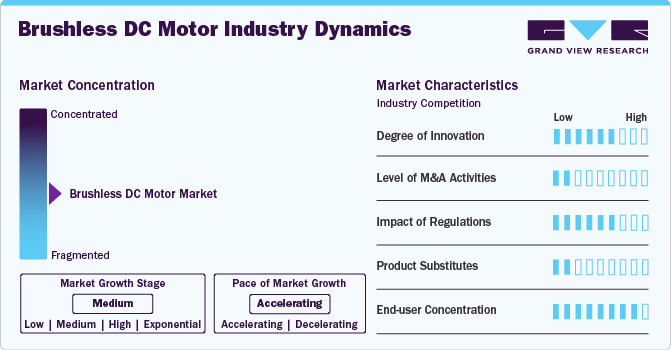
The brushless DC motor market is moderately concentrated, with a mix of global motor manufacturers, motion control technology providers, and specialized component suppliers competing across diverse application segments. The market is experiencing accelerated expansion due to increasing electrification trends, rising automation adoption, and growing demand for energy-efficient motor systems. Companies are actively focusing on advanced motor designs, controller integration, and product portfolio diversification to strengthen their competitive positioning. Manufacturers are increasingly investing in intelligent motor control technologies, high-performance permanent magnet systems, sensor-based monitoring solutions, and digitally connected motor platforms to enhance operational efficiency, reliability, and precision across critical applications.
 To learn more about this report, Download Free Sample Report
 The market is characterized by a high degree of innovation, supported by continuous advancements in power electronics, motor control algorithms, magnetic materials, and integrated drive technologies. Merger and acquisition activities remain moderate as established participants seek to expand technological capabilities, strengthen regional presence, and enhance vertically integrated manufacturing operations. The threat from substitutes remains relatively low because conventional brushed motors often have lower efficiency, higher maintenance requirements, and poorer speed control performance. Regulatory impact remains high due to increasingly stringent energy efficiency requirements, electrification initiatives, and sustainability-focused standards. Growing investments in intelligent automation systems, electric mobility platforms, and connected equipment architectures are expected to continue supporting the market's development trajectory.
Analyst Perspective
The brushless DC motor market is experiencing significant expansion, driven by rising demand for energy-efficient motor systems, ongoing advancements in power electronics, and the growing adoption of electrification and automation technologies across multiple sectors. The rising deployment of high-performance BLDC motors in electric mobility solutions, industrial equipment, HVAC systems, consumer appliances, and robotics is further supporting operational efficiency and precise motion control. As organizations increasingly prioritize energy conservation, intelligent motor management, and connected equipment architectures, BLDC motor manufacturers are well-positioned to capitalize on emerging opportunities, thereby reinforcing long-term market expansion and sustained revenue generation across the global electromechanical ecosystem.
Rotor Insights
Based on rotor, the inner rotor segment led the market with the largest revenue share of 61.2% in 2025 and is expected to grow at a significant CAGR over the forecast period. This dominance is attributed to the higher power density and compact design of inner rotor BLDC motors, making them suitable for applications requiring efficient torque delivery and space-saving configurations. Industries such as automotive, industrial machinery, and consumer electronics extensively utilize these motors, contributing to their significant market share.
The outer rotor segment also is expected to witness substantial growth from 2025 to 2030. The unique configuration of outer rotor motors, where the rotor encases the stator, offers advantages in torque density and thermal management, making them suitable for these applications. As industries continue to prioritize energy efficiency and performance, the demand for outer rotor BLDC motors is expected to rise, contributing to their significant market expansion during the forecast period.
Power Output Insights
Based on power output, the less than 750 Watts segment dominated the market with the largest revenue share of 48.8% in 2025. This high share is attributed to the wide usage of these products in numerous applications, such as fans, pumps, compressors, machine tools, domestic appliances, electric cars, HVAC applications, power tools, and automated robots. The high-efficiency BLDC motors are gaining importance due to their long operating life, lower maintenance, low energy consumption, and a higher tolerance for fluctuating voltages. The rising demand for fractional power BLDC motors for various machinery from the agriculture sector in China and India further boosts the product demand.
The above 75 kW segment also is expected to witness substantial growth from 2025 to 2030. This is owing to advantages, such as better performance, in terms of efficiency and reliability over the traditional DC motors with the same power output rating. These BLDC motors are used for a variety of industrial applications, such as milling, drilling, and grinding, deployed in industrial machinery, such as the CNC machines. Moreover, growing consumer awareness and government policies concerning energy conservation are also predicted to drive the market over the forecast period.
Speed Insights
Based on Speed, the 2,001-10,000 RPM segment accounted for the largest market share of 38.9% in 2025. These speed ranges include motors with speeds that are less than 500 RPM, ranging from 501 to 2,000 RPM, ranging from 2,001 to 10,000 RPM, and motors with speeds that exceed 10,000 RPM. The 2,001-10,000 RPM segment dominated the brushless DC motor market in 2024. This RPM range aligns well with requirements for electric vehicles (EVs), hybrid vehicles, and automotive components such as power steering and cooling fans. As the EV market grows, demand for motors in this RPM range is also increasing.
 To learn more about this report, Download Free Sample Report
 The more than 10,000 RPM segment of the brushless DC (BLDC) motor market is expected to witness substantial growth from 2025 to 2030. High-speed BLDC motors are widely used in medical applications such as dental tools, surgical instruments, and laboratory equipment. With healthcare advancements and increased demand for precision devices, the need for ultra-high-speed motors is growing significantly.
End Use Insights
Based on end use, the motor vehicle segment dominated the market with a revenue share of 28.1% in 2025. It is also anticipated to emerge as the fastest-growing segment at a CAGR of 8.1% from 2025 to 2030. The automobile industry uses motors of different types and specifications for numerous applications. Brushless DC motors are preferred over conventional powertrains primarily due to the absence of brushes resulting in less friction. Reduction in friction ensures less wear and tear of the brushless DC motor ultimately resulting in a reduction of maintenance required. These motors are thus ideal for numerous applications in motorized vehicles.
The motor vehicle end use is further sub-segmented into safety, comfort, and performance. The comfort segment acquired the highest market share in 2024 and is expected to be the fastest-growing segment by 2030. Comfort motors are primarily used in automatic window operations, sun-roof actuators, mirror adjusters, and air conditioning, and HVAC systems. Multiple powertrains are required for each of the applications mentioned above which are subsequently expected to drive the demand for brushless DC motors in vehicles by 2030. The industrial machinery segment acquired a substantial market share of more than 23.7% in 2024 and is anticipated to grow steadily from 2025 to 2030. This growth is attributed to the deployment of such equipment in complex industrial applications such as feeder drives, extruders, and robotics. In addition, technological advancements have resulted in increased efficiency of these motors which is further expected to drive the market over the forecast period.
Regional Insights
North America Brushless DC Motor market is expected to register a significant CAGR of over 6.7% from 2025 to 2030. North America has a strong presence in industries that heavily rely on BLDC motors, such as automotive, aerospace, and industrial machinery. The region is known for its technological advancements and innovation, which drives the demand for efficient and high-performance motors such as BLDC motors.
U.S. Burshless DC Motor Market Trends
The Brushless DC Motor Market in the U.S. is expected to grow at a significant CAGR from 2025 to 2030. The growing use of automation and robots in a variety of sectors, such as manufacturing, aerospace, and automotive, is the main factor propelling the market. Additionally, the market is anticipated to increase as a result of strict government rules on emissions and fuel economy as well as the rising demand for high-performance and energy-efficient motors. The market is also being driven forward by the existence of well-established automotive and aerospace sectors as well as a strong emphasis on technical improvements.
Asia Pacific Brushless DC Motor Market Trends
Asia Pacific dominated the brushless DC motor market with the largest revenue share of 48.6% in 2025. The region has a strong presence in the manufacturing of electronic components and devices across various industries. In addition, Asia Pacific has been witnessing significant investments in the manufacturing of electric vehicle components, particularly battery systems, in India, South Korea, and Japan, which further drives the demand for BLDC motors in the region. The surge in electric vehicle adoption and the flourishing consumer electronics industry also contribute to Asia Pacific's dominance in the BLDC motor market.
 To learn more about this report, Download Free Sample Report
 The brushless DC motor market in China held the largest share in the Asia Pacific region in 2025. The availability of cheap labor in China is a significant factor that has a positive impact on the brushless DC motor market. The lower labor costs make it more cost-effective for manufacturers to produce brushless DC motors in China. This cost advantage allows manufacturers to offer competitive prices for their products, making them attractive to both domestic and international customers.
Japan is home to established and reliable manufacturers of brushless DC motors. These companies have marketing networks, strong sales, a diverse product range, and advanced manufacturing technology. Some major players in the market include Nidec Corporation and MinebeaMitsumi Inc.
The brushless DC motor market in India accounted for a revenue share of more than 14% in the Asia Pacific market. The demand for brushless DC motors in India is fueled by factors such as the growing automation in industries, the increasing adoption of electric vehicles, and the rising need for energy-efficient and reliable motor solutions. The Indian government's push for electric mobility and renewable energy also contributes to the demand for brushless DC motors.
Europe Brushless DC Motor Market Trends
The demand for brushless DC motors in the automotive industry in Europe is growing. These motors are used in various automotive applications, including powertrain systems, chassis, safety fittings, and features such as motorized seats, adjustable mirrors, and sunroof systems. The increasing adoption of energy-efficient and environmentally friendly solutions across industries in Europe is driving the demand for BLDC motors.
The brushless DC motor market in the UK accounted for a revenue share of more than 22% in the European market. The rising demand for energy-efficient solutions and advancements in automation and robotics contribute to the increasing demand for BLDC motors in the UK. In the UK, automation and robotics are rapidly advancing in various industries. BLDC motors provide precise control, high performance, and reliability, making them suitable for automation applications.
The brushless DC motor market in Germany accounted for a revenue share of less than 30% in the European market. Germany is renowned for its automotive industry. BLDC motors are increasingly used in electric vehicles (EVs) for various applications, including propulsion systems, power steering, and HVAC systems. The rising adoption of EVs in Germany contributes to the demand for BLDC motors.
The growing popularity of miniature electronic devices, such as drones and mobility scooters, has led to an increased adoption of brushless DC (BLDC) motors in France. BLDC motors are widely used in high-tech electronics due to their high torque-to-weight ratio, efficiency, and precise control capabilities. They are commonly used in drones for propulsion and maneuverability, as well as in mobility scooters for efficient and reliable motor control.
Middle East & Africa Brushless DC Motor Market Trends
The brushless DC motor market in the Middle East & Africa accounted for a revenue share of 4.8%. The market growth is driven by factors such as the increasing adoption of brushless DC motors in various industries, including industrial machinery, automotive, healthcare, HVAC equipment, and others. In June 2023, General Motors surveyed, in collaboration with Morning Consult, to investigate consumer sentiments towards electric vehicles (EVs) in KSA and the UAE. The results revealed that a significant majority of respondents in both countries, with 63% in KSA and 70% in the UAE, are strongly contemplating the purchase of an EV in the future.
The increasing production and adoption of electric vehicles (EVs) in the Kingdom of Saudi Arabia (KSA) is one of the major factors driving the demand for BLDC motors. EVs rely on BLDC motors for their propulsion systems, contributing to the growth of the market. In addition, the demand for HVAC (Heating, Ventilation, and Air Conditioning) systems is also contributing to the rising demand for BLDC motors in KSA.
Key Brushless DC Motor Company Insights
Some of the key players operating in the market include ABB Ltd, and NIDEC CORPORATION, among others.
-
ABB is a multinational corporation formed in 1988 following the merger of ASEA and Brown and Boveri & Cie. ASEA operates as a holding company of ABB. The company holds expertise in automation, power technologies, robotics, electrification products, and motion sectors. It provides diverse products, services, solutions, and systems. It offers products and services for diverse industries, such as manufacturing, utilities, transportation, infrastructure, oil & gas, mining, and power generation. ABB’s automation business develops control, measurement, protection, and process optimization applications. The robotics and motion business segment offers motors, generators, mechanical transmission products, and drives. Its power technologies business segment focuses on power plant automation, power transmission, and distribution. ABB serves customers in over 100 countries. The company is listed on the New York Stock Exchange as NYSE: ABB, SIX Swiss Exchange as SIX: ABB, and Nasdaq Stockholm as Nasdaq Stockholm: ABB.
-
NIDEC CORPORATION is a part of the Nidec Group. Established in 1973, Nidec Group is a multinational conglomerate that offers a wide range of industrial, commercial, and appliance motors & machinery and electronic components & controls. The company operates through over 300 subsidiary companies and has more than 117,206 employees worldwide. As of September 2010, it operates as a subsidiary of Nidec Corporation. Its product offerings include motors for dryers and washing machines, pump motors for pools and spas, dishwashers, refrigerating, and air conditioning equipment, motors for general industrial machines, vehicle drives, and pumps. It has sales, production, and development bases in the U.S., Mexico, UK, and China. It primarily manufactures industrial & home appliances and commercial products. Nidec Group comprises Nidec ASI S.p.A., Nidec Motor Corporation, Nidec Control Techniques Ltd., and Nidec Leroy-Somer Holding.
Johnson Electric and TECO Corporation are some of the emerging market participants in the target market.
-
Johnson Electric is a Hong Kong-based designer and manufacturer of motion subsystems and motion components for automotive and industrial applications. The company caters to more than 500 customers, including tier 1 and tier 2 suppliers and OEMs in the automotive industry. It operates across two major divisions: Automotive Product Group and Industry Product Group. Johnson Electric offers various products, including AC and DC motors, steppers, gears, and piezo motors. The company’s products cater to various industries, such as automotive, business machines, building automation and security, food and beverage, defense and aerospace, HVAC, home technologies, medical devices, industrial equipment, personal care, and power equipment and power tools. The company has its innovation and product design centers in Hong Kong, China, Germany, Switzerland, Italy, Israel, Japan, the UK, and the U.S.
-
TECO Corporation is a motor manufacturer & solution provider. The company provides home appliances, heavy electric equipment, key electronic components, information technology, financial investment, communications, dining, and infrastructural engineering. It operates through six business segments, namely Electrification Products, System & Automation Products, Power Business, Household and Air Conditioning Appliances, ECO Energy Business, and IoT Applications
Key Brushless DC Companies:
The following key companies have been profiled for this study on the brushless DC motor market.
-
ABB
-
Ametek Inc.
-
Johnson Electric Holdings Limited.
-
NIDEC CORPORATION
-
Allied Motion Technologies, Inc.
-
WorldWide Electric
-
Schneider Electric
-
Regal Rexnord Corporation
-
Siemens
-
TECO Corporation
-
MinebeaMitsumi Inc.
-
ORIENTAL MOTOR USA CORP
Competitive Benchmarking
Category
Operating Strategies
Competitive Edge
Weakness
Established Players (ABB Ltd, Siemens, NIDEC CORPORATION)
- Focus on expanding high-efficiency motor portfolios through electrification-focused product development.
- Invest heavily in advanced motor control technologies, manufacturing capacity, and global distribution.
- Strong global presence, diversified customer base, and extensive motion-control expertise.
- Ability to provide reliable, energy-efficient, high-performance motor solutions across applications.
- Dependence on rare-earth magnet supply chains increases procurement and cost risks.
- Large organizational structures may reduce responsiveness to emerging technology shifts.
Emerging Players (Johnson Electric and TECO Corporation)
- Emerging players focus on developing specialized BLDC motor solutions for emerging electrification applications.
- Invest in agile product innovation, customized designs, and niche market expansion.
- Ability to rapidly adapt motor designs to evolving customer requirements.
- Flexible manufacturing capabilities support faster product development and market responsiveness.
- Limited production scale may constrain pricing competitiveness against established manufacturers.
- Restricted distribution networks can reduce visibility across global end-user markets.
Recent Developments
-
In January 2024, WorldWide Electric announced that it had acquired North American Electric, Inc., a company that specializes in the distribution of electric motors, motor controls, and shaft mount reducers. The acquisition of North American Electric, Inc. further strengthens WorldWide Electric's position in the market and expands its capabilities to serve customers in the industrial sector.
-
In March 2023, ABB unveiled the new Baldor-Reliance EC Titanium for pump, fan, and compressed air systems. This motor offers enhanced energy efficiency and optimized performance, catering to the demands of applications such as pumping, ventilation, and compressed air in industrial settings. ABB's innovation continues to address sustainability and operational efficiency challenges in diverse industries.
-
In December 2022, Nidec Motor Corporation introduced a new high-performance brushless DC motor under its Nidec Motors brand. This motor features a compact design, low noise, and high efficiency, making it suitable for applications such as robotics, medical devices, and industrial automation. The motor's advanced features and capabilities contribute to Nidec's ongoing commitment to providing innovative solutions for various industries.
-
In November 2022, Nidec Motor Corporation announced the expansion of its Monterrey, Nuevo León facility, the largest of its brushless DC motor manufacturing plants, following an investment of USD 18 million. The company specializes in producing and marketing refrigeration solutions, encompassing dishwasher motors, washing machines, dryers, and components for Heating, Ventilation, and Air Conditioning (HVAC) systems. In Mexico, the company maintains a presence across Nuevo León and Tamaulipas, having four product brands and approximately 5,000 employees.
Brushless DC Motor Market Report Scope
Report Attribute
Details
Market size in 2025
USD 22.2 billion
Estimated market size in 2026
USD 23.6 billion
Projected market size by 2033
USD 38.4 billion
Growth rate
CAGR of 7.2% from 2026 to 2033
Base year for estimation
2025
Historical data
2021 - 2024
Forecast period
2026 - 2033
Quantitative units
Revenue in USD million, and CAGR from 2026 to 2033
Report coverage
Revenue forecast, company ranking, competitive landscape, growth factors, and trends
Segments covered
Rotor, power output, speed, end use, region
Regional scope
North America; Europe; Asia Pacific; Latin America; MEA
Country scope
U.S.; Canada; Mexico; U.K.; Germany; France; China; Japan; India; South Korea; Australia; Brazil; Saudi Arabia; UAE; South Africa
Key companies profiled
ABB; Ametek Inc.; Johnson Electric Holdings Limited; NIDEC CORPORATION; Allied Motion Technologies, Inc.; WorldWide Electric; Schneider Electric; Regal Rexnord Corporation; Siemens; TECO Corporation; MinebeaMitsumi Inc.; ORIENTAL MOTOR USA CORP
Customization scope
Free report customization (equivalent up to 8 analysts' working days) with purchase. Addition or alteration to country, regional & segment scope.
Pricing and purchase options
Avail customized purchase options to meet your exact research needs. Explore purchase options
Global Brushless DC Motor Market Report Segmentation
This report forecasts revenue growth at global, regional, and country levels and provides an analysis of the latest industry trends in each of the sub-segments from 2021 to 2033. For this study, Grand View Research has segmented the global brushless DC motor market report based on rotor, power output, speed, end use, and region:
-
Rotor Outlook (Revenue, USD Million, 2021 - 2033)
-
Inner Rotor
-
Outer Rotor
-
-
Power Output Outlook (Revenue, USD Million, 2021 - 2033)
-
Less than 750 Watts
-
750 Watts to 2.99 kW
-
3 kW - 75 kW
-
Above 75 kW
-
-
Speed Outlook (Revenue, USD Million, 2021 - 2033)
-
Less than 500 RPM
-
501-2,000 RPM
-
2,001-10,000 RPM
-
More than 10,000 RPM
-
-
End use Outlook (Revenue, USD Million, 2021 - 2033)
-
Industrial Machinery
-
Motor Vehicles
-
Safety
-
Comfort
-
Performance
-
-
HVAC Equipment
-
Aerospace & Transportation
-
Household Appliances
-
Others
-
-
Regional Outlook (Revenue, USD Million, 2021 - 2033)
-
North America
-
U.S.
-
Canada
-
Mexico
-
-
Europe
-
UK
-
Germany
-
France
-
-
Asia Pacific
-
China
-
Japan
-
India
-
South Korea
-
Australia
-
-
Latin America
-
Brazil
-
-
Middle East and Africa (MEA)
-
Kingdom of Saudi Arabia (KSA)
-
UAE
-
South Africa
-
-
Research Methodology
The brushless dc motor market figures in this report are based on a proven research process that combines executive interviews with secondary research from proprietary databases, company filings, and recognized regulatory and institutional sources. Market size is built through value-chain sizing - reconciling supply-side and demand-side estimates - and triangulated with bottom-up and top-down approaches. Every estimate passes multiple levels of expert validation before publication, with each brushless dc motor segment quantified using the revenue-capture definitions in the table below.
Segment Definition
Segment - Rotor
Revenue capture definition
Inner Rotor
Revenue is captured from brushless DC motors featuring an internal rotor configuration, where the rotor rotates inside the stator assembly. This segment is driven by demand for high-speed operation, precise motion control, compact designs, and superior dynamic response across automation systems, electric mobility platforms, industrial equipment, and precision-driven applications.
Outer Rotor
Revenue is generated from brushless DC motors designed with an external rotor surrounding the stator structure. This segment is driven by requirements for higher torque output, quieter operation, improved thermal performance, and compact integration in ventilation systems, household appliances, cooling equipment, and low-speed direct-drive applications.
Segment - Power Output
Revenue capture definition
Less than 750 Watts
Revenue is captured from low-power brushless DC motors used in portable devices, small appliances, cooling fans, pumps, drones, and lightweight automation systems. This segment is driven by increasing demand for compact, energy-efficient motor solutions capable of delivering reliable performance while minimizing power consumption and maintenance requirements.
750 Watts to 2.99 kW
Revenue is generated from medium-power brushless DC motors deployed in commercial equipment, electric two-wheelers, HVAC systems, industrial tools, and light-duty machinery. This segment is driven by the need for enhanced efficiency, precise speed control, and improved operational reliability across a wide range of applications.
3 kW - 75 kW
Revenue is captured from high-performance brushless DC motors utilized in electric vehicles, industrial automation systems, robotics, material handling equipment, and advanced manufacturing operations. This segment is driven by growing requirements for higher power density, superior torque delivery, and energy-efficient motion control capabilities.
Above 75 kW
Revenue is generated from heavy-duty brushless DC motors designed for large-scale propulsion systems, industrial machinery, aerospace equipment, and specialized transportation applications. This segment is driven by increasing demand for high-output motor technologies capable of supporting continuous operation under demanding performance conditions.
Segment - Speed
Revenue capture definition
Less than 500 RPM
Revenue is captured from brushless DC motors engineered for low-speed applications requiring stable torque delivery and precise rotational control. This segment is driven by adoption in direct-drive systems, industrial positioning equipment, conveyors, and specialized machinery where controlled movement is prioritized over rotational speed.
501-2,000 RPM
Revenue is generated from brushless DC motors operating within moderate speed ranges across pumps, compressors, HVAC equipment, and industrial machinery. This segment is driven by the need for balanced performance, operational efficiency, and reliable torque characteristics in continuous-duty applications.
2,001-10,000 RPM
Revenue is captured from brushless DC motors designed for high-speed operation in electric mobility systems, industrial automation equipment, medical devices, and advanced manufacturing machinery. This segment is driven by increasing demand for efficient power transmission, rapid response capabilities, and enhanced productivity.
More than 10,000 RPM
Revenue is generated from ultra-high-speed brushless DC motors used in aerospace systems, precision tools, medical instruments, drones, and specialized industrial applications. This segment is driven by requirements for exceptional rotational performance, compact motor designs, and advanced electronic control capabilities.
Segment - End Use
Revenue capture definition
Industrial Machinery
Revenue is captured from brushless DC motors utilized in automation equipment, robotics, machine tools, conveyors, pumps, and manufacturing systems. This segment is driven by increasing investments in smart factories, precision motion control technologies, and energy-efficient industrial operations.
Motor Vehicles
Revenue is generated from brushless DC motors integrated into electric vehicles, hybrid vehicles, electric two-wheelers, power steering systems, cooling systems, and auxiliary automotive components. This segment is driven by expanding vehicle electrification initiatives, efficiency requirements, and advanced mobility technologies.
HVAC Equipment
Revenue is captured from brushless DC motors deployed in fans, blowers, compressors, ventilation systems, and climate-control equipment. This segment is driven by growing demand for energy-efficient building technologies, reduced power consumption, and improved operational performance in heating and cooling applications.
Aerospace & Transportation
Revenue is generated from brushless DC motors used in aircraft systems, rail transportation, unmanned platforms, marine equipment, and advanced mobility solutions. This segment is driven by requirements for lightweight components, high reliability, precise control, and superior operational efficiency.
Household Appliances
Revenue is captured from brushless DC motors incorporated into washing machines, refrigerators, vacuum cleaners, air purifiers, kitchen appliances, and other consumer products. This segment is driven by increasing consumer preference for quieter operation, improved energy efficiency, and longer product lifespan.
Others
Revenue is generated from brushless DC motors utilized in medical devices, renewable energy systems, power tools, telecommunications equipment, and specialized electronic applications. This segment is driven by expanding adoption of compact, high-efficiency motor technologies across emerging and niche application areas.
Estimation Model
Layer Name
Key Question
Description
Motor Demand Layer
Who are the potential adopters?
Identifies the total addressable customer base requiring high-efficiency electric motor solutions, including automotive manufacturers, industrial equipment producers, HVAC system suppliers, consumer appliance manufacturers, aerospace companies, robotics developers, medical device manufacturers, renewable energy equipment providers, and other organizations requiring precise motion control and energy-efficient motor technologies.
Electrification & Technology Enablement Layer
Who can deploy BLDC motor solutions?
Adoption is influenced by the availability of power electronics, motor control systems, permanent magnet supply chains, battery technologies, automation infrastructure, semiconductor components, energy-efficiency regulations, and investments in electrification, digitalization, and intelligent motion control technologies that support BLDC motor deployment.
Application Deployment Layer
Where are BLDC motors actively utilized?
Applies adoption levels across environments requiring efficient motor performance, including electric vehicles, industrial automation systems, robotics platforms, HVAC equipment, household appliances, aerospace systems, medical devices, power tools, renewable energy equipment, material handling systems, and advanced manufacturing operations.
Revenue Generation Layer
How is revenue generated?
Revenue is generated through the sale of brushless DC motors, motor controllers, electronic drive systems, integrated motion control solutions, replacement components, aftermarket services, maintenance contracts, system upgrades, engineering support, and customized motor assemblies.
Delivered Customizations
This report has been delivered with the following In-depth customizations
Client Request
Customization Delivered
Value Adds
BLDC Motor System Optimization & Energy Efficiency Assessment
Conducted detailed evaluation of BLDC motor systems across electric mobility platforms, industrial machinery, HVAC equipment, consumer appliances, robotics, and aerospace applications, integrating advanced motor technologies, electronic speed controllers, power electronics architectures, and performance optimization frameworks to improve operational efficiency, reliability, and energy utilization.
Enables improved motor performance, enhances energy efficiency, reduces maintenance requirements, increases operational reliability, and supports long-term equipment productivity.
Smart Motor Control Deployment & Intelligent Automation Integration Strategy
Assessed deployment of intelligent BLDC motor solutions across manufacturing facilities, automated systems, electric vehicles, commercial equipment, and connected infrastructure, integrating IIoT platforms, advanced motor controllers, cloud-based monitoring solutions, wireless communication technologies, and predictive maintenance capabilities.
Enhances operational visibility, improves system interoperability, enables real-time performance monitoring, reduces downtime, and supports digital transformation initiatives.
AI-Driven Motor Performance Analytics & Predictive Maintenance Planning
Evaluated implementation of artificial intelligence-powered analytics platforms, intelligent motor monitoring systems, predictive maintenance frameworks, anomaly detection technologies, and automated asset management solutions to improve motor efficiency, operational reliability, and lifecycle performance across critical applications.
Enables proactive maintenance strategies, improves equipment lifespan, enhances performance optimization, reduces maintenance costs, increases operational efficiency, and supports scalable automation deployments.
Frequently Asked Questions About This Report
The global brushless DC motor market size was estimated at USD 22.2 billion in 2025 and is expected to reach USD 23.6 billion in 2026.
The global brushless DC motor market is expected to grow at a compound annual growth rate of 7.2% from 2026 to 2033 to reach USD 38.4 billion by 2033.
The motor vehicle segment dominated the global brushless DC motor market with a share of 28.1% in 2025.
Asia Pacific dominated the brushless DC motor market with a share of 48.6% in 2025.
Some key players operating in the brushless DC motor market include ABB Ltd; Ametek Inc.; Johnson Electric; Nidec Motor Corporation; Allied Motion Technologies, Inc.; Baldor Electric Company Inc.; Johnson Electric; North American Electric, Inc.; Schneider Electric; and Regal Beloit Corporation.
The inner rotor segment led with a 61.2% revenue share in 2025.
The Less than 750 Watts segment dominated the global brushless DC motor market with a share of 48.8% in 2025.
Key factors driving market growth include increases in automobile production and in the number of BLDC motors used in cars, increasing popularity of features, such as motorized seats, wipers, doors, adjustable mirrors, and massage seats, is helping drive their demand, especially BLDC motors.
About the Author(s)
Electronic Devices Research Team
Semiconductors & Electronics · Electronic DevicesThis report was authored by the electronic devices research team at Grand View Research - comprising two research analysts, one senior research analyst, and one industry expert - with specialized expertise in the electronic devices segment of the semiconductors & electronics industry. All findings are based on proprietary semiconductors & electronics databases, executive interviews, and regulatory analysis, subject to internal peer review prior to publication.
Last Updated:
Speak to Analyst

Customize this report to your needs - add regions, segments, or data points, with 20% free customization.
Or view our licence options:


ISO 9001:2015 & 27001:2022 Certified
We are GDPR and CCPA compliant! Your transaction & personal information is safe and secure. For more details, please read our privacy policy.


