
- Home
- »
- Next Generation Technologies
- »
-
AI In Media And Entertainment Market Report, 2026-2033GVR Report cover
![AI In Media And Entertainment Market (2026 - 2033)Report]()
AI In Media And Entertainment Market (2026 - 2033)
Size, Share & Trends Analysis Report By Solution (Hardware/ Equipment, Services), By Application (Gaming, Fake Story Detection, Plagiarism Detection, Personalization), By Region, And Segment Forecasts
Market Size, 2025
$33.7BMarket Estimate, 2026
$43.1BMarket Forecast, 2033
$159.3BCAGR, 2026–2033
20.5%AI In Media & Entertainment Market Summary
The global AI in media and entertainment market size was valued at USD 33.7 billion in 2025 and is projected to grow from USD 43.1 billion in 2026 to USD 159.3 billion by 2033, growing at a CAGR of 20.5% from 2026 to 2033. Asia Pacific dominated the market, accounting for a revenue share of 32.5% in 2025. The region's leadership is driven by the rapid adoption of AI technologies across content creation, video streaming, gaming, digital advertising, and media production industries.

Key Market Trends & Insights
- By solution: Services segment led the market and held the largest revenue share of over 60.5% in 2025.
- By application: Sales and marketing segment led the market with the largest revenue share of 22.1% in 2025.
Regional Highlights
- Largest regional market: Asia Pacific (32.5% revenue share, 2025)
- By country: The AI in media and entertainment Market in the China held the largest share in the Asia Pacific region in 2025.
Market Size & Forecast
- 2025 Market Size: USD 33.7 Billion
- 2026 Market Size: USD 43.1 Billion
- 2033 Projected Market Size: USD 159.3 Billion
- CAGR (2026-2033): 20.5%
Countries such as China, Japan, South Korea, India, and Australia are witnessing significant investments in AI-powered recommendation engines, content personalization, virtual production, automated video editing, and generative AI applications. The adoption of AI in media & entertainment market is transforming how content is created, distributed, and consumed. AI-powered tools enabling automated content generation, from scriptwriting to video editing, making production processes faster and more efficient. Predictive analytics help companies understand audience preferences, driving more personalized content delivery. Platforms are leveraging AI to recommend shows, music, and games based on user behavior, enhancing customer satisfaction. Moreover, AI is transforming advertising through real-time audience segmentation and targeted campaigns. As a result, the media & entertainment sector is increasingly data-driven and customized.
AI helps in combating challenges such as copyright infringement and content piracy. Advanced algorithms can identify and flag unauthorized content distribution, safeguarding intellectual property. Facial recognition and deep learning tools are used to create digital replicas of actors for movies or immersive experiences. Moreover, AI enhances visual effects and animations, leading to highly realistic productions. In gaming, AI-driven characters and adaptive gameplay provide more engaging experiences for players. As these applications evolve, they offer immense potential for innovation in storytelling and audience engagement.
The growth of AI in this market is fueled by increasing investment and the demand for immersive technologies. Streaming platforms are investing heavily in AI to optimize their operations and enhance user experience. Virtual reality (VR) and augmented reality (AR) applications rely on AI for seamless integration into media platforms. AI-driven sentiment analysis allows creators to gauge audience reactions and refine their content strategies. However, challenges such as ethical concerns and algorithmic biases require careful consideration. With ongoing advancements, AI is expected to redefine the future of media & entertainment, blending creativity with technology as never before.
Market Dynamics
The AI in Media & Entertainment Market is witnessing substantial growth, driven by the increasing adoption of artificial intelligence technologies across content creation, distribution, audience engagement, and monetization processes. AI solutions are transforming the media and entertainment ecosystem by enabling personalized content recommendations, automated content generation, intelligent video editing, audience analytics, targeted advertising, and virtual production capabilities. The growing demand for immersive digital experiences, coupled with the rapid expansion of streaming platforms, online gaming, social media, and digital content consumption, is accelerating market growth.
The AI in Media & Entertainment Market is primarily driven by the increasing demand for AI-powered solutions that enhance content creation, audience engagement, and personalized user experiences. Media companies, streaming platforms, gaming studios, and content creators are increasingly leveraging artificial intelligence to automate video editing, content tagging, subtitle generation, recommendation engines, and targeted advertising. The rapid growth of OTT platforms, digital media consumption, and online gaming is creating strong demand for AI technologies capable of analyzing user behavior and delivering highly personalized content. Additionally, advancements in generative AI, machine learning, computer vision, and natural language processing are enabling faster content production, improved operational efficiency, and enhanced viewer engagement, further supporting market growth.
Despite significant growth potential, the AI in Media & Entertainment Market faces challenges related to data privacy, content authenticity, and the high costs associated with AI implementation. AI-driven personalization and audience analytics require access to large volumes of consumer data, raising concerns regarding data security, privacy regulations, and compliance requirements. Additionally, deploying advanced AI solutions often involves substantial investments in cloud infrastructure, computing resources, skilled professionals, and system integration. Smaller media organizations and independent content creators may face budget constraints that limit AI adoption. Concerns surrounding algorithmic bias, misinformation, copyright issues, and the ethical use of generative AI content also present challenges to broader market expansion.
The rapid advancement of generative AI technologies, virtual production tools, and immersive digital experiences presents significant growth opportunities for the AI in Media & Entertainment Market. Media organizations are increasingly utilizing generative AI for scriptwriting, visual effects creation, content localization, digital avatars, and synthetic media production, enabling faster and more cost-effective content development. The growing adoption of virtual production techniques in film and television, combined with rising investments in augmented reality (AR), virtual reality (VR), and metaverse-related experiences, is creating new avenues for AI integration. Furthermore, the increasing demand for real-time content personalization, interactive gaming experiences, and AI-powered advertising solutions is expected to generate substantial revenue opportunities for market participants throughout the forecast period.
Market Concentration & Characteristics
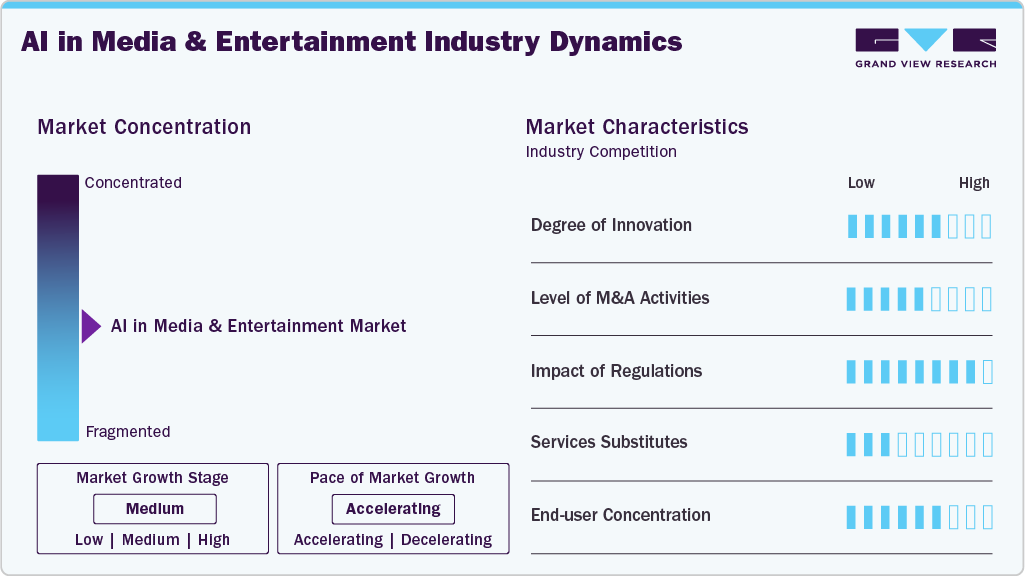
The AI in Media & Entertainment Market is moderately concentrated, characterized by the presence of global technology providers, AI platform developers, cloud service companies, and media technology firms competing on AI capabilities, content generation accuracy, personalization algorithms, analytics, scalability, and integration capabilities. Key market participants include Amazon Web Services; Inc.; EMG, Gearhouse South Africa PTY Limited; Gravity Media; GrayMeta; International Business Machines Corporation; LMG, LLC; Matchroom Sport Ltd; Production Resource Group, L.L.C. Companies are increasingly investing in generative AI, content recommendation engines, audience analytics, automated video production, virtual production technologies, and cloud-based AI platforms to strengthen their competitive positioning. Strategic partnerships, AI model development, acquisitions, and continuous innovation in content creation and personalization technologies are further intensifying competition across the market.
Analyst Perspective
The AI in Media & Entertainment Market is emerging as a transformative segment of the digital media ecosystem, driven by the growing adoption of AI to enhance content creation, personalization, production efficiency, and audience engagement. As media companies, streaming platforms, broadcasters, gaming studios, and content creators integrate AI across their operations, the demand for AI-powered content generation, recommendation engines, audience analytics, intelligent editing, and automated localization solutions is accelerating. The market is benefiting from continuous advancements in generative AI, computer vision, natural language processing, speech synthesis, and machine learning technologies that streamline creative workflows and optimize content distribution. Furthermore, the growing popularity of OTT platforms, rising demand for immersive and personalized entertainment experiences, increasing investments in virtual production and AI-driven advertising, and the expansion of responsible AI practices for content authenticity and copyright protection are strengthening the market's long-term growth outlook.
Solution Insights
Based on solution, the services segment led the market with the largest revenue share of 60.5% in 2025. The services category held a leading position in the market, driven by the rising demand for AI integration and customization in Media & entertainment workflows. Companies increasingly rely on service providers to implement and manage AI-driven solutions, ensuring smooth adoption and scalability. This segment covers consulting, maintenance, and support services, addressing critical needs for operational efficiency and technology upgrades. The flexibility of services allows businesses to optimize AI tools for tasks such as personalized recommendations, content moderation, and predictive analytics. Its adaptability and essential role in implementing AI solutions have secured its dominance in the market.
The hardware and equipment category offers significant advantages in the AI in media & entertainment market. Specialized hardware, such as GPUs and edge computing devices, ensure faster data processing and supports real-time applications such as live streaming and gaming. Advanced equipment enables the execution of complex algorithms required for high-quality visual effects, animations, and AR/VR experiences. Its ability to handle large-scale data efficiently makes it crucial for personalized content recommendations and audience analytics. With the growing need for high-performance computing, this segment provides a robust foundation for seamless AI integration across various applications.
Application Insights
Based on application, the Sales and marketing segment led the market with the largest revenue share of 22.1% in 2025. Predictive analytics enables businesses to identify potential customers and customize their strategies, accordingly, increasing conversion rates. Real-time data analysis allows marketers to optimize ad placements and content delivery across multiple platforms. AI-driven automation streamlines repetitive tasks such as email marketing and lead generation, enhancing efficiency. These advancements have made sales and marketing a pivotal focus for AI adoption in the Media & entertainment sector.

Personalization is gaining momentum as AI enables highly customized content experiences for consumers. Platforms utilize algorithms to recommend movies, music, or games based on user preferences, increasing engagement and retention. Dynamic content delivery adapts to individual viewing habits, offering seamless interaction across devices. Advertisers are adopting AI to craft personalized messages and promotions, boosting customer satisfaction. As demand for unique, user-specific experiences grows, personalization continues to expand its influence in the market.
Regional Insights
North America AI in media & entertainment market leads the global industry accounting for leading share of 33.6% in 2024. North America dominates the global AI in Media & entertainment market due to significant investments in AI research and development. The region's robust technology infrastructure enables seamless adoption of AI-powered solutions in media production and distribution. Leading companies based in North America are driving innovation in AI for content creation, targeted advertising, and audience analytics. Collaboration between media giants and AI startups fosters the development of advanced applications for streaming and gaming platforms. The strong presence of cloud service providers in the region further supports scalable AI integration across the industry.
U.S. AI In Media & Entertainment Market Trends
The U.S. is a key contributor to North America's leadership in the AI-driven Media & entertainment market. Hollywood studios and tech companies are integrating AI to enhance film production, special effects, and scriptwriting processes. AI adoption is growing in live sports broadcasting, providing real-time analytics and interactive viewer experiences. The rise of AI-powered streaming platforms in the U.S. is reshaping content delivery and personalization.
Asia Pacific AI In Media & Entertainment Market Trends
Asia Pacific dominated the AI in media and entertainment Market with the largest revenue share of 32.5% in 2025. Asia Pacific is witnessing rapid growth in the AI-driven Media & entertainment market due to its expanding digital consumer base. Countries such as China, India, and South Korea are utilizing AI for large-scale content personalization and audience analytics. AI-powered video editing and special effects are gaining traction in regional film industries, including Bollywood and K-dramas. The adoption of AI in mobile gaming and esports is driving innovation and market expansion across the region.

The AI in media and entertainment market in the China held the largest share in the Asia Pacific region in 2025.
Europe AI In Media & Entertainment Market Trends
Europe AI in media & entertainment market is emerging as a strong player in the industry, driven by innovation hubs in countries such as the UK, Germany, and France. European broadcasters are adopting AI to optimize multilingual content production and translation for diverse audiences. AI applications in media archiving and digital preservation are addressing the continent’s cultural heritage needs. The gaming industry in Europe is utilizing AI to develop adaptive gameplay and enhance user engagement.
Key AI In Media & Entertainment Company Insights
Some of the key companies in the AI In Media & entertainment market include Amazon Web Services, Inc., EMG, GrayMeta, International Business Machines Corporation and others. Organizations are focusing on increasing the customer base to gain a competitive edge in the industry. Therefore, key players are taking several strategic initiatives, such as mergers and acquisitions, and partnerships with other major companies.
-
Amazon Web Services (AWS) is advancing AI in Media & entertainment by providing cloud-based solutions that enable companies to leverage machine learning and AI tools for content creation, distribution, and personalization. AWS offers services such as Amazon Rekognition for video analysis and Amazon Polly for text-to-speech, enhancing content workflows and viewer experiences. Through its deep integration with media pipelines, AWS empowers businesses to automate processes like content moderation, editing, and metadata tagging, making production more efficient.
-
International Business Machines Corporation is utilizing AI in Media & entertainment through its AI-powered solutions like Watson Media, which helps automate content tagging, metadata extraction, and video indexing. By integrating AI with broadcasting workflows, IBM aids companies in delivering personalized experiences and improving customer engagement. Watson’s AI capabilities also support predictive analytics, helping media organizations optimize content production and distribution.
Key AI In Media & Entertainment Companies
The following key companies have been profiled for this study on the AI in media & entertainment market.
-
Amazon Web Services, Inc.
-
EMG
-
Gearhouse South Africa PTY Limited
-
Gravity Media
-
GrayMeta
-
International Business Machines Corporation
-
LMG, LLC
-
Matchroom Sport Ltd
-
Production Resource Group, L.L.C.
-
Synthesia Ltd
-
TAIT
-
Valossa Labs Ltd.
-
Veritone, Inc
-
Pixellot
-
PlaySight Interactive LTD
-
AISportsWatch GmbH
-
Spiideo
-
Sportway AB
-
Hudl
-
Move.ai
-
AutomaticTV
Competitive Benchmarking
Category
Operating Strategies
Competitive Edge
Weakness
Established Players: Amazon Web Services, Inc.; International Business Machines Corporation; Gravity Media; Production Resource Group, L.L.C.; TAIT; EVS Broadcast Equipment S.A.; Hudl; Veritone, Inc.; Matchroom Sport Ltd.; LMG, LLC; EMG, Gearhouse South Africa PTY Limited.
- Focus on expanding AI-driven media and entertainment capabilities through cloud-based AI platforms, content analytics, automated production workflows, audience intelligence, sports broadcasting technologies, virtual production, and media asset management solutions.
- Emphasize strategic partnerships, acquisitions, platform integration, global service expansion, and continuous investment in AI and automation technologies to strengthen market leadership.
- Strong global presence, established customer relationships, extensive industry expertise, scalable technology infrastructure, broad service portfolios, advanced AI and analytics capabilities, and strong positions across broadcasting, sports media, live events, content production, and digital entertainment ecosystems.
- High operational and infrastructure costs, complexity associated with integrating AI across legacy media systems, increasing regulatory and data privacy requirements, dependence on large enterprise customers, and challenges in maintaining technological differentiation amid rapid AI innovation.
Emerging Players: Synthesia Ltd.; GrayMeta; Valossa Labs Ltd.; Pixellot; PlaySight Interactive LTD; AISportsWatch GmbH; Spiideo; Sportway AB; Move.ai; AutomaticTV
- Focus on specialized AI applications such as generative video creation, automated sports production, computer vision, content intelligence, motion capture, media metadata generation, video analytics, and AI-powered broadcasting solutions.
- Invest in product innovation, strategic collaborations, regional expansion, and industry-specific applications to accelerate market penetration.
- Strong expertise in niche AI technologies, agile innovation capabilities, faster product development cycles, specialized solutions tailored to media and sports workflows, and the ability to address emerging customer requirements in content creation, automation, and audience engagement.
- Limited global reach compared to established players, smaller customer bases, resource constraints, lower brand recognition, dependence on specific application segments, and challenges in scaling operations and competing with larger technology providers on R&D investments and infrastructure capabilities.
Recent Developments
-
In November 2024, Coactive AI, a technology company in the U.S., partnered with AWS to deliver generative AI solutions for advanced image and video analytics, enabling enhanced content discovery, personalization, and moderation across industries such as media, retail, and real estate. The Coactive platform is now available on AWS Marketplace, streamlining access for customers to optimize and monetize their visual content archives.
-
In February 2024, Microsoft collaborated with media organizations, including Semafor, to introduce AI tools that enhance journalism by surfacing global sources, translations, and diverse perspectives. These initiatives aim to support reporters while addressing concerns about AI-generated misinformation and ethical practices.
-
In February 2024, Synthesia AI launched Live Collaboration, a feature that allows teams to co-edit videos in real-time or asynchronously with tools such as shared editing, commenting, and version history. This launch aims to streamline workflows, enhance creativity, and improve communication for video projects across teams.
-
In January 2024, GRUP MEDIAPRO, a multimedia communications group in Spain, in collaboration with Microsoft, launched the Artificial Intelligence and Synthetic Media Laboratory to develop innovative solutions for the audiovisual industry, emphasizing a human-centered approach and adherence to ethical principles. The laboratory aims to utilize advancements in AI, focusing on areas such as audience analysis and content personalization.
AI In Media & Entertainment Market Report Scope
Report Attribute
Details
Market size value in 2025
USD 33.7 billion
Market size value in 2026
USD 43.1 billion
Revenue forecast in 2033
USD 159.3 billion
Growth rate
CAGR of 20.5% from 2026 to 2033
Base year for estimation
2025
Historical data
2021 - 2024
Forecast period
2026 - 2033
Quantitative units
Revenue in USD billion/billion and CAGR from 2026 to 2033
Report coverage
Revenue forecast, company ranking, competitive landscape, growth factors, and trends
Segments covered
Solution, application, region
Regional scope
North America; Europe; Asia Pacific; Latin America; MEA
Country scope
U.S.; Canada; Mexico; Germany; U.K; France; Norway, Denmark, Sweden, Netherlands, Spain, Ireland, Italy, Switzerland, Belgium, China; Japan; India; South Korea; Australia; Brazil; Saudi Arabia; South Africa; UAE;
Key companies profiled
Amazon Web Services; Inc.; EMG, Gearhouse South Africa PTY Limited; Gravity Media; GrayMeta; International Business Machines Corporation; LMG, LLC; Matchroom Sport Ltd; Production Resource Group, L.L.C.; Synthesia Ltd; TAIT; Valossa Labs Ltd.; Veritone, Inc.; Pixellot; PlaySight Interactive LTD; AISportsWatch GmbH; Spiideo; Sportway AB; EVS Broadcast Equipment S.A.; Hudl; Move.ai; AutomaticTV
Customization scope
Free report customization (equivalent up to 8 analysts' working days) with purchase. Addition or alteration to country, regional & segment scope.
Pricing and purchase options
Avail customized purchase options to meet your exact research needs. Explore purchase options
Global AI in Media Entertainment Market Report Segmentation
This report offers revenue growth forecasts at the global, regional, and country levels and provides an analysis of the latest industry trends in each of the sub-segments from 2021 to 2033. For this study, Grand View Research has segmented the global AI In media & entertainment market report based on solution, application, and region:

-
Solution Outlook (Revenue, USD Million, 2021 - 2033)
-
Hardware/ Equipment
-
Services
-
-
Application (Revenue, USD Million, 2021 - 2033)
-
Gaming
-
Fake Story Detection
-
Plagiarism Detection
-
Personalization
-
Production Planning and Management
-
Sales and Marketing
-
Talent Identification
-
Content Capture
-
Sports Automatic Productions
-
-
Regional Outlook (Revenue, USD Million, 2021 - 2033)
-
North America
-
U.S.
-
Canada
-
Mexico
-
-
Europe
-
UK
-
Germany
-
France
-
-
Asia Pacific
-
China
-
Japan
-
India
-
Australia
-
South Korea
-
-
Latin America
-
Brazil
-
-
Middle East & Africa (MEA)
-
KSA
-
UAE
-
South Africa
-
-
Research Methodology
The AI in media and entertainment market figures in this report are based on a proven research process that combines executive interviews with secondary research from proprietary databases, company filings, and recognized regulatory and institutional sources. Market size is built through value-chain sizing - reconciling supply-side and demand-side estimates - and triangulated with bottom-up and top-down approaches. Every estimate passes multiple levels of expert validation before publication, with each AI in media and entertainment segment quantified using the revenue-capture definitions in the table below.
Segment Definition
Segment - Solution
Revenue capture definition
Hardware/Equipment
Revenue in this segment is generated through the development, deployment, and sale of hardware infrastructure and equipment that support artificial intelligence applications in the media and entertainment industry. These products include high-performance graphics processing units (GPUs), AI accelerators, central processing units (CPUs), servers, data storage systems, networking equipment, edge computing devices, and specialized hardware used for machine learning training, content rendering, video processing, virtual production, and real-time analytics.
Services
Revenue in this segment is generated through consulting, implementation, integration, customization, training, support, maintenance, and managed services related to AI solutions in the media and entertainment industry. These services help organizations deploy, optimize, and manage AI-powered applications for content creation, audience analytics, recommendation engines, advertising optimization, content moderation, virtual production, and workflow automation.
Segment - Application
Revenue capture definition
Gaming
Revenue in this segment is generated through the deployment and utilization of AI technologies across video game development, publishing, and player engagement activities. AI is used to enhance non-player character (NPC) behavior, procedural content generation, game testing, real-time analytics, matchmaking, player personalization, and in-game recommendations.
Fake Story Detection
Revenue in this segment is generated through the deployment of AI-powered solutions that identify, analyze, and mitigate the spread of false, misleading, or manipulated content across digital media platforms. These solutions leverage machine learning, natural language processing (NLP), computer vision, and data analytics to detect misinformation, deepfakes, fabricated news articles, and manipulated multimedia content.
Plagiarism Detection
Revenue in this segment is generated through the deployment of AI-powered solutions that identify, analyze, and prevent unauthorized content duplication across media, publishing, broadcasting, and digital content platforms. These solutions utilize machine learning, natural language processing (NLP), semantic analysis, and pattern recognition technologies to compare text, images, audio, and video content against extensive databases and online sources
Personalization
Revenue in this segment is generated through the deployment of AI-powered personalization solutions that analyze user behavior, preferences, viewing patterns, and engagement data to deliver tailored content, recommendations, and user experiences. These solutions leverage machine learning, predictive analytics, natural language processing (NLP), and recommendation algorithms to enhance content discovery across streaming platforms, digital media channels, gaming applications, music services, and online publishing platforms.
Production Planning and Management
Revenue in this segment is generated through the deployment of AI-powered solutions that streamline and optimize content production workflows across film, television, broadcasting, digital media, and entertainment industries. These solutions leverage machine learning, predictive analytics, computer vision, and automation technologies to support project scheduling, resource allocation, budget forecasting, script analysis, production tracking, and workflow optimization
Sales and Marketing
Revenue in this segment is generated through the deployment of AI-powered solutions that enhance marketing effectiveness, audience acquisition, customer engagement, and revenue generation across the media and entertainment industry. These solutions utilize machine learning, predictive analytics, natural language processing (NLP), and customer data analytics to optimize advertising campaigns, audience targeting, content promotion, lead generation, and customer relationship management.
Talent Identification
Revenue in this segment is generated through the deployment of AI-powered solutions that assist media and entertainment organizations in discovering, evaluating, and recruiting creative and professional talent. These solutions leverage machine learning, natural language processing (NLP), predictive analytics, and data mining technologies to analyze portfolios, auditions, social media presence, audience engagement metrics, and professional profiles.
Content Capture
Revenue in this segment is generated through the deployment of AI-powered technologies that facilitate the acquisition, recording, and ingestion of digital content across media and entertainment workflows. These solutions leverage computer vision, machine learning, speech recognition, and automated metadata generation to capture and process video, audio, images, and live-streamed content efficiently.
Sports Automatic Productions
Revenue in this segment is generated through the deployment of AI-powered solutions that automate the production, broadcasting, and distribution of sports content. These solutions leverage computer vision, machine learning, video analytics, and automated camera technologies to capture live sporting events, track player movements, generate highlights, manage camera angles, and produce broadcast-quality content with minimal human intervention.
Estimation Model
Layer Name
Key Question
Description
Addressable Media & Entertainment Industry Base Layer
Which industries and organizations utilize AI in media & entertainment?
Identify the global addressable base of organizations adopting AI solutions across media and entertainment, including broadcasting, film & television production, OTT streaming platforms, gaming companies, music and audio platforms, publishing, advertising agencies, sports organizations, social media platforms, and digital content creators.
AI Adoption & Deployment Layer
Which applications deploy AI technologies?
Apply AI adoption rates across media and entertainment use cases based on the deployment of machine learning, natural language processing (NLP), computer vision, generative AI, recommendation engines, predictive analytics, and automation technologies for content creation, personalization, production management, advertising, content moderation, and audience analytics.
Solution Consumption Layer
How extensively are AI solutions utilized?
Estimate AI solution consumption based on the number of AI-powered applications, software licenses, cloud-based AI services, analytics platforms, and automation tools deployed per organization. Consider usage intensity across content production, streaming, gaming, advertising, sports broadcasting, and digital media operations.
Revenue Generation Layer
How much revenue is generated?
Calculate market revenue by multiplying the volume of AI software platforms, cloud services, hardware infrastructure, and professional services deployed across media and entertainment organizations by their respective average selling prices (ASPs), subscription fees, licensing costs, and service revenues.
Delivered Customizations
This report has been delivered with the following In-depth customizations
Client Request
Customization Delivered
Value Adds
Competitive Landscape & Strategic Benchmarking
Conducted a comprehensive assessment of leading AI technology providers, media technology companies, content intelligence platforms, sports production solution providers, cloud service providers, and generative AI vendors. Evaluated competitive positioning, AI capabilities, product portfolios, content creation technologies, audience analytics solutions, deployment models, strategic partnerships, and recent developments across the AI in Media & Entertainment ecosystem
Enables stakeholders to identify market leaders, assess competitive intensity, benchmark AI capabilities, evaluate partnership and acquisition opportunities, and gain visibility into evolving competitive dynamics across the media and entertainment value chain.
End-Use Demand & Application Analysis
Assessed AI adoption trends across key application areas, including content creation, personalization, sports automatic production, production planning and management, sales and marketing, plagiarism detection, fake story detection, and content capture. Evaluated technology adoption patterns, customer requirements, investment priorities, and growth drivers across media, broadcasting, streaming, gaming, sports, and digital content industries.
Provides actionable insights into AI adoption drivers, application-specific demand patterns, high-growth use cases, and emerging industry trends, supporting market-entry, expansion, and commercialization strategies.
Technology Innovation & Growth Opportunity Assessment
Analyzed the impact of generative AI, machine learning, natural language processing (NLP), computer vision, virtual production technologies, automated content generation, audience analytics, AI-powered recommendation engines, and cloud-based AI platforms on market evolution. Identified emerging growth pockets, whitespace opportunities, and high-potential application areas across the media and entertainment ecosystem.
Supports strategic growth planning by identifying attractive investment areas, prioritizing technology development opportunities, evaluating future revenue streams, and understanding the structural trends shaping the long-term evolution of the AI in Media & Entertainment market.
Frequently Asked Questions About This Report
The global AI in media & entertainment market size was estimated at USD 33.7 billion in 2025 and is expected to reach USD 43.1 billion in 2026
The global in media & entertainment market is expected to grow at a compound annual growth rate of 20.5% from 2026 to 2033 to reach USD 159.3 billion by 2033.
Some key players operating in the AI in media & entertainment market include Amazon Web Services, Inc., EMG, Gearhouse South Africa PTY Limited, Gravity Media, GrayMeta, International Business Machines Corporation, LMG, LLC, Matchroom Sport Ltd, Production Resource Group, L.L.C., Synthesia Ltd, TAIT, Valossa Labs Ltd., Veritone, Inc., Pixellot, PlaySight Interactive LTD, AISportsWatch GmbH, Spiideo, Sportway AB, EVS Broadcast Equipment S.A., Hudl, Move.ai, AutomaticTV
Key factors driving the AI in media & entertainment market growth include cognitive opportunity in media and entertainment, automated content creation to improve workflow efficiency, and innovation and advancements in technology.
Services segment leads the market with revenue share of 60.5% in 2025 and is fastest growing in the market
Sales and Marketing segment leads the market with revenue share of 22.1% in 2025, While Personalization is the fastest growing segment in the market
U.S. leads the North America region with revenue share of 60.3% in 2025 in the AI in media & entertainment market.
China leads the Asia Pacific region with revenue share of 26.1% in 2025 in the AI in media & entertainment market.
North America dominated the AI in media & entertainment market with a share of 30.8% in 2025. This is attributable to significant investments by the companies in research & development for creating AI-based virtual production software solutions.
About the Author(s)
Next Generation Technologies Research Team
Technology · Next Generation TechnologiesThis report was authored by the next generation technologies research team at Grand View Research - comprising two research analysts, one senior research analyst, and one industry expert - with specialized expertise in the next generation technologies segment of the technology industry. All findings are based on proprietary technology databases, executive interviews, and regulatory analysis, subject to internal peer review prior to publication.
Last Updated:
Speak to Analyst


Customize this report to your needs — add regions, segments, or data points, with 20% free customization.
Or view our licence options:


ISO 9001:2015 & 27001:2022 Certified
We are GDPR and CCPA compliant! Your transaction & personal information is safe and secure. For more details, please read our privacy policy.


