- Home
- »
- Energy & Power
- »
-
Anaerobic Digestion Market Size, Industry Report, 2033GVR Report cover
![Anaerobic Digestion Market Size, Share & Trends Report]()
Anaerobic Digestion Market (2026 - 2033) Size, Share & Trends Analysis Report By Technology (Wet Anaerobic Digestion, Dry Anaerobic Digestion, Two-Phase Anaerobic Digestion, Batch Anaerobic Digestion), By Feedstock, By End-use, By Region, And Segment Forecasts
- Report ID: GVR-4-68040-865-1
- Number of Report Pages: 120
- Format: PDF
- Historical Range: 2021 - 2024
- Forecast Period: 2026 - 2033
- Industry: Research
- Report Summary
- Table of Contents
- Segmentation
- Methodology
- Download FREE Sample
-
 Download Sample Report
Anaerobic Digestion Market Summary
The global anaerobic digestion market size was estimated at USD 18.07 billion in 2025 and is projected to reach USD 39.42 billion by 2033, growing at a CAGR of 10.3% from 2026 to 2033. Market growth is primarily driven by the increasing demand for renewable energy, rising emphasis on sustainable waste management, and stringent regulations aimed at reducing greenhouse gas emissions.
Key Market Trends & Insights
- North America accounted for the largest revenue share of approximately 35.1% in the global anaerobic digestion market.
- The United States represents a major contributor to the global anaerobic digestion market.
- Based on technology, wet anaerobic digestion segment held the highest market share in 2025.
- Based on feedstock, agricultural waste segment held the highest market share in 2025.
- Based on end use, agriculture segment held the highest market share of over 30% in 2025.
Market Size & Forecast
- 2025 Market Size: USD 18.07 Billion
- 2033 Projected Market Size: USD 39.42 Billion
- CAGR (2026-2033): 10.3%
- North America: Largest market in 2025
- Asia Pacific: Fastest growing market
As governments and utilities focus on decarbonization, anaerobic digestion is gaining traction as a reliable solution for converting organic waste into biogas and renewable natural gas (RNG). Industries, municipalities, and agricultural operators are increasingly investing in anaerobic digestion systems to manage food waste, manure, sewage sludge, and industrial organic residues while generating dispatchable power and lowering landfill dependency. In addition, the growing adoption of circular economic practices and the need for energy diversification are accelerating the deployment of commercial-scale biogas plants globally.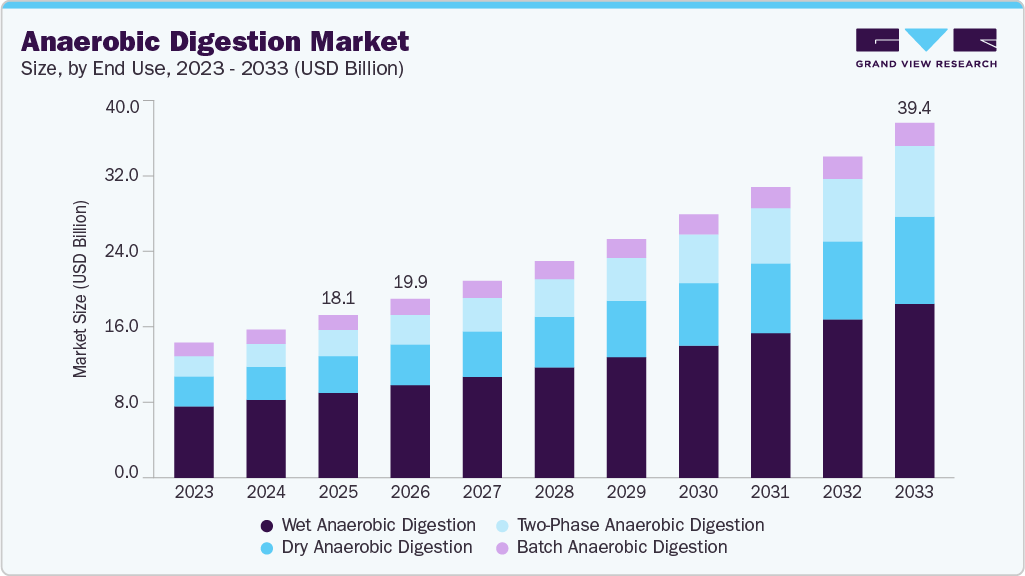
Technological advancements in digester design, biogas upgrading technologies, feedstock pre-treatment, and process monitoring systems are improving gas yields, operational efficiency, and plant reliability, making anaerobic digestion projects more economically viable. Dry anaerobic digestion systems are witnessing higher adoption due to their lower water requirements, reduced reactor volume, and ability to process high-solids organic waste, particularly in municipal applications. At the same time, project developers are increasingly integrating anaerobic digestion with combined heat and power (CHP) systems and pipeline injection infrastructure to maximize revenue streams. Organizations are also aligning with sustainability targets by leveraging biogas to reduce carbon emissions and produce nutrient-rich digestate for agricultural use. Supportive government incentives, renewable gas mandates, carbon credit programs, and strategic partnerships across waste generators, energy producers, and technology providers are strengthening the market ecosystem and positioning anaerobic digestion as a critical component of the global renewable energy and waste-to-energy landscape.
Drivers, Opportunities & Restraints
The anaerobic digestion market is primarily driven by the increasing demand for renewable energy, rising organic waste generation, and stringent environmental regulations targeting methane emission reductions. Governments and municipalities are increasingly deploying anaerobic digestion systems to convert food waste, agricultural residue, and wastewater sludge into biogas and renewable natural gas, supporting decarbonization goals while reducing landfill dependency. The technology’s ability to provide reliable baseload power and enable circular economy practices is further strengthening its adoption across industrial and municipal sectors.
Significant opportunities are emerging from the expanding renewable natural gas market, supported by government incentives such as feed-in tariffs, tax credits, and carbon credit programs. Advancements in digester design, feedstock pre-treatment, and biogas upgrading technologies are improving methane yields, operational efficiency, and overall project viability. Additionally, strategic partnerships between waste generators, utilities, and energy developers are enhancing feedstock security and enabling integrated waste-to-energy infrastructure, positioning anaerobic digestion as a critical component of the global renewable energy landscape.
However, high upfront capital investment for plant development and gas upgrading infrastructure remains a key challenge, particularly for small and mid-scale operators. Feedstock supply chain complexities, including waste segregation and transportation logistics, can impact operational consistency. Moreover, lengthy permitting timelines, evolving regulatory frameworks, and exposure to renewable natural gas price fluctuations may hinder project development, acting as potential restraints for market growth.
Technology Insights
The wet anaerobic digestion segment accounted for the largest market share of approximately 52.2% in 2025, primarily driven by its operational maturity, high process stability, and widespread deployment across municipal and agricultural waste treatment facilities. This technology is particularly effective for processing feedstocks with high moisture content, such as food waste, sewage sludge, and manure, enabling efficient microbial activity and consistent biogas yields. Its relatively lower operational risk, established infrastructure, and proven scalability have encouraged adoption among utilities and waste management operators seeking reliable waste-to-energy solutions. In addition, supportive regulatory frameworks promoting landfill diversion and renewable energy generation continue to reinforce the dominance of wet anaerobic digestion systems globally.
Meanwhile, the two-phase anaerobic digestion segment is projected to register the fastest growth, expanding at a CAGR of 13.3% during the forecast period. Growth is driven by the technology’s ability to optimize the biological process by separating acidogenesis and methanogenesis, resulting in improved methane yields, enhanced process control, and greater tolerance to feedstock variability. These advantages make two-phase systems increasingly attractive for large-scale and industrial applications focused on maximizing energy recovery and operational efficiency. Furthermore, rising investments in advanced digestion technologies, growing emphasis on process optimization, and the increasing need for higher biogas productivity are expected to accelerate the adoption of two-phase anaerobic digestion across emerging and developed markets.
Feedstock Insights
The agricultural waste segment accounted for the largest market share of approximately 26.6% in 2025, driven by the abundant availability of manure, crop residues, and other farm-based organic materials suitable for biogas production. Increasing adoption of anaerobic digestion across livestock farms and agricultural cooperatives has enabled operators to convert waste into renewable energy while generating additional revenue streams and reducing environmental impact. Supportive government incentives, rising awareness regarding methane emission reduction, and the growing integration of farm-based digesters into circular economy models are further strengthening segment growth. In addition, the ability of agricultural anaerobic digestion systems to produce nutrient-rich digestate for use as organic fertilizer enhances their economic attractiveness for farmers worldwide.
Meanwhile, the food waste segment is projected to register the fastest growth, expanding at a CAGR of 13.3% during the forecast period. Rapid urbanization, rising food waste generation, and stringent regulations aimed at diverting organic waste from landfills are key factors accelerating adoption. Municipalities and commercial establishments are increasingly investing in anaerobic digestion to manage disposal costs while supporting renewable natural gas production and decarbonization targets. Furthermore, growing investments in centralized waste processing infrastructure, coupled with corporate sustainability commitments and stricter food waste management policies, are expected to drive the deployment of food waste-based anaerobic digestion systems globally.
End Use Insights
The agriculture segment accounted for the largest market share of approximately 30.1% in 2025, primarily driven by the increasing adoption of anaerobic digestion systems across livestock farms and agricultural operations to manage organic waste and generate renewable energy. Farmers are leveraging digesters to convert manure and crop residues into biogas, reducing disposal costs while creating additional income streams through electricity generation and renewable natural gas production. Supportive government subsidies, favorable feed-in tariffs, and rising awareness of sustainable farming practices are further encouraging deployment. Moreover, the production of nutrient-rich digestate as a byproduct supports soil health and reduces dependence on chemical fertilizers, strengthening the value proposition of anaerobic digestion within the agricultural sector.
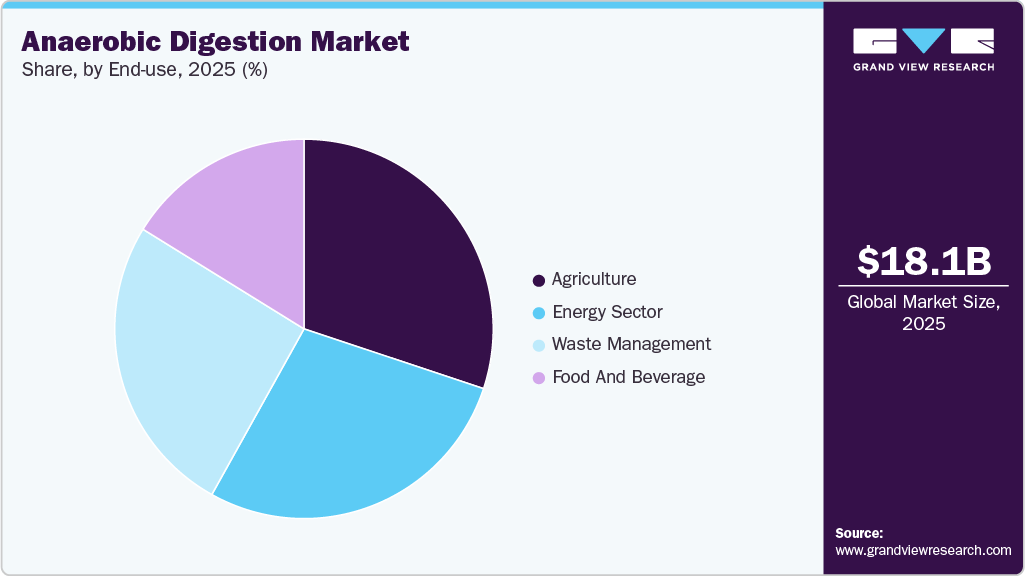
Meanwhile, the energy sector is projected to register the fastest growth, expanding at a CAGR of 11.2% during the forecast period. Utilities and independent power producers are increasingly investing in anaerobic digestion to diversify renewable energy portfolios and enhance grid reliability with dispatchable power sources. The growing demand for renewable natural gas for pipeline injection, power generation, and transportation fuel is accelerating technology adoption across energy infrastructure. In addition, decarbonization mandates, carbon credit programs, and strategic partnerships between energy companies and waste generators are expected to drive large-scale project development, positioning the energy sector as a key growth avenue for the anaerobic digestion market.
Regional Insights
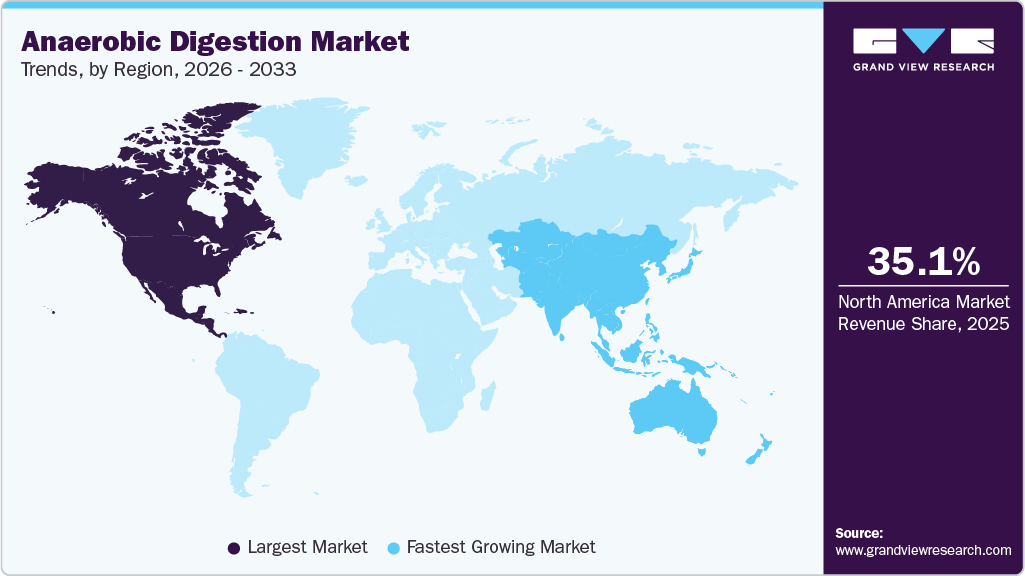
North America accounted for the largest revenue share of approximately 35.1% in the global anaerobic digestion market, driven by strong policy support for renewable natural gas (RNG), well-established waste management infrastructure, and increasing investments in sustainable energy projects. The region has witnessed significant deployment of anaerobic digestion facilities across agricultural, municipal, and industrial sectors to convert organic waste into biogas and support decarbonization targets. Favorable regulatory frameworks, including landfill diversion mandates, carbon credit programs, and tax incentives, are further accelerating project development. In addition, growing corporate sustainability commitments and the rising demand for dispatchable renewable energy are strengthening market expansion across the U.S. and Canada.
U.S. Anaerobic Digestion Market Trends
The United States represents a major contributor to the global anaerobic digestion market, supported by expanding renewable natural gas production and strong federal and state-level incentives. Increasing adoption of farm-based digesters, wastewater treatment projects, and food waste processing facilities enabling efficient organic waste management while generating low-carbon energy. Energy utilities and private developers are actively investing in biogas upgrading technologies to inject RNG into pipeline networks and support transportation fuel demand. Furthermore, growing emphasis on methane reduction and climate goals is expected to sustain long-term market growth.
Asia Pacific Anaerobic Digestion Market Trends
Asia Pacific is expected to register the fastest CAGR of 13.7% over the forecast period, supported by rapid urbanization, rising organic waste generation, and increasing government focus on renewable energy adoption. Countries such as China, India, Japan, and Australia are investing heavily in waste-to-energy infrastructure to address landfill challenges while enhancing energy security. Supportive policies promoting biogas production, expanding agricultural activities, and growing awareness of circular economy practices are further driving technology adoption. Moreover, public-private partnerships and infrastructure investments are creating strong opportunities for large-scale anaerobic digestion deployment across the region.
Europe Anaerobic Digestion Market Trends
Europe holds a significant share of the global anaerobic digestion market, supported by stringent environmental regulations, ambitious carbon neutrality targets, and mature biogas infrastructure. Countries such as Germany, the UK, France, Italy, and the Netherlands are leading adopters due to strong policy frameworks and widespread integration of anaerobic digestion within agricultural and municipal waste systems. The region is witnessing increased use of biogas for combined heat and power (CHP) generation and renewable gas injection, enhancing energy diversification. In addition, continued investments in advanced digestion technologies and circular economy initiatives are reinforcing regional market stability.
Latin America Anaerobic Digestion Market Trends
Latin America is experiencing steady growth in the anaerobic digestion market, driven by expanding agricultural activities, rising food waste volumes, and increasing focus on sustainable waste management practices. Brazil, Mexico, and Chile are emerging as key markets due to improving regulatory support and growing interest in renewable energy projects. Agricultural producers are increasingly adopting digesters to manage livestock waste while generating biogas for on-site power consumption. Moreover, investments in waste-to-energy infrastructure and efforts to reduce environmental impact are expected to support gradual market expansion across the region.
Middle East & Africa Anaerobic Digestion Market Trends
The Middle East & Africa (MEA) anaerobic digestion market is in a developing stage, supported by rising awareness of renewable energy and increasing initiatives to improve waste management systems. Countries such as the United Arab Emirates, Saudi Arabia, and South Africa are exploring biogas projects to diversify energy sources and reduce reliance on landfills. While high capital costs and infrastructure limitations remain challenges, government-led sustainability programs and growing investments in clean energy are expected to create future growth opportunities. In addition, the increasing focus on resource efficiency and emission reduction is likely to encourage broader adoption of anaerobic digestion technologies across the region.
Key Anaerobic Digestion Company Insights
Some of the key players operating in the global anaerobic digestion market include EnviTec Biogas AG, PlanET Biogas Group GmbH, Hitachi Zosen Inova AG, WELTEC BIOPOWER GmbH, Anaergia Inc., BioConstruct GmbH, BTS Biogas, Renergon International AG, DVO, Inc., and Organic Recycling Systems Ltd., among others. These companies are actively engaged in the design, engineering, construction, and deployment of anaerobic digestion and biogas upgrading systems to support renewable energy generation and sustainable waste management. Their technology portfolios span wet and dry digestion systems, high-solids processing, biomethane upgrading, and integrated waste-to-energy solutions, enabling municipalities, agricultural operators, and industrial facilities to convert organic waste into biogas and renewable natural gas.
Market participants are increasingly focusing on improving methane yields, enhancing process stability, and optimizing plant efficiency through advancements in digester design, feedstock pre-treatment, and automation technologies. Strategic initiatives such as partnerships with utilities, waste management companies, and energy providers are strengthening project pipelines and expanding geographic presence. In addition, companies are investing in modular and scalable anaerobic digestion systems to address the growing demand for decentralized energy infrastructure and circular economy solutions.
Rising investments in decarbonization and landfill diversion initiatives are encouraging technology providers to develop high-performance systems that reduce greenhouse gas emissions while maximizing resource recovery. As global organic waste volumes continue to increase and renewable natural gas gains traction as a low-carbon fuel, these companies are well-positioned to capitalize on expanding waste-to-energy opportunities, driving innovation and competition within the anaerobic digestion market.
Key Anaerobic Digestion Companies:
The following key companies have been profiled for this study on the anaerobic digestion market.
- Anaergia Inc.
- BioConstruct GmbH
- BTS Biogas Srl/GmbH
- DVO, Inc.
- EnviTec Biogas AG
- Hitachi Zosen Inova AG
- Organic Recycling Systems Ltd.
- PlanET Biogas Group GmbH
- Renergon International AG
- WELTEC BIOPOWER GmbH
Recent Developments
-
In March 2025, EnviTec Biogas commissioned its largest U.S. anaerobic digestion facility in South Dakota, processing over 300,000 gallons of dairy manure daily to produce approximately 778 Nm³/h of biomethane. This project, part of a 15-plant portfolio developed in partnership with SJI Renewable Energy Ventures, underscores EnviTec's commitment to scalable and sustainable biogas solutions.
-
In April 2025, PlanET Biogas announced its role as the technology supplier for the Convertus York Biofuels Facility in Ontario, Canada. This flagship project aims to convert organic waste into renewable natural gas (RNG), highlighting PlanET's expertise in delivering integrated anaerobic digestion and gas upgrading systems.
Anaerobic Digestion Market Report Scope
Report Attribute
Details
Market Definition
The anaerobic digestion market size represents the global revenue generated from technologies and systems that convert organic waste into biogas and renewable energy to support sustainable waste management and decarbonization.
Market size value in 2026
USD 19.86 billion
Revenue forecast in 2033
USD 39.42 billion
Growth rate
CAGR of 10.3% from 2026 to 2033
Base year for estimation
2025
Historical data
2021 - 2024
Forecast period
2026 - 2033
Quantitative units
Revenue in USD billion/million and CAGR from 2026 to 2033
Report coverage
Revenue forecast, competitive landscape, growth factors, and trends
Segments covered
Technology, feedstock, end use, region
Regional scope
North America; Europe; Asia Pacific; Latin America; Middle East & Africa
Country scope
U.S.; Canada; Mexico; Germany; UK; France; Italy; Spain; China; India; Japan; Brazil; Argentina; Saudi Arabia; UAE; South Africa
Key companies profiled
EnviTec Biogas AG; PlanET Biogas Group GmbH; Hitachi Zosen Inova AG; WELTEC BIOPOWER GmbH; Anaergia Inc.; BioConstruct GmbH; Renergon International AG; BTS Biogas Srl/GmbH; DVO, Inc.; Organic Recycling Systems Ltd.
Customization scope
Free report customization (equivalent up to 8 analysts working days) with purchase. Addition or alteration to country, regional & segment scope.
Pricing and purchase options
Avail customized purchase options to meet your exact research needs. Explore purchase options
Global Anaerobic Digestion Market Report Segmentation
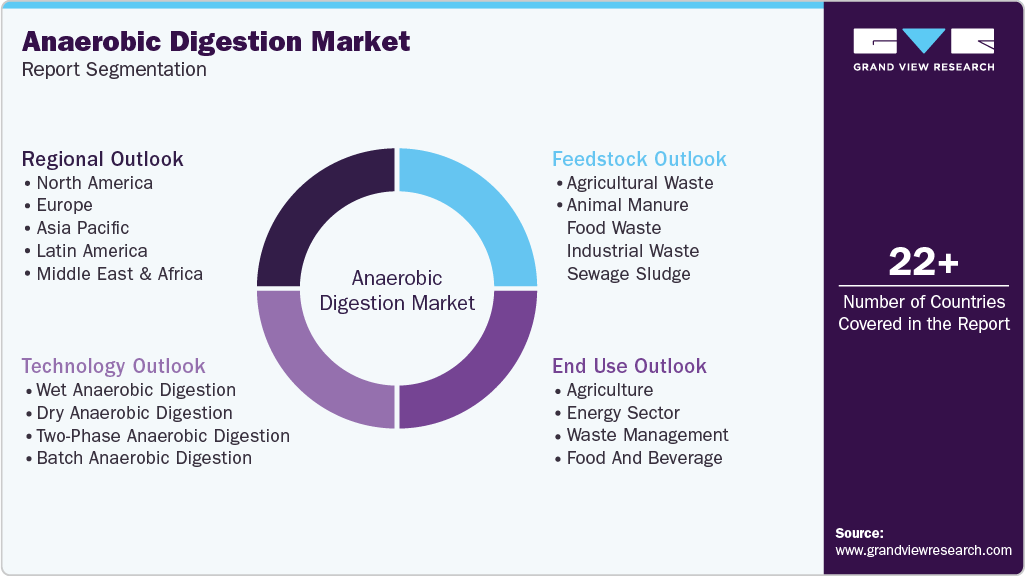
This report forecasts revenue growth at global, regional, and country levels and provides an analysis of the latest industry trends in each of the sub-segments from 2021 to 2033. For this study, Grand View Research has segmented the global anaerobic digestion market report on the basis of technology, feedstock, end use, and region:
-
Technology Outlook (Revenue, USD Million, 2021 - 2033)
-
Wet Anaerobic Digestion
-
Dry Anaerobic Digestion
-
Two-Phase Anaerobic Digestion
-
Batch Anaerobic Digestion
-
-
Feedstock Outlook (Revenue, USD Million, 2021 - 2033)
-
Agricultural Waste
-
Animal Manure
-
Food Waste
-
Industrial Waste
-
Sewage Sludge
-
-
End Use Outlook (Revenue, USD Million, 2021 - 2033)
-
Agriculture
-
Energy Sector
-
Waste Management
-
Food and Beverage
-
-
Regional Outlook (Revenue, USD Million, 2021 - 2033)
-
North America
-
U.S.
-
Canada
-
Mexico
-
-
Europe
-
Germany
-
UK
-
France
-
Italy
-
Spain
-
-
Asia Pacific
-
China
-
India
-
Japan
-
-
Latin America
-
Brazil
-
Argentina
-
-
Middle East & Africa
-
Saudi Arabia
-
UAE
-
South Africa
-
-
Frequently Asked Questions About This Report
b. The global anaerobic digestion market size was estimated at USD 18.07 billion in 2025 and is expected to reach USD 19.86 billion in 2026.
b. The global anaerobic digestion market is expected to grow at a compound annual growth rate of 10.3% from 2026 to 2033 to reach USD 39.42 billion by 2033.
b. Based on the feedstock segment, Agricultural Waste held the largest revenue share of over 26% in the feedstock battery market in 2025.
b. Some of the key vendors operating in the global anaerobic digestion market include EnviTec Biogas AG, PlanET Biogas Group GmbH, Hitachi Zosen Inova AG, WELTEC BIOPOWER GmbH, Anaergia Inc., BioConstruct GmbH, Renergon International AG, BTS Biogas Srl/GmbH, DVO, Inc., and Organic Recycling Systems Ltd., among others.
b. The key factors driving the anaerobic digestion market include rising organic waste generation, increasing demand for renewable natural gas and biogas, stringent environmental regulations targeting methane emission reduction, and growing investments in sustainable waste-to-energy infrastructure to support global decarbonization goals.


Share this report with your colleague or friend.
Need a Tailored Report?
Customize this report to your needs — add regions, segments, or data points, with 20% free customization.


ISO 9001:2015 & 27001:2022 Certified
We are GDPR and CCPA compliant! Your transaction & personal information is safe and secure. For more details, please read our privacy policy.
Trusted market insights - try a free sample
See how our reports are structured and why industry leaders rely on Grand View Research. Get a free sample or ask us to tailor this report to your needs.