
- Home
- »
- Advanced Interior Materials
- »
-
Aluminum Extrusion Market Size & Share Report, 2026-2033GVR Report cover
![Aluminum Extrusion Market (2026 - 2033)Report]()
Aluminum Extrusion Market (2026 - 2033)
Size, Share & Trends Analysis Report By Product (Shapes, Rods & Bar, Pipes & Tubes), By Application (Building & Construction, Automotive & Transportation, Consumer Goods, Electrical & Energy), By Region, And Segment Forecasts
Market Size, 2025
$98.2BMarket Estimate, 2026
$105.8BMarket Forecast, 2033
$193.3BCAGR, 2026–2033
9.0%Aluminum Extrusion Market Summary
The global aluminum extrusion market size was valued at USD 98.2 billion in 2025 and is projected to grow from USD 105.8 billion in 2026 to USD 193.3 billion by 2033, growing at a CAGR of 9.0% from 2026 to 2033. The market in Asia Pacific dominated with a revenue share of 71.7% in 2025. The automotive and transportation industry is experiencing a rise in the utilization of aluminum in both traditional internal combustion vehicles and Electric Vehicles (EVs), contributing to potential market expansion.

Key Market Trends & Insights
- By product: Shapes segment led the market with the largest revenue share of 76.1% in 2025.
- By application: Building and construction segment led the market with the largest revenue share of 50.0% in 2025.
Regional Highlights
- Largest regional market: Asia Pacific (71.7% revenue share, 2025)
- By country: The China held the largest market share in 2025.
Market Size & Forecast
- Market size in 2025: USD 98.2 Billion
- Estimated market size in 2026: USD 105.8 Billion
- Projected market size by 2033: USD 193.3 Billion
- CAGR (2026-2033): 9.0%
Auto manufacturers face challenges in complying with regulatory mandates concerning the environmental footprint of their vehicles. Agencies, such as the National Highway Traffic Safety Administration (NHTSA), the California Air Resources Board (CARB), and the U.S. Environmental Protection Agency (EPA), have enacted rules and regulations regarding Greenhouse Gas (GHG) emissions.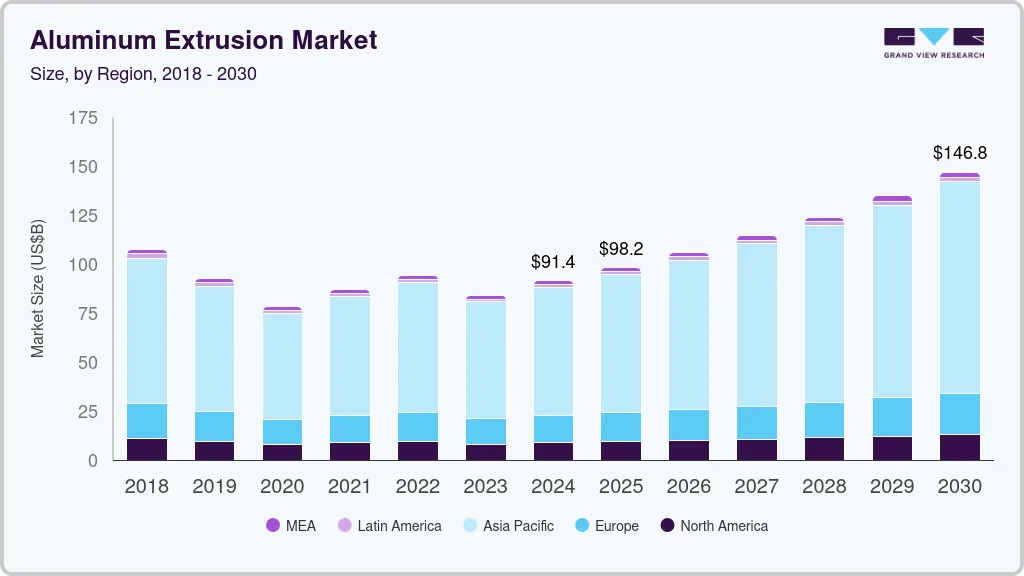
For instance, according to emission regulations issued by the NHTSA, stringency pertaining to fuel economy and carbon dioxide emissions increased by 1.5% from 2021 to 2026. This is anticipated to augment demand for automotives and different aluminum components over the projected period.
The U.S. is a significant aluminum extrusion producer and consumer. The aerospace and defense, automotive, and construction sectors in the U.S. have faced significant repercussions from economic fluctuations, leading to a decreased demand for extruded products. Negative sentiments surrounding new construction projects directly contributed to a decline in the volume of aluminum extrusion in the U.S. throughout fiscal year 2022. However, demand for construction activities has recovered gradually over a period of one year in 2023.

Construction activities were propelled owing to the announcements of mega projects such as the Gordie Howe International Bridge, the Hudson Tunnel Project, and JFK Airport Expansion, among others. These projects have led to the opening of material inflow for construction purposes. The low costs and weight of extrusion products contribute to their rising demand in various industrial applications, mainly in automotive and aerospace & defense sectors.
Market Dynamics
The aluminum extrusion market is experiencing a fast-paced growth due to increasing demand from the automotive, construction, electrical, transportation, and industrial sectors. The material’s lightweight nature, high strength, corrosion resistance, and recyclability make it an attractive choice for manufacturers seeking to improve efficiency and meet sustainability goals. Growing investments in infrastructure development, urbanization, and electric vehicle production are further supporting market expansion. Technological advancements in extrusion processes are enabling the production of complex profiles with improved precision and performance, creating new application opportunities across industries. However, volatility in aluminum prices, high energy consumption during production, and evolving environmental regulations remain key challenges for market participants. Despite these constraints, the market is expected to benefit from the increasing focus on lightweight materials, energy-efficient buildings, and sustainable manufacturing practices.
The aluminum extrusion market is benefiting significantly from the automotive industry's shift toward lightweight vehicle designs. As automakers work to improve fuel efficiency, reduce emissions, and extend the driving range of electric vehicles (EVs), aluminum extrusions have become a preferred material for a wide range of structural and functional components. Their high strength-to-weight ratio allows manufacturers to reduce overall vehicle weight without compromising safety, durability, or performance. Aluminum extrusions are increasingly used in battery enclosures, chassis systems, crash management structures, roof rails, door beams, and thermal management systems.
A notable example of this trend is the rapid growth of the global electric vehicle market. According to the International Energy Agency (IEA), global EV sales exceeded 20 million units in 2025, accounting for a significant share of new vehicle sales worldwide. Major automotive manufacturers such as Tesla, BYD, Volkswagen Group, and Hyundai Motor Company are increasingly utilizing aluminum-intensive vehicle designs to reduce weight and improve energy efficiency. Governments across Europe, North America, and the Asia-Pacific continue to implement stringent fuel economy and carbon emission regulations, encouraging automakers to expand the use of lightweight aluminum components.
The aluminum extrusion market is highly dependent on primary aluminum billets, making raw material price fluctuations a major challenge for manufacturers. Aluminum prices are influenced by factors such as energy costs, mining regulations, supply-demand imbalances, and geopolitical developments. Since raw materials account for a large portion of production expenses, sudden price increases can significantly impact profitability. These fluctuations also make it difficult for manufacturers to plan production, manage inventories, and maintain stable pricing agreements with customers. A recent example occurred in June 2025 when the U.S. increased tariffs on steel and aluminum imports from 25% to 50% under Section 232 of the Trade Expansion Act. The tariffs applied to nearly all countries except the UK and included derivative products containing these metals.
The rapid expansion of renewable energy infrastructure is creating significant growth opportunities for the aluminum extrusion market. Aluminum extrusions are widely used in solar panel frames, mounting systems, support structures, and tracking systems due to their lightweight nature, corrosion resistance, durability, and ease of installation. As countries continue investing in clean energy to achieve decarbonization targets, demand for solar installations is increasing across utility-scale, commercial, and residential projects. This trend is expected to drive substantial consumption of aluminum extrusion products, particularly in regions with aggressive renewable energy expansion plans. According to the International Energy Agency, solar PV remains the world's fastest-growing renewable power technology, with record levels of new capacity being added annually. Countries such as China, India, and the European Union are investing heavily in large-scale solar projects and rooftop solar deployment.
Market Concentration & Characteristics
The market growth stage is moderate, and the pace of the market growth is accelerating. The industry is characterized by rising demand for extruded products and growing adoption of aluminum extrusion, owing to the adoption of lightweight aluminum parts from various industries such as aerospace, automotive, and the construction industry. The industry is severely impacted by amendments in regulations and the degree of innovation.
The industry is also characterized by a high level of merger and acquisition (M&A) activity by leading aluminum extrusion manufacturers. Emerging players in the market resort to long-term agreements and collaboration in a competitive market. This is due to several factors, including the desire to gain market share and the need to consolidate in a growing market.
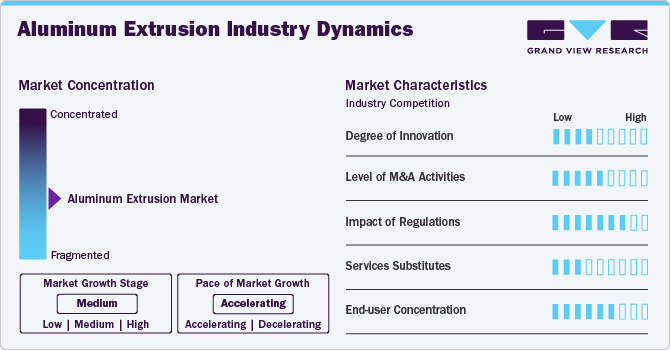
The market is also subject to increasing end-user concentration. Governments around the world are developing regulations on end-use industries that are impacting the industry. Regulations pertaining to the mining of bauxite and the production of aluminum could have a significant impact on the market, affecting the development and adoption of extrusion products.
There are a limited number of direct product substitutes for aluminum extruded products owing to its unique characteristics, such as lightweight, high strength, and corrosion resistance, among others. However, there are a number of technologies that can be used to achieve similar production outcomes in aluminum extrusion, such as automation, hot extrusion, and direct extrusion. These production technologies can be used as methods for extruding to achieve certain characteristics and improve the performance of aluminum extruded products.
Analyst Perspective
The aluminum extrusion market is witnessing a strong growth as industries increasingly look for lightweight, durable, and recyclable materials. Demand is rising across construction, automotive, renewable energy, electrical infrastructure, and consumer goods, driven by the need for energy-efficient and high-performance products. The growing adoption of electric vehicles, expansion of solar energy projects, and ongoing infrastructure development are creating strong opportunities for aluminum extrusion manufacturers. However, challenges such as fluctuating aluminum prices, high energy costs, and trade-related uncertainties continue to affect market dynamics. Looking ahead, companies that can improve production efficiency, expand value-added product offerings, and build resilient supply chains will be better positioned to benefit from the market's long-term growth potential.
Product Insights
Based on product, the shapes segment led the market with the largest revenue share of 76.1% in 2025. Aluminum's remarkable malleability facilitates seamless production of various shapes through the extrusion process. In this method, aluminum billets undergo heating and are subjected to high pressure using a ram or hydraulic press against steel dies. Subsequently, aluminum shapes are created, precisely mirroring the contours of the dies.
Within the automotive and transportation industry, aluminum shapes find applications in various components such as transmission housings, chassis, panels, engine blocks, and roof rails for a wide range of vehicles, including cars, trucks, railways, and boats. Rising demand for structural elements in vehicles is driven by the objective of achieving lighter weight. A notable instance is the construction of the Ford F-150 model, which incorporates substantial aluminum components and the vehicle's weight is significantly influenced by the utilization of aluminum in body panels and extruded shapes.
In the extrusion process, aluminum billets undergo heating and are subsequently passed through a sequence of rolls. The material is then coiled and drawn into rods, bars, and tubes through finely crafted dies. Rods and bars find extensive application in construction, particularly in the creation of scaffolding systems. These lightweight scaffolding systems present several advantages over conventional alternatives, including enhanced stability, reduced weight, and increased flexibility.
Application Insights
Based on application, the building and construction segment led the market with the largest revenue share of 50.0% in 2025. Use of extruded products in construction activities has been greatly influenced by investment in the housing sector. China currently holds a leading position in the construction sector, boasting the highest nominal value. Ongoing efforts of various countries to invest in new housing development are poised to contribute to the growth of this segment over the coming years.

The automotive and transportation sector, ranking as the second-largest in terms of volume share in 2023, is anticipated to experience a lucrative CAGR throughout the forecast period. Aluminum extrusions play a crucial role in vehicles, with wide-ranging applications including engine mounts, anti-intrusion beams, radiator beams, fuel distribution pipes, longitudinal beams, seat tracks, cross rails, roof rails, and tailgate frames, underbody space frame rockers, among other components.
Consumer goods accounted for the lowest market share in 2024 as the aluminum applications in consumer goods are lower compared to other sub-segments. Nevertheless, the anticipated surge in consumer goods manufacturing is poised to drive the need for aluminum extrusions, particularly in the production of furniture, sporting equipment, toys, refrigerators, freezers, and other significant appliances throughout the projected period. Extruded components, including sheets, tailored shapes, and bars, are extensively employed in the consumer goods industry. Customized extruded shapes find broad application in computer devices, audio-video systems, and various appliances. The escalating production of these devices and appliances is expected to contribute to a heightened demand for the product in the upcoming years.
Regional Insights
North America aluminum extrusion market is witnessing robust growth due to expanding applications across various industries, including construction, transportation, consumer goods, and renewable energy. The region's strong manufacturing base, coupled with technological innovation, supports the production of high-performance aluminum extrusions tailored to meet evolving industry standards. The shift toward sustainable materials and circular economy practices is also fueling demand, as aluminum is 100% recyclable without losing its properties. Additionally, rising investments in renewable energy infrastructure, such as solar panel framing and mounting systems, are creating new avenues for aluminum extrusions across the continent.
U.S. Aluminum Extrusion Market Trends
The automotive industry is a significant growth driver for the aluminum extrusion market in the U.S., driven by the push toward vehicle lightweighting to improve fuel efficiency and meet stringent emission regulations. Electric vehicles (EVs) particularly benefit from aluminum's properties, as manufacturers seek to extend battery range without compromising structural integrity. Furthermore, advancements in extrusion technology have enabled more complex and high-performance aluminum components, opening up new applications in aerospace, industrial machinery, and consumer goods. This technological evolution, combined with reshoring trends and domestic manufacturing incentives, is propelling the U.S. aluminum extrusion market forward.
Asia Pacific Aluminum Extrusion Market Trends
Asia Pacific dominated the aluminum extrusion market with the largest revenue share of 71.7% in 2025. The region will retain its dominant position throughout the forecast years due to the presence of major manufacturing sectors in countries, such as China, India, Vietnam, Japan, and South Korea. China is anticipated to be a pivotal driver of industry expansion among the mentioned countries, chiefly propelled by its expansive construction sector.

The aluminum extrusion market in China held the largest share in the Asia Pacific region in 2025. The Chinese government's strategic investments in transportation and energy infrastructure are expected to have a positive impact on market growth in the foreseeable future. In terms of revenue, North America is forecasted to experience substantial growth between 2026 and 2033. The resumption of commercial operations post-pandemic and recessionary pressures is anticipated to boost market growth.
Europe Aluminum Extrusion Market Trends
The aluminum extrusion market in Europe is driven by the diminishing production of the European automotive sector, which is impacting the need for aluminum and its products. In an effort to recover from this setback, manufacturers in the region have collaborated to foster the development of the automotive industry. They are endorsing specific initiatives, like the vehicle-renewal program, which concentrates on promoting sales of environmentally friendly vehicles, including clean ICEs and EVs.
Key Aluminum Extrusion Company Insights
Some of the key players operating in the market include Arconic Corp., Hindalco Industries Ltd., and Norsk Hydro ASA.
-
Hindalco Industries Ltd provides a wide range of extruded products and has increased the number of production plants across various regions through investments, collaboration, and strategic partnerships in order to expand its business. Further, it has gained economies with scale at such mass levels of production of aluminum extruded products.
-
Norsk Hydro ASA is amongst the market leaders in the aluminum extrusion industry. It has resorted to multiple acquisitions across various regions to expand its business footprint and sustain market share in such a competitive market.
Balexo Bahrain Aluminum Extrusion Company and QALEX are some of the emerging market participants in the aluminum extrusion market.
-
QALEX is an aluminum extrusion company offering high-quality extruded products in the region. The company has started acquiring small-sized market players in the country to expand its reach across the country. For instance, the recent acquisition of Abdul Noor Ahmed Extrusion Factory in the country.
Key Aluminum Extrusion Companies:
The following key companies have been profiled for this study on the aluminum extrusion market.
-
Alupco
-
Arconic Corp.
-
Bahrain Aluminum Extrusion Company
-
Constellium N.V.
-
Gulf Extrusions Co. LLC
-
Hindalco Industries Ltd.
-
Kaiser Aluminum
-
Norsk Hydro ASA
-
QALEX
Competitive Benchmarking
Category
Operating Strategies
Competitive Edge
Weakness
Established Players (Arconic Corp.; Constellium N.V.; Hindalco Industries Ltd.; Hydro Extrusions; Kaiser Aluminum; Norsk Hydro ASA)
- Focus on high-value applications such as automotive, aerospace, EVs, renewable energy, and advanced construction.
- Invest heavily in automation, digital manufacturing, and sustainability initiatives.
- Expand through acquisitions, strategic partnerships, and capacity expansions.
- Strong global manufacturing and distribution networks.
- Access to advanced extrusion technologies and R&D capabilities.
- Long-term relationships with major automotive, aerospace, and construction customers.
- Higher operating and labor costs in developed markets.
- Greater exposure to economic downturns in major end-use industries.
- Complex organizational structures can slow decision-making.
Emerging Players (Alupco; Bahrain Aluminum Extrusion Company; Gulf Extrusions Co. LLC; QALEX)
- Focus on regional demand in construction, infrastructure, and industrial sectors.
- Compete through cost-effective manufacturing and faster customer response times.
- Target niche extrusion profiles and customized projects.
- Lower operating costs and greater pricing flexibility.
- Strong understanding of local market requirements and regulations.
- Faster turnaround times for small and medium-sized orders.
- Limited geographic reach and customer diversification.
- Lower investment capacity for advanced technologies and R&D.
- Higher dependence on regional construction and industrial cycles.
Recent Developments
-
In September 2023, Hindalco Industries Ltd and Metra SpA entered into a partnership agreement to build aluminum rail coaches. The Italian company will assist the Indian manufacturer with the latest aluminum extrusion technology for building railway coaches.
-
In December 2022, Norsk Hydro ASA acquired Hueck’s Aluminum in Germany. The Norway-based market leader has acquired German aluminum extrusion and window, façade, and door system manufacturers to expand its business portfolio across the European region. This acquisition will enhance Norsk’s stake in the German market and enable both businesses to grow simultaneously.
Aluminum Extrusion Market Report Scope
Report Attribute
Details
Market size in 2025
USD 98.2 billion
Estimated market size in 2026
USD 105.8 billion
Projected market size by 2033
USD 193.3 billion
Growth rate
CAGR of 9.0% from 2026 to 2033
Base year for estimation
2025
Historical data
2021 - 2024
Forecast period
2026 - 2033
Quantitative units
Revenue in USD Million, Volume in Kilotons, and CAGR from 2026 to 2033
Report coverage
Revenue forecast, volume forecast, company ranking, competitive landscape, growth factors, and trends
Segments covered
Product, application, region
Regional scope
North America; Europe; Asia Pacific; Latin America; MEA
Country scope
U.S.; Canada; Mexico; Germany; UK; France; China; Japan; India; Brazil; and Saudi Arabia
Key companies profiled
Alupco; Arconic Corp.; Bahrain Aluminum Extrusion Company; Constellium N.V.; Gulf Extrusions Co. LLC; Hindalco Industries Ltd.; Hydro Extrusions; Kaiser Aluminum; Norsk Hydro ASA; QALEX
Customization scope
Free report customization (equivalent up to 8 analysts' working days) with purchase. Addition or alteration to country, regional & segment scope.
Pricing and purchase options
Avail customized purchase options to meet your exact research needs. Explore purchase options
Global Aluminum Extrusion Market Report Segmentation
This report forecasts volume & revenue growth at the global, regional, and country levels and provides an analysis of the latest industry trends in each of the sub-segments from 2021 to 2033. For this study, Grand View Research has segmented the global aluminum extrusion market report based on product, application, and region.

-
Product Outlook (Volume, Kilotons; Revenue, USD Million, 2021 - 2033)
-
Shapes
-
Rods & Bar
-
Pipes & Tubes
-
-
Application Outlook (Volume, Kilotons; Revenue, USD Million, 2021 - 2033)
-
Building & Construction
-
Automotive & Transportation
-
Consumer Goods
-
Electrical & Energy
-
Others
-
-
Regional Outlook (Volume, Kilotons; Revenue, USD Million, 2021 - 2033)
-
North America
-
U.S.
-
Canada
-
Mexico
-
-
Europe
-
Germany
-
UK
-
France
-
-
Asia Pacific
-
China
-
Japan
-
India
-
-
Central & South America
-
Brazil
-
-
Middle East and Africa
-
Saudi Arabia
-
-
Research Methodology
Segment Definition
Segment - Product
Revenue capture definition
Shapes
Revenue is generated from the production and sale of aluminum extrusion profiles, including solid, semi-hollow, and hollow shapes, used in applications such as building systems, transportation equipment, industrial machinery, electrical infrastructure, and consumer products.
Rods & Bar
Market revenue is derived from the manufacturing and consumption of solid aluminum extruded rods and bars used in machining, fabrication, structural applications, electrical conductors, automotive components, and industrial equipment.
Pipes & Tubes
Revenue is captured through the production and utilization of hollow aluminum extruded pipes and tubes used in HVAC systems, fluid transportation, automotive structures, renewable energy installations, industrial processing equipment, and architectural applications.
Segment - Application
Revenue capture definition
Building & Construction
Revenue is generated from the consumption of aluminum extrusions in residential, commercial, and infrastructure projects, including windows, doors, curtain walls, roofing systems, facades, structural frameworks, scaffolding, HVAC systems, and other architectural applications.
Automotive & Transportation
Market value is derived from the use of aluminum extrusions in passenger vehicles, commercial vehicles, electric vehicles, railways, aerospace, marine vessels, and trailers, including structural components, battery enclosures, chassis systems, body panels, and lightweight transportation solutions.
Consumer Goods
Revenue is captured through the demand for aluminum extrusions used in household appliances, consumer electronics, furniture, shelving systems, ladders, cookware, sporting goods, and other consumer-oriented products requiring lightweight and durable materials.
Electrical & Energy
Revenue is generated from the utilization of aluminum extrusions in power transmission and distribution systems, electrical enclosures, heat sinks, renewable energy installations, solar panel mounting structures, electrical poles, capacitors, and oil & gas transportation infrastructure.
Others
This segment generates revenue from aluminum extrusion applications in industrial machinery, automation equipment, pneumatic systems, heavy equipment manufacturing, defense, telecommunications, healthcare equipment, and other specialized engineering applications requiring precision-engineered aluminum components.
Estimation Model
Layer Name
Key Question
Description
Application Demand Assessment
Which industries drive aluminum extrusion demand?
This stage analyzes aluminum extrusion demand across building & construction, automotive & transportation, consumer goods, electrical & energy, and other end-use industries. Key indicators such as construction spending, vehicle production, renewable energy installations, consumer appliance manufacturing, and industrial output are evaluated to determine the industries generating demand for aluminum extruded products.
Extruded Product Requirement Analysis
Which extrusion products are consumed?
Demand from each end-use sector is mapped to specific aluminum extrusion product categories, including shapes, rods & bars, and pipes & tubes. Product utilization is assessed based on applications such as window and door frames, curtain walls, vehicle structures, battery enclosures, solar mounting systems, electrical conductors, HVAC systems, and industrial equipment.
Aluminum Extrusion Volume Assessment
How much aluminum extrusion is required?
The demand for individual extrusion products is converted into volume consumption (kilotons) based on production activity, infrastructure development, manufacturing output, and material intensity across applications. This stage quantifies the total volume of aluminum extrusions consumed by product type and end-use industry across different regions.
Revenue Estimation
What is the revenue generated from aluminum extrusions?
The calculated extrusion volumes are translated into market revenue using average selling prices for shapes, rods & bars, and pipes & tubes. Revenue estimates account for factors such as alloy composition, profile complexity, fabrication requirements, surface finishing, and regional pricing trends. The aggregated values are used to determine the overall aluminum extrusion market size and growth outlook.
Delivered Customizations
This report has been delivered with the following In-depth customizations
Client Request
Customization Delivered
Value Adds
Pricing Analysis
Conducted a detailed assessment of aluminum extrusion product demand across the building & construction sector, evaluating the consumption of shapes, rods & bars, and pipes & tubes in applications. The analysis identified product-level demand patterns, growth trends, and revenue contribution within the construction industry.
Helps stakeholders identify the most demanded extrusion products within the construction sector, optimize production planning, align product portfolios with market requirements, and target high-growth construction applications more effectively.
Global Trade Assessment
Evaluated international trade dynamics for aluminum extrusions, including import-export volumes, major exporting and importing countries, tariff structures, trade regulations, supply chain dependencies, and regional manufacturing competitiveness. The analysis also assessed the impact of recent trade measures and geopolitical developments on market flows.
Enables stakeholders to identify export opportunities, assess supply chain risks, understand competitive positioning, and make informed sourcing and market-entry decisions.
Growth Opportunity Assessment
Conducted a comprehensive assessment of emerging opportunities across electric vehicles, renewable energy infrastructure, energy-efficient buildings, electrical transmission systems, industrial automation, and advanced transportation applications. The study evaluated demand outlook, technology adoption trends, investment activity, and market attractiveness across key regions.
Helps stakeholders identify high-growth application areas, prioritize investment opportunities, develop expansion strategies, and capitalize on evolving industry trends and sustainability initiatives.
Frequently Asked Questions About This Report
Asia Pacific dominated the market with revenue share of 71.7% in 2025.
China dominated the Asian market with revenue share of 58.4% in 2025.
Based on product, shapes accounted for largest revenue share of 76.1% in 2025.
The aluminum extrusion market size was estimated at USD 98.2 billion in 2025 and is expected to reach USD 105.8 billion in 2026.
The aluminum extrusion market is expected to grow at a compound annual growth rate of 9.0% from 2026 to 2033 to reach USD 193.3 billion by 2033.
The key players operating in the aluminum extrusion market are Alupco; Arconic Corp.; Bahrain Aluminum Extrusion Company; Constellium N.V.; Gulf Extrusions Co. LLC; Hindalco Industries Ltd.; Hydro Extrusions; Kaiser Aluminum; Norsk Hydro ASA and QALEX.
The aluminum extrusion market is primarily driven by increasing demand for lightweight and recyclable materials in automotive, construction, and renewable energy applications.
Building and construction accounted for largest revenue share of 50.0% in 2025.
About the Author(s)
Advanced Interior Materials Research Team
Advanced Materials · Advanced Interior MaterialsThis report was authored by the advanced interior materials research team at Grand View Research - comprising two research analysts, one senior research analyst, and one industry expert - with specialized expertise in the advanced interior materials segment of the advanced materials industry. All findings are based on proprietary advanced materials databases, executive interviews, and regulatory analysis, subject to internal peer review prior to publication.
Last Updated:
Speak to Analyst


Customize this report to your needs — add regions, segments, or data points, with 20% free customization.
Or view our licence options:


ISO 9001:2015 & 27001:2022 Certified
We are GDPR and CCPA compliant! Your transaction & personal information is safe and secure. For more details, please read our privacy policy.


