- Home
- »
- Clothing, Footwear & Accessories
- »
-
Adaptive Clothing Market Size, Share, Industry Report, 2033GVR Report cover
![Adaptive Clothing Market Size, Share & Trends Report]()
Adaptive Clothing Market (2026 - 2033) Size, Share & Trends Analysis Report By Product (T-Shirts, Bottom Wear, Innerwear, One-piece Apparel), By End user (Men, Women, Kids), By Distribution Channel (Online, Offline), By Region, And Segment Forecasts
- Report ID: GVR-4-68040-891-3
- Number of Report Pages: 107
- Format: PDF
- Historical Range: 2021 - 2025
- Forecast Period: 2026 - 2033
- Industry: Consumer Goods
- Report Summary
- Table of Contents
- Segmentation
- Methodology
- Download FREE Sample
-
 Download Sample Report
Adaptive Clothing Market Summary
The global adaptive clothing market size was estimated at USD 1.53 billion in 2025 and is expected to reach USD 2.65 billion by 2033, expanding at a CAGR of 7.2% from 2026 to 2033. The global adaptive clothing market is expanding steadily as the rising number of individuals living with disabilities continues to create sustained demand for function-led apparel.
Key Market Trends & Insights
- North America adaptive clothing market accounted for a revenue share of 43.6% in 2025.
- The adaptive clothing market in the U.S. accounted for a revenue share of 56.1% of the North America revenue in 2025.
- By product, t-shirts accounted for a revenue share of 29.8% in 2025.
- By end user, men accounted for a revenue share of 52.0% in 2025.
- By distribution channel, sales through offline channel accounted for a revenue share of 67.4% in 2025.
Market Size & Forecast
- 2025 Market Size: USD 1.53 Billion
- 2033 Projected Market Size: USD 2.65 Billion
- CAGR (2026-2033): 7.2%
- North America: Largest market in 2025
- Asia Pacific: Fastest growing market
According to the World Health Organization, over 1.3 billion people globally, equivalent to nearly 16% of the population, live with a significant form of disability, highlighting a large and underserved consumer base. Furthermore, findings from the referenced study on mobility-impaired consumers indicate that more than 50% of individuals report dissatisfaction with ready-made garments, primarily due to difficulty in dressing, poor fit in seated positions, and lack of functional features. This gap is directly supporting demand for adaptive clothing designed with practical elements such as magnetic closures, adjustable openings, and seated-wear construction. As accessibility becomes a core purchase requirement, adaptive clothing is increasingly positioned as an essential apparel category driven by daily usability rather than discretionary demand.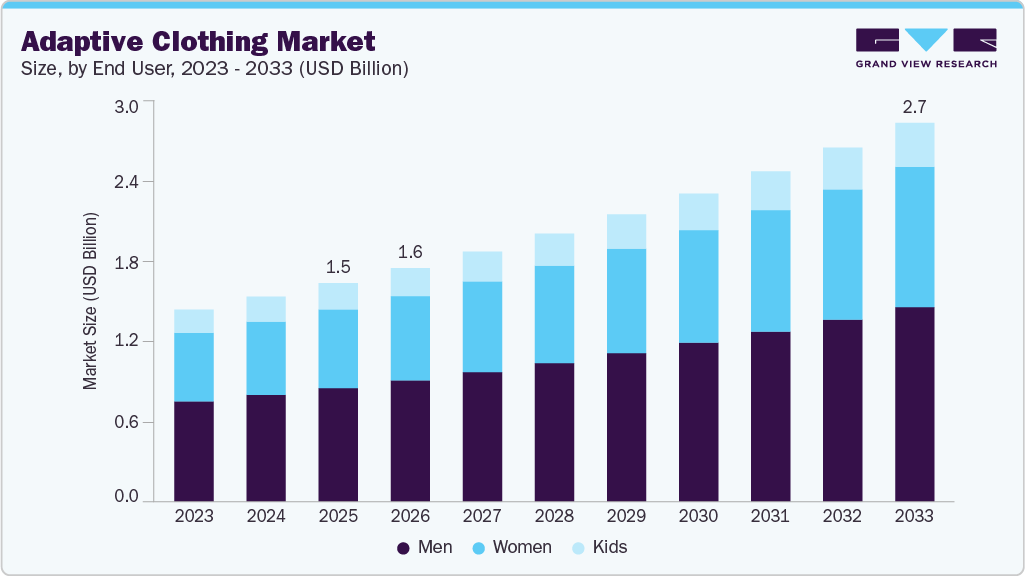
The aging population is becoming a key factor shaping demand for mobility-oriented apparel, as physical limitations associated with age increasingly influence clothing choices. According to the United Nations Department of Economic and Social Affairs, the global population aged 65 years and above stood at around 771 million in 2022 and is expected to reach nearly 994 million by 2030 and approximately 1.6 billion by 2050. This sharp rise in the elderly population is leading to a higher incidence of conditions such as reduced hand strength, joint stiffness, and restricted mobility, all of which directly affect the ease of dressing. Consequently, there is a growing preference for clothing that enables convenience and independence, with features such as stretchable fabrics, simplified openings, and easy-to-use fastenings becoming increasingly important. At the same time, older consumers are not willing to compromise on style, as they continue to participate in social and active lifestyles. This is driving demand for adaptive clothing that delivers both functional ease and modern design, reinforcing its adoption across everyday wear categories. At the same time, this consumer group continues to prioritize appearance and social participation, driving demand for adaptive clothing that combines functionality with contemporary design, thereby expanding its relevance across everyday apparel categories.
Increasing consumer awareness and social acceptance of inclusive fashion are significantly accelerating market growth. According to Forbes (January 2025), mainstream retailers such as Primark have introduced adaptive clothing ranges that integrate accessibility features into trend-driven apparel, making them suitable for a broader consumer base. In parallel, coverage from Vogue highlights that adaptive fashion is gaining visibility across fashion platforms, supported by stronger representation and growing consumer engagement with inclusive design. This shift is further reinforced by evolving retail strategies, where adaptive collections are increasingly incorporated into core product assortments rather than limited offerings. As awareness continues to rise, adaptive clothing is transitioning from a functional necessity to a normalized segment within everyday fashion consumption.
Product innovation in materials, closures, and ergonomic design continues to play a critical role in shaping the adaptive clothing market. For instance, in March 2026, advancements showcased at the Functional Fabric Fair emphasized the integration of “material intelligence” into adaptive apparel. These developments include advanced stretch fabrics that improve mobility, breathable and moisture-regulating textiles for extended wear, and skin-sensitive materials designed to reduce irritation, particularly for individuals with medical needs. In addition, innovations such as magnetic buttons, one-handed zippers, and adaptive fastening systems are improving ease of use for consumers with limited dexterity. Ergonomic garment construction, including seated-fit tailoring and pressure-reducing seams, is further enhancing comfort and wearability. These innovations are enabling adaptive clothing to deliver consistent performance while aligning with broader apparel expectations, supporting increased adoption across both functional and lifestyle segments.
Brand Market Share Insights
The global adaptive clothing market is characterized by a mix of large multinational brands and emerging design-focused labels, all aligning product strategies with evolving consumer demand for functional yet everyday apparel. Manufacturers are increasingly integrating adaptive features such as easy closures, flexible construction, and breathable fabrics into familiar, lifestyle-oriented silhouettes, enabling use across home, travel, and casual settings. Established players such as Tommy Hilfiger Adaptive and Silverts are leveraging performance-driven fabric technologies and ergonomic design capabilities to develop adaptive apparel that combines ease of wear with modern aesthetics.
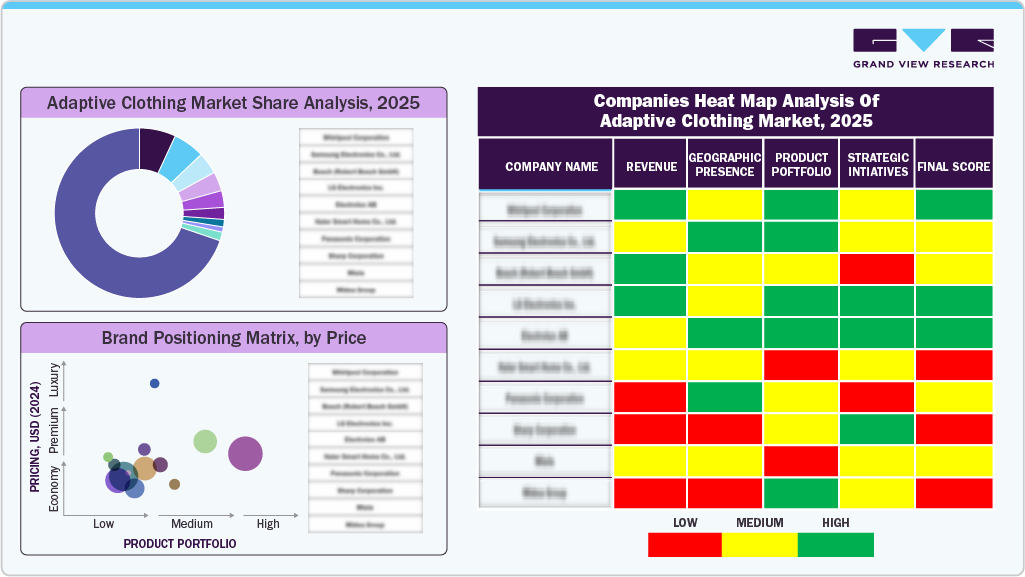
At the same time, sustainability is becoming a key differentiator, with brands incorporating recycled materials and resource-efficient production methods while maintaining product functionality. This convergence of accessibility, performance, and responsible manufacturing is shaping competition and supporting broader adoption of adaptive clothing across everyday wear categories.
Consumer Insights
Consumers in the global adaptive clothing market are increasingly evaluating products based on real-life usability, durability, and long-term comfort rather than initial styling appeal. Garments are assessed on how materials perform after repeated washing and extended wear, with factors such as stretch retention, ease of movement, and comfort during prolonged use becoming critical purchase criteria. According to research cited by the Research Institute for Disabled Consumers in March 2024, 62% of disabled shoppers report difficulty finding clothing that is both comfortable and suitable for their needs, highlighting a clear gap in product performance and usability. In addition, the same findings indicate that 77% of consumers consider adaptive clothing essential or significantly beneficial, yet only 25% currently use such products, reflecting unmet demand driven by product limitations and accessibility gaps. This is pushing consumers toward adaptive clothing that delivers consistent fit, functional design, and durability, while products that fail to perform in everyday conditions are quickly rejected.
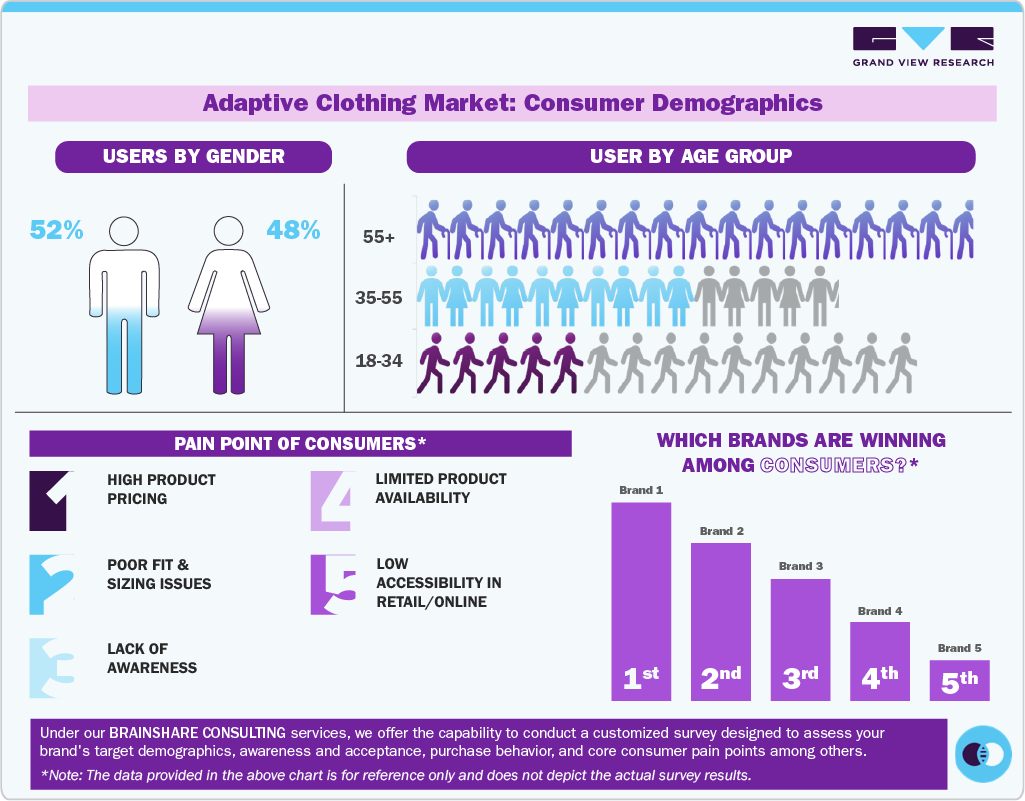
Spending behavior within the adaptive clothing market is increasingly defined by usage patterns and lifestyle requirements rather than age alone. Consumers are treating adaptive clothing as part of their everyday wardrobe, expecting repeat usability and long-term value from each purchase. At the same time, affordability and access remain key constraints, as 36% of consumers report adaptive clothing as expensive, limiting wider adoption despite strong demand. Higher-spending consumers are prioritizing garments that offer durability, comfort, stability, and multi-use functionality, while value-driven buyers respond to accessible pricing and product versatility. In parallel, market analysis highlights that a large proportion of disabled consumers remain underserved by mainstream retail, reinforcing the need for better product availability and inclusive sizing. As a result, purchase decisions are increasingly influenced by practical factors such as ease of wear, product longevity, and consistent performance, positioning adaptive clothing as a functional, repeat-purchase category embedded in daily consumption rather than occasional or need-based buying.
Product Insights
Adaptive t-shirts industry led the market with the largest revenue share of 29.8% in 2025. T-shirts are widely preferred in the global adaptive clothing market due to their ease of wear, comfort, and versatility across different age groups and mobility conditions. Adaptive t-shirts are designed with features such as magnetic closures, side openings, tag-free fabrics, and stretchable materials, making them highly suitable for individuals with limited dexterity or sensory sensitivities. In addition, their relatively affordable pricing compared to specialized adaptive garments encourages higher purchase frequency. Consumers also tend to buy multiple units for daily use, driving consistent volume demand.
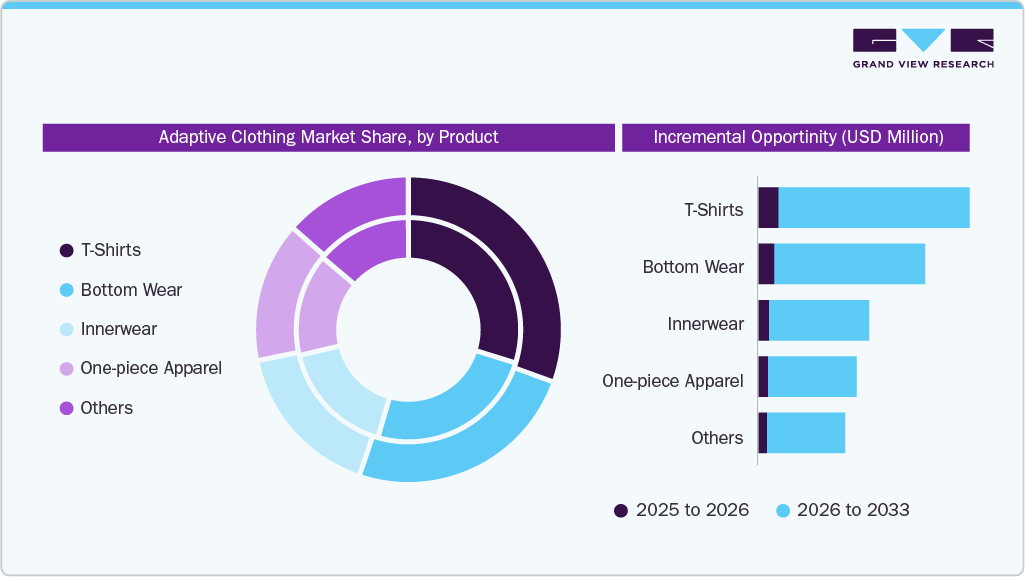
The adaptive bottom wear market is anticipated to grow at the fastest CAGR of 7.2% from 2026 to 2033, supported by the rising aging population and the increasing prevalence of mobility-related conditions that require functional clothing solutions. A growing number of elderly consumers and individuals undergoing rehabilitation are seeking adaptive lower garments that simplify dressing and reduce caregiver dependency, driving steady demand for easy-access pants and trousers. In addition, the expansion of home healthcare and assisted living environments is contributing to higher adoption of adaptive bottom wear designed for seated comfort and medical accessibility.
The segment is also benefiting from improving product availability across e-commerce platforms and specialty retailers, making adaptive bottom wear more accessible to a wider consumer base. Brands such as Silvert's, and IZ Adaptive are expanding their adaptive clothing offerings with inclusive sizing and functional designs, strengthening market penetration.
End User Insights
Men’s adaptive clothing industry led the market with the largest revenue share of 52.0% in 2025. Men account for a significant share in the global adaptive clothing market due to higher adoption of functional everyday wear that supports ease of dressing and long-hour comfort. Demand is particularly strong for adaptive shirts, trousers, and outerwear designed with features such as magnetic closures, Velcro fastenings, and stretchable fabrics, which simplify use for individuals with limited mobility or dexterity. In addition, men tend to prioritize practicality and durability in clothing, leading to consistent replacement cycles across essential wardrobe categories.
The women’s adaptive clothing market is projected to grow at the substantial CAGR of 7.5% from 2026 to 2033, driven by increasing demand for apparel that combines functionality with style and everyday versatility. Women are increasingly seeking adaptive clothing that supports ease of dressing while maintaining aesthetic appeal across daily activities, including work, travel, and social settings. Demand is reinforced by preference for garments featuring adaptive elements such as magnetic closures, wrap designs, elastic waistbands, and adjustable fits, along with soft, breathable fabrics that enhance comfort during extended wear. Growth is further supported by rising awareness around inclusive fashion and the need for clothing that caters to diverse body types, mobility levels, and health conditions. Women are placing greater emphasis on products that offer both independence and confidence, encouraging brands to design adaptive apparel that does not compromise on design or fit.
Distribution Channel Insights
The offline sales of adaptive clothing led the market with the largest revenue share of 67.4% in 2025, supported by the critical role of tactile evaluation in adaptive apparel purchases, where consumers need to physically assess fabric softness, seam placement, and closure mechanisms to ensure suitability for sensitive skin or medical conditions. In-store environments allow for direct comparison across products, which is particularly important for garments designed for assisted dressing or specialized use cases. The segment is also driven by the need for caregiver-assisted shopping, where family members or healthcare aides accompany users to select appropriate clothing, making offline retail a more practical channel than individual online browsing. In addition, offline stores often provide immediate alterations, fit adjustments, and product demonstrations.
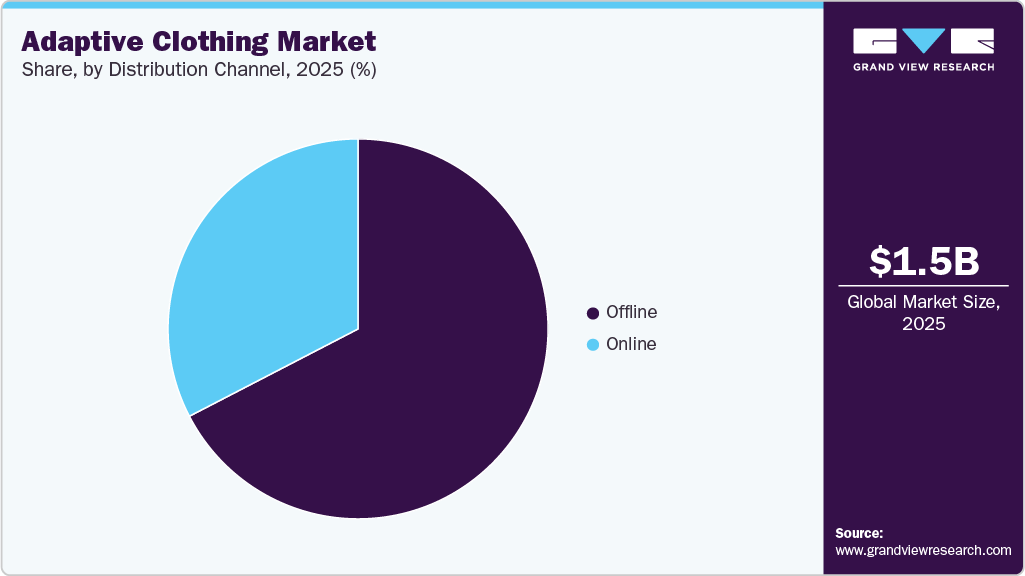
The online sales of adaptive clothing is projected to grow at the substantial CAGR of 8.5% from 2026 to 2033, driven by the expansion of direct-to-consumer (DTC) adaptive brands that launch exclusively online, bypassing traditional retail limitations and offering highly specialized products such as post-operative wear, sensory-friendly clothing, and wheelchair-adapted designs. In addition, online platforms enable brands to collect user feedback and rapidly refine product design based on real-world usage, accelerating innovation cycles. Companies such as IZ Adaptive, Zappos Adaptive, and Amazon are capitalizing on these dynamics through adaptive-focused assortments and data-driven personalization, supporting sustained channel growth.
Regional Insights
North America Adaptive Clothing Market Trends
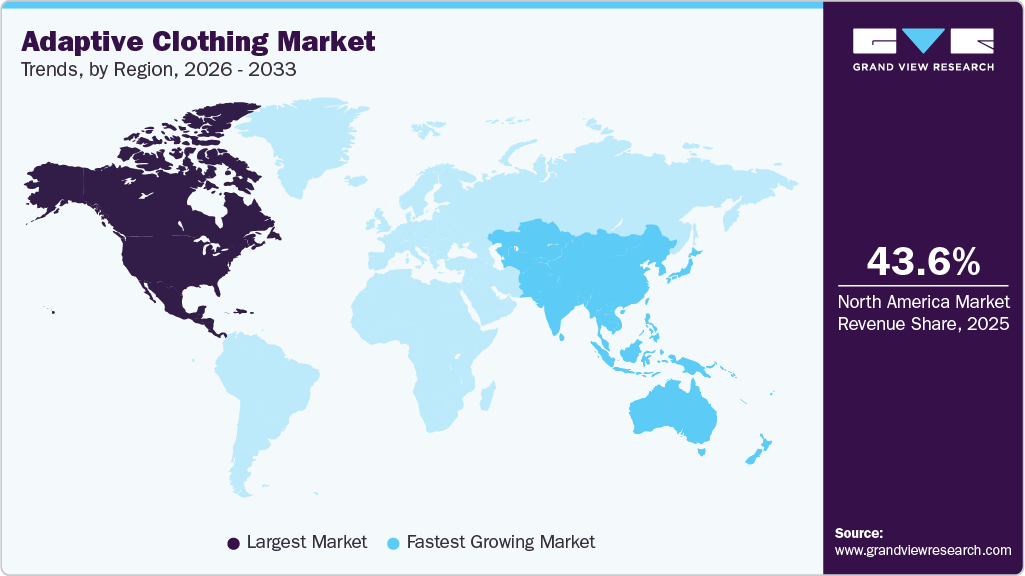
North America adaptive clothing market accounted for a revenue share of 43.6% of the global market in 2025. Adaptive Clothing industry in the North America is driven by strong regulatory and institutional support for accessibility, including disability inclusion standards across public spaces, workplaces, and education systems, which has accelerated the normalization and adoption of adaptive apparel. Demand is further supported by the high penetration of assisted living facilities and long-term care centers, where adaptive clothing is routinely used for ease of dressing and patient management. In addition, a well-developed ecosystem of adaptive-focused startups and innovation hubs in the U.S. is continuously introducing niche, problem-specific products, expanding category depth beyond basic apparel.
U.S. Adaptive Clothing Market Trends
The adaptive clothing market in the U.S. accounted for a revenue share of 56.1% of the North America revenue in 2025. Adaptive Clothing industry in the U.S. is driven by strong purchasing power and a high willingness among U.S. consumers to invest in specialized apparel that improves independence and daily comfort. Demand is further supported by the presence of a large base of digitally aware consumers who actively seek condition-specific products, enabling faster adoption of adaptive clothing across age groups. In addition, the U.S. benefits from a well-established ecosystem of direct-to-consumer adaptive brands and online-first product launches, which accelerate innovation and category expansion. Companies such as IZ Adaptive, Zappos Adaptive, and Target are strengthening market penetration through wider assortments and improved accessibility.
The adaptive clothing market in the Canada is expected to grow at a CAGR of 8.4% from 2026 to 2033. Adaptive Clothing industry in the Canada is supported by a strong public healthcare and assisted living network, where adaptive garments are routinely used for patient care, rehabilitation, and elderly support. Increasing awareness around accessibility and inclusive living is encouraging consumers to adopt clothing that improves independence and ease of dressing in daily life. The market also benefits from improved access to specialized products through both domestic and cross-border e-commerce, expanding availability beyond traditional retail.
Europe Adaptive Clothing Market Trends
Europe adaptive clothing market accounted for a revenue share of 31.1% in 2025. Europe adaptive clothing industry driven by region-specific factors such as rapidly aging populations in countries including Germany, Italy, and France, where demand for easy-to-wear garments is closely linked to elderly care and assisted living needs. Public healthcare integration across Europe enables stronger adoption of adaptive clothing in rehabilitation and long-term care settings, where functionality and patient comfort are prioritized. In addition, widespread use of public transport and walking as primary mobility modes increases demand for adaptive apparel that supports ease of movement, layering, and all-day wear in varying climates. European consumers also place high importance on discreet design, preferring adaptive clothing that blends seamlessly with minimalist fashion trends. Companies such as Zalando, Marks & Spencer, and Tommy Hilfiger are aligning with these preferences through region-specific product offerings and accessible retail channels.
Germany adaptive clothing market accounted for a revenue share of 28.5% of the Europe revenue in 2025. Adaptive Clothing in Germany is driven by a large aging population and a well-established long-term care infrastructure, where adaptive clothing is widely used to support assisted dressing and patient comfort in both institutional and home care settings. Strong statutory health insurance coverage further supports the adoption of functional garments designed for medical and rehabilitation needs. German consumers also prioritize durability, high-quality construction, and practical design, leading to steady demand for adaptive apparel with reliable fastenings and long product life. In addition, an efficient retail and e-commerce ecosystem ensures consistent product availability across the country.
UK adaptive clothing market is expected to grow at a CAGR of 9.1% from 2026 to 2033. UK adaptive clothing industry is driven by strong institutional support through public healthcare and community-based care systems, which encourage the use of adaptive clothing for patient comfort and assisted dressing. Increasing awareness around inclusive fashion and accessibility is also supporting adoption, with consumers seeking garments that combine functionality with everyday style. Demand is further strengthened by high digital penetration and well-developed e-commerce infrastructure, enabling easy access to a wide range of adaptive products.
Asia Pacific Adaptive Clothing Market Trends
The Asia Pacific adaptive clothing market is projected to grow at the fastest CAGR of 7.8% during the forecast period from 2026 to 2033. The Asia Pacific adaptive clothing industry is driven by a rapidly aging population and increasing demand for elderly care solutions, particularly in countries such as Japan, China, and South Korea, where adaptive clothing is being adopted to support mobility and assisted dressing. Expanding healthcare infrastructure and rehabilitation services across urban centers are further contributing to demand, with adaptive garments becoming part of patient care routines. In addition, rising awareness around disability inclusion and improving access through e-commerce platforms are accelerating adoption across diverse consumer groups.
China adaptive clothing market accounted for a revenue share of 38.6% of the Asia Pacific revenue in 2025. The China adaptive clothing market is driven by a rapidly aging population and increasing demand for home-based elderly care, where adaptive clothing is widely used to support ease of dressing and daily mobility. Rising prevalence of mobility-related conditions and post-surgical recovery needs is further contributing to steady demand for functional garments. In addition, China’s strong manufacturing base enables large-scale production and competitive pricing, improving accessibility across income groups.
India adaptive clothing market is expected to grow at a CAGR of 9.9% from 2026 to 2033. The India adaptive clothing industry is driven by increasing awareness around disability inclusion and rising demand for functional clothing that supports ease of dressing and daily independence. The expansion of home healthcare and caregiving services is further supporting adoption, particularly among elderly and mobility-impaired populations. In addition, improving availability of affordable adaptive garments through domestic manufacturing and value-focused brands is expanding access across urban and semi-urban areas.
Central & South America Adaptive Clothing Market Trends
Central & South America adaptive clothing market is expected to grow at a CAGR of 5.6% from 2026 to 2033. The Central & South America adaptive clothing industry is driven by improving healthcare access and the gradual expansion of rehabilitation and elderly care services, increasing demand for adaptive garments that support assisted dressing and daily mobility. Rising awareness around disability inclusion is also encouraging adoption, particularly in urban areas where access to specialized products is improving. In addition, the availability of cost-effective adaptive clothing through regional manufacturers is making these products more accessible to price-sensitive consumers.
Middle East & Africa Adaptive Clothing Market Trends
Middle East & Africa adaptive clothing market is expected to grow at a CAGR of 7.4% from 2026 to 2033. The Middle East & Africa adaptive clothing industry is driven by the increasing demand for home-based care solutions, particularly in markets where family-led caregiving is prevalent, creating steady need for clothing that simplifies assisted dressing and daily routines. In addition, rising incidence of chronic conditions such as diabetes and mobility-related disorders across the region is contributing to higher demand for functional garments designed for comfort and medical accessibility. The market is also supported by improving import access and distribution partnerships, enabling international adaptive clothing brands to enter key markets through local retailers and online platforms.
Key Adaptive Clothing Companies:
The following key companies have been profiled for this study on the adaptive clothing market.
- Tommy Hilfiger Adaptive
- Silverts
- Zappos Adaptive
- Unhidden
- The Able Label
- No Limbits
- Care+Wear
- Kinetic Balance
- Spoonie Threads
- June Adaptive
- Haxor
Recent Developments
-
In September 2025, Silverts acquired IZ Adaptive to expand its presence in inclusive fashion across North America. The deal allows IZ Adaptive to maintain its brand identity while benefiting from Silverts’ supply chain and distribution capabilities, with founder Izzy Camilleri taking on a broader design leadership role.
-
In January 2025, Primark partnered with Victoria Jenkins to launch its first adaptive clothing range for men and women, bringing inclusive fashion to the high street. The collection includes around 49 wardrobe staples such as trench coats, jeans, t-shirts, and jumpers, redesigned with functional features like magnetic fastenings, adjustable waistbands, and discreet openings to support people with disabilities. Developed using feedback from the disabled community, the range focuses on improving ease of dressing while maintaining style and affordability, marking a significant step toward more accessible and inclusive retail fashion.
Adaptive Clothing Market Report Scope
Report Attribute
Details
Market size value in 2026
USD 1.63 billion
Revenue forecast in 2033
USD 2.65 billion
Growth rate (Revenue)
CAGR of 7.2% from 2026 to 2033
Actuals
2021 - 2025
Forecast period
2026 - 2033
Quantitative units
Revenue in USD million/billion, and CAGR from 2026 to 2033
Report coverage
Revenue forecast, company ranking, competitive landscape, growth factors, and trends
Segments covered
Product, end user, distribution channel, and region
Regional scope
North America; Europe; Asia Pacific; Central & South America; Middle East & Africa
Country scope
U.S; Canada; Mexico; Germany; UK; France; Italy; Spain; China; Japan; India; Australia & New Zealand; South Korea; Brazil; South Africa
Key companies profiled
Tommy Hilfiger Adaptive; Silverts; Zappos Adaptive; Unhidden; The Able Label; No Limbits; Care+Wear; Kinetic Balance; Spoonie Threads; June Adaptive; Haxor
Customization scope
Free report customization (equivalent up to 8 analysts working days) with purchase. Addition or alteration to country, regional & segment scope.
Pricing and purchase options
Avail customized purchase options to meet your exact research needs. Explore purchase options Global Adaptive Clothing Market Report Segmentation
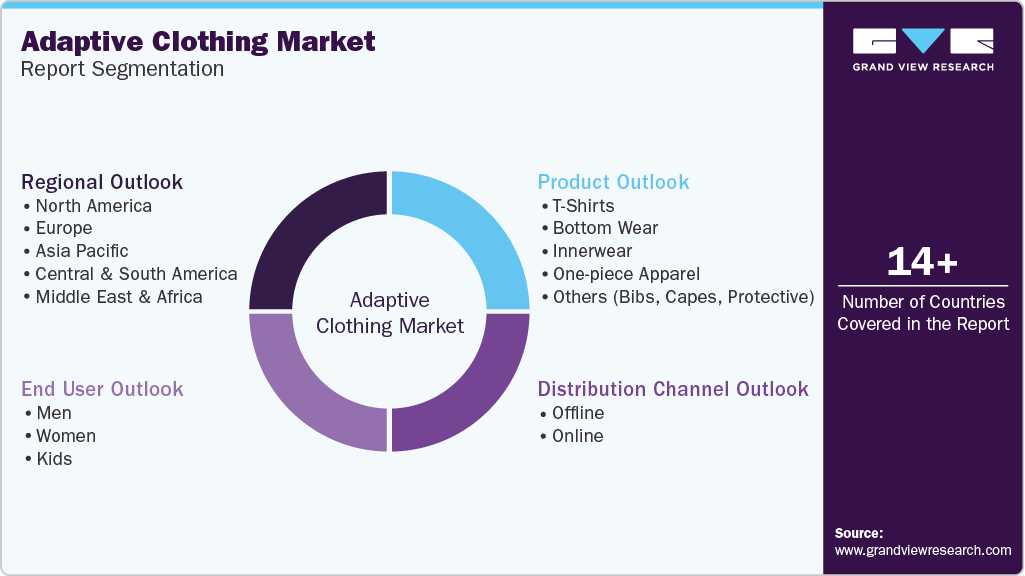
This report forecasts revenue growth at the global, regional, and country levels and provides an analysis of the latest industry trends and opportunities in each of the sub-segments from 2021 to 2033. For this study, Grand View Research has segmented the global adaptive clothing market report on the basis of product, end user, distribution channel, and region:
-
Product Outlook (Revenue, USD Million, 2021 - 2033)
-
T-Shirts
-
Bottom Wear
-
Innerwear
-
One-piece Apparel
-
Others (Bibs, Capes, Protective)
-
-
End User Outlook (Revenue, USD Million, 2021 - 2033)
-
Men
-
Women
-
Kids
-
-
Distribution Channel Outlook (Revenue, USD Million, 2021 - 2033)
-
Offline
-
Specialty Stores
-
Medical Supply Stores
-
-
Online
-
-
Regional Outlook (Revenue, USD Million, 2021 - 2033)
-
North America
-
U.S.
-
Canada
-
Mexico
-
-
Europe
-
Germany
-
UK
-
France
-
Italy
-
Spain
-
-
Asia Pacific
-
China
-
Japan
-
India
-
Australia & New Zealand
-
South Korea
-
-
Central & South America
-
Brazil
-
-
Middle East & Africa
-
South Africa
-
-
Frequently Asked Questions About This Report
b. The global adaptive clothing market size was estimated at USD 1.53 billion in 2025 and is expected to reach USD 1.63 billion in 2026.
b. The global adaptive clothing market is expected to grow at a compound annual growth rate of 7.2% from 2026 to 2023 to reach USD 2.65 billion by 2033.
b. The t-shirts segment led the market with the largest revenue share of 29.8% in 2025, due to their everyday usability, comfort, and ease of modification for adaptive features such as magnetic closures, side openings, and tag-free designs
b. Some key players operating in the adaptive clothing market include Tommy Hilfiger Adaptive; Silverts; Zappos Adaptive; Unhidden; The Able Label; No Limbits; Care+Wear; Kinetic Balance; Spoonie Threads; June Adaptive; Haxor
b. The adaptive clothing market is driven by a growing aging population and increasing prevalence of disabilities, creating demand for functional, easy-to-wear apparel


Share this report with your colleague or friend.
Need a Tailored Report?
Customize this report to your needs — add regions, segments, or data points, with 20% free customization.


ISO 9001:2015 & 27001:2022 Certified
We are GDPR and CCPA compliant! Your transaction & personal information is safe and secure. For more details, please read our privacy policy.
Trusted market insights - try a free sample
See how our reports are structured and why industry leaders rely on Grand View Research. Get a free sample or ask us to tailor this report to your needs.