
- Home
- »
- Plastics, Polymers & Resins
- »
-
Acrylonitrile Butadiene Styrene Market Report, 2026-2033GVR Report cover

Acrylonitrile Butadiene Styrene Market (2026 - 2033)
Size, Share & Trends Analysis Report Type (Opaque, Transparent, Colored), By Application (Appliances, Electrical & Electronics, Automotive, Consumer Goods, Construction), By Region, And Segment Forecasts
Market Size, 2025
$32.5BMarket Estimate, 2026
$34.6BMarket Forecast, 2033
$43.9BCAGR, 2026–2033
6.2%Acrylonitrile Butadiene Styrene Market Summary
The global acrylonitrile butadiene styrene market size was valued at USD 32.5 billion in 2025 and is projected to grow from USD 34.6 billion in 2026 to USD 43.9 billion by 2033, at a CAGR of 6.2% from 2026 to 2033. The demand for acrylonitrile butadiene styrene (ABS) is likely to increase in the automotive industry owing to its lightweight properties. Asia Pacific dominated the global market with the largest revenue share of 34.7% in 2025. The demand for acrylonitrile butadiene styrene (ABS) is likely to increase in the automotive industry owing to its lightweight properties.
 Source: Grand View Research, IR Documents, Primary Interviews, Paid DatabasesTo learn more about this report,
 Download Free Sample Report
 Key Market Trends & Insights
- By type: Opaque segment led the market with the largest revenue share of 44.6% in 2025.
- By application: Appliances segment dominated the market with the largest revenue share of 26.0% in 2025.
Regional Highlights
- Largest regional market: Asia Pacific (34.7% revenue share, 2025)
- By country: China held the largest market share in 2025
Market Size & Forecast
- Market Size in 2025: USD 32.5 Billion
- Estimated market size in 2026: USD 34.6 Billion
- Projected market size by 2033: USD 43.9 billion
- CAGR (2026-2033): 6.2%
Three ways to get this report
Buy it, customize it, or ask a question.Ask an Analyst
Analyst response in 1 business day
- AccessReport author, directly
- Reply timeWithin 1 working day
- No sales callDirect answer only
- FormatEmail reply
- CostFree, no cost
Get the Full Report
What the study covers
- FormatsPDF · Excel · Dashboard
- Timeline2026–2033 annual, 2025 base
- Coverage20+ countries, 5 regions
- Companies10+ key players profiled
Customize the Report
20% free customization
- IncludeCountries, segments, points
- TailorTo your product definition
- ExtendDeeper competitor detail
- OrA fully bespoke study
- Turnaround5–10 working days
ABS is used to manufacture various automotive components including seating, bumper, interior trim, dashboard, center consoles, headliners, and lighting. About 12.5% of all automotive polymers used in the manufacturing of passenger automobiles are made of ABS. The developing automotive industry is likely to boost market growth over the forecast period. Moreover, ABS is used for pipes and fittings and vacuum construction owing to its properties such as excellent mechanical strength, resistance, and lightweight. ABS is widely used in the production of waste collector products owing to its superior corrosion resistance and long-lastingness. These factors are likely to boost the market growth globally in the forecast period.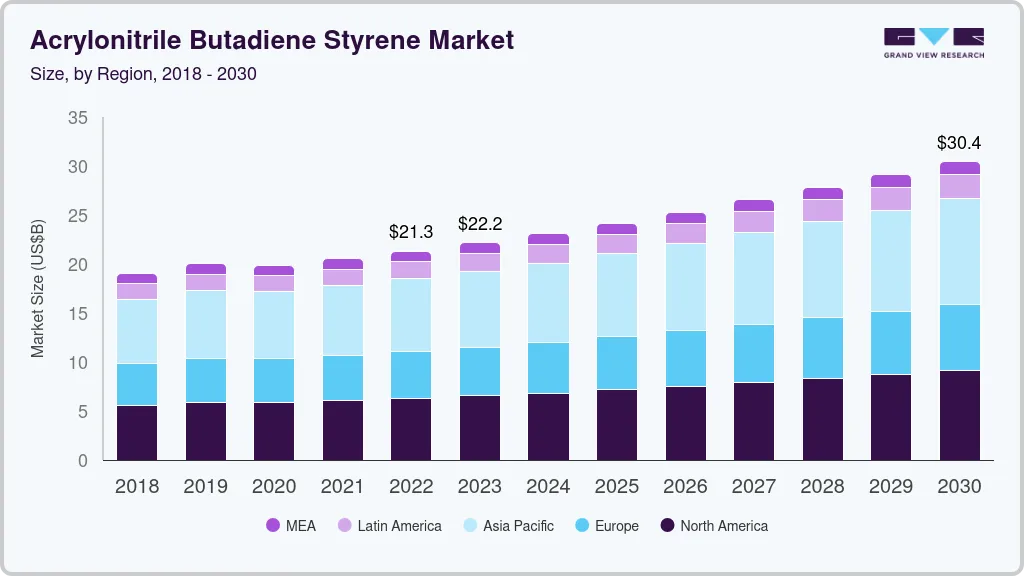 To learn more about this report, Download Free Sample Report
 To cater to the developing healthcare industry, ABS plastics are being utilized for providing higher stability to medical devices and products, such as masks, gloves, shoe and head covers, and gowns. In addition, the market offers opportunities for the usage in varieties of construction products for deteriorating infrastructures such as broadband, bridges, roads, water systems, and power grids.
Market Dynamics
The acrylonitrile butadiene styrene market is propelled by consistent demand from the automotive sector, consumer electronics, and appliance production, where its combination of impact resistance, surface quality, and cost-effectiveness makes it a favored engineering thermoplastic. The growth is further bolstered by increased vehicle manufacturing, a higher use of lightweight materials in automotive interiors, and the expansion of electronics production in the Asia-Pacific region. Nevertheless, the market is still subject to fluctuations in upstream feedstock costs (acrylonitrile, butadiene, and styrene) and cyclical demand trends from major end-use industries. Pressures related to sustainability and the rising interest in recycled ABS are also progressively affecting material substitution trends and the integration of a circular economy.
The market for acrylonitrile butadiene styrene (ABS) is largely fueled by its increasing use in automotive interiors, as manufacturers focus on lightweight materials that offer high impact resistance, excellent surface finish, and design versatility. ABS is commonly found in components such as dashboards, instrument panels, trims, and interior housings, contributing to the reduction of vehicle weight and enhancement of fuel efficiency.
This demand is bolstered by rising vehicle production and an increasing consumer preference for improved cabin aesthetics and integrated functional design. As automotive manufacturers continue to embrace lightweight and cost-effective polymer options, ABS remains a preferred material in both passenger and commercial vehicle sectors.
The ABS market faces considerable limitations due to variations in upstream feedstock costs, particularly acrylonitrile, butadiene, and styrene, which are closely tied to crude oil trends. This reliance on petrochemical cycles results in frequent changes in costs, affecting producer profit margins and stability in pricing. Such instability introduces uncertainty in purchasing and long-term agreements for downstream sectors like automotive and electronics. Furthermore, reliance on fossil-based raw materials restricts cost predictability and makes the market vulnerable to geopolitical tensions and supply chain interruptions.
The ABS market showcases significant growth possibilities due to the increasing use of recycled ABS and initiatives aimed at promoting a circular economy. Heightened regulatory demands for reducing plastic waste, along with sustainability pledges from OEMs, are driving the incorporation of both post-consumer and post-industrial recycled ABS in applications related to automotive and consumer products. This transition is paving the way for innovations in material development related to mechanical recycling, compatibility with chemical recycling, and the production of high-performance recycled varieties. As sectors gravitate towards sourcing that aligns with ESG principles, sustainable ABS options are poised to become more prominent in vital end-use markets.
Analyst Perspective
The ABS market is characterized by consistent, established demand fundamentals rooted in the automotive, electrical and electronics, and consumer goods sectors, where its balanced performance and cost-effectiveness continue to drive widespread adoption. Growth is increasingly influenced by the lightweighting of automotive interiors, the growth of electronics production in the Asia-Pacific region, and the increasing need for aesthetically appealing, durable polymer components. Nonetheless, the market remains subject to cyclical variations due to its reliance on petrochemical feedstocks and fluctuations in end-use industries, especially in automotive and appliances. In the medium term, gradual growth is anticipated to be bolstered by the incorporation of recycled ABS and slow transitions towards higher-performance, application-specific grades instead of revolutionary material replacements.
Drivers, Opportunities & Restraints
The expanding consumer electronics industry is a significant driver for the acrylonitrile butadiene styrene industry. Acrylonitrile butadiene styrene is widely used in the manufacturing of durable housings for smartphones, laptops, and other electronic devices due to its superior thermal stability, aesthetic appeal, and ease of molding into complex shapes. Rapid technological advancements, coupled with the growing global demand for electronic gadgets, especially in emerging economies, are propelling ABS consumption. In addition, the trend of smart home devices and wearable electronics is creating sustained demand for ABS as a preferred material for precision engineering applications.
The increasing emphasis on recycling and sustainability presents a substantial opportunity for growth in the acrylonitrile butadiene styrene industry. With stricter regulations and consumer awareness around reducing plastic waste, companies are focusing on developing bio-based and recycled ABS products. These innovations not only align with sustainability goals but also provide competitive differentiation for manufacturers. The growing use of recycled ABS in industries such as automotive and construction highlights its potential to meet environmental standards while maintaining the material's performance. Companies investing in advanced recycling technologies are likely to gain a competitive edge.
Volatility in raw material prices, particularly acrylonitrile, butadiene, and styrene, poses a significant restraint for the acrylonitrile butadiene styrene industry. These raw materials are derived from crude oil and natural gas, making their prices susceptible to fluctuations in global energy markets. Such volatility impacts production costs and profit margins for manufacturers, especially in regions heavily reliant on imported raw materials. Moreover, the growing adoption of alternative materials like polycarbonate and bio-based polymers in certain applications adds competitive pressure, further restraining the market’s growth potential.
Application Insights
Based on application, the appliances segment dominated the market with the largest revenue share of 26.0% in 2025. The rising demand for household appliances, such as microwave ovens, dryers, and washing machines, along with increasing consumer spending on appliances, is expected to boost the demand for acrylonitrile butadiene styrene in the appliances industry.
The growth in automotive production is likely to create demand for ABS in the automotive industry. According to OICA, the industry accounted for the worldwide production of 21.44 billion light commercial vehicles in 2023, an increase of 9% from 2022. Factors such as growing economy, rapid urbanization, growing demand for electric vehicles, and advancements in technology are expected to drive demand over the coming years.
Type Insights
Based on type, the opaque segment led the market with the largest revenue share of 44.6% in 2025. Opaque acrylonitrile butadiene styrene has various physical properties, including good chemical resistance, aging resistance, hardness, gloss, and rigidity, owing to which it has multiple uses in the automotive industry. In addition, owing to its properties, it is used in various applications including computer parts, automotive parts, luggage cases, and aircraft applications.
 To learn more about this report, Download Free Sample Report
 Opaque ABS is used to provide a smooth, long-lasting finish with high resistance to chemical and UV exposure. The hydrophobic nature of opaque ABS has led to the increased usage of acrylonitrile butadiene styrene products being used in the automotive industry for the production of various parts such as bumpers, seating, dashboard, interior trim, headliners, centre consoles, and lighting.
Factors such as suitable demographics for production and an increase in the population are expected to drive the market globally in the construction industry. Moreover, acrylonitrile butadiene styrene is used for vacuum construction and pipes and fittings due to its excellent mechanical strength and lightweight. These advantageous properties are anticipated to augment demand for opaque acrylonitrile butadiene styrene in the construction industry.
Regional Insights
The acrylonitrile butadiene styrene market in North America is anticipated to grow at the fastest CAGR during the forecast period. The increasing demand for ABS in the healthcare industry is a major driver. The material's non-toxicity, chemical resistance, and ability to be easily sterilized make it a preferred choice for medical devices, equipment housings, and drug delivery systems.
U.S. Acrylonitrile Butadiene Styrene Market Trends
The acrylonitrile butadiene styrene market in the U.S. accounted for the largest market share in North America in 2024. The booming electric vehicle (EV) market in the U.S. is significantly driving the demand for ABS. EV manufacturers are increasingly adopting ABS for lightweight components such as battery enclosures, dashboards, and trims, as they look to optimize vehicle performance and enhance energy efficiency. The strong support for EV adoption through federal incentives and state-level policies, along with substantial investments in EV production facilities by companies like Tesla and Rivian, is amplifying the demand for ABS in automotive applications. This trend reflects a growing reliance on advanced materials to meet sustainability goals and regulatory requirements in the transportation sector.
Asia Pacific Acrylonitrile Butadiene Styrene Market Trends
Asia Pacific dominated the acrylonitrile butadiene styrene market with the largest revenue share of 34.7% in 2025 and is expected to grow at the fastest CAGR of 6.5% over the forecast period. The rapid industrialization and urbanization in the Asia Pacific region are key drivers for the ABS market. The construction sector is experiencing robust growth due to increasing infrastructure development in countries like India, Indonesia, and Vietnam, creating high demand for ABS in pipes, fittings, and insulation applications.
 To learn more about this report, Download Free Sample Report
 China Acrylonitrile Butadiene Styrene Market Trends
The acrylonitrile butadiene styrene market in China held the largest share in the Asia Pacific region in 2025. The country’s vast production of automotive components, consumer electronics, and household appliances heavily relies on ABS for its superior molding and mechanical properties.
Europe Acrylonitrile Butadiene Styrene Market Trends
The acrylonitrile butadiene styrene market in Europe is anticipated to grow at a sustainable CAGR during the forecast period. In Europe, the increasing focus on sustainability and energy efficiency in construction is a major driver for the ABS market. Governments across the region are emphasizing green building practices, which include the use of high-performance materials like ABS in insulation, window frames, and piping systems. The rising adoption of modular construction, known for its efficiency and reduced environmental impact, further promotes the use of ABS due to its lightweight and durable properties.
Key Acrylonitrile Butadiene Styrene Company Insights
The acrylonitrile butadiene styrene industry is highly competitive, with several key players dominating the landscape. Major companies include LG Chemicals, Asahi Kasei, Chi Mei Corporation, Formosa Plastics, KKPC, SABIC, Styron, Styrolution, BASF SE, and DuPont. The acrylonitrile butadiene styrene industry is characterized by a competitive landscape with several key players driving innovation and market growth. Major companies in this sector are investing heavily in research and development to enhance the performance, cost-effectiveness, and sustainability of their types.
Key Acrylonitrile Butadiene Styrene Companies:
The following are the leading companies in the acrylonitrile butadiene styrene market. These companies collectively hold the largest market share and dictate industry trends.
- LG Chemicals
- Asahi Kasei Corporation
- CHIMEI
- Formosa Plastics Corporation
- KUMHO PETROCHEMICAL
- SABIC
- Trinseo
- INEOS Styrolution Group GmbH
- BASF SE
- DuPont
Competitive Benchmarking
Category
Operating Strategies
Competitive Edge
Weakness
Established Players (BASF SE, SABIC, LG Chem, Asahi Kasei, Formosa Plastics, Chi Mei Corporation, KKPC, DuPont)
- Focus on large-scale ABS production integrated with upstream petrochemical operations (styrene, acrylonitrile, butadiene). Strong emphasis on automotive-grade ABS, electrical & electronics applications, and high-volume appliance markets. Increasing investments in high-impact, heat-resistant, and recycled ABS grades to align with sustainability trends.
- Strong global manufacturing footprint, backward integration into key feedstocks, established long-term OEM and Tier-1 relationships, and broad product portfolios across commodity and engineering thermoplastics. High production efficiency enables cost competitiveness in mass-market applications.
Exposure to feedstock price volatility, slower innovation cycles for niche/customized ABS grades, and increasing pressure from sustainability regulations and recycled material mandates impacting conventional ABS demand. Emerging Players (Styron, Styrolution)
- Focused on specialty ABS and styrenics portfolio optimization, with emphasis on high-performance grades, customized formulations, and regional market expansion. Strong alignment with automotive interiors, electronics housings, and value-added ABS applications.
- Agility in product innovation, strong expertise in styrenics chemistry, faster commercialization of new ABS grades, and ability to respond quickly to OEM-specific requirements and design-driven applications.
- Limited upstream integration compared to large petrochemical majors, relatively narrower geographic scale, and higher exposure to competitive pricing pressure in commoditized ABS segments.
Recent Developments
-
In June 2024, Trinseo introduced SAN and ABS resins containing up to 60% recycled content, marketed under the trade names MAGNUM CR, MAGNUM ECO+, and TYRIL CR.
-
In June 2023, MBA Polymers UK launched a new high-quality recycled ABS product, named ABS 4125 UL, which contains over 95% post-consumer recycled content. This innovative material serves as a sustainable alternative for industries such as electronics, automotive, and cosmetics, which are increasingly seeking lower carbon products to meet rising global demand.
Acrylonitrile Butadiene Styrene Market Report Scope
Report Attribute
Details
Market Size in 2025
USD 32.5 billion
Estimated market size in 2026
USD 34.6 billion
Projected market size by 2033
USD 43.9 billion
Growth rate
CAGR of 6.2% from 2026 to 2033
Base year for estimation
2025
Historical data
2021 - 2024
Forecast period
2026 - 2033
Quantitative units
Volume in Kilotons, Revenue in USD million/billion, and CAGR from 2026 to 2033
Report coverage
Revenue forecast, company ranking, competitive landscape, growth factors, and trends
Segments covered
Type, application, region
Regional scope
North America; Europe; Asia Pacific; Central & South America; Middle East & Africa
Country scope
U.S.; Canada; Mexico; Germany; UK; France; Italy; China; India, Japan; Brazil; Argentina; GCC Countries; South Africa
Key companies profiled
LG Chemicals; Asahi Kasei; Chi Mei Corporation; Formosa Plastics; KKPC; SABIC; Styron; Styrolution; BASF SE; DuPont
Customization scope
Free report customization (equivalent up to 8 analysts' working days) with purchase. Addition or alteration to country, regional & segment scope.
Pricing and purchase options
Avail customized purchase options to meet your exact research needs. Explore purchase options
Global Acrylonitrile Butadiene Styrene Market Report Segmentation
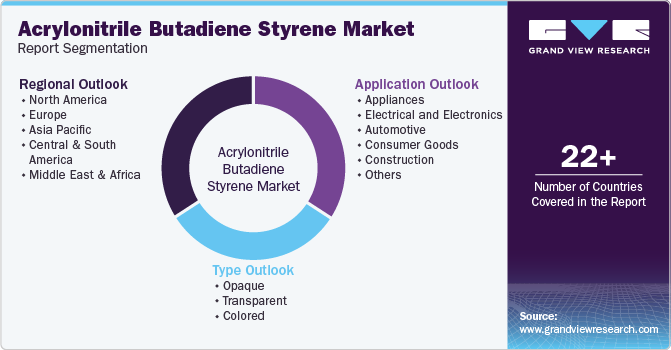
This report forecasts revenue growth at global, regional, and country levels and provides an analysis of the latest industry trends in each of the sub-segments from 2021 to 2033. For this study, Grand View Research has segmented the global acrylonitrile butadiene styrene market report based on the type, application, and region:
 To learn more about this report, Download Free Sample Report
 -
Type Outlook (Revenue, USD Million, Volume, Kilotons, 2021 - 2033)
-
Opaque
-
Transparent
-
Colored
-
-
Application Outlook (Revenue, USD Million, Volume, Kilotons, 2021 - 2033)
-
Appliances
-
Electrical and Electronics
-
Automotive
-
Consumer Goods
-
Construction
-
Others
-
-
Regional Outlook (Revenue, USD Million, 2021 - 2033)
-
North America
-
U.S.
-
Canada
-
Mexico
-
-
Europe
-
Germany
-
UK
-
France
-
Italy
-
Asia Pacific
-
China
-
India
-
Japan
-
-
Central & South America
-
Brazil
-
Argentina
-
-
Middle East & Africa
-
GCC Countries
-
Saudi Arabia
-
-
Research Methodology
The acrylonitrile butadiene styrene market figures in this report are based on a proven research process that combines executive interviews with secondary research from proprietary databases, company filings, and recognized regulatory and institutional sources. Market size is built through value-chain sizing - reconciling supply-side and demand-side estimates - and triangulated with bottom-up and top-down approaches. Every estimate passes multiple levels of expert validation before publication, with each acrylonitrile butadiene styrene segment quantified using the revenue-capture definitions in the table below.
Segment Definition
Segment - Type
Revenue capture definition
Opaque
Revenue is generated through high-volume ABS grades used in structural and functional applications where appearance transparency is not required. These include automotive interior components, appliance housings, and industrial parts, where strength, impact resistance, and cost efficiency are the primary value drivers.
Transparent
Revenue is captured through clear ABS grades used in applications requiring visibility, optical clarity, and aesthetic appeal. These include consumer electronics housings, display covers, lighting components, and certain automotive interior elements where visual design and product differentiation are critical.
Coloured
Revenue is generated through pre-pigmented or masterbatch-modified ABS used in applications requiring consistent aesthetics and brand-specific design. Demand is driven by automotive interiors, appliances, and consumer goods where customized color matching, surface finish, and design uniformity are key purchasing criteria.
Segment-Application
Revenue capture definition
Appliances
Revenue is generated through the use of ABS in refrigerator liners, air conditioner housings, vacuum cleaners, washing machine components, and small household appliances. Demand is driven by the need for impact resistance, surface finish quality, and cost efficiency in mass-produced consumer appliances.
Electrical and Electronics
Revenue is captured through ABS usage in electronic housings, computer and laptop casings, printers, chargers, switches, and electrical enclosures. Growth is supported by increasing electronics manufacturing and demand for durable, lightweight, and aesthetically finished components.
Automotive
Revenue is generated through ABS applications in interior trims, dashboards, instrument panels, door panels, pillar covers, and protective housings. Demand is driven by vehicle lightweighting trends, interior customization, and increasing global automotive production.
Consumer Goods Goods
Revenue is captured through ABS use in toys, luggage, sports equipment, furniture components, and personal accessories. Growth is supported by demand for durable, lightweight, and cost-effective materials with good aesthetic finish.
Construction
Revenue is generated through ABS applications in pipes, fittings, wall panels, protective casings, and building components requiring impact resistance and durability. Demand is driven by infrastructure development and replacement of traditional materials with engineered plastics.
Others
Revenue is derived from niche applications such as medical devices, industrial equipment housings, safety equipment, and customized engineered components where specific performance attributes like strength, chemical resistance, and design flexibility are required.
Estimation Model
Layer Name
Key Question
Description
Polymer Demand Base Layer
What is the total potential plastic consumption pool?
Captures overall demand for thermoplastics across major end-use industries such as automotive, electronics, appliances, construction, and consumer goods where ABS could theoretically substitute or compete with other materials.
Applicability Layer
Where is ABS technically and functionally suitable?
Identifies applications where ABS is preferred due to impact resistance, surface finish, cost efficiency, and ease of processing, primarily automotive interiors, appliance housings, electronic casings, and consumer products.
Competitive Substitution Layer
What share of applications actually use ABS over alternatives?
Defines the realistic adoption pool where ABS competes with PP, PVC, PC, and other engineering plastics based on performance, pricing, and design requirements across industries.
Revenue Realization Layer
How much monetized ABS demand is actually captured?
Represents actual market revenue generated from ABS consumption across applications such as appliances, automotive, electronics, and consumer goods, adjusted for regional pricing, product grades (opaque, transparent, colored), and processing routes.
Delivered Customizations
This report has been delivered with the following In-depth customizations
Client Request
Customization Delivered
Value Adds
Competitive Benchmarking
We provided a structured benchmarking of key ABS producers based on product portfolio strength, styrenics integration, automotive and electronics penetration, regional manufacturing footprint, and focus on specialty vs commodity ABS grades. The analysis also differentiated players based on capability in high-impact, transparent, colored, and recycled ABS offerings.
Enabled clear identification of market leaders versus cost-driven regional players, highlighting competitive positioning across innovation intensity, pricing power, and end-use specialization. Supported evaluation of strategic gaps in high-performance and sustainable ABS segments.
Pricing Analysis
We developed a pricing structure across ABS grades including opaque, transparent, and coloured variants, mapped to feedstock dependency (acrylonitrile, butadiene, styrene), processing complexity, and end-use application intensity. The analysis also captured regional pricing differentials and premiumization in automotive and electronics-grade ABS.
Provided visibility into cost drivers and margin sensitivity across the value chain, enabling understanding of price volatility linked to petrochemical cycles. Supported strategic procurement and product positioning decisions across end-use industries.
Opportunity Assessment
We assessed growth opportunities across automotive lightweighting, electronics miniaturization, appliance demand expansion, and increasing adoption of recycled ABS. The analysis highlighted high-growth regions such as Asia-Pacific and application-specific expansion in interiors, casings, and consumer goods.
Identified high-potential demand pockets driven by sustainability mandates, EV penetration, and electronics manufacturing growth. Supported prioritization of application segments and geographies offering highest incremental ABS demand potential.
Frequently Asked Questions About This Report
Some key players operating in the acrylonitrile butadiene styrene market include LG Chemicals, Asahi Kasei Corporation, CHIMEI, Formosa Plastics Corporation, KUMHO PETROCHEMICAL, SABIC, Trinseo, and INEOS.
Key factors that are driving the market growth include a rising focus on lightweight automobiles & emission control and increasing demand from electrical & electronics applications.
Appliances dominated the acrylonitrile butadiene styrene market across the application segmentation in terms of revenue, accounting for a market share of 26.0% in 2025.
The global acrylonitrile butadiene styrene market size was estimated at USD 32.5 billion in 2025 and is expected to reach USD 34.6 billion in 2026.
The global acrylonitrile butadiene styrene market is expected to grow at a compound annual growth rate of 6.2% from 2026 to 2033 to reach USD 43.9 billion by 2033.
Based on type, the opaque segment led the market with the largest revenue share of 44.6% in 2025. Opaque acrylonitrile butadiene styrene has various physical properties, including good chemical resistance, aging resistance, hardness, gloss, and rigidity, owing to which it has multiple uses in the automotive industry.
Asia Pacific dominated the acrylonitrile butadiene styrene market with the largest revenue share of 34.7% in 2025. The rapid industrialization and urbanization in the Asia Pacific region are key drivers for the ABS market.
North America accounted for a significant share of the ABS market in 2025. The increasing demand for ABS in the healthcare industry is a major driver. The material's non-toxicity, chemical resistance, and ability to be easily sterilized make it a preferred choice for medical devices, equipment housings, and drug delivery systems.
About the Author(s)
Plastics, Polymers & Resins Research Team
Bulk Chemicals · Plastics, Polymers & ResinsThis report was authored by the plastics, polymers & resins research team at Grand View Research - comprising two research analysts, one senior research analyst, and one industry expert - with specialized expertise in the plastics, polymers & resins segment of the bulk chemicals industry. All findings are based on proprietary bulk chemicals databases, executive interviews, and regulatory analysis, subject to internal peer review prior to publication.
Last Updated:
Speak to Analyst

Customize this report to your needs - add regions, segments, or data points, with 20% free customization.
Or view our licence options:


ISO 9001:2015 & 27001:2022 Certified
We are GDPR and CCPA compliant! Your transaction & personal information is safe and secure. For more details, please read our privacy policy.


