
- Home
- »
- Automotive & Transportation
- »
-
Vehicle Roadside Assistance Market Size Report, 2026-2033GVR Report cover

Vehicle Roadside Assistance Market (2026 - 2033)
Size, Share & Trends Analysis Report By Service Type, By Provider, By Vehicle Type (Passenger Cars, Commercial Vehicles), By Region (North America, Europe, Asia Pacific, Latin America, MEA), And Segment Forecasts
Market Size, 2025
$27.7BMarket Estimate, 2026
$28.9BMarket Forecast, 2033
$41.7BCAGR, 2026–2033
5.3%Vehicle Roadside Assistance Market Summary
The global vehicle roadside assistance market size was valued at USD 27.7 billion in 2025 and is projected to grow from USD 28.9 billion in 2026 to USD 41.7 billion by 2033, at a CAGR of 5.3% from 2026 to 2033. The market in Europe dominated with a revenue share of 35.2% in 2025. The market growth can be attributed to the increasing global vehicle ownership and rising traffic volumes, which are leading to a higher incidence of vehicle breakdowns and on-road emergencies.
 Source: Grand View Research, IR Documents, Primary Interviews, Paid DatabasesTo learn more about this report,
 Download Free Sample Report
 Key Market Trends & Insights
- By service type: Towing segment held the largest market share of 32.2% in 2025.
- By provider: Auto manufacturer segment held the largest market share in 2025.
- By vehicle type: Passenger cars segment held the largest market share in 2025.
Regional Highlights
- Largest regional market: Europe (35.2% revenue share, 2025)
- By country: Germany held the largest market share in 2025
Market Size & Forecast
- Market size in 2025: USD 27.7 Billion
- Estimated market size in 2026: USD 28.9 Billion
- Projected market size by 2033: USD 41.7 Billion
- CAGR (2026-2033): 5.3%
Three ways to get this report
Buy it, customize it, or ask a question.Ask an Analyst
A direct answer, usually in 1 working day
- AccessReport author, directly
- Reply timeWithin 1 working day
- No sales callDirect answer only
- FormatEmail reply
- CostFree, no cost
Get the Full Report
What the study covers
- FormatsPDF · Excel · Dashboard
- Timeline2026–2033 annual, 2025 base
- Coverage20+ countries, 5 regions
- Companies10+ key players profiled
Customize the Report
20% free customization
- IncludeCountries, segments, points
- TailorTo your product definition
- ExtendDeeper competitor detail
- OrA fully bespoke study
- Turnaround5–10 working days
This is significantly increasing the demand for towing, battery support, flat tire assistance, and emergency repair services to ensure uninterrupted mobility and driver safety. The rising integration of advanced technologies such as artificial intelligence (AI), global positioning system (GPS), telematics, and internet of things (IoT) in roadside assistance operations is propelling the growth of the market. For instance, AI is used to optimize vehicle dispatching by ensuring that the nearest service provider arrives at the customer quickly. AI also analyzes factors such as traffic, location, and the type of service needed to make real-time decisions, enhancing efficiency and response times. In addition, with telematics systems, vehicles can transmit real-time data to service providers, enabling them to quickly diagnose issues and determine the best course of action. This technology allows for faster response times and more accurate service, reducing downtime and enhancing the overall customer experience.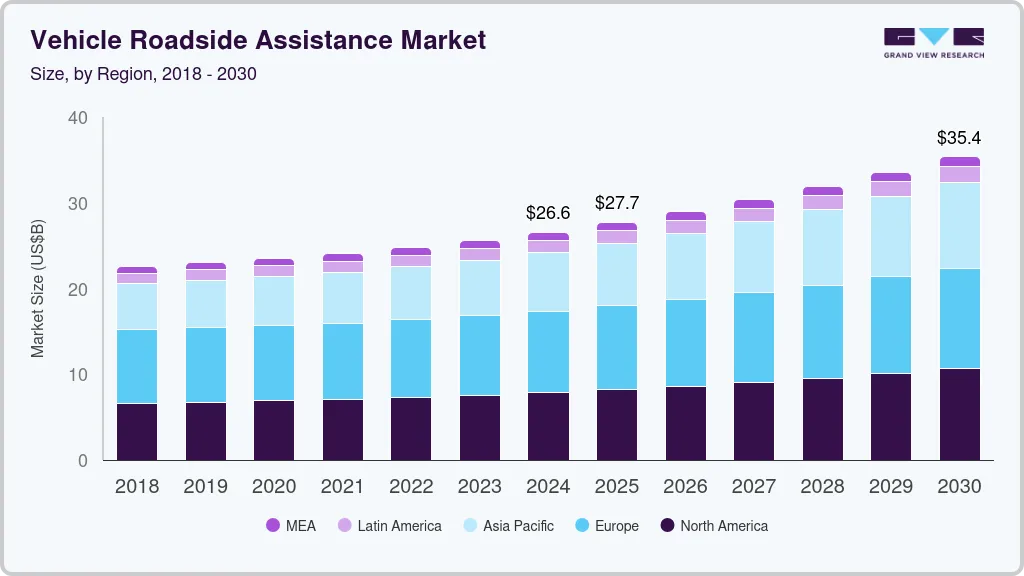 To learn more about this report, Download Free Sample Report
 Furthermore, mobile applications are now central to modern vehicle roadside assistance services. They offer a convenient way for users to request emergency help, track service progress in real time, and communicate with providers. Features such as in-app chat, GPS tracking, digital payments, and instant updates streamline the process and enhance customer satisfaction. These applications also improve transparency by allowing users to monitor technician arrival times and receive real-time status notifications, reducing uncertainty during emergencies. As adoption increases, mobile applications are driving operational efficiency, thus emphasizing customer engagement and supporting market growth.
The rising adoption of electric and autonomous vehicles across the globe is another major trend in the vehicle roadside assistance industry. These vehicle types are becoming more prevalent, prompting roadside assistance providers to adapt services to meet their unique requirements. For electric vehicles, technicians now have advanced diagnostic tools, battery support systems, and mobile charging solutions to address battery and charging issues. For autonomous vehicles, providers are developing new protocols to handle advanced technologies and address potential software-related issues. Thus, the rising demand for battery assistance services due to the increased number of electric vehicles on the roads is boosting the market’s growth.
Despite the growth and advancements in the vehicle roadside assistance industry, several restraining factors, such as varying levels of service quality and cybersecurity concerns, could hamper the growth of the market. As vehicles, infrastructure, and service platforms become more interconnected through the internet, they become more vulnerable to cyber threats. Hackers could potentially compromise smart road systems or vehicle networks, leading to disruptions such as traffic jams, accidents, or unauthorized access to personal data. This poses a significant risk to operational efficiency, user safety, and privacy.
Market Dynamics
Integrating roadside assistance into vehicle purchase packages and motor insurance policies is driving growth in the roadside assistance market. Automotive OEMs and insurance providers now offer complimentary or subscription-based roadside assistance to increase customer convenience, strengthen brand loyalty, and enhance the ownership experience. Services such as towing, battery jump-starts, flat tire assistance, and emergency fuel delivery are now standard in many vehicle and insurance plans.
In addition, partnerships among roadside assistance providers, insurance companies, and automotive manufacturers are expanding service coverage and improving operational efficiency. These collaborations deliver faster response times and seamless customer support through integrated digital platforms and mobile applications. As competition increases, companies use roadside assistance programs as a strategic differentiator to attract and retain customers, thus supporting global market growth.
High operational and service management costs are a key barrier to growth in the vehicle roadside assistance industry. Service providers are required to maintain extensive towing fleets, emergency response infrastructure, service stations, and 24/7 customer support systems to ensure rapid assistance across wide geographic regions. These operational requirements significantly increase infrastructure, labor, and maintenance expenses for companies operating in the market.
In addition, service providers must also invest in digital dispatch systems, GPS tracking, technician training, and network expansion to improve efficiency and response times. Managing third-party partnerships and ensuring consistent service quality across regions further increases operational complexity. These challenges can reduce profitability, especially for smaller providers in competitive, price-sensitive markets.
The adoption of connected vehicle technologies is providing a significant opportunity in the roadside assistance market. Vehicles with telematics, sensors, and real-time monitoring transmit health data to service providers, enabling faster issue detection and improved support. This helps providers identify mechanical problems before failures occur, thereby increasing efficiency and customer convenience.
Predictive maintenance enables roadside assistance companies to offer proactive solutions rather than relying solely on emergency response. By analyzing vehicle data, providers can recommend timely maintenance or repairs, reducing breakdowns and downtime. As connected mobility platforms and smart technologies advance, service quality and customer engagement are expected to improve, thus supporting long-term growth for providers worldwide.
Market Concentration & Characteristics
The vehicle roadside assistance industry is fragmented, with the presence of numerous global, regional, and local service providers operating across different geographies. Large companies such as Allianz Partners, Agero, Inc., ARC Europe, and GEICO compete alongside regional towing operators, insurance providers, and automotive OEM-linked assistance networks. The fragmented nature of the market is driven by the strong regional dependence of roadside service operations and the need for extensive local support networks.
 To learn more about this report, Download Free Sample Report
 The vehicle roadside assistance industry is characterized by rising adoption of subscription-based roadside assistance programs, digital dispatch platforms, and connected vehicle support services. Companies are focusing on expanding service coverage and enhancing customer experience through mobile applications and real-time tracking solutions. In addition, partnerships between insurers and roadside assistance providers are becoming increasingly common to strengthen after-sales support and customer retention strategies.
Service Type Insights
The towing segment led the market with the largest revenue share of 32.27% in 2025. The increasing number of vehicles on the road and the rising incidence of vehicle breakdowns, accidents, and mechanical failures are primarily driving the growth of the towing segment. Growing urban congestion and the increasing frequency of long-distance travel are further accelerating the demand for fast and reliable towing services to ensure uninterrupted mobility and emergency vehicle support. In addition, the strong presence of roadside assistance and towing service providers across global markets is supporting segment growth. For instance, the American Automobile Association (AAA) operates a network of more than 63,000 towing and roadside assistance service vehicles across the U.S., enabling extensive emergency support coverage for its members.
The tire replacement segment is expected to grow at the fastest CAGR during the forecast period. The increasing prevalence of vehicle ownership, coupled with the wear and tear, creates demand for tire replacement services. In addition, the rise in awareness about vehicle maintenance and safety encourages drivers to seek timely assistance for tire-related issues. Moreover, the integration of tire replacement services into comprehensive roadside assistance packages enhances their appeal, providing added convenience for consumers. This trend is further supported by partnerships between roadside assistance providers and tire manufacturers, which facilitate quicker access to tire replacement and repair services, thereby emphasizing the segment’s growth.
Provider Insights
The auto manufacturer segment accounted for the largest market revenue share in 2025. The auto manufacturer segment held the largest market share in 2025. Many manufacturers now include roadside assistance in their vehicle offerings, often as part of warranty or service packages, thereby driving segment growth. This approach ensures vehicle owners have immediate support during breakdowns. Auto manufacturers such as Ford Motor Company, Tesla, Inc., Nissan Motor Corporation, and Chevrolet, among others, provide roadside assistance for their customers. For instance, Ford offers complimentary roadside assistance for up to five years or 60,000 miles on new vehicles, generally aligning with the powertrain warranty. This coverage includes towing, flat tire changes, battery jump-starts, fuel delivery, and lockout services.
The motor insurance segment is expected to register at the fastest CAGR during the forecast period. The segment growth is driven by the integration of roadside assistance services into comprehensive auto insurance policies. To enhance customer satisfaction and policyholder retention, insurers, including Allianz Partners, Liberty Mutual Insurance, Reliance General Insurance, and many others, are increasingly offering services such as towing, battery jump-starts, flat tire assistance, fuel delivery, and emergency repairs as value-added benefits. Insurance providers are partnering with third-party roadside assistance companies to expand service coverage and improve response times. In addition, the adoption of digital claims management systems and data analytics allows insurers to optimize dispatch operations, increase efficiency, and reduce costs.
Vehicle Type Insights
The passenger cars segment accounted for the largest market revenue share in 2025. Rising sales of electric and ICE-powered passenger cars, including SUVs, sedans, and luxury models, are driving segment growth. Increased consumer demand for personal mobility, comfort, and advanced technology further supports this trend. According to the International Organization of Motor Vehicle Manufacturers (OICA), global passenger car sales reached 70.97 million units in 2025, indicating strong demand in both developed and emerging markets. The continued popularity of SUVs, valued for their comfort, premium features, and safety, also contributes to market expansion. In addition, automakers are enhancing the customer experience by offering value-added services such as roadside assistance, connected vehicle support, and maintenance packages, which further emphasize segment growth.
 To learn more about this report, Download Free Sample Report
 The commercial vehicles segment is anticipated to grow at the fastest CAGR during the forecast period. The increasing volume of goods transported and the expansion of e-commerce, have led to a higher demand for logistics and transportation services, which in turn drives the need for reliable roadside assistance for commercial fleets. In addition, heavy commercial vehicles often operate in challenging conditions, covering extensive distances and navigating difficult terrains. Whether facing a tire blowout on a remote highway or an engine malfunction in the middle of the night, ensuring safety is crucial. Roadside assistance services provide critical support to drivers and operators, delivering timely, efficient assistance when unforeseen issues arise. Thus, rising demand for heavy truck roadside assistance services across the globe is further driving the segment’s growth.
Regional Insights
The vehicle roadside assistance market in North America was identified as a lucrative region in 2025. The adoption of telematics and connected car technologies is driving the market's growth in the region. Moreover, the integration of roadside assistance with insurance policies is becoming more common in the region, extending the market reach and increasing accessibility for a diverse customer base, thereby driving the market’s growth.
U.S. Vehicle Roadside Assistance Market Trends
The vehicle roadside assistance market in the U.S. held a dominant position in North America in 2025. The high vehicle ownership rate in the U.S. creates a continuous demand for reliable roadside support. Consumer demand for rapid, effective service further fuels market growth in the country, as drivers increasingly seek comprehensive, responsive assistance solutions.
Europe Vehicle Roadside Assistance Market Trends
Europe dominated the global vehicle roadside assistance market with the largest revenue share of 35.25% in 2025. The market growth in the region is primarily driven by the strong presence of established roadside assistance service providers and the high penetration of subscription-based vehicle support services. Key companies operating in the European market include Viking Assistance Group AS, ARC Europe, Allianz Partners, and Falck A/S. For instance, Falck A/S offers comprehensive roadside assistance services across Europe, including towing, on-site repair support, and subscription-based vehicle maintenance services designed to improve vehicle reliability and ensure uninterrupted mobility for customers.
 To learn more about this report, Download Free Sample Report
 The vehicle roadside assistance market in the UK is expected to grow rapidly in the coming years. The country’s growth is driven by its high vehicle density, increasing urbanization, and the rising number of aging vehicles on the road. Older vehicle fleets are more susceptible to mechanical failures and battery issues, which is significantly increasing the demand for roadside assistance services such as towing, on-the-spot repairs, and emergency support. In addition, growing consumer preference for reliable mobility support services and vehicle maintenance coverage is further contributing to market growth across the UK
The Germany vehicle roadside assistance market held a substantial market share in Europe in 2025. Germany's strong automotive ecosystem and high vehicle density contribute to the steady expansion of the roadside assistance market. The country’s focus on advanced vehicle technologies, including autonomous driving and connected cars, has led to an increasing need for tech-integrated roadside solutions.
Asia Pacific Vehicle Roadside Assistance Market Trends
The vehicle roadside assistance market in the Asia Pacific is anticipated to grow at the fastest CAGR during the forecast period. Growing urban populations and increased vehicle ownership in countries such as China and India are major factors behind the market's growth in the region. In addition, rising disposable incomes and an increasing middle-class population are leading to higher vehicle sales, which ultimately drive the demand for roadside vehicle services.
The India vehicle roadside assistance market is expected to grow at a significant CAGR during the forecast period. The country’s growth is supported by rising vehicle ownership, expanding highway infrastructure, and greater consumer awareness of emergency support services. Increased numbers of passenger and commercial vehicles, along with more long-distance travel, are fueling demand for towing, battery jump-starts, flat tire assistance, and on-site repairs. Moreover, automobile manufacturers and insurance providers are offering more subscription-based roadside assistance programs to improve customer convenience and after-sales support nationwide.
The vehicle roadside assistance market in China held a substantial market share in the Asia Pacific in 2025.China’s rapid vehicle growth, particularly in urban centers, is a key driver of the roadside assistance market. The country’s push for widespread EV adoption has created a surge in demand for EV-related roadside services, including fast-charging infrastructure and mobile battery swapping.
Key Vehicle Roadside Assistance Company Insights
Some of the key companies in the vehicle roadside assistance industry include Ford Motor Company, Chevrolet, and Nissan Motor Co., Ltd., among others. Organizations are focusing on establishing networks and brand trust, while digital disruptors and tech-driven startups are reshaping the industry with AI-based solutions, mobile applications, and on-demand services.
In addition, key players are taking several strategic initiatives, including new product launches, business expansions, collaborations, and partnerships.
-
Ford Motor Company is a manufacturer of automobiles. The company manufactures and designs a wide range of trucks, cars, electrified vehicles, SUVs, and Lincoln luxury vehicles. It offers roadside assistance, including towing, tire & battery assistance, and more.
-
Nissan Motor Co., Ltd. is an automobile manufacturer known for its innovative designs and diverse vehicle lineup. The company produces a wide range of vehicles, including sedans, SUVs, sports cars, and light commercial vehicles, marketed under the Nissan and Infiniti brands. It offers vehicle roadside assistance covering mechanical breakdown, battery jump-starts, emergency fuel delivery, and more.
Key Vehicle Roadside Assistance Companies:
The following key companies have been profiled for this study on the vehicle roadside assistance market.
-
GEICO
-
Viking Assistance Group AS
-
ARC Europe
-
Allstate Insurance Company
-
Agero, Inc.
-
Prime Assistance Inc.
-
SOS International A/S
-
Allianz Partners
-
Ford Motor Company
-
Nissan Motor Corporation.
Competitive Benchmarking
Operating Strategies
Competitive Edge
Weaknesses
Mature Players: GEICO; Viking Assistance Group AS; ARC Europe; Allstate Insurance Company; Agero, Inc.; Allianz Partners
- Focus on expanding service coverage and improving response times.
- Invest in digital roadside assistance platforms and connected vehicle services.
- Strong brand presence and extensive roadside service networks.
- Ability to provide comprehensive emergency assistance services.
- High operational and maintenance costs.
- Strong competition from regional service providers.
Emerging Players: Prime Assistance Inc.; SOS International A/S; Ford Motor Company; Nissan Motor Corporation
- Focus on partnership-based and subscription roadside assistance models.
- Expand OEM-linked after-sales support services.
- Offer flexible and customized assistance plans.
- Strong integration with vehicle service and maintenance programs.
- Limited service coverage compared to established players.
- Dependence on third-party support networks in some regions.
Recent Developments
-
In October 2025, Force Motors Limited launched a three-year complimentary roadside assistance (RSA) program for all its vehicles to enhance customer support and improve after-sales service coverage. The initiative aimed to provide 24/7 emergency assistance services, including towing support, breakdown assistance, battery jump-starts, and flat tyre support, thereby strengthening customer convenience and vehicle uptime across India.
-
In May 2025, India Yamaha Motor introduced a five-year roadside assistance (RSA) program for customers across India as part of its 40-year milestone celebrations in the country. The program included services such as towing assistance, battery jump-start support, flat tyre assistance, minor running repairs, and emergency medical support. The initiative complemented the company’s recently launched 10-year warranty program and reflected Yamaha’s increasing focus on strengthening after-sales support and enhancing long-term customer ownership experience.
Vehicle Roadside Assistance Market Report Scope
Report Attribute
Details
Market size in 2025
USD 27.7 billion
Estimated market size in 2026
USD 28.9 billion
Projected market size by 2033
USD 41.7 billion
Growth rate
CAGR of 5.3% from 2026 to 2033
Base year for estimation
2025
Historical data
2021 - 2024
Forecast period
2026 - 2033
Quantitative units
Revenue in USD million/billion, and CAGR from 2026 to 2033
Report coverage
Revenue forecast, company market share, competitive landscape, growth factors, and trends
Segments covered
Service type, provider, vehicle type, region
Regional scope
North America; Europe; Asia Pacific; Latin America; MEA
Country scope
U.S.; Canada; Mexico; Germany; UK; France; China; Japan; India; South Korea; Australia; Brazil; KSA; UAE; South Africa
Key companies profiled
GEICO; Viking Assistance Group AS; ARC Europe; Allstate Insurance Company; Agero, Inc.; Prime Assistance Inc.; SOS International A/S; Allianz Partners; Ford Motor Company; Nissan Motor Corporation
Customization scope
Free report customization (equivalent up to 8 analysts working days) with purchase. Addition or alteration to country, regional & segment scope.
Pricing and purchase options
Avail customized purchase options to meet your exact research needs. Explore purchase options
Global Vehicle Roadside Assistance Market Report Segmentation
This report forecasts revenue growth at global, regional, and country levels and provides an analysis of the latest industry trends in each of the sub-segments from 2021 to 2033. For this study, Grand View Research has segmented the global vehicle roadside assistance market report based on service type, provider, vehicle type, and region.
 To learn more about this report, Download Free Sample Report
 -
Service Type Outlook (Revenue, USD Million, 2021 - 2033)
-
Towing
-
Tire Replacement
-
Fuel Delivery
-
Lockout/Replacement Key Service
-
Battery Assistance
-
Others
-
-
Provider Outlook (Revenue, USD Million, 2021 - 2033)
-
Motor Insurance
-
Auto Manufacturer
-
Automotive Clubs
-
Independent Warranty Providers
-
-
Vehicle Type Outlook (Revenue, USD Million, 2021 - 2033)
-
Passenger Cars
-
Commercial Vehicles
-
-
Regional Outlook (Revenue, USD Million, 2021 - 2033)
-
North America
-
U.S.
-
Canada
-
Mexico
-
-
Europe
-
Germany
-
UK
-
France
-
-
Asia Pacific
-
China
-
Japan
-
India
-
South Korea
-
Australia
-
-
Latin America
-
Brazil
-
-
Middle East and Africa (MEA)
-
KSA
-
UAE
-
South Africa
-
-
Delivered Customizations
This report has been delivered with the following In-depth customizations
Client Request
Customization Delivered
Value Adds
Vehicle Roadside Assistance Market Analysis
Regional roadside assistance demand assessment
Evaluation of subscription-based and insurance-linked assistance models
Identified high-growth service segments
Supported service portfolio expansion strategy
Vehicle Owner Behavior Study
Analysis of consumer preference for roadside assistance plans
Assessment of vehicle breakdown and emergency support trends
Improved customer targeting strategy
Supported pricing and membership model decisions
Competitive Landscape Assessment
Benchmarking of leading roadside assistance providers
Service portfolio and coverage comparison
Supported competitive intelligence
Identified market differentiation opportunities
Frequently Asked Questions About This Report
The towing segment led with a 32.2% revenue share in 2025, while the tire replacement segment is the fastest-growing.
The auto manufacturer segment held the largest revenue share in 2025, while the motor insurance segment is the fastest-growing.
The passenger cars segment held the largest revenue share in 2025, while the commercial vehicles segment is the fastest-growing.
The global vehicle roadside assistance market is expected to grow at a CAGR of 5.3% from 2026 to 2033, reaching USD 41.7 billion by 2033.
The global vehicle roadside assistance market size was valued at USD 27.7 billion in 2025 and is estimated at USD 28.9 billion for 2026.
Europe dominated with a 35.2% revenue share in 2025.
Key players include GEICO; Viking Assistance Group AS; ARC Europe; Allstate Insurance Company; Agero, Inc.; Prime Assistance Inc.; SOS International A/S; Allianz Partners; Ford Motor Company; Nissan Motor Corporation
The market growth can be attributed to the increasing global vehicle ownership and rising traffic volumes, which are leading to a higher incidence of vehicle breakdowns and on-road emergencies.
About the Author(s)
Automotive & Transportation Research Team
Technology · Automotive & TransportationThis report was authored by the automotive & transportation research team at Grand View Research - comprising two research analysts, one senior research analyst, and one industry expert - with specialized expertise in the automotive & transportation segment of the technology industry. All findings are based on proprietary technology databases, executive interviews, and regulatory analysis, subject to internal peer review prior to publication.
Last Updated:
Speak to Analyst

Customize this report to your needs - add regions, segments, or data points, with 20% free customization.
Or view our licence options:


ISO 9001:2015 & 27001:2022 Certified
We are GDPR and CCPA compliant! Your transaction & personal information is safe and secure. For more details, please read our privacy policy.


