
- Home
- »
- IT Services & Applications
- »
-
SoC as a Service Market Size And Share Report, 2026-2033GVR Report cover

SoC as a Service Market (2026 - 2033)
Size, Share & Trends Analysis Report By Service (Prevention Services, Detection Services, Incident Response Services), By Offering, By Enterprise Size, By Application, By End Use, By Region, and Segment Forecasts
Market Size, 2025
$13.1BMarket Estimate, 2026
$14.3BMarket Forecast, 2033
$27.4BCAGR, 2026–2033
9.8%SoC as a Service Market Summary
The global SoC as a service market size was valued at USD 13.1 billion in 2025 and is projected to grow from USD 14.3 billion in 2026 to USD 27.4 billion by 2033, at a CAGR of 9.8% from 2026 to 2033. The market in North America dominated with a revenue share of 37.1% in 2025. The industry is witnessing strong growth as organizations shift from traditional in-house security monitoring toward outsourced, cloud-delivered cybersecurity operations.
 Source: Grand View Research, IR Documents, Primary Interviews, Paid DatabasesTo learn more about this report,
 Download Free Sample Report
 Key Market Trends & Insights
- By service: Incident response services segment held the largest market share of 42.2% in 2025.
- By offering: Co-managed segment held the largest market share in 2025.
- By enterprise size: Large enterprises segment held the largest market share of 56.5% in 2025.
- By application: Endpoint security segment held the largest market share in 2025.
- By end use: BFSI segment held the largest market share of 25.0% in 2025.
Regional Highlights
- Largest regional market: North America (37.1% revenue share, 2025)
- Fastest-growing regional market: Europe (highest CAGR, 2026-2033)
- By country: The U.S. held the largest market share in 2025
Market Size & Forecast
- Market size in 2025: USD 13.1 Billion
- Estimated market size in 2026: USD 14.3 Billion
- Projected market size by 2033: USD 27.4 Billion
- CAGR (2026-2033): 9.8%
GVR research-powered AIAsk Prism AI about the SoC as a service marketGet cited answers from GVR research on market growth, segments, regulations and forecasts.Start with✓ Source-linked answers ✓ Market-specific context ✓ Traceable figuresExplore Prism AI ↗
Additionally, the rise in cyberattacks, ransomware incidents, insider threats, and multi-vector attacks has significantly accelerated demand for 24/7 threat detection, incident response, and continuous monitoring services. Enterprises are adopting SoC as a service solution to strengthen cybersecurity resilience while reducing the operational burden associated with maintaining internal security teams. To learn more about this report, Download Free Sample Report
 A major trend shaping the market is the growing adoption of AI-driven and automated security operations. Vendors are integrating artificial intelligence, machine learning, behavioral analytics, and threat intelligence into managed SOC platforms to improve real-time threat detection and reduce alert fatigue. The evolution of intelligent SecOps, AI-powered SIEM, and agentic SOC frameworks is enabling faster incident triage, predictive threat analysis, and automated response orchestration. Organizations are also emphasizing human-AI collaboration models where AI enhances analyst productivity rather than replacing cybersecurity expertise completely.
Another significant trend is the increasing shift toward cloud-native and hybrid security architectures. As enterprises continue migrating workloads to public cloud, hybrid cloud, and multi-cloud environments, the need for scalable and remotely managed SOC services has expanded considerably. Organizations are seeking unified visibility across endpoints, identities, applications, networks, and cloud workloads to address fragmented security environments. In parallel, the implementation of zero-trust security models, managed detection and response (MDR), extended detection and response (XDR), and integrated SIEM platforms is reshaping service offerings across the market.
The industry is also benefiting from the global shortage of skilled cybersecurity professionals and increasing regulatory compliance requirements. Small and medium-sized enterprises, which often lack dedicated cybersecurity infrastructure, are rapidly adopting subscription-based SOCaaS models for enterprise-grade protection at lower operational costs. Regionally, North America currently dominates the market due to high cybersecurity spending and advanced digital infrastructure. At the same time, the Asia Pacific is expected to witness the fastest growth driven by accelerating digital transformation, cloud adoption, and increasing cyber risks across emerging economies. Leading companies are focusing on strategic partnerships, AI-enabled innovation, and managed security expansion to strengthen competitive positioning in the evolving cybersecurity landscape.
Market Dynamics
The increasing frequency of cyberattacks, ransomware incidents, phishing campaigns, and advanced persistent threats (APTs) is significantly driving the growth of the security operations center (SoC) as a service market. Organizations are adopting outsourced security operations services to gain access to 24/7 threat monitoring, real-time incident response, threat intelligence, and advanced security analytics without the high costs associated with building and maintaining an in-house SOC infrastructure. The growing complexity of hybrid IT environments, cloud adoption, and remote work models is further accelerating demand for scalable and managed cybersecurity operations services.
For instance, in 2025, IBM’s X-Force Threat Intelligence Index highlighted that cybercriminals increasingly targeted cloud environments, critical infrastructure, and identity systems through ransomware, phishing, and credential-based attacks, prompting enterprises to strengthen continuous security monitoring and incident response capabilities. Many organizations, particularly SMEs, are increasingly relying on SoC as a Service providers to address cybersecurity talent shortages and improve operational resilience against evolving threats. Additionally, rising regulatory requirements, increasing cyber insurance expectations, and the need for rapid threat detection are encouraging enterprises to outsource security operations to specialized providers. Therefore, the growing demand for cost-effective, scalable, and continuously managed cybersecurity operations is significantly contributing to the growth of the industry.
Concerns regarding data privacy, regulatory compliance, and reduced control over security operations are among the key factors restraining the growth of the market. Organizations outsourcing cybersecurity monitoring and incident management to third-party providers often face challenges related to sensitive data exposure, limited visibility into security operations, and dependency on external vendors for critical threat response activities. These concerns are particularly significant in highly regulated industries such as BFSI, healthcare, government, and defense.
For instance, enterprises operating across multi-cloud and hybrid environments often remain cautious about sharing confidential operational data, network telemetry, and customer information with external SoC providers due to risks associated with data sovereignty, compliance violations, and third-party security breaches. Additionally, varying regional cybersecurity regulations and cross-border data transfer restrictions can complicate outsourced security operations management. Moreover, integration challenges with legacy systems, concerns regarding service-level consistency, and potential delays in incident escalation may discourage some organizations from fully outsourcing their security operations. As a result, concerns over operational transparency, governance, and control continue to limit broader adoption of SoC as a Service solution across certain enterprises and sectors.
Market Concentration and Characteristics
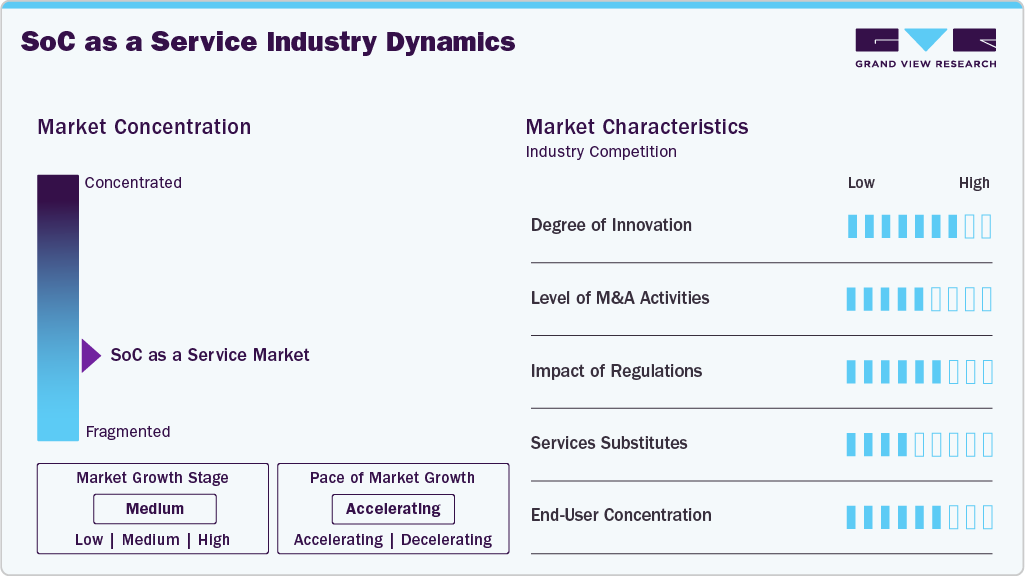
The industry is moderately fragmented, with a combination of global cybersecurity vendors, managed security service providers (MSSPs), telecom operators, and niche security operations specialists competing across the ecosystem. Major players such as IBM, AT&T Cybersecurity, Secureworks, Arctic Wolf, Palo Alto Networks, Verizon, and Cisco hold significant market presence due to their advanced threat intelligence capabilities, global SOC infrastructure, and managed detection and response (MDR) expertise. However, the market also includes many regional MSSPs and cloud-native security providers offering specialized monitoring, incident response, and compliance-focused services, contributing to competitive fragmentation.
In terms of characteristics, the market demonstrates a high degree of innovation, driven by advancements in artificial intelligence (AI), automation, behavioral analytics, XDR integration, cloud-native security monitoring, and real-time threat intelligence platforms. Vendors are increasingly integrating AI-driven alert prioritization, automated incident response, and predictive analytics to improve SOC efficiency and reduce response times. The market is also witnessing moderate-to-high merger and acquisition (M&A) activity, as cybersecurity companies acquire MDR, XDR, and threat intelligence firms to strengthen managed security portfolios and expand global service capabilities.
 To learn more about this report, Download Free Sample Report
 Regulatory impact is significant, with growing cybersecurity compliance requirements such as GDPR, HIPAA, PCI DSS, NIS2, and critical infrastructure protection regulations driving enterprise demand for continuous security monitoring and managed SOC services. Service substitutes, such as in-house SOCs and traditional MSSPs, exist; however, SoC as a Service offers greater scalability, cost efficiency, and access to advanced cybersecurity expertise for organizations lacking internal security resources. Additionally, the market exhibits high end-user concentration among BFSI, healthcare, government, retail, IT & telecom, and critical infrastructure sectors due to their elevated cyber risk exposure and stringent compliance obligations.
Service Insights
The incident response services segment dominated the market with a 42.2% revenue share in 2025 due to the rising frequency and complexity of cyberattacks that demand immediate containment, investigation, and remediation to minimize operational and financial damage. Organizations rely on outsourced SoC providers because they offer rapid, expert-led response capabilities supported by advanced threat intelligence, automation, and AI-driven detection tools, which significantly reduce mean time to detect (MTTD) and mean time to respond (MTTR). Additionally, the global shortage of skilled cybersecurity professionals has made it difficult for enterprises to maintain in-house incident response teams, accelerating the shift toward managed services. Growing regulatory pressure across industries such as BFSI, healthcare, and critical infrastructure further reinforces the need for strong incident handling and breach reporting capabilities, making incident response a critical and most revenue-generating component of SoC as a service offering.
The prevention services segment is expected to grow at the highest CAGR during the forecast period as organizations increasingly shift from reactive cybersecurity approaches to proactive threat prevention strategies that aim to stop attacks before they occur. Rising cyber threat sophistication, coupled with expanding attack surfaces driven by cloud adoption, remote work, and interconnected digital ecosystems, is compelling enterprises to invest in advanced preventive capabilities such as vulnerability management, zero-trust architecture, identity and access management, and AI-driven threat detection. Additionally, organizations are focusing on reducing dependency on costly incident response by strengthening early-stage risk identification and mitigation, while regulatory compliance requirements are also pushing enterprises to adopt stronger security posture management and preventive controls, collectively driving rapid growth in prevention-focused SoC as a service offering.
Offering Insights
The co-managed segment dominated the market in 2025 by accounting for the largest revenue share due to its hybrid operating model, which combines the strengths of in-house security teams with external SOC expertise, tools, and 24/7 monitoring capabilities. Organizations prefer co-managed offerings as they allow them to retain control over critical security functions while leveraging the advanced threat intelligence, automation, and scalability provided by managed service providers. This model is particularly attractive to mid- and large-sized enterprises that already have internal security infrastructure but lack the resources or specialized expertise to handle evolving and sophisticated cyber threats alone. Additionally, co-managed services offer greater flexibility, faster deployment, and cost efficiency compared to fully in-house SOC setups, making them a preferred choice for organizations aiming to enhance their security posture without fully outsourcing operations.
The fully managed segment is expected to grow significantly during the forecast period as organizations increasingly seek end-to-end cybersecurity outsourcing to overcome the shortage of skilled security professionals and the rising complexity of cyber threats. Fully managed SoC as a Service offerings provide complete responsibility for threat monitoring, detection, investigation, and response, allowing enterprises to offload security operations entirely to specialized providers. This is particularly beneficial for small and medium-sized enterprises and organizations with limited internal cybersecurity capabilities, as it enables access to advanced tools, 24/7 monitoring, and expert-driven incident handling without the high costs of building and maintaining an in-house SOC. Additionally, growing adoption of cloud environments, remote work models, and stringent regulatory compliance requirements are driving demand for always-on, fully integrated security services, further accelerating the shift toward fully managed SOC solutions.
Enterprise Size Insights
The large enterprises segment dominated the market in 2025 due to their extensive and complex IT infrastructures, which span multiple geographies, cloud environments, and on-premises systems, creating a significantly larger attack surface that requires continuous monitoring and advanced security operations. These organizations are prime targets for sophisticated cyberattacks, including advanced persistent threats (APTs), ransomware campaigns, and state-sponsored attacks, which increases their investment in robust SOC capabilities. Additionally, large enterprises typically have higher cybersecurity budgets, enabling them to adopt premium SoC as a service offering AI-driven threat intelligence, managed detection and response, and incident response at scale. Their need to comply with strict regulatory frameworks across industries such as BFSI, healthcare, and critical infrastructure further drives demand for centralized and highly mature security operations, reinforcing their dominant market share.
The SMEs segment is expected to grow at a significant CAGR during the forecast period due to the increasing need for cost-effective, scalable, and easy-to-deploy cybersecurity solutions amid rising cyber threats targeting smaller organizations. SMEs often lack dedicated in-house security teams, making them highly vulnerable to ransomware, phishing, and data breaches, which is driving strong adoption of SoC as a service solution that provides enterprise-grade security without heavy capital investment. Additionally, the growing availability of subscription-based and cloud-delivered SOC models allows SMEs to access advanced capabilities such as 24/7 monitoring, threat intelligence, and incident response on a flexible pricing structure. Rapid digital transformation, cloud adoption, and regulatory compliance pressures are further encouraging SMEs to strengthen their cybersecurity posture, thereby accelerating their adoption of SoC as a service offering.
Application Insights
The endpoint security segment dominated the market in 2025 due to the rapid expansion of connected devices, remote work environments, and cloud-based operations, which have significantly increased the number of endpoints vulnerable to cyberattacks. Laptops, mobile devices, servers, and IoT devices have become primary entry points for threats such as ransomware, phishing, and malware, making endpoint protection a critical priority for organizations across industries. Additionally, enterprises are increasingly deploying advanced endpoint detection and response (EDR) and extended detection and response (XDR) solutions integrated within SOC services to enable real-time monitoring, behavioral analysis, and rapid threat containment. The growing need for visibility and control across distributed workforces, coupled with the rising sophistication of endpoint-targeted attacks, has made endpoint security a foundational component of SoC as a service, driving its dominance in the market.
The network security segment is expected to grow at a significant CAGR during the forecast period due to the rapid expansion of cloud computing, hybrid IT environments, and increasing interconnectivity across enterprise networks, which collectively create a larger and more complex attack surface. Organizations are prioritizing network-level protection to defend against advanced cyber threats such as DDoS attacks, ransomware propagation, and unauthorized access attempts that target vulnerabilities within data flows and network infrastructure. Additionally, the growing adoption of zero-trust network architectures, secure access service edge (SASE) frameworks, and AI-driven network monitoring tools is driving strong demand for continuous network traffic analysis and anomaly detection capabilities within SoC as a service. The rise in remote work, IoT deployments, and digital transformation initiatives is further intensifying the need for robust, scalable network security solutions, thereby fueling their accelerated growth in the market.
End Use Insights
The BFSI segment accounted for the largest revenue share in 2025 due to its high exposure to sophisticated cyber threats and the critical nature of financial data, transactions, and customer information it manages in the South and Central America SoC as a service market. Banks, insurance companies, and financial institutions are prime targets for ransomware, phishing, fraud, and advanced persistent threats, making continuous security monitoring and rapid incident response essential for operational stability and trust. Additionally, BFSI organizations operate under stringent regulatory and compliance frameworks such as data protection laws, cybersecurity mandates, and financial auditing requirements, which necessitate robust SOC capabilities to ensure real-time threat detection, reporting, and breach mitigation. The sector’s large IT infrastructure, high transaction volumes, and increasing adoption of digital banking and fintech platforms further drive demand for an advanced SoC as a service solution, reinforcing its dominant market position.
 To learn more about this report, Download Free Sample Report
 The healthcare segment is expected to grow significantly over the forecast period as healthcare organizations increasingly become targets of ransomware attacks, data breaches, and cyber espionage due to the large volume of sensitive patient and medical data they manage. The rapid adoption of digital healthcare technologies, including electronic health records (EHRs), telemedicine platforms, connected medical devices, and cloud-based healthcare systems, has expanded the attack surface and increased the need for continuous security monitoring and threat detection. Additionally, stringent regulatory requirements related to patient data privacy and cybersecurity compliance are driving hospitals, clinics, and healthcare providers to strengthen their security infrastructure through an advanced SoC as a service solution. The growing need to ensure uninterrupted healthcare operations and protect critical medical systems from cyber disruptions is further accelerating adoption across the healthcare sector.
Regional Insights
North America SoC as a service market accounted for the largest revenue share of 37.1% in 2025, driven by the region’s advanced cybersecurity infrastructure, high adoption of cloud and digital technologies, and increasing frequency of sophisticated cyber-attacks targeting enterprises and critical infrastructure. Organizations across sectors such as BFSI, healthcare, government, retail, and IT & telecom are heavily investing in managed security operations to address ransomware threats, data breaches, and evolving compliance requirements. The strong presence of leading cybersecurity vendors, rapid adoption of AI-driven threat detection and XDR platforms and increasing implementation of zero-trust security frameworks further support market growth in the region. Additionally, stringent regulatory standards related to data privacy and cybersecurity resilience, along with the growing shortage of skilled cybersecurity professionals, are accelerating enterprise reliance on outsourced and co-managed SoC services across North America.
 To learn more about this report, Download Free Sample Report
 U.S. SoC as a Service Market Trends
The SoC as a service market in the U.S. is expected to grow significantly during the forecast period from 2026 to 2033 due to the increasing frequency of ransomware attacks, nation-state cyber threats, and large-scale data breaches targeting enterprises and critical infrastructure across the country. The rapid expansion of cloud computing, hybrid work environments, and AI-driven digital transformation initiatives is creating more complex security environments that require continuous monitoring and advanced threat detection capabilities. Additionally, stringent cybersecurity regulations and compliance requirements across industries are driving organizations to strengthen their security operations through outsourced and managed SOC solutions. The strong presence of leading cybersecurity technology providers, increasing adoption of zero-trust frameworks, and rising investments in AI-powered threat intelligence and XDR platforms are further accelerating market growth in the U.S.
Asia Pacific SoC as a Service Market Trends
The SoC as a service market in Asia Pacific held a significant share in 2025 due to rapid digital transformation, expanding cloud adoption, and increasing cybersecurity investments across emerging and developed economies such as China, India, Japan, South Korea, and Southeast Asian countries. The region is witnessing strong growth in connected devices, e-commerce platforms, digital banking, smart manufacturing, and remote work infrastructure, which has significantly expanded the cyber threat landscape and increased demand for continuous security monitoring services. Additionally, rising incidents of ransomware, phishing, and data breaches, along with growing government focus on cybersecurity regulations and critical infrastructure protection, are encouraging organizations to adopt managed SOC solutions. The increasing presence of SMEs adopting cost-effective cloud-based security services and the shortage of skilled cybersecurity professionals across the region are further contributing to the growing demand for SoC as a service offering in the Asia Pacific.
China SoC as a Service market held a substantial share in 2025 due to the country’s rapid digitalization, large-scale adoption of cloud computing, and expanding deployment of smart manufacturing, industrial IoT, and connected enterprise infrastructures. Increasing cyber threats targeting financial institutions, government systems, telecommunications networks, and manufacturing facilities have significantly accelerated demand for advanced security monitoring and incident response services. Additionally, China’s strong focus on cybersecurity regulations, data protection laws, and critical information infrastructure security is compelling enterprises to strengthen their security operations capabilities. The growing adoption of AI-driven cybersecurity solutions, rising investments in domestic cybersecurity technologies, and increasing digital transformation initiatives across sectors such as BFSI, healthcare, e-commerce, and industrial manufacturing are further driving the demand for SoC as a service solution in the country.
The SoC as a service market in Japan is expected to grow rapidly in the coming years, driven by the increasing frequency of sophisticated cyberattacks targeting critical infrastructure, manufacturing systems, financial institutions, and government organizations across the country. Japan’s accelerating digital transformation initiatives, growing adoption of cloud computing, smart factories, IoT-enabled systems, and remote work environments are creating more complex cybersecurity challenges that require continuous monitoring and rapid threat response capabilities. Additionally, the country’s strong emphasis on cybersecurity resilience, data protection, and regulatory compliance is encouraging enterprises to adopt advanced managed security services. The shortage of skilled cybersecurity professionals in Japan, combined with rising investments in AI-powered threat detection, zero-trust security frameworks, and managed SOC platforms, is further supporting the rapid expansion of the market in Japan.
Europe SoC as a Service Market Trends
The SoC as a Service market in Europe is anticipated to register considerable growth from 2026 to 2033 due to increasing cybersecurity threats targeting enterprises, government institutions, financial organizations, and critical infrastructure across the region. The rapid adoption of cloud computing, digital banking, industrial automation, and connected technologies is significantly expanding the attack surface, driving demand for continuous threat monitoring and incident response services. Additionally, stringent data protection and cybersecurity regulations, including GDPR and regional cyber resilience initiatives, are compelling organizations to strengthen their security operations and compliance capabilities through managed SOC solutions. The growing focus on zero-trust architectures, AI-driven threat intelligence, and secure digital transformation strategies, along with the shortage of skilled cybersecurity professionals across several European countries, is further accelerating the adoption of SoC as a Service offering throughout the region.
The UK SoC as a Service market is expected to grow rapidly in the coming years due to the increasing incidence of ransomware attacks, phishing campaigns, and cyber threats targeting financial institutions, healthcare systems, government agencies, and critical infrastructure across the country. The growing adoption of cloud-based environments, hybrid work models, and digital transformation initiatives is driving demand for advanced security monitoring and threat detection services capable of protecting complex IT infrastructures. Additionally, stringent cybersecurity and data protection regulations, along with rising awareness regarding cyber resilience and business continuity, are encouraging organizations to invest in managed SOC solutions. The increasing integration of AI-driven threat intelligence, zero-trust security frameworks, and managed detection and response (MDR) services, combined with a shortage of skilled cybersecurity professionals, is further supporting strong market growth in the UK.
The SoC as a service market in Germany held a substantial share in 2025 due to the country’s strong industrial base, advanced manufacturing ecosystem, and widespread adoption of Industry 4.0 technologies, which have increased the need for robust cybersecurity monitoring and protection. Germany’s large presence of automotive, industrial automation, BFSI, and engineering enterprises has led to rising demand for continuous threat detection and incident response services to safeguard critical operational and enterprise systems from cyberattacks. Additionally, stringent data protection and cybersecurity regulations, along with increasing concerns regarding ransomware and attacks on critical infrastructure, are driving organizations to strengthen their security operations capabilities through managed SOC solutions. The growing adoption of cloud computing, connected industrial environments, and AI-powered security technologies is further contributing to the country’s strong market position.
Key SoC as a Service Companies Insights
Some of the key companies operating in the SoC as a service market, including Accenture, Atos, Capgemini, Check Point Software Technologies, Cisco Systems, among others, are some of the leading participants in the market.
-
In March 2026, Fortinet introduced a unified, cloud‑delivered SOC‑as‑a‑Service model (FortiSOC) that integrates logging, analytics, automation, and FortiGuard managed‑detection coverage into a single managed SOC workflow. This SOC‑as‑a‑Service now embeds agentic AI‑driven triage, investigation, and response, and third‑party environments, enabling MSSPs and enterprises to outsource or augment SOC operations with AI‑assisted, end‑to‑end detection and response.
-
In October 2025, Cisco Canada’s AI‑powered Security Operations Centre (SOC) showcase in Toronto is a hands‑on, immersive SOC‑as‑a‑service‑style environment that lets organizations experience AI‑driven detection, investigation, and response workflows using Cisco Security, Talos, ThousandEyes, and Splunk to pressure‑test defenses and accelerate incident response.
-
In July 2025, Accenture and Microsoft are expanding their partnership to deliver SOC‑as‑a‑service‑style capabilities by using generative‑ and agentic‑AI‑powered security operations on Microsoft’s platform (Sentinel/Defender) with Accenture’s managed‑detection and Adaptive MxDR services, enabling clients to outsource or augment 24/7 SOC workflows with AI‑driven triage, investigation, and response.
Key SoC as a Service Companies
The following key companies have been profiled for this study on the SoC as a service market.
-
Accenture
-
Atos
-
Capgemini
-
Check Point Software Technologies
-
Cisco Systems
-
DXC Technology
-
Fortinet
-
HCLTech
-
IBM
-
Infosys
-
Kyndryl
-
Palo Alto Networks
-
Secureworks
-
Tata Consultancy Services
-
Wipro
Competitive Benchmarking
Operating Strategies
Competitive Edge
Weakness
Mature Players: IBM; Accenture; Capgemini; Atos; DXC Technology; Tata Consultancy Services; Wipro; HCLTech; Infosys; Kyndryl
- Integrating SOCaaS directly into larger managed IT, cloud migration, and helpdesk outsourcing contracts to provide an all-in-one corporate tech operating framework.
- Maintaining a vast global network of physical, multilingual 24/7 Security Operations Centers to satisfy rigid localized data residency laws for banking, government, and healthcare clients.
- The capability to deploy thousands of dedicated on-the-ground analysts and engineering armies to manage large-scale post-incident remediation and compliance overhauls globally.
- Proven expertise in monitoring complex, customized on-premise mainframe structures and niche industry hardware setups that newer cloud-only software platforms overlook.
- Their massive corporate scale can result in a rigid, "cookie-cutter" approach to alert management, which can frustrate clients needing bespoke rulesets or niche environment tuning.
- Relying on substantial human-analyst workforces can make their service pricing less competitive for high-growth, mid-market companies seeking streamlined automated solutions.
Emerging Players: Palo Alto Networks; Fortinet; Check Point Software Technologies; Cisco Systems; Secureworks
- Transitioning clients away from human-heavy log monitoring toward autonomous SOC software models that ingest telemetry and orchestrate response at machine speed.
- Focusing explicitly on managing and monitoring their own world-class, cloud-native security stacks to drive maximum telemetry efficiency.
- directly into client operations.
- Leveraging deep, automated playbooks and localized machine-learning engines to detect, validate, and isolate critical infrastructure threats in milliseconds.
- Direct, seamless access to world-renowned threat research teams to feed real-time indicator updates
- Vendor-led SOCaaS offerings frequently run best when using the provider's own hardware/software firewalls and agents, making heterogeneous environment management more difficult.
- Unlike IBM or the GSIs, these pure-plays generally do not manage non-security operations, forcing clients to handle multiple vendor relationships
SoC as a Service Market Report Scope
Report Attribute
Details
Market size in 2025
USD 13.1 billion
Estimated market size in 2026
USD 14.3 billion
Projected market size by 2033
USD 27.4 billion
Growth rate
CAGR of 9.8% from 2026 to 2033
Actual data
2021 - 2025
Forecast period
2026 - 2033
Quantitative units
Revenue in USD million/billion and CAGR from 2026 to 2033
Report coverage
Revenue forecast, company share, competitive landscape, growth factors, and trends
Segments covered
Service, offering, enterprise size, application, end use, region
Regional scope
North America; Europe; Asia Pacific; Latin America; MEA
Country scope
U.S.; Canada; Mexico; UK; Germany; France; China; India; Japan; Australia; South Korea; Brazil; UAE; Saudi Arabia; South Africa
Key companies profiled
Accenture; Atos; Capgemini; Check Point Software Technologies; Cisco Systems; DXC Technology; Fortinet; HCLTech; IBM; Infosys; Kyndryl; Palo Alto Networks; Secureworks; Tata Consultancy Services; Wipro
Customization scope
Free report customization (equivalent to 8 analysts working days) with purchase. Addition or alteration to country, regional & segment scope.
Pricing and purchase options
Avail customized purchase options to meet your exact research needs. Explore purchase options
Global SoC as a Service Market Report Segmentation
This report forecasts revenue growth at global, regional, and country levels and provides an analysis of the latest industry trends in each of the sub-segments from 2021 to 2033. For this study, Grand View Research has segmented the global SoC as a service market report based on service, offering, enterprise size, application, end-use, and region.
-
Service Outlook (Revenue, USD Billion, 2021 - 2033)
-
Prevention Services
-
Detection Services
-
Incident Response Services
-
-
Offering Outlook (Revenue, USD Billion, 2021 - 2033)
-
Fully Managed
-
Co-Managed
-
-
Enterprise Size Outlook (Revenue, USD Billion, 2021 - 2033)
-
Large Enterprises
-
SMEs
-
-
Application Outlook (Revenue, USD Billion, 2021 - 2033)
-
Network Security
-
Cloud Security
-
Endpoint Security
-
Application Security
-
Others
-
-
End Use Outlook (Revenue, USD Billion, 2021 - 2033)
-
BFSI
-
Healthcare
-
Government
-
Manufacturing
-
Energy & Utilities
-
IT & telecom
-
Transportation & logistics
-
Others
-
-
Regional Outlook (Revenue, USD Billion, 2021 - 2033)
-
North America
-
U.S.
-
Canada
-
Mexico
-
-
Europe
-
Germany
-
UK
-
France
-
-
Asia Pacific
-
China
-
India
-
Japan
-
South Korea
-
Australia
-
-
Latin America
-
Brazil
-
-
Middle East & Africa
-
UAE
-
Saudi Arabia
-
South Africa
-
-
Delivered Customizations
This report has been delivered with the following In-depth customizations
Client Request
Customization Delivered
Value Adds
Regional SOC-as-a-Service demand analysis for North America and Europe
Assessment of cybersecurity outsourcing trends and SOC adoption across regulated industries
Evaluation of the impact of compliance mandates (GDPR, NIS2, HIPAA) on SOC outsourcing decisions
Identified high-demand regulated sectors and geographies
Supported regional expansion and GTM strategy
MDR vs SOC-as-a-Service adoption benchmarking for mid-market enterprises
Comparative analysis of SOC-as-a-Service, MDR, and hybrid SOC adoption trends across enterprise segments
Evaluation of cost, scalability, and response time advantages of managed SOC models
Highlighted optimal service adoption pathways by enterprise size
Supported service packaging and pricing strategy refinement
SOC modernization assessment for a BFSI enterprise
Evaluation of existing SOC maturity, alert triage efficiency, and incident response workflows
Analysis of transition readiness from in-house SOC to hybrid or managed SOC models
Identified SOC capability gaps and automation opportunities
Supported roadmap for SOC transformation and efficiency improvement
Frequently Asked Questions About This Report
Europe is the fastest-growing region over the forecast period.
The incident response services segment held the highest market share of 42.2% in 2025. while prevention services is the fastest-growing segment.
The co-managed segment held the highest market share in 2025, while fully managed is growing significantly.
The large enterprises segment accounted for the largest share of 56.5% in 2025, while SMEs is growing significantly.
The endpoint security segment held the largest market share in 2025, while network security is growing significantly.
The global SOC as a service market was valued at USD 13.1 billion in 2025 and is expected to reach USD 14.3 billion in 2026.
The global SOC as a service market is expected to grow at a compound annual growth rate of 9.8% from 2024 to 2030 to reach USD 27.4 billion by 2033.
Key players operating in the SoC as a service Market include Check Point Software Technologies, IBM CORPORATION, Atos SE, Thales, Verizon, Fortinet Inc., Cloudflare, Inc., Arctic Wolf Networks, AT&T, NTT, Clearnetwork, Inc., ConnectWise, LLC., Teceze, Eventus Security, and Kaseya.
The SOC as a service market is expanding rapidly due to the escalating complexity of cyber threats and the imperative for robust security measures across diverse industries. SOC (security operations center) as a Service involves outsourcing security operations, including threat detection, incident response, and continuous monitoring, to specialized third-party providers.
North America dominated with a 37.1% revenue share in 2025.
About the Author(s)
IT Services & Applications Research Team
Technology · IT Services & ApplicationsThis report was authored by the it services & applications research team at Grand View Research - comprising two research analysts, one senior research analyst, and one industry expert - with specialized expertise in the it services & applications segment of the technology industry. All findings are based on proprietary technology databases, executive interviews, and regulatory analysis, subject to internal peer review prior to publication.
Last Updated:
Speak to Analyst

Customize this report to your needs - add regions, segments, or data points, with 20% free customization.
Or view our licence options:


ISO 9001:2015 & 27001:2022 Certified
We are GDPR and CCPA compliant! Your transaction & personal information is safe and secure. For more details, please read our privacy policy.


