- Home
- »
- Next Generation Technologies
- »
-
Sales Enablement Platform Market Size, Share Report, 2033GVR Report cover
![Sales Enablement Platform Market (2026 - 2033)Report]()
Sales Enablement Platform Market (2026 - 2033)
Size, Share, & Trends Analysis Report By Component (Platform, Service), By Deployment (On-premise, Cloud), By Enterprise Size (Large Organization, Small and Medium Organization), By End Use, And Segment Forecasts
Market Size, 2025
$6.0BMarket Estimate, 2026
$6.9BMarket Forecast, 2033
$21.2BCAGR, 2026–2033
17.3%Sales Enablement Platform Market Summary
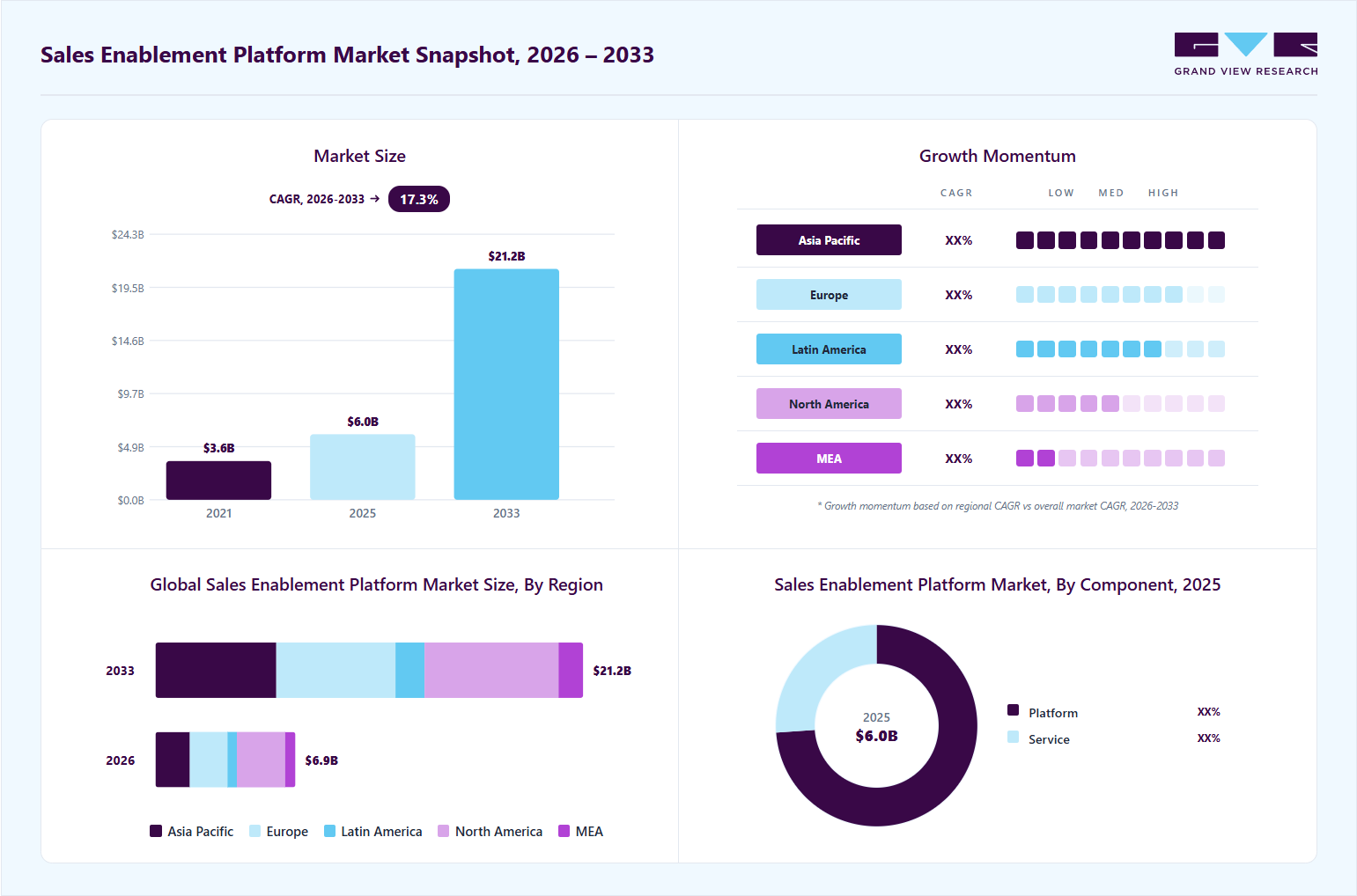
The global sales enablement platform market size was valued at USD 6.0 billion in 2025 and is projected to grow from USD 6.9 billion in 2026 to USD 21.2 billion by 2033, growing at a CAGR of 17.3% from 2026 to 2033. North America dominated the market with the largest revenue share of 34.9% in 2025. The market is experiencing robust growth primarily driven by the rising demand for real-time data and analytics, which enhance decision-making and optimize sales strategies.
Key Market Trends & Insights
- By component: Platform segment led the market with the largest revenue share of 73.9% in 2025.
- By deployment: Cloud segment led the market with the largest revenue share of 54.4% in 2025.
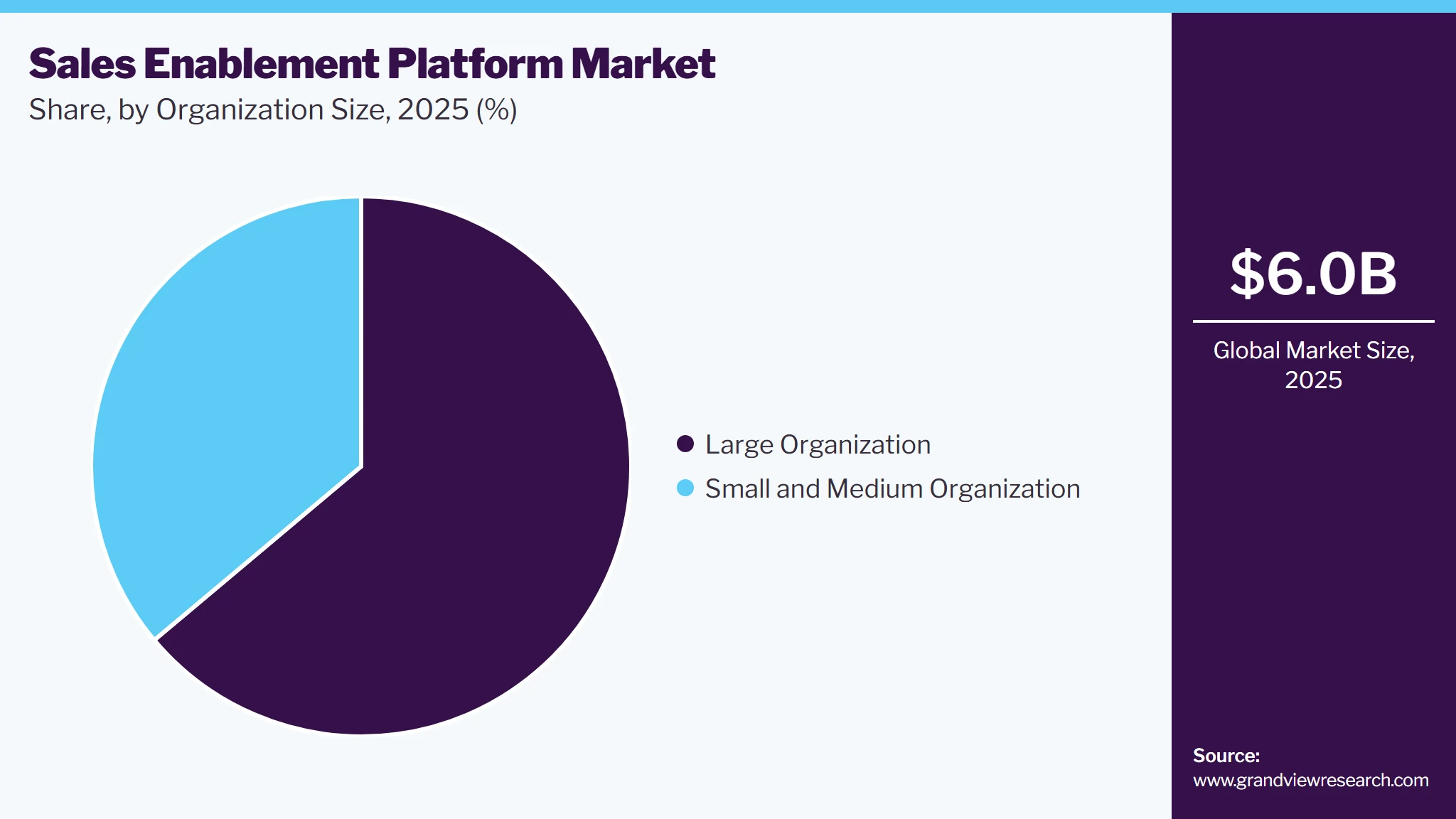
- By enterprise size: Large enterprise segment led the market with the largest revenue share of 63.9% in 2025.
- By end use: Consumer goods & retail segment led the market with the largest revenue share of 26.8% in 2025
Regional Highlights
- Largest regional market: North America (34.9% revenue share, 2025)
- By country: The U.S. held the largest market share in 2025.
Market Size & Forecast
- Market size in 2025: USD 6.0 Billion
- Estimated market size in 2026: USD 6.9 Billion
- Projected market size by 2033: USD 21.2 Billion
- CAGR (2026-2033): 17.3%
Another significant driver is the growing automation of sales processes to streamline workflows and improve efficiency. In addition, the rise of personalized customer experiences and tailored content is pushing companies to adopt sales enablement solutions that can deliver targeted and relevant interactions, further fueling market expansion.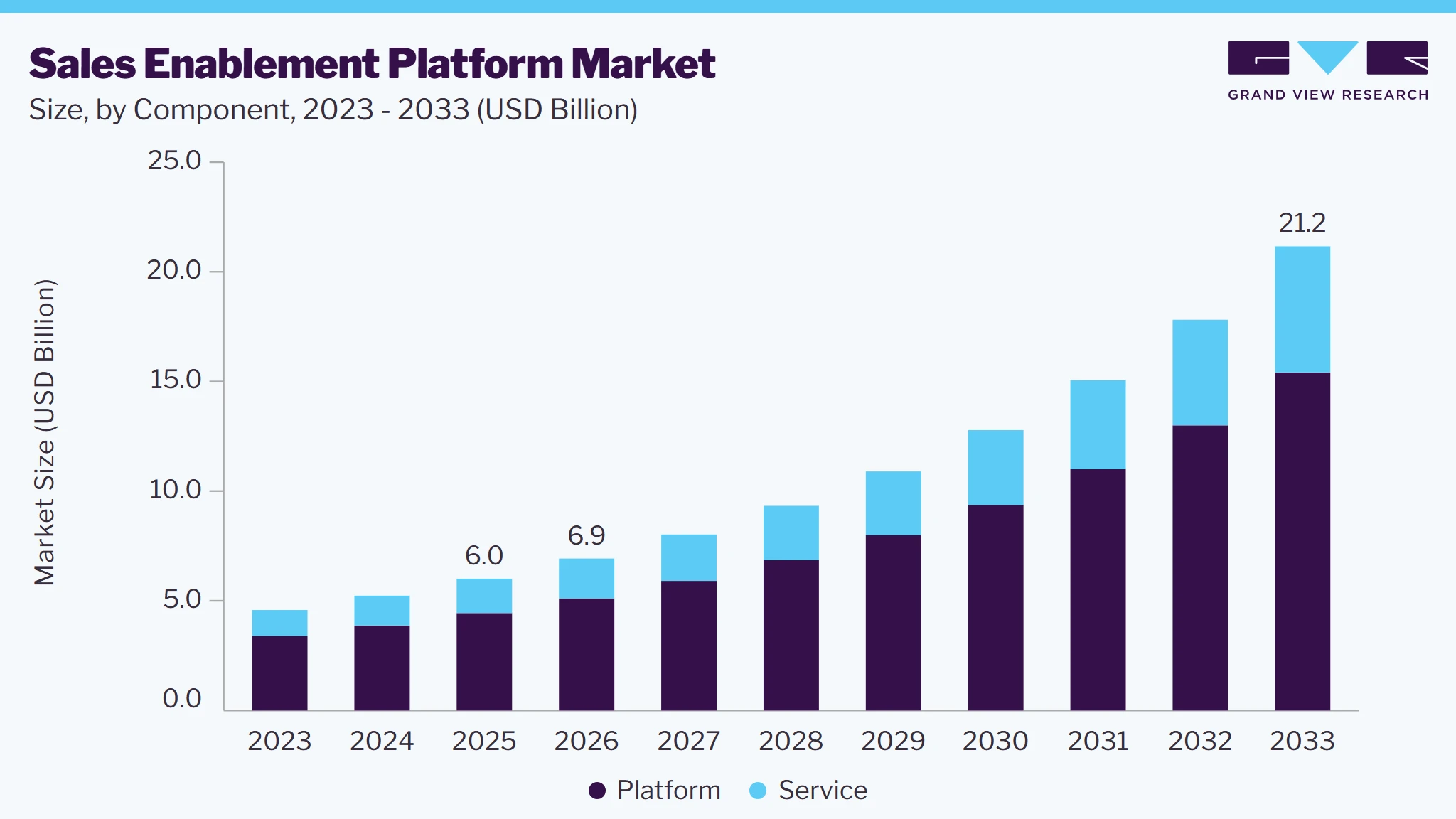
The growing use of technologies such as Artificial Intelligence (AI) and Machine Learning (ML) is transforming the sales enablement platform market by enhancing sales operations, interactions with customers, and closing deals. AI and ML algorithms can analyze vast amounts of data to uncover patterns and insights that would be impossible for humans to identify quickly. This capability allows sales teams to tailor their approaches based on predictive analytics, forecasting customer behavior, and identifying the best strategies for engaging potential clients. With AI, sales enablement platforms can provide real-time recommendations on content, messaging, and next steps, significantly improving the efficiency and effectiveness of sales processes.
The growing demand for content personalization is one of the leading drivers of market growth. Sales enablement platforms equip sales teams with the tools to create, manage, and deliver tailored content that resonates with individual customer needs and preferences. This personalized approach enhances the customer experience and significantly improves the chances of converting leads into sales. In a May 2024 survey conducted by Exclaimer, a UK-based information technology company, 86% of respondents considered personalized one-on-one marketing crucial for B2B marketing success, with most acknowledging its significance. 58% of the respondents believed that data-driven marketing is the most successful one-on-one marketing method. Personalized marketing strategies are yielding increasingly promising results owing to the growing volumes of customer data accessible to marketers over the past decade, revolutionizing automation efforts.
In addition to the CRM systems, sales enablement platforms are also integrating with a variety of other tools to create a more cohesive sales ecosystem. These include marketing automation software, content management systems, communication tools, and analytics platforms. For instance, integration with marketing automation software allows for better alignment between sales and marketing teams, ensuring that sales teams have access to the latest marketing content and insights. Similarly, integration with communication tools such as Slack or Microsoft Teams facilitates real-time collaboration and information sharing among team members.
In March 2024, TransUnion, a U.S.-based information technology company, introduced OneTru, a solution enablement platform that offers a complete and more persistent picture of a consumer. It manages and delivers data and insights by unifying separate data and analytics assets related to aspects such as credit risk, marketing, and fraud prevention. This integration enhances accuracy, compliance, and contextual insights, addressing the growing challenges of data volume, variety, and regulatory concerns. The market is witnessing the growing demand for such solutions that enable users to integrate with other tools and features that can improve the outcomes of sales practices.
Market Dynamics
The sales enablement platform market is experiencing strong growth as organizations increasingly focus on improving sales productivity, streamlining customer engagement, and enhancing revenue generation through data-driven selling strategies. Sales enablement platforms provide centralized solutions for content management, sales training, coaching, buyer engagement, analytics, and AI-powered recommendations, enabling sales teams to deliver more personalized and effective customer interactions. The growing adoption of digital selling models, remote and hybrid work environments, customer relationship management (CRM) integration, and artificial intelligence technologies is accelerating demand for advanced sales enablement solutions across industries.
The increasing adoption of artificial intelligence (AI), machine learning, and digital selling strategies is a major driver of the Sales Enablement Platform market. Organizations are leveraging sales enablement solutions to automate repetitive tasks, optimize content delivery, improve lead qualification, and provide real-time insights that help sales representatives engage prospects more effectively. The growing shift toward virtual selling, omnichannel customer engagement, and personalized buyer experiences has further increased the need for platforms that can align sales and marketing efforts while improving conversion rates. As businesses continue investing in revenue intelligence, predictive analytics, and AI-driven coaching tools, sales enablement platforms are becoming essential for enhancing sales performance and accelerating revenue growth.
For instance, in February 2026, Gong introduced Mission Andromeda, a major platform upgrade that added AI-powered sales coaching, conversational intelligence, sales-focused chatbots, and unified account management capabilities. The release was designed to help revenue teams improve sales execution, coaching effectiveness, and customer engagement through AI-driven insights and workflow automation. Such developments demonstrate the increasing role of AI in modern sales enablement platforms and reinforce the market's growth trajectory.
Data integration complexities and organizational adoption challenges remain significant restraints for the Sales Enablement Platform market. Many enterprises operate multiple sales, marketing, customer service, and CRM systems that require seamless integration with sales enablement platforms to ensure data consistency and workflow efficiency. Integrating disparate data sources can be time-consuming, costly, and technically challenging, particularly for large organizations with legacy IT environments.
In addition, successful implementation often requires significant changes to sales processes, employee training, and organizational culture. Resistance to adopting new technologies, inadequate user engagement, and inconsistent utilization across sales teams can limit the effectiveness and return on investment of sales enablement initiatives. These challenges may slow deployment timelines and hinder broader market adoption.
The rapid advancement of revenue intelligence solutions, generative AI technologies, and digital buyer engagement platforms is creating substantial opportunities for the Sales Enablement Platform market. Generative AI is enabling sales teams to automatically create personalized outreach content, sales presentations, proposals, and customer communications while reducing administrative workloads. Revenue intelligence capabilities are providing deeper visibility into pipeline performance, customer behavior, and sales forecasting accuracy, helping organizations make more informed business decisions.
Furthermore, increasing demand for personalized customer experiences and data-driven selling is encouraging businesses to invest in advanced buyer engagement technologies that facilitate seamless interactions across multiple channels. As organizations prioritize sales effectiveness, customer retention, and revenue optimization, the integration of AI-powered analytics, conversational intelligence, and automated coaching capabilities is expected to create significant long-term growth opportunities for sales enablement platform providers.
Analyst Perspective
The sales enablement platform market sits at the intersection of several powerful structural growth drivers, including accelerating digital selling adoption, increasing use of artificial intelligence (AI) in sales processes, growing demand for data-driven customer engagement, and expanding enterprise investments in revenue optimization. As organizations increasingly prioritize sales productivity, buyer personalization, and alignment between sales and marketing teams, sales enablement platforms have emerged as critical tools for improving sales effectiveness and shortening deal cycles. The market also benefits from long-term demand generated by remote and hybrid selling models, omnichannel customer engagement strategies, revenue intelligence adoption, and the growing need for continuous sales training and coaching. The central competitive advantage, however, will belong to providers that can seamlessly integrate AI-powered insights, content management, sales coaching, buyer engagement tools, advanced analytics, and CRM ecosystem connectivity into a unified platform that enhances revenue generation and sales performance.
Component Insights
Based on component, the platform segment led the market with the largest revenue share of 73.9% in 2025. The emphasis on streamlining operational tasks and reducing repetitive activities is among the primary drivers driving the demand for sales enablement platforms. In recent years, companies have been investing significantly in enhancing their sales processes. At this juncture, sales enablement platforms offer a unified platform for businesses to connect sellers to relevant content, deliver real-time visibility into customer engagement, and provide flexible methods for presenting content. Additionally, these platforms provide sellers with the right training and guidance, guiding and training them on content management techniques and sales communication skills. As such, sales enablement platforms can ensure that sales teams have access to up-to-date information, effective training programs, and the tools needed to engage with customers effectively, a comprehensive approach that enhances the overall efficiency and productivity of the sales teams and leads to improved sales outcomes and customer satisfaction.
The services segment is expected to grow at a significant CAGR during the forecast period. The growth of the service segment can be attributed to the increasing demand for specialized expertise in deploying and managing sales enablement platforms as organizations strive to maximize their Return on Investment (ROI) from these advanced solutions. The implementation of advanced sales enablement platforms can be a typically complex and sophisticated task requiring expert guidance. Organizations across various industries are looking forward to implementing sales enablement platforms and training programs customized and tailored to their specific needs.
Deployment Insights
Based on deployment, the cloud segment led the market with the largest revenue share of 54.4% in 2025. The cloud segment is poised for significant growth, driven by several compelling factors, including the scalability and agility offered by cloud-based deployment. Cloud-based sales enablement platforms can allow organizations to easily scale their usage based on demand, enabling flexibility in resource utilization and cost management. Cloud-based platforms can also offer flexibility in terms of cost, access, and utilization capabilities. Organizations can subscribe to cloud-based platforms on a pay-per-use basis and access those remotely irrespective of the location. Online accessibility enhances collaboration between geographically dispersed teams, supports remote working, saves operational costs, and enhances productivity. Cloud-based deployment can equally ensure that organizations benefit from continuous updates and new features without deploying any significant internal IT resources.
The on-premise segment is expected to grow at a significant CAGR during the forecast period. The relevance of on-premise sales enablement platforms has grown significantly, particularly among organizations operating in highly regulated industries, such as finance and healthcare. These companies prioritize on-premise solutions to maintain control over their customers’ data and comply with industry-specific regulations. These businesses often have robust in-house IT infrastructure conducive to hosting and managing software internally. On-premise sales enablement platforms also offer a higher degree of customization and integration with existing systems, which helps businesses manage and track sales performance more effectively. Thus, as organizations continue to emphasize data sovereignty and security, on-premise deployments are expected to remain a viable choice, presenting a steady opportunity for the growth of the segment.
Enterprise Size Insights
Based on enterprise size, the large enterprise segment led the market with the largest revenue share of 63.9% in 2025. The growing adoption of sales enablement platforms among large organizations can be attributed to the need to manage distributed sales teams and handle complex sales processes efficiently. Large organizations often deal with extensive product portfolios and diverse customer bases, necessitating sophisticated tools to manage sales activities, track performance, and ensure consistency across sales teams. The rising demand for sales enablement platforms and reporting capabilities, the need for seamless integration, and the focus on improving the productivity of the sales teams and their mutual collaboration are among the major factors driving the demand for sales enablement platforms among large organization.
The small & medium organization segment is expected to grow at a significant pace during the forecast period. The need to streamline sales processes and enhance productivity is prompting small and medium-sized organizations to opt for sales enablement platforms. Small and medium-sized often operate with limited resources and smaller sales teams, making it crucial to maximize efficiency and effectiveness. At this juncture, sales enablement platforms can provide Small and Medium Organization with the tools and insights that were previously accessible only to large organization, democratizing advanced sales techniques and technologies. Other key drivers driving the demand for sales enablement platforms among Small and Medium Organization include the increasing adoption of digital tools by Small and Medium Organization, the need for cost-effective solutions that can provide a competitive edge, and the rising awareness of the benefits of data-driven sales strategies.
End Use Insights
Based on end use, the consumer goods & retail segment led the market with the largest revenue share of 26.8% in 2025. The rising demand for personalized customer offerings, sales channels, and sales scripts are among the key factors driving the demand for sales enablement platforms among consumer goods and retail organizations. Sales enablement platforms boasting sales enablement platform and AI capabilities can enable sales teams to deliver personalized experiences and facilitate tailored interactions and recommendations preferred by most modern consumers. The increasing adoption of e-commerce and omnichannel strategies is also pushing retailers to adopt sophisticated sales enablement tools that can seamlessly integrate online and offline sales activities, ensuring a cohesive customer journey. As retailers gather large volumes of customer data, there is a significant opportunity to implement sales enablement platforms to analyze this data and generate actionable insights to optimize inventory management, predict consumer trends, and enhance promotional strategies.
The IT & telecom segment is expected to grow at a significant rate during the forecast period. The growing adoption of sales enablement platforms by the incumbents of the IT & telecommunications industry can be attributed to the rapid pace of advances in technology and the subsequent need for sales teams to stay updated with the latest products and services. These platforms offer comprehensive resources, such as product information, sales collaterals, and training materials, which enable sales teams to effectively understand the value propositions of complex IT and telecom solutions. On the other hand, the integration capabilities of sales enablement platforms with CRM systems and other enterprise applications can enhance the efficiency and productivity of sales teams, allowing them to focus on building strong customer relationships and closing deals effectively.
Regional Insights
North America dominated the sales enablement platform market with the largest revenue share of 34.9% in 2025. The North America market is witnessing robust growth, primarily driven by the presence of several large organization and the rapid adoption of advanced technologies by these organization. A highly competitive business environment in the U.S. is prompting organization to opt for innovative tools to enhance their sales processes. The emphasis organization are putting on pursuing customer-centric strategies and personalized sales approaches is pushing market players to introduce comprehensive sales enablement solutions.

U.S. Sales Enablement Platform Market Trends
The sales enablement platform market in the U.S. held the largest share in the North America region in 2025. The U.S. market is driven by the presence of several large organization known for the adoption of innovative solutions based on the latest, emerging technologies. Leading organization in the U.S. are aggressively investing in advanced sales enablement tools based on AI and ML to gain actionable insights and streamline sales processes. For instance, in September 2022, Seismic, a provider of sales enablement solutions announced a strategic collaboration with Microsoft Corporation. The collaboration envisaged integrating Seismic's content production, automation, and engagement intelligence with Microsoft Corporation’s Viva Sales as part of the efforts to transform the future of sales operations by streamlining everyday workflows for modern sales representatives.
Europe Sales Enablement Platform Market Trends
The sales enablement platform market in Europe is growing significantly at a CAGR of over 17.8% from 2026 to 2033. The pursuit of personalized selling techniques, growing demand for customized sales management tools catering to diverse customer expectations, and rising emphasis on leveraging AI and analytics to gain actionable insights into sales performance are some of the key factors driving the growth of the Europe market. A noticeable demand for user-friendly, multi-language, and secure sales enablement platforms can be considered the highlight of the European market. Key market players in Europe are introducing innovative solutions to cater to this demand.
Asia Pacific Sales Enablement Platform Market Trends
The sales enablement platform market in the Asia Pacific is growing significantly at a CAGR of over 19.8% from 2026 to 2033. The Asia Pacific market is experiencing robust growth driven by the rapid digital transformation and increasing adoption of advanced technologies. Companies across the region are investing heavily in sales enablement tools to enhance their sales processes and improve productivity. The support various governments are extending toward digitization, the presence of a large customer base, and the rapid use of digital platforms for buying and selling goods across the region are driving the adoption of innovative solutions that support personalized sales operations and data-driven decision-making.
Key Sales Enablement Platform Company Insights
Key players operating in the market are focusing on various strategic initiatives, including new product development, partnerships & collaborations, and agreements to gain a competitive advantage over their rivals. The following are some instances of such initiatives.
-
In February 2024, Sydney FC announced a strategic partnership with Bigtincan, an AI-powered sales enablement platform, to enhance organizational performance through innovative technology. This collaboration aims to leverage Bigtincan's advanced AI capabilities, including personalized skill development apps for players and AI-driven virtual showrooms for fan engagement.
-
In May 2023, Mindtickle announced the acquisition of Enable Us, a provider of digital sales rooms and buyer enablement solutions. The move aims to integrate buyer and sales enablement into a single platform. The acquisition enhances Mindtickle's existing portfolio of revenue productivity tools by allowing sales teams to collaborate more effectively with buyers through personalized content experiences.
-
In May 2023, Rallyware, Inc. announced the acquisition of Myagi, enhancing its capabilities in performance enablement and sales force operations. Myagi's platform, which focuses on retail sales training and communication, will complement Rallyware’s AI-driven performance enablement solutions. This acquisition aims to provide a more comprehensive toolset for improving workforce productivity and sales effectiveness, benefiting both companies’ clients through integrated and advanced training and operational support.
Key Sales Sales Enablement Platform Companies
The following key companies have been profiled for this study on the sales enablement platform market.
-
Accent Technologies, Inc.
-
Bigtincan Holdings Limited
-
Bloomfire
-
Brainshark, Inc.
-
ClearSlide, Inc.
-
Highspot
-
Mediafly
-
Mindtickle Inc.
-
PITCHER AG
-
QorusDocs Ltd.
-
Qstream, Inc.
-
Rallyware, Inc.
-
SAP SE
-
Seismic
Competitive Benchmarking
Category
Operating Strategies
Competitive Edge
Weakness
Established Players (Seismic, Highspot, SAP SE, Mindtickle Inc., Bigtincan Holdings Limited)
Expand AI-powered sales enablement capabilities, revenue intelligence, and conversational analytics across their platforms.
Invest in advanced integrations with CRM, marketing automation, customer engagement, and productivity applications.
Strong brand recognition and extensive enterprise customer bases across multiple industries.
Comprehensive platform offerings that combine content management, sales training, coaching, analytics, and AI-driven insights.
Higher implementation costs and longer deployment cycles for complex enterprise environments.
Greater organizational complexity can reduce agility in responding to niche market requirements.
Emerging Players (Mediafly, Bloomfire, QorusDocs Ltd., PITCHER AG, Qstream, Inc.)
Focus on specialized sales enablement capabilities such as buyer engagement, proposal automation, knowledge management, mobile selling, and sales learning.
Expand market presence through industry-specific solutions and targeted regional growth strategies.
Greater flexibility and agility in introducing new features and responding to changing customer needs.
Strong specialization in specific sales enablement functions that address targeted business challenges.
Smaller customer bases and lower brand visibility compared to established market leaders.
Limited financial resources for large-scale product development, acquisitions, and international expansion.
Sales Enablement Platform Market Report Scope
Report Attribute
Details
Market size value in 2025
USD 6.0 billion
Estimated market size in 2026
USD 6.9 billion
Projected market size by 2033
USD 21.2 billion
Growth rate
CAGR of 17.3% from 2026 to 2033
Base year for estimation
2025
Historical data
2021 - 2024
Forecast period
2026 - 2033
Quantitative units
Revenue in USD million/billion and CAGR from 2026 to 2033
Report coverage
Revenue forecast, company market share, competitive landscape, growth factors, and trends
Segments covered
Component, deployment, organization size, end use, and region
Regional scope
North America; Europe; Asia Pacific; Latin America; MEA
Country scope
U.S.; Canada; Mexico; U.K.; Germany; France; China; India; Japan; Australia; South Korea; Brazil; UAE; Kingdom of Saudi Arabia; South Africa
Key companies profiled
Accent Technologies, Inc.; Bigtincan Holdings Limited; Bloomfire; Brainshark, Inc.; ClearSlide, Inc.; Highspot; Mediafly; Mindtickle Inc.; PITCHER AG; QorusDocs Ltd.; Qstream, Inc.; Rallyware, Inc.; SAP SE; Seismic
Customization scope
Free report customization (equivalent up to 8 analysts' working days) with purchase. Addition or alteration to country, regional & segment scope.
Pricing and purchase options
Avail customized purchase options to meet your exact research needs. Explore purchase options
Global Sales Enablement Platform Market Report Segmentation
This report forecasts revenue growth at global, regional, and country levels and provides an analysis of the latest industry trends in each of the sub-segments from 2021 to 2033. For this study, Grand View Research has segmented the sales enablement platform market report based on component, organization size, deployment, end use, and region:
-
Component Outlook (Revenue, USD Billion, 2021 - 2033)
-
Platform
-
Service
-
-
Deployment Outlook (Revenue, USD Billion, 2021 - 2033)
-
On-premise
-
Cloud
-
-
Organization Size Outlook (Revenue, USD Billion, 2021 - 2033)
-
Large Organization
-
Small and Medium Organization
-
-
End Use Outlook (Revenue, USD Billion, 2021 - 2033)
-
BFSI
-
Consumer Goods & Retail
-
Healthcare & Lifesciences
-
IT & Telecom
-
Manufacturing
-
Others
-
-
Regional Outlook (Revenue, USD Billion, 2021 - 2033)
-
North America
-
U.S.
-
Canada
-
Mexico
-
-
Europe
-
Germany
-
UK
-
France
-
-
Asia Pacific
-
China
-
India
-
Japan
-
South Korea
-
Australia
-
-
Latin America
-
Brazil
-
-
Middle East & Africa
-
U.A.E
-
Saudi Arabia
-
South Africa
-
-
Research Methodology
Segment Definition
Segment - Component
Revenue capture definition
Platform
Revenue is primarily generated through recurring subscription fees charged on a monthly, annual, or multi-year basis for access to sales enablement software. Pricing is typically based on the number of users, sales seats, feature modules, content storage, analytics capabilities, AI-powered functionalities, and integrations with CRM and marketing automation systems.
Service
Revenue is generated through professional and managed services including implementation, deployment, customization, system integration, onboarding, sales training, consulting, technical support, and ongoing optimization services that help organizations maximize platform adoption and sales performance.
Segment - Deployment
Revenue capture definition
On-premise
Revenue is generated through perpetual software licensing fees, infrastructure setup charges, implementation services, maintenance contracts, software upgrades, and technical support provided for deployments hosted within an organization's own IT environment.
Cloud
Revenue is primarily generated through recurring subscription fees for Software-as-a-Service (SaaS) offerings, including access to platform features, cloud hosting, storage, security, analytics, AI-driven capabilities, and continuous software updates delivered through a vendor-managed environment.
Segment - Enterprise Size
Revenue capture definition
Large Enterprises
Revenue is generated through enterprise-wide software subscriptions, custom integrations, advanced analytics, AI-powered sales intelligence modules, dedicated support services, and multi-year licensing agreements deployed across large sales teams and global business operations.
SMEs
Revenue is primarily generated through standardized subscription plans, user-based pricing models, implementation services, and scalable sales enablement solutions designed to improve sales productivity and customer engagement while maintaining cost efficiency.
Segment - End Use
Revenue capture definition
BFSI
Revenue is generated from platform subscriptions and services used to support relationship management, regulatory-compliant sales processes, advisor training, customer acquisition, and personalized financial product sales.
Consumer Goods & Retail
Revenue is generated through subscriptions and services that enable sales teams, distributors, and retail partners to access product information, training content, customer insights, and performance analytics to improve sales effectiveness and channel engagement.
Healthcare & Lifesciences
Revenue is generated from solutions that support pharmaceutical representatives, medical device sales teams, and healthcare organizations with compliant content management, sales training, customer engagement, and performance tracking capabilities.
Media & Entertainment
Revenue is generated through platform subscriptions and associated services that help advertising sales teams, media agencies, broadcasters, publishers, streaming platforms, and entertainment companies manage sales content, train sales representatives, engage advertisers and sponsors, track audience insights, and improve advertising inventory monetization and revenue generation.
IT & Telecom
Revenue is generated through platform subscriptions and services that help technology and telecom sales teams manage complex sales cycles, deliver technical content, engage prospects, and improve pipeline visibility and revenue forecasting.
Manufacturing
Revenue is generated from sales enablement solutions that support distributor networks, field sales teams, dealer channels, product training, and customer engagement activities across industrial and manufacturing sectors.
Others
Revenue is generated from subscriptions and professional services provided to sectors such as education, media, transportation, hospitality, energy, and professional services that utilize sales enablement platforms to enhance sales productivity, content management, and customer interactions.
Estimation Model
Demand Identification Layer
Addressable Market Layer
Adoption & Utilization Layer
Monetisation Layer
Who can benefit from sales enablement platforms?
Who can deploy sales enablement platforms?
Who is actively adopting and using sales enablement platforms?
How much revenue is generated?
Assess the number of potential customers across enterprises, SMBs, sales-driven organizations, and customer-facing teams globally.
Evaluate digital maturity, CRM adoption, sales process sophistication, budget availability, cloud readiness, and integration requirements.
Analyze trends in sales transformation, AI-driven selling, remote/hybrid sales models, content management needs, coaching and training requirements, buyer engagement tools, and productivity optimization initiatives.
Estimate revenue through subscription licenses, per-user pricing, enterprise contracts, AI add-ons, analytics modules, training and onboarding services, professional services, and platform expansion within existing customers.
Target segments
Deployment readiness
Active adoption
Revenue generation
Technology, financial services, healthcare, manufacturing, telecom, retail.
Inside sales, field sales, channel sales, revenue operations teams.
Buyer engagement and sales productivity users.
Subscriptions, services, expansion revenue.
Delivered Customizations
This report has been delivered with the following In-depth customizations
Client Request
Customization Delivered
Value Adds
AI-Powered Sales Enablement, Revenue Intelligence & Digital Selling Assessment
Conducted a focused assessment of adoption trends across AI-powered sales enablement platforms, revenue intelligence solutions, conversational analytics, and digital selling technologies. Evaluated enterprise demand for AI-driven sales coaching, content recommendations, predictive analytics, buyer engagement tools, CRM integrations, and workflow automation across key industries and regions.
Helps stakeholders identify high-growth technology segments, prioritize product investments, evaluate AI-driven sales transformation opportunities, and align business strategies with evolving enterprise sales productivity and customer engagement requirements.
Enterprise Adoption & Industry Vertical Assessment
Analyzed sales enablement platform adoption patterns across BFSI, IT & Telecom, Healthcare & Lifesciences, Retail, Manufacturing, Media & Entertainment, and other sectors. Assessed sales process digitization, remote and hybrid selling models, sales training requirements, customer engagement strategies, content management needs, and integration with CRM and marketing technology ecosystems.
Provides insights into key revenue-generating customer segments, evolving sales enablement requirements, industry-specific use cases, and adoption barriers, enabling targeted go-to-market, product development, and customer acquisition strategies.
Market Expansion, Competitive Landscape & Growth Opportunity Assessment
Evaluated opportunities related to generative AI integration, revenue intelligence expansion, buyer engagement technologies, sales coaching automation, and emerging sales productivity solutions. Assessed challenges associated with platform integration, user adoption, data management, competitive differentiation, and evolving customer expectations across regional markets.
Supports investment and growth decisions by identifying underserved market segments, benchmarking competitors, assessing technology readiness, and uncovering long-term growth opportunities driven by AI innovation, digital selling transformation, revenue optimization initiatives, and increasing demand for data-driven sales execution.
Frequently Asked Questions About This Report
The global sales enablement platform market size was estimated at USD 6.0 billion in 2025 and is expected to reach USD 6.9 billion in 2026.
The global sales enablement platform market is expected to grow at a compound annual growth rate of 17.3% from 2026 to 2033 to reach USD 21.2 billion by 2033.
The sales enablement platform market is experiencing robust growth driven primarily by the increasing demand for real-time data and analytics, which enhance decision-making and optimize sales strategies. Another significant driver is the growing automation of sales processes to streamline workflows and improve efficiency.
North America dominated with 34.9% revenue share in 2025.
Asia Pacific is the fastest-growing region over the forecast period.
The platform segment led with a 73.9% revenue share in 2025, while the service segment is the fastest-growing segment.
The cloud segment led with a 54.4% revenue share in 2025, while the on-premise segment is the fastest-growing segment.
The large enterprise segment led with a 63.9% revenue share in 2025, while SMEs segment is the fastest-growing segment.
Key players operating in the sales enablement platform market include Accent Technologies, Inc.; Bigtincan Holdings Limited; Bloomfire; Brainshark, Inc.; ClearSlide, Inc.; Highspot; Mediafly; Mindtickle Inc.; PITCHER AG; QorusDocs Ltd.; Qstream, Inc.; Rallyware, Inc.; SAP SE; Seismic
About the Author(s)
Next Generation Technologies Research Team
Technology · Next Generation TechnologiesThis report was authored by the next generation technologies research team at Grand View Research - comprising two research analysts, one senior research analyst, and one industry expert - with specialized expertise in the next generation technologies segment of the technology industry. All findings are based on proprietary technology databases, executive interviews, and regulatory analysis, subject to internal peer review prior to publication.
Last Updated:
Speak to Analyst

Need a Tailored Report?
Customize this report to your needs — add regions, segments, or data points, with 20% free customization.
Or view our licence options:


ISO 9001:2015 & 27001:2022 Certified
We are GDPR and CCPA compliant! Your transaction & personal information is safe and secure. For more details, please read our privacy policy.