
- Home
- »
- Communication Services
- »
-
Recruitment Process Outsourcing Market Report, 2026-2033GVR Report cover
![Recruitment Process Outsourcing Market (2026 - 2033)Report]()
Recruitment Process Outsourcing Market (2026 - 2033)
Size, Share & Trends Analysis Report By Type (On-demand, Enterprise, Function), By Service (On-site, Off-site), By Enterprise Size (Small & Medium Enterprises (SMEs)), By End Use (Healthcare), By Region, And Segment Forecasts
Market Size, 2025
$12.8BMarket Estimate, 2026
$14.2BMarket Forecast, 2033
$31.5BCAGR, 2026–2033
12.1%Recruitment Process Outsourcing Market Summary
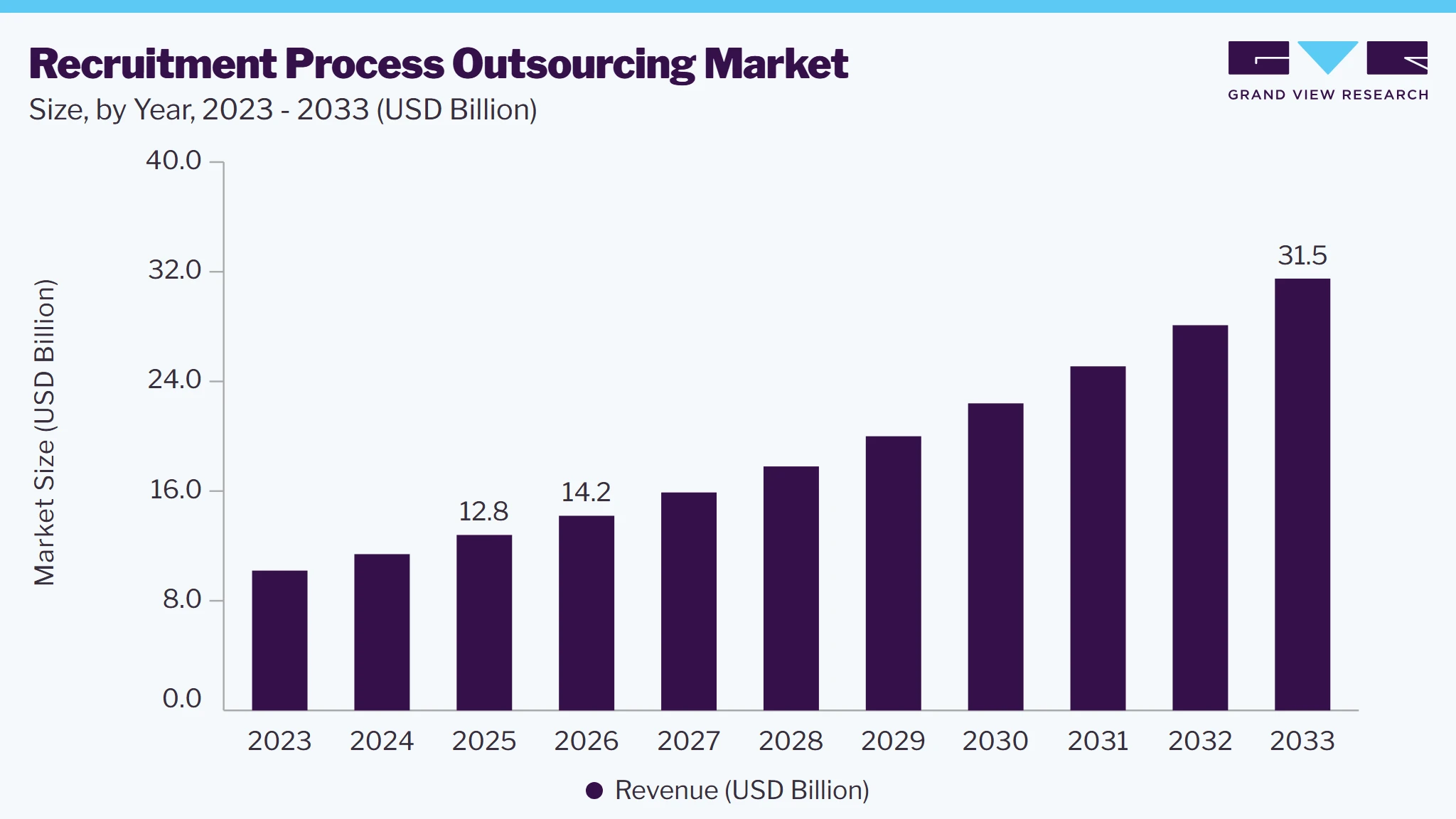
The global recruitment process outsourcing market size was valued at USD 12.8 billion in 2025 and is projected to grow from USD 14.2 billion in 2026 to USD 31.5 billion by 2033, growing at a CAGR of 12.1% from 2026 to 2033. North America dominated the market, accounting for the largest revenue share of over 41.0% in 2025. An effective recruiting process and reducing overhead costs are the primary factors driving the overall market.
Key Market Trends & Insights
- By type: Enterprise-based segment accounted for the largest revenue share of over 55.0% in 2025.
- By service: Off-site segment accounted for the largest revenue share of above 66.0% in 2025.
- By enterprise size: Large enterprise segment accounted for the largest revenue share of approximately 69.0% in 2025.
Regional Highlights
- Largest regional market: North America (41.0% revenue share, 2025)
- Fastest-growing regional market: Asia Pacific (highest CAGR, 2026-2033)
- By country: The U.S. held the largest market share in 2025.
Market Size & Forecast
- 2025 Market Size: USD 12.8 Billion
- 2026 Market Size: USD 14.2 Billion
- 2033 Projected Market Size: USD 31.5 Billion
- CAGR (2026 - 2033): 12.1%
Recruitment process outsourcing (RPO) service providers perform several tasks, from sourcing and candidate selection to maintaining the quality of recruits. Service providers are implementing innovative technologies such as artificial intelligence (AI) and machine learning (ML) to automate interview scheduling and CV screening, enhancing their capabilities. Service providers are further channeling better candidate engagement through chatbots and other assessment tools. AI is expected to be a game-changer in the recruitment industry. It automates candidate sourcing, rediscovery, employee reference, and diversity hiring tasks to improve strategic workforce planning.The growing attrition rate across industries is a key factor in favor of the RPO market. To remain competitive, several service providers readily offer a replacement for any candidate who quits an organization quickly. Moreover, the education system is rapidly evolving, providing hands-on industry experience and advanced skills to both fresh graduates and post-graduates. As a result, selecting the right candidate is becoming increasingly challenging for recruiters. The market is also benefiting from employers' increased focus on core competencies and ways to reduce recruitment costs.
In the automation era, companies are trying to increase or maintain headcount rather than reduce it. Companies invest in digital technologies, requiring a skilled workforce to perform new and complementary tasks to those done by machines. However, the labor shortage and the difficulty of finding just-in-time talent are restraining companies' growth. As a result, the companies outsource hiring, boosting market growth. To bridge the gap between the new skilled workforce requirement and existing resources, only some companies are upskilling their workforce to build the required expertise. Companies are also deploying diverse approaches to address this challenge, including developing a learning culture within the organization to provide career guidance and training sessions.
RPO vendors focus on technology adoption and social media integration to deliver more creative talent sourcing. The leading RPO firms have already adopted big data, cloud, SaaS, and mobile technologies. The introduction of ATS, automatic CV screening for keywords, and self-scheduling interviews enables candidates to improve candidate quality while managing costs. As a result, RPO vendors focus on technology-oriented strategies, most commonly by collaborating with tech providers and developing their proprietary solutions. Moreover, clients are more inclined toward a technologically updated recruitment process. AI and ML, including chatbots and clever assessment tools such as gamification, are the next stage of innovation in RPO.
Small & medium enterprises opt for RPO services to shift from conventional HR activities to strategic decision-making. RPO is becoming more popular as companies emphasize talent acquisition and workforce planning to address human resource challenges. On the other hand, large businesses are looking for a single solution to handle all of their HR needs. Major market players have already introduced robust RPO services.
RPO vendors focus on creating specialized and diverse service offerings to gain a competitive advantage. The specialization lies in geographical footprints, employer segment focus, industry verticals, job families, strategic value addition, type and source of hires, and global sourcing. Moreover, RPO service providers offer a range of recruitment models tailored to clients' needs. The typical model includes on-demand, project-based, and end-to-end RPO.
However, RPO service providers must comply with basic regulations governing employee information security across the organization. For instance, in the U.S., the Health Insurance Portability and Accountability Act (HIPAA) requires companies to safeguard clients' information from being misused. Similarly, the General Data Protection Regulation (GDPR), which applies to organizations operating in the European Union, requires companies to protect the data processed through any system or software.
Market Dynamics
Organizations worldwide face challenges in sourcing, evaluating, hiring, and retaining the talent required to meet dynamic workforce demands and a limited skill pool. The traditional recruitment process often proves inefficient in hiring the right-skilled candidate within the stipulated time windows. This leads to longer turnaround times and improper handling. Companies are now outsourcing their hiring processes to professional RPO firms. This saves considerable time and resources and allows companies to focus on their core competencies.
RPO providers offer dedicated recruitment expertise, advanced sourcing technologies, extensive candidate networks, and scalable hiring solutions that help organizations reduce time-to-hire and cost-per-hire while improving candidate quality. Sectors such as information technology, healthcare, engineering, and BFSI, among others, continuously need an appropriate talent pool for dynamic roles. This is efficiently handled by RPO companies at a fraction of the cost. Several major companies, including IBM, PepsiCo, and Johnson & Johnson, have leveraged RPO partnerships to support large-scale and specialized hiring initiatives.
Leading RPO providers, including Korn Ferry, ManpowerGroup Talent Solutions, and Randstad Sourceright, are integrating advanced technologies and expanding their AI-enabled recruitment capabilities to help clients address talent shortages and improve hiring outcomes. With even changing demand for new skill sets and growing competitiveness among candidates, RPOs with scalable, technology-centric solutions are expected to fuel market growth.
The RPO industry is expected to face several notable restraints. Data security and confidentiality are among the key challenges, as organizations share confidential employee and candidate data with external providers. Some organizations are reluctant to outsource recruitment processes because they fear losing control over the quality of hires, their employer branding policies, and their overall recruitment strategy.
Implementing and switching to RPO services involves considerable expenses, especially for SMEs with smaller budgets than large corporations. In addition, integrating with existing human resource management and recruiting software can create additional issues when migrating to RPO. Furthermore, relying on external providers poses additional risks, including the quality of their services and the likelihood of unsatisfactory recruitment results. Another obstacle related to this issue is the local labor laws across regions, which complicate the delivery of uniform RPO services.
Recruitment process outsourcing (RPO) companies are finding new avenues to effectively recruit their staff. Competition for skilled labor among organizations is growing, encouraging firms to partner with RPO providers to increase the efficiency and speed of recruitment procedures. Owing to the growing preference for telecommuting and flexible working arrangements, outsourcing companies can recruit globally. The development of technological solutions, such as machine learning, artificial intelligence, and recruitment analytics, has improved candidate sourcing, screening, engagement, and hiring efficiency.
Demand for qualified professionals in sectors such as IT, health care, finance, and engineering will drive the outsourcing of recruitment processes. In addition, fostering a startup culture in developing countries will create subsequent growth opportunities for recruitment outsourcing services. The growing employment standards within large organizations regarding diversity, equality, and inclusivity create a significant demand for effective recruitment strategies.
Analyst Perspective
The growing scale of global companies, the complexity of required skills, and the availability of a vast talent pool are major factors encouraging companies to adopt RPO services. RPO service providers are leveraging advanced technologies such as AI and ML to screen, engage, recruit, and retain the most appropriate candidates. This has helped companies improve their recruitment efficiency. RPO also helps companies to follow the regulations of the local labor law and scale their operation without compromising on their core competency. As job roles and required skills become more complex, the demand for RPO is expected to remain high over the coming years.
Type Insights
The enterprise-based segment accounted for the largest revenue share, above 55.0% in 2025. Enterprise engagement RPO, or full-scale or end-to-end recruitment process outsourcing, is a fully outsourced recruitment solution typically provided under multi-year contracts. It is a versatile solution that includes services such as candidate sourcing, screening, scheduling interviews, onboarding, and post-interview monitoring. It reduces the burden of talent pooling, allowing organizations to focus on their core business activities. In the developed economies of the U.S. and the UK, the demand for a full-scale RPO model for hiring against targeted competencies is high in Fortune 500 companies.
The on-demand segment is expected to grow at the fastest CAGR of approximately 17.0% during the forecast period. SMEs recognize the benefits offered by RPO providers and are duly adopting the services for their recruitment needs. Owing to budget constraints, SMEs often prefer cost-effective recruitment models. On-demand RPO serves this purpose by providing flexible, scalable, and low-cost services as needed. Using this model, the organization can scale its recruiting capabilities based on business demand. As a result, the on-demand segment is gaining traction and is likely to grow strongly over the forecast period.
Service Insights
The off-site segment accounted for the largest revenue share of approximately 66.0% in 2025. Off-site recruitment process outsourcing provides a centralized approach to client hiring for various locations. The recruitment firms work with clients to provide the best talent globally. In this process, recruitment firms follow the best practices and personalized approaches to drive optimal results and encourage more diverse hiring. Countries have different employment laws and hiring cultures, which must be considered in recruitment. RPO firms play a crucial role in international hiring by leveraging deep knowledge of the region and its culture, as well as expertise in labor laws and standards. These firms follow proper record-keeping, compliance regulations, and auditable processes and methods. As a result, multinational companies are embracing RPO services for their global recruitment programs.
The on-site segment is estimated to register the fastest CAGR of above 17.0% over the forecast period. On-site service is the extension of the company's existing HR department. A recruitment service provider works with the company's HR team to deliver a holistic hiring solution. Several end-use industries widely adopt on-site services, as they build effective relationships between the recruiter and the RPO firm, simplify the hiring process by providing a single point of contact, and improve service efficiency and effectiveness. The on-site service model provides the client with transparency into recruitment fees and the number of agencies involved.
Enterprise Size Insights
The large enterprise segment accounted for the largest revenue share of approximately 69.0% in 2025. There is an enormous demand for outsourced recruitment services in large enterprises across the manufacturing, financial services, and pharmaceutical sectors. Most of this demand comes from Greenfield projects, in which companies must establish full-fledged HR departments and seek staffing partners to provide end-to-end recruitment solutions. Moreover, large firms have larger budgets and require more sophisticated services, including recruitment and other HR functions, 360-degree interviewing, recruitment audits, and applications.
The small and medium segment is estimated to register the fastest CAGR of above 17.0% over the forecast period. SMEs often have a dedicated HR team that handles recruitment and other functions, such as payroll, training, and employee relations. These firms need more budget and a quick turnaround time for recruiting candidates. However, SMEs need help managing continuous fluctuations in the hiring process. SMEs focus on reducing total recruiting costs and simplifying the recruitment experience for potential candidates, which has led to increased adoption of RPO among SMEs.
End Use Insights
The BFSI segment held the largest revenue share of above 28.0% in 2025. The financial sector is evolving rapidly due to digital disruptions, changing operating models, and new market entrants. Owing to the challenges associated with hiring and developing people with the required skills and knowledge base, financial institutions prioritize outsourcing their recruitment processes to recruit top talent. The sector comprises insurance companies, commercial banks, co-operatives, asset management firms, venture capitalists, and other small financial bodies. The growth of these entities translates into substantial economic activities, leading to direct or indirect job creation. Stable economic growth and rising per capita income in developing countries also drive demand for financial services. As a result, credit, insurance, and investment penetration are rising among lower-income groups, indicating the sector's strong growth.
The healthcare segment is expected to grow at the fastest CAGR of approximately 18.0% over the forecast period. The healthcare sector is relatively diverse, from hospitals, enterprises, home healthcare services, community care facilities for elders, and medical and diagnostic labs. All these healthcare verticals require a skilled workforce to operate in a regulated environment. Personal care and home health aides are the fastest-growing occupations in the healthcare sector. The demand for healthcare services from the aging population and people with chronic conditions is expected to drive employment growth in the sector in the near future. Technological proliferation is expected to create additional employment opportunities in the healthcare sector, thereby increasing the need for outsourced recruitment.
Regional Insights
North America dominated the market, accounting for the largest revenue share of over 41.0% in 2025. The United States dominated the regional market that year and is likely to maintain its dominance throughout the projection period. The US economy is resuming normalcy, with improved employment rates, increased demand for higher education qualifications, and upskilling in new industries. Furthermore, the healthcare and manufacturing industries, particularly healthcare, are creating new job opportunities across the country. Several government initiatives and favorable conditions have helped revive the industrial sector in the United States, creating new jobs.

Canada Recruitment Process Outsourcing Market Trends
The recruitment process outsourcing market in Canada, with its four provinces of Ontario, Alberta, British Columbia, and Quebec, considerably contributes to the RPO market in North America. These provinces outsource the majority of their hiring needs, producing more than half of all money in Canada. Because of the growing migration from other South American countries, Mexico has experienced strong growth in recent years. Employers in Mexico intend to increase employment while maintaining a consistent hiring process, creating potential development opportunities for service providers.
Asia Pacific Recruitment Process Outsourcing Market Trends
The recruitment process outsourcing market in the Asia Pacific is expected to grow at the fastest CAGR of above 19.0% during the forecast period. RPO service providers are increasing their presence in fast-growing regional markets, including the Asia Pacific. Increased investments by international corporations across numerous sectors drive expansion, as these companies continually seek ways to remain competitive. Many recruitment outsourcing transactions have been observed in regions with rapidly expanding labor markets, such as India and China.
The area is expected to increase significantly over the projected period due to the growing number of small, medium, and large companies in the Asia Pacific. Furthermore, the regional market is expected to be driven by the expansion of international corporations. Due to strong expansion in sectors such as healthcare, information technology, and manufacturing, India is expected to grow rapidly over the next seven years.
Many small & medium logistics firms need more dedicated HR departments. A single employee is responsible for all HR-related tasks, including recruiting, payroll, and administrative work. These firms sometimes need to be equipped with digital resources and are doing their jobs traditionally. For instance, in the Asia Pacific region, face-to-face meetings are still considered more valuable. Moreover, changing the supply chain management system requires financial investment, time, and resources; thus, companies sometimes avoid implementing it. Therefore, in the initial years, the logistics sector has yet to take advantage of the advantages offered by RPO services.
Key Recruitment Process Outsourcing Company Insights
Market players are implementing strategies such as product launches, acquisitions, and collaborations to expand their global reach. For instance, in April 2023, Recruiter.com introduced the Recruiter Marketplace to revolutionize talent acquisition. This platform facilitates connections between employers and verified freelance talent acquisition experts by utilizing automation. It offers unparalleled flexibility, cost-effectiveness, and access to a worldwide talent pool. With the Recruiter Marketplace, recruiters can engage with employers project by project, providing a flexible, on-demand solution. It enables businesses, regardless of size, to effectively adjust their hiring efforts according to their needs, giving them a competitive advantage in today's rapidly evolving market.
Key Recruitment Process Outsourcing Companies
The following key companies have been profiled for this study on the recruitment process outsourcing market.
-
ADP, Inc.
-
Alexander Mann Solutions (AMS)
-
Cielo, Inc.
-
Hudson Global Inc.
-
IBM Corporation
-
Manpower Group
-
Korn Ferry
-
People Scout - A True-blue Company
-
Pontoon Solutions
-
Randstad N.V.
-
Seven-step
-
Fortune Media IP Limited
Recent Developments
-
In October 2025, KellyOCG + Sevenstep, a recognized staffing company, was recognized in the Global Recruitment Process Outsourcing (RPO) PEAK Matrix. The company invested in automating, using AI, and adopting mobile tools to simplify hiring processes.
-
In September 2025, Xpheno, a leading specialist staffing firm in India, launched its Recruitment Process Outsourcing (RPO) vertical. The company is positive about capitalizing on the huge potential in the Indian market with this launch.
-
In September 2025, Chapter 2, a global talent recruiter and renowned RPO service provider, announced its expansion in the U.S. market. The company opened its first U.S.-based office in Manhattan. The move was intended to capitalize on the U.S. talent acquisition services market, following its success in EMEA.
Recruitment Process Outsourcing Market Report Scope
Report Attribute
Details
Market size in 2025
USD 12.8 billion
Estimated Market size in 2026
USD 14.2 billion
Projected Market size by 2033
USD 31.5 billion
Growth rate
CAGR of 12.1% from 2026 to 2033
Historical data
2021 - 2025
Forecast period
2026 - 2033
Quantitative units
Revenue in USD billion, and CAGR from 2026 to 2033
Report coverage
Revenue forecast, company ranking, competitive landscape, growth factors, and trends
Segments covered
Type, service, enterprise size, end-use, region
Regional Scope
North America; Europe; Asia Pacific; Latin America; MEA
Country Scope
U.S.; Canada; UK; Germany; France; China; Japan; India; Australia; South Korea; Brazil; Mexico; Saudi Arabia; South Africa; UAE
Key companies profiled
ADP, Inc.; Alexander Mann Solutions (AMS); Cielo, Inc.; Hudson Global Inc.; IBM Corporation; ManpowerGroup; Korn Ferry; PeopleScout — A TrueBlue Company; Pontoon Solutions; Randstad N.V.; Sevenstep; Fortune Media IP Limited
Customization scope
Free report customization (equivalent to up to 8 analysts working days) with purchase. Addition or alteration to country, regional & segment scope.
Pricing and purchase options
Avail of customized purchase options to meet your exact research needs. Explore purchase options
Global Recruitment Process Outsourcing Market Report SegmentationThis report forecasts revenue growth at global, regional, and country levels and provides an analysis of the latest industry trends in each of the sub-segments from 2021 to 2033. For this study, Grand View Research has segmented the global recruitment process outsourcing market based on type, service, enterprise size, end use, and region:
-
Type Outlook (Revenue, USD Billion, 2021 - 2033)
-
On-demand
-
Function-based
-
Enterprise-based
-
-
Service Outlook (Revenue, USD Billion, 2021 - 2033)
-
On-site
-
Off-site
-
-
Enterprise Size Outlook (Revenue, USD Billion, 2021 - 2033)
-
Small & Medium Enterprises (SMEs)
-
Large Enterprises
-
-
End-use Outlook (Revenue, USD Billion, 2021 - 2033)
-
BFSI
-
Healthcare
-
Manufacturing
-
IT & Telecom
-
Education
-
Others
-
-
Regional Outlook (Revenue, USD Billion, 2021 - 2033)
-
North America
-
U.S.
-
Canada
-
-
Europe
-
UK
-
Germany
-
France
-
-
Asia Pacific
-
China
-
Japan
-
India
-
Australia
-
South Korea
-
-
Latin America
-
Brazil
-
Mexico
-
-
Middle East and Africa
-
Saudi Arabia
-
South Africa
-
UAE
-
-
Frequently Asked Questions About This Report
The global recruitment process outsourcing market is expected to grow at a CAGR of 12.1% from 2026 to 2033 to reach USD 31.5 billion by 2033.
North America dominated the global market with a revenue share of 41.0% in 2025.
Some key players operating in the RPO market include ADP, Inc.; Alexander Mann Solutions (AMS); Cielo, Inc.; Hudson Global Inc.; IBM Corporation; ManpowerGroup; Korn Ferry; PeopleScout — A TrueBlue Company; Pontoon Solutions; Randstad N.V.; Sevenstep; Fortune Media IP Limited
The large enterprise segment held the highest market share of 69.0% in 2025.
The global recruitment process outsourcing market size was valued at USD USD 12.8 billion in 2025 and is estimated at USD 14.2 billion in 2026.
About the Author(s)
Communication Services Research Team
Technology · Communication ServicesThis report was authored by the communication services research team at Grand View Research - comprising two research analysts, one senior research analyst, and one industry expert - with specialized expertise in the communication services segment of the technology industry. All findings are based on proprietary technology databases, executive interviews, and regulatory analysis, subject to internal peer review prior to publication.
Last Updated:
Speak to Analyst


Customize this report to your needs — add regions, segments, or data points, with 20% free customization.
Or view our licence options:


ISO 9001:2015 & 27001:2022 Certified
We are GDPR and CCPA compliant! Your transaction & personal information is safe and secure. For more details, please read our privacy policy.


