
- Home
- »
- Technology
- »
-
Online Gaming Market Size, Share & Growth Report, 2033GVR Report cover

Online Gaming Market (2026 - 2033)
Size, Share & Trends Analysis Report By Genre (Action & Adventure, Multiplayer Online Battle Arena, Real-time strategy, Role-playing games), By Device (Computers, Smartphones & Tablets, Gaming Consoles), By Region, And Segment Forecasts
Market Size, 2025
$144.6BMarket Estimate, 2026
$162.6BMarket Forecast, 2033
$280.3BCAGR, 2026–2033
8.1%Online Gaming Market Summary
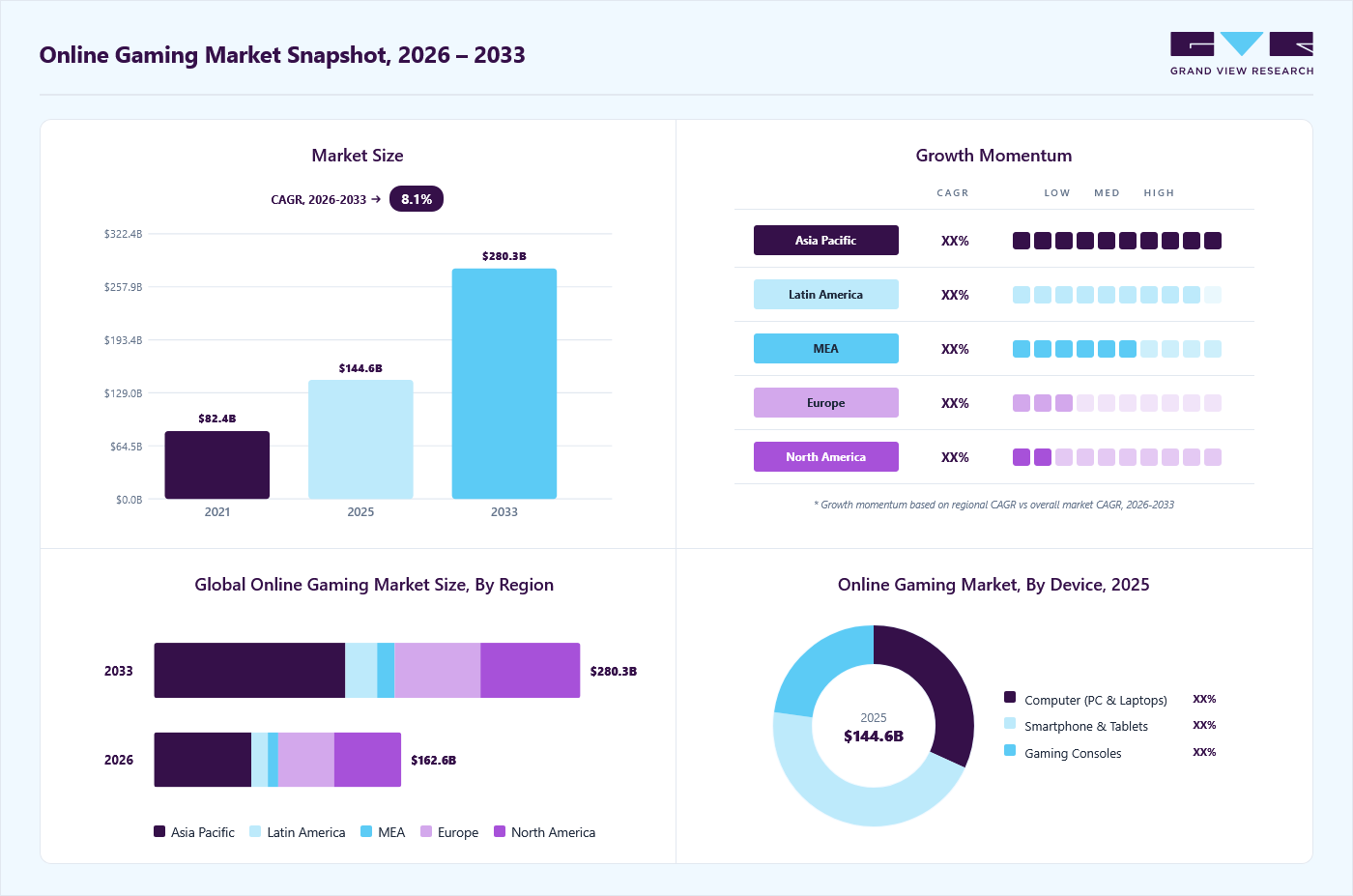
The global online gaming market size was valued at USD 144.6 billion in 2025 and is projected to grow from USD 162.6 billion in 2026 to USD 280.3 billion by 2033, growing at a CAGR of 8.1% from 2026 to 2033. Asia Pacific dominated global market with the largest revenue share of 38.6% in 2025. The industry is driven by the rapid expansion of high-speed internet connectivity and the widespread adoption of smartphones, which have made gaming more accessible and affordable for a diverse global audience.
 Source: Grand View Research, IR Documents, Primary Interviews, Paid DatabasesTo learn more about this report,
 Download Free Sample Report
 Key Market Trends & Insights
- By genre: shooter segment led the market with the largest revenue share of 20.5% in 2025.
- By device: Smartphone & tablets segment led the market with the largest revenue share of 45.3% in 2025.
Regional Highlights
- Largest regional market: Asia Pacific (38.6% revenue share, 2025)
- By country: The China held the largest market share in 2025.
Market Size & Forecast
- Market size in 2025: USD 144.6 Billion
- Estimated market size in 2026: USD 162.6 Billion
- Projected market size by 2033: USD 280.3 Billion
- CAGR (2026-2033): 8.1%
Three ways to get this report
Buy it, customize it, or ask a question.Ask an Analyst
Analyst response in 1 business day
- AccessReport author, directly
- Reply timeWithin 1 working day
- No sales callDirect answer only
- FormatEmail reply
- CostFree, no cost
Get the Full Report
What the study covers
- FormatsPDF · Excel · Dashboard
- Timeline2026–2033 annual, 2025 base
- Coverage20+ countries, 5 regions
- Companies10+ key players profiled
Customize the Report
20% free customization
- IncludeCountries, segments, points
- TailorTo your product definition
- ExtendDeeper competitor detail
- OrA fully bespoke study
- Turnaround5–10 working days
Additionally, advances in technology, including the rollout of 5G networks, cloud gaming platforms, virtual reality (VR), and augmented reality (AR), are also transforming the user experience, enabling smoother gameplay, enhanced graphics, and interactive features, which are expected to drive the online gaming industry in the coming years.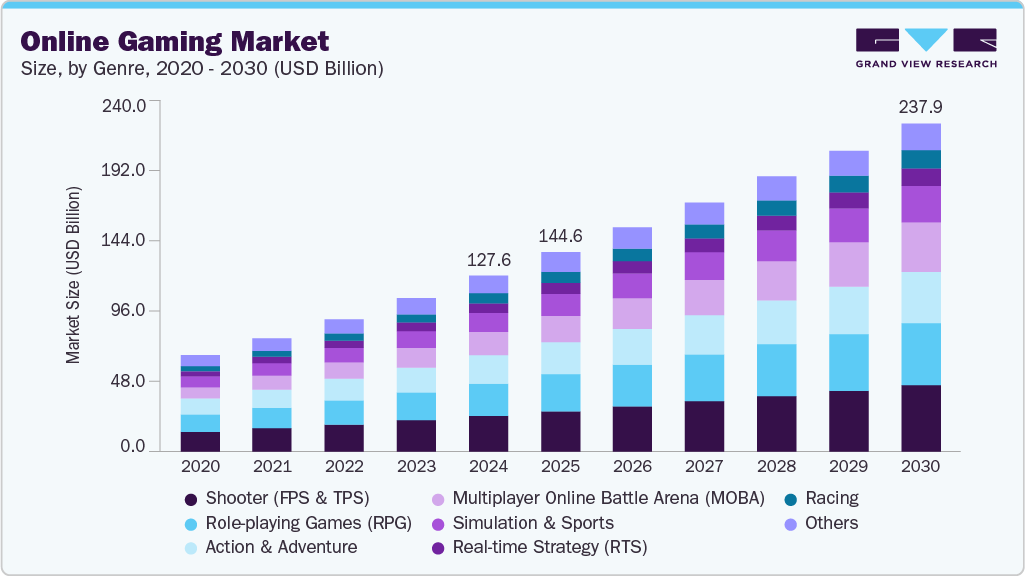 To learn more about this report, Download Free Sample Report
 Additionally, the growing adoption of mobile gaming, expanding digital infrastructure, and rising disposable incomes in emerging economies are the key factors accelerating online gaming industry growth. The widespread availability of affordable smartphones and the migration of popular titles such as PUBG, Fortnite, and Call of Duty to mobile platforms have democratized gaming access. Cloud gaming platforms such as NVIDIA GeForce Now and Xbox Cloud Gaming are also lowering entry barriers by removing the need for expensive consoles.
Additionally, the widespread availability of smartphones has significantly democratized gaming, granting access to digital entertainment across diverse income groups and regions. Budget-friendly devices equipped with powerful processors now enable users to engage in sophisticated, high-quality gaming experiences previously limited to expensive consoles or PCs. This affordability has broadened the gamer demographic, attracting a wider audience ranging from casual to hardcore players, and facilitating online gaming industry expansion, particularly in emerging economies where smartphone penetration is rapidly increasing.
Furthermore, continuous advancements in graphics and visual fidelity have significantly heightened gamer expectations and opened new market opportunities. Techniques such as real-time ray tracing, physically based rendering, and ultra-high-definition displays enable developers to create increasingly lifelike and immersive game worlds. This mutual reinforcement between hardware and software advancements creates a self-sustaining cycle, where progress in one area propels rapid development in the other, driving the expansion and evolution of the gaming industry. For instance, in January 2025, NVIDIA Corporation launched the GeForce RTX 50 Series GPUs, featuring fifth-generation Tensor Cores and real-time ray tracing, which delivered dramatic improvements in graphics quality and rendering speed.
Moreover, companies are investing heavily in advanced technologies such as cloud gaming infrastructure and AI-driven personalization to enhance player experience and operational efficiency. Investments also focus on building immersive experiences through augmented reality (AR) and virtual reality (VR), expanding mobile-first gaming platforms, and developing robust monetization models, including free-to-play games, battle passes, and microtransactions, thus driving sustained revenue growth in the online gaming industry.
Market Dynamics
Online gaming platforms are gaining strong traction as they offer immersive features such as real-time multiplayer gameplay, cross-platform compatibility, cloud gaming access, AI-powered matchmaking, in-game social interaction, and live-streaming integration. These platforms enable players to access a vast range of gaming experiences while enhancing engagement through personalized content, competitive esports, and continuous updates. The growing preference for interactive digital entertainment, coupled with rising smartphone penetration, expanding 5G connectivity, and increasing availability of affordable high-speed internet, is expected to continue driving growth in the online gaming market.
The rapid expansion of smartphone adoption, supported by affordable mobile data plans and widespread 4G and 5G network deployment, is significantly increasing access to digital gaming experiences. Consumers can now participate in multiplayer competitions, social gaming environments, and cloud-based gameplay without the need for expensive hardware. This accessibility is broadening the player base across both developed and emerging economies, encouraging higher participation rates and longer gaming sessions.
Advancements in mobile processing capabilities, graphics performance, and network reliability are further enhancing the overall user experience. Game developers are increasingly optimizing titles for mobile platforms, enabling seamless gameplay and real-time interaction across devices. The combination of portable accessibility, improved connectivity infrastructure, and continuous content updates is encouraging greater user engagement, strengthening player retention, and supporting sustained demand for interactive entertainment experiences.
Increasing regulatory oversight surrounding online gameplay, data privacy, digital payments, and age-appropriate content is creating operational challenges for platform operators. Governments across various regions are implementing stricter compliance requirements related to player protection, cybersecurity, and responsible gaming practices. These evolving regulations can increase administrative complexity while requiring companies to modify existing business models and operational frameworks.
Concerns regarding excessive screen time, in-game spending mechanisms, and youth participation are prompting authorities to introduce additional restrictions on certain gaming activities. Compliance with diverse regional regulations often requires substantial investments in monitoring systems, content moderation, and player verification technologies. Such requirements may increase operating costs and limit monetization flexibility, particularly for smaller developers seeking expansion across multiple international markets.
The increasing adoption of virtual reality, augmented reality, and metaverse-related technologies is creating significant opportunities for enhanced player interaction. These technologies enable highly immersive environments where users can participate in interactive events, virtual communities, and persistent digital worlds. As hardware accessibility improves and technological barriers decline, developers are gaining new avenues to deliver differentiated entertainment experiences beyond traditional gameplay formats.
Gaming companies are increasingly exploring virtual commerce, digital asset ownership, interactive live events, and user-generated content ecosystems to diversify revenue sources. The convergence of immersive technologies with social networking and digital economies is encouraging deeper user participation and longer engagement cycles. As consumer interest in experiential digital environments continues to rise, companies capable of delivering innovative virtual experiences are expected to strengthen their competitive positioning.
Market Concentration & Characteristics
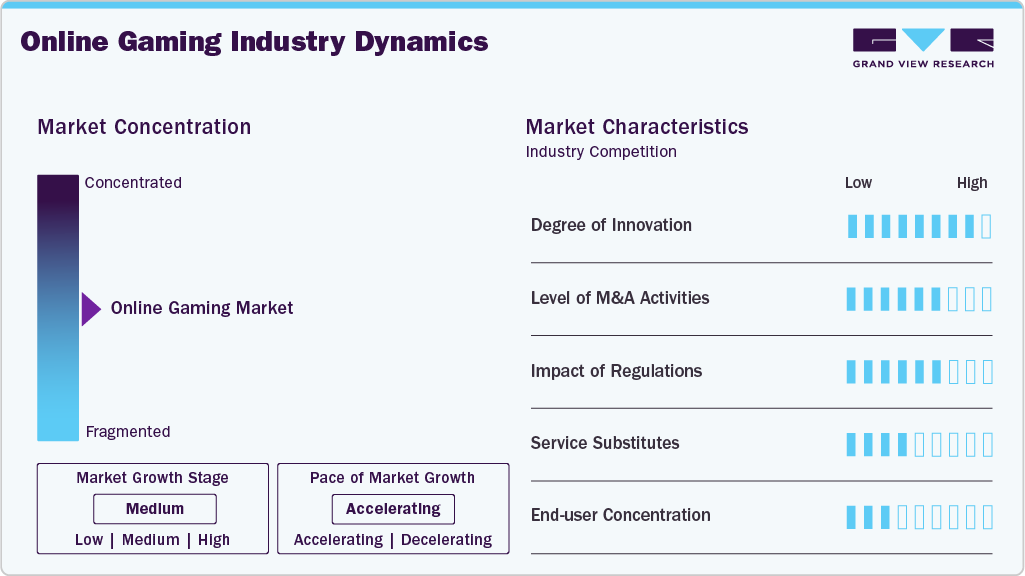
The online gaming market is moderately concentrated, with a mix of leading global game publishers, platform operators, console manufacturers, mobile gaming companies, and emerging cloud gaming providers. The market is expanding due to rising consumer demand for interactive digital entertainment, increasing smartphone penetration, and the growing availability of high-speed internet and advanced gaming infrastructure across developed and emerging economies. Strategic partnerships among game developers, esports organizations, cloud service providers, telecommunications companies, and content creators are becoming increasingly common as companies focus on expanding player reach and enhancing user engagement. Continuous investments in artificial intelligence, cloud gaming technologies, cross-platform functionality, immersive gameplay experiences, and live-service content models are emerging as core competitive strategies across the market.
 To learn more about this report, Download Free Sample Report
 The market is characterized by a very high level of innovation, driven by advancements in cloud-based game streaming, AI-powered personalization, and AR/VR integration technologies. The industry is witnessing moderate merger and acquisition activities as gaming companies seek to strengthen content portfolios, acquire development capabilities, and expand global player communities. Competition from video streaming services, social media platforms, short-form digital content, and other entertainment alternatives remains moderately high, although consumer preference for interactive and community-driven experiences continues to strengthen. Growing investments in esports ecosystems, virtual economies, user-generated content platforms, and immersive digital environments are expected to further reinforce competitive differentiation across the online gaming market.
Analyst Perspective
The online gaming market remains one of the fastest-growing segments within the broader digital entertainment industry. Future competitive leadership will likely be determined by companies that successfully combine cloud gaming infrastructure, cross-platform accessibility, AI-driven personalization, and community-based engagement models. Mobile gaming will continue to dominate user acquisition, while esports, virtual worlds, and immersive AR/VR experiences are expected to create substantial long-term revenue opportunities. Companies capable of building scalable gaming ecosystems with strong monetization frameworks and creator-driven content strategies are expected to capture the largest market share over the forecast period.
Genre Insights
Based on Genre, the shooter segment led the market with the largest revenue share of 20.5% in 2025 and is expected to grow at a CAGR over the forecast period. Companies are leveraging large-scale multiplayer ecosystems and user-generated modes to sustain engagement. The integration of cross-platform functionality and regular content updates keeps the experience fresh. For instance, in August 2025, Epic Games, Inc. introduced a major content expansion for its online shooter with new tactical modes and themed collaborations. The combination of accessibility, innovation, and community engagement ensures shooters remain the most dominant segment in the market.
The multiplayer online battle arena (MOBA) segment is expected to register the fastest CAGR of over 13% from 2025-2030. The segmental growth is driven by real-time team-based competition, evolving esports tournaments, and interactive spectator modes that enhance engagement. Publishers are incorporating AI-driven matchmaking systems and character customization to maintain balanced gameplay. Continuous updates, battle passes, and event-driven content foster loyalty and encourage microtransactions. For instance, in July 2025, Tencent’s multiplayer online battle arena title introduced a global seasonal championship with exclusive digital rewards, significantly boosting participation across mobile and PC platforms.
Device Insights
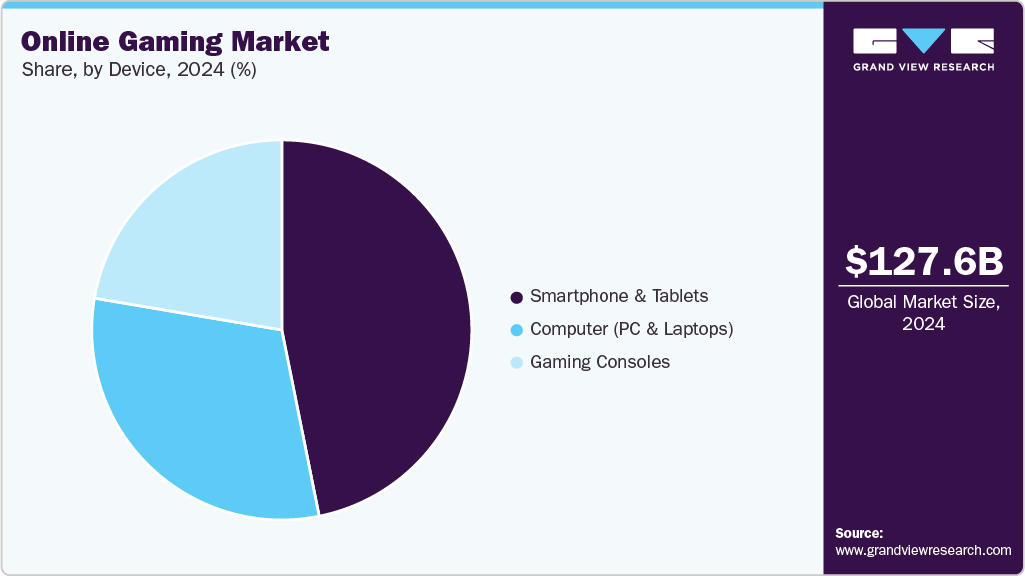
Based on device, the smartphone & tablets segment led the market with the largest revenue share of 45.3% in 2025, owing to widespread accessibility, affordable internet, and quick content updates. Companies such as Apple, Inc., Gameloft SE, and Tencent Holdings Limited are focusing on mobile-first design with cloud integration and localized content. In-app purchases, event-based monetization, and AR-based gaming continue to expand the mobile ecosystem. For instance, in May 2025, Tencent launched a major mobile update that integrated social mini-games and augmented reality missions to boost user engagement.
 To learn more about this report, Download Free Sample Report
 The gaming consoles segment is expected to register significant growth from 2025 to 2030. Companies are focusing on digital game libraries, cross-console online access, and immersive multiplayer experiences. Cloud syncing and social gaming hubs are further strengthening console ecosystems. The console segment continues to evolve as a premium access point for immersive and socially connected online gaming.
Regional Insights
North America accounted for a significant share of over 26% in 2024, driven by high disposable incomes coupled with a mature console and PC ecosystem. Robust broadband and 5G roll-outs support real-time multiplayer and streaming services, boosting engagement. Subscription-based gaming services are increasingly common and encourage longer retention. The strong esports infrastructure and streaming culture further deepen participation and monetization.
U.S. Online Gaming Market Trends
The U.S. online gaming market dominated the region with a share of over 77% in 2024, driven by widespread broadband and mobile penetration enabling high-quality multiplayer experiences, as well as strong adoption of cloud-based game streaming services by gamers. Rising esports viewership and the shift toward in-game social features are encouraging longer play sessions and more in-game monetization.
Europe Online Gaming Market Trends
The online gaming market in Europe accounted for a share of over 22% in 2024, characterized by widespread high-speed internet access, a strong mobile and console gamer base, and digital distribution dominance, where digital purchases accounted for gaming revenues. The region benefits from vibrant esports tournaments, cross-platform launches and localization across multiple languages, helping major players to address diverse markets.
Germany online gaming market is expected to grow in the coming years, driven by the growing time spent on online gaming platforms, especially console and mobile. Investment by gaming startups, competitive gaming events, and the annual Gamescom trade show creates visibility and drives user engagement.
The online gaming market in the UK is rapidly expanding, with strong disposable incomes, sophisticated monetization strategies employed by publishers and advanced infrastructure including widespread fiber broadband and 5G rollout. A well-developed esports ecosystem, prominent streaming culture, and high smartphone penetration drive uptake of competitive and social gaming.
Asia Pacific Online Gaming Market Trends
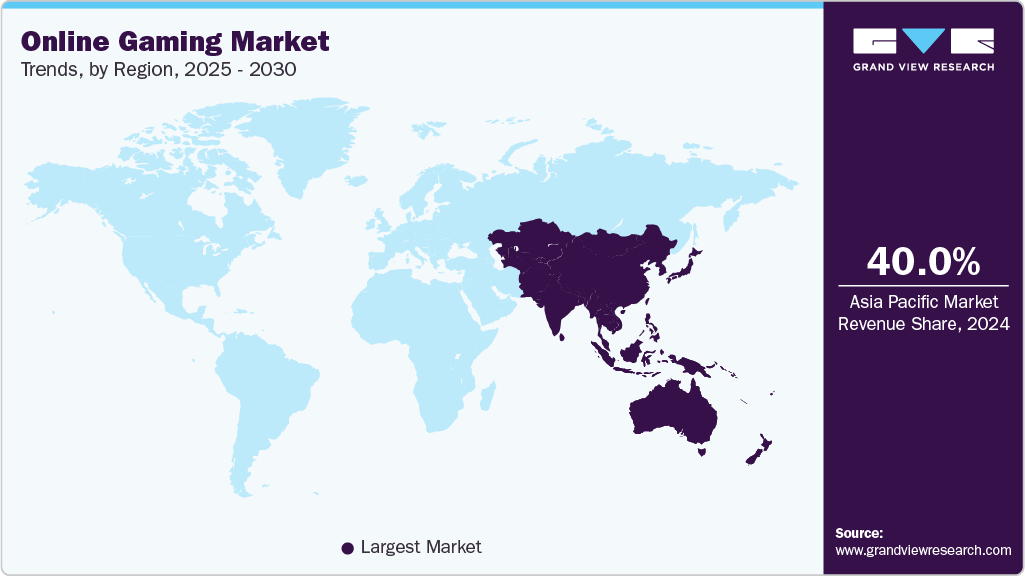
Asia Pacific dominated the online gaming market with the largest revenue share of 38.6% in 2025, owing to massive smartphone penetration, large young populations and strong gaming cultures in countries such as China, Japan, South Korea and India. The region is seeing rapid adoption of live-service models, mobile-first gaming design, in-game microtransactions and cloud gaming. Advanced mobile infrastructure (4G/5G) and rising disposable incomes are enabling more immersive and socially connected gaming experiences.
 To learn more about this report, Download Free Sample Report
 The online gaming market in China held the largest share in the Asia Pacific region in 2025. China online gaming market is driven by massive smartphone and 5G adoption, and the global success of locally developed IPs. Free-to-play monetization models and player spending underpin revenue growth. Growth of premium console/PC titles, global expansion by Chinese studios and integration of AI innovations into gaming platforms further drive the market.
The online gaming market in Japan is rapidly expanding, driven by a long-standing video game culture, high console and mobile adoption, and strong consumer willingness to pay for premium content and season-based game models. Major players regularly launch titles that dominate domestic charts and often perform strongly overseas. The rise of mobile-only games and cloud-enabled experiences is expanding reach beyond traditional console players.
Key Online Gaming Company Insights
Key players operating in the online gaming market are undertaking various initiatives to strengthen their presence and increase the reach of their products and services. Strategies such as expansion activities and partnerships are key in propelling the market growth. Some of the key players operating in the market include Apple, Inc., and Microsoft Corporation, among others.
-
Apple, Inc. is a technology company renowned for its seamless integration of hardware, software, and services across a wide range of devices. The company continues to expand its presence in the online gaming market by leveraging its unified ecosystem, which includes iPhone, iPad, Mac, Apple TV, and the Vision Pro. Apple’s dedicated Games app offers a centralized platform for game discovery, social interaction, and multiplayer connectivity, while Apple Arcade delivers a curated library of exclusive titles. Advanced technologies such as Metal 4 graphics API, real-time cloud savers, and cross-device synchronization enhance gaming performance and player experience.
-
Microsoft Corporation drives the online gaming market through Xbox Cloud Gaming, Game Pass, and cross-platform multiplayer integration. Its ecosystem blends console, PC, and mobile play, providing seamless access via the cloud. Strategic acquisitions and investments in metaverse technologies enhance engagement, making Microsoft a pivotal enabler of connected entertainment experiences.
KRAFTON, Inc. and Bandai Namco Entertainment Inc, are some of the emerging market participants in the online gaming market.
-
KRAFTON, Inc. is a gaming company that develops and publishes innovative, engaging, and memorable gaming experiences across various platforms, including mobile, console, and PC. The company leads the online battle royale segment through evolving content ecosystems within PUBG and Battlegrounds Mobile India. Its focus on localization, live events, and player-driven engagement enhances platform revenue streams. The company’s expansion into tactical and extraction shooters positions Krafton as a core innovator, shaping competitive online gaming markets globally.
-
Bandai Namco Entertainment Inc. is a global publisher and developer leveraging its vast portfolio of intellectual properties and strong multiplayer network capabilities. The company drives user engagement across its online platforms with a hybrid approach that includes live-service releases and esports-ready titles, fostering vibrant, persistent communities around flagship franchises such as Tekken and Dragon Ball. Emphasizing digital content expansions and transmedia integration, Bandai Namco maximizes interactive revenue streams and bolsters its position in the competitive online gaming market.
Key Online Gaming Companies:
The following key companies have been profiled for this study on the online gaming market.
-
Apple, Inc.
-
Bandai Namco Entertainment Inc.
-
Electronic Arts, Inc.
-
Epic Games, Inc.
-
Gameloft SE
-
Krafton Inc.
-
Microsoft Corporation
-
Nintendo Co., Ltd.
-
Peak Games
-
Rovio Entertainment Corporation
-
Sony Interactive Entertainment, Inc.
-
Tencent Holdings Limited
-
Ubisoft Entertainment SA
-
Warner Bros. Entertainment Inc.
-
Zhejiang Century Huatong Group Co., Ltd.
Competitive Benchmarking
Category
Operating Strategies
Competitive Edge
Weakness
Established Players (Tencent Holdings Limited, Microsoft Corporation, Sony Interactive Entertainment, Inc.)
- Focus on expanding cross-platform gaming ecosystems through content, cloud, and community partnerships.
- Invest heavily in live-service development to enhance engagement, retention, and monetization.
- Strong global franchises, loyal player communities, and diversified gaming portfolios.
- Extensive development resources support premium content creation across multiple platforms.
- Dependence on established franchises may limit responsiveness to changing player preferences.
- Large organizational structures can slow innovation compared to agile independent studios.
Emerging Players (Krafton Inc., Peak Games, Zhejiang Century Huatong Group Co., Ltd.)
- Focus on expanding mobile-first gaming portfolios through regional content partnerships.
- Invest in innovative gameplay features to increase engagement across emerging markets.
- Greater agility enables rapid adaptation to evolving player preferences globally.
- Strong niche game offerings support differentiated positioning within competitive segments.
- Limited financial resources may restrict large-scale content development initiatives.
- Smaller user bases can reduce monetization opportunities compared to established competitors.
Recent Developments
-
In September 2025, Electronic Arts, Inc. partnered with New York City FC to connect fans to their favorite football players and club through the EA SPORTS FC platform, focusing on content collaboration and immersive fan experiences. This renewal strengthens EA SPORTS' engagement with sports fans through digital and gaming platforms.
-
In August 2025, Tencent Holdings Limited showcased its largest-ever lineup at Gamescom 2025, emphasizing collaboration with global studios and innovation, particularly toward sustainability and enhanced player engagement globally. This presence underlines Tencent’s international ambitions and innovation drive.
-
In May 2025, Apple, Inc., completed its acquisition of a video-game studio when it bought RAC7. The acquisition is positioned as a targeted move to strengthen Apple Arcade content and bring experienced internal creators into Apple’s gaming/content teams rather than signaling a broad change to Apple’s M&A strategy.
Online Gaming Market Report Scope
Report Attribute
Details
Market size in 2025
USD 144.6 billion
Estimated market size in 2026
USD 162.6 billion
Projected market size by 2033
USD 280.3 billion
Growth rate
CAGR of 8.1% from 2026 to 2033
Base year for estimation
2025
Historical data
2021 - 2024
Forecast period
2026 - 2033
Quantitative units
Revenue in USD billion and CAGR from 2026 to 2033
Report coverage
Revenue forecast, company ranking, competitive landscape, growth factors, and trends
Segments covered
Genre, device, region
Regional scope
North America; Europe; Asia Pacific; Latin America; MEA
Country scope
U.S.; Canada; Mexico; Germany; U.K.; France; China; Japan; India; South Korea; Australia; Brazil; Saudi Arabia; South Africa; UAE
Key companies profiled
Apple Inc.; Bandai Namco Entertainment Inc.; Electronic Arts Inc.; Epic Games Inc.; Gameloft SE; Krafton Inc.; Microsoft Corporation; Nintendo Co., Ltd.; Peak Games; Rovio Entertainment Corporation; Sony Interactive Entertainment Inc.; Tencent Holdings Limited; Ubisoft Entertainment SA; Warner Bros. Entertainment Inc.; Zhejiang Century Huatong Group Co., Ltd.
Customization scope
Free report customization (equivalent up to 8 analysts' working days) with purchase. Addition or alteration to country, regional & segment scope.
Pricing and purchase options
Avail customized purchase options to meet your exact research needs. Explore purchase options
Global Online Gaming Market Report Segmentation
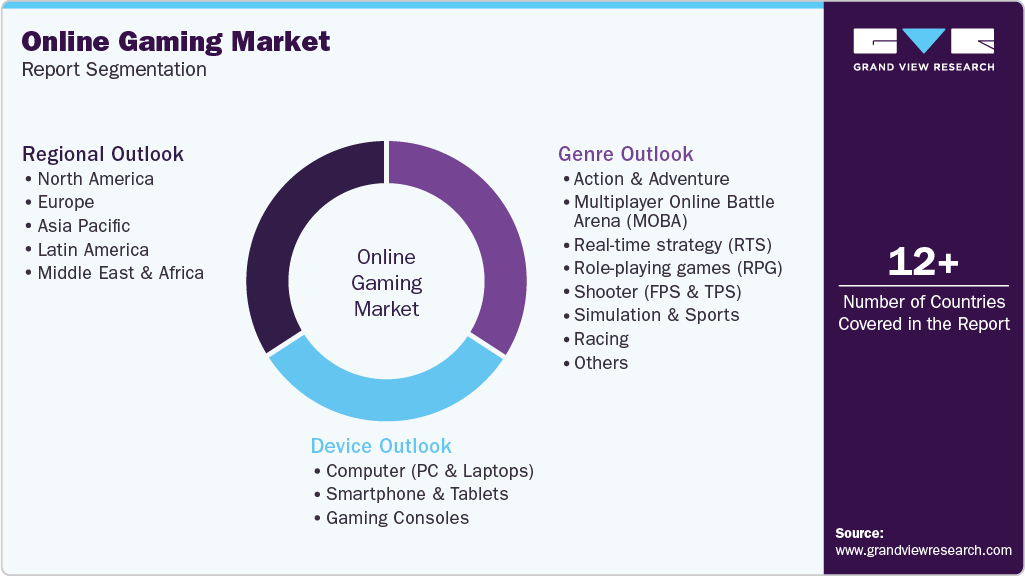
This report forecasts revenue growth at global, regional, and country levels and provides an analysis of the latest industry trends in each of the sub-segments from 2021 to 2033. For this study, Grand View Research has segmented the global online gaming market report based on genre, device, and region:
 To learn more about this report, Download Free Sample Report
 -
Genre Outlook (Revenue, USD Million, 2021 - 2033)
-
Action & Adventure
-
Multiplayer Online Battle Arena (MOBA)
-
Real-time strategy (RTS)
-
Role-playing games (RPG)
-
Shooter (FPS and TPS)
-
Simulation and Sports
-
Racing
-
Others
-
-
Device Outlook (Revenue, USD Million, 2021 - 2033)
-
Computer (PC & Laptops)
-
Smartphone & Tablets
-
Gaming Consoles
-
-
Regional Outlook (Revenue, USD Million, 2021 - 2033)
-
North America
-
U.S.
-
Canada
-
Mexico
-
-
Europe
-
Germany
-
UK
-
France
-
-
Asia Pacific
-
China
-
Japan
-
India
-
South Korea
-
Australia
-
-
Latin America
-
Brazil
-
-
Middle East and Africa (MEA)
-
UAE
-
Saudi Arabia
-
South Africa
-
-
Research Methodology
Segment Definition
Segment - Genre
Revenue capture definition
Action & Adventure
Revenue is generated through premium game purchases, downloadable content, in-game cosmetics, season passes, and live-service monetization models. This segment remains a major contributor to the online gaming market due to its immersive storytelling, open-world exploration, character progression systems, and strong appeal among both casual and dedicated gamers.
Multiplayer Online Battle Arena (MOBA)
Market revenue is driven by in-game purchases, character skins, battle passes, esports sponsorships, and competitive gaming events. The segment benefits from highly engaged player communities, recurring content updates, and strong esports ecosystems that encourage long-term player retention and digital spending.
Real-Time Strategy (RTS)
Revenue is generated through game sales, expansion packs, premium multiplayer features, and participation in competitive tournaments. Demand is supported by players seeking strategic gameplay experiences, resource management mechanics, and skill-based competition across online multiplayer environments.
Role-Playing Games (RPG)
Revenue is generated from game purchases, virtual items, character upgrades, expansion content, and subscription-based services. Strong player engagement is fueled by extensive character customization, narrative-driven experiences, persistent virtual worlds, and multiplayer role-playing ecosystems.
Shooter (FPS and TPS)
Revenue is generated through premium titles, in-game cosmetics, weapon skins, battle passes, esports events, and advertising partnerships. The segment maintains a significant market presence due to competitive gameplay mechanics, multiplayer engagement, and continuous content updates that encourage recurring player expenditure.
Simulation and Sports
Market earnings are supported by annual game releases, downloadable content, virtual currencies, player packs, and online multiplayer subscriptions. Growing consumer interest in realistic gameplay experiences, sports leagues, and life-simulation environments continues to strengthen revenue generation across this category.
Racing
Revenue is derived from game sales, vehicle customization purchases, expansion content, esports competitions, and premium subscription offerings. The segment attracts players through realistic driving experiences, competitive multiplayer racing formats, and partnerships with automotive brands and motorsport organizations.
Others
This category generates revenue through casual games, puzzle games, card games, educational games, sandbox experiences, and emerging gaming formats. Continued innovation in gameplay mechanics and mobile gaming accessibility supports diversified monetization opportunities across niche gaming segments.
Segment - Device
Revenue capture definition
Computer (PC & Laptops)
Revenue is generated through premium game purchases, digital distribution platforms, subscription services, esports participation, and downloadable content. The segment remains important in the online gaming market due to superior hardware capabilities, strong adoption of competitive gaming, extensive game libraries, and strong engagement among core gaming audiences.
Smartphone & Tablets
Market revenue is driven by in-app purchases, advertising, subscriptions, battle passes, and virtual item sales. This segment represents the largest user base in the online gaming market, as consumers increasingly prefer convenient, accessible gaming experiences on mobile devices, supported by widespread internet connectivity.
Gaming Consoles
Revenue is captured through hardware-linked game purchases, online subscription services, downloadable content, digital storefront transactions, and exclusive game releases. Strong brand ecosystems, immersive gaming experiences, and growing multiplayer engagement continue to support sustained spending across console gaming platforms.
Estimation Model
Layer
Key Question
Purpose
Audience Layer
Who are the potential online gaming users?
Identify the total addressable gaming audience by estimating the population with access to digital entertainment technologies such as PCs, consoles, mobile devices, and connectivity across target regions. This establishes the potential online gaming audience from the foundation for market sizing.
Digital Access Layer
Who can access online gaming platforms?
Filter the potential user base based on access to gaming-enabled infrastructure, including high-speed internet connectivity, smartphones, and online gaming platforms. This defines the subset of users capable of participating in online gaming activities.
Engagement Layer
Who actively participates in online gaming?
Apply online gaming adoption rates to the reachable audience and segment users into casual gamers, competitive gamers, eSports participants, mobile gamers, PC gamers, and console gamers. This converts the reachable population into active gaming users based on frequency of play, game genre preferences, and engagement levels.
Monetisation Layer
How much revenue is generated?
Estimate revenue from in-game purchases, downloadable content (DLC), battle passes, premium game sales, subscription services, cloud gaming memberships, advertising revenue, esports participation, and virtual item transactions. Multiply active paying users by average revenue per user (ARPU) to derive total online gaming market revenue.
Delivered Customizations
This report has been delivered with the following In-depth customizations
Client Request
Customization Delivered
Value Adds
Player Growth, Gaming Behavior & Platform Adoption Trends
Conducted a focused analysis of online gaming participation across mobile, PC, console, and cloud gaming platforms, covering player demographics, gameplay frequency, multiplayer engagement, in-game spending patterns, esports participation, social gaming interactions, and regional platform adoption trends.
Helps stakeholders identify high-value player segments, evaluate evolving gaming preferences, and assess monetization opportunities across subscriptions, in-game purchases, advertising, and cross-platform engagement strategies.
Game Monetization, Content Strategy & Player Engagement Trends
Evaluated market trends related to free-to-play gaming models, in-game monetization frameworks, downloadable content adoption, esports ecosystem development, creator-driven content, social features, virtual economies, and player engagement tools including battle passes, loyalty programs, and AI-driven personalization.
Provides insights into emerging player engagement trends, retention strategies, monetization models, and commercially attractive gaming experiences that support platform differentiation and long-term user acquisition.
Gaming Infrastructure, Digital Ecosystem & Market Expansion Opportunity Assessment
Assessed demand for scalable cloud gaming infrastructure, multiplayer networking technologies, digital distribution platforms, payment ecosystems, regional publishing partnerships, and expansion opportunities across developed and emerging gaming markets.
Supports investment and expansion strategies by identifying underserved gaming communities, evaluating platform scalability and infrastructure readiness, and strengthening long-term opportunities within the global online gaming ecosystem.
Frequently Asked Questions About This Report
The global online gaming market was estimated at USD 144.6 billion in 2025 and is expected to reach USD 162.6 billion in 2026.
The U.S. online gaming market accounted for 77.6% of the market in 2025.
Key factors driving the online gaming market include the rapid expansion of high-speed internet connectivity, the widespread adoption of smartphones, and advances in technology, such as the rollout of 5G networks, cloud gaming platforms, virtual reality (VR), and augmented reality (AR).
The Asia Pacific online gaming dominated the market with a share of 38.6% in 2025.
The Asia Pacific is the fastest-growing region over the forecast period.
The shooter segment led with a 20.5% revenue share in 2025, while the multiplayer online battle arena is the fastest-growing segment.
The smartphone & tablets segment led with a 45.3% revenue share in 2025, and is the fastest-growing device.
Some key players operating in the online gaming market include Apple Inc.; Bandai Namco Entertainment Inc.; Electronic Arts Inc.; Epic Games Inc.; Gameloft SE; Krafton Inc.; Microsoft Corporation; Nintendo Co., Ltd.; Peak Games; Rovio Entertainment Corporation; Sony Interactive Entertainment Inc.; Tencent Holdings Limited; Ubisoft Entertainment SA; Warner Bros. Entertainment Inc.; Zhejiang Century Huatong Group Co., Ltd.
The global online gaming market is expected to grow at a compound annual growth rate of 8.1% from 2026 to 2033, and is expected to reach USD 280.3 billion by 2033.
About the Author(s)
Technology Research Team
Research · TechnologyThis report was authored by the technology research team at Grand View Research - comprising two research analysts, one senior research analyst, and one industry expert - with specialized expertise in the technology segment of the research industry. All findings are based on proprietary research databases, executive interviews, and regulatory analysis, subject to internal peer review prior to publication.
Last Updated:
Speak to Analyst

Customize this report to your needs - add regions, segments, or data points, with 20% free customization.
Or view our licence options:


ISO 9001:2015 & 27001:2022 Certified
We are GDPR and CCPA compliant! Your transaction & personal information is safe and secure. For more details, please read our privacy policy.


