
- Home
- »
- Next Generation Technologies
- »
-
Influencer Marketing Platform Market Size Report, 2026-2033GVR Report cover

Influencer Marketing Platform Market (2026 - 2033)
Size, Share & Trends Analysis Report By Application (Campaign Management, Search & Discovery, Analytics & Reporting), By Organization Size, By End-use (Food & Entertainment, Sports & Fitness), By Region, And Segment Forecasts
Market Size, 2025
$34.2BMarket Estimate, 2026
$45.2BMarket Forecast, 2033
$116.2BCAGR, 2026–2033
14.4%Influencer Marketing Platform Market Summary
The global influencer marketing platform market size was valued at USD 34.2 billion in 2025 and is projected to grow from USD 45.2 billion in 2026 to USD 116.2 billion by 2033, at a CAGR of 14.4% from 2026 to 2033. North America dominated the global market, accounting for the largest revenue share of 31.0% in 2025. The market is driven by the rapid growth of social media usage, increasing consumer preference for authentic and personalized brand communication, and the shift of advertising budgets from traditional media to digital channels.
 Source: Grand View Research, IR Documents, Primary Interviews, Paid DatabasesTo learn more about this report,
 Download Free Sample Report
 Key Market Trends & Insights
- By application: Search & discovery segment dominated the market, with a share of 33.9% in 2025.
- By organization size: Large enterprises segment accounted for the largest market share of 75.3% in 2025.
- By end use: Fashion & lifestyle segment held the largest revenue share of 32.0% in 2025.
Regional Highlights
- Largest regional market: North America (31.0% revenue share in 2025)
- Fastest growing regional market: Asia Pacific (highest CAGR, 2026-2033)
- By Country: The U.S. held the largest market share in 2025.
Market Size & Forecast
- Market size in 2025: USD 34.2 Billion
- Estimated market size in 2026: USD 45.2 Billion
- Projected market size by 2033: USD 116.2 Billion
- CAGR (2026-2033): 14.4%
Three ways to get this report
Buy it, customize it, or ask a question.Ask an Analyst
Analyst response in 1 business day
- AccessReport author, directly
- Reply timeWithin 1 working day
- No sales callDirect answer only
- FormatEmail reply
- CostFree, no cost
Get the Full Report
What the study covers
- FormatsPDF · Excel · Dashboard
- Timeline2026–2033 annual, 2025 base
- Coverage20+ countries, 5 regions
- Companies10+ key players profiled
Customize the Report
20% free customization
- IncludeCountries, segments, points
- TailorTo your product definition
- ExtendDeeper competitor detail
- OrA fully bespoke study
- Turnaround5–10 working days
As businesses seek more authentic and targeted ways to reach audiences, influencer marketing platforms have become essential tools for discovering, managing, and measuring influencer campaigns at scale. The growing adoption of platforms such as Instagram, YouTube, TikTok, and emerging social channels is significantly boosting demand for data-driven influencer collaborations. Additionally, the integration of advanced technologies such as artificial intelligence (AI), machine learning (ML), and predictive analytics is enhancing campaign performance by enabling better influencer identification, audience targeting, fraud detection, and ROI measurement. Influencer marketing platforms streamline campaign workflows, automate outreach, and provide real-time analytics, allowing brands to optimize marketing spend and improve engagement outcomes. To learn more about this report, Download Free Sample Report
 The demand for influencer marketing platforms is increasing as organizations seek to enhance brand visibility, audience engagement, and return on marketing investment in an increasingly digital and social media-driven landscape. Many enterprises are rapidly adopting influencer marketing solutions that enable seamless discovery of relevant influencers, centralized campaign management, and performance tracking across multiple social media platforms. These platforms allow brands to efficiently manage collaborations, automate outreach, and analyze campaign effectiveness using real-time data and insights. Additionally, the rapid adoption of technologies such as artificial intelligence (AI), machine learning (ML), and data analytics is driving the need for more advanced, scalable influencer marketing platforms that support audience targeting, sentiment analysis, and fraud detection. Influencer marketing platforms play a critical role in enabling accurate influencer selection, measuring content performance, and optimizing campaign strategies, helping organizations improve engagement rates and make data-driven marketing decisions.
The increasing adoption of digital marketing strategies at scale has significantly transformed how large enterprises engage with their target audiences, enabling them to leverage influencer marketing platforms more effectively than smaller organizations. Large enterprises typically operate across multiple regions and customer segments, requiring sophisticated tools to manage high-volume campaigns, track performance metrics, and ensure brand consistency. Influencer marketing platforms provide these capabilities through centralized dashboards, advanced analytics, and automated campaign management, allowing large organizations to execute complex, multi-channel influencer strategies efficiently. These capabilities enhance personalization, audience targeting, and overall campaign effectiveness, strengthening their dominance in the market.
Furthermore, large enterprises were early adopters of influencer marketing platforms during the COVID-19 pandemic, when traditional advertising channels were disrupted. With larger marketing budgets and greater digital maturity, these organizations quickly shifted toward influencer-driven campaigns to maintain brand visibility and customer engagement. The surge in social media consumption further amplified the effectiveness of such campaigns, encouraging continued investment in influencer marketing platforms. This trend has persisted post-pandemic, as large enterprises continue to prioritize data-driven marketing, long-term influencer partnerships, and global campaign scalability, thereby reinforcing their leading position in the influencer marketing platform market.
Market Dynamics
Influencer marketing platforms are gaining significant traction, offering advanced capabilities such as influencer discovery, campaign management, audience analytics, content performance tracking, fraud detection, and ROI measurement. Additionally, the increasing adoption of digital marketing strategies, growing consumer trust in influencer recommendations, and the rise of AI-powered analytics and automation tools, along with the expansion of social commerce and creator economy ecosystems, are expected to continue driving growth in the influencer marketing platform market.
The influencer marketing platform market is primarily driven by the rapid expansion of social media usage and the growing shift toward creator-led marketing strategies. Consumers increasingly engage with content on platforms such as Instagram, and YouTube, where influencers play a key role in shaping purchase decisions through authentic and relatable storytelling. This has encouraged brands to allocate larger portions of their digital marketing budgets to influencer collaborations.
In addition, the effectiveness of influencer-driven campaigns in generating higher engagement rates compared to traditional advertising is accelerating adoption across industries. Brands are increasingly relying on influencer marketing platforms to identify relevant creators, manage campaigns, and track performance in real time, making influencer marketing a core component of modern digital advertising strategies. Overall, this strong shift toward creator-led engagement and performance-driven marketing is expected to remain a key growth catalyst for the influencer marketing platform market over the forecast period.
A key restraint in the influencer marketing platform market is the increasing concern around influencer fraud and the lack of standardized performance measurement. Issues such as fake followers, bot-generated engagement, and inflated metrics can distort campaign effectiveness and reduce trust in influencer partnerships. This creates uncertainty for brands when selecting influencers and evaluating return on investment.
Additionally, the fragmented nature of social media platforms makes it difficult to accurately measure cross-platform campaign performance. Variations in engagement metrics, attribution challenges, and limited transparency in audience authenticity further complicate performance tracking, limiting the scalability of influencer marketing investments for some organizations.
The expansion of social commerce presents a significant opportunity for the influencer marketing platform market. As platforms increasingly integrate shopping features directly into social media ecosystems, influencers are becoming direct sales channels, enabling seamless discovery-to-purchase journeys. This shift allows brands to link influencer campaigns directly to conversions, improving ROI visibility and campaign effectiveness.
Furthermore, the growing advancements in AI-driven marketing automation are creating new opportunities for platform innovation. AI enables smarter influencer discovery, predictive campaign performance, automated content optimization, and personalized audience targeting. These capabilities are helping brands run more efficient, scalable, and data-driven influencer campaigns, further accelerating market growth.
Market Concentration & Characteristics
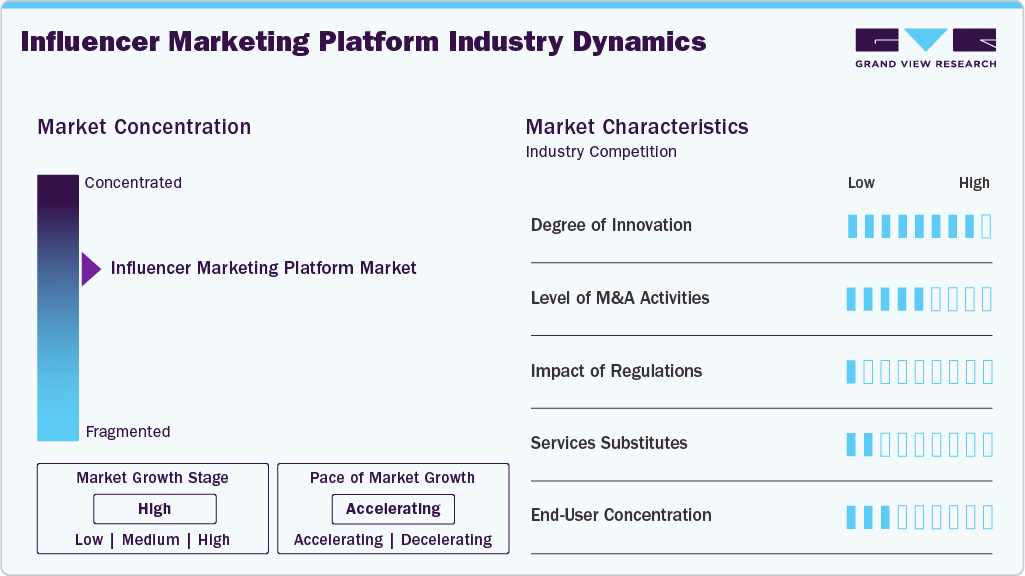
The influencer marketing platform market is moderately concentrated, with a mix of established global social media companies, specialized influencer marketing SaaS providers, digital advertising technology firms, and emerging AI-driven creator economy platform. Strategic collaborations between brands, influencer agencies, content creators, and platform providers are becoming more common as organizations aim to improve campaign targeting, audience matching, and return on investment. Continuous investments in AI-powered influencer discovery, automated campaign management, audience sentiment analysis, fraud detection, and cross-platform performance tracking are emerging as key competitive strategies across the market.
 To learn more about this report, Download Free Sample Report
 The market is characterized by a high level of innovation, driven by advancements in generative AI content creation, predictive analytics for influencer performance, real-time campaign optimization, and automated brand creator matchmaking systems. The industry is witnessing increasing consolidation as digital marketing platforms acquire niche influencer analytics startups and creator management tools to strengthen their end-to-end marketing ecosystems. Competition from traditional advertising channels is declining as influencer-driven social commerce, short-form video monetization, and creator-led brand storytelling deliver higher engagement and conversion rates. Growing investments in social commerce infrastructure, AI-driven personalization engines, and integrated marketing cloud platforms are expected to further accelerate demand across the influencer marketing platform market.
Analyst Perspective
The influencer marketing platform market is shaped by the rapid expansion of digital commerce, rising social media engagement, and the growing shift toward creator-led brand communication, in which audiences respond more strongly to authentic, relatable content than to traditional advertising. The strongest long-term competitive advantage will belong to the provider that can integrate influencer discovery, AI-powered audience intelligence, automated campaign execution, real-time performance analytics, and seamless connectivity with e-commerce and social commerce ecosystems into a unified creator economy platform. Such platforms aims to enable brands to run highly targeted, performance-driven influencer campaigns, continuously optimize marketing spend efficiency, and build scalable, data-backed relationships with creators across global digital channels.
Application Insights
Based on application, the search & discovery segment led the market with the largest revenue share of 33.9% in 2025 and is expected to grow at a CAGR over the forecast period, driven by increased collaborations between brands and influencers for specific campaigns. The search and discovery solutions help companies find the right brand ambassadors by leveraging audience demographics, content performance, and effectiveness. For instance, HypeAuditor provides search and discovery features for various social media platforms, such as Tik Tok, Instagram, and YouTube.
The analytics and reporting segment is expected to register substantial gains over the coming years, owing to the rising need among companies to analyze the critical factors in promotion campaigns, including campaign effectiveness, content penetration, and influencer engagement. These factors allow companies to adjust the content to their requirements. For instance, Smartfluence is a renowned predictive analytics services provider that enables clients to address the potential risks in influencer campaigns.
Organization Size Insights
Based on organization size, the large enterprises segment led the market with the largest revenue share of 75.3% in 2025, owing to the increasing demand for effective and cost-effective marketing strategies. Several large-scale organizations had restricted their business activities during the pandemic. This subsequently reduced their advertising budget, creating the demand for newer promotion tools and leveraging the internet as a primary channel of marketing. Moreover, these enterprises have a significant social media following, which can help them increase engagement through influencers and build effective business relationships.
The SME segment is anticipated to record a significant growth rate over the forecast period. The growth can be credited to the increasing collaboration between these companies and micro- and nano-influencers to create brand awareness and drive traffic to their websites at affordable prices. For instance, in April 2022, a prominent influencer marketing platform Mavrck announced to team up with a leading social media marketing and commerce platform Later for small businesses and creators.
End-use Insights
Based on end use, the fashion & lifestyle segment led the market with the largest revenue share of 32.0% in 2025. This can be ascribed to the increasing adoption of influencer marketing to meet the rising need for high-end lifestyle and fashion brands to be more approachable to people. Various fashion companies employ influencers to advertise new clothes and accessories, thereby keeping people abreast with the latest fashion trends.
 To learn more about this report, Download Free Sample Report
 The food and entertainment segment held a significant revenue share of in 2025, considering the increasing demand for new and diverse entertainment forms such as Over-The-Top (OTT) platforms, mobile game tournaments, and online music events, etc. This significant rise in screen time during the pandemic provided the food and entertainment companies with an opportunity to implement influencer marketing for promoting new online content and events.
Regional Insights
North America dominated the influencer marketing platform market with the largest revenue share of 31.0% in 2025, driven by the strong presence of advanced digital infrastructure, high social media penetration, and early adoption of innovative marketing technologies across the region. The widespread use of platforms such as Instagram, YouTube, TikTok, and Facebook has created a mature ecosystem for influencer marketing, enabling brands to effectively engage with diverse and highly active online audiences. Additionally, the presence of major influencer marketing platform providers, advertising agencies, and global brands in the region significantly contributes to market growth.
 To learn more about this report, Download Free Sample Report
 U.S. Influencer Marketing Platform Market Trends
The influencer marketing platform market in U.S. held the largest share in the North America region in 2025. The U.S. dominates the North America influencer marketing platform market due to its highly advanced digital ecosystem and strong presence of leading social media and technology companies that enable large-scale influencer-driven campaigns. The country has a vast base of enterprises and brands rapidly adopting influencer marketing platforms to enhance customer engagement, improve brand visibility, and drive measurable marketing outcomes across industries such as retail, fashion, beauty, entertainment, and consumer goods.
Additionally, the presence of major platform providers such as Meta Platforms, Google, and YouTube, along with popular social media channels like Instagram and TikTok, is accelerating innovation and adoption of influencer marketing solutions. These platforms provide advanced analytics, audience insights, and content monetization tools, enabling brands to optimize influencer partnerships and campaign performance. The strong focus on data-driven marketing strategies, high digital advertising spends, and continuous technological advancements further support the country’s leading position in the influencer marketing platform market.
Europe Influencer Marketing Platform Market Trends
The Europe influencer marketing platform market is witnessing steady growth, driven by the increasing demand for transparent, compliant, and data-driven marketing solutions across industries. The region benefits from a strong regulatory framework, including data protection requirements such as the General Data Protection Regulation, which is encouraging organizations to adopt influencer marketing platforms that ensure transparency in advertising, secure data handling, and proper disclosure of paid partnerships. Additionally, rising investments in digital transformation and the rapid growth of social media usage are supporting market expansion across countries such as Germany, United Kingdom, and France. Brands in the region are increasingly leveraging influencer marketing platforms to enhance customer engagement, build brand authenticity, and comply with evolving advertising standards.
Asia Pacific Influencer Marketing Platform Market Trends
The Asia Pacific influencer marketing platform market is expanding significantly, driven by rapid digital transformation, increasing social media penetration, and the growing shift toward digital-first advertising strategies across industries. The region benefits from the strong expansion of e-commerce, fintech, and digital services, along with a rapidly growing base of internet and smartphone users across countries such as China, India, and Japan. The rising popularity of social media platforms and content-driven marketing is significantly contributing to market growth.
Additionally, the increasing adoption of advanced technologies such as artificial intelligence (AI), data analytics, and automation tools is enhancing influencer discovery, audience targeting, and campaign performance measurement. Government-led digital initiatives and the rapid growth of small and medium-sized enterprises (SMEs) are further accelerating the demand for scalable and cost-efficient influencer marketing platforms. The need for real-time engagement, improved customer insights, and personalized content strategies is driving widespread adoption of influencer marketing solutions across the Asia-Pacific region.
Key Influencer Marketing Platform Company Insights
The influencer marketing platform market features several key players that significantly shape its global landscape through advanced campaign management capabilities, data-driven insights, and scalable influencer collaboration tools. Upfluence Inc. is a prominent provider of influencer marketing solutions, widely recognized for its comprehensive platform that enables influencer discovery, relationship management, campaign automation, and performance tracking across industries such as retail, fashion, beauty, and consumer goods. The company’s robust technology infrastructure and integration with e-commerce platforms support efficient campaign execution and measurable return on investment.
-
Upfluence Inc. is a global provider of influencer marketing platforms, enabling brands to discover, manage, and collaborate with influencers at scale. Its comprehensive solution offers advanced influencer search, campaign automation, performance analytics, and integrated e-commerce capabilities, allowing organizations to optimize marketing strategies, enhance audience engagement, and drive measurable return on investment across digital channels.
-
Speakr Inc. is a provider of influencer marketing solutions, enabling brands to identify relevant influencers, manage campaigns, and measure performance across multiple social media platforms. Its platform leverages data analytics and audience insights to improve targeting accuracy, streamline campaign execution, and optimize engagement outcomes, helping organizations build effective, scalable influencer marketing strategies.
Key Influencer Marketing Platform Companies:
The following key companies have been profiled for this study on the influencer marketing platform market.
-
Upfluence Inc.
-
Speakr Inc.
-
AspireIQ
-
Grapevine Logic Inc.
-
Mavrck
-
Klear
-
NeoReach
-
Traackr Inc.
-
Webfluential
-
Hypetap Pty Ltd.
Competitive Benchmarking
Category
Operating Strategies
Competitive Edge
Weakness
Established Players (Upfluence Inc., AspireIQ, Mavrck, Traackr Inc.)
- Focus on expanding end-to-end influencer marketing ecosystems including discovery, campaign management, analytics, and creator relationship management.
- Invest heavily in AI-driven influencer identification, performance tracking, and enterprise-grade SaaS integrations with CRM and marketing automation platforms.
- Strong enterprise client base with scalable SaaS platforms and comprehensive feature sets covering the full influencer marketing lifecycle.
- Advanced analytics, automation, and data-driven influencer-matching capabilities deliver high campaign efficiency and ROI optimization.
- High platform complexity can lead to longer onboarding times and dependency on enterprise clients.
- Strong competition from newer AI-native platforms may challenge innovation speed and pricing flexibility.
Emerging & Specialized Players (NeoReach, Klear, Grapevine Logic Inc., Speakr Inc., Webfluent)
- Focus on niche influencer marketing solutions, including data-driven influencer discovery, campaign automation for SMEs, regional influencer networks, and performance-based creator collaborations.
- Emphasize AI-powered analytics, cost-efficient campaign execution, and flexible self-serve platforms. Expand through partnerships with agencies, e-commerce platforms, and social commerce ecosystems.
- Strong agility and innovation in developing lightweight, user-friendly platforms tailored for SMEs and mid-sized brands.
- Competitive advantages in cost efficiency, faster deployment, and specialized influencer databases for targeted industries or regions.
- Limited global footprint and weaker enterprise penetration compared to large SaaS leaders.
- Smaller financial and technological resources may limit large-scale AI development and platform expansion.
Recent Developments
-
In February 2026, Upfluence Inc. announced the launch of an AI-powered influencer discovery and campaign optimization feature within its platform. This enhancement enables brands to identify high-performing influencers through predictive analytics, automate campaign workflows, and gain deeper audience insights to improve targeting and ROI measurement. The update highlights the increasing integration of artificial intelligence in influencer marketing platforms to enhance campaign efficiency and data-driven decision-making
-
In January 2024, Mavrck announced its rebranding and integration with Later, forming a unified social marketing platform aimed at combining influencer marketing, social media management, and commerce capabilities. This development enables brands to manage creator partnerships, content scheduling, and performance tracking within a single ecosystem, enhancing campaign efficiency and measurable outcomes. The move reflects the growing industry trend toward platform consolidation and end-to-end influencer marketing solutions
Influencer Marketing Platform Market Report Scope
Report Attribute
Details
Market size in 2025
USD 34.2 billion
Estimated market size in 2026
USD 45.2 billion
Projected market size by 2033
USD 116.2 billion
Growth rate
CAGR of 14.4% from 2026 to 2033
Base year for estimation
2025
Historical data
2021 - 2024
Forecast period
2026 - 2033
Quantitative units
Revenue in USD billion and CAGR from 2026 to 2033
Report coverage
Revenue forecast, company ranking, competitive landscape, growth factors, and trends
Segments covered
Application, organization size, end use, region
Regional scope
North America; Europe; Asia Pacific; Latin America; MEA
Country scope
U.S., Canada, Germany, UK, France, Russia, Spain, China, India, Japan, Indonesia, Australia & New Zealand, Brazil, Mexico, UAE, Saudi Arabia, South Africa
Key companies profiled
Upfluence Inc.; Speakr Inc.; AspireIQ; Grapevine Logic Inc.; Mavrck; Klear; NeoReach; Traackr Inc.; Webfluential; Hypetap Pty Ltd.
Customization scope
Free report customization (equivalent up to 8 analysts' working days) with purchase. Addition or alteration to country, regional & segment scope.
Pricing and purchase options
Avail customized purchase options to meet your exact research needs. Explore purchase options
Global Influencer Marketing Platform Market Report Segmentation
This report forecasts revenue growth at global, regional, and country levels and provides an analysis of the latest industry trends in each of the sub-segments from 2021 to 2033. For this study, Grand View Research has segmented the global influencer marketing platform market report based on application, organization size, end-use, and region:
 To learn more about this report, Download Free Sample Report
 -
Application Outlook (Revenue, USD Billion, 2021 - 2033)
-
Campaign Management
-
Search & Discovery
-
Analytics & Reporting
-
Influencer Management
-
-
Organization Size Outlook (Revenue, USD Billion, 2021 - 2033)
-
Large Enterprises
-
SMEs
-
-
End Use Outlook (Revenue, USD Billion, 2021 - 2033)
-
Food & Entertainment
-
Sports & Fitness
-
Travel & Holiday
-
Fashion & Lifestyle
-
Others
-
-
Regional Outlook (Revenue, USD Billion, 2021 - 2033)
-
North America
-
U.S.
-
Canada
-
-
Europe
-
U.K.
-
Germany
-
France
-
Russia
-
Spain
-
-
Asia Pacific
-
China
-
Japan
-
India
-
Indonesia
-
Australia & New Zealand
-
-
Latin America
-
Brazil
-
Mexico
-
-
Middle East and Africa (MEA)
-
Saudi Arabia
-
UAE
-
South Africa
-
-
Research Methodology
Segment Definition
Segment - Application
Revenue capture definition
Campaign Management
Revenue is generated through tools and platforms that enable brands to plan, execute, and optimize influencer marketing campaigns. This includes features for campaign creation, content scheduling, collaboration workflows, budget allocation, and performance tracking to ensure efficient execution and improved ROI.
Search & Discovery
Revenue is driven by solutions that help brands identify and shortlist relevant influencers based on audience demographics, engagement rates, niche relevance, and content style. AI-powered search algorithms and databases enable faster and more accurate influencer-brand matching.
Analytics & Reporting
Revenue is captured through advanced analytics tools that provide insights into campaign performance, audience engagement, conversion metrics, reach, and ROI measurement. This segment supports data-driven decision-making and optimization of influencer marketing strategies.
Segment - Organization Size
Revenue capture definition
Large Enterprises
Revenue is generated from adoption of influencer marketing platforms by large organizations with significant marketing budgets. These enterprises use advanced platform features for large-scale campaigns, multi-region execution, deep analytics, and integrated marketing strategies.
SME’s
Revenue is driven by small and medium enterprises adopting cost-effective influencer marketing solutions to enhance brand visibility and customer engagement. SMEs typically focus on targeted campaigns, micro-influencers, and budget-efficient digital marketing tools
Segment - End Use
Revenue capture definition
Food & Entertainment
Revenue is generated through influencer marketing activities by brands in the food, dining, entertainment, and media sectors. This includes collaborations with content creators for product promotions, reviews, events, and experiential marketing campaigns.
Sports & Fitness
Revenue is driven by fitness brands, sports organizations, and wellness companies leveraging influencers for product endorsements, training content, and lifestyle promotion to engage health-conscious audiences.
Travel & Holiday
Revenue is generated through tourism boards, travel agencies, and hospitality brands using influencer campaigns to promote destinations, travel experiences, and holiday packages through visually engaging content.
Fashion & Lifestyle
Revenue is captured from fashion, beauty, and lifestyle brands partnering with influencers to showcase apparel, accessories, grooming products, and lifestyle experiences aimed at trend-conscious consumers.
Others
Revenue is generated from industries not covered in major categories, including education, technology, automotive, and niche consumer goods, where influencer marketing is used for brand awareness and customer engagement.
Estimation Model
Layer Name
Key Question
Description
Digital Marketing Base Layer
Who are the potential influencer marketing platform adopters?
Identify the total addressable market by estimating the number of brands, advertisers, SMEs, e-commerce businesses, startups, agencies, and enterprises actively investing in digital marketing across global and regional markets.
Social & Creator Readiness Layer
Who can implement influencer marketing platforms?
Filter the potential adopter base based on digital maturity, social media adoption intensity, marketing budget availability, content marketing strategy sophistication, e-commerce integration, and ability to engage with creator ecosystems.
Platform Adoption Layer
Who actively uses influencer marketing platforms?
Apply adoption rates to digitally mature organizations and segment usage across campaign management, influencer discovery, analytics, influencer relationship management, and social commerce-driven marketing initiatives.
Revenue Generation Layer
How much revenue is generated?
Estimate revenue from SaaS subscriptions, campaign management tools, analytics and reporting modules, influencer databases, AI-powered discovery engines, transaction fees, managed services, and enterprise platform integrations.
Delivered Customizations
This report has been delivered with the following In-depth customizations
Client Request
Customization Delivered
Value Adds
Influencer Marketing Platform Adoption & Commercialization Trends
Assessed adoption across brands, SMEs, agencies, and enterprises. Analyzed key drivers such as rising social media usage, growth of creator-led marketing, expansion of social commerce, shift of ad spend to digital channels, and demand for measurable campaign performance. Reviewed deployment maturity across awareness, engagement, conversion, and affiliate campaigns.
Helps identify high-growth segments, prioritize investment focus, assess platform readiness, and capture opportunities from creator economy expansion and performance-based marketing.
Influencer Marketing Platform Technology Landscape & Innovation Assessment
Evaluated AI-driven influencer discovery, audience analytics, predictive performance modeling, fraud detection, generative AI content tools, and social listening capabilities. Assessed integration with e-commerce platforms, real-time analytics, and overall platform maturity.
Enables understanding of technology shifts, identification of key innovations, benchmarking of platform capabilities, and prioritization of investments in AI and automation.
Competitive Benchmarking & Strategic Positioning Analysis
Analyzed leading platforms and SaaS providers across product features, influencer databases, AI capabilities, pricing models, integrations, and global reach. Reviewed commercialization strategies and ecosystem partnerships.
Supports strategic decisions by highlighting competitive strengths, differentiation opportunities, partnership potential, and market whitespace areas.
Frequently Asked Questions About This Report
The global influencer marketing platform market size was estimated at USD 34.2 billion in 2025 and is expected to reach USD 45.2 billion in 2026.
Some of the key players in the global influencer marketing platform market include Upfluence Inc.; Speakr Inc.; AspireIQ; Grapevine Logic Inc.; Mavrck; Klear; NeoReach; Traackr Inc.; Webfluential; Hypetap Pty Ltd.
Key factors that are driving the influencer marketing platform market growth include technological disruptions in the influencer marketing industry and the advent of social media.
North America dominated the global market, accounting for the largest revenue share of 31.0% in 2025.
The global influencer marketing platform market is expected to grow at a compound annual growth rate of 14.4% from 2026 to 2033 to reach USD 116.2 billion by 2033.
The search and discovery application segment dominated the global influencer marketing platform market with a share of 33.9% in 2025.
Large enterprises segment accounted for the largest market share of 75.3% in 2025.
Fashion & lifestyle segment held the largest revenue share of 32.0% in 2025.
Asia Pacific is the fastest-growing region over the forecast period.
About the Author(s)
Next Generation Technologies Research Team
Technology · Next Generation TechnologiesThis report was authored by the next generation technologies research team at Grand View Research - comprising two research analysts, one senior research analyst, and one industry expert - with specialized expertise in the next generation technologies segment of the technology industry. All findings are based on proprietary technology databases, executive interviews, and regulatory analysis, subject to internal peer review prior to publication.
Last Updated:
Speak to Analyst

Customize this report to your needs - add regions, segments, or data points, with 20% free customization.
Or view our licence options:


ISO 9001:2015 & 27001:2022 Certified
We are GDPR and CCPA compliant! Your transaction & personal information is safe and secure. For more details, please read our privacy policy.


