
- Home
- »
- Medical Devices
- »
-
Indonesia Medical Imaging Market Size & Share Report, 2033GVR Report cover

Indonesia Medical Imaging Market (2026 - 2033) Size, Share & Trends Analysis Report By Product (X-ray Devices, MRI, Ultrasound, Computed Tomography, Nuclear Imaging, Endoscopy Devices), By Application, By End Use, By Procurement, And Segment Forecasts
Indonesia Medical Imaging Market Summary
The Indonesia medical imaging market size is estimated to be USD 347.4 million in 2025 and is projected to reach USD 527.6 million by 2033, growing at a CAGR of 5.4% from 2026 to 2033. This growth is driven by rising healthcare expenditure, increasing prevalence of chronic diseases, and a growing aging population requiring advanced diagnostic services. Expansion of hospitals and diagnostic centers, particularly in urban areas, is improving access to imaging technologies. Government initiatives to strengthen healthcare infrastructure and expand universal health coverage are further supporting market demand. In addition, increasing adoption of digital imaging, demand for early disease detection, and rising awareness among physicians and patients are accelerating equipment upgrades.
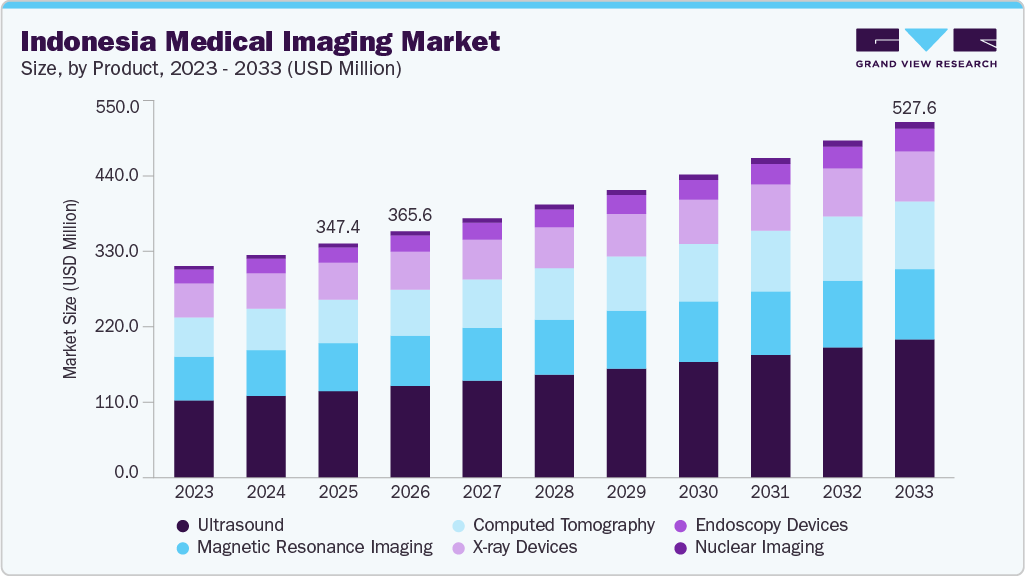 Source: Grand View Research, IR Documents, Primary Interviews, Paid DatabasesTo learn more about this report,
 Download Free Sample Report
 The increasing prevalence of chronic disease and increasing hospital visits are expected to drive market growth in Indonesia. For instance, the RSJPD Harapan Kita Hospital, a national referral health facility for treating cardiovascular diseases in Indonesia, experiences a substantial patient influx, with approximately 124,000 outpatient visits recorded annually. In addition, the facility accommodates around 35,000 inpatient cases per year, which includes about 3,500 patients undergoing heart surgery during their hospital stay.
The Hospitals Management Asia (HMA) reported in March 2023 that the Harapan Kita was committed to enhancing its healthcare services by incorporating advanced and cutting-edge technology and equipment. The hospital also acquired dual-source Multi Slice Computed Tomography (MSCT) diagnostic tool, featuring the CT Somatom Drive model, which is further expected to support the hospital in providing efficient and innovative medical care.
In addition, the continuous increase in the number of patients is driving the demand for better healthcare infrastructure in the country, which is expected to drive further demand in the market. For instance, according to Hospitals Management Asia (HMA), in November 2022, Harapan Kita expanded its facilities with the inauguration of the ventricle building, which involved an investment of approximately USD 43.1 billion. The hospital is also aiming to construct ten additional catheterization laboratories to enhance its medical services and capabilities in the future.
The adoption of artificial intelligence to advance medical imaging services is also expected to boost market growth. This is expected to help bring advanced technology to the country and contribute to the overall improvement in the healthcare infrastructure.
Moreover, despite technical improvements and the increased adoption of advanced imaging tools, Indonesia faces a significant challenge, with its physician-to-population ratio being three times lower than that of East Asia and the Pacific, particularly affecting 42 percent of the population residing in rural areas. By integrating Indonesia's comprehensive demographic and health data with AI's analytical prowess, doctors are expected to potentially enhance their diagnostic and treatment capabilities. This collaboration is expected to lead to improved overall healthcare quality across Indonesia.
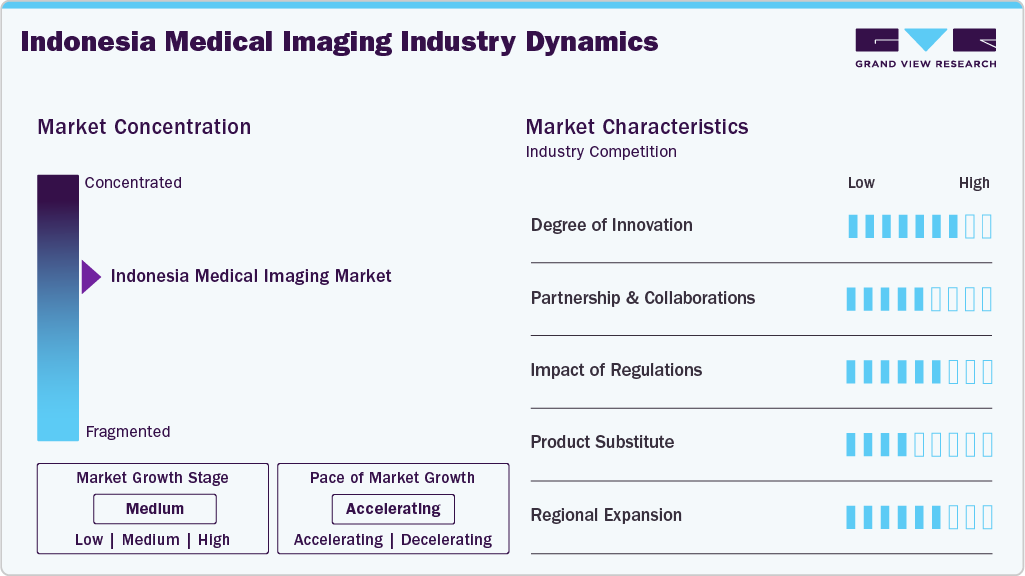
Market Concentration & Characteristics
The Indonesian medical imaging industry is at a mid-growth stage, with momentum steadily increasing. Market expansion is supported by rapid innovation, driven by advances in imaging technologies and their wider clinical adoption. The growing availability of diverse imaging modalities is further stimulating product demand across healthcare facilities. Merger and acquisition activity remains moderate, largely focused on diversification strategies, expanding customer reach, and strengthening product portfolios. Companies are also pursuing partnerships to enhance market presence. For example, according to BritCham Indonesia, in October 2023, Siloam Hospitals Group strengthened its long-term collaboration with Philips Indonesia to ensure consistent delivery of high-quality healthcare services.
The degree of innovation in Indonesia’s medical imaging industry is rising, supported by strong public-private collaboration and adoption of advanced systems. A key example is the first installation of the Philips Azurion system at Kediri Regency General Hospital in East Java in November 2025. This initiative, led by Indonesia Ministry of Health in partnership with Philips, aims to expand access to minimally invasive, image-guided care nationwide. According to Astri Ramayanti Dharmawan, the collaboration brings advanced treatment closer to communities. The Azurion platform enables real-time imaging for complex procedures, improving precision while reducing recovery time and hospital stays.
 To learn more about this report, Download Free Sample Report
 Strategic partnerships and collaborations are central to accelerating growth in Indonesia’s medical imaging industry by expanding access, strengthening infrastructure, and supporting long-term healthcare resilience. A major example is the December 2025 collaboration between GE HealthCare and the Indonesia Ministry of Health under the Strengthening Indonesia’s Health Referral Network (SIHREN) program. Through this multi-year agreement, GE HealthCare will supply more than 300 advanced CT scanners to public hospitals across all 38 provinces by 2028, significantly improving early diagnosis and treatment of non-communicable diseases such as cancer, stroke, and heart disease.
The project, governed by World Bank procurement regulations, represents Indonesia’s largest healthcare infrastructure investment to date, emphasizing equitable access for both urban and rural communities. Beyond equipment supply, the partnership supports national healthcare resilience through local manufacturing, workforce training, and knowledge transfer. GE HealthCare has strengthened its local footprint with a production facility in Bogor in collaboration with PT Kalbe Farma’s subsidiary, Forsta, enhancing supply-chain stability and technical skills development.
Additional initiatives, including MR system deployments and the Regional Innovation & Training Experience hub in Jakarta, highlight how partnerships are not only expanding diagnostic capacity but also building sustainable clinical expertise across Indonesia.
Regulatory frameworks play a crucial role in shaping the growth of Indonesia’s medical imaging industry by ensuring patient safety, maintaining the quality of technology, and promoting equitable access to diagnostic services. Oversight by the Indonesia Ministry of Health and the National Agency of Drug and Food Control (BPOM) governs device approval, importation, and clinical use, influencing market entry timelines. Alignment with international standards and transparent tender processes encourages participation from global manufacturers. In addition, government-led programs supporting public hospital modernization and universal health coverage stimulate demand for compliant imaging systems, while stricter quality and performance requirements drive adoption of advanced, reliable technologies.
Product substitutes in Indonesia’s medical imaging market include alternative diagnostic methods that reduce reliance on high-cost imaging systems. Conventional X-ray and ultrasound often substitute for CT or MRI in basic diagnostics due to lower cost and wider availability, especially in secondary hospitals. Clinical laboratory tests and point-of-care diagnostics can partially replace imaging for disease screening and monitoring. In some cases, telemedicine-supported clinical assessment reduces unnecessary imaging referrals. However, these substitutes offer limited anatomical detail and diagnostic precision, underscoring the ongoing need for advanced imaging modalities to address complex conditions, facilitate early disease detection, and ensure accurate treatment planning across Indonesia’s healthcare system.
Product Insights
The ultrasound segment accounted for the largest market share in the Indonesian market in 2025, due to its affordability, portability, and broad clinical applicability. Ultrasound systems are widely used across obstetrics and gynecology, cardiology, abdominal imaging, and emergency care, making them essential in both urban hospitals and rural healthcare facilities. Their non-ionizing nature supports frequent use without radiation risks, aligning with patient safety regulations. The growing government focus on maternal health, expansion of primary healthcare centers, and rising adoption of portable and point-of-care ultrasound systems further strengthened demand, positioning ultrasound as the most accessible and cost-effective imaging modality nationwide.
The nuclear imaging segment is witnessing rapid expansion, largely driven by the rising incidence of cancer and cardiovascular diseases that require functional and molecular imaging for accurate diagnosis and treatment planning. The increasing adoption of PET and SPECT systems in tertiary hospitals enhances early detection and guides therapeutic decisions. Government investments in oncology infrastructure, expansion of public referral hospitals, and improved availability of radiopharmaceuticals further support market growth.
According to the Global Cancer Observatory, Indonesia recorded 408,661 new cancer cases in 2022, with a mortality rate exceeding 50%. Common cancers include breast, lung, cervical, colorectal, and liver cancers, with cases projected to rise 63% by 2040. High mortality is often linked to delayed diagnosis and treatment, underscoring the need for early detection. Nuclear imaging enables precise assessment, improving treatment outcomes, particularly for conditions like breast cancer, where early detection significantly increases survival rates. Collaboration between hospitals, government bodies, and equipment providers, along with increased clinician awareness, is accelerating the adoption of nuclear imaging technologies despite high costs. Enhancing access to these systems in both urban and remote regions is crucial for reducing late-stage diagnoses and enhancing national healthcare resilience.
Application Insights
The oncology segment accounted for the largest share of the Indonesia medical imaging industry in 2025, driven by the rising incidence of cancer and growing demand for early detection and precise treatment planning. The increasing prevalence of breast, lung, cervical, colorectal, and liver cancers, coupled with high mortality rates from delayed diagnosis, has intensified the need for advanced imaging solutions. The adoption of PET, SPECT, and CT systems in tertiary hospitals, along with government investments in oncology infrastructure and the availability of radiopharmaceuticals, has further fueled growth. Enhanced clinician awareness and public health initiatives are also supporting widespread use of oncology imaging technologies nationwide.
The cardiology segment is experiencing rapid growth, driven by the rising prevalence of cardiovascular diseases such as coronary artery disease, heart failure, and stroke. Increasing adoption of advanced imaging modalities, including echocardiography, CT angiography, and cardiac MRI, is enhancing early diagnosis, risk assessment, and treatment planning. Government initiatives to improve cardiovascular care, expansion of specialized cardiac centers, and growing awareness among clinicians and patients are further fueling demand. In addition, technological advancements enabling high-resolution, real-time imaging and non-invasive assessment are supporting faster, accurate diagnostics, positioning cardiology imaging as a critical and rapidly expanding segment in the market.
End Use Insights
The hospitals segment held the largest share in 2025, driven by strong investments in advanced diagnostic technologies and rising demand for accurate, in-house imaging services. A key example is the acquisition of the world’s first photon-counting CT, the NAEOTOM Alpha, by RS Abdi Waluyo in Jakarta. This makes it the first hospital in Indonesia to offer photon-counting CT benefits, enabling ultra-high-resolution 3D and real-time imaging. Developed by Siemens Healthineers, the system enhances diagnostic accuracy, supports better treatment planning, and reflects hospitals’ central role in adopting cutting-edge imaging technologies to improve patient outcomes nationwide.
The following statements directly support the above perspective on improving diagnostic accuracy and patient outcomes in Indonesia’s healthcare system:
"We are thrilled to introduce the NAEOTOM Alpha to Indonesia, this is a game-changing technology which will enable us to stay at the forefront of medical imaging in Indonesia. This system will help improve patient care and outcomes, and we are confident that it will be embraced by medical professionals across the country."
-Sp.JP, Director of RS Abdi Waluyo.
“The company's mission is to improve patient care and outcomes by providing medical professionals with the tools they need to diagnose and treat a wide range of medical conditions. This system is expected to have a significant impact on the medical community in Indonesia, enabling doctors to make faster and more accurate diagnoses, and to develop more effective treatment plans for their patients,”
- Country Head of Siemens Healthineers Indonesia
The diagnostic imaging centers segment experienced rapid growth in 2025, driven by rising demand for accessible, cost-effective diagnostic services outside hospital settings. The increasing prevalence of chronic diseases and growing awareness of early diagnosis are encouraging patients to seek imaging services at standalone centers. Expansion of private diagnostic chains, adoption of advanced modalities such as CT, MRI, and ultrasound, and shorter waiting times are further supporting growth. Additionally, government efforts to reduce hospital burden, coupled with expanding health insurance coverage, are improving patient access to diagnostic imaging centers across urban and semi-urban regions.
Procurement Insights
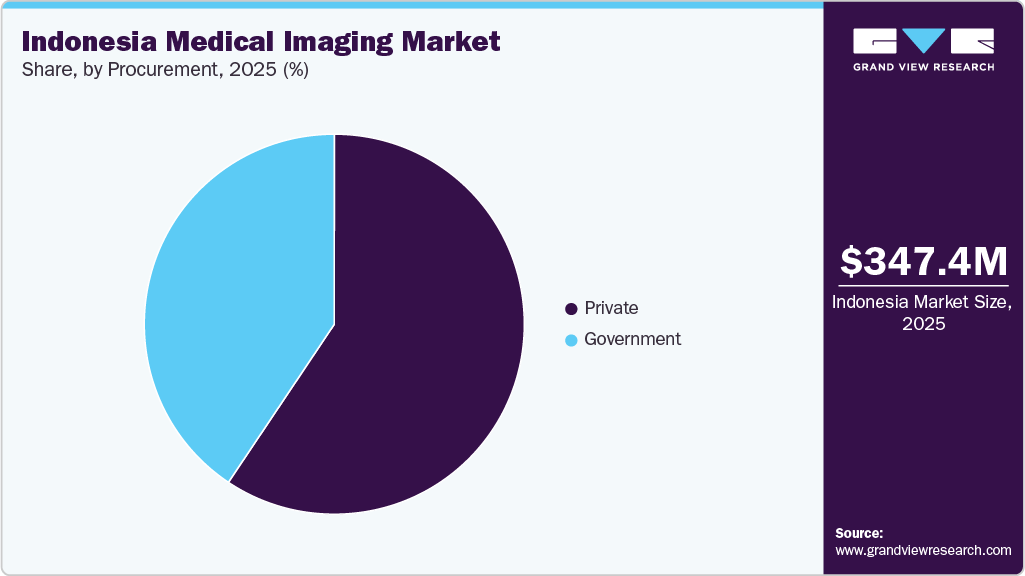
The private segment accounted for the largest share in 2025, driven by strong investments from private hospitals, diagnostic imaging centers, and specialty clinics. Private healthcare providers are rapidly adopting advanced imaging technologies such as CT, MRI, ultrasound, and nuclear imaging systems to enhance diagnostic accuracy and attract patients. Faster decision-making, flexible budgeting, and a focus on service differentiation enable private players to upgrade equipment more quickly than public institutions. In addition, rising medical tourism, growing middle-class healthcare spending, and partnerships with global imaging manufacturers are further strengthening the dominance of private procurement in Indonesia’s medical imaging industry.
 To learn more about this report, Download Free Sample Report
 The government segment is experiencing rapid growth in Indonesia’s medical imaging industry, driven by increased public healthcare spending and national initiatives to improve diagnostic access. Large-scale investments in public hospitals and referral networks are enabling wider deployment of imaging technologies such as CT, MRI, ultrasound, and nuclear imaging systems. Government programs aimed at strengthening universal health coverage and reducing regional healthcare disparities are accelerating equipment procurement, particularly in underserved and remote areas. In addition, international funding support, structured tender processes, and a strong focus on early disease detection and non-communicable disease management are further supporting growth in government-led imaging procurement across Indonesia.
Key Indonesia Medical Imaging Company Insights
The medical imaging market in Indonesia is highly competitive, with key players such GE Healthcare, Koninklijke Philips N.V., and Siemens Healthineers, others. The major companies undertake various organic and inorganic strategies, such as product introduction, collaborations, and regional expansion, to serve the unmet needs of their customers.
Key Indonesia Medical Imaging Companies:
- GE Healthcare
- Koninklijke Philips N.V.
- Siemens Healthineers
- Canon Medical Systems Corporation
- Mindray Medical International
- Esaote
- Samsung Medison Co., Ltd.
- PerkinElmer Inc.
- FUJIFILM VisualSonics Inc.
Three ways to get this report
Buy it, customize it, or ask a question.Ask an Analyst
A direct answer, usually in 1 working day
- AccessReport author, directly
- Reply timeWithin 1 working day
- No sales callDirect answer only
- FormatEmail reply
- CostFree, no cost
Get the Full Report
What the study covers
- FormatsPDF · Excel · Dashboard
- Timeline2026–2033 annual, 2025 base
- Coverage20+ countries, 5 regions
- Companies10+ key players profiled
Customize the Report
20% free customization
- IncludeCountries, segments, points
- TailorTo your product definition
- ExtendDeeper competitor detail
- OrA fully bespoke study
- Turnaround5–10 working days
Recent Developments
-
In August 2024, Siemens Healthineers highlighted how digital innovation and public-private partnerships are reshaping Indonesia’s healthcare system at Hospital Management Asia in Bali. Led by Alfred Fahringer, discussions emphasized improving access, affordability, and clinical outcomes through advanced digital and imaging technologies nationwide.
-
In October 2024, Indonesia’s Ministry of Health approved an AI-based osteoporosis screening tool from Acer Medical. The VeriOsteo OP software analyzes X-ray images to assess bone mineral density, supporting early detection, as up to 16 million elderly Indonesians face osteoporosis risk, while accelerating broader adoption of medical imaging AI nationwide.
-
In January 2023, GE HealthCare aided the expansion of healthcare access in Indonesia through a partnership with the Indonesia Ministry of Health and the U.S. Trade and Development Agency (USTDA). This partnership focused on digitizing healthcare delivery, enabling remote diagnosis and treatment of underserved communities across Indonesia.
Indonesia Medical Imaging Market Report Scope
Report Attribute
Details
Market size value in 2026
USD 365.6 million
Revenue forecast in 2033
USD 527.6 million
Growth rate
CAGR of 5.4% from 2026 to 2033
Actual period
2021 - 2024
Forecast period
2026 - 2033
Quantitative units
Revenue in USD million and CAGR from 2026 to 2033
Report coverage
Revenue forecast, company ranking, competitive landscape, growth factors, and trends
Segments covered
Product, application, end use, procurement
Key companies profiled
GE Healthcare; Koninklijke Philips N.V.; Siemens Healthineers; Canon Medical Systems Corporation; Mindray Medical International; Esaote; Samsung Medison Co., Ltd.; PerkinElmer Inc.; FUJIFILM VisualSonics Inc.
Customization scope
Free report customization (equivalent up to 8 analysts working days) with purchase. Addition or alteration to country, regional & segment scope.
Pricing and purchase options
Avail customized purchase options to meet your exact research needs. Explore purchase options
Indonesia Medical Imaging Market Report Segmentation
This report forecasts revenue growth at country levels and provides an analysis of the latest industry trends and opportunities in each of the sub-segments from 2021 to 2033. For this study, Grand View Research has segmented the Indonesia medical imaging market report on the basis of product, application, end use, and procurement:
-
Product Outlook (Revenue, USD Million, 2021 - 2033)
-
X-ray Devices
-
Radiography
-
Fluoroscopy
-
Mammography
-
-
Magnetic Resonance Imaging
-
Closed System
-
Open System
-
-
Ultrasound
-
Handheld
-
Compact
-
Cart/trolley
-
-
Computed Tomography
-
High-end Slice
-
Mid-end Slice
-
Low-end Slice
-
Cone beam CT
-
-
Nuclear Imaging
-
SPECT
-
PET-CT
-
-
Endoscopy Devices
-
Rigid Endoscope Systems
-
Flexible Endoscope Systems
-
Capsule Endoscopy Systems
-
-
-
Application Outlook (Revenue, USD Million, 2021 - 2033)
-
Cardiology
-
Oncology
-
Neurology
-
Orthopedics
-
Gastroenterology
-
Gynecology
-
Others
-
-
End Use Outlook (Revenue, USD Million, 2021 - 2033)
-
Hospitals
-
Diagnostic Imaging Centers
-
Others
-
-
Procurement Outlook (Revenue, USD Million, 2021 - 2033)
-
Private
-
Government
-
Frequently Asked Questions About This Report
The Indonesia medical imaging market size was estimated at USD 347.4 million in 2025 and is expected to reach USD 365.6 million in 2026.
The Indonesia medical imaging market is projected to grow at a compound annual growth rate (CAGR) of 5.4% from 2026 to 2033 to reach USD 527.6 million by 2033.
The ultrasound segment accounted for the largest market share in Indonesia’s medical imaging market in 2025 due to its affordability, portability, and broad clinical applicability. Ultrasound systems are widely used across obstetrics and gynecology, cardiology, abdominal imaging, and emergency care, making them essential in both urban hospitals and rural healthcare facilities.
Some of the key players operating in the market include GE Healthcare; Koninklijke Philips N.V.; Siemens Healthineers; Canon Medical Systems Corporation.
Increasing technological advancements, increased healthcare expenditure, government reimbursement initiatives, and the establishment of new facilities by market players in the country are major driving factors for the growth of this market.
About the Author(s)
Medical Devices Research Team
Healthcare · Medical DevicesThis report was authored by the medical devices research team at Grand View Research - comprising two research analysts, one senior research analyst, and one industry expert - with specialized expertise in the medical devices segment of the healthcare industry. All findings are based on proprietary healthcare databases, executive interviews, and regulatory analysis, subject to internal peer review prior to publication.
Last Updated:
Speak to Analyst

Customize this report to your needs - add regions, segments, or data points, with 20% free customization.
Or view our licence options:


ISO 9001:2015 & 27001:2022 Certified
We are GDPR and CCPA compliant! Your transaction & personal information is safe and secure. For more details, please read our privacy policy.


