
- Home
- »
- Healthcare IT
- »
-
Electronic Health Records Market Size Report, 2026-2033GVR Report cover

Electronic Health Records Market (2026 - 2033)
Size, Share & Trends Analysis Report By Product (On-premises, Web & Cloud-Based EHR), By Type (Acute, Outpatient), By Business Model, By Application (Cardiology, Neurology), By End-use, By Region, And Segment Forecasts
Market Size, 2025
$35.9BMarket Estimate, 2026
$37.5BMarket Forecast, 2033
$53.1BCAGR, 2026–2033
5.1%Electronic Health Records Market Summary
The global electronic health records market size was valued at USD 35.9 billion in 2025 and is projected to grow from USD 37.5 billion in 2026 to USD 53.1 billion by 2033, at a CAGR of 5.1% from 2026 to 2033. North America dominated the global market, with a revenue share of 43.0% in 2025. The increasing focus on interoperability, health information exchange, and the integration of electronic health records (EHRs) with clinical decision support and analytics tools is a key driver of market growth, along with numerous national digital health initiatives that promote EHR adoption.
 Source: Grand View Research, IR Documents, Primary Interviews, Paid DatabasesTo learn more about this report,
 Download Free Sample Report
 Key Market Trends & Insights
- By product: Web and cloud-based EHR held the largest market share of 83.7% in 2025.
- By type: Acute segment held the largest market share of 45.6% in 2025.
- By business model: Professional services held the largest market share of 32.6% in 2025.
- By end use: Hospital segment held the largest market share of 52.8% in 2025.
Regional Highlights
- Largest regional market: North America (43.0% revenue share, 2025)
- Fastest-growing regional market: Asia Pacific (fastest CAGR, 2026-2033)
- By country: The U.S. held the largest market share in 2025.
Market Size & Forecast
- Market size in 2025: USD 35.9 Billion
- Estimated market size in 2026: USD 37.5 Billion
- Projected market size by 2033: USD 53.1 Billion
- CAGR (2026-2033): 5.1%
Three ways to get this report
Buy it, customize it, or ask a question.Ask an Analyst
A direct answer, usually in 1 working day
- AccessReport author, directly
- Reply timeWithin 1 working day
- No sales callDirect answer only
- FormatEmail reply
- CostFree, no cost
Get the Full Report
What the study covers
- FormatsPDF · Excel · Dashboard
- Timeline2026–2033 annual, 2025 base
- Coverage20+ countries, 5 regions
- Companies10+ key players profiled
Customize the Report
20% free customization
- IncludeCountries, segments, points
- TailorTo your product definition
- ExtendDeeper competitor detail
- OrA fully bespoke study
- Turnaround5–10 working days
The growing adoption of telehealth and remote care is expanding the role of electronic health records as a central repository for longitudinal patient information. Technological advancements are also accelerating the integration of artificial intelligence (AI) into EHR platforms. In August 2026, Oracle Health expanded its Clinical AI Agent with AI-assisted coding, clinician-controlled dictation, and chart-review capabilities that surface relevant patient information from across the EHR. In February 2026, Oracle updated the Oracle Health Clinical AI Agent to include automated clinical order creation during patient visits. These developments are broadening EHR functionality beyond electronic documentation toward intelligent clinical workflow support and automation.
 To learn more about this report, Download Free Sample Report
 The rising demand for centralized, streamlined healthcare administration is another factor driving EHR market growth. Consolidating patient information across inpatient, outpatient, emergency, and physician settings can help organizations coordinate care, standardize workflows, and reduce fragmentation across clinical systems. In December 2025, Saint Peter’s Healthcare System selected Epic to launch a centralized EHR platform that provides a single, integrated patient record across multiple care settings. The system is also designed to improve access to tests, medications, clinical summaries, and appointments through the Epic MyChart patient portal.
“The integration of Epic will elevate Saint Peter’s delivery of care while allowing for improved efficiency to manage revenue cycles across the entire health-care system continuum, and most importantly, allow us to better serve our patients, no matter which services they access.”
-Dr. Jordan Tannenbaum, PgC Healthcare Informatics, vice president/chief information officer and chief medical information officer at Saint Peter’s Healthcare System.
“Having Epic will be a game-changer for Saint Peter’s and will mark a major step forward in improving quality, safety, and the coordination of care.”
-Leslie D. Hirsch, president and CEO of Saint Peter’s Healthcare System.
Partnerships and collaborations are further contributing to the expansion of specialized EHR solutions. For example, NextGen Healthcare continues its collaboration with the American Podiatric Medical Association (APMA), with NextGen Office incorporating podiatry-specific templates developed with podiatrists. Such specialty-focused functionality enables EHR platforms to address clinical workflows and documentation requirements that vary across medical specialties.
Market Dynamics
The continued digitization of healthcare is shaping the electronic health records market, growing demand for interoperable health information exchange, and increasing integration of AI into clinical workflows. In addition, data privacy requirements, cybersecurity risks, implementation complexity, and fragmented health IT environments remain important constraints. Emerging opportunities increasingly center on AI-enabled EHR platforms, cloud-based deployment, national digital health infrastructure, and connected healthcare ecosystems that extend electronic records beyond documentation to longitudinal, data-driven care.
The growing emphasis on interoperability and seamless health information exchange is supporting demand for electronic health records (EHRs) across healthcare systems. Healthcare providers increasingly require EHR platforms that can exchange clinical information with hospitals, laboratories, pharmacies, payers, public health agencies, and other care providers. Interoperability enables more complete longitudinal patient records and supports coordinated care across different healthcare settings. In the U.S., the Office of the National Coordinator for Health Information Technology (ONC) continues to expand standards supporting the access, exchange, and use of electronic health information. In July 2026, ONC released the United States Core Data for Interoperability (USCDI) Version 7, adding new data elements to advance interoperability in patient care.
The expansion of national health information exchange networks is further strengthening the role of EHRs as a connected healthcare infrastructure. In June 2026, the U.S. Department of Health and Human Services reported that more than 1 billion health records had been exchanged through the Trusted Exchange Framework and Common Agreement (TEFCA), compared with 10 million the year before. Such developments are increasing the value of EHR platforms that support standardized data exchange and integration with external health information systems. As healthcare organizations move beyond standalone electronic documentation toward connected clinical ecosystems, interoperability capabilities are becoming an increasingly important consideration in EHR selection and upgrades.
Concerns surrounding data security, patient privacy, and cyberattacks remain a key restraint for the electronic health records market. EHR platforms store large volumes of sensitive clinical and personal information, making healthcare organizations attractive targets for ransomware, unauthorized access, and data breaches. Compliance with requirements such as HIPAA also increases the technical and operational burden associated with protecting electronic protected health information. In April 2026, the HHS Office for Civil Rights announced four ransomware-related settlements involving breaches affecting more than 427,000 individuals. Such data breach incidents reinforce the need for healthcare organizations to invest in security controls, risk assessments, system hardening, and ongoing compliance, which can increase the complexity and cost of EHR deployment and maintenance.
The integration of AI into EHR platforms presents a significant opportunity for vendors to expand beyond electronic documentation and support broader clinical and administrative workflows. AI can analyze information contained within longitudinal patient records to assist with clinical documentation, coding, information retrieval, decision support, and workflow automation. The availability of increasingly standardized electronic health data is also creating a stronger foundation for AI-enabled applications. In June 2026, HHS and ONC held a national event focused on accelerating the adoption of clinical AI, reflecting growing policy and industry attention toward incorporating AI into healthcare delivery.
EHR vendors are already incorporating AI capabilities into commercial platforms, creating opportunities for differentiated products and additional services. Ambient documentation, automated coding, intelligent chart review, clinical summarization, and AI-assisted workflow management can reduce manual documentation requirements and help clinicians access relevant information more efficiently. ONC's regulatory framework is also evolving alongside these technologies; the HTI-1 Final Rule introduced transparency requirements for AI and predictive algorithms incorporated into certified health IT. As healthcare providers increasingly seek to integrate clinical AI with EHR data, vendors that can integrate these capabilities while maintaining interoperability, security, transparency, and clinician oversight may expand the functional scope of EHR platforms.
Market Characteristics & Concentration
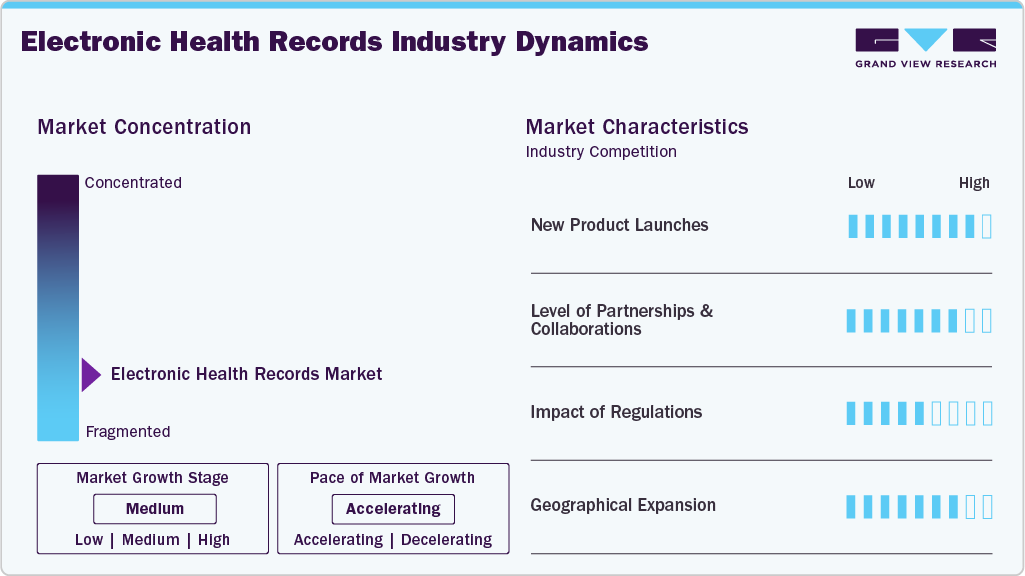
The chart below illustrates the relationships among concentration, characteristics, and participants in the electronic health records industry. The x-axis represents the level of industry concentration, ranging from low to high. The y-axis represents various market characteristics, including industry competition, new product launches, regulatory impact, merger and acquisition activity, and geographic expansion.
Product innovation and strategic partnerships are shaping competition in the EHR market as vendors expand EHR functionality beyond electronic documentation toward AI-enabled clinical workflows. Recent launches increasingly focus on natural-language interaction, ambient documentation, clinical summarization, and intelligent access to patient information. In August 2025, MEDITECH added Avo’s AI Scribe to its Expanse EHR through its Accelerator program, enabling ambient listening and automated clinical documentation within the EHR workflow. MEDITECH has continued to expand its AI ecosystem, adding additional solutions such as Ask Avo and Chart Assist to its Accelerator portfolio in September 2026. These developments indicate a broader shift toward embedding third-party AI capabilities directly into EHR platforms.
 To learn more about this report, Download Free Sample Report
 EHR vendors are also pursuing broader technology collaborations to integrate AI, data platforms, and clinical applications into existing healthcare infrastructure. In June 2026, Oracle Health and Baystate Health expanded their strategic collaboration to deploy Oracle Health EHR, along with its AI Data Platform, Patient Portal, and Clinical AI Agent, across the health system. Such collaborations allow healthcare organizations to modernize existing EHR environments while adding AI-enabled capabilities without treating the electronic record as a standalone documentation system.
Regulatory developments continue to influence the EHR market by establishing requirements for interoperability, health IT certification, information exchange, and responsible use of emerging technologies. In the U.S., the Health Information Technology for Economic and Clinical Health (HITECH) Act established the federal framework for promoting health IT and electronic health records, while subsequent ONC rules have expanded requirements for certified health IT. The regulatory focus has increasingly shifted from EHR adoption toward interoperability and data access.
Geographic expansion remains an important strategy for EHR vendors seeking to diversify their customer base and establish positions in healthcare systems undergoing digital transformation. Vendors are increasingly targeting markets where governments and healthcare organizations are investing in interoperable national health infrastructure, cloud-based platforms, and modernization of legacy systems.
Analyst Perspective
The electronic health records market is evolving from documentation-focused systems into broader digital infrastructure for healthcare delivery. EHR platforms are increasingly used to integrate clinical information, improve interoperability, streamline workflows, and support data-driven decision-making across care settings. Cloud-based EHRs, AI, ambient documentation, and analytics are expanding platform capabilities beyond traditional record management. Interoperability, cybersecurity, data privacy, and integration complexity remain important purchasing considerations. Vendors are therefore focusing on usability, automation, connectivity, clinical workflow integration, and partnerships with healthcare technology providers. Future market development will depend on reducing administrative burdens, connecting fragmented health information, and converting clinical data into actionable insights without disrupting care delivery.
Case Study
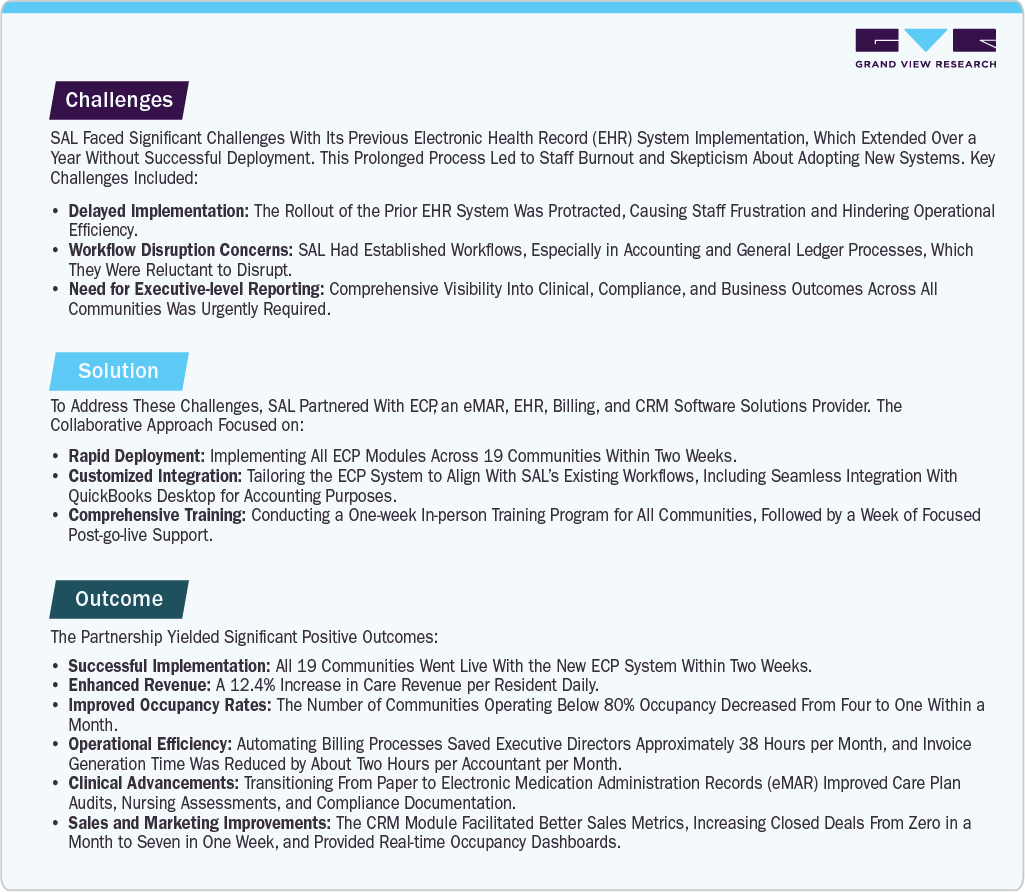
SAL Management Group operates 19 assisted living communities across Utah and is dedicated to providing safe, home-like environments with exceptional care experiences. The following case study emphasizes how strategic collaboration and tailored solutions can overcome implementation challenges, enhance operational efficiency, improve resident care, and increase revenue in the assisted living sector.
 To learn more about this report, Download Free Sample Report
 Product Insights
The web and cloud-based EHR segment accounted for 83.7% of the global electronic health records market revenue in 2025 and is projected to register the fastest CAGR of 5.2% over the forecast period. Adoption is supported by the growing preference for scalable EHR solutions among physicians, ambulatory practices, and smaller healthcare providers. Unlike traditional on-premises systems, cloud-based EHR platforms can be accessed via web browsers and typically require less dedicated hardware and in-house IT infrastructure, reducing upfront deployment costs. Vendor-managed updates, maintenance, and security capabilities further simplify technology management for healthcare organizations. Cloud-based EHR systems also offer interoperability and connected care requirements. Subscription-based models allow providers to access EHR functionality without substantial capital investment while supporting integration with patient portals, virtual care, analytics, and external healthcare information systems. In March 2026, Oracle highlighted the continued transition of EHRs from provider-managed on-premises software to cloud-delivered services, noting that newer cloud-based systems increasingly support interoperability with other EHRs, clinical knowledge bases, government databases, and research systems.
The on-premise EHR segment continues to serve healthcare organizations that prefer greater control over their EHR infrastructure, data storage, system configuration, and internal security policies. These deployments allow providers to maintain EHR hardware and software within their own IT environments, which can be relevant for organizations with established data centers, specific customization requirements, or strict data governance policies. However, on-premise EHR systems typically require greater internal responsibility for infrastructure maintenance, system upgrades, cybersecurity, and technical support.
Type Insights
The acute segment accounted for the largest share of the electronic health records industry, representing 45.6% of revenue in 2025, driven by the extensive deployment of EHR systems across hospitals, where electronic records support clinical documentation, medication management, quality reporting, and interdepartmental coordination. In the U.S., eligible hospitals paid under the Inpatient Prospective Payment System (IPPS), as well as critical access hospitals, remain subject to the Medicare Promoting Interoperability Program, which requires reporting of specified interoperability and electronic clinical quality measures. CMS continues to use the program to promote the meaningful use and exchange of electronic health information.
The outpatient segment is expected to grow at the fastest CAGR of 5.3% over the forecast period. Increasing adoption among physician practices, outpatient clinics, and other non-hospital care settings is supported by the need for simpler, practice-oriented systems that can manage clinical documentation, prescribing, scheduling, and patient engagement without the complexity of large hospital-wide deployments. In 2026, CMS continued to include Promoting Interoperability requirements within MIPS, with measures such as electronic prescribing and prescription drug monitoring program queries applicable to eligible clinicians. Small practices are also specifically recognized within the program, reinforcing the importance of interoperable EHR capabilities across ambulatory settings.
Business Model Insights
The professional services segment accounted for the largest share of the electronic health records market, representing 32.6% of revenue in 2025, and is expected to register the fastest CAGR over the forecast period. As EHR deployments become more integrated with clinical, administrative, financial, and interoperability systems, healthcare organizations increasingly require specialized implementation and optimization support. Professional services encompass project management, technical and application expertise, workflow and clinical process optimization, regulatory consulting, system configuration, data migration, and end-user training. The growing complexity of EHR implementations and the need to integrate third-party applications are supporting demand for these services. In April 2026, Oracle Health expanded its interoperability capabilities through its CMS Aligned Network status and solutions designed to connect patient data across healthcare settings, highlighting the continuing need for implementation and integration expertise.
The subscription segment is expected to grow at a significant CAGR of 5.2% over the forecast period as healthcare providers increasingly adopt cloud-based EHR platforms through recurring payment models. Subscription-based EHR solutions typically provide access to software, updates, maintenance, technical support, and selected services for a recurring fee, reducing the need for substantial upfront software investment and dedicated infrastructure. The model is particularly relevant for physician practices, ambulatory care providers, and smaller healthcare organizations seeking scalable health IT solutions. The subscription models provide vendors with a flexible framework.
Application Insights
The cardiology segment held the largest share of 9.5% in 2025. Cardiology practices generate and manage diverse clinical data from electrocardiograms (ECGs), echocardiography, cardiac catheterization, imaging, laboratory tests, medications, and longitudinal patient histories. Integration of these data within specialty EHR systems can reduce fragmented documentation and enable clinicians to access diagnostic results and treatment information from a centralized patient record. The growing burden of cardiovascular disease and continued demand for hospital and outpatient cardiac services are therefore supporting the adoption of cardiology-focused EHR solutions. Increasing integration with diagnostic devices, clinical decision-support tools, and health information exchange platforms is further expanding their functionality.
The neurology segment is expected to grow at the fastest CAGR of 5.2% during the forecast period, supported by the rising global burden of neurological disorders and increasing demand for specialized, data-intensive clinical workflows. In October 2025, the World Health Organization reported that neurological conditions affected more than 3 billion people globally and were responsible for more than 11 million deaths annually. The organization also identified weak health information systems as a barrier to effective neurological care and evidence-based decision-making. Neurology EHR systems can help organize detailed patient histories, neurological examinations, imaging, electrophysiology, medication records, and longitudinal outcomes.
End Use Insights
The hospital segment accounted for the largest share of the electronic health records market, representing 52.8% of revenue in 2025. Hospitals increasingly rely on EHR systems to integrate clinical, financial, and administrative information across departments and to support quality reporting, care coordination, and patient engagement. The transition toward value-based care is further increasing the importance of structured and interoperable health data, as hospitals are increasingly assessed on clinical outcomes, patient experience, safety, and efficiency rather than service volume alone. In the U.S., the Medicare Promoting Interoperability Program continues to require eligible hospitals and critical access hospitals to demonstrate meaningful use of certified EHR technology.
 To learn more about this report, Download Free Sample Report
 The ambulatory surgery centers (ASCs) segment is anticipated to grow at the fastest CAGR of 5.3% during the forecast period. Increasing migration of procedures from inpatient hospitals to outpatient settings is creating greater demand for EHR systems that can efficiently manage surgical documentation, scheduling, medications, clinical records, and post-procedure follow-up. Interoperability is particularly important as ASC patients frequently receive care across multiple providers and facilities, requiring the timely exchange of clinical information.
Regional Insights
North America accounted for the largest share of the electronic health records market, representing 43.0% of global revenue in 2025, owing to a mature healthcare IT infrastructure, widespread EHR adoption, established health information exchange networks, and regulatory frameworks supporting interoperability of electronic health information. In the U.S., the Medicare Promoting Interoperability Program continues to require eligible hospitals and critical access hospitals to demonstrate the meaningful use of certified EHR technology, with requirements covering interoperability, electronic clinical quality measures, and health information exchange. In addition, CMS finalized requirements for greater EHR resilience and security risk management beginning with the 2026 reporting period.
 To learn more about this report, Download Free Sample Report
 The U.S. electronic health records market held the largest country-level revenue share in 2025, supported by healthcare digitization, regulatory requirements, and demand for interoperable data. The market is shifting toward cloud-based EHR platforms with embedded AI and automation. In July 2026, ONC released USCDI Version 7, adding new data elements to advance interoperability. In August 2025, Oracle introduced its AI-driven Oracle Health EHR for U.S. ambulatory providers, featuring voice-based interaction, cloud infrastructure, and AI agents for clinical workflows.
“The availability of the ambulatory EHR highlights Oracle’s fundamental focus on delivering an immersive, AI-first, and cloud-based solution designed to optimize clinical workflows and reimagine clinician and patient experiences.”
-Mutaz Shegewi, Senior Research Director, Worldwide Healthcare Provider AI, Platforms and Technologies, IDC.
Europe Electronic Health Records Market Trends
The European electronic health records industry is set for significant growth as healthcare systems adopt interoperable, patient-centered digital infrastructure. Key factors include established healthcare systems and ongoing investment in electronic records and digital health platforms. The European Health Data Space (EHDS) Regulation, effective March 2025, establishes a framework for accessing and exchanging health data across EU Member States and introduces harmonized standards for EHR systems. This regulation is anticipated to drive demand for interoperable EHR platforms and technologies in European healthcare systems.
The UK electronic health records market is set to grow as the National Health Service (NHS) expands its electronic patient record infrastructure. With an investment worth over USD 2 billion from NHS England’s Frontline Digitization Program, 95% of NHS trusts aim for EPR implementation or upgrades by March 2026. The focus is shifting towards interoperability and the creation of unified patient records. By 2026, the NHS will develop the Single Patient Record, allowing patients to access their records through the NHS App starting in 2028, marking a transition to connected, longitudinal patient records.
Asia Pacific Electronic Health Records Market Trends
The Asia Pacific electronic health records industry is expected to grow at the fastest CAGR of 8.0% over the forecast period, supported by expanding healthcare infrastructure, increasing adoption of digital health technologies, and government-led efforts to establish interoperable health information systems. Countries across the region are increasingly investing in digital health infrastructure to improve the accessibility, exchange, and use of patient information. In June 2026, WHO SEARO and the George Institute for Global Health announced a collaboration focused on digital health and AI for primary care and noncommunicable disease management, reflecting the broader regional emphasis on integrating digital technologies into national health systems.
The China electronic health records market accounted for the largest share of Asia Pacific in 2025, supported by its extensive healthcare infrastructure and continued investment in digital health. Government initiatives are also advancing health information exchange; in August 2025, China reported that 22 provinces had implemented a national medical imaging data-sharing pathway. Electronic vaccination records are also being shared across provinces, reinforcing the broader shift toward interoperable digital health records.
Latin America Electronic Health Records Market Trends
The Latin America electronic health records industry is expected to grow significantly as healthcare providers embrace digital transformation and interoperability. The rise of cloud-based healthcare technologies enables scalable EHR deployments, and investments in national health information infrastructure enhance electronic patient data exchange. The increasing use of digital health platforms in both the public and private sectors is driving the need for integrated systems for clinical records and patient data. In Brazil, recent investments in health-data infrastructure highlight the region's shift towards connected, digitally enabled healthcare delivery.
Middle East & Africa Hospital Electronic Health Records Market Trends
The Middle East and Africa electronic health records industry is poised for significant growth as governments push for healthcare digitization and interoperability. Investments in national health information infrastructure are increasing the demand for EHR platforms to connect various healthcare providers. For instance, Saudi Arabia is advancing its eHealth strategy to unify electronic health records and support digital health and AI solutions through the Health Innovation Sandbox initiative.
Key Electronic Health Records Company Insights
Companies in the electronic health records (EHR) market are focusing on product launches, strategic partnerships, cloud expansion, interoperability, and acquisitions to enhance their technology portfolios. Competitive efforts are increasingly directed towards integrating AI, ambient documentation, analytics, and data-exchange capabilities into EHR systems. Notable developments include athenahealth’s December 2025 partnership with Microsoft to integrate Dragon Copilot into athenaOne and WellSky’s AI-powered ambient listening feature introduced in its Specialty Care EHR in October 2025. In 2026, EHR vendors continued to grow through new customer contracts and platform migrations, indicating strong demand for cloud-based, interoperable, and AI-enabled EHR solutions.
Key Electronic Health Records Companies:
The following key companies have been profiled for this study on the electronic health records market.
-
Oracle
-
GE Healthcare
-
Veradigm LLC
-
Epic Systems Corporation
-
eClinicalWorks
-
Greenway Health, LLC
-
NextGen Healthcare, Inc.
-
Medical Information Technology, Inc. (Meditech)
-
TruBridge, Inc.
-
AdvancedMD, Inc.
-
CureMD Healthcare
-
McKesson Corporation
Recent Developments
-
In August 2026, athenahealth highlighted its AI-native clinical architecture, incorporating native ambient technology directly into athenaOne. The platform is being developed to support real-time clinical workflows and reduce documentation burden within the EHR.
-
In July 2026, Suki reported that its ambient AI technology had been integrated with major EHR platforms, including Epic, Oracle Health, athenahealth, and MEDITECH. The platform supports clinical documentation, coding, patient instructions, and other workflow functions across healthcare settings.
-
In July 2026, Nabla launched a medical-grade dictation product for Apple devices, expanding its clinical AI offering beyond ambient documentation. Nabla continues to integrate ambient AI, dictation, and coding capabilities with EHR platforms to support broader clinical workflows.
-
In June 2026, Suki partnered with Sevocity to integrate ambient AI into its EHR platform, enabling automated clinical documentation and reducing documentation time for healthcare providers.
Electronic Health Records Market Report Scope Table
Report Attribute
Details
Market size in 2025
USD 35.9 billion
Estimated market size in 2026
USD 37.5 billion
Projected market size by 2033
USD 53.1 billion
Growth rate
CAGR of 5.1% from 2026 to 2033
Actual data
2021 - 2025
Forecast period
2026 - 2033
Quantitative units
Revenue in USD million/billion and CAGR from 2026 to 2033
Report coverage
Revenue forecast, company ranking, competitive landscape, growth factors, and trends
Segments covered
Product, business model, type, application, end use, region
Regional scope
North America; Europe; Asia Pacific; Latin America; Middle East & Africa
Country scope
U.S.; Canada; Mexico; Germany; UK; France; Italy; Spain; Norway; Denmark; Sweden; China; Japan; India; South Korea; Australia; Thailand; Brazil; Argentina; Saudi Arabia; South Africa; UAE; Kuwait
Key companies profiled
Oracle; GE Healthcare; Veradigm LLC; Epic Systems Corporation; eClinicalWorks; Greenway Health, LLC; NextGen Healthcare, Inc.; Medical Information Technology, Inc. (Meditech); TruBridge, Inc.; AdvancedMD, Inc.; CureMD Healthcare; McKesson Corporation
Customization scope
Free report customization (equivalent up to 8 analysts' working days) with purchase. Addition or alteration to country, regional & segment scope.
Pricing and purchase options
Avail customized purchase options to meet your exact research needs. Explore purchase options
Global Electronic Health Records Market Report Segmentation
This report forecasts revenue growth and provides an analysis of the latest trends in each of the sub-segments from 2021 to 2033. For this study, Grand View Research has segmented the electronic health records market report based on product, type, business model, application, end use, and region:
-
Product Outlook (Revenue, USD Million/Billion, 2021 - 2033)
-
On-premises
-
Web & Cloud-Based EHR
-
-
Type Outlook (Revenue, USD Million/Billion, 2021 - 2033)
-
Acute
-
Outpatient
-
Post-Acute
-
-
Business Model Outlook (Revenue, USD Million/Billion, 2021 - 2033)
-
Licensed Software
-
Technology Resale
-
Subscriptions
-
Professional Services
-
Others
-
-
Application Outlook (Revenue, USD Million/Billion, 2021 - 2033)
-
Cardiology
-
Neurology
-
Radiology
-
Oncology
-
Mental and Behavioral Health
-
Nephrology and Urology
-
Gastroenterology
-
Pediatrics
-
General Medicine
-
Physical Therapy and Rehabilitation
-
Others
-
-
End Use Outlook (Revenue, USD Million/Billion, 2021 - 2033)
-
Hospital
-
Ambulatory Surgical Centers
-
Other End-use
-
-
Regional Outlook (Revenue, USD Million/Billion, 2021 - 2033)
-
North America
-
U.S.
-
Canada
-
Mexico
-
-
Europe
-
UK
-
Germany
-
France
-
Italy
-
Spain
-
Denmark
-
Sweden
-
Norway
-
-
Asia Pacific
-
China
-
Japan
-
India
-
South Korea
-
Australia
-
Thailand
-
-
Latin America
-
Brazil
-
Argentina
-
-
Middle East and Africa (MEA)
-
South Africa
-
Saudi Arabia
-
UAE
-
Kuwait
-
-
Frequently Asked Questions About This Report
The global electronic health records market size was valued at USD 35.9 billion in 2025 and is estimated at USD 37.5 billion for 2026.
Cloud & web-based EHR segment dominated the market with a revenue share of 83.7% in 2025.
Key factors include growing emphasis on interoperability and health information exchange, integration of EHRs with clinical decision support and analytics tools, and increasing national digital health initiatives promoting EHR adoption.
The professional services segment led with a 32.6% revenue share in 2025 and is the fastest-growing area.
North America dominated with a 43.0% revenue share in 2025.
Asia Pacific is the fastest-growing region over the forecast period.
The global electronic health records market is expected to grow at a CAGR of 5.1% from 2026 to 2033, reaching USD 53.1 billion.
Acute EHR segment dominated the market in 2025 with a revenue share of 45.6%.
Key players include Oracle; GE Healthcare; Veradigm LLC; Epic Systems Corporation; eClinicalWorks; Greenway Health, LLC; NextGen Healthcare, Inc.; Medical Information Technology, Inc. (Meditech); TruBridge, Inc.; AdvancedMD, Inc.; CureMD Healthcare; McKesson Corporation.
About the Author(s)
Healthcare IT Research Team
Healthcare · Healthcare ITThis report was authored by the healthcare it research team at Grand View Research - comprising two research analysts, one senior research analyst, and one industry expert - with specialized expertise in the healthcare it segment of the healthcare industry. All findings are based on proprietary healthcare databases, executive interviews, and regulatory analysis, subject to internal peer review prior to publication.
Last Updated:
Speak to Analyst

Customize this report to your needs - add regions, segments, or data points, with 20% free customization.
Or view our licence options:


ISO 9001:2015 & 27001:2022 Certified
We are GDPR and CCPA compliant! Your transaction & personal information is safe and secure. For more details, please read our privacy policy.


