
- Home
- »
- Automotive & Transportation
- »
-
Electric Forklift Market Size, Growth Report, 2026-2033GVR Report cover

Electric Forklift Market (2026 - 2033)
Size, Share & Trends Analysis Report By Product (Counterbalanced, Pallet Trucks, Reach Trucks, Pallet Stackers), By Battery Type (Lithium-ion, Lead Acid, Hydrogen Fuel-Cell), By End Use (Chemical, Food & Beverage), By Region, And Segment Forecasts
Market Size, 2025
$56.9BMarket Estimate, 2026
$64.6BMarket Forecast, 2033
$158.8BCAGR, 2026–2033
13.7%Electric Forklift Market Summary
The global electric forklift market size was valued at USD 56.9 billion in 2025 and is projected to grow from USD 64.6 billion in 2026 to USD 158.8 billion by 2033, at a CAGR of 13.7% from 2026 to 2033. Asia Pacific dominated the global market, accounting for the largest revenue share of 39.9% in 2025. The industry is experiencing rapid growth, driven by rising environmental consciousness and strict emission regulations.
 Source: Grand View Research, IR Documents, Primary Interviews, Paid DatabasesTo learn more about this report,
 Download Free Sample Report
 Key Market Trends & Insights
- By product: Pallet trucks segment accounted for the largest share of 28.9% in 2025.
- By end use: Industrial segment held the largest market share in 2025.
- By battery type: Li-ion segment dominated the market in 2025.
Regional Highlights
- Largest regional market: Asia Pacific (39.9% revenue share, 2025)
- By country: The China electric forklift industry is a major contributor to the global market.
Market Size & Forecast
- Market size in 2025: USD 56.9 Billion
- Estimated market size in 2026: USD 64.6 Billion
- Projected market size by 2033: USD 158.8 Billion
- CAGR (2026-2033): 13.7%
Three ways to get this report
Buy it, customize it, or ask a question.Ask an Analyst
Analyst response in 1 business day
- AccessReport author, directly
- Reply timeWithin 1 working day
- No sales callDirect answer only
- FormatEmail reply
- CostFree, no cost
Get the Full Report
What the study covers
- FormatsPDF · Excel · Dashboard
- Timeline2026–2033 annual, 2025 base
- Coverage20+ countries, 5 regions
- Companies10+ key players profiled
Customize the Report
20% free customization
- IncludeCountries, segments, points
- TailorTo your product definition
- ExtendDeeper competitor detail
- OrA fully bespoke study
- Turnaround5–10 working days
Manufacturers are increasingly shifting towards electric forklifts as a more sustainable and eco-friendly option. In addition, electric forklifts provide numerous benefits, such as minimized accidents, smoother acceleration and braking, reduced noise levels, and a safer working environment for employees. These factors are expected to create significant growth opportunities for the market in the coming years.
 To learn more about this report, Download Free Sample Report
 Electric forklifts are transforming the material handling industry by leveraging battery-powered electric motors, which significantly reduce emissions and operating costs compared to traditional fossil fuel-based forklifts. Furthermore, the integration of automation and robotics is rapidly gaining momentum within warehouses. The primary objective is to boost operational efficiency, streamline processes, and reduce labor costs. Urban environments face limitations in available land, making efficient space utilization a critical concern. Hence, warehouses are being constructed or revamped with a major emphasis on maximizing storage capacity to tackle this challenge effectively.
The decreasing cost of batteries and the growing demand for fuel-efficient and low-maintenance equipment are making electric forklifts increasingly attractive to customers. The performance and efficiency of electric forklifts have undergone significant transformations due to the remarkable advancements in battery technology. The introduction of lithium-ion batteries has been a transformative factor in the forklift industry, offering higher energy density compared to conventional lead-acid batteries. Lithium-ion batteries can store more energy in a compact and lightweight form, enabling electric forklifts to operate on a single charge for an extended period without compromising performance. This innovation has revolutionized the forklift industry by providing a more efficient and sustainable solution for material handling operations.
Several manufacturers are focusing on investing heavily in their research & development activities to manufacture technologically advanced electric forklifts. For instance, in January 2024, Hyster-Yale Materials Handling, Inc. expanded its integrated lithium-ion forklift lineup with the introduction of the four-wheel J30-70UTL and three-wheel J32-40UTTL. The new electric forklift models, available in capacity ranges of 3,200 to 4,000 pounds and 3,000 to 7,000 pounds, are designed to cater to a broader range of operations. These models provide benefits such as fast charging times, zero tailpipe emissions, zero battery maintenance, and consistent power delivery. Such initiatives are expected to contribute to the market’s growth from 2026 to 2033.
High upfront costs of electric forklifts compared to IC forklifts hamper the growth of the market. The higher upfront investment in electric forklifts includes the cost of the forklift's battery, chassis, and charger. Additionally, electric forklifts require the installation of battery charging stations, which adds to the initial costs. However, the operational costs decrease over time compared to those of IC forklifts due to reduced maintenance requirements.
Product Insights
The pallet trucks segment dominated the market in 2025 and accounted for a 28.9% share of the global revenue. The segment is driven by high demand in end-use industries and the availability of a diverse product range in terms of load-handling capability. Electric pallet truck forklifts provide benefits such as efficiency and ease of use, leading to increased productivity in material handling tasks. Thus, electric pallet trucks are becoming increasingly used in logistics and warehouses for efficient item handling.
The reach truck segment is projected to witness significant growth from 2026 to 2033. The reach trucks are ideal for maneuvering within a narrow aisle as the truck wheels are positioned right below the operator, creating space for a restricted turn radius. The growing traction of e-commerce and retail has stimulated the growth of warehouses across different locations. Thus, the demand for reach trucks is also observed in growth.
Battery Type Insights
The lithium-ion segment dominated the market in 2025 and is expected to grow at the fastest CAGR during the forecasted period. Lithium-ion forklift batteries offer numerous benefits, including higher energy density, longer lifespan, reduced maintenance requirements, faster charging capabilities, and more eco-friendly options compared to other battery types. These advantages are transforming the application of lithium-ion batteries in electric forklifts, providing new opportunities for efficient and sustainable material handling operations. In addition, as businesses are seeking eco-friendly solutions to reduce their carbon footprint due to growing environmental concerns, the demand for lithium-ion based electric forklifts is expected to improve from 2026 to 2033.
The hydrogen fuel-cell segment is projected to witness significant growth from 2026 to 2033. With hydrogen fuel-cell batteries, electric forklifts can operate continuously for extended periods without the need for lengthy recharge cycles. In addition, hydrogen fuel-cell batteries deliver consistent and high-power output, allowing electric forklifts to handle heavy loads and operate swiftly. Thus, the increasing adoption of hydrogen fuel-cell batteries in electric forklifts owing to their advantages, such as lower emission rate and no charging, swapping, or maintenance of batteries, is driving the segment’s growth.
End Use Insights
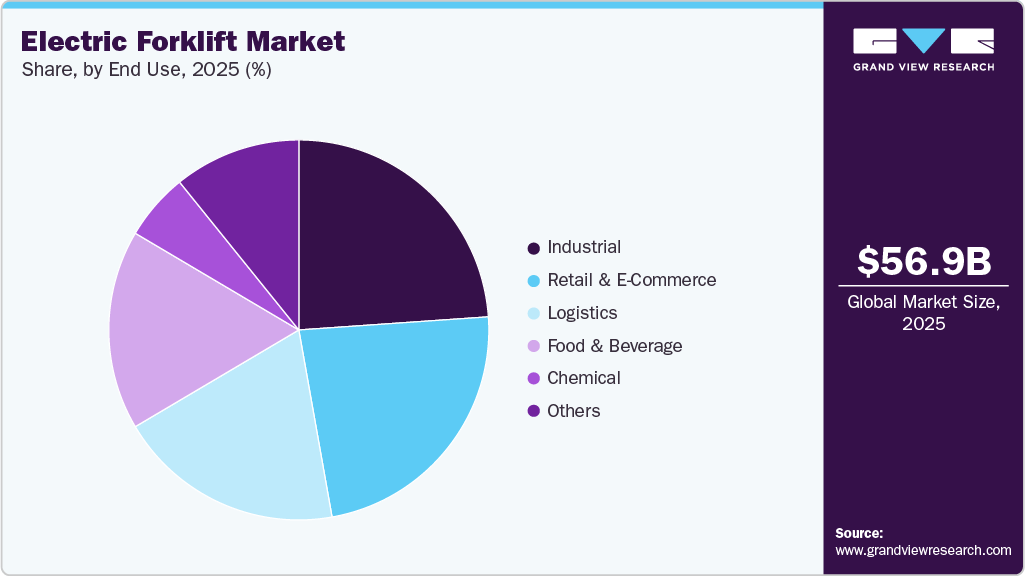
The industrial segment dominated the market in 2025. Economic expansion and an increase in disposable income are driving the thriving manufacturing across different industries, which is expected to boost the industrial segment growth. The use of robotics and automation in the industrial sector has increased the demand for electric forklifts. These machines have the potential to improve operational efficiency. Thus, the multiple advantages of electric forklifts, including lower operating costs, reduced maintenance, quieter operation, and zero emissions, make them an increasingly popular choice across various industrial applications.
 To learn more about this report, Download Free Sample Report
 The retail & e-commerce segment is projected to witness significant growth from 2026 to 2033. The rapid expansion of the e-commerce industry has driven a significant surge in demand for warehousing and logistics services. As a result, electric forklifts have become essential tools in logistics centers and warehouses globally, playing a crucial role in optimizing efficiency and maximizing productivity. In addition, electric forklifts allow operators to quickly move substantial quantities of stock, ensuring that warehouses and e-commerce distribution centers maintain optimal efficiency and continuous operations. Thus, the increasing adoption of electric forklifts in the retail and e-commerce sectors, owing to their abovementioned benefits, is boosting the segment’s growth.
Regional Insights
The North America electric forklift market is expected to witness considerable growth from 2026 to 2033. In North America, electric forklifts are gaining traction among end-users due to their lower operating costs, environmental sustainability, and advancements in battery technology.
U.S. Electric Forklift Market Trends
The electric forklift market in the U.S. is expected to grow at a CAGR of 12.3% from 2026 to 2033. Factors such as rapid advancements in battery technology and rapid growth in the industries such as retail and e-commerce can be attributed to the market’s growth in the U.S.
Canada electric forklift market is expected to grow at the highest CAGR from 2026 to 2033. The increasing government initiatives for enhancing environmental sustainability and the development of charging infrastructure are propelling the demand for electric forklifts in Canada.
Asia Pacific Electric Forklift Market Trends
The electric forklift market in the Asia Pacific held the largest market share 39.9% in 2025 and is expected to grow at the highest CAGR of 14.7% from 2026 to 2033. Manufacturers are increasingly inclining toward plant automation, contributing to the growth. Further, forklifts improve operational efficiency and workflow in production processes by easing supply chain distribution activities. The introduction of new products is a major strategy of several regional players for attracting new customers and improving their customer base.
 To learn more about this report, Download Free Sample Report
 China electric forklift market is expected to grow at a notable CAGR of 15.3% from 2026 to 2033. The vast presence of electric forklift manufacturers in China can contribute to the market’s growth. In the competitive landscape of electric forklift manufacturers, several Chinese companies have emerged, each striving to dominate the market with their innovative designs and cutting-edge technology.
The electric forklift market in India is anticipated to grow at a significant CAGR from 2026 to 2033. The electric forklift market in India is undergoing a transformative shift driven by technological advancements and automation. Electric, connected, and automated forklifts are emerging as the new standard, enhancing safety, efficiency, and workplace ergonomics.
Japan electric forklift market is expected to witness a moderate growth rate from 2026 to 2033. As the Japanese manufacturing sector increasingly adopts automation and Industry 4.0 technologies, electric forklifts are being integrated into automated material handling systems, propelling the market’s growth in the country.
Europe Electric Forklift Market Trends
The electric forklift market in Europe is expected to register a CAGR of 13.4% from 2026 to 2033. The region is experiencing increased demand for electric forklifts owing to its flourishing automotive and electronic industry. Being a manufacturing hub for major automotive and consumer electronics OEMs, the demand for forklifts is set to increase within the region.
The UK electric forklift market is expected to grow at the highest CAGR from 2026 to 2033. The rapid growth of the retail and e-commerce sectors in the U.K. and the growing consumer demand for environmentally responsible practices are driving the demand for electric forklifts in the country.
The electric forklift market in Germany is expected to grow at a considerable CAGR from 2026 to 2033. The growth can be attributed to factors such as growing technological advancements, evolving consumer preferences, and regulatory support.
MEA Electric Forklift Market Trends
The electric forklift market in MEA is expected to experience steady growth, with a CAGR of 11.0% from 2026 to 2033. Increasing demand for electric forklifts in the manufacturing and e-commerce industries, infrastructure development, and rapid urbanization in the country are driving the growth of the market in the MEA region.
The Kingdom of Saudi Arabia (KSA) electric forklift marketis anticipated to grow at a notable CAGR from 2026 to 2033. The demand for forklifts in the country can be attributed to the growth of the petrochemical and export industries. The country holds a major share of crude oil reserves, and the use of electric forklifts to carry equipment, oil barrels, and containers is expected to drive the demand for these forklifts.
Key Electric Forklift Companies Insights
Some of the key companies operating in the market include Toyota Material Handling, KION Group AG, Jungheinrich AG, Mitsubishi Logisnext Co., Ltd., Crown Equipment Corporation, and Hyster-Yale Materials Handling, Inc.
-
Toyota Material Handling is a subsidiary of Toyota Industries Corporation. The company offers an extensive product range of forklifts and business services, such as forklift renting, selling used forklifts, fleet management solutions, financing, and equipment maintenance services.
-
The KION Group AG manufactures and supplies industrial trucks and offers supply chain solutions. The company’s product portfolio encompasses material handling trucks, such as warehouse and forklift trucks, along with software solutions and automation technology for optimizing supply chains and related services.
Clark Material Handling Company, Doosan Corporation, Hangcha Forklift, Komatsu Ltd., and Anhui Heli Co., Ltd., are some of the emerging companies in the electric forklift market.
-
Clark Material Handling Company, a subsidiary of Clark Equipment Company, manufactures and distributes forklifts, pallet jacks, pallet stackers, and working platform vehicles for indoor warehousing and shipping applications.
-
Anhui Heli Co., Ltd. manufactures and distributes industrial machines and trucks. The company’s product portfolio encompasses electric & ICE forklifts, warehouse equipment, heavy forklifts, tractors, wheel loaders, and attachments.
Key Electric Forklift Companies:
The following key companies have been profiled for this study on the electric forklift market.
- Anhui Heli Co., Ltd.
- Clark Material Handling Company
- Crown Equipment Corporation
- Doosan Corporation
- Hangcha Forklift
- Hyster-Yale Materials Handling, Inc.
- Jungheinrich AG
- KION Group AG
- Komatsu Ltd.
- Mitsubishi Logisnext Co., Ltd.
- Toyota Material Handling
Recent Developments
-
In February 2026, Jungheinrich launched the EFG 5 electric counterbalance truck for heavy-duty applications and also introduced new EFG 2/2i and 3/3i electric counterbalance trucks, reinforcing its push into compact and heavy-duty electric forklifts.
-
In January 2026, Anhui Heli’s Europe R&D Center won International Design Awards for its 55-ton electric concept forklift, a green heavy-duty concept that can extend to 70 tons and highlights the company’s electrification direction in large industrial vehicles.
-
In March 2023, Hangcha Forklift announced the launch of the XE series electric forklifts for the global market. The electric forklifts fall under the 1.5 to 3.8-ton category and have a battery capacity of up to 80 V/608 Ah. The forklift has a range of 18 km/h and a gradeability of 25%. The launch of the new series is another addition to the company’s electric forklift product portfolio.
-
In February 2023, Doosan Corporation announced the launch of B60NX and B80NS heavy-lifting electric counterbalance forklift trucks under the NXE series. The B80NS series is available in 8.0 to 10.0-ton capacity, while the B60NX is available in 6.0 to 8.0-ton capacity. Both forklifts have a compact design for increased maneuverability in congested areas. The forklifts are designed for light to heavy-duty tasks with enhanced ergonomic features for improved productivity and the safety of the operator.
-
In October 2022, Toyota Material Handling announced the launch of a 3-wheel electric forklift with features such as a full-suspension seat, operator assistance, EZ fingertip control option, a 4.3-inch high-resolution display, onboard programming, and diagnostics. The base features of the vehicle include an AC drive motor and a 3,000-4,000 lbs. capacity.
-
In April 2022, Toyota Material Handling Ohio (TMH Ohio) announced a merger with ProLift to expand its footprint in Northern Ohio, Indiana, and Kentucky regions. The merger aims to expand the company’s customer base and allow the company to provide consistent performance across three regions.
Electric Forklift Market Report Scope
Report Attribute
Details
Market size in 2025
USD 56.9 billion
Estimated Market size in 2026
USD 64.6 billion
Projected Market size by 2033
USD 158.8 billion
Growth rate
CAGR of 13.7% from 2026 to 2033
Base year for estimation
2025
Historical data
2021 - 2024
Forecast period
2026 - 2033
Quantitative units
Revenue in USD million/billion and CAGR from 2026 to 2033
Report coverage
Revenue forecast, company market share, competitive landscape, growth factors, and trends
Segments covered
Product, battery type, end use, region
Regional scope
North America; Europe; Asia Pacific; Latin America; Middle East & Africa
Country scope
U.S.; Canada; Mexico; UK; Germany; France; Spain; Italy; China; India; Japan; South Korea; Australia; Brazil; Argentina; Kingdom of Saudi Arabia (KSA); UAE; South Africa
Key companies profiled
Clark Material Handling Company; Crown Equipment Corporation; Doosan Corporation; Hangcha Forklift; Hyster-Yale Materials Handling, Inc.; Jungheinrich AG; Komatsu Ltd.; Toyota Material Handling; Anhui Heli Co., Ltd.; KION Group AG; Mitsubishi Logisnext Co., Ltd.
Customization scope
Free report customization (equivalent to up to 8 analysts working days) with purchase. Addition or alteration to country, regional, and segment scope
Pricing and purchase options
Avail customized purchase options to meet your exact research needs. Explore purchase options
Global Electric Forklift Market Report Segmentation
The report forecasts revenue growth at global, regional, and country levels and provides an analysis of the latest industry trends in each of the sub-segments from 2021 to 2033. For this study, Grand View Research has segmented the global electric forklift market report based on product, battery type, end use, and region.
 To learn more about this report, Download Free Sample Report
 -
Product Outlook (Revenue, USD Million, 2021 - 2033)
-
Counterbalanced
-
Pallet Trucks
-
Reach Trucks
-
Pallet Stackers
-
Others
-
-
Battery Type Outlook (Revenue, USD Million, 2021 - 2033)
-
Lithium-Ion
-
Lead Acid
-
Hydrogen Fuel-Cell
-
-
End use Outlook (Revenue, USD Million, 2021 - 2033)
-
Chemical
-
Food & Beverage
-
Industrial
-
Logistics
-
Retail & E-Commerce
-
Others
-
-
Regional Outlook (Revenue, USD Million, 2021 - 2033)
-
North America
-
U.S.
-
Canada
-
Mexico
-
-
Europe
-
UK
-
Germany
-
France
-
Spain
-
Italy
-
-
Asia Pacific
-
China
-
India
-
Japan
-
South Korea
-
Australia
-
-
Latin America
-
Brazil
-
Argentina
-
-
Middle East & Africa
-
Kingdom of Saudi Arabia
-
UAE
-
South Africa
-
-
Frequently Asked Questions About This Report
Increasing emphasis on environmental sustainability is a major driving force behind the global electric forklift market. Unlike ICE forklifts, electric forklifts generate zero direct emissions while in operation. This has become particularly significant owing to mounting concerns about climate change and the implementation of more stringent environmental regulations. As a result, businesses are increasingly choosing electric forklifts to minimize their carbon footprint and align with their sustainability objectives.
Asia Pacific dominated with a 39.9% revenue share in 2025.
The industrial segment held the largest revenue share in 2025.
The lithium-ion segment held the largest revenue share in 2025 and is the fastest-growing type.
Key players include Clark Material Handling Company; Crown Equipment Corporation; Doosan Corporation; Hangcha Forklift; Hyster-Yale Materials Handling, Inc.; Jungheinrich AG; Komatsu Ltd.; Toyota Material Handling; Anhui Heli Co., Ltd.; KION Group AG; Mitsubishi Logisnext Co., Ltd.
The global electric forklift market size was valued at USD 56.9 billion in 2025 and is estimated at USD 64.6 billion for 2026.
The global electric forklift market is expected to grow at a CAGR of 13.7% from 2026 to 2033, reaching USD 158.8 billion by 2033.
Pallet trucks dominated the electric forklift market with a market share of 28.9% in 2025. Pallet trucks growth is attributed owing to their eco-friendly nature. They emit zero emissions, helping to lower carbon footprints and enhance air quality. Industries are embracing these EVs to meet environmental regulations and sustainability targets.
About the Author(s)
Automotive & Transportation Research Team
Technology · Automotive & TransportationThis report was authored by the automotive & transportation research team at Grand View Research - comprising two research analysts, one senior research analyst, and one industry expert - with specialized expertise in the automotive & transportation segment of the technology industry. All findings are based on proprietary technology databases, executive interviews, and regulatory analysis, subject to internal peer review prior to publication.
Last Updated:
Speak to Analyst

Customize this report to your needs - add regions, segments, or data points, with 20% free customization.
Or view our licence options:


ISO 9001:2015 & 27001:2022 Certified
We are GDPR and CCPA compliant! Your transaction & personal information is safe and secure. For more details, please read our privacy policy.


